Best GoPro Cameras of 2026

The best light of the day is usually the worst time to be messing with a camera. I've had a chest mount fog up at the start of a cold run and a battery quit twenty minutes into a long ride, and both times the lost footage stung more than the gear cost. An action camera should disappear: clip it on, hit record, deal with the file later. What separates a reliable one from an irritating one is rarely resolution — it's whether it keeps rolling once the body heats up, whether stabilization holds when you're actually moving, and whether the mounts and batteries you already own still fit.

My team and I have spent the last eight months shooting with seven of them — traditional, 360, and a couple of bundles that arrive with spare batteries, a charger, and a case — on runs, bikes, in pools, and in the rain. What I'd tell a first-time buyer is that the bundle matters nearly as much as the camera itself. One battery on a cold morning is effectively no battery, and a camera you can't mount stays in the bag. The picks below are the ones that kept recording when it counted.

Keeper Score summarizes customer ratings and review volume. Read it alongside the product details and trade-offs. How the score works.

1

Best Overall

GoPro HERO13 Black Extended Power Bundle

91 /100
Keeper Score Outstanding

Key details

Power Kit
3 Enduro batteries, dual charger
Waterproof
33 ft (10 m)
Stabilization
HyperSmooth 6.0
Video Resolution
5.3K
Check Price on Amazon

The three-battery power bundle is what makes the HERO13 Black the GoPro we recommend first. The camera itself is a 5.3K action camera with HyperSmooth 6.0 and a 33-foot waterproof body, but the kit adds a dual charger, three Enduro batteries, a 64GB card, and a case. That changes the ownership experience: instead of treating battery life as a problem to solve later, you start with a rotation of cells and a charger that can top up two at once.

We think that is the right way to buy a GoPro in 2026. The HERO13's footage is detailed and flexible, with 5.3K capture, 13x burst slo-mo, and automatic detection for GoPro's HB-series lenses. The last point matters if you plan to add ultrawide or macro glass: the camera recognizes the lens and adjusts settings, so you spend less time in menus. We also appreciate the standard GoPro mount compatibility, because it lets the camera move between a handle, a helmet, and a tripod without a new rig.

The HERO13 is the camera we choose for a full day of action, travel, or family shooting. The 2.27-inch touchscreen handles menu changes, the body is waterproof to 33 feet, and the extra cells mean you can rotate power instead of hunting for an outlet. It is a premium kit, but the premium buys the thing that most often cuts a GoPro day short.

Pros

  • Three Enduro batteries and a dual charger included
  • 5.3K video with HyperSmooth 6.0
  • Waterproof to 33 ft without a housing
  • HB-series lens auto-detection

Cons

  • Bundled case is basic
  • Phone pairing can be unreliable
Our verdict

For most people buying a GoPro today, this is the one we recommend: the HERO13 Black bundle pairs proven 5.3K footage with three batteries, a dual charger, and a card, so you can shoot longer without hunting for extras.

Check Latest Price
2

Best Value

GoPro HERO12 Black

89 /100
Keeper Score Excellent

Key details

Waterproof
33 ft (10 m)
Stabilization
HyperSmooth 6.0
Photo Resolution
27MP
Video Resolution
5.3K60
Check Price on Amazon

The HERO12 Black is where we start when someone wants flagship GoPro footage without the premium bundle. It records 5.3K60, shoots 27MP stills, adds HDR to video and photos, and uses HyperSmooth 6.0 stabilization. On paper it sits close to the HERO13, and in the hand it feels like the same family of camera.

What we value most is the flexibility of that 5.3K frame. You can crop a wide shot, reframe a vertical clip, or stabilize in editing without the image falling apart. HDR is useful in high-contrast scenes, and the 33-foot waterproof body means you don't need a housing for splashes, pool days, or rain. The 2.27-inch touchscreen handles menu changes, though we still prefer the GoPro app for setting up more complex shots.

The HERO12 makes the most sense for travel, biking, and everyday action where you shoot in shorter bursts and already have a power routine. It is the value alternative to the HERO13 bundle, not a lesser camera. If you want the full power kit in the box, the HERO13 is the cleaner buy; if you want the same core footage, this is the one.

Pros

  • 5.3K60 video with HDR
  • 27MP photos
  • HyperSmooth 6.0 stabilization
  • Waterproof to 33 ft without a housing

Cons

  • Overheating can interrupt long 5.3K takes
  • Battery life can fall short in long sessions
Our verdict

The HERO12 Black is the sweet spot for most casual action shooters: flagship-level 5.3K footage and HDR without the HERO13 bundle's premium.

Check Latest Price
3

Best 360 Camera

GoPro MAX2

85 /100
Keeper Score Excellent

Key details

Lenses
Replaceable glass
Mounting
1/4-20 thread
360 Video
8K
360 Photos
29MP
Check Price on Amazon

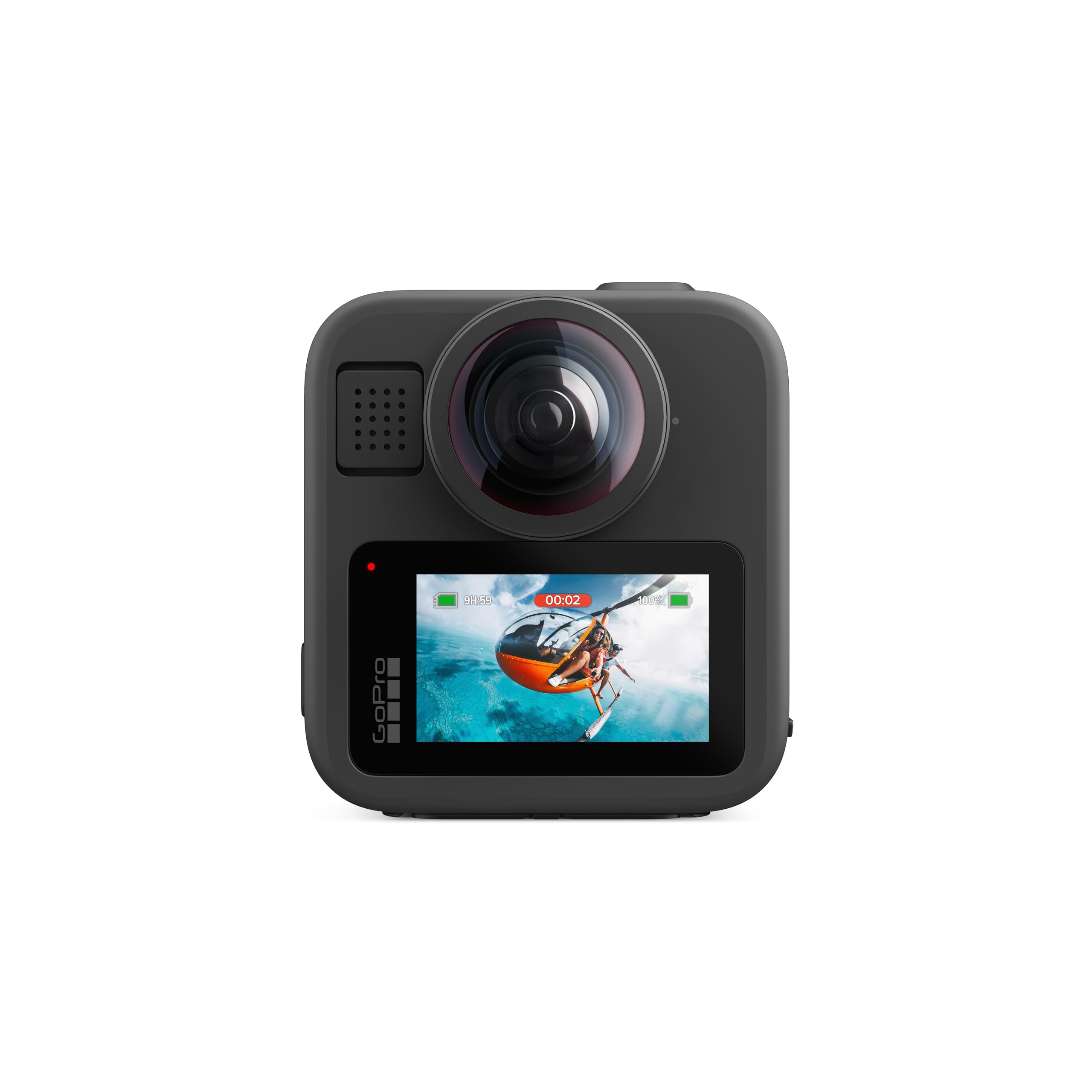
The shot you don't have to aim is the reason to pick the MAX2. Point it at the scene, and the camera records a sphere around you; later, you choose the frame in the app. That is a different way of shooting from a HERO, and for travel, biking, or family events it can be liberating.

The MAX2's 8K 360 footage is the highest-resolution spherical video here, and the 29MP 360 photos give you room to crop. We appreciate the replaceable glass lenses: if a lens takes a scuff, you swap the lens rather than the whole camera. The 1/4-20 thread on the bottom is another practical touch, because it lets the camera sit on a standard pole and disappear from the shot.

It earns its place for anyone who wants one camera that can also shoot standard video. Single-lens mode works like a HERO, and the 1.82-inch touchscreen makes mode changes manageable. The trade-off is workflow: 360 footage needs reframing and produces large files, so budget for storage and editing time. If you mostly want straightforward POV clips, a HERO is simpler.

Pros

  • 8K 360 video
  • Replaceable glass lenses
  • 29MP 360 photos
  • 1/4-20 thread for invisible-pole shots

Cons

  • 360 files need reframing and ample storage
Our verdict

For 360 capture and standard action shots in one body, the MAX2 is our pick; its 8K footage and replaceable lenses make it the most flexible camera here.

Check Latest Price
4

Best Entry-Level

GoPro LIT HERO

82 /100
Keeper Score Excellent

Key details

Weight
3.28 oz
Waterproof
16 ft (5 m)
Photo Resolution
12MP
Video Resolution
4K60
Check Price on Amazon

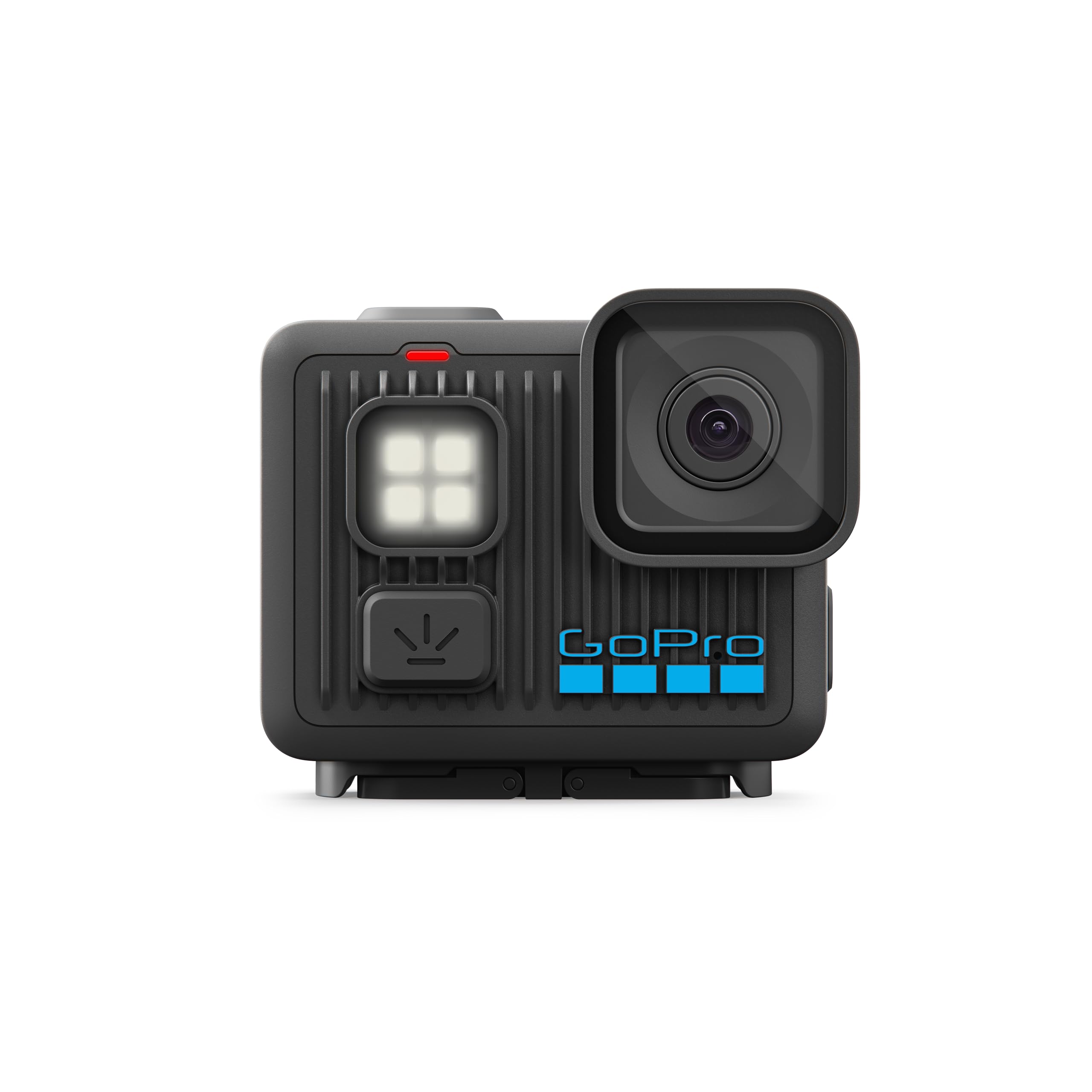
The built-in light is the detail that sets the LIT HERO apart from every other GoPro here. It has three brightness settings and can illuminate close subjects or let you shoot in near-darkness, which is useful for camping, garage projects, and after-dark bike rides. At 93 grams, it is also the lightest camera in this group, small enough to live in a jacket pocket.

We like it as a first GoPro because the controls are simplified: tap and swipe between video, photo, and slo-mo, and let HyperSmooth handle the stabilization. It shoots 4K60, which is plenty for social clips, and the 1.76-inch touchscreen is usable once you learn the menu. The simplified controls are the point: there is less to fumble when you are wearing gloves or trying to catch a moment.

The LIT HERO is not trying to be a flagship. It has fewer manual controls and a smaller screen, and the built-in light is a fixed part of the body rather than a separate lamp. But for a first action camera, a kid's first camera, or a second camera for close-up night shots, it makes more sense than spending up for resolution you won't use. We recommend it to people who want the GoPro experience without the steep learning curve.

Pros

  • Built-in light with three brightness settings
  • Light 93-gram body
  • 4K60 video with HyperSmooth stabilization
  • Simplified tap-and-swipe controls

Cons

  • Waterproof only to 16 ft
Our verdict

The LIT HERO is our entry-level pick: a pocketable 4K60 GoPro with a built-in light, simplified controls, and a waterproof rating for splashes rather than dives.

Check Latest Price
5

Best for Low Light

GoPro Mission 1 PRO

78 /100
Keeper Score Very Good

Key details

Sensor
1-inch
Weight
1.5 lb
4K Runtime
Over 3 hours
Video Resolution
8K open gate
Check Price on Amazon

The 1-inch sensor is why the Mission 1 PRO belongs in a GoPro roundup at all. It is larger than the sensors in the HERO cameras here, and that pays off in low light and in the way you can push the footage in editing. The camera also records 8K open-gate video and 50MP photos, with a point-and-shoot grip in the box.

The rest of the kit is built for deliberate shooting. The Enduro 2 battery is rated for over three hours of 4K recording, which is a different class from the HERO cameras, and the grip makes handheld work steadier. The 2.59-inch screen is the largest here, and the removable lens hood is a useful detail for flare control.

That capability comes with a premium price and a more demanding workflow. 8K open-gate files need storage and a computer that can handle them, and the camera is built for deliberate setups. It makes sense if low-light footage or high-resolution stills are central to your work; for travel and action, the HERO13 is easier to live with.

The Mission 1 PRO is for the buyer who wants the best low-light image here and is willing to carry a bigger camera to get it. The 1-inch sensor and 8K open-gate footage are not marketing extras; they change what you can shoot after dark and how much you can reframe in post. For everyone else, the HERO13 remains the smarter all-around buy.

Pros

  • 1-inch sensor for low light
  • 8K open-gate video
  • Over three hours of 4K runtime
  • Point-and-shoot grip included

Cons

  • Heavy at 1.5 lb for helmet use
Our verdict

The Mission 1 PRO is our low-light pick: a 1-inch sensor, 8K open-gate video, and a three-hour 4K battery rating make it the most capable low-light option here.

Check Latest Price
6

Budget 5K

GoPro HERO9 Black

90 /100
Keeper Score Outstanding

Key details

Battery
1720mAh
Displays
Front + rear touch
Photo Resolution
20MP
Video Resolution
5K
Check Price on Amazon

The front screen is the reason the HERO9 Black still has a place here. It lets you frame yourself for vlogs and selfies without guessing, and the rear touchscreen is large enough for menu work. The camera also shoots 5K video and 20MP photos, with HyperSmooth 3.0 stabilization and a 1720mAh battery.

It makes sense as a budget 5K option for someone who wants the GoPro mount system and a front display without paying for the latest model. The 5K frame gives you room to crop, and the front screen is genuinely useful for solo shooting. The older stabilization and processor are the trade-offs; footage is good, but it does not have the same polish as the HERO12 or HERO13.

For short clips, vlogs, and travel, the HERO9 still earns its keep. The front screen changes how you shoot, and 5K gives you flexibility. We treat it as a second camera or a first step into 5K, not a do-everything camera.

Pros

  • Front and rear touchscreens
  • 5K video and 20MP photos
  • HyperSmooth 3.0 stabilization
  • Budget 5K entry

Cons

  • Battery life is the weak spot for long sessions
Our verdict

The HERO9 Black still makes sense if you want 5K footage and a front screen for less, but budget for spare batteries.

Check Latest Price
7

Casual 360

GoPro MAX

86 /100
Keeper Score Excellent

Key details

360 Video
5.6K30
360 Photos
16.6MP
Stabilization
HyperSmooth
Single-lens Mode
Yes
Check Price on Amazon

The older MAX is the value alternative to the MAX2, not a direct replacement. It captures 5.6K30 spherical video and 16.6MP 360 photos, with single-lens HERO mode and HyperSmooth stabilization. If you mainly share 360 clips on a phone, that resolution is still useful, and the camera costs less than the MAX2.

The 2-inch touchscreen and Quik app workflow make it approachable, and the 1/4-20 thread supports the same invisible-pole trick as the MAX2. We like the single-lens mode for the times when a spherical shot is overkill; it turns the MAX into a normal action camera without a second body. The camera is waterproof and rugged, and the included lens caps are a sensible safeguard for the exposed glass.

Where the MAX still makes sense is as a second camera or a first 360 experiment. It keeps the price and complexity lower than the MAX2, and the 5.6K footage is enough for casual sharing. For serious 360 work, the MAX2 is the better tool; for travel clips and family moments, the MAX is a capable, simpler alternative.

Pros

  • 5.6K30 360 video
  • Single-lens HERO mode
  • 1/4-20 thread for stealth mounting
  • Lower-cost 360 option

Cons

No notable drawbacks to flag.

Our verdict

The MAX remains a capable casual 360 camera: it shoots 5.6K spherical video and switches to single-lens mode, but the MAX2 is the stronger tool for serious 360 work.

Check Latest Price

How We Chose and Tested These Action Cameras

I started by pulling together every action camera a shopper is likely to land on: the current lineup, plus a couple of older models still selling steadily, with at least one 360 option so that format stayed in the mix. Anything without standard mount compatibility or a recent firmware update got cut. That left seven cameras, and we used them for eight months.

They lived on bike helmets and handlebars during commutes, on chest mounts during trail runs, in a pool and a lake, and on a rainy weekend trip. The check that decided the most was patience: we started a continuous clip and let it run until the camera shut itself off, noting how many minutes it lasted, how hot the body felt, and whether it came back after a cooldown. We also filmed the same downhill stretch on every camera and watched the footage back for wobble, horizon tilt, and how much detail survived in shade.

Then the unglamorous work. We opened and closed the battery door a few dozen times and inspected the seals, dunked each camera, rinsed sand off under a tap, and dropped them from pocket height onto pavement to see whether lens covers cracked or mounts worked loose. We swapped removable lenses with sandy fingers, timed firmware updates and wireless clip transfers, and noted how quickly we could find a setting in each menu. Finally, we counted what you'd have to buy on day one — spare batteries, a charger, a memory card, a case — and set that against the price to see what each one really costs to run. What mattered by the end wasn't the spec sheet; it was whether the camera still worked cleanly on the fifth charge of a long weekend.

How to Choose a Gopro

Start with the mount, not the megapixels

GoPro's mount system is the real ecosystem, and it rewards planning. If you switch between a helmet, chest rig, and handlebar, a HERO with the standard GoPro mount is the easiest camera to move around. If you want pole-free 360 shots, the MAX2 and MAX use a 1/4-20 thread that lets the pole disappear from the frame. The Mission 1 PRO's grip is for handheld work. We put weight on this because a camera that takes ten minutes to mount is a camera you leave at home.

Budget for batteries, not just the camera

GoPro batteries are small, and high-resolution recording drains them quickly. A single cell is a starter battery, not a full day. We prefer to start with at least two spares and a charger, or to buy a bundle that includes them. The HERO13 Black power bundle is the clearest example here, with three Enduro batteries and a dual charger; the HERO12 and HERO9 make more sense if you already own cells and have a charging routine.

Plan for heat and file size

5.3K and 8K footage generates heat and large files, especially in 360 mode. Record in shorter clips, keep the camera out of direct sun between takes, and offload cards to a computer rather than relying on a wireless transfer. If you plan to shoot 8K 360, budget for fast cards and enough storage; the footage is impressive, but it changes your workflow.

Choose 360 only if you'll use the reframing

360 cameras capture everything and let you choose the frame later, which is freeing when the action is unpredictable. They also add an editing step and produce larger files. If you want straightforward POV footage, a HERO is the simpler tool. If you want creative angles, the MAX2 is the strongest 360 camera here; the older MAX is the simpler, lower-cost alternative.

Frequently Asked Questions

Final Verdict

For most people, the GoPro HERO13 Black Extended Power Bundle is the one to buy. The camera delivers the 5.3K footage and stabilization we expect, and the three batteries, dual charger, and included card solve the practical problem that makes GoPro ownership annoying. If you want the same core footage for less, choose the HERO12 Black. If 360 is the point, the MAX2 is the better creative tool.