Best 360 Cameras of 2026

A 360 camera is supposed to fix the oldest problem in action footage: you get one shot at the angle, and the moment you look away, it's gone. The promise is that you hold the camera up, keep riding, and pick the frame later — if the battery, the lens, and the app all cooperate.

I've been strapping these to handlebars and helmets since the format was glitchy and niche. Over the past eight months, my team and I have shot with nine different 360 cameras on mountain bike trails, in the surf, on a motorcycle commute, and on family walks where nobody wants to stop and fiddle with settings. Low-light footage, a seamless invisible selfie stick effect, and lenses you can swap after a drop separated the good ones fast.

The spec first-time buyers overrate is resolution. Every camera here claims 8K, yet the differences that actually matter come from stabilization, sensor size, and how bearable the reframing app is at 11 p.m. The picks below are the ones we kept reaching for.

Keeper Score summarizes customer ratings and review volume. Read it alongside the product details and trade-offs. How the score works.

1

Best Overall

Insta360 X5

92 /100
Keeper Score Outstanding

Key details

Sensors
Dual 1/1.28-inch
360 Video
8K30fps
Battery Life
208 minutes
Water Resistance
Waterproof
Check Price on Amazon

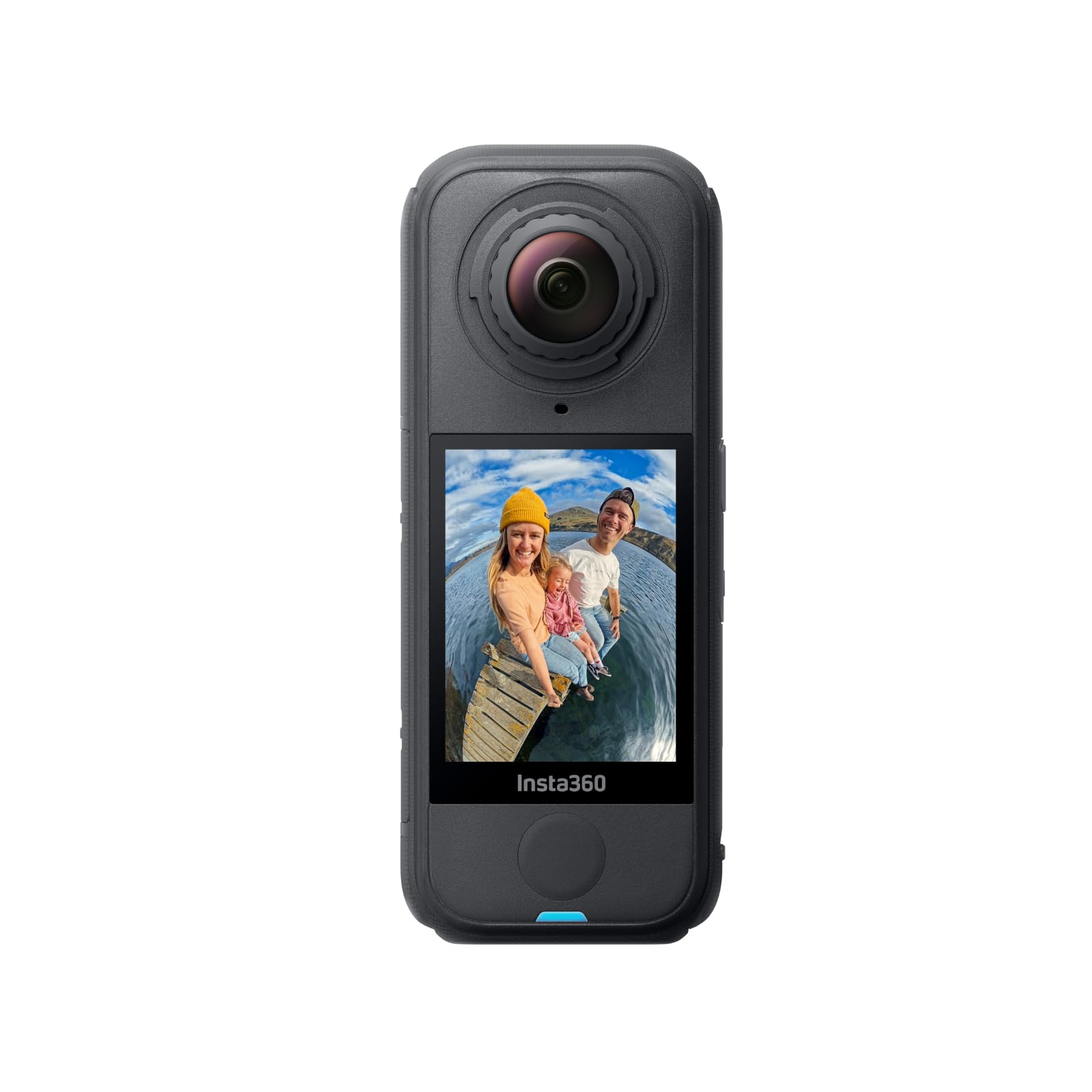
The Insta360 X5 is the 360 camera we recommend first because it makes the hardest part of the format feel easy: you can shoot without aiming and still come home with a usable frame. Dual 1/1.28-inch sensors and 8K30 capture give you enough detail to reframe and crop, and the footage holds color and contrast better after the sun drops than the 5.7K AKASO. That combination is why it sits at the top of this set rather than being another spec-heavy also-ran.

Stabilization is the other reason it earns the spot. FlowState and full horizon lock keep walking and bike footage level without a gimbal, and the 2.5-inch screen is big enough to check the shot before you commit. The 208-minute battery rating is the figure we plan around; 8K and cold weather will shorten it, so a spare belongs in the bag for a ski day or a long ride.

Waterproofing and replaceable lenses matter more on a 360 camera because both lenses are exposed all the time. The X5 is built to take a knock and swap glass if one gets scratched, which takes the panic out of carrying it loose. The invisible selfie stick effect is here too, giving you a third-person angle without a second person holding the camera.

The catch is the workflow. Reframing still takes time, and the app asks you to learn keyframes if you want precise camera moves. For quick social clips, the AI-assisted tools are enough; for a polished edit, budget the time. That editing step is the main thing we tolerate rather than love, but it is not a reason to choose a lesser camera.

Pros

  • Sharp 8K30 360 footage
  • Strong low-light detail
  • Waterproof body and replaceable lens
  • Long 208-minute battery rating

Cons

  • Premium price in this set
Our verdict

We recommend the X5 as the default 360 camera for most people because it pairs 8K detail and strong low-light footage with waterproofing and a long battery rating.
Check Latest Price
2

Best Low-Light

DJI Osmo 360

86 /100
Keeper Score Excellent

Key details

Sensor
1-inch
360 Video
8K30fps
360 Photos
120MP
Water Resistance
Waterproof
Check Price on Amazon

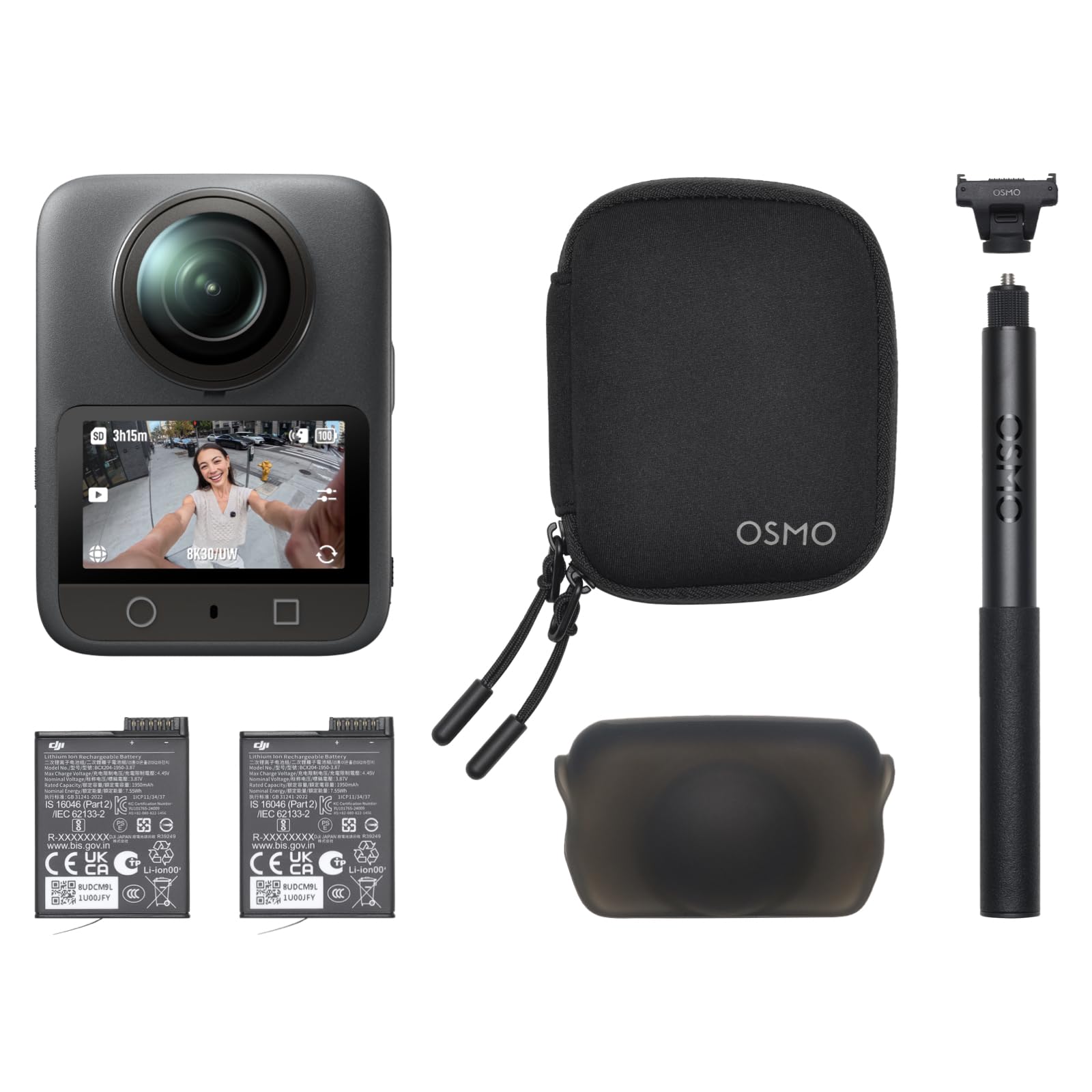
The DJI Osmo 360 is built around a 1-inch sensor, which is unusual in a 360 action camera and changes what the footage looks like after dark. It records 8K30 360 video and 120MP photos, and the Essential Combo includes DJI's 1.2m invisible selfie stick, so the third-person effect works out of the box. A 4K120 boost mode is there when you want a flatter, more conventional clip.

Our pick for low light is the Osmo 360. On evening walks and indoor shoots, the larger sensor gives the footage a cleaner, more usable look than the smaller-sensor cameras here, and the stabilization is steady enough for handheld walking. We also appreciate the stick in the box, because the invisible-stick effect is half the reason to buy a 360 camera and DJI doesn't make you add it separately.

The Osmo is also the better stills camera of this group. A 120MP 360 photo gives you room to crop a frame and still have a usable image, and the magnetic quick-release makes it easy to move between a selfie stick and a standard mount. We came back to it for city trips because it handles both jobs in one bag.

At 183g, the Osmo is light enough to carry in a jacket pocket, and the 2-inch screen is clear enough for setup. The magnetic mount system is the quiet win: moving from a stick to a bike mount takes seconds, which makes it easier to actually use the camera in more places.

Pros

  • Excellent low-light footage
  • 8K30 video and 120MP stills
  • Invisible selfie stick included
  • 4K120 boost mode

Cons

  • Editing app is less intuitive
Our verdict

If your 360 footage happens after dark, the Osmo 360's one-inch sensor makes it our low-light pick, with 8K video and 120MP stills in a pocketable body.

Check Latest Price
3

Best Waterproof Pick

GoPro MAX2

85 /100
Keeper Score Excellent

Key details

Weight
13.8 oz
360 Video
8K
360 Photos
29MP
Water Resistance
Waterproof
Check Price on Amazon

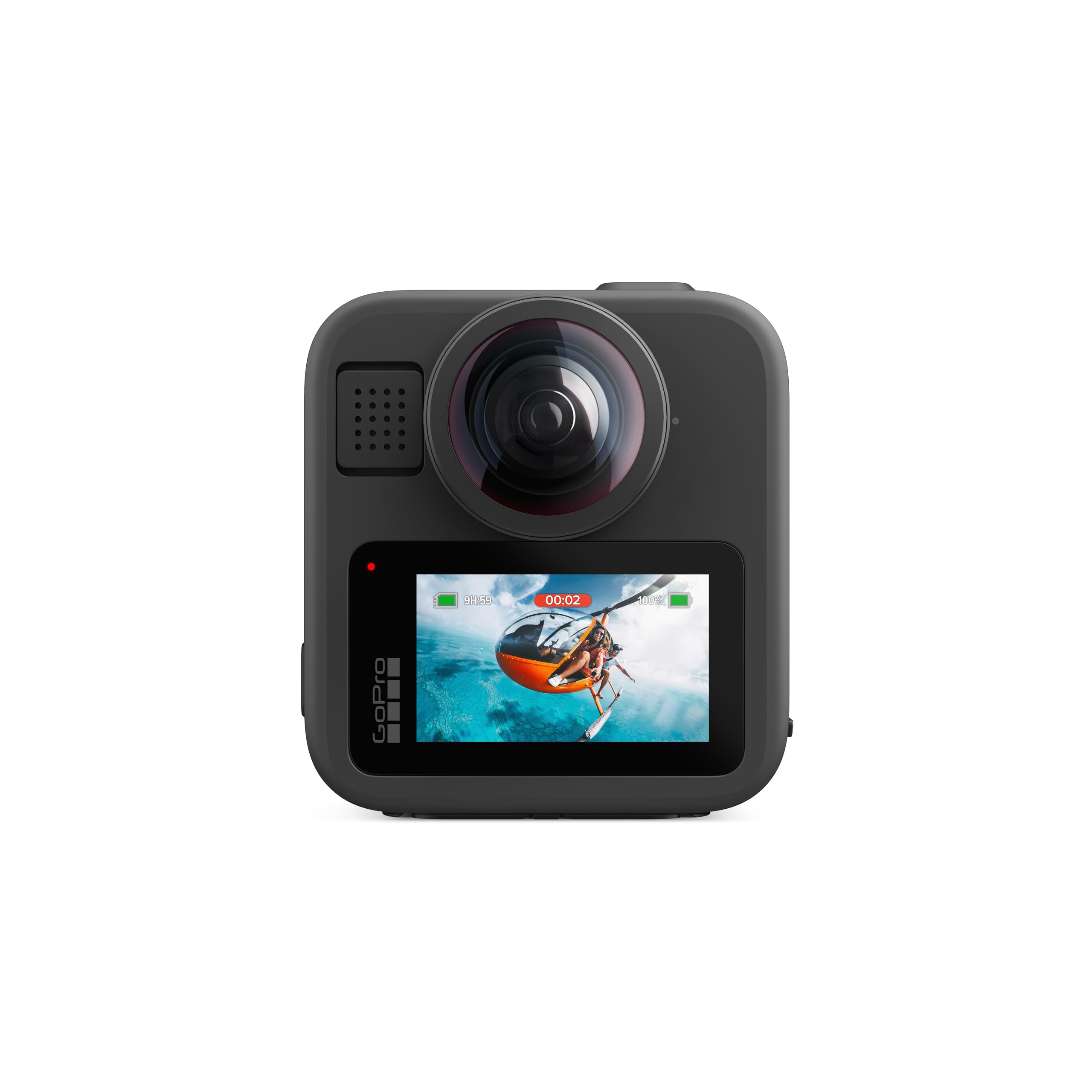
The GoPro MAX2 is a waterproof 8K 360 camera with replaceable glass lenses and six microphones. It is waterproof without a case, and its glass lenses are replaceable if they get scratched. The body is built for mounts and rough handling, and the current price is lower than the X5's.

The 8K spherical footage and 29MP photos are the headline, but the six microphones are what we noticed in playback: wind and voices come through more clearly than on the tiny-mic 360 cameras. The 1.82-inch touchscreen is there for setup, but we mostly use the app and leave the camera mounted. A 1960mAh Enduro battery is included, and the kit also has a curved adhesive mount and mounting buckle, so it is ready for a helmet or bar.

For wet, muddy, or handlebar-mounted days, the MAX2 is the one we pack. It is simpler and more rugged than the X5, and the lower price leaves room for a spare battery and a decent mount. We also like that the lenses are water-repelling glass, because a quick wipe is often all the cleanup a wet day needs. That trade of polish for toughness is the whole reason it earns a spot.

Pros

  • Waterproof without a case
  • Replaceable glass lenses
  • 8K spherical video and 29MP photos
  • Six microphones for clearer audio

Cons

  • Small 1.82-inch touchscreen
  • Bulkier than the lightweight picks
Our verdict

The MAX2 is the waterproof 8K 360 camera we trust for wet, muddy action, with replaceable glass lenses and clear audio at a lower price than the X5.

Check Latest Price
4

Best Budget

AKASO 360

86 /100
Keeper Score Excellent

Key details

Sensors
Dual 1/2-inch 48MP
360 Video
5.7K
360 Photos
72MP
Water Resistance
Water resistant
Check Price on Amazon

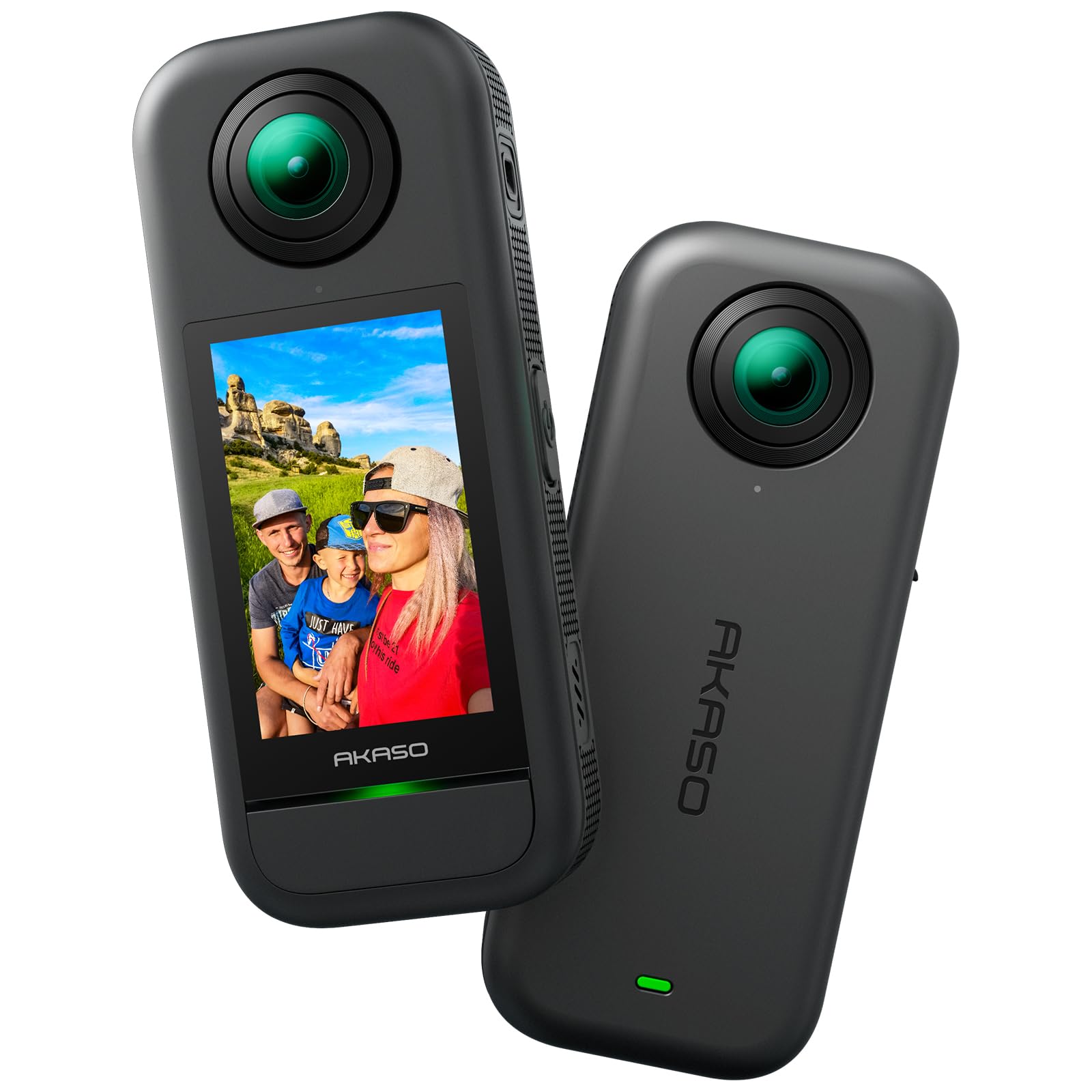
The AKASO 360 sits at the budget end of this set. It records 5.7K 360 video and 72MP photos, uses dual 1/2-inch 48MP sensors, and ships with two batteries, a USB cable, and a one-year warranty. At 180g, it is easy to slip into a pocket, and the 2.29-inch touchscreen is useful for framing.

We like it most as a first 360 camera. Horizon lock and AI tracking are the features that usually get cut at this price, and having them here means you can try third-person shots and moving reframes without risking a premium camera. The two included batteries are a thoughtful inclusion for a budget kit. The touchscreen makes the basic settings easy enough to change without the app, which is not always true at this end of the market.

The boundary is water. AKASO rates it water resistant, not waterproof, so it is fine for splashes and light rain but not for submersion. The app also takes patience to connect; pair it at home, confirm the Wi-Fi handshake, and keep the manual nearby before a trip. For dry adventures, it delivers the 360 basics at the lowest entry point here.

Pros

  • 5.7K 360 video and 72MP photos
  • Two batteries in the box
  • Horizon lock and AI tracking
  • Beginner-friendly controls and app

Cons

  • Battery life is short in 5.7K
  • Low-light footage gets noisy
Our verdict

The AKASO 360 is the budget pick for a first 360 camera, with 5.7K video, two batteries, and simple controls for daylight shooting.

Check Latest Price
5

Dry Travel

Insta360 X4 Air

91 /100
Keeper Score Outstanding

Key details

Lenses
Replaceable
Weight
5.82 oz
360 Video
8K30fps
Water Resistance
Not water resistant
Check Price on Amazon

The Insta360 X4 Air is the 360 camera we grab when weight is the enemy. At 165g it is the lightest model here, and it still shoots 8K30 360 video with replaceable lenses. That combination makes it the easiest camera in this group to carry all day and the one most likely to be with you when something worth filming happens.

The trade is weather sealing. The listing says not water resistant, so this is a dry-weather camera: no surf, no rain, no dunking. For a hike, a city break, or a day at a theme park, that limitation is easy to live with; for action sports, it is the reason to choose the X5 or MAX2 instead. If you shoot mostly in fair weather and want the least weight on a selfie stick, that is a fair trade; if the camera will live on a bike or a board, pay for sealing.

The app is where you will do the real work, and the X4 Air fits that workflow well. We like it as a travel companion and a second camera to a waterproof flagship; it makes 8K 360 feel pocketable rather than precious. The replaceable lenses are the detail that sold us, because a scratched lens on a lightweight travel camera would otherwise be a disaster.

Pros

  • Very light 165g body
  • 8K30 360 video
  • Replaceable lenses
  • Pocketable travel design

Cons

  • Small 2.09-inch display
Our verdict

The X4 Air is the lightweight 8K choice for travelers who want pocketable 360 footage without the bulk of a flagship.

Check Latest Price

How We Tested These 360 Cameras

We started with a list of 30-odd 360 cameras from the brands that dominate this category and narrowed it using specs that change the day-to-day experience: sensor size, whether the lens is replaceable, waterproofing that doesn't require a case, in-camera stabilization, and price. Nine made the final cut, and we bought or borrowed each one the way a reader would.

Testing ran for eight months and followed the cameras rather than a lab bench. We clamped them to handlebars and chest rigs, stuck them on helmets, and carried them on selfie sticks through a month of morning commutes, a wet weekend in the surf, a cold morning on a ski hill, and a lot of dusk rides. On every outing we ran the battery flat with stabilization on, noted how warm the body got, and logged how much usable footage we got per charge.

Back at the desk, we imported everything and reframed a one-minute clip in each app, timing it from import to export and watching for a visible seam where the selfie stick should have disappeared. We shot the same dusk ride on every camera to compare how much detail survived in low light, and we checked horizon lock by tilting each one on purpose.

Durability got the least ceremony: rinsing salt water off under a tap, dunking each camera, swapping lenses after deliberate drops, and pairing the app repeatedly from trailheads with one bar of signal. Anything that fought us on those steps dropped out of contention, no matter how good the footage looked.

How to Choose a 360 Camera

Resolution, Sensor Size, and Low Light

8K is useful because extra pixels let you reframe a 360 clip and still export a sharp flat video, but resolution is not the same as image quality. A 5.7K camera with a decent sensor can look better in daylight than an 8K model that falls apart indoors. If you shoot at night, prioritize sensor size; the DJI Osmo 360's 1-inch sensor is the clearest example here. For daylight social clips, 5.7K is plenty and saves card space; for cropped stills or 4K exports, 8K gives you more room.

Waterproofing and Lens Protection

A 360 camera has two exposed lenses, so sealing and lens protection matter more than they do on a normal action camera. Match the rating to the day: the X5 and GoPro MAX2 are waterproof and the AKASO 360 is water resistant only, while the X4 Air is explicitly not water resistant. Water resistant means splashes, not submersion. Replaceable lenses on the X5, MAX2, and X4 Air are worth paying for because a scratched lens is otherwise a repair rather than a swap.

Stabilization, Mounting, and the Selfie-Stick Effect

Stabilization is what makes 360 footage watchable on a bike, a helmet, or a walking tour. FlowState, HyperSmooth, and horizon lock all aim at the same result: a level horizon and smooth motion without a gimbal. The invisible selfie stick effect is the other feature to check, because it depends on a stick and, in some kits, the stick is extra. DJI includes one with the Osmo 360 Essential Combo; with the others, budget for the accessory. A 360 camera without a stick still works, but you lose the third-person shots that make the format distinctive.

Battery Life and the Editing Workflow

360 cameras burn through power faster than their battery ratings suggest, especially in 8K or cold weather. Treat the listed runtime as a best case, and buy a spare battery before a long day; the X5's 208-minute figure is generous, but a ski day will still eat it. Editing is the other recurring cost. Reframing is a skill, and the app you choose determines whether it feels like a creative tool or a chore. Try the app before you buy, and be honest about how much time you will spend on it.

Weight, Size, and Where It Goes

A 360 camera that stays in a bag is not much use. Weight matters most if you shoot on a selfie stick for hours: the 165g X4 Air is the easiest to carry, while the GoPro MAX2 is built for mounts and rough handling. Balance that against sealing, because the lightest model here is not water resistant. If your camera will live on a bike or a helmet, prioritize a secure mount and a rugged body; if it travels in a pocket, prioritize weight and a quick-release mount.

Frequently Asked Questions

Final Verdict

Start with the Insta360 X5. It is the most complete 360 camera here: 8K detail, strong stabilization, waterproofing, and a battery rating that makes a full day feel realistic. If your shooting happens after dark, the DJI Osmo 360's 1-inch sensor is the better tool, provided you accept a slower editing workflow. For water, mud, and a lower total spend, the GoPro MAX2 is the tougher pick.