Best Floodlight Cameras of 2026

A floodlight camera has one job at 3 a.m.: turn a dark driveway into something you can actually identify. Plenty of them light up beautifully and still hand you a gray smudge where a face should be. Mine snapped on for a passing cat, then missed a delivery I couldn't make out — which is the whole problem in miniature. What you want is light bright enough to deter, a lens that holds color after dark, and an alert that lands while it still matters.

We've spent the past six months living with 12 of these, from hardwired units to solar models strapped to a fence post. The thing first-time buyers underestimate is the subscription: the sticker price says little about what it costs to keep your recordings, and some of our best footage was only useful because it was stored locally. Power and Wi-Fi quietly decide the rest — wired means an afternoon with a drill, battery and solar mean placement freedom and a charging habit.

Everything below earned its spot on how it behaved after sunset, not on its spec sheet.

Keeper Score summarizes customer ratings and review volume. Read it alongside the product details and trade-offs. How the score works.

1

Best Overall

Ring Floodlight Cam Wired Pro

93 /100
Keeper Score Outstanding

Key details

Siren
110 dB
Motion Detection
3D Motion Detection
Video Resolution
2K
Floodlight Brightness
2,000 lumens
Check Price on Amazon

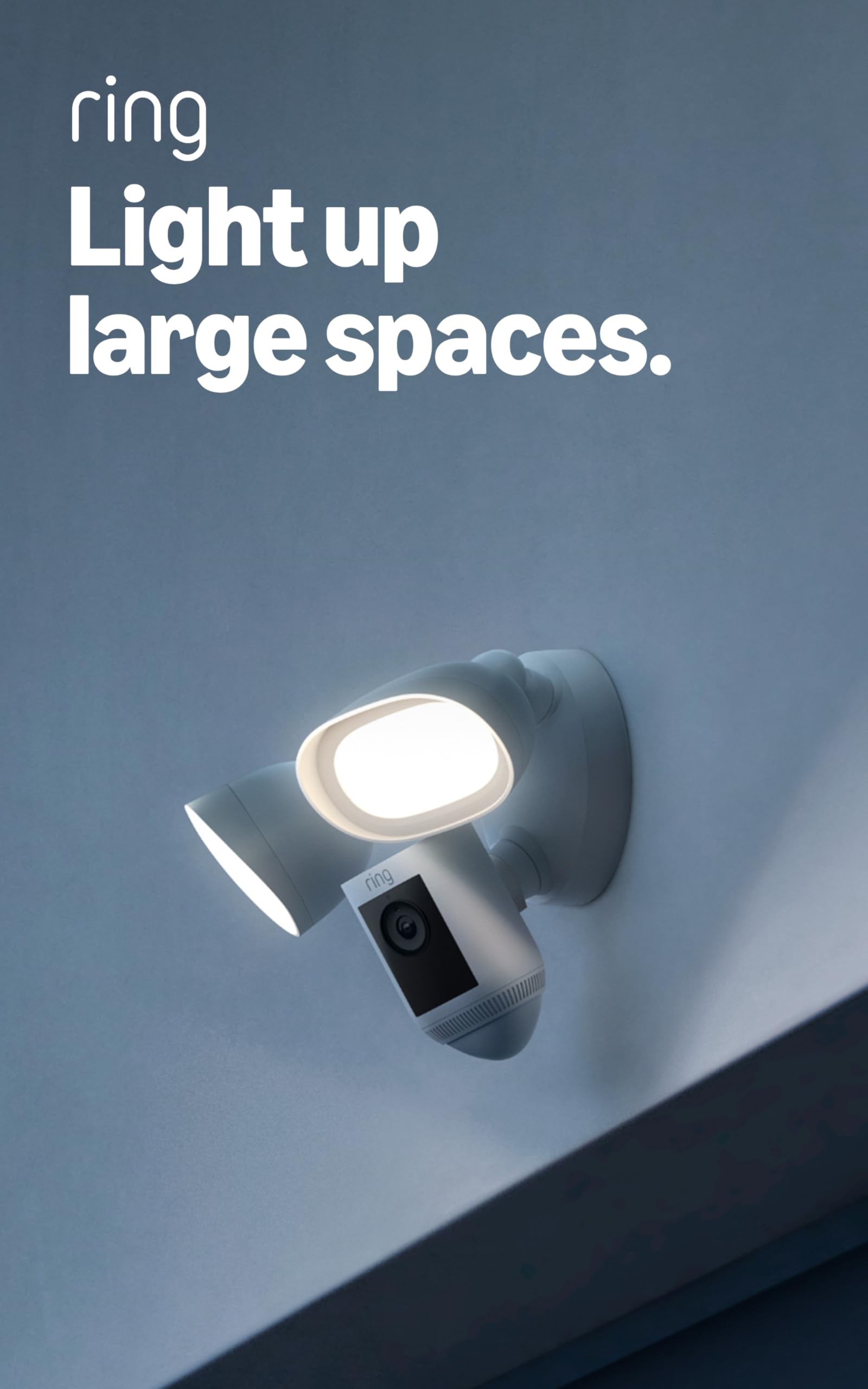
The Wired Pro is the one we reach for when a shopper wants a floodlight camera without a research project. It balances a 2K image, 2,000 lumens of light, and Ring's 3D motion detection in a wired fixture that replaces an existing outdoor light. Nothing here is the absolute best in the group — the 4K models pull more detail and the Reolink Elite throws a wider beam — but the combination is the easiest to live with.

What we appreciate most is the motion logic. 3D Motion Detection lets you draw precise zones, so the light and alerts respond to someone walking up the driveway rather than every car passing the street. The 110dB siren and two-way talk with Audio+ add real use beyond recording: you can warn off a stranger or tell a delivery driver where to leave a package. Setup is the other quiet win; the wired fixture follows a familiar outdoor-light installation, and the Ring app walks you through the rest.

The trade-off is detail. This is a 2K camera, and the 4K Pro and Reolink Elite resolve more at the far edge of a long driveway. At porch or garage distance, the wide view and 3D zones matter more than the extra pixels, and the Wired Pro keeps the price in the middle of this group. If you need to read a plate from the street, step up to the 4K Pro; if you mostly want to see who is at the door, this is enough.

Ring's advanced alerts and video history lean on a subscription, which is the recurring cost to plan for. The camera still works as a light and live-view camera without it, but the smart features are where the convenience lives. For a first floodlight camera, that is a fair trade; for a subscription-averse buyer, the eufy or Reolink picks are the better fit.

Pros

  • Bright 2,000-lumen floodlights
  • 3D motion zones cut false alerts
  • 110 dB siren and two-way talk
  • Straightforward wired setup

Cons

  • Advanced alerts require a Ring plan
Our verdict

We recommend the Wired Pro as the default outdoor floodlight camera: it pairs clear 2K video and bright 2,000-lumen lighting with the least fussy wired setup here.
Check Latest Price
2

Best for 4K Detail

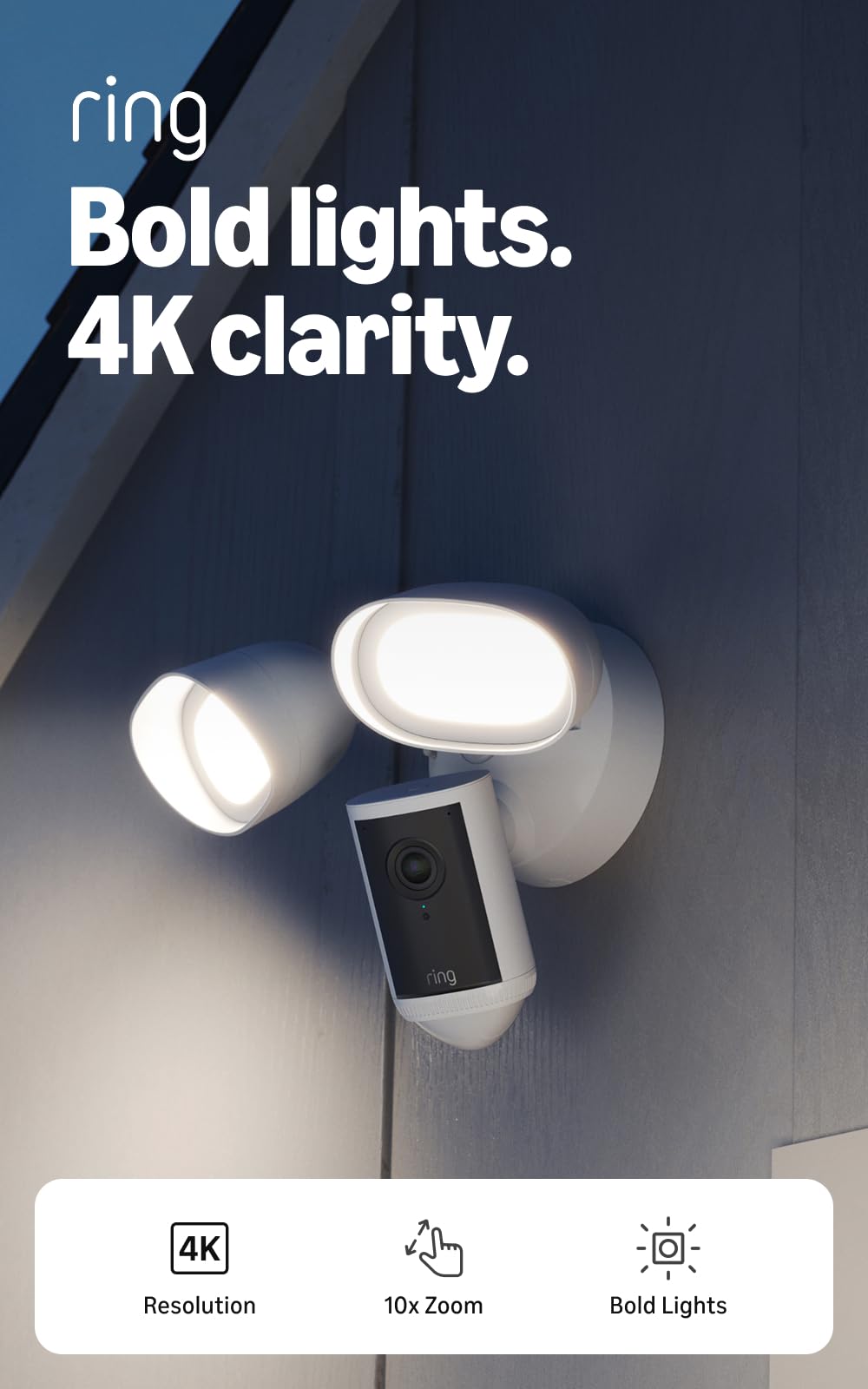
Ring Floodlight Cam 4K Pro

89 /100
Keeper Score Excellent

Key details

Zoom
10x
Motion Detection
3D Motion Detection
Video Resolution
4K
Floodlight Brightness
2,000 lumens
Check Price on Amazon

A 4K sensor and 10x enhanced zoom are the reasons to look at the Ring Floodlight Cam 4K Pro. Where the 2K Wired Pro gives you a clean wide view, the 4K Pro pulls more from the far end of a driveway or a side yard, and Ring's Low-Light Sight keeps color in the near-dark when the floodlights are off. That makes it the better camera for reading a face or a plate at distance, not just for lighting the door.

We like the 4K Pro most for long, narrow spaces where the camera has to cover ground. The 2,000-lumen light is unchanged from the Wired Pro, so the upgrade is in the lens and the detail, not the brightness. The 3D motion detection is the same zone-based system, and two-way talk with Audio+ is clear enough for a quick conversation at the gate. It is a focused upgrade rather than a different camera.

The 4K Pro is a fixed camera, so it cannot sweep a wide yard the way the eufy E340 can. It is also a Ring camera, which means the app, alerts, and ecosystem are the draw as much as the lens. If you already use Ring, the upgrade feels natural; if you are starting fresh, compare the 360° coverage of the eufy before you commit.

Pros

  • 4K video with 10x zoom
  • 3D motion zones
  • Color low-light view

Cons

  • Premium price for the 4K upgrade
Our verdict

Choose the 4K Pro if detail at a distance is the priority; its 4K lens and 10x zoom are the sharpest combination Ring offers here.

Check Latest Price
3

Best 360° Coverage

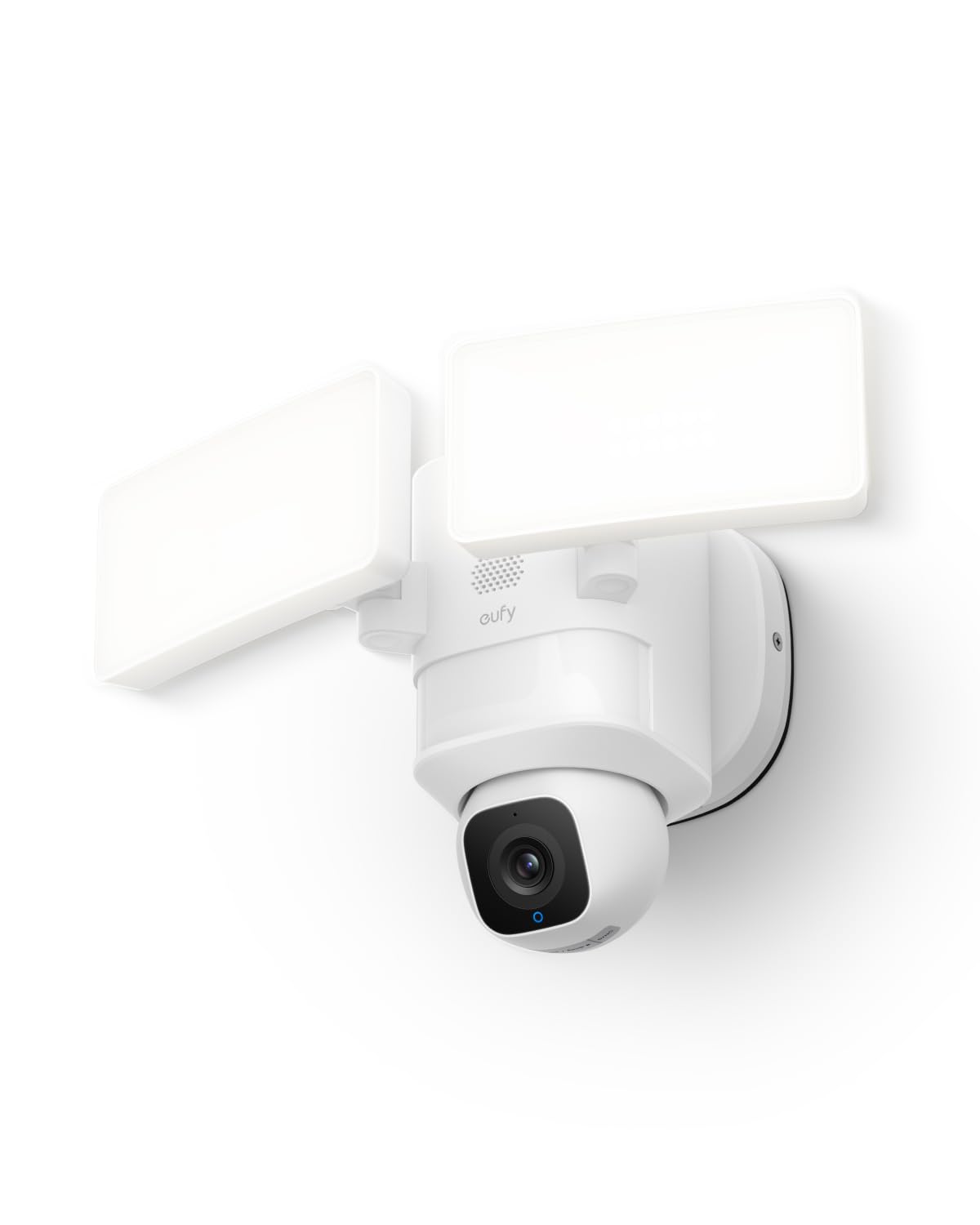
eufy Floodlight Camera E340

86 /100
Keeper Score Excellent

Key details

Field Of View
360°
Local Storage
microSD up to 128 GB
Video Resolution
3K wide, 2K telephoto
Floodlight Brightness
2,000 lumens
Check Price on Amazon

A fixed floodlight camera sees what its lens sees. The eufy E340 adds a pan-tilt head and two lenses, so one fixture can sweep a driveway, a side gate, and a porch without three separate cameras. The 3K wide lens handles the big picture, the 2K telephoto pulls close-ups, and the 360° mechanism moves between them.

The light and storage are equally practical. The 2,000-lumen floodlight is bright enough for a driveway, the 95dB alarm adds a deterrent, and a microSD card up to 128GB enables 24/7 local recording without a monthly fee. That last point matters: a camera that only saves clips behind a subscription gets expensive over a few years.

We like the E340 best for yards with more than one approach, because the coverage is the feature you notice every day. The catch is that pan-tilt cameras have to decide what to follow. The E340 can overreact to motion and swing away from the person you wanted to watch, so the detection zones and tracking sensitivity are the first settings to tune. A fixed camera is simpler; this one is more capable when it is aimed well.

It is also a substantial fixture, so plan on a solid mounting point and a strong dual-band Wi-Fi 6 signal. Compared with the E30, the E340 buys the sharper 3K wide lens and 8x hybrid zoom; compared with the Ring 4K Pro, it trades absolute resolution for 360° reach and local storage. The 8x zoom is the part that makes the second lens worth having: it turns a wide scene into a usable close-up without moving the mount.

Pros

  • 360° pan-tilt coverage
  • 3K wide and 2K telephoto lenses
  • Local 24/7 recording via microSD
  • 2,000-lumen light and 95dB alarm

Cons

  • No 4K resolution
Our verdict

The E340 is our pick for a wide, irregular yard: its 360° pan-tilt head and dual lenses cover angles a fixed floodlight camera cannot.

Check Latest Price
4

Best Value 360°

eufy Floodlight Camera E30

87 /100
Keeper Score Excellent

Key details

Power Source
Hardwired
Field Of View
360°
Video Resolution
2K
Floodlight Brightness
2,000 lumens
Check Price on Amazon

The E30 is the lower-cost route to the 360° coverage that makes the eufy cameras interesting. You still get the pan-tilt head, the 2,000-lumen floodlight, AI person and vehicle tracking, and local 24/7 recording with a microSD card. What you give up is the E340's second lens and 8x hybrid zoom; we think that is usually the right trade for a porch or garage.

We like it because the useful parts survive the downgrade. The 2K picture is clear, the light is bright and adjustable, and the 360° sweep covers more of a driveway than a fixed 160° camera. The app is straightforward, and the no-subscription storage keeps the long-term cost down. It is not the sharpest camera here, but it sees more of the yard than the 2K fixed models.

Against the E340, you lose the telephoto detail and the sharper wide lens; against the Ring Wired Pro, you gain the moving view and lose the simpler fixed installation. If you mostly check a driveway from your phone, the moving view is worth more than the extra sharpness.

Pros

  • 360° pan-tilt coverage
  • 2,000-lumen adjustable light
  • Subscription-free local recording

Cons

  • 2.4GHz Wi-Fi only
Our verdict

The E30 is the value pick for 360° coverage: it keeps the pan-tilt head, bright light, and local recording that matter most, with fewer extras.

Check Latest Price
5

Best Wire-Free Solar

Tapo C615F Floodlight Camera

86 /100
Keeper Score Excellent

Key details

Power Source
Solar/battery
Field Of View
360° horizontal, 130° vertical
Video Resolution
2K 3MP
Floodlight Brightness
800 lumens
Check Price on Amazon

Solar power is the reason the Tapo C615F exists in this group. A panel tops up the battery, so you can mount a pan-tilt camera on a shed, fence, or gate without running cable. The 360° horizontal and 130° vertical view covers more angles than a fixed floodlight, and local storage keeps the subscription out of the decision.

We like it for the installs where wiring is the real obstacle. The 2K 3MP picture is clear, the person and vehicle detection is useful, and the pan-tilt head covers more angles than a fixed lens. It is not a substitute for a wired floodlight; think of it as a camera with a built-in porch light, not a stadium light.

The solar panel needs direct sun to do its job. Tapo claims 45 minutes of direct sunlight powers a full day of use, and the battery can last up to 140 days on a charge, but shade, a north-facing eave, or a dirty panel changes the math. Check the sun exposure before you choose the mount; a sunny fence line is the easy case.

Compared with the Reolink Solar two-pack, the Tapo gives you one pan-tilt camera instead of two fixed ones. Compared with the wired eufy E30, it trades brightness and constant power for placement freedom. The pan-tilt head is what makes it more than a solar spotlight: one mount can look at the gate, then the path, without a second camera.

Pros

  • Solar-powered wire-free install
  • 360° pan-tilt view
  • 2K 3MP video
  • Subscription-free local storage

Cons

  • 800 lumens is modest for a large yard
  • 2.4GHz Wi-Fi only
Our verdict

The Tapo C615F is the wire-free pick for a gate or shed: solar power and a 360° view make it easy to place, as long as 800 lumens is enough light.

Check Latest Price
6

Bright Driveways

Wyze Floodlight Camera v2

85 /100
Keeper Score Excellent

Key details

Connectivity
2.4 GHz Wi-Fi
Field Of View
160°
Video Resolution
2K HD
Floodlight Brightness
2,800 lumens
Check Price on Amazon

2,800 lumens is a lot of light for a floodlight camera, and the Wyze v2 uses it well. The two dimmable LED heads turn night into day across a driveway, and the 160° lens with 270° PIR coverage watches a wide area. The 2K color night video is clear enough to identify a person at the door, and the 105dB siren is loud enough to be a real deterrent.

The fixed design keeps the cost down. Wyze mounts over an existing electrical box, the app handles motion zones and brightness, and there is less machinery to adjust. The 2K image is not as detailed as the 4K picks, but it is sharper than the 1080p Blink models and bright enough to use color at night. For a driveway where the light has to reach the street, that is the useful combination.

We recommend it where the light matters more than the view. The two dimmable heads are the detail that matters after dark: you can run them low for ambience or full for a driveway, without losing the color image. It is the camera you choose for light output, not for coverage.

Pros

  • 2,800-lumen floodlight
  • 2K color night video
  • 160° wide view

Cons

  • 2.4GHz Wi-Fi only
  • No pan-tilt coverage
Our verdict

The Wyze v2 is the brightness-for-money pick: 2,800 lumens and crisp 2K color night video for a fixed driveway view, if your Wi-Fi is strong.

Check Latest Price
7

Panoramic Coverage

Reolink Elite Floodlight WiFi

81 /100
Keeper Score Excellent

Key details

Connectivity
Dual-band Wi-Fi 6
Field Of View
180°
Video Resolution
4K 8MP
Floodlight Brightness
3,000 lumens
Check Price on Amazon

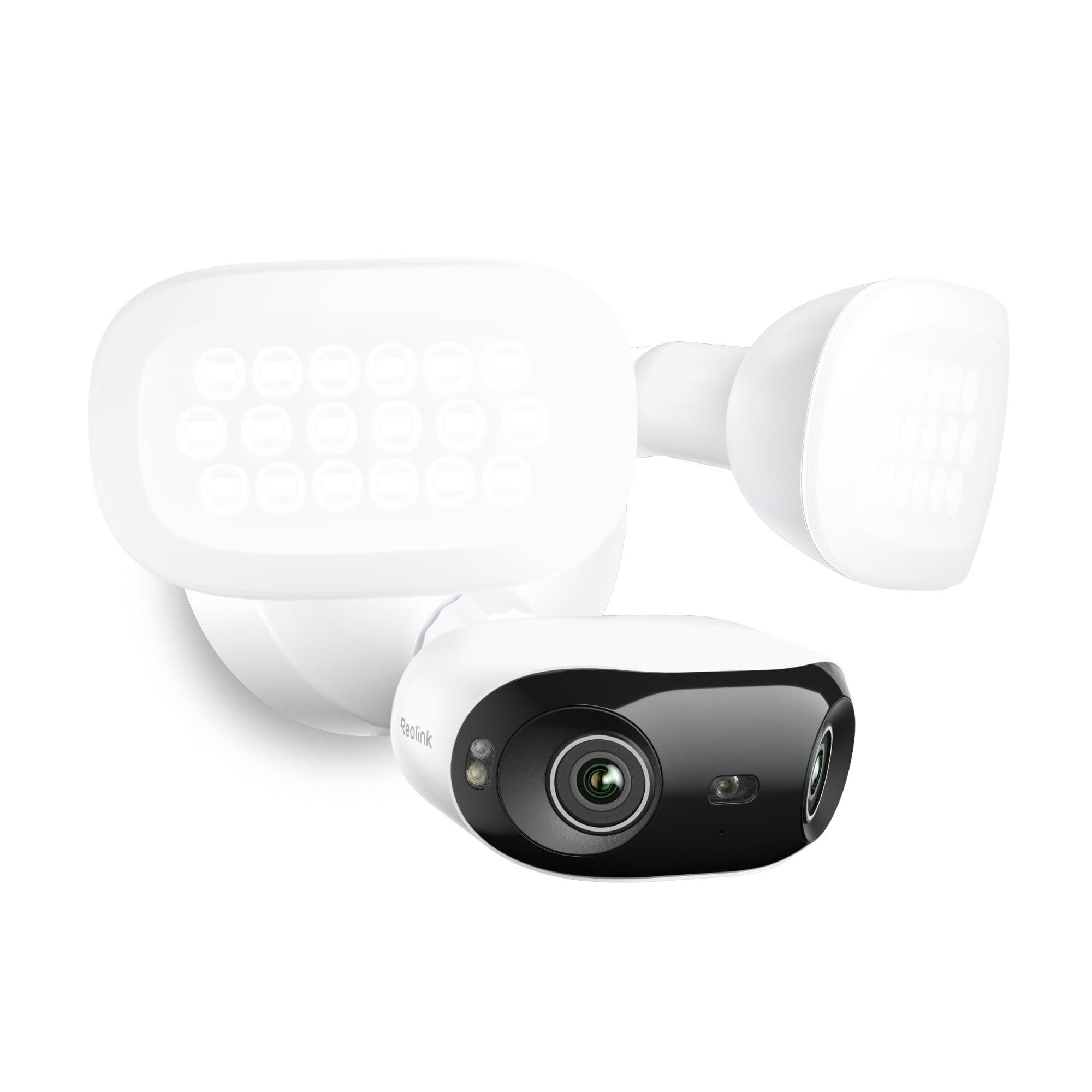
The Elite's 180° panoramic view is the widest fixed view here. Two lenses stitch together a scene that covers both sides of a driveway without panning, and the 4K 8MP sensor gives you enough resolution to crop into a face or a plate. The 3,000-lumen light is the brightest in this group, with dimming and color adjustment for different settings.

Local storage is the other draw. Reolink supports 24/7 recording to a microSD card up to 512GB or an NVR, and the AI detection for people, vehicles, and animals runs without a subscription. The dual-band Wi-Fi 6 connection is the right modern spec for a 4K stream. For a subscription-averse buyer, that combination is hard to beat.

The app and pairing are not as turnkey as Ring's, and the camera can be fussy about staying connected. That is not a dealbreaker for a tech-comfortable installer, but it is the reason the Elite is not our default for a simple porch.

We like the Elite best for a wide driveway or a corner where one camera has to see both directions. The 180° view and 3,000-lumen light do more for that job than a narrower, brighter-looking spec sheet suggests. The dual-lens stitch is the part to see before you commit: it covers both sides of a driveway in one frame, and that is hard to fake with a narrower lens.

Pros

  • 180° panoramic 4K view
  • 3,000-lumen dimmable light
  • Local 24/7 recording without subscription
  • Dual-band Wi-Fi 6

Cons

  • Large, heavy fixture
Our verdict

The Reolink Elite is the panoramic pick: a 180° 4K view, 3,000 lumens, and local recording make it a strong fit for a wide driveway if you can handle a heavier install.

Check Latest Price
8

Off-Grid Coverage

Reolink Solar Floodlight Cam 2-Pack

81 /100
Keeper Score Excellent

Key details

Pack Count
2 cameras
Power Source
Solar/battery
Video Resolution
2K 4MP
Floodlight Brightness
1,000 lumens
Check Price on Amazon

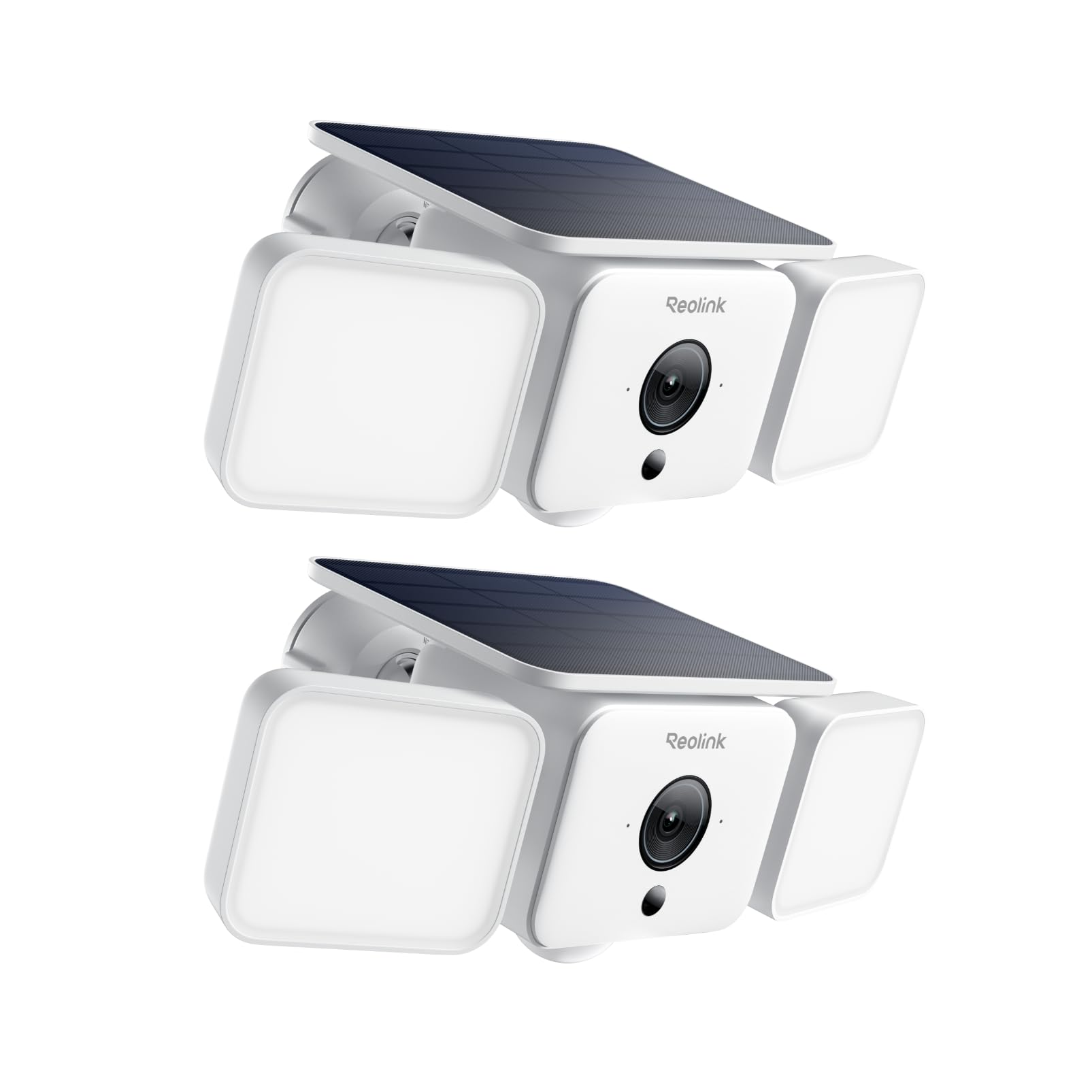
Two cameras, two solar panels, and no wiring: the Reolink Solar two-pack is built for the person who has a gate and a shed, or a fence line and a back patio, and no power at either. Each camera pairs a 2K 4MP sensor with up to 1,000 lumens of motion-activated light, a 3W solar panel, and a battery. The 150° lens and 110dB siren make each one useful as a deterrent, not just a camera.

The kit math is the appeal. You get two cameras for less than a single premium wired floodlight, and the solar panel keeps the battery topped up with minimal maintenance. The 2K video is sharp for the price, and the color night vision is good enough to see who is at the gate. For a remote building or a rental property, that is a lot of coverage without an electrician.

Detection is the weak spot. The cameras can be too sensitive in daylight and slow to catch a person at night, so the sensitivity and activity zones need tuning after installation. The wireless connection is also less dependable than a wired camera's, which is the trade for going off-grid. Neither issue is unique to Reolink, but both are worth planning for.

We recommend the Reolink pair when you need to cover two separate areas and wiring is out of the question. Compared with the Tapo C615F, you give up the pan-tilt head and get two fixed cameras; for two gates or two dark corners, that is the better value. The 3W panel is the piece that makes the kit work: two cameras can sit on a fence for months without a ladder, provided the panels see sun.

Pros

  • Two cameras and two solar panels
  • 2K video with color night vision
  • Wire-free solar power

Cons

  • 1,000 lumens is modest for large yards
Our verdict

The Reolink Solar two-pack is the practical off-grid choice for two dark corners: solar power, 2K video, and a built-in siren without an electrician.

Check Latest Price

How We Tested Floodlight Cameras (Mostly After Dark)

We started with every floodlight camera we could find in stock and priced for a normal house, then cut to models that differ in ways that matter — wired versus battery and solar, fixed lens versus pan and tilt, local storage versus cloud-only. That left 12, each mounted where these actually go: over a garage door, beside a back gate, on a side yard with no street light. Testing ran six months, long enough to see them through rain, a heat wave, and the night a raccoon found the trash bins.

Installation came first, because a camera that fights you on day one rarely gets better. I timed each wired install solo — breaker off, old fixture down, bracket up — and noted whether the mounting holes lined up with a standard junction box or sent me back to the hardware store. Battery and solar units got judged on where they could go and how often they needed charging. Then setup: a stopwatch from power-on to first alert on my phone.

Nights were the real test. I walked the driveway at dusk and again at midnight to see when color gave way to black and white, read a license plate at about 25 feet, and checked whether the floodlight washed out the thing it was lighting. Brightness was judged by how far the light reached, not the lumen count on the box.

For motion, I crossed the frame at an angle, walked straight at the lens, and let cars pass on the street to see what counted as an event; pan-and-tilt models only earned credit if they held me to the edge of the yard. I tallied false alerts from rain, moths, and branches over the full six months, logged dropped connections, and priced two years of cloud storage against a local card.

How to Choose a Floodlight Camera

Start With Power, Not Resolution

A wired camera is the simplest route to constant power, brighter lights, and 24/7 recording. If an existing outdoor light already has a compatible electrical box, a wired model like the Ring Wired Pro or Reolink Elite is the least compromised choice. Battery and solar models trade that constant power for placement freedom; they are the right answer for a shed, gate, or rental where running cable is the bigger expense.

The trap is assuming solar means unlimited power. A solar panel needs direct sun, and a shaded eave or a north-facing wall can leave the battery short. Check the mount's sun exposure before you choose a wire-free model, and keep the panel clean.

Match Lumens to the Space

Lumens measure light output, and the difference between 800 and 2,000 is the difference between lighting a doorway and lighting a driveway. For a path, porch, or gate, 800 to 1,000 lumens can be enough; for a driveway or a large yard, look for 2,000 lumens or more. The Wyze v2 at 2,800 and the Reolink Elite at 3,000 are the brightest picks here, while the Tapo C615F's 800 lumens suit a smaller area.

Adjustability matters as much as the peak number. Dimmable lights and separate motion and dusk-to-dawn modes let you keep the light useful without turning your yard into a nuisance for neighbors. We prefer a camera with brightness control over one that only switches on at full blast.

Decide Between Fixed and Moving Views

A fixed 150° to 180° lens is simple, stable, and usually cheaper. It is the right choice for a porch or a driveway where you can aim the camera once. A pan-tilt model like the eufy E30 or E340 covers more angles from one mount, but it has to decide what to follow, and tracking can swing toward the wrong motion. Tune the detection zones before you trust it.

If your yard has two or three approaches, the moving view can replace a second camera. If you mainly need a bright light over a door, the fixed view is less to adjust and less to go wrong.

Video Detail and Night Clarity

2K is enough to identify a person at porch distance, and it keeps the file sizes and Wi-Fi demands manageable. Step up to 4K if you need to read a plate or a face at the far end of a long driveway; the Ring 4K Pro and Reolink Elite are the detail picks here. HDR helps in harsh light, and color night vision is more useful than black-and-white when you need to describe clothing or a vehicle.

Do not buy resolution you cannot stream. A 4K camera on a weak Wi-Fi signal can look worse than a stable 2K feed. Check the camera's Wi-Fi band and your router's coverage before you pay for extra pixels.

Plan for Storage and Subscriptions

Local storage is the long-term budget story. eufy and Reolink support microSD recording without a monthly fee, and the Reolink Elite can also record to an NVR. Ring's advanced alerts and history lean on a Ring plan, and Arlo Secure unlocks the smart features after a trial. The camera still works without a plan, but the convenience is what you are paying for.

Decide before you buy whether you want clips on a card, a cloud history, or both. If you choose local storage, install the card before you mount the camera; it is much easier at a table than on a ladder.

Frequently Asked Questions

Final Verdict

Most buyers should start with the Ring Floodlight Cam Wired Pro. It has the best balance of bright 2,000-lumen light, clear 2K video, and a wired setup that is easy to live with. If detail at a distance matters more, the Ring 4K Pro is the step up; if you need 360° coverage, the eufy E30 is the value pick. For a gate or shed with no power, the Tapo C615F is the wire-free choice.