Best Outdoor Security Cameras of 2026

It's 2 a.m., something knocks the recycling bin over, and the clip your camera sends you is a gray smudge with a glowing dot in the corner — which is usually when people start shopping for a better one. A camera worth mounting outside has to do three unglamorous things: wake up when something real happens, capture enough detail to tell a raccoon from a person, and keep running through rain and a week of gray skies without sending you up a ladder with a screwdriver.

I've kept cameras on my own house for years, and my team has now spent six months living with 12 more, from a single solar unit to full multi-camera kits. Two things surprise first-time buyers: coverage beats raw resolution (a camera that pans to follow someone across the driveway is more useful than a sharper one with a blind spot), and "no subscription" is what really decides the price, since cloud storage can outcost the hardware in two years. The picks below earned their place on both counts.

Keeper Score summarizes customer ratings and review volume. Read it alongside the product details and trade-offs. How the score works.

1

Best Overall

eufy eufyCam C37 4-Cam Kit

85 /100
Keeper Score Excellent

Key details

Power
Solar + battery
Cameras
4
Resolution
2K
Local Storage
64GB
Check Price on Amazon

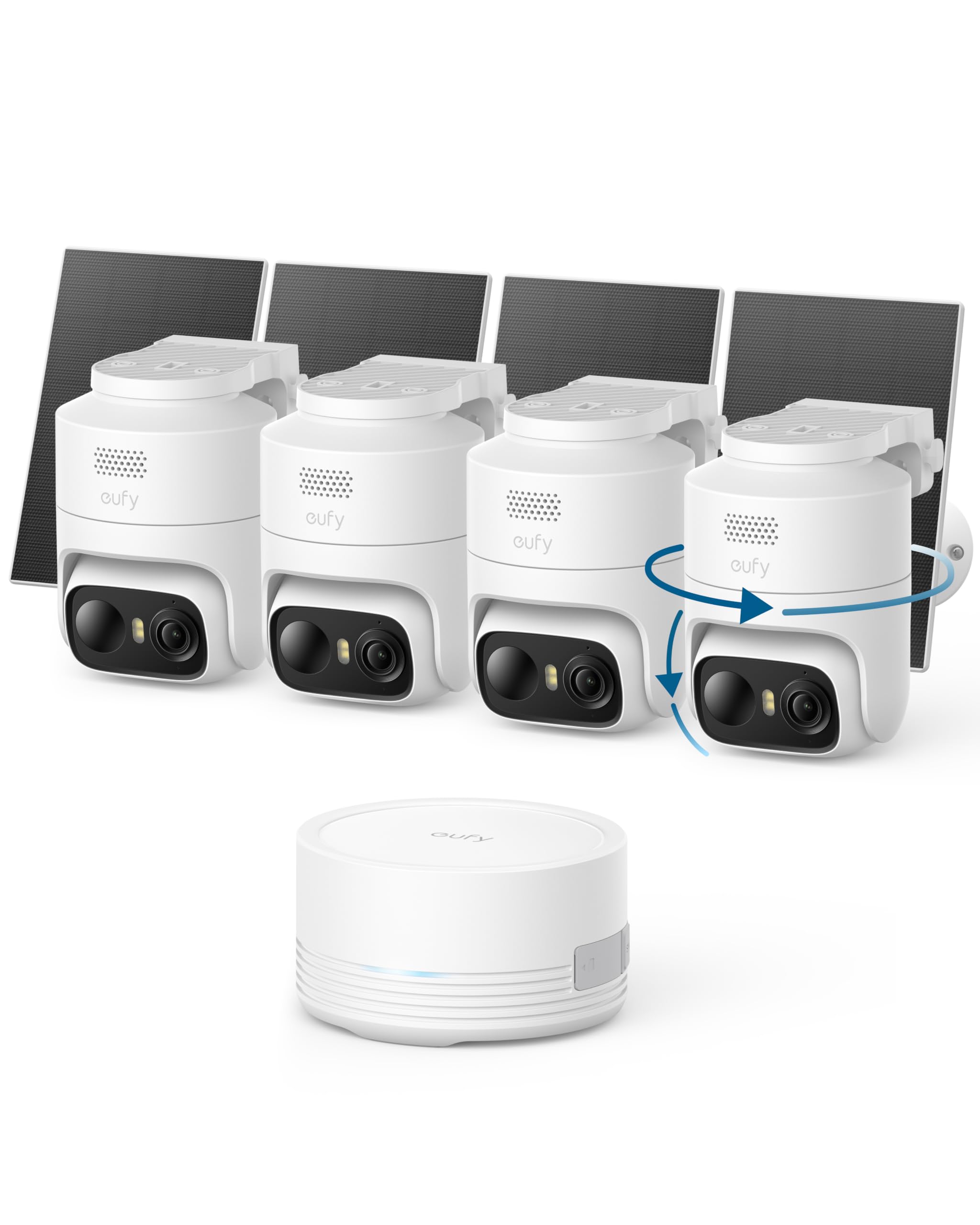
The eufy C37 kit is the one we reach for when a reader wants whole-home coverage without turning the purchase into a subscription. Four cameras, each with 360-degree pan and tilt, cover more ground than a single fixed lens, and the 2K color night view is enough to identify a person at the door or a car in the drive. That combination is why it earns the top spot here: the kit feels complete before you add a single accessory.

The 64GB local storage is the detail that separates it from the 32GB kits on this list. Clips live in the HomeBase Mini, so you can review events without paying a monthly fee, and the base keeps the cameras off your main Wi-Fi network. We like that arrangement because it makes the system easier to live with after the novelty wears off. The trade-off is 2K video rather than the 3K detail of the SoloCam S340, but the C37's wider coverage matters more for a whole-property kit.

The solar panels are a genuine convenience, not a spec-sheet extra: each camera gets its own panel, so you can place the cameras where the view is best and put the panels where the sun is. We also appreciate the human, vehicle, pet, and face detection, which cuts down on alerts from branches and passing shadows. The system is easy to live with once the base is connected, and the four solar panels mean fewer trips up a ladder.

Pros

  • Four 360° solar cameras in one kit
  • 64GB local storage without a subscription
  • AI detection for people, vehicles, pets, and faces
  • 2K color night vision

Cons

  • 2.4GHz-only Wi-Fi limits some mesh setups
  • HomeBase Mini needs a wired router connection
Our verdict

We recommend the eufy C37 kit for a whole-home setup where you want four 360-degree solar cameras, 64GB of local storage, and no monthly fee.

Check Latest Price
2

Best for Wide Yards

aosu D1 Classic 4-Cam Kit

86 /100
Keeper Score Excellent

Key details

Power
Solar powered
Cameras
4
Resolution
2K (3MP)
Local Storage
32GB
Check Price on Amazon

The aosu D1 Classic is the four-camera kit we point to when the yard is wide and the budget still has a ceiling. Each camera pans and tilts through 360 degrees, so one mount can watch a side gate, a patio, and the back of a garage without adding another camera. The 2K picture is sharp enough for faces and vehicles at a reasonable distance, and the color night view keeps the scene readable after dark.

What we like most is the 32GB base. It arrives ready to record, holds roughly 120 days of loop recording, and doesn't ask for a subscription to review an event. The base connects to your router by Ethernet and the cameras talk to the base rather than your home Wi-Fi, which can make the video feed steadier in a house with a crowded network. We found that a useful trade: one more box near the router, less chasing of weak camera signals.

Auto tracking is the feature that separates this kit from fixed cameras. The camera follows a person across the yard, and the motor is quiet enough that it doesn't call attention to itself. Solar panels keep the batteries topped up, and the app shows each camera's charge so you can catch a weak panel before it becomes a dead camera. We treat tracking as a convenience rather than a guarantee; a subject that moves behind a tree or parked car can slip out of frame.

Pros

  • Four 360° auto-tracking cameras
  • 32GB local storage, no subscription
  • Solar power reduces recharging
  • 2K color night vision

Cons

  • A camera can stop charging
Our verdict

We recommend the aosu D1 for a wide yard where four pan-and-tilt cameras, local storage, and no monthly bill matter more than a perfect tracking record.

Check Latest Price
3

Best Wired System

ANNKE 8-Cam Wired System

89 /100
Keeper Score Excellent

Key details

Cameras
8
Resolution
1080p
Night Vision
100 ft
Local Storage
1TB HDD
Check Price on Amazon

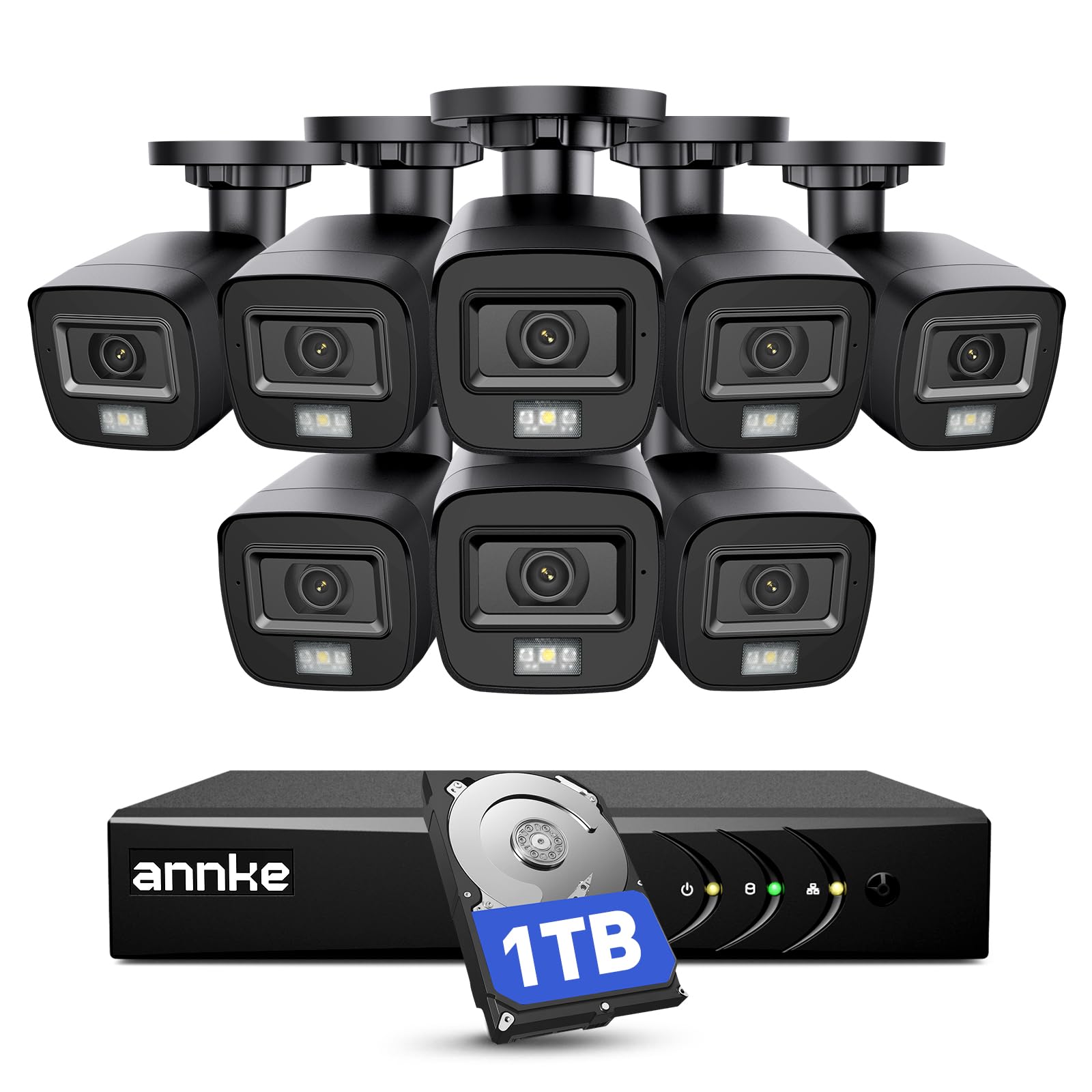
The ANNKE kit is the outlier here: it records around the clock to a 1TB DVR instead of waking up when something moves. That makes it the pick for a driveway, shop, or rental where a gap in the timeline is the thing you cannot tolerate. Eight cameras and a preinstalled hard drive mean the system is ready to record before you open the app.

The label needs decoding. The DVR is a 3K Lite model, but the eight included cameras are 1080p, not 3K. We judge the kit on that 1080p image, and it holds up in daylight; the 100-foot infrared night vision is the more useful number for a big lot. AI human and vehicle detection helps sort a day of footage, and 24/7 recording means you can scroll back to a time rather than hope an alert fired.

Wired installation is the trade-off. You need to run BNC cable from each camera to the DVR and find a safe outdoor power route for the adapters. The IP67 housing handles rain and dust, and the included 60-foot cables cover a lot of small-property layouts, but this is not a kit you install in an afternoon without planning. We like it for a permanent setup where the cable can be routed neatly.

The 1TB drive is the part that makes the kit feel finished on day one. It supports up to 10TB if you want a longer archive, and H.265+ compression stretches the storage further. We also appreciate that the DVR works with TVI, AHD, CVI, CVBS, and IP cameras, so the box has a life beyond the eight cameras in the box.

Pros

  • 24/7 recording to a 1TB DVR
  • Eight cameras cover a large property
  • IP67 weather protection
  • 100 ft infrared night vision

Cons

  • The 8-channel DVR leaves no room for another camera
  • Remote app connectivity can be inconsistent
Our verdict

We recommend the ANNKE kit for a property that needs eight wired cameras and round-the-clock recording, not motion-triggered clips.

Check Latest Price
4

Best Single Camera

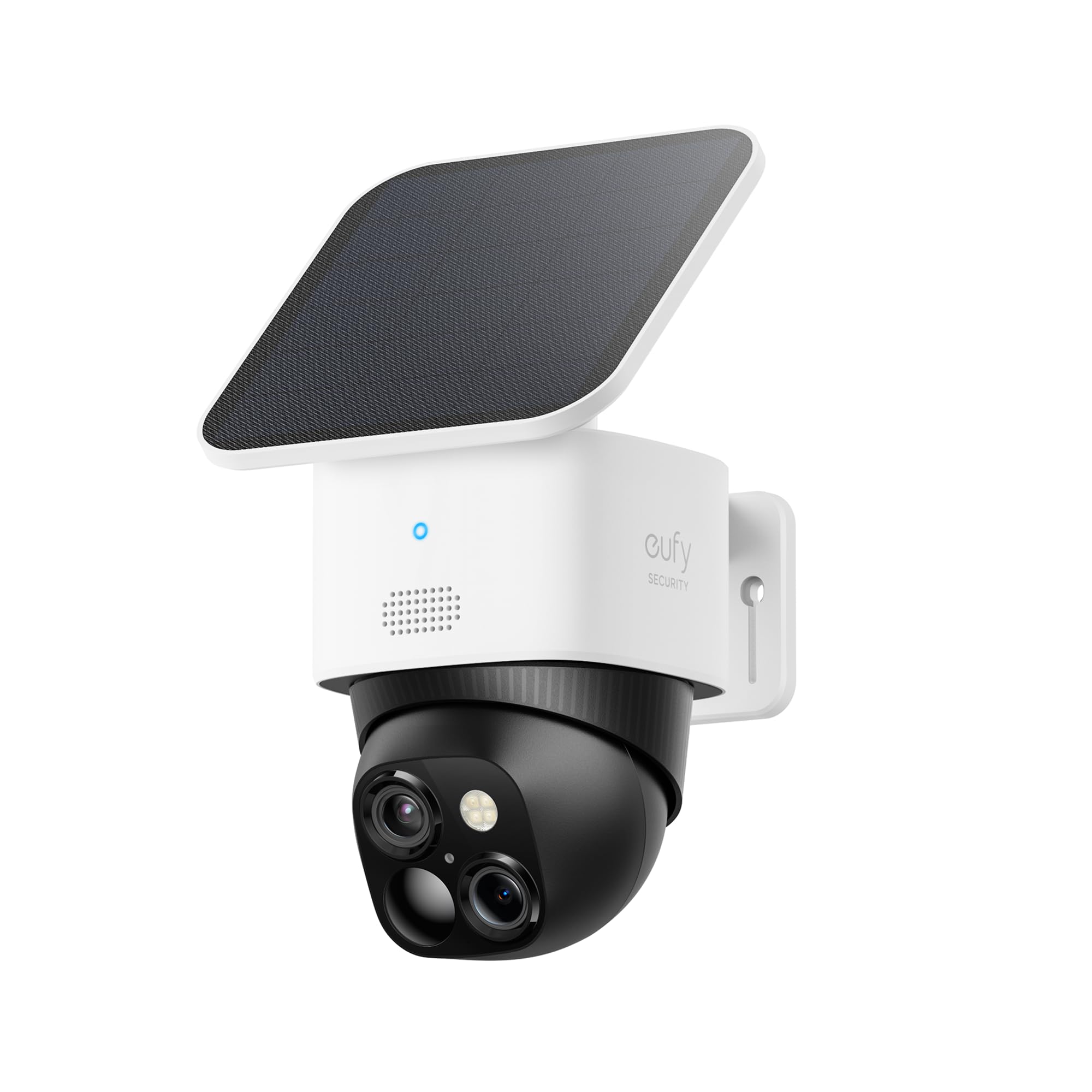
eufy SoloCam S340

84 /100
Keeper Score Excellent

Key details

View
360° pan/tilt
Cameras
1
Resolution
3K
Local Storage
8GB
Check Price on Amazon

A single camera has to justify its place differently from a kit. The eufy SoloCam S340 does that with a dual-lens 3K image, a 360-degree pan-and-tilt mount, and an 8GB local store that keeps recent clips on the camera. We choose it when the goal is a detailed view of one choke point, not blanket coverage of a whole yard.

The second lens is the reason to pay attention. It gives the S340 a tighter, more detailed view than the 2K kits here, and the 8x hybrid zoom is useful for reading a license plate or a face at the end of a walk. We like that the 8GB storage works without a subscription; it keeps recent clips on the camera instead of in a cloud account. The solar panel is removable, so you can angle it toward the sun while the camera looks where you need it.

The mount is the other practical detail. Pan and tilt coverage means one camera can sweep a driveway, a side door, and a back fence, but it cannot watch all three at once. We set it to patrol the important arc and accept that a fixed camera at the far corner catches what the S340 misses. For a renter or a small property, that is a fair trade for avoiding cable and a monthly bill.

Pros

  • 3K dual-lens video with 8x zoom
  • 360° pan and tilt coverage
  • 8GB local storage, no monthly fee
  • Removable solar panel

Cons

  • 8GB storage is modest for busy scenes
  • Night vision reach is listed at 6 m
Our verdict

We recommend the eufy SoloCam S340 for a single high-detail view of a driveway or yard, especially where running power is impractical.

Check Latest Price
5

Best Budget Solar Pair

SEHMUA 2K Solar 2-Pack

87 /100
Keeper Score Excellent

Key details

Power
Solar + battery
Cameras
2
Resolution
2K
Night Vision
98 ft
Check Price on Amazon

Solar panels are the reason to look at the SEHMUA pair. Two 2K cameras, each with a removable panel and a 6,000mAh battery, cover a shed and a side yard without an extension cord. The cameras pan through 355 degrees and show a 360-degree view, and the 98-foot night vision is long enough for a driveway.

The important distinction is that this is pan and tilt, not auto tracking. The camera turns where you point it in the app; it does not follow a person walking through the frame. That is fine for a fixed view you adjust now and then, but it is not the same experience as the tracking kits here. We like the pair for a spot where you want a wider view without paying for a motorized follow feature.

For the money, the pair is easy to recommend for a first solar setup. The picture is clear, the install is a screw-and-aim job, and the solar panels keep the batteries from becoming a weekly chore. We like it best on a shed, garage, or side gate where you check the app a few times a day rather than rely on constant tracking. The app is simple enough to check from a phone, and the two-camera kit covers more ground than a single fixed lens.

Pros

  • Two solar-powered 2K cameras
  • 355° pan and 360° view
  • 98 ft night vision
  • Simple screw-in installation

Cons

  • 2.4GHz Wi-Fi only
  • Motion alerts can miss events
Our verdict

We recommend the SEHMUA pair for a budget solar setup on a shed and side yard, as long as you can live without auto tracking.

Check Latest Price
6

Best Budget Camera

HITELLARCAM 2K Camera

86 /100
Keeper Score Excellent

Key details

Power
Battery
Cameras
1
Storage
Free cloud + SD
Resolution
2K
Check Price on Amazon

The HITELLARCAM is the camera we suggest when someone wants to try outdoor monitoring without committing to a system. It is a single 2K battery camera with free cloud storage, a 5,200mAh rechargeable battery, and support for both 2.4GHz and 5GHz Wi-Fi. That combination is rare at the entry end of this list.

Free cloud storage is the hook, but the local SD slot is what makes the camera practical. You can keep clips on a card and treat the cloud as a backup rather than a recurring bill. The 2K picture is clear in daylight and color at night, and the app is simple enough to set up without a hub. We also like the dual-band Wi-Fi because a 5GHz connection can be steadier in a crowded house, provided the camera is close enough to the router.

The battery is the part to plan around. In a busy spot, the charge drains faster than the rated months suggest. We like it for a porch, garage side, or rental where you can reach the camera to recharge and the subject is close to the lens. It is not the camera for a long driveway or a property where you want to set it and forget it.

Pros

  • Free cloud storage with no subscription
  • 2K video and color night vision
  • Dual-band 2.4/5GHz Wi-Fi
  • 5,200mAh rechargeable battery

Cons

  • Night vision reach is short
Our verdict

We recommend the HITELLARCAM for a first outdoor camera on a tight budget, with the caveat that its night view is short-range.

Check Latest Price
7

Starter Multi-Camera

GMK 4-Pack Camera System

83 /100
Keeper Score Excellent

Key details

Power
Battery
Cameras
4
Storage
MicroSD up to 128GB
Resolution
2K
Check Price on Amazon

The GMK kit is the least expensive way here to put four cameras around a house. You get four 2K bullet cameras, a 110-degree lens on each, and a microSD slot that takes up to 128GB. There is no base station and no solar panel, so the kit is simple in the way a starter system should be.

The 110-degree lens is narrower than the 360-degree pan-tilt kits, so four cameras do not equal four wide views. We place these at corners and aim them at choke points: front walk, back door, driveway, side gate. The 33-foot night vision is enough for a porch or garage, but not for the far end of a long yard.

Battery life is the caveat. Without solar panels, four cameras mean four charging sessions, and a busy driveway will drain them faster than a quiet back fence. We accept that for a starter kit because the install is a screw-and-aim job and the app keeps all four feeds in one place. If you want to mount them high and forget them, the solar kits here are the better fit.

What we appreciated most is the simplicity of the box: four cameras, one app, local storage, and no hub to place near the router. The 2K picture is clear enough for faces at the door, and the motion alerts are easy to adjust. We treat it as a first set to learn what you need, not a permanent system for a large property.

Pros

  • Four cameras for a starter system
  • 2K video with color night vision
  • MicroSD storage up to 128GB
  • No hub required

Cons

  • 2.4GHz-only Wi-Fi
Our verdict

We recommend the GMK four-pack for a first multi-camera setup where budget matters more than long battery life or wide-angle coverage.

Check Latest Price
8

Local-Storage Kit

Vivideye 4MP 4-Cam Kit

84 /100
Keeper Score Excellent

Key details

Power
Solar + battery
Cameras
4
Resolution
4MP
Local Storage
128GB
Check Price on Amazon

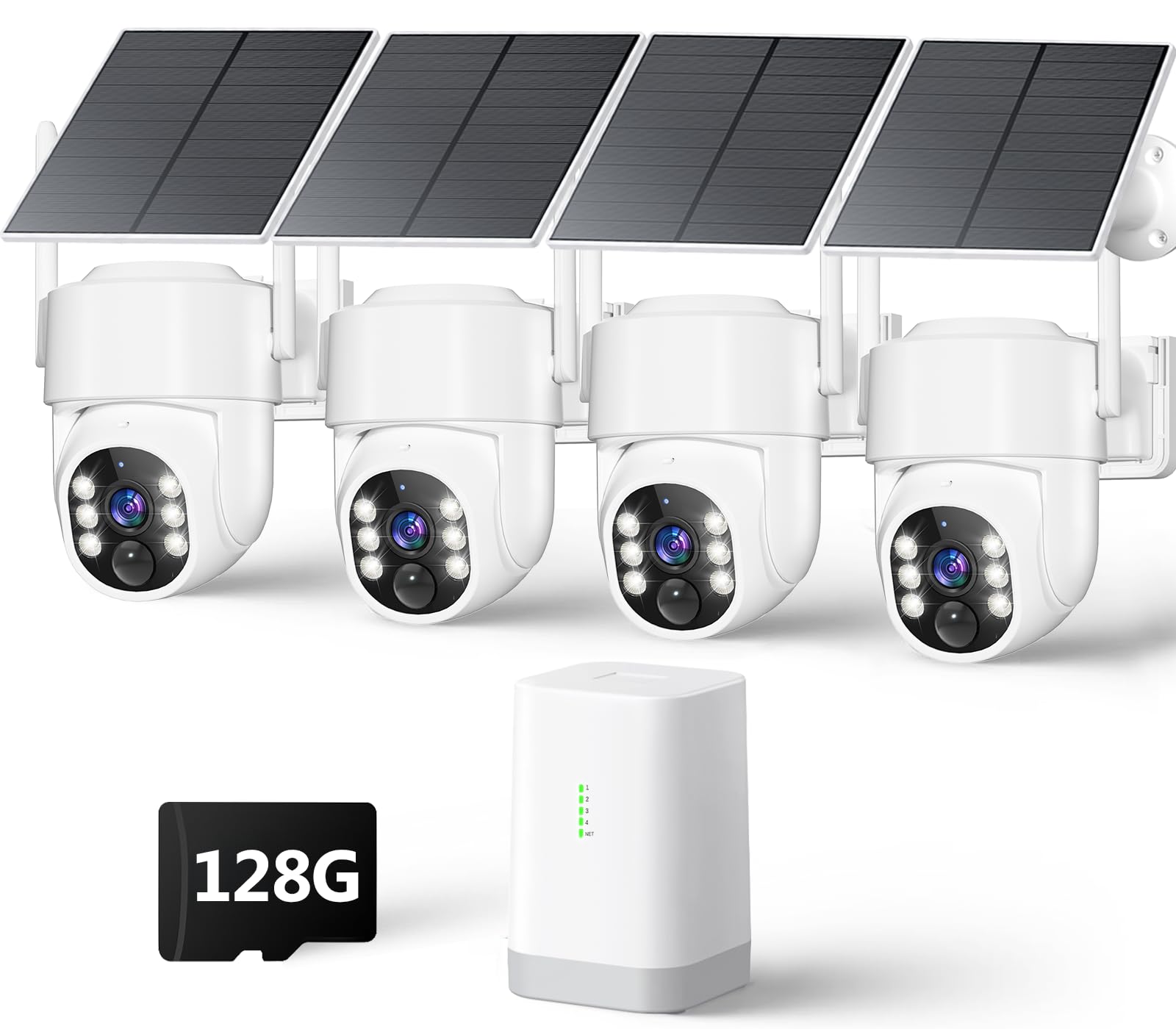
The Vivideye kit puts four 4MP solar cameras and a 128GB base in one box. The cameras pan and tilt, track people automatically, and record color at night. The base is the part that makes the kit interesting: it holds the storage locally and keeps the system off a monthly cloud plan.

The 128GB hub is the detail that separates it from the 32GB and 64GB kits here. You are not buying a card for each camera or checking a slot on the side of a mount; the recordings land in one place. The four cameras come paired to the base, which saves time during installation. We like that arrangement for a rental or a small business where a single local archive is easier to manage.

The 4MP image is the highest resolution among the kits here, and the 60-foot night vision is well matched to a driveway or backyard. The 5W solar panels and 8,000mAh batteries are sized for the four cameras, and the IP66 housing handles rain and dust. The dual-band Wi-Fi 6 support is a plus if your router is close enough to use 5GHz.

Reliability is the open question. The system can stop recording after a short run. We like the hardware and the no-fee storage, but we treat this as a promising kit for a buyer who wants local control rather than the safest default. The 128GB hub is the part we keep coming back to; it is why the kit belongs on a short list rather than a spec sheet.

Pros

  • 128GB local storage in the hub
  • 4MP video with color night vision
  • Four solar pan-tilt cameras
  • No monthly subscription

Cons

  • Four-channel hub leaves no room to expand
Our verdict

We recommend the Vivideye kit for a four-camera property where 128GB local storage and no monthly fee matter more than a long track record.

Check Latest Price

How We Tested Outdoor Security Cameras

We started with about 50 models and cut the list down by asking three questions: does it record locally without a monthly fee, can it run on battery or solar instead of a dedicated power line, and is it a single camera or a kit you can spread around a property. That left 12 wired and wireless units that we installed at my house and my parents' place over six months.

Setup was timed solo, from opening the box to the first push alert, on brick, a wood fence, and under an eave. I noted whether the mount needed a drill, whether the app found the camera on the first try, and how long it took to pull a live feed on a phone at the far end of the yard; cameras that dropped connection or lagged behind a walking person got marked down.

Then we spent weeks being deliberately boring — walking up the driveway, jogging, letting the dog out, driving in and out — and logged every alert: what triggered it, whether the person, vehicle, or package label was right, how often a swaying branch set it off, and whether the clip started before the subject entered the frame. Night footage was checked at about 30 feet, with and without a porch light, to see if a face was identifiable or just a bright smear.

Battery and solar models were charged to full and run through heavy alert weeks, including a stretch of overcast days, to see which panels actually kept up. Everything stayed up through storms and a cold snap; we checked housings for water and cameras for reconnecting on their own after a router reboot. Finally, we added a year of the manufacturer's cloud plan to each camera's price to see what it really costs to own.

How to Choose Outdoor Security Cameras

Coverage First, Resolution Second

Start with what you need to see. A fixed camera with a 110-degree lens, like the GMK, covers a doorway or a slice of driveway; a 360-degree pan-and-tilt model, like the eufy C37 or aosu D1, sweeps a wider area from one mount. We prefer two or three well-placed cameras over one expensive camera pointed at everything, because most homes have more than one approach. Resolution helps identify a face or plate, but coverage decides whether the camera sees the person at all.

Power: Solar, Battery, or Wired

Power decides where you can mount the camera and how often you touch it. Solar panels are the easiest if the panel gets direct sun; battery cameras are flexible but mean a ladder and a charging cable; wired systems need a cable route but can record continuously. The ANNKE kit is the wired exception here for a reason: it trades installation effort for a 24/7 timeline. We treat solar as a placement challenge, not a magic fix, and check each panel's charge in the app after the first week.

Storage and the Subscription Question

We read 'no subscription' closely. A base station with 32GB or 64GB, a microSD card, or built-in storage can keep clips local, but retention depends on how many cameras and events you have. Local storage is usually cheaper over time and keeps working if the internet drops; cloud storage adds convenience but a recurring bill. Check whether person, vehicle, or face detection lives on the camera or behind a paid plan before you assume the monthly cost is zero.

Motion Alerts and Night Vision

Motion detection is where budget cameras feel budget. A simple PIR sensor triggers on heat; AI detection filters people, vehicles, and pets; auto tracking follows a subject across the yard. More alerts is not better if most are branches or shadows, so look for adjustable zones and sensitivity. At night, color video needs a spotlight or ambient light, while infrared gives a black-and-white view farther out. Aim at the choke points people actually use, not the widest possible arc.

Installation and Weatherproofing

Wi-Fi is the quiet failure point. A 2.4GHz signal travels farther through walls, while 5GHz is faster but shorter; base-station kits can keep camera traffic off your main network but need the base near the router. Check the signal at the mount before you drill. For weather, an IP65, IP66, or IP67 rating covers rain and dust to different degrees, and a wired system needs protected connections outdoors. Mount securely, then test the live view before you tighten everything down.

Frequently Asked Questions

Final Verdict

Start with the eufy C37 kit. It gives you four 360-degree solar cameras, 64GB of local storage, and no monthly bill, which is the most complete package here for a typical house. If you need a continuous timeline rather than motion clips, the ANNKE wired system is the better tool. For a single high-detail view, the SoloCam S340 is the one we choose.