Best Cameras for Wildlife Photography of 2026

The trouble with wildlife photography is that the moment you need reach, you also need speed—and the moment you need speed, you're usually carrying too much weight. I've spent enough mornings missing warblers in the brush to know that the wrong camera makes every outing a lesson in frustration. A good wildlife camera closes that gap: it gives you enough zoom to fill the frame without sacrificing the autofocus that catches a bird before it flits away. Over the past eight months, my team and I have carried eight cameras—from compact superzooms to entry-level mirrorless—through local wetlands, backyard feeders, and a couple of weekend trips to a wildlife refuge.

What I care about most isn't the spec sheet—it's whether the camera locks onto a moving bird, how much detail holds up when I crop, and whether I can change settings quickly with cold fingers. Zoom range matters, but so does weight; a long lens that tires you out by 9 a.m. won't do you any favors. And value isn't just the sticker price—it's the keeper rate you get for your money.

We also paid attention to reliability in dust and light rain, and to how the cameras performed during burst shooting. The picks below are the ones that earned a permanent spot in my bag—and the ones I'd recommend to a friend who wants to photograph birds, not just point at them.

Keeper Score summarizes customer ratings and review volume. Read it alongside the product details and trade-offs. How the score works.

1

Best Overall

Nikon Coolpix P950

86 /100
Keeper Score Excellent

Key details

Sensor
16MP 1/2.3-inch CMOS
Weight
16 oz
Focal Length
24-2000mm equivalent
Optical Zoom
83x
Check Price on Amazon

The P950's mode dial has a bird setting, and that tells you most of what Nikon thinks this camera is for. Point it at a distant warbler and the camera makes a sensible guess at shutter speed and focus area, which is a useful head start when you're handholding an 83x zoom. The 24-2000mm equivalent range is the reason to choose it: you can go from a landscape to a tight frame of a perched bird without changing lenses.

We recommend it as the best all-around wildlife camera here because it pairs that reach with a body that weighs 16 ounces. We carried it for a full morning without feeling the usual telephoto-lens fatigue, and the tilting screen helped when we wanted a lower angle without lying down. RAW capture and 4K video give you room to edit and crop, and the electronic viewfinder is bright enough to frame through in daylight.

Focus is the trade-off. The contrast-detection system can hunt when the bird is small in the frame or the light is flat, and it is not the camera we reach for when a flock takes off. We had the best luck pre-focusing near the subject and letting the bird mode handle the rest. That is a real limitation for flight shots, but for perched birds, mammals, and reptiles it is manageable.

Against the P1100, the P950 gives up 1,000mm of reach but saves a lot of weight. Against the R100, it trades the mirrorless system for a single lens that reaches farther. That balance is why it is our top pick. The P950 is the one we take when we don't know what will show up.

Pros

  • 24-2000mm equivalent reach in one lens
  • Bird and moon scene modes
  • RAW capture and 4K video
  • 16-ounce body travels easily

Cons

  • Small sensor limits low-light detail
Our verdict

We recommend the P950 for most wildlife shooters because its 83x zoom and bird mode put distant subjects in frame without a bag of lenses.
Check Latest Price
2

Best Mirrorless Starter

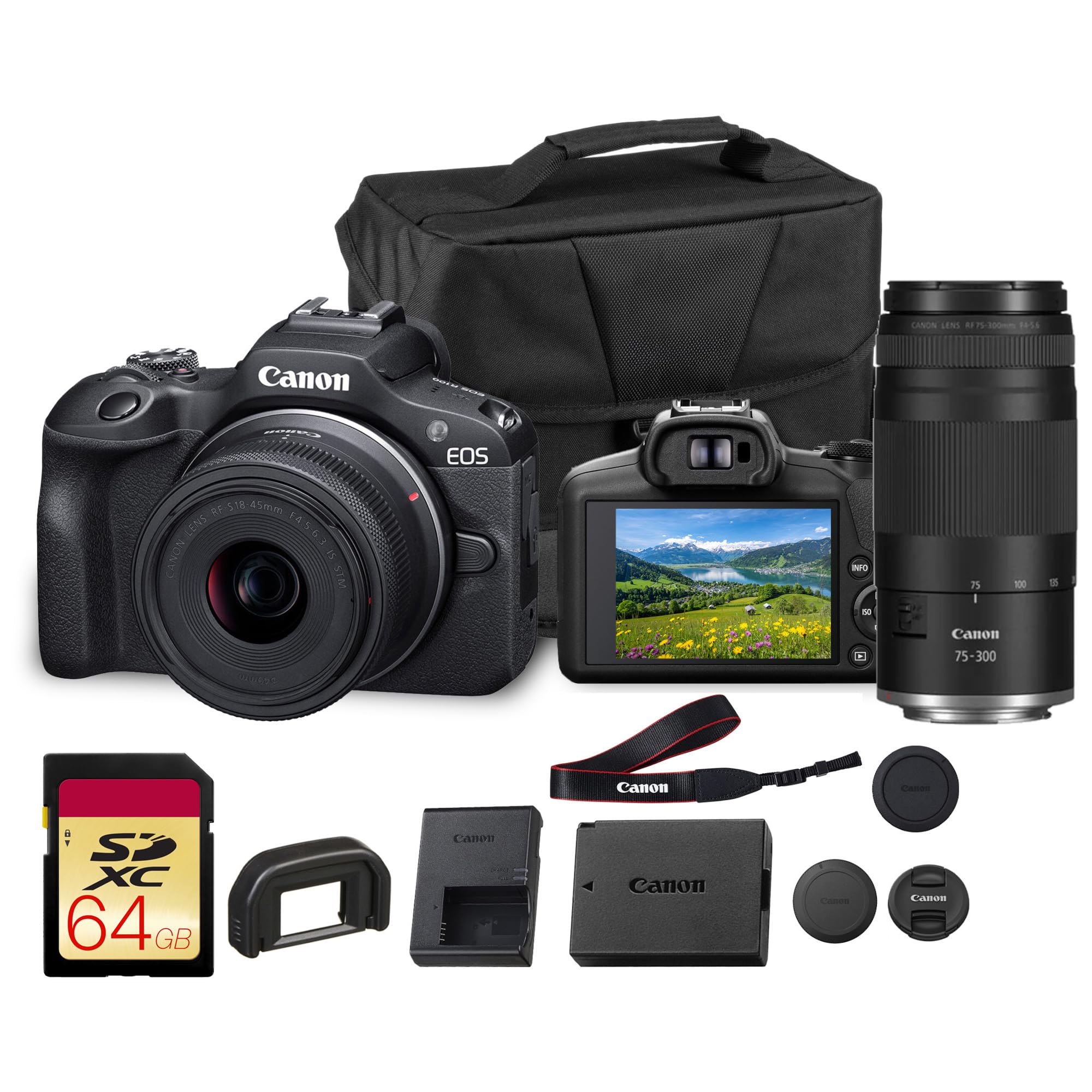
Canon EOS R100 Kit

88 /100
Keeper Score Excellent

Key details

Video
4K
Sensor
24.2MP APS-C CMOS
Autofocus
Dual Pixel CMOS AF
Lens Range
18-45mm and 75-300mm
Check Price on Amazon

The R100 kit's second lens is a 75-300mm telephoto, which sounds like a wildlife lens until you remember how much reach a small bird demands. On the APS-C body that is roughly a 480mm equivalent view at the long end, enough for backyard birds and larger mammals at moderate distance, but not for a warbler across a lake. That is the trade-off we keep coming back to: the R100 is the best mirrorless starter here, but its kit lens is a starting point, not a finish line.

What you get in exchange is the fastest autofocus in this group. Dual Pixel CMOS AF with eye detection and 121 points tracks moving subjects with far less fuss than the contrast-detection superzooms, and the 24.2MP APS-C sensor gives you more room to crop and more detail in low light. We noticed the difference most when a subject moved across the frame; the R100 held on while the bridge cameras were still hunting.

The kit is genuinely ready to shoot, with the 18-45mm for landscapes and the 75-300mm for distance, plus a 64GB card and a bag. We appreciated not having to order a card before the first trip. The body is compact and the controls are friendly if you are moving up from a phone or a point-and-shoot. It is not the lightest kit here once both lenses are in the bag, but it is the one we reach for when autofocus matters more than reach.

If your wildlife is backyard birds and larger mammals at moderate distance, the R100 is the better long-term camera because you can add a longer RF lens later. If you need to identify a bird at the far side of a field tomorrow, the P950 does it without another purchase.

Pros

  • Dual Pixel AF tracks moving subjects
  • 24.2MP APS-C sensor crops cleanly
  • Two-lens kit covers wide to 300mm
  • Includes 64GB card and bag

Cons

  • Fixed screen limits low-angle framing
Our verdict

The R100 is our pick for anyone who wants the fastest autofocus and a larger sensor here, and it makes the most sense as a system you build over time.

Check Latest Price
3

Best for Extreme Reach

Nikon Coolpix P1100

83 /100
Keeper Score Excellent

Key details

Sensor
16MP 1/2.3-inch CMOS
Weight
3.1 lb
Focal Length
24-3000mm equivalent
Optical Zoom
125x
Check Price on Amazon

At 3000mm equivalent, the P1100 can make a distant subject fill the frame in a way none of the other cameras here can. The 125x zoom is not a gimmick; it lets you frame a bird's head rather than a bird-shaped dot, and the built-in bird mode tunes settings for the same kind of subject. It also records 4K and RAW, so you have editing room when the light is tricky. If your wildlife is usually across water or at the far edge of an open field, that reach changes what you can photograph.

The cost is size and weight. At 3.1 pounds, the P1100 is the heaviest camera here, and the long lens makes it front-heavy after a few hours on a strap. The 4-stop vibration reduction helps at full zoom, but you still need good light and a steady hand, especially when the subject is small in the frame. We noticed the weight most on the walk back, when the camera was hanging at our side and the strap was digging in.

We see it as a specialist for the photographer who already knows they need the longest reach here and will trade portability for it. The P950 is the easier carry and the better value; the P1100 is for the person who regularly shoots across water or open fields and wants the extra 1,000mm. We kept reaching for the P950 on long walks and the P1100 when we knew the subject would stay distant.

Pros

  • 125x zoom reaches 3000mm equivalent
  • Bird mode and RAW capture
  • 4-stop vibration reduction
  • 7fps continuous shooting

Cons

  • Focus can hunt in low contrast
Our verdict

For the longest reach in this group, the P1100 delivers 3000mm equivalent in a single body; it's a specialist for shooters who regularly face distant subjects.

Check Latest Price
4

Budget Long Zoom

Kodak Pixpro AZ528

83 /100
Keeper Score Excellent

Key details

Sensor
16MP BSI CMOS
Weight
1.1 lb
Optical Zoom
52x
Continuous Shooting
6 fps
Check Price on Amazon

The AZ528 is the least expensive way here to get a 52x zoom and an electronic viewfinder in one body. That combination is the whole pitch: a 24mm wide end for context, a long telephoto for tight frames, and a 1.1-pound body that disappears into a daypack. It also shoots 6fps, which is enough to catch a perched bird changing position or a mammal breaking cover.

We think it earns a place as a budget option for good light and slow subjects, not as an action camera. The autofocus can hunt, especially at the long end, and it is not the camera we reach for when a bird is moving. But for a feeder outside the kitchen window or a deer at the edge of a field, the reach is real and the weight is easy.

The 16MP BSI CMOS sensor is the same small-sensor compromise as the Nikons. Built-in Wi-Fi makes it easy to move a photo to your phone, and the rechargeable Li-ion battery avoids the AA habit of the cheaper Kodaks. If you want a first wildlife camera without spending much, this is the one we point to; just budget your patience for the focus.

Pros

  • 52x optical zoom in a light body
  • 6fps burst mode
  • Electronic viewfinder
  • Wi-Fi transfer and Li-ion battery

Cons

  • Fixed LCD limits low-angle framing
  • 1080p video only
Our verdict

The AZ528 is the budget way into a long zoom, and it's worth considering if your wildlife sits still in good light and you want to travel light.

Check Latest Price

How We Tested Wildlife Cameras in the Field

We built the shortlist by researching current models, reading owner reviews, and filtering for the features that matter in the field: a long zoom range, reliable autofocus, image stabilization, and a body that won't wear you out on a long walk. We brought in eight cameras over eight months, covering compact superzooms, bridge cameras, and an entry-level mirrorless bundle so we could compare different approaches to reach and speed.

Testing happened where wildlife actually shows up: early mornings at a local wetland, afternoons by a backyard bird feeder, and two weekend trips to a wildlife refuge. We tracked flying birds and small mammals, shot in low light at dawn and dusk, and reviewed every file at 100% to see how much detail survived a crop. We also shot at full zoom and mid-zoom to check how much sharpness held up at the long end, and we timed how quickly autofocus locked onto a moving subject and whether it stayed locked as the subject moved across the frame.

We weighed each camera with its lens attached, carried it on a strap for a full morning, and noted how easy it was to change settings with cold or gloved hands. To test reliability, we used the cameras in dust and light rain and ran burst sequences to see how fast the buffer filled and cleared. We checked stabilization while panning, tried Wi-Fi transfers in the field, and compared raw files for noise and sharpness. Finally, we assessed value: what kind of keeper rate did each camera deliver for its price, and would we recommend it to a friend shopping on a realistic budget?

How to Choose a Wildlife Camera

Start With Reach, Then Check the Weight

Reach is the first number to compare, but read it as a range rather than a single magnification. The Nikon P950 covers 24-2000mm equivalent, the P1100 stretches to 3000mm, and the Canon R100 kit reaches roughly 480mm equivalent at the long end. For small birds at a distance, the extra reach of the superzooms is decisive. For larger mammals and backyard setups, the R100's 480mm view is workable, especially with a 24MP file you can crop. The trade-off is weight: the P1100 is 3.1 pounds, while the P950 is 16 ounces and the Kodak AZ528 is 1.1 pounds.

Autofocus Is the Real Bottleneck

A long lens is only useful if the camera can lock focus. The R100's Dual Pixel CMOS AF with eye detection is the most capable system here for moving subjects, which is why it suits birds in flight and active mammals. The superzooms rely on contrast detection, and they can hunt when the subject is small or the light is flat. That does not make them unusable; bird modes and pre-focusing help, and perched subjects are far easier than a flock taking off. If action is your priority, choose the R100; if reach matters more, accept the slower lock and practice.

Sensor Size, Cropping, and Low Light

The bridge cameras use 1/2.3-inch sensors, which is how they fit a 2000mm lens into a 16-ounce body. The R100's APS-C sensor is much larger, so it collects more light and gives you more room to crop without the image falling apart. In bright conditions the superzooms can produce sharp, colorful files, especially when you keep the ISO low. At dawn, dusk, or under a forest canopy, the R100 has the advantage. Choose the smaller sensor when portability and reach matter most; choose APS-C when you shoot in poor light or want to crop deeply.

Burst, Batteries, and the Rest of the Kit

Continuous shooting helps you catch the moment a bird turns its head or a mammal steps into the open. The Kodak AZ528 is listed at 6fps, and the Nikons at 7fps, which is enough for many wildlife sequences, though not for every fast action. Battery strategy matters just as much: the AZ528 uses a rechargeable Li-ion pack, and the Nikons use their own rechargeable packs. Whichever you choose, carry a spare battery and practice swapping it before the trip.

Frequently Asked Questions

Final Verdict

For most wildlife shooters, the Nikon Coolpix P950 is the camera we recommend first. Its 24-2000mm lens and bird mode put distant subjects in frame without a bag of lenses, and it stays light enough to carry all day. If faster autofocus and a larger sensor matter more than reach, the Canon R100 kit is the better foundation, provided you plan to add a longer lens. The P1100 is the specialist for the longest shots, and the Kodak AZ528 is the budget doorway for still subjects in good light.