Best Cameras for Macro Photography of 2026

Macro photography is mostly a focusing problem. You find the beetle on the fence post, crouch, get within a few inches, and the camera hunts, beeps, and locks onto the wood behind it. Getting close is easy; getting close and staying sharp is the trick.

I've spent the last few springs photographing dew on leaves and whatever insects wander into my kitchen, and over eight months my team tested 10 cameras for exactly that work, from beginner DSLR kits to superzooms and small flip-screen compacts. Here's what a first-timer should know: the giant zoom number on the box says almost nothing about close-up performance. Minimum focus distance does, and a small sensor's extra depth of field can be a real advantage when your subject is the size of a grain of rice.

You'll also want a screen that tilts, since you spend more time on your knees in the dirt than you'd expect, and a battery that survives an afternoon of live view with Wi-Fi running. The picks below span budgets and skill levels, but they all passed the same close-focus test.

Keeper Score summarizes customer ratings and review volume. Read it alongside the product details and trade-offs. How the score works.

1

Best Overall

Canon EOS Rebel T7 Kit

94 /100
Keeper Score Outstanding

Key details

Sensor
24.1MP APS-C CMOS
Weight
3 lb
Lens Mount
Canon EF
Included Lenses
18-55mm and 75-300mm
Check Price on Amazon

Macro is decided at the lens mount, and the Rebel T7 is the only camera here that has one. The EF mount means a dedicated macro lens can go on the front, which is the only way in this group to reach life-size framing and choose your own working distance. In the box you get an 18-55mm and a 75-300mm zoom: a sensible pair for learning, and neither of them a macro lens.

We still pick it, because that is a purchase you grow into rather than a ceiling you hit. The 24.1MP APS-C sensor is the largest here by a wide margin, and that is what gives you clean files at the small apertures close-up work wants — f/8 and beyond, where a tiny sensor starts to smudge. Budget for the macro lens in the same breath as the camera: the body is the platform, the glass is the macro.

Handling is straightforwardly that of an entry-level DSLR. Three pounds with a lens mounted is steady on a tripod and noticeable on a long walk, and the optical viewfinder is easier to use in bright sun than any screen. Continuous shooting runs at 3 fps, so you time insect shots rather than spray them.

The nine-point autofocus is the most basic system in this group, and at close range it hunts between the subject and the background. That matters less than it sounds, because manual focus is how most macro gets shot anyway — focus by hand, watch the plane of focus, and the camera stops being the limitation. Until you have read the manual, leave the mode dial on close-up; after that, manual mode and a still subject will teach you more than any scene preset.

Pros

  • EF mount accepts a real macro lens
  • 24.1MP APS-C sensor, the largest here
  • Optical viewfinder is easy in sunlight
  • Close-up scene mode eases first attempts

Cons

  • Neither kit lens is a macro lens
Our verdict

The Rebel T7 earns our top spot because the EF mount turns macro from a fixed feature into an upgrade path: the body now, a real macro lens when you're ready.

Check Latest Price
2

Best for Skittish Subjects

Nikon COOLPIX P950

86 /100
Keeper Score Excellent

Key details

Zoom
83x optical (24-2000mm equivalent)
Screen
3.2-inch tilting LCD
Sensor
16MP 1/2.3-inch CMOS
Weight
16 oz
Check Price on Amazon

Two thousand millimeters is the number that matters here. The COOLPIX P950's 83x zoom runs from a 24mm equivalent to a 2000mm equivalent, and that reach answers the macro problem from a different direction: instead of moving in until a dragonfly fills the frame, you stand back and let the lens do the work. For anything that leaves when you get within a foot, that working distance is worth more than magnification.

We recommend it to the patient wildlife shooter and not to someone chasing a stamens-and-pollen shot. There is no lens to change, so close-up framing is whatever the zoom gives you, and the 16MP 1/2.3-inch sensor is the smallest of the group — dim light costs you, and a background will not melt into a clean wash. What you get instead is 4K video, a tilting 3.2-inch screen that is genuinely useful when you are crouched in grass, and stabilization that makes the long end hold still.

Sixteen ounces does not sound like much until you have held it up for a minute waiting for a bee to settle. Most of that weight is lens barrel, and the camera hangs like a small DSLR rather than a compact. Brace it on a fence post or a monopod and the sharpness comes back. It is the most expensive camera here, and that price only makes sense if you will use the reach — for flowers and coins, a macro lens on the Rebel T7 gives you more control.

Pros

  • 83x zoom reaches distant small subjects
  • 4K video and a tilting 3.2-inch screen
  • Stabilization steadies the long end
  • RAW files for post-processing

Cons

  • Fixed lens, no macro optic to add
  • Small 1/2.3-inch sensor limits low light
Our verdict

We reach for the P950 when the subject will not let us close: the 83x zoom turns distance into magnification, and that is a real advantage for insects.

Check Latest Price
3

Budget Starter Kit

Yatao YT01 Digital Camera

79 /100
Keeper Score Very Good

Key details

Lenses
Wide-angle and screw-on macro
Sensor
64MP 1/2.7-inch CMOS
Batteries
Two included
In The Box
64GB card, mic, fill light
Check Price on Amazon

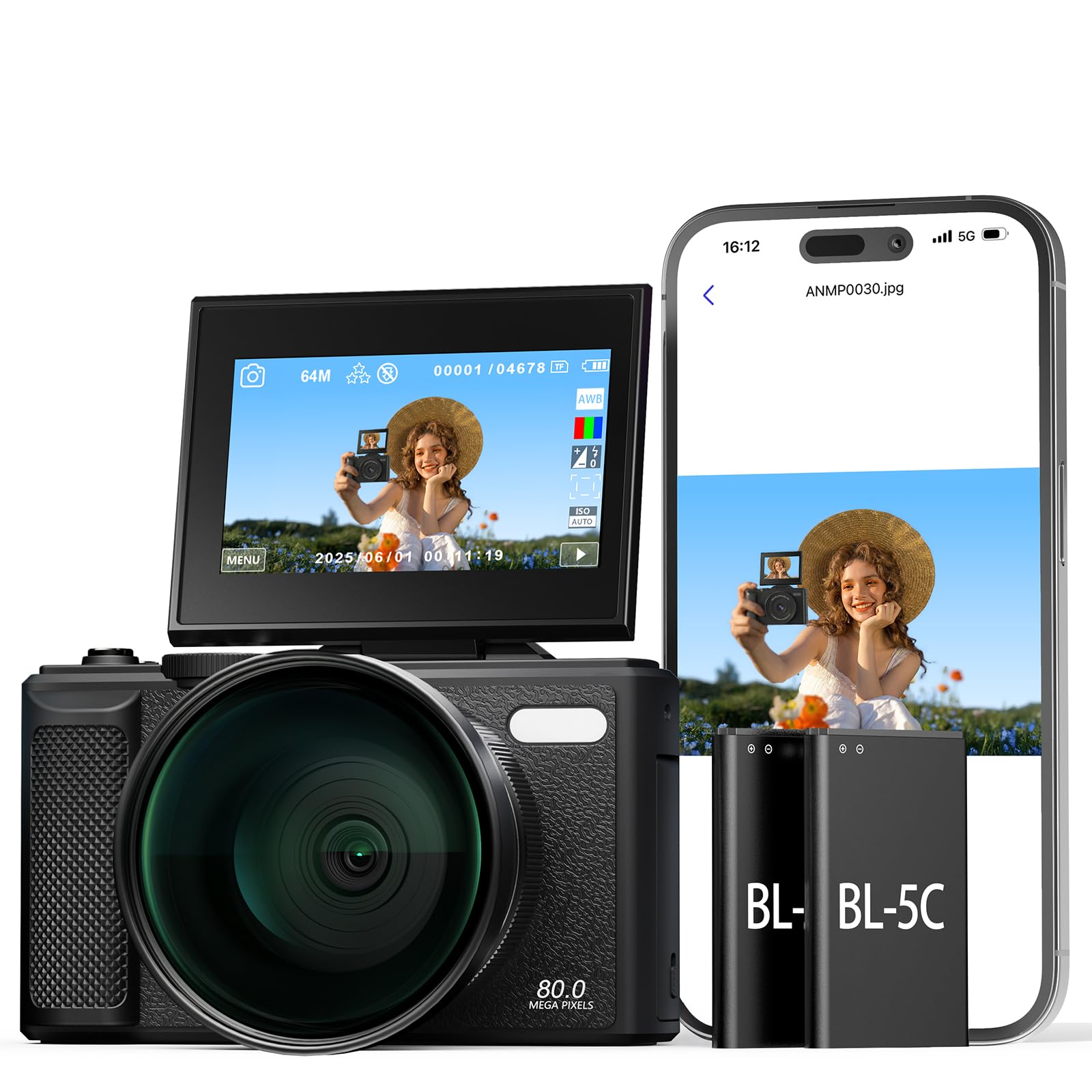
A 64GB card, two batteries, a charging stand, a microphone, a fill light, a lens hood and a screw-on macro lens: the Yatao YT01 turns up as a starter kit rather than a camera. At the budget end of this group that is the whole pitch, and it is a more honest one than the 64MP figure on the box.

The fill light is the piece we kept coming back to. Lean in close to a small subject and you are usually shading it with your own body, so a little continuous light clipped on top solves the problem without a flash rig or a diffuser. The macro attachment goes on the front of the fixed lens and shortens the distance it will focus from — not a macro lens, but it does get you nearer than the bare camera manages.

Battery life is the weak spot, and the second battery in the box is what turns a short outing into a workable afternoon. The 1/2.7-inch sensor and the fixed lens put a ceiling on the whole thing as well: this is a camera for finding out whether close-up composition appeals to you, not one to build a system around. Nothing here needs buying on day two, and that is the point of it.

Pros

  • Continuous fill light helps at close range
  • 64GB card, two batteries, and mic included
  • Screw-on macro lens gets you closer

Cons

  • Fixed lens with digital-only zoom
Our verdict

The YT01 is the kit we hand someone who wants to try close-ups before committing to a lens: everything needed to shoot is in the box.

Check Latest Price
4

Lowest-Cost Trial

Krunia W8 Digital Camera

85 /100
Keeper Score Excellent

Key details

Lenses
Wide-angle and macro included
Sensor
80MP 1/2.8-inch CMOS
Weight
8.96 oz
In The Box
64GB card and two batteries
Check Price on Amazon

Cheapest in this group and unapologetic about it, the Krunia W8 puts a wide-angle lens, a macro lens, a built-in flash, a 64GB card and two batteries in the box. At 254 grams it disappears into a jacket pocket, which is more than the DSLRs here can say.

For a curious beginner, this makes more sense to us than a phone attachment. The macro lens is a real piece of glass that goes on the front of the camera lens rather than a software mode, and the flash fires from the top of the body, above the lens, which is the right place for lighting something small. It is enough to learn framing and light from.

Control is the thing you give up. With a 1/2.8-inch sensor and a fixed lens, depth of field and background are decided for you, and the 80MP badge does not change how close the lens focuses — which is the number that actually matters in macro. As a first camera, or a low-risk way to find out whether close-ups hold your interest, it earns its spot.

Pros

  • Macro and wide-angle lenses included
  • Built-in flash for close-range light
  • 254 grams slips into a jacket pocket
  • 64GB card and two batteries in the box

Cons

  • Screw-on macro lens, not a true macro optic
  • Small 1/2.8-inch sensor limits low light
Our verdict

For the least money here, the W8 hands you a macro lens, a flash and a memory card — enough to find out whether close-up photography is for you.

Check Latest Price

How We Tested These Cameras Up Close

We started with a shortlist of roughly 30 cameras: DSLR kits with a telephoto or macro-capable lens in the bag, superzooms, and compact point-and-shoots that advertise a close-up mode. Anything that couldn't focus closer than about four inches got cut, as did anything priced beyond what a first-time buyer would reasonably spend. That left 10.

Each camera went home with a tester for the full eight months. We shot the same four subjects on repeat: dew-covered leaves at sunrise, coins and a printed ruler on the kitchen counter for a focus-distance check, live insects on garden plants, and small objects on a desk under a lamp. Because macro happens low to the ground, we noted how each screen articulated and whether the body balanced well enough to shoot one-handed while crouched.

Autofocus got the hardest workout. We let each camera pick its own point on a moving subject, usually a bee working a flower, and counted how many frames came back sharp versus locked on the background. Batteries were run flat in live view with Wi-Fi on, the way you'd actually use them, and we noted how long each session lasted before the warning icon appeared. Weight mattered more than expected on a two-hour walk with a camera around the neck.

Back at the desk we looked at files at 100 percent for smeared detail in the center and soft corners, and compared how much of the frame each camera filled with a thumbnail-sized subject. Zoom range we tested on its own, pulling back until the composition fell apart, since reach helps with skittish insects but doesn't substitute for getting close. Beginners on the team judged menus and auto modes, and anything that needed a manual read before the first good frame lost points on value.

How to Choose a Camera for Macro Photography

Start With the Lens, Not the Body

Magnification comes from the lens, so an interchangeable mount is the only route to true life-size framing. The Rebel T7 is the one camera here that offers it, and the consequence is a two-part purchase: body and kit zooms first, a dedicated macro lens when the budget allows.

Fixed-lens compacts take the other route, using a screw-on close-up lens or a close-up scene mode. That gets you substantially closer with no second purchase, and it sets a ceiling you cannot buy your way past.

Decide How Close You Need to Get

A whole flower is comfortable at a third of life size; a beetle's shell or the date on a coin wants 1:1. Working distance matters as much as magnification, because at high magnification the front element ends up inches from the subject — fine for a still life, hopeless for a bee.

That is the argument for reach over magnification. The P950's 2000mm equivalent lets you fill the frame from far enough back that your subject has not noticed you yet.

Sensor Size, Depth of Field, and Light

Small sensors make deep depth of field easy, which is why a budget compact can render a whole flower sharp with no effort. The trade is noise in dim light and a background that will not go soft.

An APS-C body does the opposite: a sharp subject against a clean wash, and a depth of field at 1:1 so thin that you will stop down to f/8 or beyond and then need more light to compensate. Whichever way you go, plan on adding light rather than finding it.

Focus, Support, and Lighting

Autofocus hunts at close range, switching between the subject and whatever sits behind it, so manual focus is the default for macro rather than a purist's choice. That makes a body you can focus by hand, mounted on a tripod, more useful than a fast autofocus system.

Light is the other half of the job. A diffused flash freezes a moving subject, while a small continuous light is easier to aim while you compose. The fill light bundled with the Yatao kit is the second kind.

Frequently Asked Questions

Final Verdict

The Canon EOS Rebel T7 is our pick for macro photography, because the EF mount is the only one here that accepts a real macro lens, and everything in the kit stays useful while you save for one. Start with the body and the zooms; add the glass when you know what you want to shoot.

If your subjects will not sit still, the Nikon COOLPIX P950's 83x zoom trades magnification for distance and earns its place. And if you are not yet sure macro will stick, the budget compacts are a cheap way to find out.