Best Cameras for Hiking of 2026

The camera in your phone takes better pictures than it has any right to — until you're on a scramble with both hands on rock, or the cold kills the battery somewhere above treeline. That's the gap a hiking camera fills: something you clip to a strap, shoot with gloves on, and trust when the weather turns.

My team and I spent the past eight months carrying 12 of these on day hikes and a few wet mornings nobody volunteered for. What separated them had less to do with resolution than you'd expect: stabilization matters more on a trail than another bump in megapixels, since a 4K clip shot while you're breathing hard is worthless if it looks like an earthquake. Mounting hardware was the quiet decider too — the best camera in the world is dead weight if the clip wobbles on your shoulder strap.

We also watched the unglamorous things: whether a battery survived a cold start, whether files transferred over Wi-Fi back at the car, whether a camera shrugged off a knock against granite. The ones below earned a permanent spot in the pack.

Keeper Score summarizes customer ratings and review volume. Read it alongside the product details and trade-offs. How the score works.

1

Best Overall

DJI Osmo Action 4

94 /100
Keeper Score Outstanding

Key details

Sensor
1/1.3-inch CMOS
Weight
5.11 oz
Battery Life
160 minutes
Water Resistance
Waterproof
Check Price on Amazon

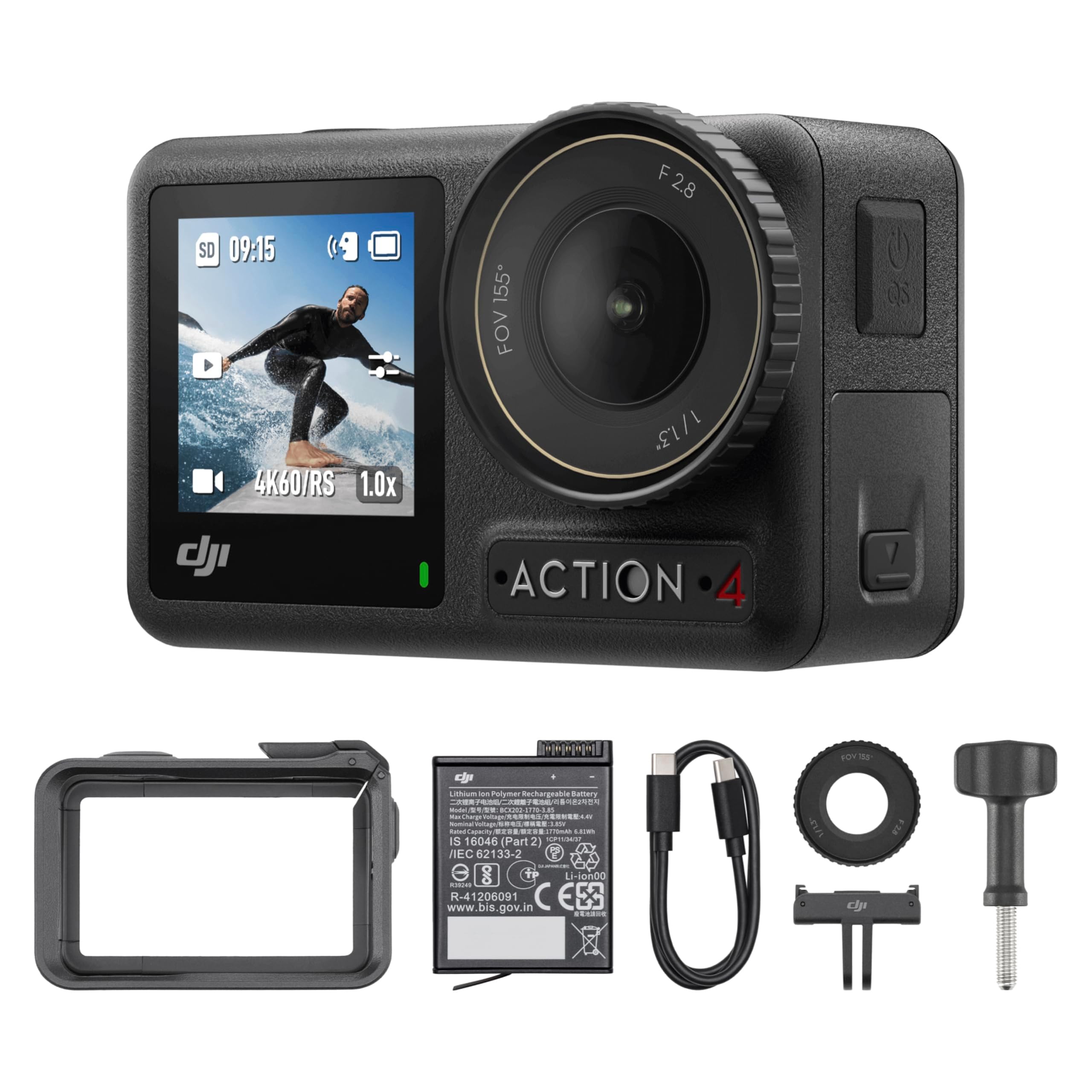
A 1/1.3-inch sensor is a serious thing to find in a camera this small, and it's the reason the Osmo Action 4 leads this list. Under tree cover, and in the hour after the sun drops behind a ridge, the bigger sensor holds color and detail where the small-sensor cameras here start to smear. You get 4K at up to 120fps with a 155-degree field of view, plus a 10-bit D-Log M profile for anyone who grades footage — if you don't, shoot the standard profile and ignore it.

At 145 grams it's heavier than the thumb cameras, and it's still the one we reach for. The magnetic quick-release mount moves it from a pack strap to a helmet in seconds, which matters when the trail turns from walking into scrambling, and the battery is rated for 160 minutes and for operation down to -20°C, so a cold start above treeline doesn't end the day's footage. RockSteady and HorizonBalancing kept our walking clips steady enough that we stopped packing a gimbal for trail video.

It's waterproof as sold, so there's no housing to forget in the tent. The Essential Combo ships with a single battery, and a second one is the first thing to budget for on a long day. App pairing is the fussiest part of ownership — it works, but often needs a second attempt on some phones. Neither changes the recommendation: this is the camera for someone who wants one device for stills, video, rain and cold.

Pros

  • Large sensor holds detail in shade and at dusk
  • Battery rated 160 minutes and down to -20°C
  • Waterproof with no housing to remember

Cons

  • App pairing is fussy on some phones
Our verdict

For most hikers this is the camera to buy: big-sensor footage in shade, a battery that shrugs off a cold morning, and waterproofing without a housing. We haven't found a better all-round trail companion in this group.
Check Latest Price
2

Best Value

AKASO Brave 7 LE

89 /100
Keeper Score Excellent

Key details

Weight
3.77 oz
Screens
Dual color screens
Battery Life
2 hours
Water Resistance
IPX7 body
Check Price on Amazon

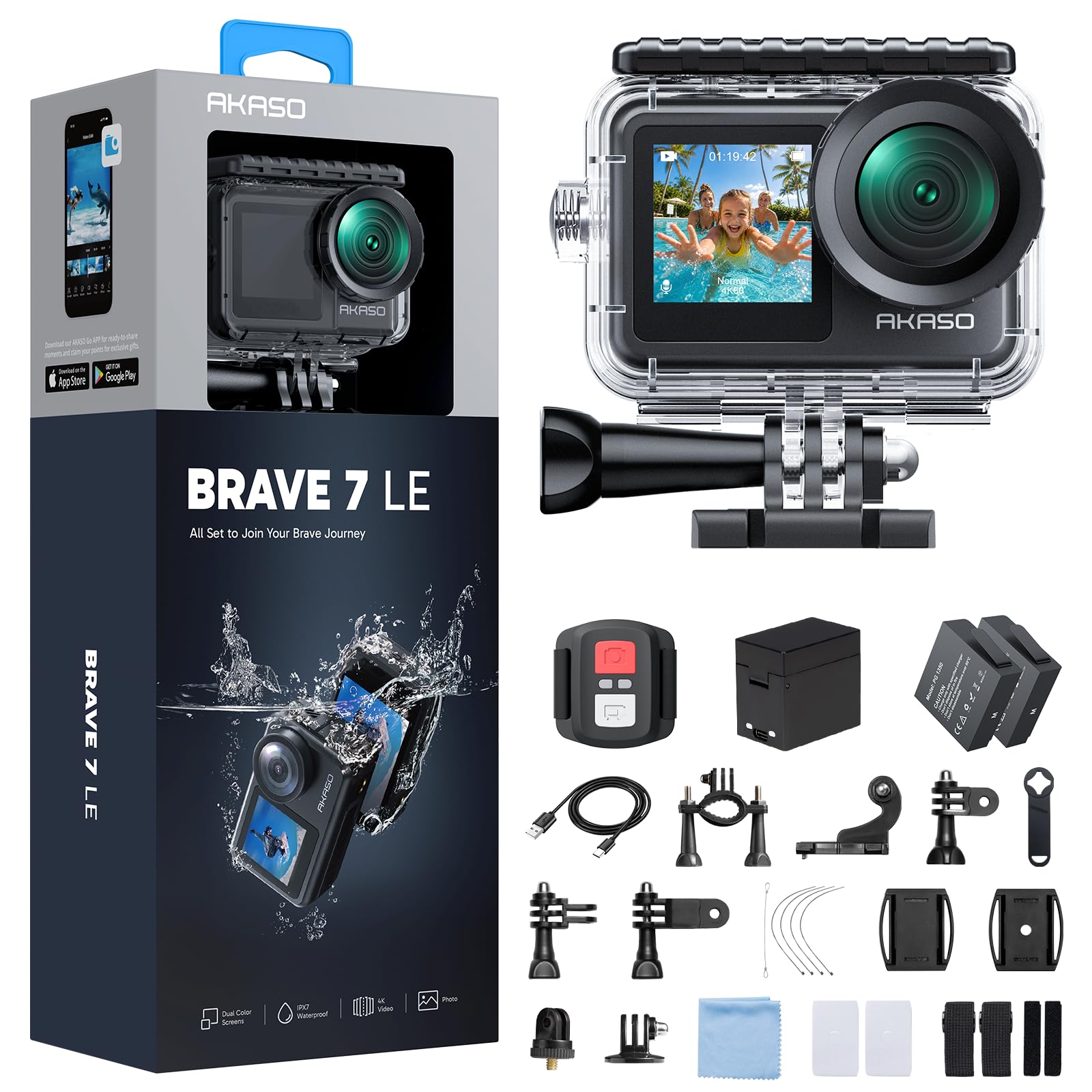
If you hike in wet weather and the budget is tight, this is the pick. The Brave 7 LE's body is IPX7 water-resistant on its own, so drizzle, waterfall spray and a splash at a stream crossing don't require the housing, and the housing is still in the box for anything that goes underwater. We like that more than any other feature: the moment you have to stop and wrestle a camera into a case is the moment you stop filming.

It weighs 107 grams and carries a color screen on the front as well as the back. That reads like a vlogging feature and turns out to be a hiking one — prop it on a rock to film yourself, or glance at the front screen to confirm it's still recording when it's mounted facing away from you. The kit is unusually complete: two batteries, a dual charger, a wrist remote, and enough mounts for a pack strap or a helmet.

Where it gives ground is when the light goes. The 6-axis EIS 2.0 smooths out footfall on graded trail, but electronic stabilization crops into the frame, and footage under deep canopy is softer than what the Osmo Action 4 produces. At 4K30 and 20MP stills it's far more camera than the price suggests, and the menus stay simple enough to work one-handed with a trekking pole in the other.

Pros

  • IPX7 body handles rain without a case
  • Two batteries and a dual charger included
  • Front screen confirms recording at a glance

Cons

  • Housing still required for anything underwater
Our verdict

Our value pick: a sealed body that shrugs off rain, two batteries in the box, and 4K footage that holds up on the trail.

Check Latest Price
3

Best Hands-Free POV

Sixmou i3 Thumb Camera

84 /100
Keeper Score Excellent

Key details

Weight
1.26 oz
Battery Life
150 minutes
Included Card
64 GB
Waterproof Depth
131 ft with case
Check Price on Amazon

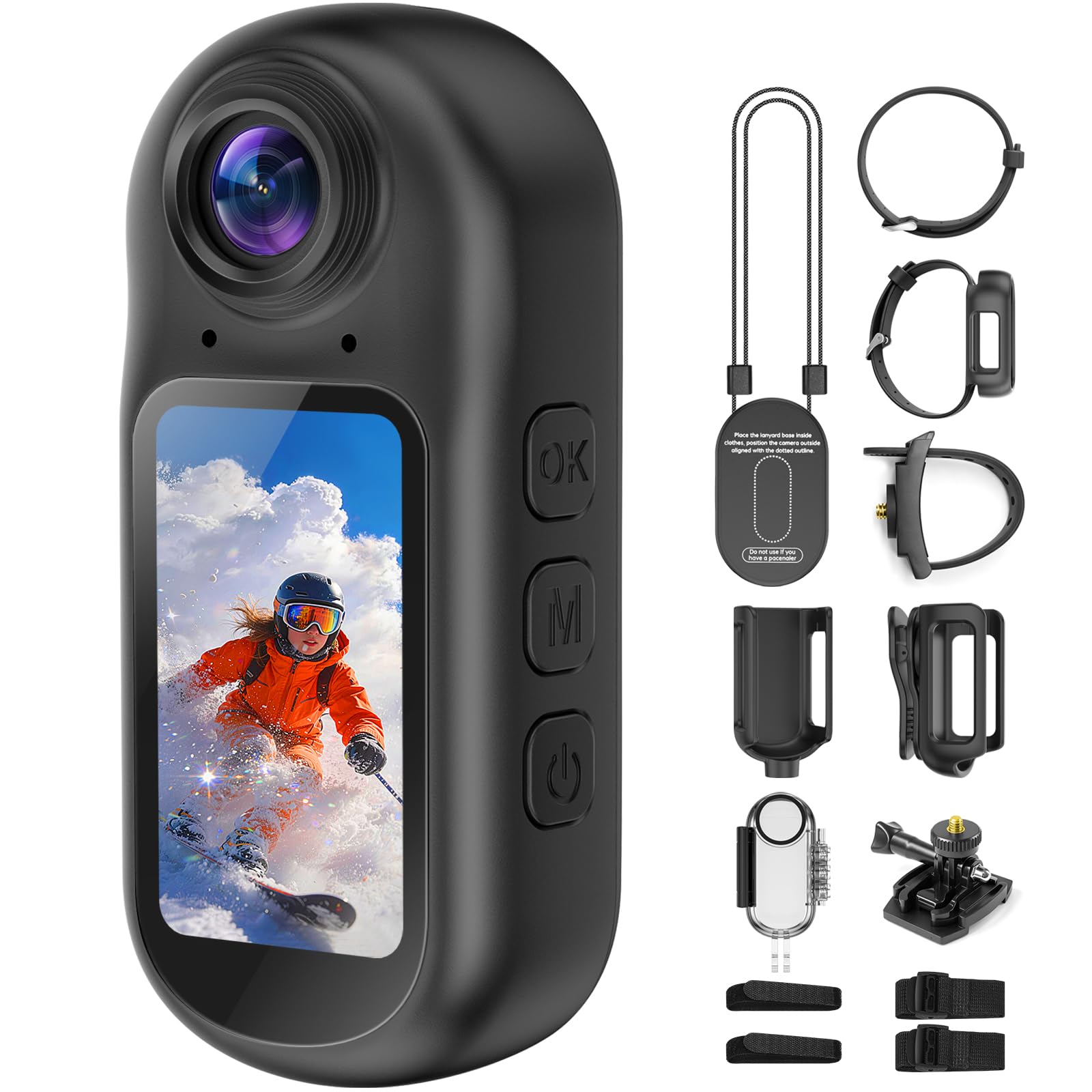
35.7 grams is the whole pitch, and it's a better pitch than it sounds. The Sixmou i3 is smaller than a thumb and ships with a magnet pendant, a spring clip and a 64GB card, so it goes onto a pack strap or a jacket placket and then stops being something you think about.

The rest of the spec sheet is respectable for the size: 4K recording, a 150-degree view, 150 minutes from an 800mAh battery, and a case rated to 131 feet if you want it underwater. Stills come out at 12MP, well short of the 20MP the AKASO cameras claim, so treat video as its job.

This is the camera for a record of the walk rather than a portfolio. Clipped to a shoulder strap it catches the trail, the weather and the conversation without you breaking stride, and because it weighs almost nothing you actually bring it. Footage is good in good light and falls apart at dusk, and the digital stabilization is working with a very light body — pan slowly and it holds up. Think of it as a second camera rather than your only one: it's the POV angle, not the hero shot.

Pros

  • 35.7 grams, unnoticeable on a strap
  • 150 minutes of recording per charge
  • 64GB card and mounts included

Cons

  • Stills are limited to 12MP
  • Digital stabilization only
Our verdict

Clipped to a shoulder strap it disappears, and that's the point: hands-free trail footage from a camera you never leave behind.

Check Latest Price
4

Best Budget Starter

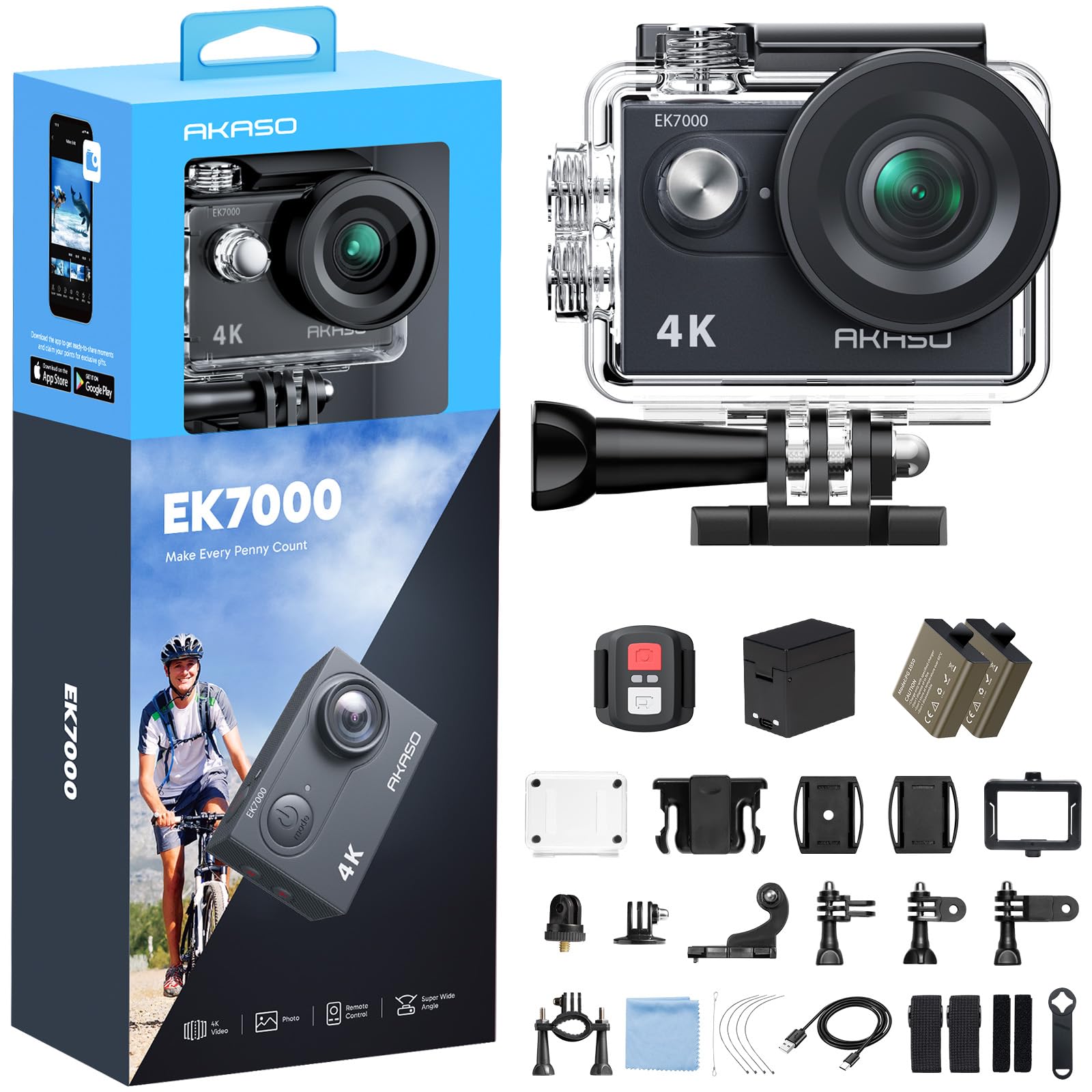
AKASO EK7000

89 /100
Keeper Score Excellent

Key details

Video
4K at 30fps
Weight
2 oz
Battery Life
90 minutes
Waterproof Depth
131 ft with case
Check Price on Amazon

The EK7000 is the least expensive camera here, and it's still the one we suggest to anyone who isn't sure an action camera will earn its place in the pack. For the money you get 4K30 video, 20MP stills, a 2.4G wrist remote, two batteries, a dual charger, a waterproof case rated to 131 feet, and a box of mounts. The mount kit is the real value — assembling the same set of brackets and straps separately is usually the expensive part of getting started.

At 2 ounces it's the lightest full-size action camera in this group, and the wrist remote earns its place on a hike: you can start recording with the camera on a pole or a helmet without reaching for the shutter. The 170-degree lens gives the classic fisheye look, which is great for a whole ridge line and less great for anything close, since it pushes everything away from the camera.

The compromises are predictable. Detail falls apart in low light, and the stabilization is built for gentle movement rather than a running descent. As a first camera, or a second one you won't mind scratching on granite, it's hard to argue with.

Pros

  • Complete kit: case, remote, mounts, two batteries
  • Only 2 ounces in the hand
  • 4K30 and 20MP for the least money here

Cons

  • Battery life falls short of a full day
Our verdict

Our budget pick: a complete starter kit — case, remote, two batteries, mounts — that records 4K and won't ruin a trip if it gets scratched.

Check Latest Price
5

Dry-Day Vlogging

DJI Osmo Pocket 3

89 /100
Keeper Score Excellent

Key details

Sensor
1-inch CMOS
Weight
6.31 oz
Stabilization
3-axis gimbal
Water Resistance
Not water resistant
Check Price on Amazon

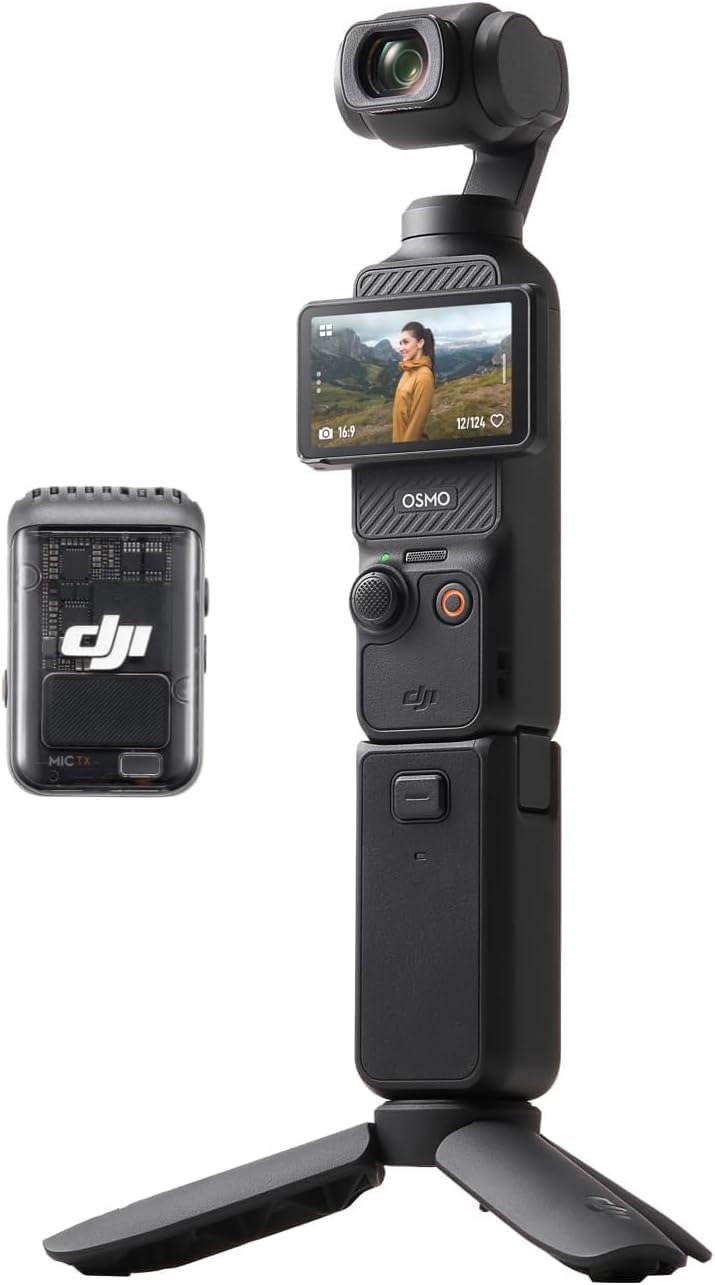
The Pocket 3 isn't water resistant, has no dust sealing, and costs more than anything else in this roundup. That's the caveat and it belongs first, because on a dry hike it's the most enjoyable camera here to shoot with.

The reason is mechanical. A 3-axis gimbal holds the 1-inch sensor steady in a way electronic stabilization can't, because it doesn't crop the frame or correct the motion afterwards. Walking footage comes out smooth without the slightly soupy look EIS leaves behind, and the 2-inch screen rotates for vertical shooting. The Creator Combo bundles the DJI Mic 2 transmitter, a battery handle, a mini tripod and a wide-angle lens — a vlogging kit in one box rather than a camera with add-ons.

It stops being the right answer anywhere the weather turns. Rain, dust, a river crossing, a scramble where the camera swings into rock — none of that suits a gimbal head and an unsealed body, and the gimbal is the part that fails when it happens. At 5.5 inches tall it also wants a jacket pocket rather than a hip pocket. Keep it for dry ridge walks, camp footage and the drive to the trailhead, and take an action camera when there's rain in the forecast.

Pros

  • Gimbal smooths walking footage without cropping
  • 1-inch sensor for dusk and camp light
  • Creator Combo includes a wireless mic kit

Cons

  • No water or dust resistance
Our verdict

For dry-day vlogging and camp footage, nothing here is steadier or easier to shoot with — just don't take it anywhere wet.

Check Latest Price
6

Zoom and Stills

Kodak PIXPRO WPZ2

85 /100
Keeper Score Excellent

Key details

Sensor
16MP BSI CMOS
Weight
6.21 oz
Optical Zoom
4x
Waterproof Depth
49 ft (15 m)
Check Price on Amazon

The WPZ2 is the only camera here with an optical zoom — 4x, working out to 27-108mm in full-frame terms — and that single fact is why it earns a place. A distant ridge, a bird on a rock, a friend halfway up a switchback: on a trail, reach is worth more than another frame rate.

It's also a proper camera rather than an action cam, with a shutter button, a 16MP BSI CMOS sensor, a 2.7-inch LCD and a built-in flash, waterproof to 49 feet without a housing and shockproof from 2 meters. It weighs 6.21 ounces, and the yellow body is genuinely easy to find at the bottom of a pack.

Video is where it makes concessions: 1080p only, no 4K, and digital stabilization rather than anything cleverer. If your hiking footage is clips for family and social, that's enough. If you're chasing cinematic trail video, it isn't, and the Osmo Action 4 is the better tool.

Our take is that the WPZ2 earns its spot for stills-first hikers who want reach and don't want to baby a camera. The seal is the whole ballgame — check the rubber gasket for grit, close and lock the battery door deliberately, and never open it wet or on a sandy bank. Treated that way it's the most camera-like of the waterproof options here.

Pros

  • 4x optical zoom no action camera here offers
  • Waterproof to 49 feet with no housing
  • Shockproof from 2 meters

Cons

  • 1080p video only
  • LCD washes out in bright sun
Our verdict

The pick for stills-first hikers: a real zoom, 49-foot waterproofing without a housing, and a body that fits a hip pocket.

Check Latest Price
7

Clip-On Recording

acgiewo AG700 Mini Camera

87 /100
Keeper Score Excellent

Key details

Video
4K at 30fps
Screen
1.47 inches
Weight
1.23 oz
Battery Life
150 minutes
Check Price on Amazon

We clipped this to a jacket and forgot about it for a long stretch of a ridge walk, which is the highest compliment you can pay a hiking camera. At 35 grams with a magnetic clip and a pendant, it rides on clothing or a strap without bouncing, and unlike most cameras this small it has a 1.47-inch screen, so you can see what you're framing.

The rest is stronger than the size suggests: 4K at 30fps, EIS 3.0 six-axis stabilization, 2.4G Wi-Fi and Bluetooth for pairing with a phone, and 150 minutes of recording from the battery. Daylight footage is clear, and the stabilization visibly cuts the bounce you get from walking.

The honest framing is this: it's a small brand with a short record, and the camera's own listing makes no water-resistance claim, so treat it as a dry-weather tool unless a rating shows up. What it does well — a screen you can frame with, a clip that holds, a weight you forget — nothing else here combines in one package. For hands-free clips on a sunny day, it's the least fussy option in this group.

Pros

  • 35 grams, clips on and stays put
  • 1.47-inch screen for framing
  • 150 minutes of recording

Cons

  • Not rated for rain or splashes
  • Stills are 12MP
Our verdict

A 35-gram clip-on with a real screen: the easiest way here to record hands-free trail clips, as long as the forecast is dry.

Check Latest Price

How We Tested Hiking Cameras

We built the shortlist by pulling in every action camera, clip-on POV camera, and rugged point-and-shoot that weighed about a pound or less and claimed at least splash resistance, then cutting anything that needed a mount we couldn't strap to a pack or a bike. Twelve of them came with us over eight months.

Each camera rode on a shoulder strap, a hip belt, or a handlebar for at least four hikes, including one long climb where we shot handheld while breathing hard to see how the stabilization coped. We recorded with gloves on, in drizzle, in cold morning air, and at least once in a stream, where we left each waterproof model submerged for ten minutes and then checked the card slot and battery door for moisture. Two got dropped from waist height onto rock — not on purpose, but we counted it.

Battery life was logged, not guessed: percentage at the trailhead, percentage at the summit, and how fast a cold morning drained it. Back at the car we timed how long a two-minute 4K clip took to move to a phone over Wi-Fi, and how many tries it took for the app to find the camera at all. We handed each one to someone who'd never touched it and counted the seconds until they were recording — ease of use out here is mostly about how few menus stand between you and the shutter. Stills were compared side by side on a laptop in shade and midday glare, and accessories got sorted into what we'd actually carry versus what stayed in the box. Value came last: what you get for the money against what you'd end up leaving at home.

How to Choose a Hiking Camera

Action camera, zoom compact, or gimbal

Start with how you shoot rather than with specifications. If most of your footage happens while you're moving — walking, scrambling, skiing down — an action camera is the right shape: small, mountable, one button. If you stop, compose and pull a distant ridge closer, a compact like the Kodak WPZ2 gives you reach that no action camera here has.

A gimbal camera such as the Osmo Pocket 3 is a third thing entirely, built for smooth handheld video on dry days. Most hikers who want a bit of everything end up carrying an action camera and using a phone for the occasional still.

A sealed body or a case you have to fit

This is the choice that decides how much you actually film. A camera that is water-resistant on its own — the AKASO Brave 7 LE is the clearest example here — stays out in drizzle and comes back out of the pack without ceremony. A camera that only goes underwater inside a housing, like the EK7000, means the case comes out for rain too, with plastic between you and the buttons and a muffled microphone.

Buy the sealed body if you hike somewhere wet. Tolerate the housing if your trips are dry and the water is optional — but check the gasket every time you seal it, because a grain of sand is all it takes.

Weight, and where the camera rides

Thirty-five grams on a shoulder strap is nothing. A 145-gram camera swinging from a chest mount for six hours is something you notice. Weight is only half of it, though; mounting is what decides whether you film at all. A thumb camera on a magnet or clip catches the things you never stop for, while a heavier camera that lives in the lid pocket gets used at viewpoints.

Decide where it will ride before you decide which one to buy, and check the mount is in the box. The AKASO kits spread a wide set of mounts; the mini cameras include clips and magnets instead.

Battery claims and cold mornings

Every battery figure here is a best case measured in mild conditions, and cold is what erodes them: a battery that runs all afternoon in July can fade fast on a frosty start. Carry spares, keep them inside a jacket rather than an outside pocket, and swap before a battery dies rather than after.

Two batteries in the box, as with the Brave 7 LE and the EK7000, are worth more on a hike than a bigger single-battery rating. On a multi-day trip, a power bank and a cable cover the gap between charges.

Stabilization and low light

Electronic stabilization works by cropping and shifting the frame, which smooths footfall but costs field of view and can leave footage slightly soft. A mechanical gimbal, like the Pocket 3's, stabilizes without the crop but adds a mechanism that does not enjoy being knocked.

Low light matters more than either on a wooded trail. A bigger sensor holds color and detail where small ones smear, and the Osmo Action 4's 1/1.3-inch chip is the largest here. If you film at dawn, at dusk or under canopy, pay for the sensor.

Frequently Asked Questions

Final Verdict

The DJI Osmo Action 4 is the camera we point most hikers toward: the largest sensor in this group for shaded trails, a battery rated for cold mornings, and waterproofing that doesn't depend on a housing left in the tent.

If the budget is tighter or the forecast is grim, the AKASO Brave 7 LE covers rain and ships with two batteries. Take the Osmo Pocket 3 instead only when the hikes are dry and the footage is the whole point.