Best Camera Sensor Cleaning Kits of 2026

A grey smudge in the corner of a perfectly good sky is how most of us find out the sensor is dirty. The fix is a swab and a couple of drops of solution, but the first time you lower a stick toward an exposed sensor it feels more like surgery than maintenance. A good kit buys you nerve: swabs that won't shed, solution that dries without a film, and enough of both that you aren't rationing.

I've cleaned sensors on a kitchen table, in a rental car, and once in a hotel bathroom with the shower running to settle the dust. Over four months, my team and I ran 14 kits through that routine — from a sleeve of swabs and a bottle to hard cases full of blowers, brushes, and pens. Mostly, the differences came down to fewer things than the packaging suggests.

Width matters most: 24mm for full frame, 16mm for APS-C, 12mm for Micro Four Thirds. The wrong size drags solution past the edge of the sensor or leaves the corners dirty, and either way you're going back in. The kits below are the ones that made the whole job feel routine.

Keeper Score summarizes customer ratings and review volume. Read it alongside the product details and trade-offs. How the score works.

1

Best Overall

UES 21-in-1 Full Frame Kit

94 /100
Keeper Score Outstanding

Key details

Case
Waterproof travel case
Swab Width
24mm full frame
Cleaner Volume
30 ml
Swabs Included
10
Check Price on Amazon

Ten 24 mm swabs and a 30 ml bottle is more swab supply than any other kit here that also includes a full set of tools, and that is the reason this box is our default. A wet clean normally takes two swabs, one pass in each direction, and a sensor with oil on it can take three or four, so most kits are really two-clean kits. This one gets a full-frame body through four or five sessions before you need to restock, and nothing in the case is filler: an air blower for loose grit, a lens pen for fingerprints on the front element, five microfiber cloths, a 50-sheet tissue book and a separate screen cloth.

The order of work is what decides whether a sensor clean goes right, and this kit supports the boring version: blower first to lift loose dust, then a swab dampened with a drop or two, swept once in each direction, then a check shot. The solution is alcohol- and ammonia-free, which is what you want on coated cover glass and on the multicoated front elements you will clean with the same bottle. We kept to a couple of drops per swab and got a clean pass with no smear, which is the whole trick.

If your body is APS-C, order a 16 mm kit instead — a 24 mm swab is wider than the frame, so the edges of the pass run past the sensor onto the chamber walls. The UES APS-C kit and the Altura box both solve that. Otherwise, the detail we ended up appreciating most is the case: it is waterproof, which matters when a bottle of fluid rides in a bag next to a body.

Pros

  • Ten full-frame swabs, the deepest supply here
  • 30 ml of alcohol-free, ammonia-free fluid
  • Blower, lens pen, cloths and tissues included
  • Waterproof case keeps the bottle contained

Cons

  • One bottle has to serve lenses and sensor
Our verdict

The kit we reach for first: ten 24 mm swabs, 30 ml of alcohol-free fluid and every supporting tool, so one order covers a full-frame clean from blower to final check.

Check Latest Price
2

Best for APS-C

Altura Photo APS-C Kit

94 /100
Keeper Score Outstanding

Key details

Case
Hard-shell zippered case
Swab Width
16mm APS-C
Cleaner Volume
60 ml
Swabs Included
6
Check Price on Amazon

Sixteen millimetres is the number to check here, because that is the width cut for the 23.6 x 15.6 mm APS-C frame. A pass forward and a pass back covers the sensor without wandering onto the chamber walls, which is the difference between cleaning a sensor and redistributing dust around it. In the box you get six individually wrapped, vacuum-sealed swabs, a 60 ml bottle of plant-based cleaner with no alcohol or ammonia, a lens pen, a blower, a brush, a microfiber cloth and a zippered hard-shell case.

What we noticed in use is how little the kit asks of you. The case holds the swabs flat and sealed instead of letting them rattle loose in a drawer, and the bottle is generous in a way that changes how you behave with it — you use enough to wet the swab properly instead of trying to make it last, which is where most streaks come from. The fluid also lifts a smudge off a coated front element without the haze some alcohol cleaners leave behind, so the same box handles the lens you were about to clean anyway.

Where the money goes is the case and the bottle rather than the swab count. That is the trade against the UES kits: fewer swabs in the box, more fluid and a sturdier shell around it. Plan a swab refill before you plan a fluid one, and this is a kit you will still be using when the second bottle would have been the third.

Pros

  • 16 mm swabs cut for APS-C sensors
  • 60 ml of alcohol- and ammonia-free fluid
  • Hard-shell case keeps swabs flat and sealed

Cons

  • 16 mm swabs fit APS-C bodies only
Our verdict

For an APS-C body this is the box to beat: 16 mm swabs that fit the frame properly, a 60 ml bottle that outlasts them, and the best case in this guide.

Check Latest Price
3

Best for Lenses and Sensors

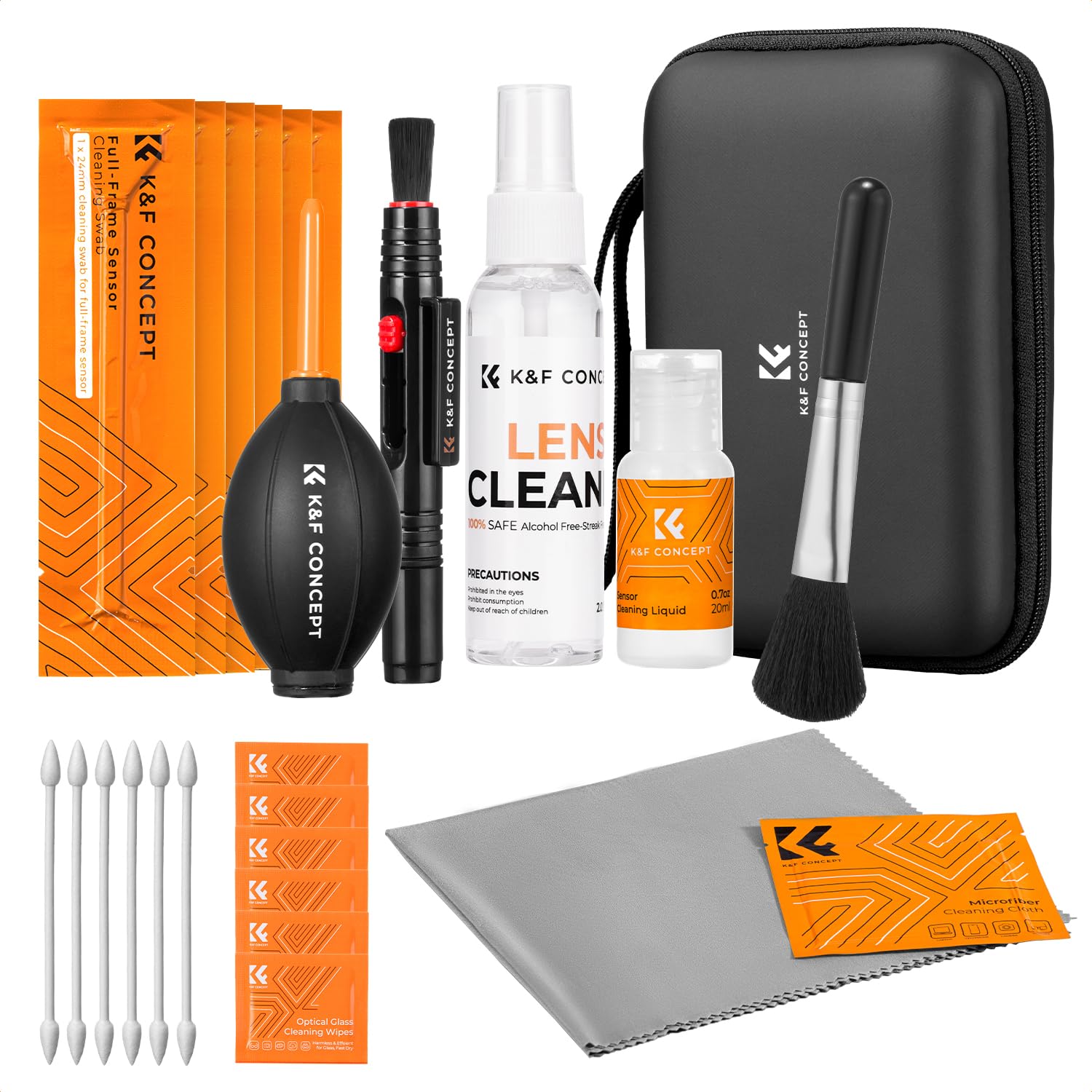
K&F Concept 25-in-1 Kit

92 /100
Keeper Score Outstanding

Key details

Case
Hard case
Cleaners
60 ml lens, 20 ml sensor
Swab Width
24mm full frame
Swabs Included
6
Check Price on Amazon

Two bottles is the difference: 60 ml of lens cleaner and a separate 20 ml sensor solution, both ammonia-free and low in VOCs. Most kits here give you one bottle and leave you to decide what to put it on, which is fine until you are cleaning a front element with fluid you bought for the sensor. The rest of the case is complete — six 24 mm swabs sealed individually in vacuum packaging, cotton swabs, a large and a small microfiber cloth, an air blower, a lens pen and a hard case with a two-year warranty behind it.

The swabs are the part we cared about most. Each one comes out of its own vacuum pack flat and lint-free, the flexible grip lets the head follow the sensor without much pressure, and 24 mm covers a full-frame sensor in a single sweep. Individually sealed swabs are worth paying a little more for: a swab that has been loose in a bag has picked up exactly the grit you are trying to lift off the glass.

Where this box beats the UES 21-in-1 is balance — you get proper lens cleaner as well as sensor fluid, and the two jobs stop competing for one bottle. If you clean a sensor twice a year and your lenses every week, that is the right way round, and the 60 ml bottle will be the one you notice running low first.

Pros

  • Separate 60 ml lens and 20 ml sensor cleaners
  • Swabs individually vacuum-sealed
  • Hard case and two-year warranty

Cons

  • Only six swabs for a two-bottle kit
Our verdict

For photographers who clean lenses as often as sensors, the split bottles and six sealed 24 mm swabs make this the better-balanced full-frame box here.

Check Latest Price
4

Best Travel Kit

VSGO DKL-20F Kit

91 /100
Keeper Score Outstanding

Key details

Case
Compact carrying case
Cleaners
15 ml sensor, 30 ml lens
Swab Width
24mm full frame
Swabs Included
6
Check Price on Amazon

Everything in this case is scaled for a bag rather than a desk. The blower is a mini version designed for lenses, hot shoes and zoom rings, so it clears grit out of the places a full-size rocket blower is too fat to reach; the pen carries an activated carbon pad on one end for fingerprints and a brush on the other; and the whole set zips into a case small enough to live in a side pocket. That is why it is the kit we pack. You still get six 24 mm vacuum-sealed swabs, a 15 ml sensor cleaner and a separate 30 ml lens cleaner, so the cleaning job itself is not compromised for the size.

What we used most was the pen. Carbon on one end handles a thumbprint on the front element, the brush handles dust around the mount, and neither requires you to open the fluid. This is a bag kit rather than a shelf kit: the point is that a spot on the sensor does not end a shoot, and the sealed swabs mean the tool you need is still clean when you finally open it.

Pros

  • Compact case sized for a camera bag
  • Separate 15 ml sensor and 30 ml lens cleaners
  • Mini blower reaches hot shoes and zoom rings
  • Dual-tip pen with carbon pad and brush

Cons

  • Six swabs and 15 ml cover about two cleanings
Our verdict

The kit that lives in the camera bag: a compact case, a mini blower for hot shoes and zoom rings, and 24 mm swabs with dedicated sensor fluid for when a spot appears on the road.

Check Latest Price
5

Best Budget APS-C Kit

UES APS-C Sensor Kit

94 /100
Keeper Score Outstanding

Key details

Formula
Alcohol-free
Swab Width
16mm APS-C
Cleaner Volume
15 ml
Swabs Included
14
Check Price on Amazon

Fourteen swabs for an APS-C sensor is serious supply — seven cleanings if you use two per pass, which is more than most people will do in a couple of years. The kit is deliberately small: fourteen 16 mm swabs, each made in a cleanroom and individually vacuum-sealed, and a 15 ml bottle of alcohol-free, ammonia-free fluid. That is the entire box.

For a body that already has a blower and a cloth in the bag, we think that is exactly the right shape. The 16 mm head fits an APS-C frame cleanly, the fluid dries without leaving a smear, and the sealed wrapper means you are not wiping a swab across your sensor after it has been sitting open in a drawer for a year. If you are starting from nothing, spend the extra on the Altura or ParaPace boxes, which add the supporting tools. If you are restocking, this is the best value for APS-C swabs and fluid on their own.

Pros

  • Fourteen 16 mm APS-C swabs
  • Alcohol-free, ammonia-free solution
  • Each swab individually vacuum-sealed

Cons

  • No blower, pen or case in the box
Our verdict

The straightforward APS-C restock: fourteen 16 mm vacuum-sealed swabs and 15 ml of alcohol-free fluid, with none of the tools you already own.

Check Latest Price
6

First-Time Buyers

ParaPace 28-Piece Kit

93 /100
Keeper Score Outstanding

Key details

Case
Water-resistant hard case
Swab Width
16mm APS-C
Cleaner Volume
20 ml
Swabs Included
5
Check Price on Amazon

If you have never cleaned a sensor and you own no cleaning gear at all, this is the box that gets you started: a water-resistant, shockproof hard case holding an air blower, a dual-sided carbon pen, brushes, cloths, five vacuum-sealed 16 mm APS-C swabs and a 20 ml bottle of alcohol-free, ammonia-free fluid.

The swabs are the part that matters, and 16 mm is the width an APS-C sensor wants. The case is the reason the kit is worth more than its parts: everything stays together, the swabs stay flat, and you can throw it in a pack without a bottle of fluid emptying itself into your bag. The blower is a basic one and so are the brushes, and at this end of the market that is expected.

The honest framing of a kit at this price is that nothing here will hurt a sensor if you use one swab once and do not flood it, and nothing here feels like the Altura box either. What we appreciated is that the tools are useful rather than filler — the pen and the blower both earn their place in the case instead of padding out a piece count. Buy it as a first kit or as a spare that lives in a bag; the shell alone is worth having.

Pros

  • Hard, water-resistant case holds everything
  • Five vacuum-sealed 16 mm APS-C swabs
  • Blower, carbon pen, brushes and cloths included

Cons

  • Only five swabs in the box
Our verdict

The cheapest complete kit here: a hard case, a blower, a carbon pen and five sealed 16 mm swabs for an APS-C body — basic tools that still do the job.

Check Latest Price
7

Micro Four Thirds

K&F Concept M4/3 Kit

91 /100
Keeper Score Outstanding

Key details

Packaging
Vacuum-sealed swabs
Swab Width
12mm Micro Four Thirds
Cleaner Volume
20 ml
Swabs Included
10
Check Price on Amazon

Micro Four Thirds is the format most kits ignore, and a 16 mm swab on a 12 mm sensor is a bad trade — you push fluid and dust across the chamber walls along with the glass. K&F cuts these to 12 mm for Olympus and Panasonic bodies, seals each of the ten swabs in vacuum packaging, and pairs them with a 20 ml bottle of mild, ammonia-free liquid and a flexible grip rod that lets the head follow the sensor without much pressure.

Ten swabs is the number that matters. A two-pass clean uses two, and a sensor that has been sitting dirty can take three or four, so the ten-pack means you finish the job with the swabs already in the box rather than ordering more halfway through and leaving the camera open while you wait.

Finishing is where this kit needs a light hand. One drop on the swab and an easy pass leaves the cover glass clear; too much fluid shows a faint haze that takes a second swab to lift, so keep the first pass dry enough and hold a spare in reserve. The rod is comfortable over a full sweep, the metal-free head will not mark the surround, and there is a two-year warranty behind it.

For an Olympus or Panasonic body we think the sizing settles the argument: nothing else in this guide fits a 12 mm sensor, and improvising with a wider swab is how people end up paying someone else to finish the job. Keep the passes light, use one swab each way, and this does what it is cut for.

Pros

  • 12 mm swabs cut for Micro Four Thirds
  • Ten individually vacuum-sealed swabs
  • Mild ammonia-free 20 ml fluid

Cons

  • 12 mm swabs fit Micro Four Thirds only
Our verdict

The only correctly sized option for Micro Four Thirds: ten vacuum-sealed 12 mm swabs and 20 ml of mild fluid for Olympus and Panasonic bodies.

Check Latest Price
8

Full-Frame Restocking

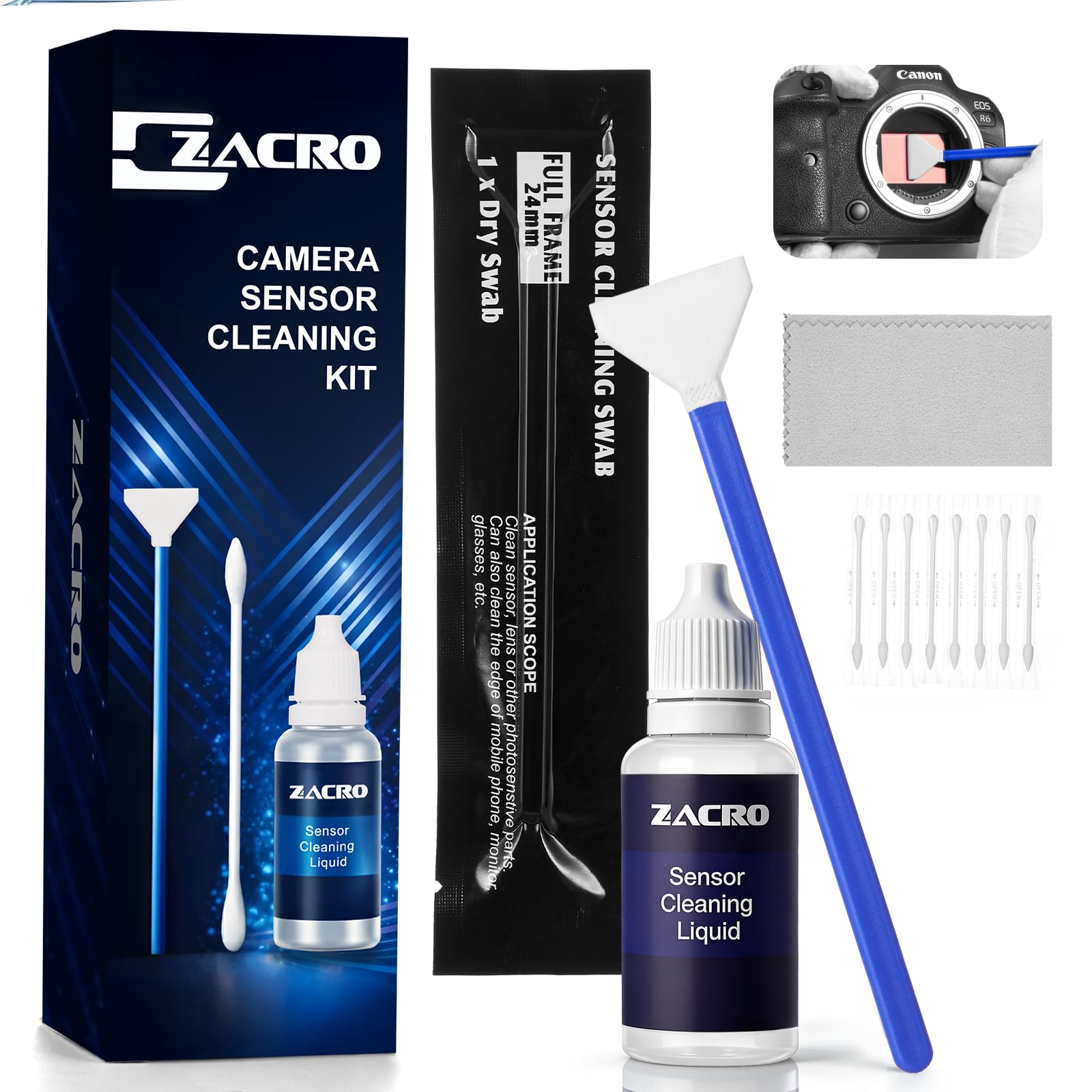
Zacro 24mm Swab Kit

89 /100
Keeper Score Excellent

Key details

Extras
8 cotton swabs, cloth
Swab Width
24mm full frame
Cleaner Volume
20 ml
Swabs Included
8
Check Price on Amazon

Eight 24 mm swabs, a 20 ml bottle of ammonia-free fluid, eight cotton swabs and a cloth. That is the entire contents list, and for a certain kind of buyer it is the sensible one. It is also the cheapest way in this guide to put full-frame swabs and sensor fluid in a drawer.

The buyer is someone who already keeps a blower and a microfiber cloth in the camera bag and just needs the part that runs out. The swabs are flat microfiber pads rather than brushes, which is what you want against a sensor: a pad wipes, a brush pushes dust around. Each one is lint-free, the fluid is the same mild, low-VOC sort the bigger kits use, and the cotton swabs handle the edges of the mount and the viewfinder.

The bottle is the detail we liked. The tip is pointed, so a drop lands where you aim it on the swab instead of running down the side of the bottle, and 20 ml is plenty of doses — the swabs will be gone long before the fluid is.

As a first kit it is short: buy the ParaPace box or the UES 21-in-1 if you need the whole toolbox in one order. As a top-up, eight full-frame swabs and a bottle of fluid for the least money here is hard to argue with. Keep it in the bag, use one swab each way, and a dusty sensor stops being a reason to leave the camera at home.

Pros

  • Eight 24 mm full-frame swabs
  • 20 ml of ammonia-free, low-VOC fluid
  • Cheapest swab-and-fluid pack in this guide

Cons

  • No blower, pen or case included
Our verdict

The full-frame top-up we keep in the bag: eight 24 mm swabs, 20 ml of ammonia-free fluid and a pointed bottle for drop control, for anyone who already owns the tools.

Check Latest Price

How We Tested Sensor Cleaning Kits

We started with every kit we could find that named a sensor format, then cut anything that didn't state a swab width — that number decides whether the kit fits your camera at all. Fourteen made the final list: full-frame, APS-C, and Micro Four Thirds sets, from bare sleeves of swabs and a bottle to hard cases with blowers, brushes, and pens. They spent four months in rotation across two DSLRs and two mirrorless bodies.

Each kit faced the same test. I shot an out-of-focus white wall at f/22, opened the file on a laptop at 100 percent, and counted the dark spots. Then the clean itself, done in a dim room with only a headlamp — partly so I could see the sensor, partly so I could see what the swab left behind. After every wet pass I tilted the sensor toward the light looking for streaks, haze, or a lint trail, then reshot the wall and compared.

Swab fit separated the field first. An oversized swab on a crop sensor often pushed solution past the edge of the glass, which dried into a visible tide mark; undersized ones left the corners untouched and sent me back in twice. I noted whether a swab dragged or skipped across the surface, and whether individually sealed swabs stayed lint-free once opened — the vacuum-packed ones clearly beat the loose ones.

Ease of use came down to step count: how many pieces I had to open before the first pass, whether the blower and brush cleared loose dust so I could skip a wet clean entirely, and whether I could finish the job without leaving the table. For completeness and value, I counted how many cleans each kit realistically delivers — swabs and solution together — before you'd have to reorder.

How to Choose a Camera Sensor Cleaning Kit

Match the swab width to your sensor

Full-frame sensors take 24 mm swabs, APS-C takes 16 mm, and Micro Four Thirds takes 12 mm. Get it wrong and the kit is useless in a way that is easy to miss until you are looking at a file on a big screen. A 24 mm swab on an APS-C body still covers the frame, but the extra width runs past the sensor onto the chamber walls and picks up the dust you were trying to remove; a 16 mm swab on a full-frame body simply leaves a strip untouched, and you will find it in the same corner of every shot.

Check your camera's sensor format before you order and buy the width that matches it. A kit with the right swab is worth more than a bigger kit with the wrong one.

Count swabs, not tools

Swabs are the consumable; the bottle is not. A normal wet clean uses two swabs, one for each direction of the pass, and a sensor with oil or pollen on it can take three or four before it comes clean. That makes a six-swab kit a two- or three-clean kit, which is why we treat the ten- and fourteen-swab boxes here as a season's supply and the rest as a top-up.

Fluid lasts far longer — 15 to 30 ml is dozens of doses — so the swabs are what send you back to the store. If you already own a blower and a microfiber cloth, buy swabs and fluid on their own and put the saving toward more swabs.

One bottle or two

Most kits ship a single bottle labelled for lenses and sensors, and that works: the fluids are mild and safe on coated glass. What you give up is the freedom to use it generously. Kits that split the job, like the K&F Concept 25-in-1 with 60 ml for lenses and 20 ml for the sensor, or the VSGO DKL-20F with 30 and 15 ml, let you clean a front element without rationing the bottle you need for the sensor.

Whichever you choose, look for alcohol-free and ammonia-free on the label. Those formulas are the safer default on multicoated lenses and on the cover glass over the sensor.

What a first clean actually needs in the box

Blow first, swab second, and never with your breath. The blower lifts the grit a swab would otherwise drag across the glass, and skipping it is the most common way a first clean goes wrong. After that, look for individually vacuum-sealed swabs, because a swab that has been loose in a bag has been collecting exactly the dust you are removing, and a hard or zippered case that keeps them flat and sealed.

If you own none of this, buy the whole box rather than assembling it piece by piece — that is how you end up without a blower.

Frequently Asked Questions

Final Verdict

For most full-frame shooters, the UES 21-in-1 ends the search: ten 24 mm swabs and 30 ml of fluid is enough supply to finish a clean properly rather than ration it, and the blower, pen, cloths and waterproof case mean no follow-up order. It is the kit we hand people who ask once and want to stop thinking about it.

If your body is APS-C, buy the Altura Photo box instead. The 16 mm swabs fit the frame the way they should, the 60 ml bottle outlasts every other kit here, and the hard case is the one that survives a camera bag.