Best Camera Cleaning Kits of 2026

The first time you spot a dark speck in the same corner of every photo, your stomach drops — is that the sensor? A cleaning kit is what spares you the trip to a repair shop: a blower, a brush, a swab and the right solution handle most of it in two minutes at the kitchen table, and they keep a good lens from going soft behind a scratch. The trouble is that kits are piles of accessories of wildly uneven quality — a blower that wheezes, swabs cut for a sensor you don't own, a cloth that pushes dust from one corner to another.

I've cleaned my own sensors for years, and the lesson is always the same: the swab has to match the body. Over three months my team and I worked through 16 kits, from a pen and a cloth in a pouch to full sensor-cleaning suites, judging completeness, how well each lifted dust and fingerprints, how the tools held up, and value. The picks below are the ones that earned a permanent spot in the bag.

Keeper Score summarizes customer ratings and review volume. Read it alongside the product details and trade-offs. How the score works.

1

Best Overall

Altura Photo Camera Lens Cleaning Kit

95 /100
Keeper Score Outstanding

Key details

Case
Hard case
Lens Cleaner
56.7 ml, alcohol- and ammonia-free
Included Tools
Blower, lens pen, brush, swabs, microfiber cloths
Check Price on Amazon

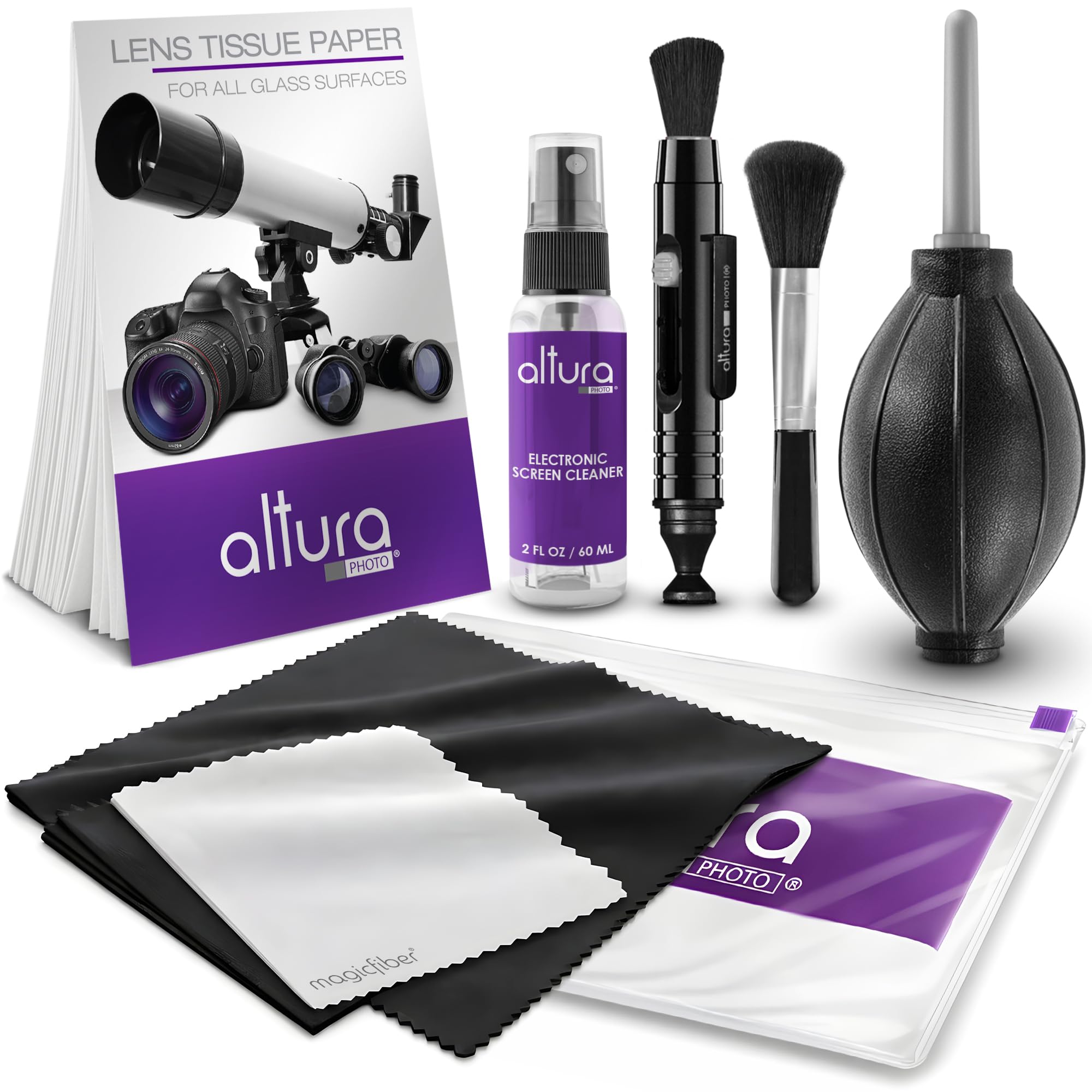
A proper clean happens in stages, and this kit is built so you can work through all of them without leaving the case open while you hunt for a missing tool. Altura packs a rocket blower, a lens pen, a brush, microfiber cloths, sensor swabs and a 56.7 ml spray bottle into one rigid case. That is why it is our default recommendation for most people: nothing in it is fussy, and nothing obvious is missing.

The spray is the part we are pickiest about, because it is the part that touches the coating. This one is alcohol- and ammonia-free and has no scent to it, which is what we want on anti-reflective glass. It also became the bottle we reach for on eyeglasses and a laptop screen, which tells you something about how often a camera lens is actually the thing you are cleaning.

The routine the kit supports is the one we follow: blower first for loose grit, then the brush or the carbon head of the pen for anything with a grip, then a cloth or a swab for whatever survives. The MagicFiber cloths are soft enough that we use them on a front element without a second thought, and the case holds each piece in place instead of letting them rattle into a heap.

If you wet clean a full-frame sensor more than occasionally, look at the K&F Concept 25-in-1 instead, since it adds a sensor solution and swabs cut to that width. For lenses, bodies, screens and the occasional light sweep in the chamber, this is the kit we hand to friends who ask.

Pros

  • Covers dry and wet cleaning in one case
  • Alcohol- and ammonia-free spray safe for coatings
  • Rigid case holds every piece in place
  • Works with any camera brand

Cons

  • Single cleaner bottle, no separate sensor solution
Our verdict

Our pick for most people: dry and wet cleaning in one hard case, with an alcohol-free spray that is gentle on coated glass.
Check Latest Price
2

Best for Full-Frame Sensors

K&F Concept 25-in-1 Camera Cleaning Kit

92 /100
Keeper Score Outstanding

Key details

Case
Hard case
Sensor Swabs
6 × 24mm, vacuum sealed
Included Tools
Air blower, lens pen, two microfiber cloths
Cleaning Liquids
60 ml lens cleaner and 20 ml sensor cleaner
Check Price on Amazon

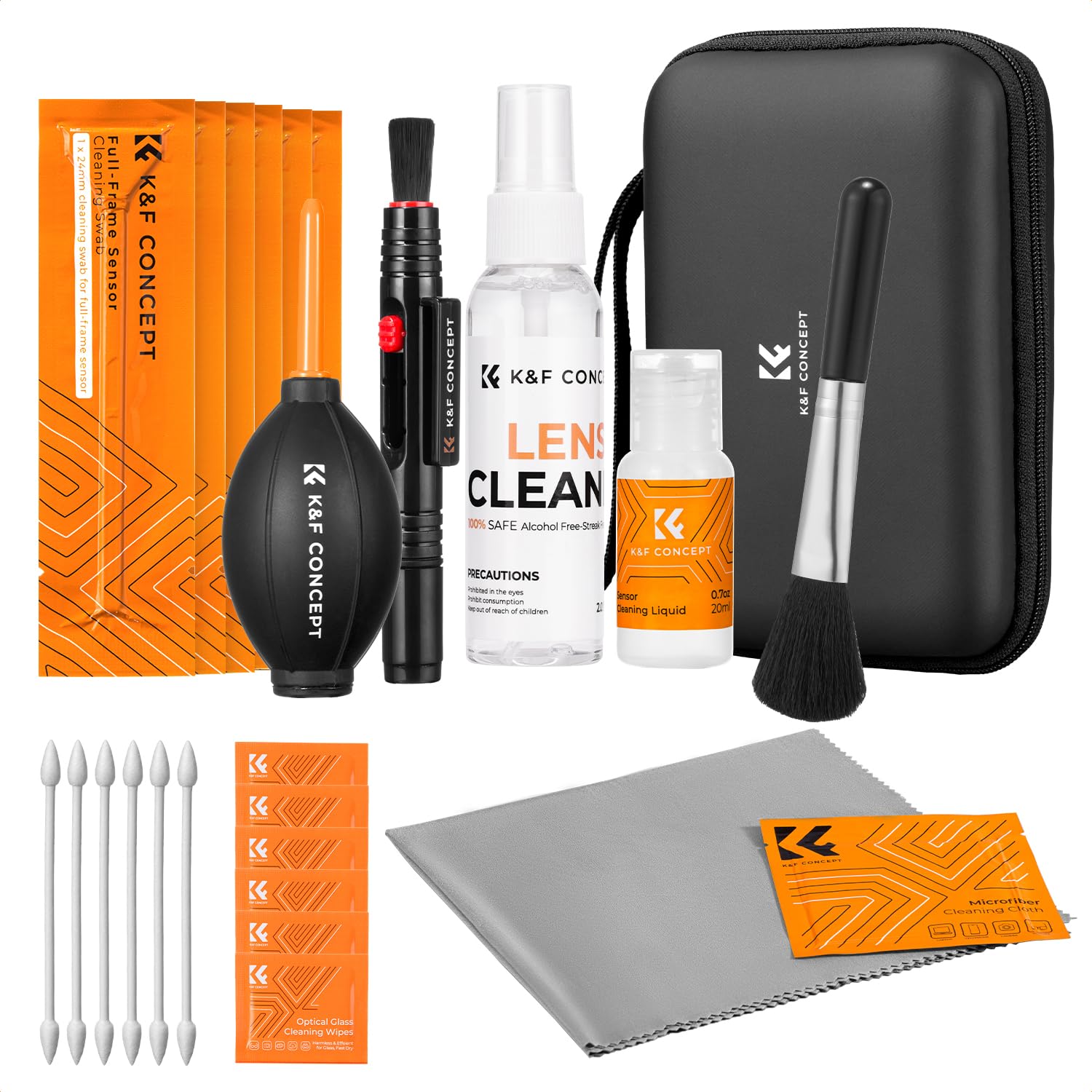
Twenty-four millimeters is the number that decides this kit. That is the width of a full-frame sensor, and the six swabs inside are cut for exactly that: one straight sweep, then discard. Each one is vacuum-sealed, so the head has never been touched before it meets your sensor, which is the part of wet cleaning that is hard to fake with a cotton swab.

The detail we appreciate most is that the liquids are split, with 60 ml for lenses and 20 ml for sensors in two labeled bottles. A sensor solution has to flash off without leaving a film, and having it separated takes the guesswork out of the one step where guesswork gets expensive. Add two cloth sizes, the blower, the pen and a hard case and this is the most complete wet-cleaning kit of the ones we covered.

Six swabs means six sessions, so order a spare pack before a long trip if your sensor is a dust magnet. The cotton swabs and the smaller cloth are there to round out the count; the reason to buy is the sealed swabs and the two bottles.

Pros

  • Six individually sealed 24mm full-frame swabs
  • Separate 60 ml lens and 20 ml sensor solutions
  • Two cloth sizes plus blower and pen
  • Two-year manufacturer warranty

Cons

  • Only six swabs in the box
Our verdict

The full-frame kit to buy if you plan to wet clean: six sealed 24mm swabs and separate lens and sensor solutions in a hard case.

Check Latest Price
3

Best Budget Kit With Sensor Swabs

ParaPace 28-Piece Camera Cleaning Kit

93 /100
Keeper Score Outstanding

Key details

Case
Water-resistant hard case
Kit Size
28 pieces
Sensor Swabs
5 × 16mm, vacuum sealed
Cleaning Solution
20 ml, alcohol-free
Check Price on Amazon

Sixteen millimeters is the whole argument: that is an APS-C sensor, and the five swabs in this kit are vacuum-sealed and cut to match. For anyone who has priced a shop sensor clean and wondered whether to try it at home, a kit with the right-size swab and a bottle of solution is the answer.

Around the swabs sits a 20 ml bottle of alcohol-free solution, an air blower, a carbon-tipped pen and a hard shell case described as water-resistant and shockproof. The case is what we didn't expect at this end of the range: a rigid zipped shell that holds everything and shrugs off a packed bag, rather than a drawstring pouch that lets the swabs get crushed.

Our judgement is that this is the best value in this group for an APS-C owner, because the swabs and the solution are the expensive part of sensor cleaning and here they come with a whole case built around them instead of padding. Full-frame owners should look elsewhere; a 16mm head can't cover a larger sensor in one pass.

Pros

  • Five sealed 16mm swabs for APS-C sensors
  • Water-resistant, shockproof hard shell case
  • Alcohol-free solution safe on coated glass
  • Blower, pen and swabs cover the whole routine

Cons

  • Solution bottle is small at 20 ml
Our verdict

For APS-C shooters ready to clean their own sensor, this kit has the right-size swabs, a safe solution and a hard case without overspending.

Check Latest Price
4

Best Minimalist Kit

K&F Concept 4-in-1 Camera Lens Cleaning Kit

94 /100
Keeper Score Outstanding

Key details

Weight
3.52 oz
Warranty
2 years
Included Tools
Air blower, lens pen, 2 microfiber cloths
Check Price on Amazon

No swabs and no bottle of fluid, and for a bag kit that is the point. The 4-in-1 is a silicone blower, a lens pen and two individually vacuum-packed microfiber cloths, 3.52 ounces in total. It is the one we leave in the camera bag permanently, because nothing in it can leak, dry out or empty itself over a lens.

The blower earns its place: a one-way intake pulls air from behind rather than pushing the same dusty mouthful back at the glass, and the soft nozzle can go close to a front element without your pulse rising. The pen handles both ends of the job, with a retractable brush for grit and a carbon head for fingerprints, and the two-year manufacturer warranty runs longer than most kits here offer.

What it does not do is sensors. The pen's plastic body is also the piece to treat gently, so keep it in a compartment rather than loose in a pocket where the brush collar takes the knocks. For lenses, filters and the outside of the body, the small footprint is a fair trade.

Pros

  • Packs down to blower, pen and two cloths
  • One-way intake blower with a soft nozzle
  • Cloths individually vacuum packed
  • Two-year manufacturer warranty

Cons

  • No pouch or case to keep it together
Our verdict

The kit we keep in the bag: blower, pen and cloths for lens dust and fingerprints, with no liquid to leak and almost no weight.

Check Latest Price
5

Compact Sensor Care

VSGO DKL-20F Sensor Cleaning Kit

91 /100
Keeper Score Outstanding

Key details

Case
Carrying case
Sensor Swabs
6 × 24mm
Included Tools
Mini air blower, dual-tip lens pen
Cleaning Liquids
30 ml lens cleaner and 15 ml sensor cleaner
Check Price on Amazon

Open the case and everything has a slot: a mini blower with a narrow nozzle, a dual-tip pen, six 24mm swabs, a 30 ml lens cleaner and a 15 ml sensor cleaner. It is a full-frame sensor kit that takes up about as much bag space as a small filter pouch.

Two separate liquids at this size is the detail we appreciate, and the narrow blower nozzle is the one we didn't know we wanted. It reaches a hot shoe and the groove of a zoom ring, where a full-size rocket blower just pushes air past the target. The swabs are the same 24mm full-frame width as the K&F kit, so the single-sweep technique carries straight over.

What holds it back is depth of record: there is far less use behind this kit than behind the Altura or the K&F Concept 25-in-1, which is why it sits here as a considered alternative rather than a headline pick. If the compact case and the twin bottles are what you are after, the specification is all there.

Pros

  • Separate 30 ml lens and 15 ml sensor cleaners
  • Narrow-nozzle mini blower reaches tight gaps
  • Six 24mm full-frame swabs in a small case
  • Dual-tip pen with carbon head

Cons

  • 24mm swabs suit full-frame sensors only
Our verdict

A tidy full-frame kit with two separate solutions and a blower that reaches tight gaps, from a model with a shorter track record.

Check Latest Price
6

Starter Kits

Zacro 14-in-1 Camera Lens Cleaning Kit

93 /100
Keeper Score Outstanding

Key details

Case
Storage box
Kit Size
14 pieces
Included Tools
Blower, two-in-one pen, brushes, 5 cloths, 20 lens papers
Cleaning Liquid
20 ml
Check Price on Amazon

Count the consumables rather than the tools. Five microfiber cloths and 20 sheets of lens paper are the parts of a kit you actually use up, and Zacro includes both alongside the blower, two-in-one pen, brush and beauty brush.

There is also a 20 ml bottle of detergent and four cleaning rods in the black storage box. What we noticed is how fast cloths and paper disappear: one pass over a dusty front element, one over a filter, and you are reaching for a fresh sheet. A kit that ships with a stack of them stays useful far longer than one with a single cloth you keep shaking out.

Our judgement is that this is a sound all-rounder for someone who wants everything in one box and is happy to keep sensor cleaning simple. Set against the Altura kit at a similar price, the trade is clear: Zacro gives you more cloths and lens paper, Altura gives you a bigger spray bottle and a hard case.

Pros

  • Five microfiber cloths and 20 lens papers
  • Two-in-one pen plus separate brushes
  • Compact storage box fits a camera bag
  • Works with Canon, Sony and Nikon bodies

Cons

No notable drawbacks to flag.

Our verdict

A complete kit for everyday lens and body cleaning, with enough cloths and lens paper that you won't be reordering next month.

Check Latest Price
7

Second Kits

kioguc 14-Piece Camera Lens Cleaning Kit

87 /100
Keeper Score Excellent

Key details

Case
Storage box
Kit Size
14 pieces
Included Tools
Air blower, lens pen, brush, microfiber cloth
Check Price on Amazon

The cheapest kit here makes its case by subtraction: no liquid, no swabs, just a blower, a lens pen, a brush, a microfiber cloth and a bag, boxed together. For a beginner who mostly needs dust off a front element, that is a reasonable place to start.

The tools are the same shapes you will find in kits that cost more. The rocket blower shifts loose grit, the brush gets into a filter thread, and the pen's carbon head lifts a fingerprint off the coating. If your camera lives in a bag and you change lenses indoors, that covers most of what you meet.

Where the description runs ahead of the contents is the sensor talk. The listing says the kit cleans lenses, sensors, screens and bodies, but what is packed in the box is dry tools. Nothing in it will scratch a coated lens; nothing in it will wet clean a sensor either.

Our judgement is that this is the second kit rather than the only one: the set for the glovebox, the desk drawer, the bag you don't worry about. If you are buying once, put the money into a kit that brings liquid and swabs, and keep this one as the spare.

Pros

  • Blower, pen, brush and cloth in one box
  • Storage box and bag keep the pieces together
  • Fits SLR and mirrorless bodies

Cons

  • Dry tools only, no liquid or swabs listed
Our verdict

A cheap, genuinely useful set of dry tools for dust and fingerprints, best bought as a spare kit rather than your only one.

Check Latest Price

How We Tested Camera Cleaning Kits

We started with the listings themselves, then crossed off anything that didn't state a swab width, that bundled full-frame swabs into a kit aimed at crop-sensor bodies, or that padded its piece count with things nobody reaches for — a tiny screwdriver, a plastic pick. Sixteen kits made the cut, and we spent three months using them the way a kit actually gets used: on lenses and bodies that had been outdoors, not on a clean bench.

Every kit got the same jobs. I fogged a UV filter with a fingerprint and followed each kit's own instructions to the letter, counting how many passes it took before the glass came clear and whether the solution dried into a film. We shot a blank white wall at f/16 to find sensor dust, then cleaned until the spots were gone, noting whether the swab dragged, shed fibers, or left a streak along the edge. Blowers went first on loose grit before anything touched the glass, because order matters more than any single tool, and we watched whether brushes and pens picked dust up or simply moved it around.

Then we lived with them. Each case rode in a camera bag next to a lens for a month while we watched latches, hinges, and zippers, and the microfiber cloths went through a dozen washes to see whether they stayed soft or started shedding. At the end we counted how many pieces we had genuinely reached for — completeness only counts when the parts work — and set that against the price, which is where big kits tend to fall apart: a generous piece count means little once half the pieces are unusable.

How to Choose a Camera Cleaning Kit

Match the Swab to Your Sensor

Sensor swabs are cut to a sensor's width, and only two sizes matter here: 16mm for APS-C and 24mm for full-frame. A 24mm head on an APS-C body overhangs the edges and can push solution where you can't see it; a 16mm head on a full-frame sensor needs two or three passes to cover the surface, which is more chances to drag something across the glass.

So buy on the number, not the brand. The ParaPace kit is built around 16mm swabs; the K&F Concept 25-in-1 and the VSGO DKL-20F are built around 24mm. If you don't know your sensor format, that single figure is worth checking before anything else in this guide.

Decide Whether You'll Wet-Clean at All

Every kit here covers the dry pass: blower first, then brush or pen, then a cloth. Wet cleaning is the step that separates a lens kit from a sensor kit. A kit with sealed swabs and a bottle labeled for sensors takes you into the chamber; a blower-pen-cloth set like the K&F Concept 4-in-1 or the kioguc does not, and that's a design choice rather than a shortfall.

If you have never wet cleaned and want to start, buy the swabs and solution anyway and rehearse the motion on a filter first. A single straight sweep with light pressure is the whole technique, and practising it on glass you can replace beats learning it on a sensor.

Read the Contents List, Not the Piece Count

Twenty-eight pieces can mean five swabs and twenty-three tissues. What earns its place in a kit is the blower, the lens pen, the cloths, and — if you wet clean — the sealed swabs and the solution. Everything else is consumable padding, useful but not a reason to choose one box over another.

Two details are worth checking in the listing. The liquid should be alcohol- and ammonia-free if it's going near coated glass, and the swabs should be individually sealed so the head hasn't collected grit in the case. Both are cheap to state and expensive to get wrong.

Think About Where the Kit Will Live

A rigid case protects swabs and stops a pen getting crushed, but it takes up bag space. If the kit is going to sit in a camera bag between shoots, a blower-pen-cloth set that weighs almost nothing earns its keep on most days. If it lives at home and comes out for maintenance sessions, one of the larger cased kits is easier to work out of.

Our rule: keep a small kit in the bag and a full one wherever you download your cards. Two kits sound indulgent until the first time you need a blower in the field and find you left it on a shelf.

Plan for the Consumables

Cloths, lens paper, swabs and solution run out long before the blower does. Washable microfiber comes back if you keep it clean and store it away from grit; a sealed swab does not — one swab, one pass, then bin it. That makes swab count the number that really matters on a sensor kit, and cloth count the one that matters on a lens kit.

A bottle in the 15 to 20 ml range is a handful of wet cleans, not a lifetime supply, so factor a reorder into what the kit costs you over a year. Generous cloth and paper counts stretch the time between top-ups, which is exactly where a kit like the Zacro earns its place.

Frequently Asked Questions

Final Verdict

For most people the Altura Photo kit is the one to buy. It handles the whole routine — blower, brush, pen, cloth, spray — and the alcohol- and ammonia-free formula is the safest thing in this group to put on a coated front element. Add swabs and a hard case and there is nothing left to buy separately.

Two situations change the answer. If you shoot full-frame and intend to wet clean, the K&F Concept 25-in-1 gives you the right swab width, a separate sensor solution and a two-year warranty. If you shoot APS-C, the ParaPace kit does the same job with 16mm swabs and a hard shell case.