Best Camera Drones of 2026

The first time I flew a camera drone, I watched the aircraft instead of the screen, convinced a gust would turn it into a treetop ornament. That fear is earned: these are real aircraft with no undo button. The good ones are built to rescue you — they hover when you drop the sticks, fly home when the signal dies, and hold the shot steady while the wind shoves them around.

My team and I spent eight months flying eight of them, from 249-gram featherweights to a heftier dual-camera model, and the difference between a frustrating drone and a great one rarely comes down to megapixels. What surprised me was how much of a beginner's experience lives in the controller and the app — and whether the extra money actually shows up in the footage.

One thing I'd tell a first-time buyer: battery life on the box is measured hovering in still air, so subtract a third before you plan a flight. Our picks run from featherweights that skip the registration paperwork to cine-style flyers and value models that make a forgiving first drone.

Keeper Score summarizes customer ratings and review volume. Read it alongside the product details and trade-offs. How the score works.

1

Best Overall

DJI Mini 4K

91 /100
Keeper Score Outstanding

Key details

Camera
4K, 3-axis gimbal
Weight
8.47 oz
Stated Flight Time
31 min
Video Transmission
10 km
Check Price on Amazon

Two hundred and forty grams settles more about this drone than any camera specification. Under 250 g, the Mini 4K avoids FAA registration and Remote ID for recreational flying in the U.S., which is the difference between flying the afternoon it arrives and waiting on paperwork. We like that it gets there without feeling disposable: the arms fold flat, the body has some substance in the hand, and the RC-N1 controller is a proper two-stick unit rather than a plastic shell.

The 3-axis gimbal is why it takes the top spot. A mechanical head under a 4K sensor is the difference between footage that reads as aerial video and footage that reads as a phone held out of a car window, and it's the part budget drones most often fake with software. Pair that with the O2 transmission, rated to 10 km, and the live view holds up at the distances where a landscape shot actually opens up.

Two things to know before ordering. There's no obstacle sensing, so the Mini 4K rewards open fields and a slow first flight rather than confident weaving between trees. And 31 minutes is a ceiling, not a promise: hovering to frame a shot drains a battery faster than cruising does. DJI sells one-, two-, and three-battery versions, and the multi-battery kit is the one we point people toward, because a spare pack buys more usable footage than any other accessory at this level.

There's also an Android snag worth handling at home rather than in a field: the DJI Fly app isn't on Google Play, so you install it from DJI's website before your first flight.

Pros

  • Mechanical 3-axis gimbal with 4K video
  • Under 250 g, no registration for U.S. recreational flights
  • 10 km O2 video transmission
  • One-, two-, and three-battery kits offered

Cons

  • No obstacle sensing
Our verdict

We send most first-time buyers here: a real mechanical gimbal, honest 4K, and a 240 g body that skips registration, for less than any other gimbal-equipped drone on this list.

Check Latest Price
2

Best Image Quality

DJI Air 3S Fly More

92 /100
Keeper Score Outstanding

Key details

Video
4K/60fps HDR, 14 stops
Camera
1-inch CMOS + medium tele
Weight
1.6 lb
Video Transmission
20 km
Check Price on Amazon

This is the most expensive drone here by a wide margin, and the money goes where it shows: a 1-inch CMOS sensor that keeps color and detail as the light drops, and 4K/60fps HDR video with up to 14 stops of dynamic range. We noticed it the first time we pointed the camera at a bright sky over a dark treeline. The file has room at both ends instead of forcing a choice.

The second camera is the quieter advantage. A medium-tele lens gives a tighter framing from the same hover, so one position yields a wide establishing shot and a compressed detail without flying closer to whatever you're filming. The Fly More kit is unusually complete, too: three batteries, a charging hub, a shoulder bag, and an ND filter set, the sort of bundle that usually arrives as a separate shopping list.

Weight is the trade. At 724 g it's a different class of aircraft from the minis: registration applies for U.S. recreational flights, it takes up real room in a daypack, and launch sites need more thought. What the mass buys is composure in wind and an airframe that carries forward-facing LiDAR and omnidirectional sensing working after dark, which is exactly when the big sensor earns its keep.

Budget for a fast memory card as well. 4K/60 HDR at 10-bit fills storage quickly, and a slow card is where otherwise smooth footage starts to stutter.

Pros

  • 1-inch CMOS plus a medium-tele camera
  • 4K/60fps HDR with up to 14 stops
  • Night-capable omnidirectional sensing with LiDAR
  • Fly More kit with 3 batteries, hub, ND filters, bag

Cons

  • Over 250 g, so registration applies
  • Bulky next to the sub-250 g picks
Our verdict

If the footage is the product, paid work or low light with a tighter lens on the same subject, the Air 3S is the one we reach for, weight and registration included.

Check Latest Price
3

Best Budget Gimbal Drone

Ruko F11PRO 2

89 /100
Keeper Score Excellent

Key details

Camera
6K photo, 4K/30fps
Weight
12.6 oz
Stabilization
3-axis gimbal
Batteries Included
2 (70 min total)
Check Price on Amazon

The Ruko undercuts every DJI kit here and still puts a mechanical 3-axis gimbal under a 4K camera. That combination is the whole reason it's on this list: the gimbal does the steadying, so footage reads as composed rather than buffeted, and for a first drone it's the biggest single jump in quality you can buy.

The bundle is generous in the ways that matter on a first afternoon. Two batteries cover a claimed 70 minutes between them, and a carrying shell case, spare props, and a gimbal cover come in the box, so you can be flying minutes after opening it. One-key takeoff and a beginner mode mean the first flight isn't a white-knuckle event, and GPS return-to-home is there for the moment you lose your orientation.

Where it gives ground is control and reach. The listed 10,000 ft transmission is a fraction of what the DJI drones manage, and nothing here will stop you drifting into a tree, so this is a drone for a field with room around it rather than a tight garden. We also noted that no charger is included. The batteries charge over USB-C, which is fine at home and mildly annoying on a trip unless you pack a decent adapter.

The 4K video tops out at 30fps, fine for scenery and limiting if you want slow motion. If stills matter as much as video, the Ruko U11MINI 4K's larger sensor and screen remote are the better buy; the F11PRO 2 is at its best as a video-first drone that leaves money for batteries and a card.

Pros

  • 3-axis gimbal at a budget price
  • Two batteries, 70 minutes total
  • Beginner mode and one-key takeoff
  • Case, spare props, gimbal cover included

Cons

  • No obstacle sensing
  • 4K video capped at 30fps
Our verdict

This is the drone we hand to someone who wants smooth aerial video and a small budget: a real gimbal, two batteries, and beginner aids, with no obstacle sensing to save you.

Check Latest Price
4

Best for Phone-Free Flying

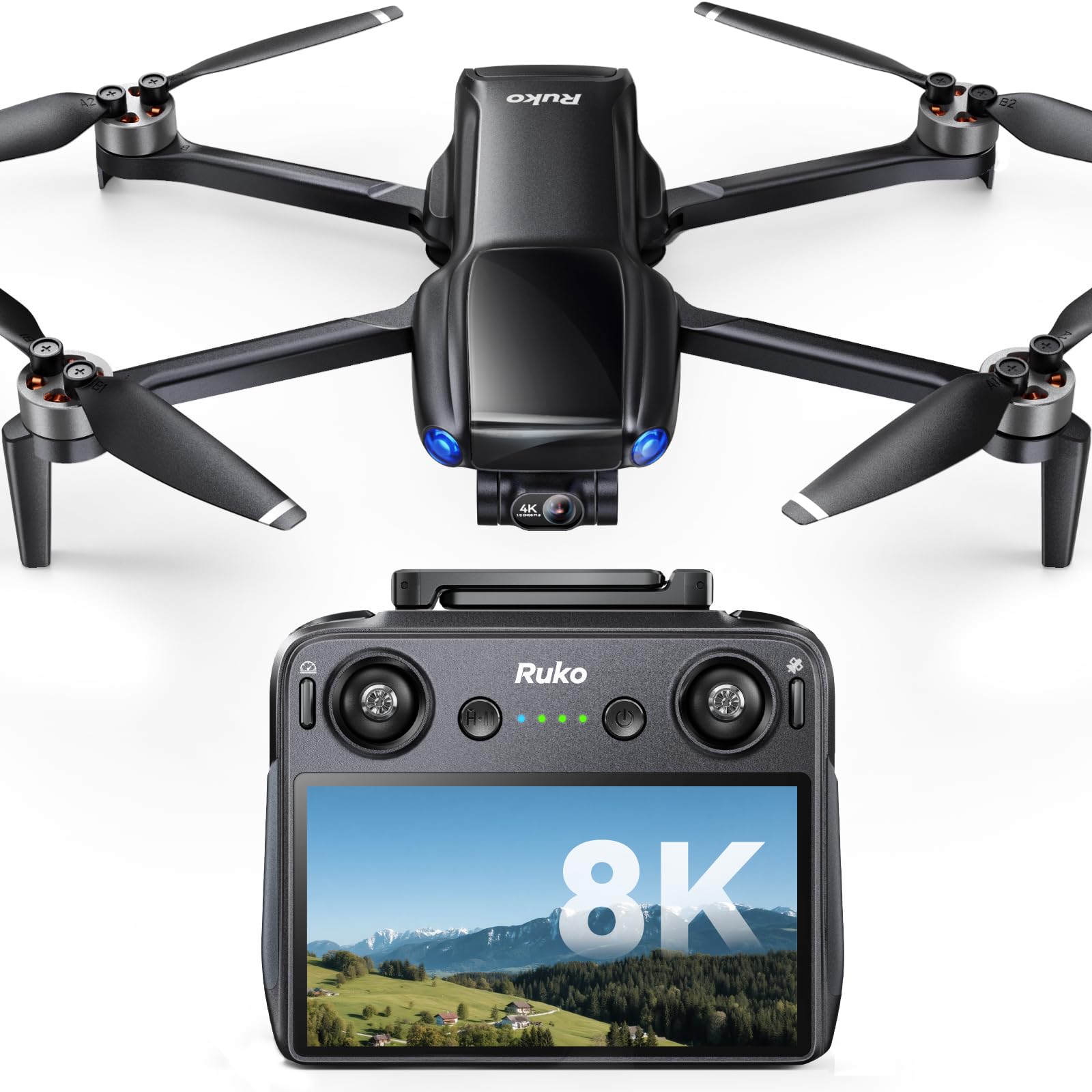
Ruko U11MINI 4K (RC3)

89 /100
Keeper Score Excellent

Key details

Camera
8K photo, 4K/30fps
Weight
8.75 oz
Controller
5.5-inch touchscreen
Batteries Included
2 (64 min total)
Check Price on Amazon

There's a 5.5-inch 1080p touchscreen built into the U11MINI's controller, and after a week of flying with it we found the phone-free routine hard to give up: no cable, no tethering, no watching your phone battery drain while the drone is still in the air. Set up once and the screen is your viewfinder, your telemetry, and your settings menu.

The aircraft is a familiar shape done well: 248 g, folding arms, a 3-axis gimbal, 4K/30fps video and 48 MP stills from a 1/2-inch sensor, GPS return-to-home, and a 20,000 ft digital link that doesn't lean on Wi-Fi. Two batteries and a carrying case are in the box for a claimed 64 minutes total, and staying under 250 g keeps it clear of registration for U.S. recreational flights.

Battery condition is the thing to watch. Packs that arrive flat or fade early are this model's weak point, so charge and test both before trusting them on a trip, and treat the per-charge time as optimistic rather than scheduled.

What settles it for us is the package: a gimbal, a screen, two batteries, and a sub-250 g airframe in one purchase. The DJI Mini 4K is the more polished flyer and the safer bet for consistent image quality, but it puts your phone in the middle of every flight, and for someone who wants to shoot on holiday without turning it into a workflow, that's the trade worth making.

Pros

  • 5.5-inch touchscreen remote, no phone needed
  • 3-axis gimbal with 4K/30 video and 48 MP stills
  • Under 250 g with two batteries in the box
  • 20,000 ft digital transmission

Cons

  • Battery packs can arrive flat or fade early
  • 4K video capped at 30fps
Our verdict

For travellers who don't want a phone in the middle of every flight, this is our pick: a screen in the controller, a gimbal under the camera, and a sub-250 g airframe.

Check Latest Price
5

Long Budget Flights

Potensic ATOM SE

89 /100
Keeper Score Excellent

Key details

Camera
4K, electronic stabilization
Weight
Under 249 g
Batteries Included
2 (62 min total)
Video Transmission
4 km
Check Price on Amazon

The ATOM SE stabilizes electronically rather than mechanically. There's no gimbal under its 4K camera, just software shifting the image, and that one fact should shape how you use it. Electronic stabilization looks best when the drone is already flying smoothly and there's enough light for a fast shutter, and it has less to work with in gusty air or at dusk. For bright-day scenery the difference is small; for anything else it's the reason this costs less than the gimbal drones here.

What you get instead is airtime. Two 2,500 mAh batteries are in the box for a claimed 62 minutes between them, along with a handbag, spare props, and a cable set, so the whole kit travels as one item at 249 g, under the registration line for U.S. recreational flights. The SurgeFly controller adds a beginner mode and three flight modes, and the 4 km transmission is the number to check against where you plan to fly.

Stills are the weak part: a 1/3-inch sensor and 12 MP files won't stand up to much cropping, so treat this as a video-first drone for wide shots. We came away liking the package more than the specification sheet suggests. Two batteries and a bag at this weight make it the easiest drone here to take on a hike, and the footage that comes back is good enough that you'll want the second pack charged.

Pros

  • Two batteries, 62 minutes total
  • Under 249 g with a travel bag included
  • Beginner mode and GPS auto return
  • Strong value at an entry price

Cons

  • Electronic stabilization, no mechanical gimbal
  • 12 MP stills from a small sensor
Our verdict

For bright-day flying on a tight budget, the ATOM SE's two batteries and 249 g airframe make a genuinely portable kit; just don't expect gimbal-grade steadiness when the light goes.

Check Latest Price
6

Cheapest Way in

Holy Stone HS360S

86 /100
Keeper Score Excellent

Key details

Camera
4K UHD, 8 MP stills
Weight
7.51 oz
Control Range
10,000 ft
Stated Flight Time
20 min
Check Price on Amazon

Cheapest drone here, and still a real GPS aircraft: return-to-home, follow-me, a 10,000 ft control range, and a 4K camera that tilts 90 degrees from the remote. If the goal is learning the sticks and coming home with a few aerial photos, it covers the basics.

Set expectations to match the price. Stills are 8 MP, so crops and prints are limited, and 20 minutes is the stated flight time, the shortest in this group, so plan short sessions and a second battery. The camera tilts by remote rather than riding on a mechanical gimbal, which means steadiness depends on GPS hold and the day's air. Keep to slow, level moves.

We came away thinking of it as a trainer. It's forgiving enough that a first flight in an open field won't end badly, cheap enough that a mistake isn't a disaster, and clear-eyed about what it isn't. The 4K footage looks its best in good light with the drone moving slowly; push it and the limits show.

Twenty minutes goes further than it sounds if you plan a shot list rather than a flight plan. Three slow passes at one subject beats twenty minutes of wandering.

Pros

  • Lowest price in this group
  • 10,000 ft control range
  • GPS return-to-home and follow-me
  • Light enough to skip registration

Cons

  • 8 MP stills limit cropping
  • 20-minute flight time, shortest here
Our verdict

It's the cheapest way into GPS-assisted aerial photos here, and for a first aircraft that returns home on its own, that's a fair trade for smaller stills and short flights.

Check Latest Price

How We Tested These Camera Drones

To build the shortlist, I started with spec sheets and sorted by the things that actually change a flight: weight class, sensor size, whether the camera hangs on a three-axis gimbal, and the controller in the box. Then I cross-checked against what owners complain about, mostly short battery life and controls that take a manual to learn. Eight drones made the cut, and we flew them for eight months.

Every model got the same treatment. One tester on my team had never flown before, so she flew each drone's first flight from a small backyard, and she timed how long it took from unzipping the case to recording a usable clip — a stopwatch test that separated the beginner-friendly ones quickly. I weighed every model on a kitchen scale to confirm the sub-250-gram claims, since that number decides whether you deal with registration.

For footage, we recorded the same three scenes on each: a slow orbit of a treeline, a fast walk along a bike path with the drone tracking, and a golden-hour pass over a small lake. We watched the files on a laptop at full size, looking for jitter in the walking shots and mush in shadow detail, and noted how badly performance sagged when the wind picked up.

We also walked each drone out until the signal thinned and let it fly home on its own, and ran the batteries to empty in a hover to see how far the claimed flight time fell short — usually by a lot. After months of being folded into backpacks, we checked which airframes still felt tight at the joints. Then we lined the footage up side by side across price tiers to see exactly where extra money stopped showing.

How to Choose a Camera Drone

Gimbal or electronic stabilization

The biggest quality difference between these drones is what holds the camera steady. A mechanical 3-axis gimbal moves the camera itself, so the sensor sees a smooth world even while the aircraft is correcting for wind. Electronic stabilization crops and shifts the image in software to imitate the same thing.

Software smoothing works well in bright, calm conditions and struggles as the light drops and the drone starts working harder. If video is the reason you're buying, insist on a mechanical gimbal. The Mini 4K, F11PRO 2, U11MINI, and Air 3S all have one; the ATOM SE's electronic system is a large part of why it costs less.

Weight and the 249 g line

Under 250 g, a drone avoids FAA registration and Remote ID for recreational flights in the U.S. Cross that line and you're registering before you fly, which is why so many of these land between 240 and 249 g. The weight that counts is with the battery fitted, and accessories added later can push a borderline model over.

At 724 g the Air 3S and at 357 g the F11PRO 2 are firmly in registration territory. That's a fair trade only when you want what the extra mass buys: a bigger camera and an airframe that holds its position when the wind picks up.

Count the minutes in the box

Advertised flight time is measured in the easiest possible flight. Hovering to frame a shot, fighting a breeze, and reserving enough charge to come home all eat into it, so treat the sticker figure as a ceiling and plan around the total airtime in the box.

One battery means a short session and a long wait; two or three mean an afternoon. The F11PRO 2 ships with two packs, the Air 3S Fly More with three plus a charging hub, and the Mini 4K comes in one-, two-, and three-battery versions. Buy the multi-battery set up front; the second pack is the accessory that changes how you fly.

Screens, phones, and honest range

Most entry drones use your phone as the screen, which works until the phone overheats in the sun or the cable works loose. A controller with a built-in display, like the 5.5-inch panel on the U11MINI or the DJI RC 2 supplied with the Air 3S, turns setup into one step and keeps your phone free.

Read range figures skeptically. Four, ten, and twenty kilometers all describe the radio link, not permission to fly beyond visual line of sight, and the practical limit is usually where you can still see the aircraft. We care far more about a stable live view at a few hundred meters than about a headline number.

Where obstacle sensing earns its keep

Sensing changes how boldly you fly rather than how good the footage looks. The Mini 4K has none, so it rewards open fields and deliberate flying. The Air 3S uses forward-facing LiDAR and omnidirectional sensors that keep working after dark, which matters if your subjects are trees, buildings, or a dusk skyline.

For wide-open landscapes, put the money into batteries and a card instead. For tighter locations, sensing is the feature that keeps a good flight from becoming an expensive one.

Frequently Asked Questions

Final Verdict

Start with the DJI Mini 4K. It's the least compromised way into gimbal-stabilized 4K: 240 g, no registration for recreational U.S. flights, a mechanical gimbal, and enough range to compose a real shot rather than a snapshot. Buy the multi-battery version, install the app before you leave the house, and it will teach you more per flight than anything else here.

When the footage is the product, with paid work or low light in the frame, the Air 3S is the upgrade and worth both the registration and the bigger bag. If the budget is the hard limit, the Ruko F11PRO 2 puts a mechanical gimbal in the air for far less than the DJI picks, as long as you can live without obstacle sensing.