Best Binocular Harnesses of 2026

Every binocular comes with a neck strap, and every neck strap starts to fail around mile three — the glass swings into your sternum on the downhill, the webbing saws at your collar, and you end up carrying the binoculars instead of using them. A chest harness moves that weight onto your shoulders and keeps the optics right where your hands already are. My team and I have worn 12 of them over the past six months, from birding mornings to a long week in the high country.

The first decision is strap versus pack. A strap harness runs cooler and lets you glass instantly, but leaves the lenses in the dust; a chest pack seals everything behind a lid. Either way, the small stuff decides it — how hard the magnet pulls, whether the pocket swallows a rangefinder without a fight, and whether the closure is quiet enough for a bird twenty feet away.

Fit and comfort are what determine whether you're still wearing it on day four or leaving it in the truck, and price doesn't track neatly with either. Here's what held up.

Keeper Score summarizes customer ratings and review volume. Read it alongside the product details and trade-offs. How the score works.

1

Best Overall

Vortex Binocular Harness Strap

94 /100
Keeper Score Outstanding

Key details

Fit
One size, adjustable
Weight
3.17 oz
Warranty
Unlimited, unconditional
Carry Style
Chest strap harness
Check Price on Amazon

There is nothing clever about the Vortex harness, which is why we point most people to it first. It is one of the least expensive options here, it weighs 3.17 ounces, and it fixes the problem every binocular owner has: a neck strap turns a 10x42 into an anchor by mid-morning. The straps go over both shoulders, the glass sits flat against your sternum, and nothing swings into your chest on the downhill.

We noticed the difference most on climbs. With the load spread across the back instead of hanging from the throat, the binoculars stay put when you bend forward, and they come up to your eyes without a tangle of strap to sort out first. Adjustment is a one-time job: pull the webbing through the buckles over your heaviest jacket and you are set for the season. The stretch takes up the slack when you peel a layer off, and one size covers a wide spread of bodies.

The catch is at the attachment. The clips go through your binoculars' strap lugs, and a narrow lug can refuse the hardware without a short adapter strap, so test that at home rather than at the trailhead. There is also no cover and no padding, so your glass rides exposed to rain, dust, and brush. Birders and hikers who want the weight gone and nothing else take that trade every time, and the unlimited, unconditional warranty is unusual at this end of the range.

Pros

  • Moves the weight off your neck
  • Holds binoculars flat and still against the chest
  • One-size adjustment works over layers
  • Unlimited, unconditional warranty

Cons

  • No cover or padding for the glass
  • Clips can need an adapter on narrow lugs
Our verdict

We tell most people to start here: it takes the weight off your neck for less than any chest pack, and it fits almost any binocular.

Check Latest Price
2

Best Ultralight

Rick Young Premium Binocular Harness

88 /100
Keeper Score Excellent

Key details

Weight
2.24 oz
Carry Style
Shock-cord harness
Carry Positions
Five
Fits Binoculars Up To
5 x 6.5 x 1.25 inches
Check Price on Amazon

What we keep coming back to is the end of the day: the entire harness wraps around the binoculars and disappears into a jacket pocket. It is a shock-cord system, 2.24 ounces of elastic and a pair of swivel hooks, and it is the only harness here that stores tangle-free on the optic itself. Nothing about it looks like the padded chest rigs most hunters picture.

Worn, it behaves like a light bungee. The cord hugs your torso, the binoculars ride high on the chest, and there is enough give to lift them without unclipping anything. Rick Young lists five carry positions, and the low-profile ones are the ones we used most, because the harness sits under a pack strap and does not foul a bowstring or a sling. Add layers and the cord still holds tension, which is the entire point of elastic in cold weather.

Setup takes more patience than a buckle harness, and the rear adjuster is the weak spot: lean back against a pack or a treestand and you will know it is there. Capacity is limited too. The cord is cut for binoculars up to about 5 by 6.5 by 1.25 inches, so a 56mm roof prism is the wrong partner. For long approaches and anyone counting ounces, though, nothing else here packs smaller.

Pros

  • Packs down wrapped around the binoculars
  • Lightest harness here at 2.24 ounces
  • Holds tension over bulky layers
  • Five carry positions

Cons

  • Rear adjuster can dig against a pack
  • Cord limits it to smaller binoculars
Our verdict

Buy this if packed size and weight decide your kit: nothing else here disappears into a pocket the way this cord harness does.

Check Latest Price
3

Best Value Chest Pack

NEW VIEW CamoRanger Chest Pack

85 /100
Keeper Score Excellent

Key details

Fits
10x42-class binoculars
Closure
Adjustable buckle
Material
600D polyester with rain cover
Carry Style
Chest pack
Check Price on Amazon

If you want your binoculars in a case rather than hanging free, this is where the money goes furthest. The CamoRanger is a compact chest pack built around 10x42-class glass, with a fleece-lined main compartment, a buckle closure instead of a zipper, a detachable rangefinder pouch, and a rain cover that stows with the pack.

Quiet matters more than we expected. The lid closes on a buckle-and-bungee arrangement rather than a rip of hook-and-loop, and the fabric does not announce you when you shift position. On a still morning that is the difference between a second look at something and an empty ridge. The layout is sensible too: a phone, calls, and a rangefinder each have a place, and the main compartment takes the binoculars plus a snack without turning into a duffel.

The straps are where it gives ground. The top runs out of adjustment on tall or broad frames, and shorter torsos can end up with the case riding lower than a chest carry should, so put it on over your heaviest coat before the season starts rather than on the morning of. For everyone the harness does fit, this is the least expensive way here to get a real case, quiet access, and a dedicated spot for a rangefinder.

Pros

  • Fleece-lined case protects the glass
  • Buckle closure opens quietly
  • Rangefinder pouch and rain cover included
  • Least expensive chest pack here

Cons

  • Top straps run short on tall frames
Our verdict

The chest pack we point value shoppers to: a real fleece-lined case with quiet access for 10x42 glass, as long as the straps fit your frame.

Check Latest Price
4

Best Storage

MOXULE Binocular Chest Pack

90 /100
Keeper Score Outstanding

Key details

Weight
1.28 lb
Closure
Magnetic lid
Storage
Rangefinder pouch, phone pocket, mesh
Carry Style
Chest pack
Check Price on Amazon

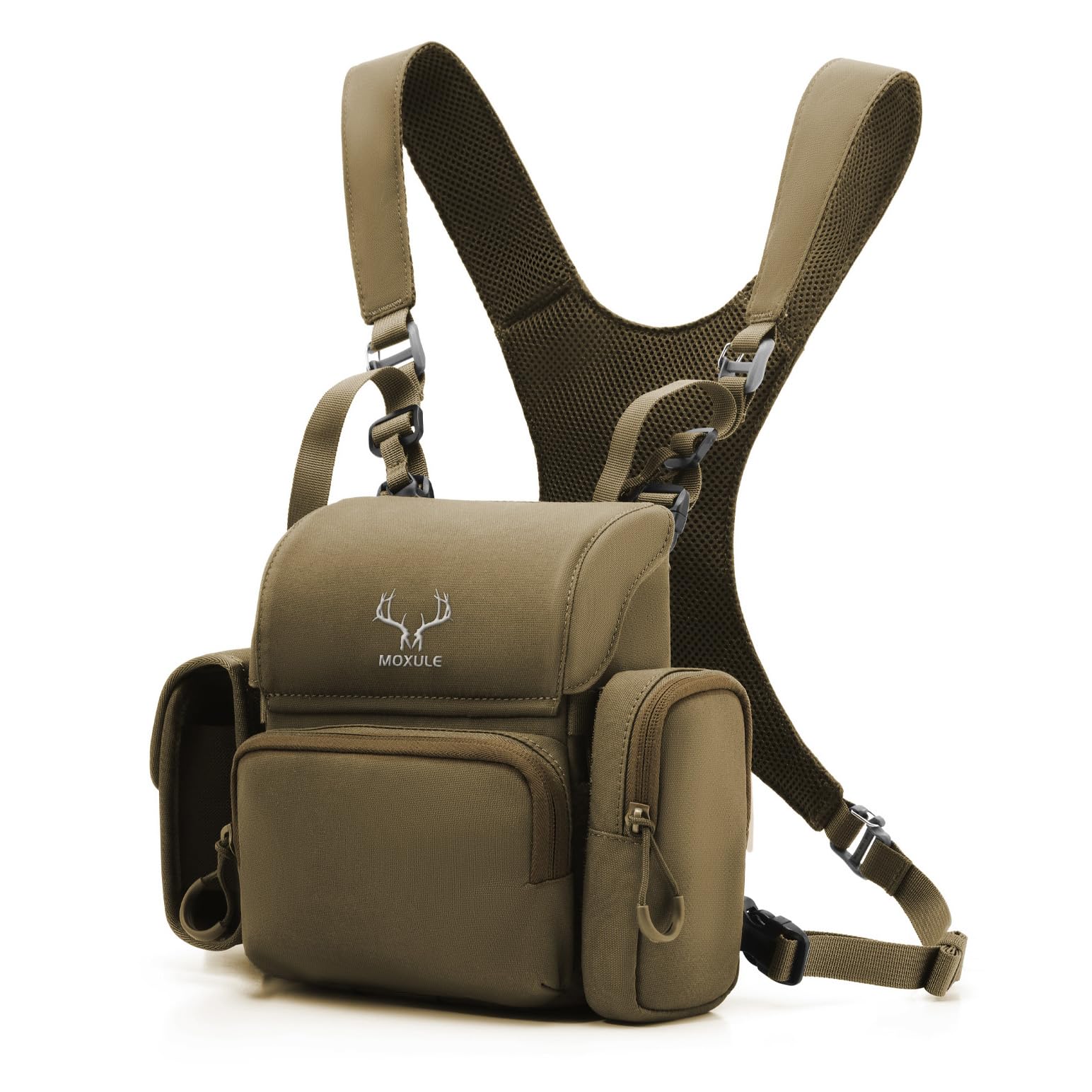
It is the biggest thing on this page, and on the right kind of day that is the whole point. The main compartment fits binoculars plus two mesh pouches inside, and the outside carries a detachable rangefinder pouch, a side pocket, a front pocket sized for a phone, a rain cover, and a cleaning cloth. Pack for a full day of glassing and you stop ferrying gear between your chest and your backpack.

The lid is magnetic and the interior is built to stay quiet, which is the detail that decides whether a chest pack gets worn or left in the truck. Nylon this stiff, 500D and treated for water, usually announces itself; here the case holds its shape when you open it one-handed with gloves on. The front pocket got the most use from us, since a phone or a tag that lives on your chest is one you actually check.

Bulk is the trade. At 0.58 kg empty and roughly 10.6 by 8.5 by 4.3 inches outside, it is a real piece of luggage on the chest, and in July you feel it. What you get back is capacity: this is the pack here you can load for a full day without clipping a second pouch on.

So it is the wrong pack for a minimalist and the right one for someone carrying calls, a rangefinder, and a phone alongside the glass, all reachable without shrugging off a pack. That is a specific brief, and this is the pick that fills it best in this group.

Pros

  • Holds binoculars, rangefinder, phone, and calls
  • Silent magnetic lid opens one-handed
  • Rain cover and cleaning cloth included

Cons

  • Runs large for compact binoculars
  • Rangefinder sleeve is snug on bigger units
Our verdict

For a hunter whose chest is the day's command center, this is the pack that carries glass, a rangefinder, and a phone without a second bag.

Check Latest Price
5

Best for Large Binoculars

Vortex Glasspak Pro Harness

90 /100
Keeper Score Outstanding

Key details

Fits
50mm and 56mm binoculars
Weight
7.76 oz
Exterior
DWR-treated Cordura
Carry Style
Chest harness pack
Check Price on Amazon

The priciest harness here is also the only one built around 50 and 56mm binoculars, and that tells you most of what you need to know. If you carry big objectives, this is the case that fits them without the glass sloshing around, and it is the pick we point to when someone's binoculars have outgrown everything else on the page.

Vortex builds it for backcountry days: DWR-treated Cordura outside, a quiet microfiber interior, front, side, and rear pockets, and modular attachment points for a rangefinder pouch. There are no magnets anywhere in the closure, which is deliberate. The lid opens and shuts without a click, and the bungee on the rangefinder holder is just as quiet. Quick-release buckles get you out of the harness without pulling it over your head, and the whole thing is shaped to sit under a backpack's shoulder straps rather than fight them.

Two things to know before you commit. The lid has no way to stay folded open, so in wind it can flop forward into your sightline, and a hand on it becomes habit. Sizing is literal as well: the Large handles 50 and 56mm glass and the Small tops out at 42mm, so match it to your objective instead of assuming. The unlimited, unconditional warranty is a real part of what you are paying for.

Pros

  • Sized for 50mm and 56mm binoculars
  • Magnet-free closure stays quiet
  • Wears comfortably under a backpack
  • Unlimited, unconditional warranty

Cons

  • Lid will not stay folded open in wind
Our verdict

If your binoculars are 50mm or bigger, this is the case built for them, and the quiet magnet-free closure is worth the premium.

Check Latest Price
6

Swapping Optics

Bushnell Harness with Quick-Detach Clips

84 /100
Keeper Score Excellent

Key details

Fit
One size, multi-point adjustment
Weight
5.64 oz
Warranty
1 year
Carry Style
Harness with quick-detach clips
Check Price on Amazon

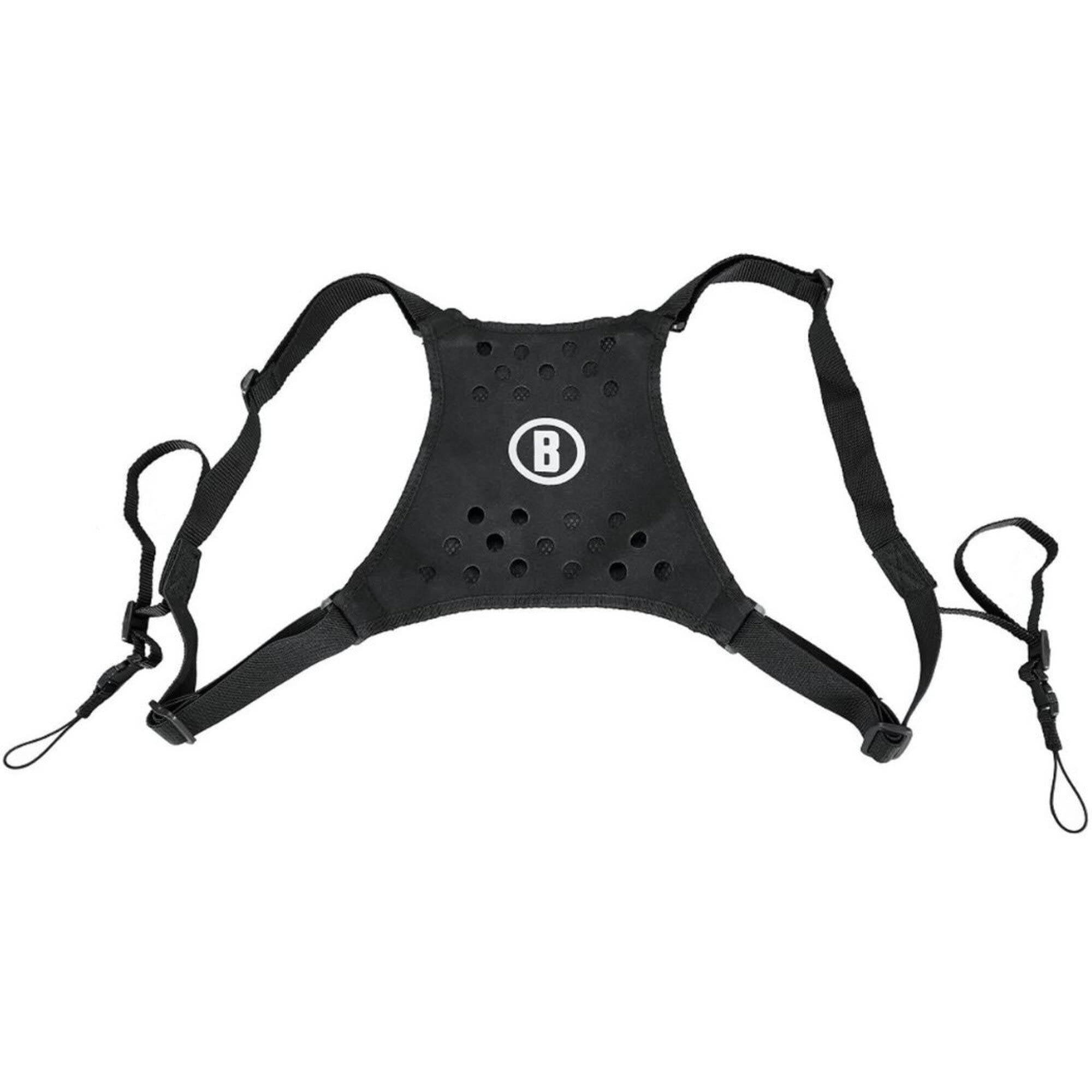
The clips are the reason to look at this one. Bushnell puts a quick-detach buckle on each side, so you can snap the binoculars off the harness and pass them to your kid, stow them in a pack, or switch to a rangefinder without dragging a strap over your head. For a family sharing one pair of glass, or anyone alternating between optics, that is a small feature that changes how a day runs.

The rest is deliberately plain, and we treated it as the fair-weather, low-bulk option: breathable mesh, plenty of adjustment points, and a light harness that does not build heat against your chest the way a padded case does. There is no cover and no water resistance, so rain means the binoculars come off and go into a pack.

Where it lands is as a second harness, the one that lives in the truck, gets handed to a kid, or comes along on a trip where you may not glass at all. You will not baby it, and it will not cost you a season if it spends most of the year in a glovebox.

Pros

  • Quick-detach clips swap optics in seconds
  • Breathable mesh stays cool
  • Light and easy to adjust

Cons

  • Plastic clasps carry the load
Our verdict

A sensible second harness for sharing binoculars or swapping to a rangefinder, provided you keep an eye on the plastic clasps.

Check Latest Price
7

Camera Crossover

Trummul Binocular Harness Strap

90 /100
Keeper Score Outstanding

Key details

Weight
3.88 oz
Buckles
Snap release
Carries
Binoculars, cameras, rangefinders
Carry Style
X-shaped strap harness
Check Price on Amazon

Binoculars are not the only thing this strap carries, which is why it belongs in a photography guide. The X-frame takes binoculars, a camera body, or a rangefinder on the same rig, and each side has its own snap buckle, so you can run a camera on one clip and glass on the other. If you already swap between optics, that flexibility is worth more than another single-purpose upgrade.

At 0.11 kg it is among the lightest harnesses here, and it goes on like a vest: over the shoulders, buckle at the chest, adjust once. Weight lands across the back instead of on the neck, which is the whole job, and it fits over a jacket without a fight. The straps have enough stretch in them to lift a camera or a pair of binoculars without unclipping anything.

Two details to plan around. The leather patch at the back is there for grip, and in heat it makes itself known against a thin shirt, fine in October, less so in July. The rings also take patience the first time you thread them onto a strap lug, and on some binoculars the leather strips need trimming to pass through. Neither is a dealbreaker at this end of the range, but do the fitting at the kitchen table rather than in a parking lot.

Pros

  • Carries binoculars, a camera, or a rangefinder
  • Separate snap buckle on each side
  • Light at 0.11 kg

Cons

  • Leather back patch runs hot
  • Rings and strips need patience to fit
Our verdict

A light, cheap X-harness that also carries a camera or rangefinder, which makes it the one to try if you shoot and glass on the same walk.

Check Latest Price
8

Rugged Build

Lone Trail Chest Pack

87 /100
Keeper Score Excellent

Key details

Closure
Magnetic
Material
500D Cordura
Case Size
6 x 7.1 inches
Carry Style
Chest pack
Check Price on Amazon

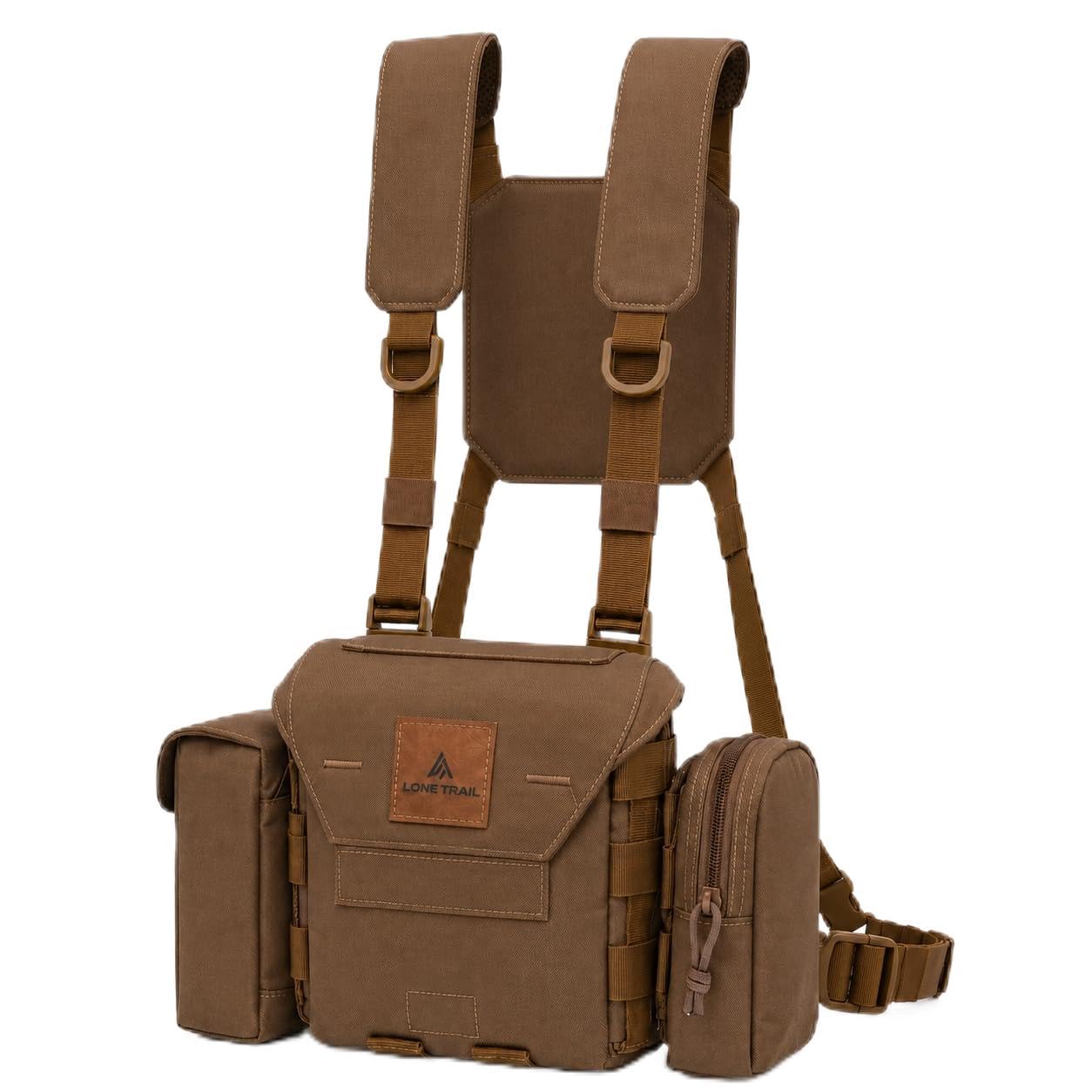
Where the MOXULE pack optimizes for capacity, this one optimizes for abuse. It is 500D Cordura with heavy stitching, a 6 by 7.1-inch main case, a separate rangefinder pouch, and PALS webbing for adding more. The seams and strap anchors, the two places a chest pack usually fails first, are the parts that look overbuilt here.

Adjustment is the part we appreciated most. The shoulder and chest straps move independently and hold where you set them, so the case rides high on the sternum instead of sagging toward the belt line, and the padded back panel keeps it from turning into a heat pack on a long climb. The magnets release quietly and the interior is lined, so one-handed access with gloves on works the way it should.

The closure is the compromise. The magnets do the quiet part well, but on a full case the flap can sit proud instead of sealing, and the side and rangefinder pockets are tighter than the dimensions suggest, so measure your rangefinder before you commit. There are no binocular tethers in the box either, which means adding a lanyard if you glass above a scree slope.

It suits someone who wants a hard-wearing case and would rather carry the extra layers in a pack than on the chest. Come in expecting a quiet lid rather than a weather-tight one, and it does the job without drama.

Pros

  • Heavy-duty 500D Cordura build
  • Straps hold their adjustment
  • Quiet magnetic access
  • Modular PALS webbing

Cons

  • Magnet flap sits proud on a full case
  • Pockets are smaller than the dimensions suggest
Our verdict

The tough, quiet chest rig for someone who wants durability and a proper strap fit rather than a mobile office on the sternum.

Check Latest Price

How We Chose and Tested the Best Binocular Harnesses

We started by pulling every harness we could find that was built to carry full-size glass, from the names hunters and birders already trust to smaller outfits selling chest rigs direct. We dropped anything with a fixed, one-size bridge or no way to adjust the shoulder straps, then narrowed to 12 that spanned the price range, covered both strap-style harnesses and full chest packs, and split between rangefinder-pocket and webbing-only layouts.

Those 12 got carried for six months: early spring scouting hikes, a summer of birding walks on local trails, and a week-long trip where they were on from before dawn until after dark. We loaded each with a 10x42 and, where it fit, a 50mm pair, and wore them over a t-shirt on warm days and over a rain shell when the weather turned — walking, climbing fences, ducking branches, and sitting still in a blind for hours.

Setup was timed with gloves on, and we noted which straps crept loose over a full day. At each stop we opened and closed the lid one-handed while the other hand held the glass, listening for velcro rip, then checked whether the magnet still grabbed after the pocket was stuffed with a rangefinder, a phone, and a snack. Each pack got two minutes under a hose to see whether the inside stayed dry, and a hundred-yard jog to see how far the glass shifted. Comfort was judged at hour six, not hour one, and value came down to what the extra money actually bought.

How to Choose a Binocular Harness

Strap Harness or Chest Pack

A strap harness holds the binoculars against your chest with nothing over them; a chest pack puts them in a lined case with a lid. The strap wins on weight, heat, and speed, because there is nothing to open and the glass is already coming up. The pack wins when weather, dust, or brush is against you, and when you want a rangefinder, phone, and calls on your chest instead of in a backpack. If your only complaint is a sore neck, a strap harness solves it for less.

Matching the Harness to Your Binoculars

Two numbers decide whether a harness works: the outside dimensions of your binoculars and the width of the strap lugs. Case-style packs list an interior size and a lens class such as 42mm, 50mm, or 56mm, and a compact 10x42 in an oversized pack will rattle all day, while a 56mm objective simply will not close in a case built for 42s. Clip-style straps pass through the lugs, so a narrow lug can refuse the hardware without a short adapter. Check both before you order; an attachment billed as universal rarely is.

Weight and Where the Load Goes

Every harness exists to move weight off your neck and onto your back and shoulders, and elastic does that better than flat webbing because it keeps tension as you move. Then look at the harness's own weight. The lightest cord harness here is 2.24 ounces, while the largest chest pack is well over a pound before you put anything in it. On a long approach that gap shows up by mid-afternoon. On a short sit, capacity matters more than ounces.

Setting It Up for Layers and Body Shape

The fit you dial in over a t-shirt is not the fit you need over a parka. Shoulder straps and the chest span run out of adjustment first, and a case that sits at your sternum in July can end up at your waistline in November. Set the harness up wearing your bulkiest coat, then check two things: the case rides high enough to reach without looking down, and nothing presses on the back of your neck when you lean forward. If you are tall, check top-strap length before anything else.

Closures, Noise, and Weather

Magnets, buckles, bungees, and zippers all close a case, and each makes a different amount of noise. Magnets are the quietest and the fastest one-handed, but a magnetic flap can sit proud over a stuffed compartment instead of sealing. Buckles and bungees are secure and quiet enough for most hunting; zippers are the loudest and the most weather-tight. Still-hunting calls for the closure you can work with gloves on. Wet country calls for the one that seals.

Frequently Asked Questions

Final Verdict

Most people should buy the Vortex strap and stop there: it is the least expensive way here to get the weight off your neck, it fits nearly any binocular, and there is nothing to adjust once it is set.

Step up only when your days demand something the strap cannot do. Rain, brush, and a chest full of gear point to the MOXULE; a compact 10x42 kit with a rangefinder points to the CamoRanger; and if you carry 50 or 56mm glass, the Glasspak Pro is the only case here built for it.