Best 8K Cameras of 2026

8K is a resolution number, but resolution is rarely what makes footage look good. The size of the sensor behind the lens and the way a camera steadies the wobble in your hands decide far more — a small chip with a big number on the box falls apart at dusk, and crisp detail with clumsy stabilization turns a hike into an earthquake.

I've spent six months carrying 11 of these cameras — palm-sized action cams, a pocket gimbal, and a couple of full-size camcorders — onto bike trails, into a pool, and through a family birthday party. The ones I reached for were never the ones with the longest spec sheet. They were the ones already recording before the moment passed, and the ones a first-timer could figure out without a manual.

Value is the other separator: a bundled mic, spare battery, and memory card can save real money, while some boxes are padded with accessories that never leave the bag. Budget for power, too — 8K drains a battery noticeably faster than 4K, and the files are big enough that a slow card will stutter. The picks below are sorted by how you'll actually shoot.

Keeper Score summarizes customer ratings and review volume. Read it alongside the product details and trade-offs. How the score works.

1

Best Overall

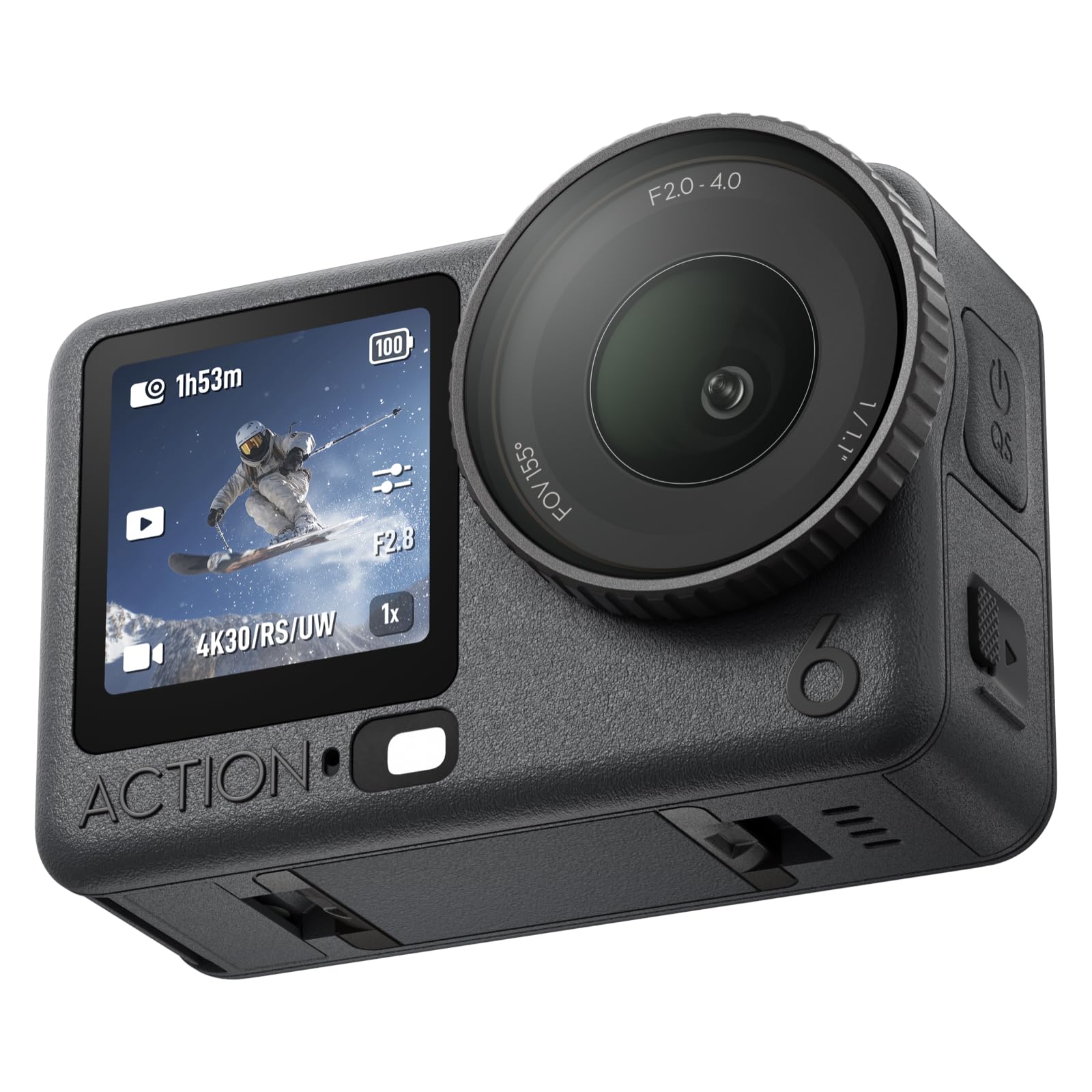
DJI Osmo Action 6

90 /100
Keeper Score Outstanding

Key details

Sensor
1/1.1" square
8K Video
8K
Battery Life
4 hours
Water Resistance
Waterproof
Check Price on Amazon

The variable aperture is the detail that makes the Osmo Action 6 more than another 8K action camera. It runs from f/2.0 to f/4.0, so you can open up in dim interiors or stop down when the sun is bouncing off water. That flexibility matters because 8K footage shows every bit of noise and every blown highlight.

We think that makes it the safest 8K pick in this set for mixed conditions. The 1/1.1-inch square sensor gives it more light-gathering room than the budget compacts here, while RockSteady 3.0 and HorizonSteady keep handheld footage level when you are walking, riding, or filming from a moving vehicle. At 149 grams, it is light enough to carry all day, and the waterproof body means you do not need a separate housing for rain or splashes.

The 8K mode is best treated as a tool for cropping and reframing, not as the default for a long day. Very dim scenes still favor a larger-sensor camera, and the action-camera form is less comfortable for long interviews than a camcorder.

If you want one camera for hiking, biking, travel, and family video, this is the one we reach for. It does not have the 360 reframing of the X5 or the detachable screen of the Luna, but it handles more situations without a special workflow. The quick-release adapter mount makes it easier to move between setups, which is the kind of everyday flexibility an 8K action camera needs.

Pros

  • Variable f/2.0–f/4.0 aperture adapts to changing light
  • 1/1.1-inch sensor and RockSteady stabilization
  • Waterproof body with a rated 4-hour battery
  • Light 149-gram body travels easily

Cons

  • 8K clips fill cards and batteries quickly
  • 2.5-inch screen is cramped for precise framing
Our verdict

The Osmo Action 6 is our top pick: it pairs 8K capture with a variable aperture, strong stabilization, and a waterproof body that handles more situations than anything else here.

Check Latest Price
2

Best 360

Insta360 X5

92 /100
Keeper Score Outstanding

Key details

Sensors
Dual 1/1.28"
8K 360 Video
8K30fps
Battery Life
208 minutes
Water Resistance
Waterproof
Check Price on Amazon

The appeal of the X5 is not a single frame you compose through a viewfinder; it is the freedom to shoot in every direction and reframe later. With dual 1/1.28-inch sensors and 8K30 360 capture, you can ride, ski, or walk through a scene and decide afterward whether the story is the road ahead, the scenery beside you, or the reaction on your face.

The invisible selfie-stick effect and FlowState stabilization are what make that footage usable. The camera removes the stick from the image, so third-person shots look like they came from a drone or a friend walking alongside. Horizon lock keeps the frame level when the terrain is not. We also like the replaceable lens design for adventure use; a scratched lens is a real risk on a rock or a handlebar.

We keep coming back to the X5 because it solves a problem the flat 8K cameras here cannot: it captures the whole scene and lets you decide later. The trade-off is battery life. 8K 360 is power-hungry, and the X5 is not the longest-running camera in this group, so carry a spare for a full day. That is a fair trade for the flexibility, and it is why the X5 is our 360 pick.

Pros

  • 8K30 360 capture with dual 1/1.28-inch sensors
  • Invisible selfie-stick effect and FlowState stabilization
  • Waterproof body with a replaceable lens
  • Reframe one shot into multiple angles

Cons

  • 8K 360 files are heavy to store and edit
Our verdict

For 360 shooting, the X5 is the one we reach for: 8K30 footage, strong stabilization, and a waterproof body let you shoot first and choose the angle later.

Check Latest Price
3

Best for Vlogging

Insta360 Luna Ultra

87 /100
Keeper Score Excellent

Key details

Zoom
12x
Video
8K30fps HDR
Lenses
Dual Leica
Screen
Detachable 2" touchscreen
Check Price on Amazon

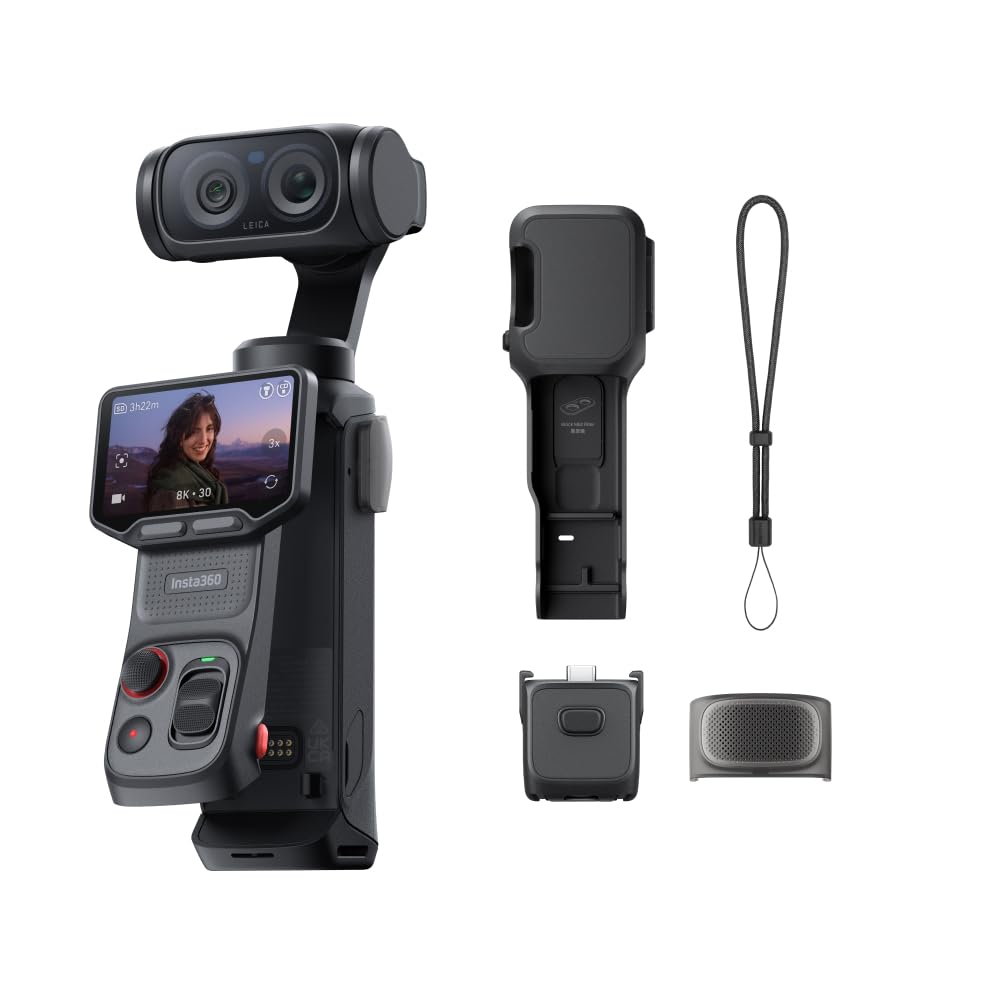
The detachable 2-inch touchscreen is the feature that changes how the Luna Ultra feels in use. You can pull it off the body and use it as a remote monitor, which makes it easier to frame a shot when the camera is on a mini tripod or held at arm's length. We think that is a genuinely useful vlogging trick, not a gimmick, because it solves the problem of not being able to see yourself while the camera is pointed at you.

The rest of the kit backs it up. Dual Leica lenses give you up to 6x lossless and a 12x zoom range, plus 8K30 HDR with Dolby Vision. The pocket gimbal form keeps it stable, and Leica color science gives footage a polished look straight out of camera. For travel and product demos, that zoom range is more useful than a fixed wide lens.

What keeps the Luna Ultra from the top spot is consistency. Battery life is one of the compromises, and recording can stop unexpectedly, so we treat it as a camera to test thoroughly before a paid job. The zoom and detachable screen still make it the best vlogging pick here, but they come with a higher cost and a need for a spare battery.

Pros

  • Detachable touchscreen works as a remote monitor
  • Dual Leica lenses with 6x lossless zoom
  • 8K30 HDR with Dolby Vision
  • Pocket gimbal stability for handheld vlogging

Cons

  • Zoom becomes digital beyond 6x
  • Detachable screen is another part to keep track of
Our verdict

We point vloggers who want a detachable screen and a long zoom to the Luna Ultra, provided they can live with its battery and reliability quirks.

Check Latest Price
4

Best Budget Camcorder

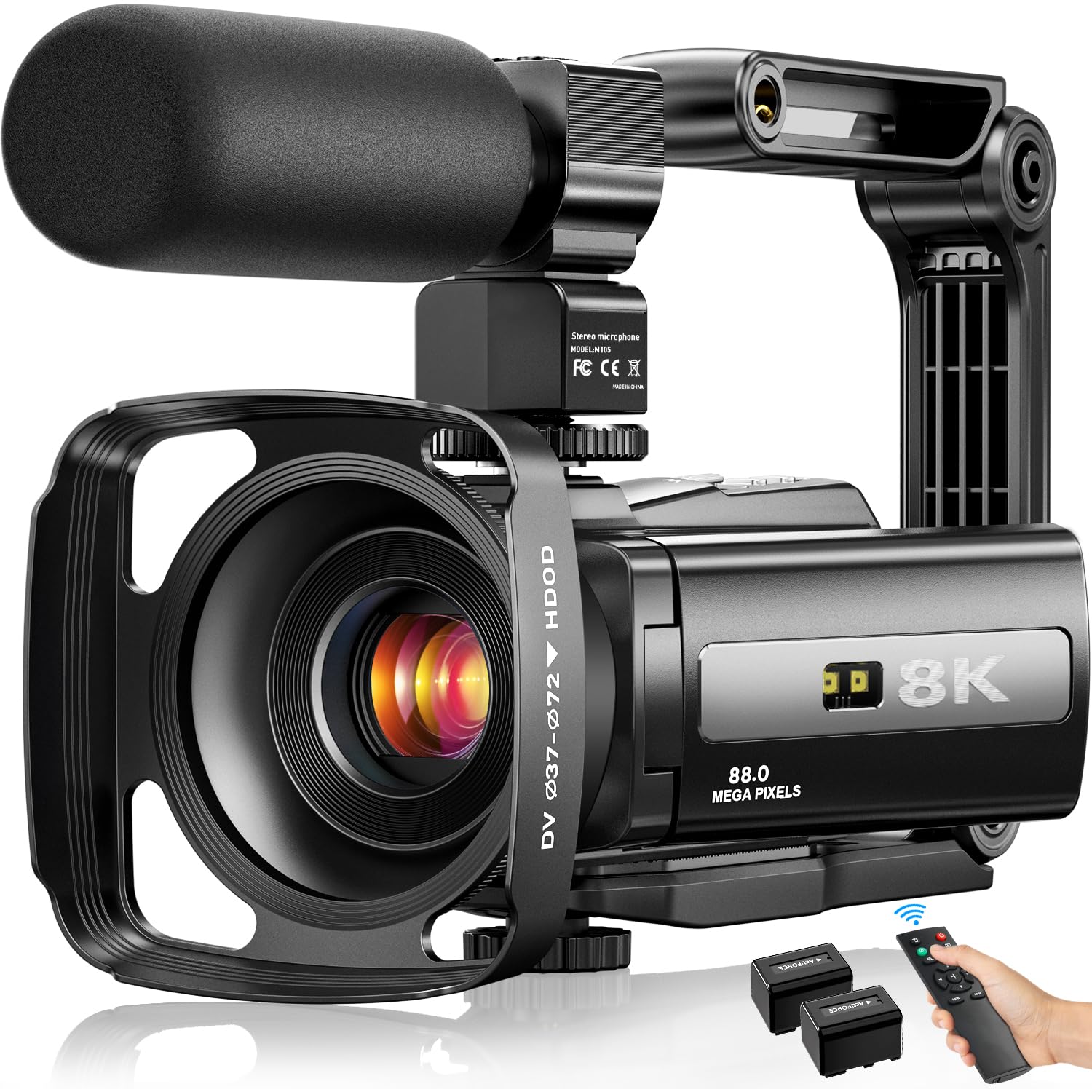
FlyFrost 8K Video Camera

79 /100
Keeper Score Very Good

Key details

Screen
3" touchscreen
8K Video
8K at 15fps
Stabilization
6-axis gyroscope
Included Storage
32GB
Check Price on Amazon

The first thing to understand about the FlyFrost is that its 8K mode runs at 15fps. That is fine for static scenes, landscapes, interviews, and tripod work, but it is not the mode for running children or fast action. The camera is better understood as an affordable 8K camcorder for controlled shots than as a do-everything action camera.

For the money, the package is generous: an external microphone, lens hood, handheld stabilizer, remote, two batteries, and a 32GB card. The 6-axis gyroscope stabilization helps with handheld work, and the 3-inch touchscreen and IR night vision add flexibility after dark. We like that the external mic is included because audio is usually the first thing budget cameras compromise.

We think the FlyFrost earns its place as the budget camcorder pick because it gives you a complete 8K shooting kit without asking you to assemble the basics. The fixed focus means you need to stay at a sensible distance, but for interviews, travel scenery, and family events it is a lot of camera for the money. If you need 8K at 30fps or 60fps, look at the action and 360 picks instead.

Pros

  • Complete kit includes mic, stabilizer, remote, and cards
  • 8K video for static and controlled scenes
  • 6-axis stabilization and IR night vision
  • Lightweight handheld camcorder body

Cons

  • Fixed focus limits close-up flexibility
Our verdict

The FlyFrost is our budget camcorder pick for controlled 8K shots: it arrives with an external mic, stabilizer, and remote, so you can start shooting without assembling a kit.

Check Latest Price
5

Best Budget Point-And-Shoot

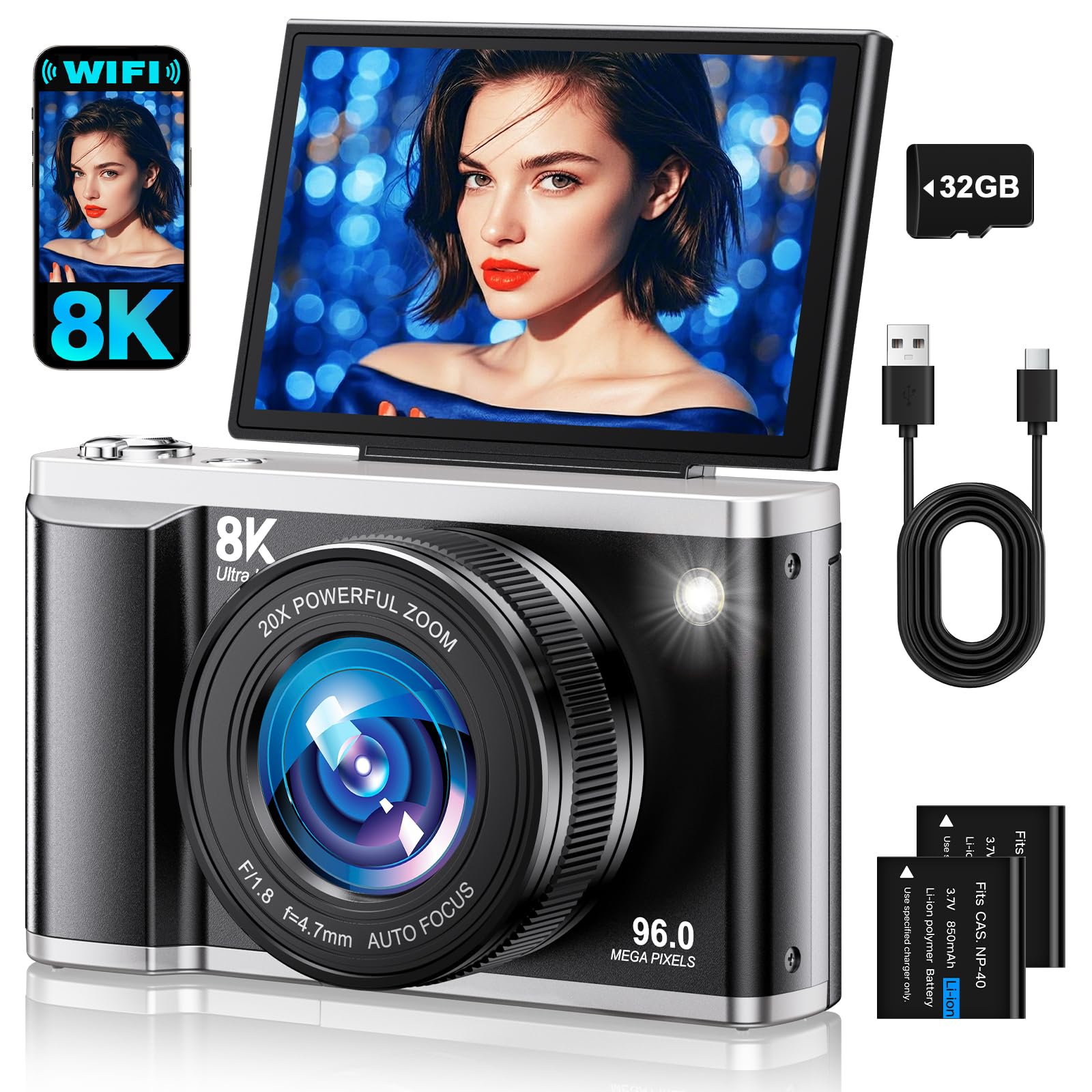
AUREAPIX 8K Digital Camera

81 /100
Keeper Score Excellent

Key details

Zoom
20x digital
Screen
3.5" 180° flip
8K Video
8K
Photo Resolution
96MP
Check Price on Amazon

The AUREAPIX is the kind of camera that makes 8K feel approachable: a 3.5-inch 180° flip screen, Wi-Fi transfer, autofocus, 20x digital zoom, two batteries, and a 32GB card, all in a compact body. The 96MP stills and 8K video are the headline, but the flip screen is what makes it useful for selfies and simple YouTube setups. We like that it does not require a bag of accessories to get started.

We recommend it as a first 8K camera because it keeps the workflow simple: flip the screen, frame yourself, and transfer clips over Wi-Fi. The autofocus and 20x zoom give you more reach than a phone, and the two batteries are a practical touch for a day out. It is not the camera we grab for low light or fast action; the small 1/2.3-inch sensor and digital stabilization set those limits. But for daylight travel, family video, and learning the basics, it is an easy camera to recommend.

Pros

  • 180° flip screen simplifies selfies and vlogging
  • 8K video and 96MP stills in a compact body
  • Wi-Fi transfer and two included batteries
  • Simple controls suit beginners

Cons

  • 20x zoom is digital, so detail softens at the long end
Our verdict

Beginners who want a flip screen and simple controls should look at the AUREAPIX first; we like it for daylight travel and family video, not low-light action.

Check Latest Price
6

Event Camcorder

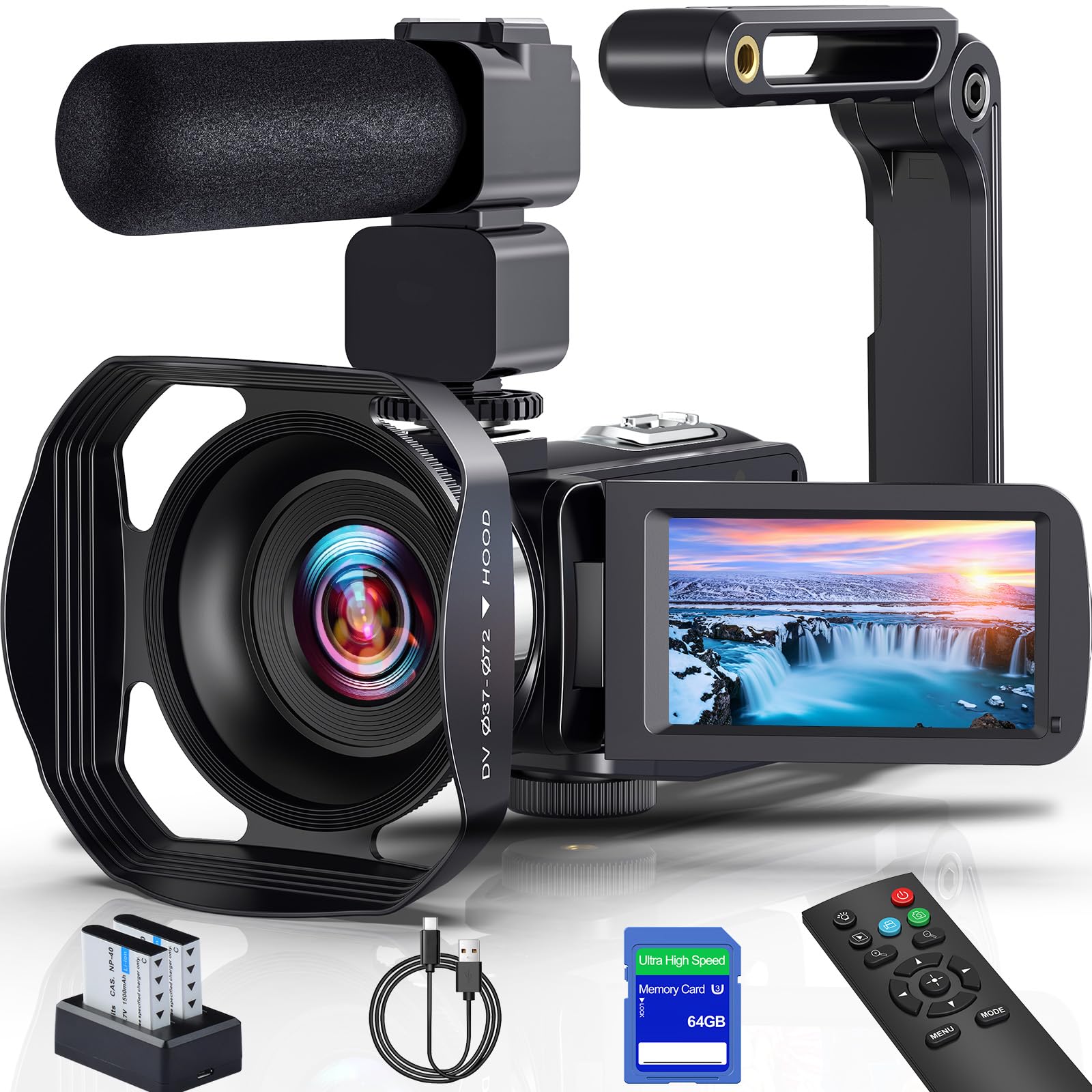
Tixeuo 8K Video Camera

92 /100
Keeper Score Outstanding

Key details

Screen
3" touchscreen
8K Video
7680×4320
Included Storage
64GB
Photo Resolution
64MP
Check Price on Amazon

The Tixeuo arrives as a kit rather than a bare camera: a 64GB card, two batteries, an external microphone, a handheld stabilizer, a lens hood, a remote, and a charging cradle. That is the right way to sell an 8K camcorder to a first-time buyer, because the accessories are the difference between a frustrating first weekend and a usable one.

The core specs are aimed at event and travel work: 8K at 7680×4320, 64MP stills, an 18x digital zoom, a 3-inch touchscreen, and IR night vision. The 2.4G remote and Wi-Fi app control make it easier to start recording without touching the camera, which is handy on a tripod. We like the included mic especially; on-camera audio is usually the weak link in budget camcorders.

The handling is camcorder-like rather than pocketable, so this is a camera you plan around. The 3-inch touchscreen and physical controls are familiar if you have used a camcorder, and the included stabilizer helps with handheld shots. It is the kind of camera that rewards a tripod and a little setup time.

We see the Tixeuo as a strong also-consider rather than a top pick because the kit is more convincing than the camera's flexibility. If you want an 8K camcorder for speeches, ceremonies, and tripod shooting, the included mic and 64GB card make it an easy package to live with. If you need autofocus that tracks or a lens that zooms optically, spend more on the action or vlogging picks.

Pros

  • 64GB card, mic, stabilizer, and remote included
  • 8K 7680×4320 capture and 64MP stills
  • IR night vision and 2.4G remote control

Cons

  • Fixed focus limits close-up and moving subjects
Our verdict

We like the Tixeuo for tripod-heavy event work because the 64GB card, external mic, and stabilizer come in the box; its fixed focus and digital zoom need careful framing.

Check Latest Price
7

Large-Screen Vlogging

Gavonde 8K Digital Camera

82 /100
Keeper Score Excellent

Key details

Screen
4" touchscreen
Battery
3000mAh
8K Video
8K
Included Storage
32GB
Check Price on Amazon

The 4-inch touchscreen is the reason to look at the Gavonde. It is larger than the screens on most compact 8K cameras here, and the dual front and rear lenses make it easy to switch between a selfie view and a normal shot with one button. We think that combination is genuinely friendly for a first vlogging camera, especially if you mostly frame yourself at arm's length.

The rest of the package is practical: 8K video, 64MP stills, Wi-Fi transfer, a 3000mAh battery, a 32GB card, and a microphone jack. The larger battery is a useful buffer for a day of casual shooting, and the mic jack gives you room to improve audio beyond the built-in mic. What it is not is a camera for low light or fast action. The 1/2.5-inch sensor favors good light, and the compact body is not rugged. For travel, family video, and learning to vlog, that is a fair set of priorities.

Pros

  • 4-inch touchscreen is easy to frame with
  • Dual front and rear lenses simplify selfies
  • 3000mAh battery and 32GB card included
  • Microphone jack adds audio flexibility

Cons

  • No built-in flash
  • Automatic exposure only, with no manual control
Our verdict

The Gavonde is our large-screen budget pick: beginners get a 4-inch touchscreen and dual lenses for selfies, with the trade-off of a daylight-only sensor and automatic exposure.

Check Latest Price

How We Tested 8K Cameras — On Trails, at Parties, and After Dark

We started with roughly 40 cameras sold as 8K, read the spec sheets and hunted down unedited sample footage, and set aside anything whose resolution came from upscaling a smaller sensor rather than resolving it. We kept a spread of formats and prices — waterproof action cams, a pocket gimbal, and camcorders with built-in mics — then bought 11 of them at retail and shot with them for six months.

Testing happened where these cameras actually go: a bike trail in drizzle, a pool, a handheld walk of several blocks, a dim birthday party, a night street for the low-light and infrared modes, a cold trailhead morning, and a talking-head setup using each camera's included microphone. We counted the seconds from power-on to first frame, watched how much of a handheld clip still looked steady, checked whether shadow detail survived at dusk, and noted whether autofocus held a face walking toward the lens. We also logged the point at which a body got hot enough to stop recording on its own, and whether the screen was readable in direct sun.

Battery life got its own pass: each camera recorded continuously at its top resolution until it died, and we noted the runtime alongside how warm the card door felt. For reliability, we cycled the same cards repeatedly and looked for dropped frames, corrupted files, lockups, and fogged lenses after moving from cold air into a warm room. To judge ease of use, we timed how long it took to change frame rate without opening the manual, and for value we tallied what actually came in the box.

How to Choose an 8K Camera

Check the 8K mode, not just the badge

Look for 7680×4320 and read the frame rate beside it. Some budget cameras advertise 8K but record at 15fps, which is fine for landscapes and interviews and choppy for movement. If you shoot action, look for 8K30 or higher; the DJI Osmo Action 6 and Insta360 X5 are the safer choices here for motion. The budget camcorders are better for controlled shots.

Match the body to your shooting style

An action camera is waterproof, mountable, and built for movement. A 360 camera captures everything around you and lets you reframe later. A camcorder gives you a long zoom, a mic input, and a familiar handheld shape. A compact point-and-shoot is the simplest route for selfies and travel. Choose the body first, then compare specs within that category; a great 8K sensor does not help if the camera is awkward for the way you shoot.

Sensor size, aperture, and stabilization decide the keep rate

Larger sensors and faster apertures help in dim light, and 8K magnifies noise and camera shake. The Osmo Action 6's 1/1.1-inch sensor and variable aperture give it more room than the 1/2.3-inch compacts here. The X5's dual sensors and FlowState stabilization are built for movement. Budget cameras rely on digital stabilization, so they reward steady hands and good light.

Plan for storage, batteries, and editing

8K files are large, and a 32GB card in a starter kit is a beginning, not a day's supply. Use a card rated for the camera's highest bitrate, carry a spare battery, and expect longer transfers and more editing work. The Osmo Action 6's 4-hour battery rating is an outlier here; most 8K cameras need a top-up or a second battery for a full day.

Audio and handling are part of the camera

8K video with poor audio still feels amateur. Look for a mic input or an included external mic; the FlyFrost and Tixeuo include one. A flip or detachable screen helps you frame yourself, and a remote or app control saves you from touching the camera on a tripod. Budget for the audio and handling you need before you spend extra on resolution.

Frequently Asked Questions

Final Verdict

The DJI Osmo Action 6 is the 8K camera we recommend first. It has the most complete mix of image quality, stabilization, waterproof build, and battery life here, and its variable aperture makes 8K more usable in changing light. If you want one camera for travel, action, and everyday video, start there.

Choose the Insta360 X5 if you want 360 reframing, or the Luna Ultra if vlogging and a detachable screen matter more than a lower price. The budget camcorders are the right call only when controlled shots and a complete kit matter more than frame rate.