Best 1-Inch Sensor Compact Cameras of 2026

The number that decides how a compact camera behaves is the one printed smallest on the box: sensor size. A 1-inch chip has about four times the surface area of a typical point-and-shoot's, which is why these cameras keep color in the shade and hold noise together indoors. The catch is that the body only stays pocketable if the maker gives something up — reach, aperture, or controls.

Over eight months I've carried seven of them, from vlogging-first models with flip screens to pocket zooms with 10x reach, and the gaps that matter aren't usually the ones the spec sheet brags about. Autofocus that holds a moving subject, dials you can find by feel, and a battery that survives an afternoon out separate the camera you keep in your bag from the one that ends up in a drawer.

These aren't cheap, so it's worth knowing what each step up in price actually buys you — usually the lens and the autofocus, rarely the megapixel count. Below are the seven that earned a spot, sorted by who they suit.

Keeper Score summarizes customer ratings and review volume. Read it alongside the product details and trade-offs. How the score works.

1

Best Overall

Sony RX100 VII

83 /100
Keeper Score Excellent

Key details

Lens
24-200mm f/2.8-4.5
Video
4K
Sensor
20.1MP 1-inch stacked CMOS
Weight
9.7 oz
Check Price on Amazon

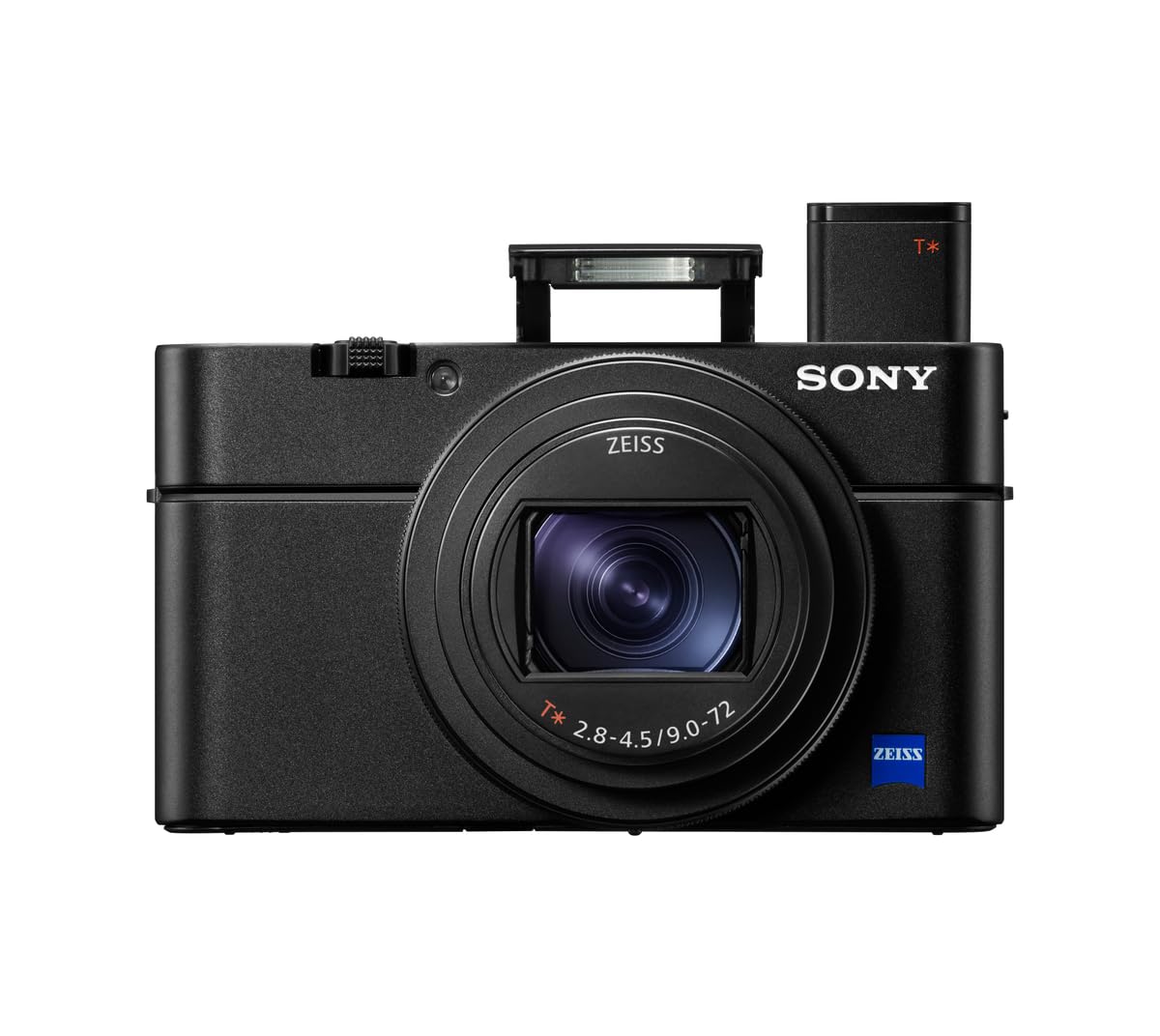
The 24-200mm lens is why the RX100 VII sits at the top of this group. It is an eight-power zoom that still collapses into a body you can drop in a jacket pocket, so you get wide street scenes and tight portraits from the same camera. The 20.1MP stacked sensor and 4K recording make it a genuine stills-and-video tool rather than a compromise.

What changed our shooting was the autofocus. The 357-point phase-detection system and real-time tracking held onto moving subjects in our testing, and the 20fps blackout-free burst meant we could keep shooting without the finder freezing. We also appreciated the pop-up OLED viewfinder on bright days; it is small, but it keeps the camera usable when the rear screen washes out.

The lens is the main trade-off. It starts at f/2.8 and drops to f/4.5 at 200mm, so the ZV-1 is the better low-light pick at the wide end. At the long end, you will lean on higher ISO indoors. That is a fair compromise for the reach, and the built-in microphone jack makes it more useful for video than its size suggests.

Our favorite detail is the memory recall. We set one preset for street stills and another for 4K video, then switched between them without menu diving. That is the kind of small workflow win that makes a compact feel like a working camera rather than a toy.

Pros

  • 24-200mm zoom covers wide to telephoto
  • Fast phase-detect autofocus
  • 4K video with microphone input
  • Pocketable 275g body

Cons

  • Premium price for a compact
Our verdict

We recommend the RX100 VII for most people because its 24-200mm zoom, fast autofocus, and 4K video make it the most complete pocket camera in this set.

Check Latest Price
2

Best for Vlogging

Sony ZV-1

90 /100
Keeper Score Outstanding

Key details

Lens
24-70mm f/1.8-2.8
Video
4K
Screen
3-inch side flip-out
Sensor
20.1MP 1-inch stacked CMOS
Check Price on Amazon

The side flip-out screen is the first thing that makes the ZV-1 feel purpose-built. You can frame yourself at arm's length, check focus, and keep the camera steady without guessing where you are in the frame. For solo video, that is a bigger practical win than a slightly larger sensor or one more frame per second.

The 24-70mm f/1.8-2.8 lens is the other half of the appeal. It gathers enough light for indoor talking-head clips and gives a soft background when you want one, and the real-time eye autofocus kept faces sharp in our handling. We had fun with the Product Showcase setting, which shifts focus from a face to an object in front of the lens; it is a small feature, but it solves a real problem for product demos.

That reach is the boundary. It is a people-and-places lens, not a travel zoom, so the RX100 VII or ZS100 will suit you better when you need to pull distant details closer. The ZV-1 is at its best in a bag with a small tripod, ready for quick clips and street stills.

Pros

  • Bright f/1.8-2.8 lens
  • Side flip-out screen for solo framing
  • 4K video with real-time eye AF

Cons

  • No built-in electronic viewfinder
Our verdict

For solo video, we reach for the ZV-1: the flip screen, bright 24-70mm lens, and eye autofocus make framing and focus easier than the alternatives here.

Check Latest Price
3

Best Travel Zoom

Panasonic Lumix ZS100

82 /100
Keeper Score Excellent

Key details

Lens
25-250mm f/2.8-5.9
Video
4K
Sensor
20.1MP 1-inch MOS
Viewfinder
1,166k-dot EVF
Check Price on Amazon

A 25-250mm lens in a body this small is the ZS100's argument. That 10x range covers wide interiors and a stage across the room, and it is the reason to pick this camera over the shorter Sony pair. The 20.1MP 1-inch sensor and 4K recording keep the image quality in the same conversation, even if the lens slows to f/5.9 at the long end.

We were glad to have the built-in EVF. It is a 1,166k-dot finder that makes framing easier in sunlight and gives the camera a more serious feel than a screen-only compact. The 4K Photo and Post Focus modes are also more than novelty: you can shoot a burst and pick a frame later, or select a focus point after the fact, which is useful for quick family shots.

The controls are the part that takes patience. The buttons are small and the menu is dense, so it is worth setting up the custom controls before a trip. Once you do, the EVF and zoom make it a very capable travel companion.

Pros

  • 10x 25-250mm zoom range
  • Built-in 1,166k-dot EVF
  • 4K video and 4K Photo modes

Cons

  • Autofocus can hunt in low light
Our verdict

We like the ZS100 for travel because its 25-250mm zoom and EVF cover scenes the shorter Sony lenses cannot, provided you can live with slower autofocus.

Check Latest Price
4

Wide-Angle Video

Canon PowerShot V10

84 /100
Keeper Score Excellent

Key details

Lens
19mm fixed wide-angle
Video
4K
Sensor
15.2MP 1-inch CMOS
Weight
7.52 oz
Check Price on Amazon

The built-in stand is the detail that makes the PowerShot V10 more useful than its size suggests. It folds forward or back, so the camera can sit on a table for a solo clip or lean back for a low-angle shot without a tripod. We like that kind of integrated problem-solving; it means one less accessory in the bag.

The 19mm equivalent lens is wide enough to fit you and a room behind you at arm's length, and the 1-inch sensor gives the footage more depth than a phone clip. The 4K recording and built-in stereo mic make it a natural first video camera, and the flip screen keeps you framed while you talk. It is not a general-purpose stills or zoom camera; it is a wide-angle video tool.

The 2-inch screen is the compromise. It flips and works for framing, but it feels small next to the 3-inch panels on the other picks. The fixed 19mm lens also means no zoom, so you move your feet or accept the wide view. For travel clips, product demos, and casual vlogging, that is a reasonable trade; for family photos and distant subjects, choose the RX100 VII or ZS100.

Pros

  • Built-in stand folds front and back
  • 19mm wide lens suits arm's-length framing
  • 4K video with stereo mic

Cons

  • Battery rated for about two hours
  • No eye-level viewfinder
Our verdict

We see the V10 as a specialist for arm's-length video and tabletop clips, where its built-in stand and wide 19mm lens do more than a zoom would.

Check Latest Price

How We Tested 1-Inch Sensor Compact Cameras

We started by pulling every current compact built around a 1-inch sensor, then cut anything that wouldn't slide into a jacket pocket or that cost noticeably more than the rest without adding a feature we'd genuinely use. That left seven cameras. We bought them at retail and shot with them for eight months.

Each one went everywhere: a Saturday farmers market, a friend's birthday indoors after dark, a weekend hiking trip, and a lot of ordinary dog walks. We photographed the same scenes on all seven — the same stall at golden hour, the same dim restaurant table — then opened the files at full size to see where detail held and where noise turned into color blotches. We ran every zoom to both ends and checked whether the corners went soft, noted whether each body slid into a front jeans pocket without a fight, and weighed it with a spare battery in the bag.

Autofocus is where the money goes, so we chased a running dog and a kid on a swing and counted how many frames came back sharp, then repeated it in low light. For video we filmed while walking to judge how well stabilization held, and adjusted exposure one-handed mid-stride to see how quickly the controls fell under a thumb. We logged battery life by counting shots and minutes of 4K per charge on full days out, and kept a running note of anything that froze, jammed, or started rattling.

What we found is that the price steps buy you a better lens or better autofocus far more often than better stills at base settings — worth knowing before you pay for reach you won't use.

How to Choose a 1-Inch Sensor Compact Camera

Choose the Lens Range First

Your first decision is zoom range versus lens speed. A long zoom like the RX100 VII's 24-200mm or the ZS100's 25-250mm lets you frame a street scene and then reach across a room without changing position. A shorter, brighter lens such as the ZV-1's 24-70mm f/1.8-2.8 gives you more light and softer backgrounds, but you give up reach. The Canon V10's fixed 19mm goes further in that direction: it is built for arm's-length video, not for pulling in distant details. Pick the range you will actually use most days, then accept the trade-off.

Autofocus Matters More Than Megapixels

Every camera here has enough resolution for everyday prints and social sharing, so autofocus is the better differentiator. Phase-detection systems like the RX100 VII's 357-point array are the ones to prioritise for kids, pets, and street scenes, because they hold focus as subjects move. Contrast-based systems can be fine for landscapes but may hunt in dim light. If you shoot moving subjects indoors, check the autofocus specification before you fall for a nicer body or a longer zoom.

Match the Video Features to Your Setup

4K is now common, but the surrounding details decide whether a camera is pleasant to shoot with. A side flip-out screen, like the ZV-1's, makes solo framing much easier; a built-in stand, like the V10's, turns a tabletop into a support; a microphone jack, like the RX100 VII's, lets you improve audio later. Handheld clips also benefit from stabilization, especially at the long end of a zoom. If you mostly shoot static travel scenes, the screen and audio options matter less than a good viewfinder.

Budget for Batteries and Setup Time

Pocket cameras run on small batteries, and a video-heavy day can drain one quickly. A spare battery is the first accessory to buy, followed by a fast UHS-I U3 card for 4K. The controls also take planning: the ZS100's buttons are small and its menu is dense, while the Sony bodies reward anyone who sets up custom buttons and memory recall. Give yourself an evening with the manual before a trip; it is the difference between fumbling and catching the shot.

Frequently Asked Questions

Final Verdict

For most people, the Sony RX100 VII is the one to buy: it is the only camera here that pairs a true pocket body with a 24-200mm zoom, fast phase-detect autofocus, and 4K video. If video is the main job, the Sony ZV-1's flip screen and bright 24-70mm lens make it the easier tool. If you want the longest reach, the Panasonic ZS100 goes to 250mm. The Canon V10 is the specialist for wide, arm's-length video, not a general stills camera.