Best Wireless Flash Triggers of 2026

The stand is at the right height, the softbox is feathered just so, the frame looks exactly right — and the shutter fires with no flash. A wireless trigger is the least glamorous thing in the bag and the one that decides whether the shot exists at all. Get the right one and your off-camera light pops every time, from anywhere in the room, and you can dial three lights up or down without crossing the floor between frames.

I've shot enough dim receptions to be picky about this. Over the past eight months my team and I put 11 triggers through real work — a basement product shoot, a reception hall lit mostly by candles and DJ lights, dusk portraits where we leaned on high-speed sync, and a fair amount of standing in parking lots seeing how far the signal actually carried.

Here's what the spec sheets leave out: channel counts and range claims rarely decide anything. What bites you is a hot-shoe foot that loosens after a month in the bag, a screen you can't read at waist height in a dark room, and batteries that drain while the thing sits idle. The picks below survived all three.

Keeper Score summarizes customer ratings and review volume. Read it alongside the product details and trade-offs. How the score works.

1

Best Overall

Godox Xpro-C

93 /100
Keeper Score Outstanding

Key details

Mount
Canon E-TTL / E-TTL II
Power
2 AA batteries
High-speed Sync
1/8000 sec
Groups And Channels
16 groups, 32 channels
Check Price on Amazon

Five dedicated group buttons and a screen tilted up toward you are the two details that decide whether a four-light setup feels orderly or fiddly, and the Xpro-C gets both right. Because the LCD is slanted, we can read every group's mode and power with the camera on a tripod at chest height instead of tilting the whole rig toward us. Changing the rim light is a button press and a turn of the wheel.

That layout is why this is the trigger we hand Canon shooters first. It covers the whole job: E-TTL II metering, 1/8000 sec high-speed sync for shooting wide open in daylight, 16 groups across 32 channels, and a wireless ID setting that keeps it clear of other radio gear at a crowded venue. Of everything here, its physical group buttons are the fastest way to grab one specific light without going through a menu.

The TCM button is the feature we appreciate most, because it bridges the two ways of working. Meter a light in TTL until the exposure looks right, long-press TCM, and the trigger converts that reading into an equivalent manual power value. Lock that in and you can shoot a hundred frames that don't drift every time the subject moves.

It's a Canon-pattern trigger built for E-TTL and E-TTL II bodies, so it's the wrong purchase for a Sony or Nikon kit — a mount question, not a quality one. Everyone else needs only one habit: spare AAs in the bag, because the screen and the radio draw enough that a pair won't carry a long studio day.

Pros

  • 16 groups over 32 channels for multi-light sets
  • TCM converts a TTL reading into manual power
  • 1/8000 sec high-speed sync for daylight work
  • Group buttons and slanted screen keep settings readable

Cons

  • Battery door and power switch are the fragile parts
Our verdict

We recommend the Xpro-C as the default for Canon shooters: trustworthy TTL, 1/8000 sec high-speed sync, and 16 groups you can adjust without leaving the camera.
Check Latest Price
2

Best for Sony

Godox X3 Pro S

89 /100
Keeper Score Excellent

Key details

Mount
Sony Alpha (MI shoe)
Power
Built-in battery, USB-C
Wireless Range
100 m
Groups And Channels
16 groups, 32 channels
Check Price on Amazon

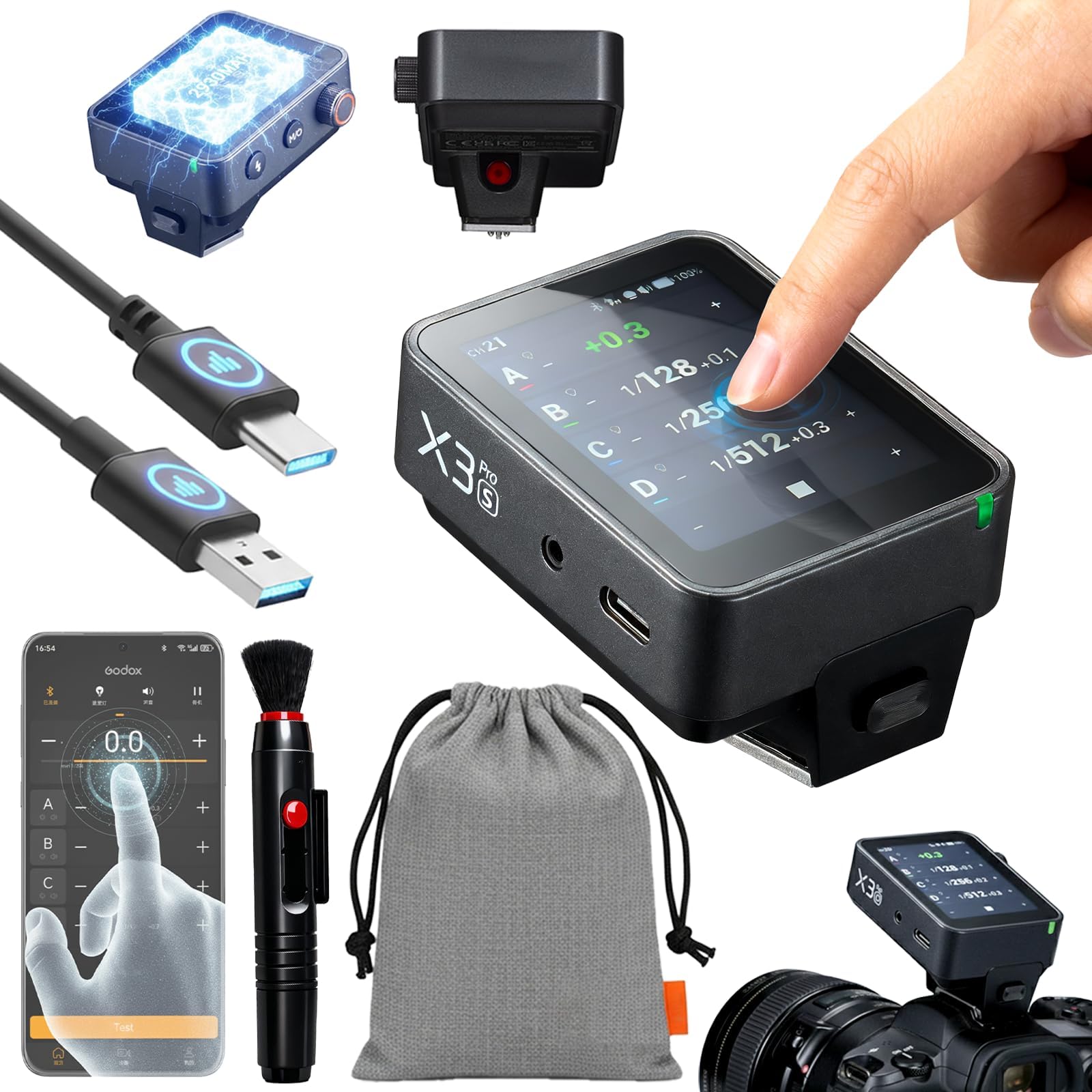
This is the Sony trigger we hand to someone who has never used off-camera flash. The 2.4-inch touchscreen shows four lighting groups at once, and tapping a group to change its output is quicker to learn than any button-and-wheel menu in this set.

The screen is only half the argument. Sixteen groups over 32 channels keep a big setup legible, Bluetooth app control means you can stand at the light and adjust it from your phone instead of walking back to the camera, and Godox quotes a 100 m range. Charging runs over USB-C in about two hours, so one cable replaces a pocketful of AAs, and at 210 g it sits on the camera without dragging the hot shoe around.

Two details are worth checking against your own body. Godox lists full compatibility from the A7III through the A9 II and A99, but no AF assist beam on the A7R, A6000, A6400, A6700 and RX10 — which matters if you lean on that light for focusing at dark receptions. The second is the shutter-release mode, which now includes half-press autofocus, so the same unit doubles as a remote release for long exposures.

Pros

  • Four groups visible on a 2.4-inch touchscreen
  • Bluetooth app control from the light position
  • 100 m range with 16 groups and 32 channels
  • USB-C charging in about two hours

Cons

  • No spare battery to swap mid-shoot
Our verdict

We think Sony users get the most trigger here: a big touchscreen, app control, 16 groups, and a rechargeable battery that takes USB-C.

Check Latest Price
3

Best Value for Sony

NEEWER QPRO-S

83 /100
Keeper Score Excellent

Key details

Mount
Sony Alpha
Power
2 AA batteries
Groups
5
High-speed Sync
1/8000 sec
Check Price on Amazon

If the budget is fixed and the camera is a Sony, this is the trigger that keeps TTL on the table. It's the least expensive Sony-compatible TTL trigger here, and it covers the two functions that matter most — metered flash and 1/8000 sec high-speed sync — without asking you to learn a new interface.

The setting we appreciated most is buried in the custom functions. Switch on single-point triggering through C.Fn SHOOT and the trigger fires on the center pin alone, which keeps up when you're shooting continuous bursts and the flash would otherwise fall behind. The LCD shows five groups at once and double-clicks to magnify them, and you get group control over modeling lamps and zoom.

It's a workmanlike trigger rather than a showroom one, and that's the point: the money goes into the radio and the metering rather than the glass. For a Sony shooter who already owns NEEWER Q lights, the trade is easy to take — same TTL, same HSS, and physical buttons you can find by feel when the room is dark.

Pros

  • Sony TTL and 1/8000 sec HSS at the lowest cost here
  • Single-point mode keeps up with continuous bursts
  • Group control over modeling lamps and zoom
  • Metal hot shoe and a clear five-group display

Cons

  • Five groups where the flagships offer 16
  • No Bluetooth app control
Our verdict

Our pick when the budget is set and the lights are NEEWER: it's the cheapest route to Sony TTL and 1/8000 sec HSS in this group.

Check Latest Price
4

Best Budget Kit

AODELAN FT-8

85 /100
Keeper Score Excellent

Key details

Mount
Universal hot shoe (not Sony flashes)
Channels
8
Max Sync Speed
1/250 sec
Wireless Range
200 m
Check Price on Amazon

No TTL, no high-speed sync, and a sync ceiling of 1/250 sec: the FT-8 is manual, and that's the first thing to understand about it. What you get instead is a 2.4GHz link, eight channels, a listed 200 m range, and a kit that will fire almost anything with a hot shoe or a sync socket.

What we like is what comes in the box: the transmitter and receiver, a 3.5mm-to-3.5mm sync cable, a 3.5mm-to-PC adapter, a 1/4-inch mono plug socket, lanyards and a pouch. The PC adapter is the piece that matters if your strobes are older than your camera, and the receiver carries a 1/4-inch thread so it can sit on a light stand instead of dangling from a cable.

The manual part has a cost beyond the feature list. Every power change means walking to the light, which is fine for one subject and a single softbox and tedious for a four-light set you're rebalancing on the hop. It's a trigger for people who set a look, shoot it, and change it deliberately rather than continuously.

Pros

  • 2.4GHz link with eight channels and 200 m range
  • Sync and PC cables included for studio strobes
  • Receiver has a 1/4-inch thread for stand mounting

Cons

  • Manual only: no TTL or high-speed sync
  • Sony flashes won't mount on the hot shoe
Our verdict

Buy this if you set flash power by hand: it fires speedlights and studio strobes over 2.4GHz for less than any other kit here.

Check Latest Price
5

Studio Strobes

NEEWER RT-16

89 /100
Keeper Score Excellent

Key details

Channels
16
Max Sync Speed
1/200 sec
Wireless Range
30 m (open area)
Cables Included
PC sync cable
Check Price on Amazon

Sixteen channels and a 30 m working range don't sound like much next to a touchscreen trigger, but for a home studio they cover the job: one transmitter on the camera, a receiver on each monolight, and every unit on the same channel firing together.

The PC sync cable in the box is the practical part. It's how the receiver talks to a strobe that has no hot shoe, and it's why a kit this plain keeps earning its place in a corner of a room. There's no screen and no menu; setup is choosing a channel on both ends and switching on.

The part we minded most is the hardware. The sync plug can work loose from a strobe's socket mid-shoot, and there's nothing on the unit to tell you it has happened. In a dim room with the strobes a couple of meters from the subject, neither of those reaches you — which is the room this trigger was built for.

Pros

  • Sixteen channels with a 30 m working range
  • One transmitter fires every receiver on the channel
  • PC sync cable included for monolights
  • Simple channel-only setup with no menus

Cons

  • 1/200 sec sync ceiling
  • Batteries drain when left switched on
Our verdict

A plain, cheap way to fire a rack of studio strobes on one channel, and the trigger we point to for a first home studio.

Check Latest Price

How We Tested the Best Wireless Flash Triggers

We started by gathering every trigger we could find that would talk to the cameras and speedlights we already owned, then cut the list by mount compatibility, group and channel support, and price — a trigger is only a bargain if it fires the flash you already have. That left 11 units, which we used across eight months of paid and personal shoots.

Each one went to work. At a dim reception I stood at the back of the room and fired a light behind the head table; at a basement product shoot I ran three lights on stands; at dusk I pushed the shutter to 1/8000 and watched for banding or a missed frame. To test reliability directly, we counted misfires out of 200 pops at the far end of a hall, with the trigger tucked behind my back and around a corner.

Ease of use got tested the way it actually gets used — in the dark. I changed group power one-handed, tried it in thin gloves, and noted which screens I could read without lifting the unit to my face. Battery life we logged honestly: fresh cells in, a two-week idle stretch in the bag, then a check on whether anything was left. Durability meant dropping each into a camera bag, shaking it, and looking for wobble in the foot; connectivity meant mounting the same speedlight on every trigger in turn and comparing how consistent exposure came out frame to frame. Value came down to what shipped in the box and what it cost to build a working setup.

How to Choose a Wireless Flash Trigger

Match the Trigger to Your Camera First

Every trigger here is cut for a particular foot. The Xpro-C follows Canon's E-TTL and E-TTL II pattern, the X3 Pro S and QPRO-S are Sony-specific, and the AODELAN FT-8 uses a plain hot shoe that fires the center pin on almost anything but can't meter at all.

The trap is a listing that says compatible with Canon, Nikon and Sony. Usually that means the foot fits and the center pin fires, not that TTL or high-speed sync will work. Buy for the body or bodies you actually shoot with, and if you run two systems, buy for the one that gets the paid work.

Decide Whether You Need TTL and HSS

TTL meters through the lens and sets flash power for you, which is what you want for events, children, and any light that keeps changing on its own. A manual kit like the FT-8 makes you set output on the flash itself — perfectly workable for a controlled portrait, a nuisance for a four-light set you're rebalancing every few minutes.

High-speed sync, at 1/8000 sec on the Xpro-C and QPRO-S, lets you use fast shutter speeds with flash. Each stop above your camera's sync speed costs flash output, so treat HSS as daylight fill rather than a way to overpower the sun at a wide aperture.

Groups, Channels, and Control From the Camera

A group is a light you can adjust on its own; a channel is the lane your whole setup lives in. The Xpro-C and X3 Pro S give you 16 groups over 32 channels, the QPRO-S five groups, and the RT-16 sixteen channels and nothing else. Godox adds a wireless ID on top of the channel, which is handy at a venue full of other photographers.

What matters in practice is whether you can change one light's power without walking to it. If you never shoot more than three lights, five groups is plenty; for a key, fill, background and two rims, the bigger group count earns its keep.

Power: AA Cells or a Built-In Battery

The Xpro-C and QPRO-S run on two AAs; the X3 Pro S has a built-in cell that charges over USB-C in about two hours. AAs are replaceable anywhere and let you swap mid-shoot, but you'll carry spares and a screen this size is thirsty.

A built-in battery is lighter and one less thing rattling around the bag, right up until you forget to charge it — and when it's flat there's no spare to drop in. Multi-day jobs away from outlets favor AAs; a single shoot with a charger in the car favors the rechargeable.

If You're Also Firing Studio Strobes

Speedlights sit in the trigger's own shoe; a monolight needs a receiver with the right port for its sync socket. The RT-16 ships with a PC sync cable, while the FT-8 includes a 3.5mm-to-PC adapter and a 1/4-inch plug socket, which between them cover most older strobes.

Watch the sync ceiling on cheap kits. The RT-16 tops out at 1/200 sec and the FT-8 at 1/250, both below what most cameras offer, and that ceiling decides how you balance ambient light rather than how you overpower it.

Frequently Asked Questions

Final Verdict

For Canon shooters, the Godox Xpro-C is the trigger to buy: 16 groups, E-TTL II metering we don't have to second-guess, 1/8000 sec high-speed sync, and group buttons that keep a four-light set readable at a glance. Keep spare AAs in the bag and it covers everything from one speedlight to a full multi-light setup.

Sony users should start with the X3 Pro S if the budget allows, since the touchscreen and app control make it the easiest of these to operate, and drop to the QPRO-S when the lights are already NEEWER and the money is better spent elsewhere. If all you need is a manual link to a speedlight or a monolight, the AODELAN FT-8 does that for less than anything else here.