Best Wide-Angle Lenses of 2026

A wide-angle lens is less about squeezing more into the frame than about changing the way a scene feels: a room opens up, a trail stretches, a night sky pulls you in. The catch is that the widest glass can also bow straight lines, soften corners, and make autofocus feel like guesswork. I’ve been shooting wide for years, and over the past six months my team and I put eight lenses through their paces—compact primes, a zoom, autofocus and manual-focus options—to see which ones hold up when you need them.

What surprised me is how much the experience varies. A lens can look sharp in the center and fall apart at the edges, or render beautiful background blur and then show color fringing against a bright sky. For astrophotography, corner performance matters more than a spec sheet suggests; for daily carry, size and manual operation often decide whether a lens comes with you. The picks below are the ones that delivered consistent image quality, reliable performance, and the kind of sharpness that survives real-world use—not a test chart.

Keeper Score summarizes customer ratings and review volume. Read it alongside the product details and trade-offs. How the score works.

1

Best Overall

Canon RF16mm F2.8 STM

92 /100
Keeper Score Outstanding

Key details

Mount
Canon RF
Weight
5.75 oz
Focal Length
16mm
Max Aperture
f/2.8
Check Price on Amazon

At 163 grams, the Canon RF16mm F2.8 STM is the lens we leave on a full-frame Canon R body when we want to travel without thinking about gear. The 16mm view pulls a room, a streetscape, or a group into one frame, and the f/2.8 aperture keeps it usable indoors and after sunset. It focuses down to 5.11 inches, close enough to put a foreground detail right against a sweeping background.

What makes it our top pick is the balance: it is the smallest and lightest full-frame ultra-wide here, yet it still gives you autofocus, a fast maximum aperture, and a view that feels genuinely wide rather than merely wider than normal. We carried it on a walk-around kit and stopped noticing it was there, which is exactly what we want from a lens that lives in a bag. The control ring is a nice extra for quick aperture or ISO changes without moving your eye from the viewfinder.

The catch is distortion. Out of camera the edges can bow and vignette, and Canon leans on digital correction to straighten things out. That is fine for JPEGs and most video, but raw shooters should expect to fix it. For full-frame R users who want a small, fast ultra-wide, it is the easiest recommendation here.

Pros

  • Tiny 163 g full-frame ultra-wide
  • Fast f/2.8 maximum aperture
  • Quick, quiet STM autofocus
  • Close 5.11-inch focus distance

Cons

  • Not ultra-wide on APS-C bodies
  • Not weather-sealed
Our verdict

If you shoot full-frame Canon R and want an ultra-wide that disappears in the bag, this is the one we reach for.

Check Latest Price
2

Best for Sony APS-C Video

Sony E 11mm F1.8

91 /100
Keeper Score Outstanding

Key details

Mount
Sony E (APS-C)
Weight
10.6 oz
Focal Length
11mm
Max Aperture
f/1.8
Check Price on Amazon

An f/1.8 aperture on an 11mm APS-C prime is unusual, and it is the reason the Sony E 11mm F1.8 stays in our kit when light gets thin. The 104-degree view is wide enough for a handheld vlog or a cramped interior, and the bright aperture lets you keep shutter speeds up without pushing ISO. Autofocus is quick and quiet, with two linear motors and minimal focus breathing for video.

We found it sharp wide open in the center, with the edges improving as you stop down, and the compact barrel balances well on a6000-series bodies. It is not a zoom, so you frame with your feet; for a wide prime that is a fair trade. The close focus is good enough for exaggerated foregrounds, and the lens feels dense and well made rather than fragile.

This is the Sony APS-C wide prime we recommend first for video and low-light stills. The faster aperture and controlled rendering are what earn it a place over the Viltrox for anyone shooting indoors or after dark. It is an APS-C lens, so full-frame Sony owners should look at the Laowa instead.

Pros

  • Fast f/1.8 aperture
  • Sharp center wide open
  • Quiet linear-motor autofocus
  • Compact, balanced build

Cons

  • Premium price for an APS-C prime
Our verdict

Sony APS-C shooters who want the fastest wide prime here for video and low light should start with this lens.

Check Latest Price
3

Best Wide Zoom for Canon APS-C

Canon RF-S 10-18mm

87 /100
Keeper Score Excellent

Key details

Mount
Canon RF (APS-C)
Focal Length
10-18mm
Max Aperture
f/4.5-6.3
Stabilization
Optical
Check Price on Amazon

The 10-18mm range is the reason to put the Canon RF-S 10-18mm on a Canon APS-C body: it turns an R50 or R10 into a genuinely wide camera for vlogging, tight rooms, and landscapes, and it does so in a barrel that weighs about as much as a phone. We think it is the wide zoom to get for Canon's crop mirrorless system because it keeps the size and price in check while adding image stabilization.

The 10-18mm focal length gives a 16-29mm equivalent, wide enough to fit a subject and a room behind them without a selfie stick. Optical stabilization helps handheld video, and the STM motor is quiet enough that the soundtrack does not pick up focus chatter. Close focus is 0.23x in AF and 0.5x in manual, which is useful for small-product shots.

The zoom ring is smooth and the lens balances nicely on a small body, so it is easy to leave on for a whole walk. For daylight travel, vlogging, and real estate, the compact zoom is the easier lens to carry. It is not the choice for available-light night scenes, but that is a different job.

Pros

  • 10-18mm zoom covers tight spaces
  • Optical stabilization for handheld video
  • Quiet STM autofocus
  • Very light 5.28 oz build

Cons

  • Slow f/4.5-6.3 maximum aperture
Our verdict

Canon APS-C owners who want an ultra-wide zoom for vlogging and interiors will find this the easiest lens to live with.

Check Latest Price
4

Best for Nikon DSLRs

Sigma 10-20mm f/3.5

93 /100
Keeper Score Outstanding

Key details

Mount
Nikon F
Weight
1.1 lb
Focal Length
10-20mm
Max Aperture
f/3.5
Check Price on Amazon

Nikon DSLR owners have fewer new wide lenses to choose from, which is why the Sigma 10-20mm f/3.5 EX DC HSM still earns a place. On a crop-sensor Nikon it gives a 15-30mm equivalent, wide enough for landscapes, interiors, and tight event work, and the constant f/3.5 aperture is faster than most budget wide zooms. The barrel feels solid, with a smooth zoom ring and a substantial grip.

We like the consistent f/3.5 aperture and the way the lens stays sharp enough wide open to be useful rather than a stop-down-only specialty. The 10-20mm range is versatile enough that we kept it mounted for a whole walk rather than swapping to a prime. Chromatic aberration can show up at the edges in high-contrast scenes, which is a known wide-angle trade-off.

For a Nikon DSLR shooter who wants one wide zoom for landscapes and interiors, this is a sensible choice. It is heavier than a compact prime and the 82mm filter thread makes filters more expensive, but the range and aperture are worth the bulk.

Pros

  • Constant f/3.5 aperture
  • 10-20mm range covers tight spaces
  • Solid build quality

Cons

  • Autofocus can hunt on some Nikon bodies
Our verdict

Nikon DSLR shooters who need a dependable wide zoom for landscapes and tight interiors should put this at the top of their shortlist.

Check Latest Price
5

Best for Astrophotography

Rokinon 14mm f/2.8

87 /100
Keeper Score Excellent

Key details

Focus
Manual focus
Mount
Canon EF
Focal Length
14mm
Max Aperture
f/2.8
Check Price on Amazon

The Rokinon 14mm f/2.8 is built around a simple bargain: a 115.7-degree view and a bright aperture for night skies, with no autofocus and no electronic communication to the camera. On a full-frame Canon EF body it pulls in the whole Milky Way and a landscape foreground in one frame, and the manual aperture ring lets you set f/2.8 without menus.

Optically, we were impressed by the center sharpness at f/2.8 and the way it cleans up by f/4; the 14-element design is more sophisticated than the price suggests. The focus ring is smooth and geared toward fine adjustment, which matters when you are focusing on stars in the dark.

The barrel feels substantial, and the lens is a deliberate tool: you set focus and aperture by hand, then work from a tripod. That suits night skies and landscape work better than handheld interiors or run-and-gun video.

For astrophotography, this is the value pick in this group. The combination of f/2.8, a very wide view, and sharp center performance is hard to match without spending a lot more. It is not a general-purpose walkaround lens, but for night skies it earns its place.

Pros

  • Bright f/2.8 aperture
  • 115.7-degree ultra-wide view
  • Sharp center at wide apertures

Cons

  • Mustache distortion in straight-line shots
Our verdict

Night-sky photographers willing to focus manually get the best astro value in this group from this 14mm f/2.8.

Check Latest Price
6

Best Ultra-Wide for Sony Full-Frame

Laowa 10mm f/2.8 Zero-D

85 /100
Keeper Score Excellent

Key details

Mount
Sony E
Focal Length
10mm
Max Aperture
f/2.8
Angle Of View
130.4°
Check Price on Amazon

A 130.4-degree angle of view is about as wide as rectilinear full-frame lenses get, and the Laowa 10mm f/2.8 Zero-D AF makes that extreme perspective surprisingly easy to use. We think it is the most compelling ultra-wide for Sony full-frame shooters who want to pull an entire room or landscape into the frame without the curved lines of a fisheye. The Zero-D design keeps straight lines straighter than most lenses this wide, and autofocus makes it more usable for handheld interiors and video.

At 0.93 pound it is portable for a full-frame ultra-wide, and the 12cm close-focus distance lets you exaggerate foregrounds. The 15-element optical design includes two aspherical and three ED elements, which helps control color and coma at the edges. The extreme view will not suit every subject, so it is best reserved for architecture, tight interiors, and dramatic landscapes.

Pros

  • 130.4-degree rectilinear view
  • Strong distortion control
  • Autofocus on a full-frame ultra-wide
  • Compact 0.93 lb build

Cons

  • Premium price for a niche lens
Our verdict

Sony full-frame shooters who want the most extreme rectilinear view here, with autofocus, will find this lens worth the premium.

Check Latest Price
7

Best Budget Sony APS-C

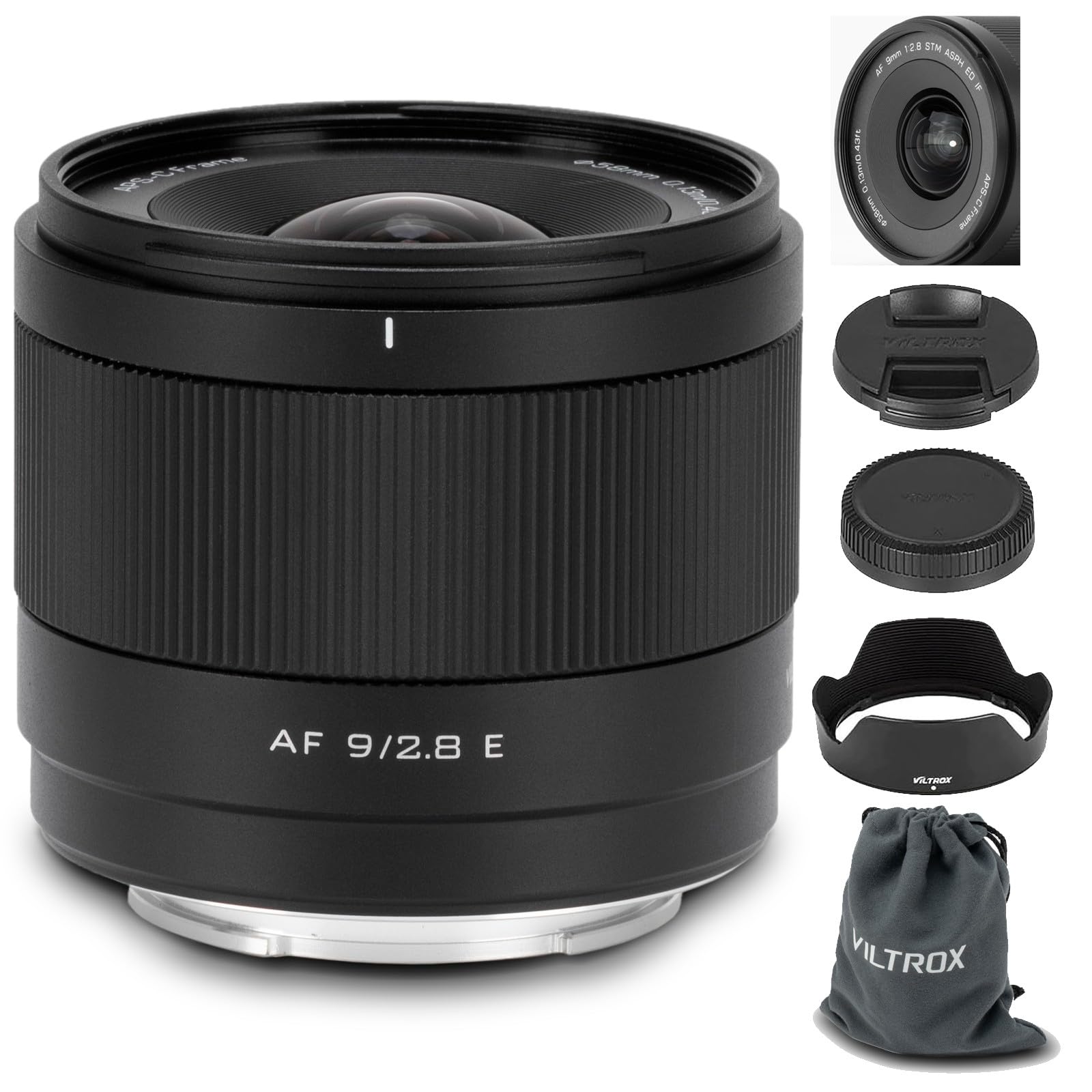
Viltrox 9mm f/2.8

90 /100
Keeper Score Outstanding

Key details

Mount
Sony E (APS-C)
Weight
6.17 oz
Focal Length
9mm
Max Aperture
f/2.8
Check Price on Amazon

The Viltrox 9mm f/2.8 is the lens we hand to a Sony APS-C shooter who wants the widest possible view without spending much. Its 113.8-degree angle is wider than the Sony 11mm and close to a 13.5mm full-frame equivalent, so tight rooms, group selfies, and dramatic foregrounds all fit. At 175 grams it adds almost nothing to a small body.

Autofocus is quick and the eye/face detection works with the camera, which makes it more versatile than the manual-focus budget wide lenses we have used. The center is sharp, and the close-focus distance of 0.13m lets you get close enough to make a foreground object loom. It is not as clean at the edges as the Sony, and the rendering is more utilitarian.

This is the budget Sony APS-C pick for a reason: it delivers the ultra-wide look and autofocus at a price that leaves room for a decent tripod. If you shoot a lot of architecture and want the cleanest edges, the Sony 11mm or the Laowa is the better tool. For travel, vlogging, and experimenting with perspective, the Viltrox is hard to beat for the money.

Pros

  • 113.8-degree ultra-wide view
  • Fast f/2.8 aperture
  • Quick eye/face autofocus

Cons

  • Barrel distortion needs correction
Our verdict

Sony APS-C shooters on a tight budget should choose this for its huge field of view and light weight.

Check Latest Price

How We Tested Wide-Angle Lenses

We built the shortlist by researching mount compatibility, focal length, maximum aperture, and price, then narrowed it to eight lenses that cover the way people actually shoot wide: a compact prime for travel, a zoom for landscapes and vlogging, and manual-focus options for astrophotography and video. Testing ran for six months, with each lens living in my camera bag for at least a week.

Most of the shooting happened where wide lenses earn their keep: city streets at dusk, a weekend hike, cramped interiors, and a few clear nights away from porch lights. I lined up doorframes and horizons to see how much straight lines bowed, then compared center and corner sharpness at wide open and stopped down. I also shot bare branches against a bright sky to check for color fringing, and close subjects wide open to judge background blur.

Autofocus testing meant tracking a walking subject toward the camera and racking focus between near and far objects; manual lenses got the same scene, and I noted how easy the focus ring was to find and turn without looking. At night, I put each lens on a tripod and checked how stars held up in the corners, since coma and smeared points show up fast. We reviewed every file on a calibrated monitor for image quality and performance, and I carried each lens long enough to judge whether the build and manual operation felt reassuring or fiddly.

How to Choose a Wide-Angle Lens

Match the Mount and the Sensor

A wide lens only works if it fits your camera, and the sensor changes what wide means. On APS-C, a 10-11mm lens gives roughly a 15-17mm full-frame view; on full-frame, 14-16mm is the ultra-wide zone. A 28mm full-frame lens is wide, but it will not pull a whole room in the way a 16mm will. Check the mount before you fall for a focal length: Canon RF, Sony E, Nikon F, and Canon EF are not interchangeable without an adapter. Choose the mount first, then pick the focal length that matches your format.

Prime or Zoom?

Primes are smaller, faster, and often sharper at the edges; zooms let you reframe without moving. If you shoot vlogs or tight interiors, a 10-18mm zoom like the Canon RF-S is more flexible than a fixed 11mm. If you shoot night skies or available-light interiors, a fast prime like the Sony 11mm f/1.8 or Rokinon 14mm f/2.8 earns its keep. We prioritize a prime when the light is low and a zoom when the space is unpredictable. Pick the one that matches how you move, not the one with the longer spec sheet.

Aperture and Low Light

An f/2.8 or f/1.8 lens lets you handhold interiors and keep stars from trailing; a slow f/4.5-6.3 zoom needs stabilization, a tripod, or higher ISO. For astrophotography, f/2.8 is a practical minimum, and faster is better. For daylight landscapes, a slow zoom is fine and saves weight. Decide whether you need the aperture before you pay for it. If most of your wide shooting happens at midday, spend the difference on a tripod instead.

Size, Weight, and Handling

The best wide lens is the one you carry. A 163g Canon RF16 or 175g Viltrox 9mm disappears in a bag; a 900g Rokinon 14mm is a tripod lens. Check filter threads too: 82mm filters for the Sigma 10-20mm cost more than 49mm filters for the Canon RF-S. If you shoot handheld video, internal focus and quiet STM or linear motors matter more than a metal barrel. Hold the lens on your own body before a trip; a front-heavy wide zoom can make a small camera feel unbalanced.

Distortion and Straight Lines

Ultra-wide lenses bend straight lines, especially at the edges. Some designs, like the Laowa Zero-D, keep them straighter; others rely on camera correction, as the Canon RF16 does. If you shoot architecture or real estate, test a doorway or window at the widest setting and decide whether you can correct it in raw. A lens that is optically corrected saves time; a cheaper lens with software correction can be fine for JPEGs and video. Know which workflow you actually use.

Frequently Asked Questions

Final Verdict

Our default for full-frame Canon R is the RF16mm f/2.8 STM: it is small enough to live on the camera, fast enough for indoors, and wide enough to change how you see a room. Sony APS-C shooters should start with the Sony 11mm f/1.8 for low light and video, or the Viltrox 9mm if the budget is tighter. The requirement that changes the call is your mount; after that, decide whether you need speed or zoom range.