Best Viltrox Lenses of 2026

The knock on budget glass used to be easy to sum up: soft wide open, slow to focus, plasticky in the hand. Viltrox has spent the past few years dismantling that — the lenses it ships now autofocus natively on Sony and Fuji bodies, hold their sharpness at the widest aperture, and cost a fraction of the first-party equivalent. The lens you'd talk yourself out of at full price is now one you can justify carrying every day.

I've carried a compact prime for years, and the first thing I check is never the spec sheet — it's whether autofocus can keep up with a friend's kid running at me. My team and I spent six months shooting with 12 of these lenses, and the gap between the good ones and the merely cheap ones is narrower than the price tags suggest.

Worth knowing before you scroll: focal length matters more than the aperture printed on the barrel. A bright 85mm and a bright 35mm solve different problems, and the pancake wides are a different purchase again. Here's what earned a spot in the bag.

Keeper Score summarizes customer ratings and review volume. Read it alongside the product details and trade-offs. How the score works.

1

Best Overall

Viltrox AF 35mm F1.7 E

89 /100
Keeper Score Excellent

Key details

Mount
Sony E (APS-C)
Weight
6 oz
Focal Length
35mm
Max Aperture
f/1.7
Check Price on Amazon

A 35mm prime on Sony APS-C lands in the standard-view sweet spot: wide enough for street scenes and environmental portraits, tight enough to separate a subject when you open the aperture. The f/1.7 maximum is the part that makes the lens worth carrying after dark, and the 9-blade diaphragm gives out-of-focus highlights a rounder shape than a cheaper kit lens manages. We think this is the most broadly useful lens in this group for a first upgrade.

At 170g, it barely changes the balance of a small body like an a6700 or ZV-E10, and the 52mm filter thread is a practical size to share with other lenses. The 11-element formula includes two high-refractive, one ED, and one aspherical element, which is a serious optical layout for a budget prime. Sharpness wide open is one of its strongest traits in this set, and the STM motor is quick and quiet enough for casual video; Viltrox also tunes it to keep focus breathing low.

The catch is coverage: this is an APS-C lens, so a full-frame Sony body crops it. That is not a flaw for the a6000-series buyer it is built for, but it is the reason the full-frame 35mm f/1.8 II EVO exists. If you want one lens that stays on the camera for everyday photos, this is the one we point to first. The 52mm thread also matches the 20mm f/2.8 FE, so one filter set can cover two lenses in this guide.

Pros

  • Keeps low-light shots handheld at f/1.7
  • Easy all-day carry at 170g
  • Sharp wide open
  • Smooth, quiet video autofocus

Cons

  • No weather sealing
Our verdict

For Sony APS-C shooters who want one small, fast prime to leave on the camera, this is the Viltrox we recommend first.
Check Latest Price
2

Best for Full-Frame Ultra-Wide

Viltrox AF 16mm F1.8 FE

89 /100
Keeper Score Excellent

Key details

Mount
Sony FE
Filter Size
77mm
Focal Length
16mm
Max Aperture
f/1.8
Check Price on Amazon

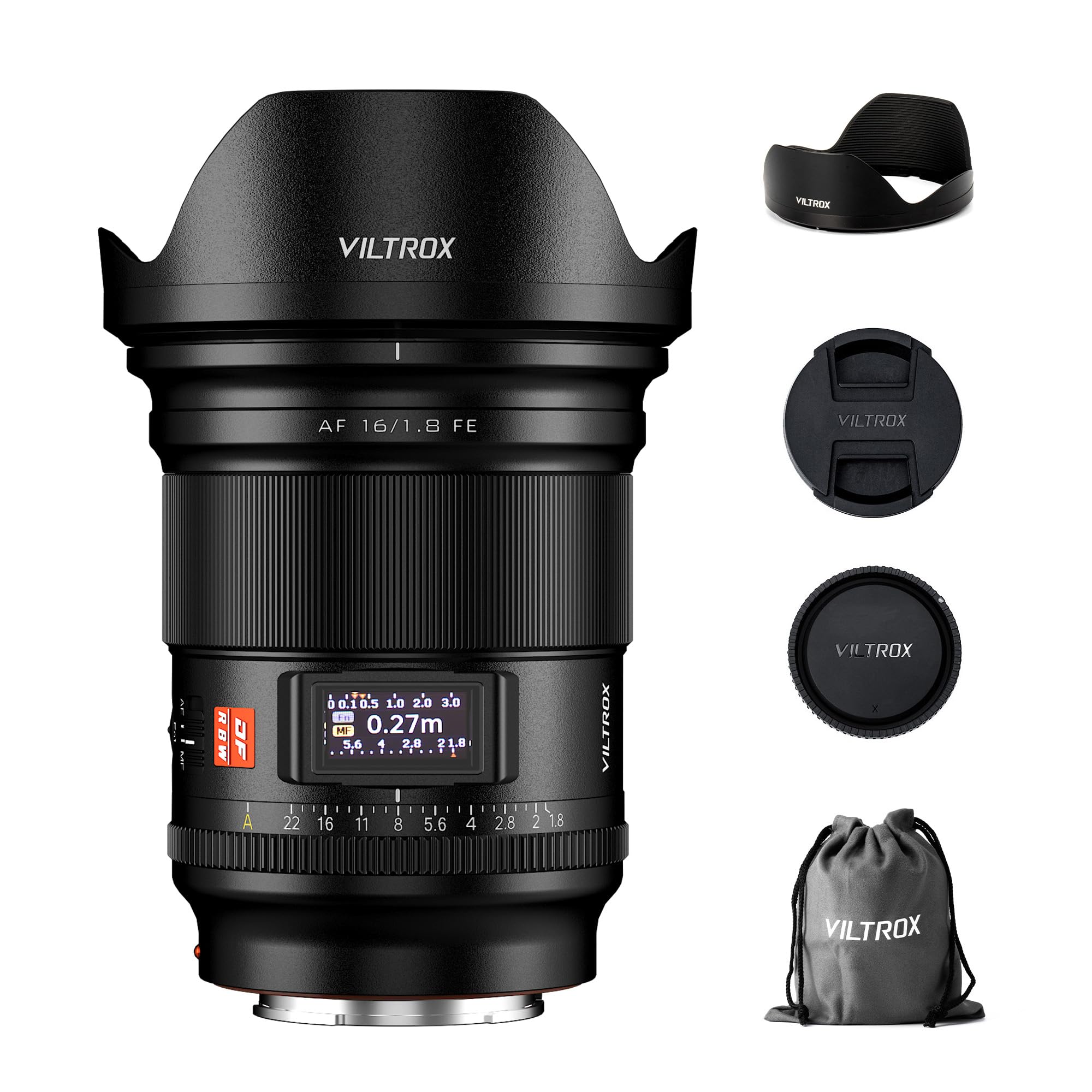
The built-in LCD is the first thing that separates this 16mm from the rest of the wide-angle pack. It shows aperture and focus distance on the barrel, which saves a trip to the camera menus when the camera is on a gimbal or low to the ground. Pair that with an f/1.8 aperture on a full-frame lens and you have a wide-angle that works indoors without pushing the ISO.

We think the combination earns its premium price: the 15-element, 12-group formula includes three aspherical elements, and the STM motor is built for smooth focus pulls rather than snap-and-hunt stills. In this set, it is the most capable full-frame ultra-wide for low light. The wide view puts a lot in the frame, but the lens still takes 77mm filters, so a polarizer or ND set is a real expense to plan for.

The 16mm is the one to pick when the room is the subject: architecture, tight interiors, or a vlog frame that needs width and a bright aperture at the same time. It is not the smallest or cheapest wide here, but it is the most complete video tool of the group. The 14mm f/4.0 is the budget alternative when f/1.8 is not worth the extra cost.

Pros

  • Handles dim interiors at f/1.8
  • LCD shows settings at a glance
  • Fast focus for stills and video
  • 77mm filters are easy to find

Cons

  • No weather sealing
Our verdict

A full-frame ultra-wide with a bright f/1.8 aperture and a useful top-plate LCD, this is the Viltrox to choose for interiors, architecture, and low-light video.

Check Latest Price
3

Best for Portraits

Viltrox AF 85mm F1.4 Pro FE

89 /100
Keeper Score Excellent

Key details

Mount
Sony FE
Filter Size
77mm
Focal Length
85mm
Max Aperture
f/1.4
Check Price on Amazon

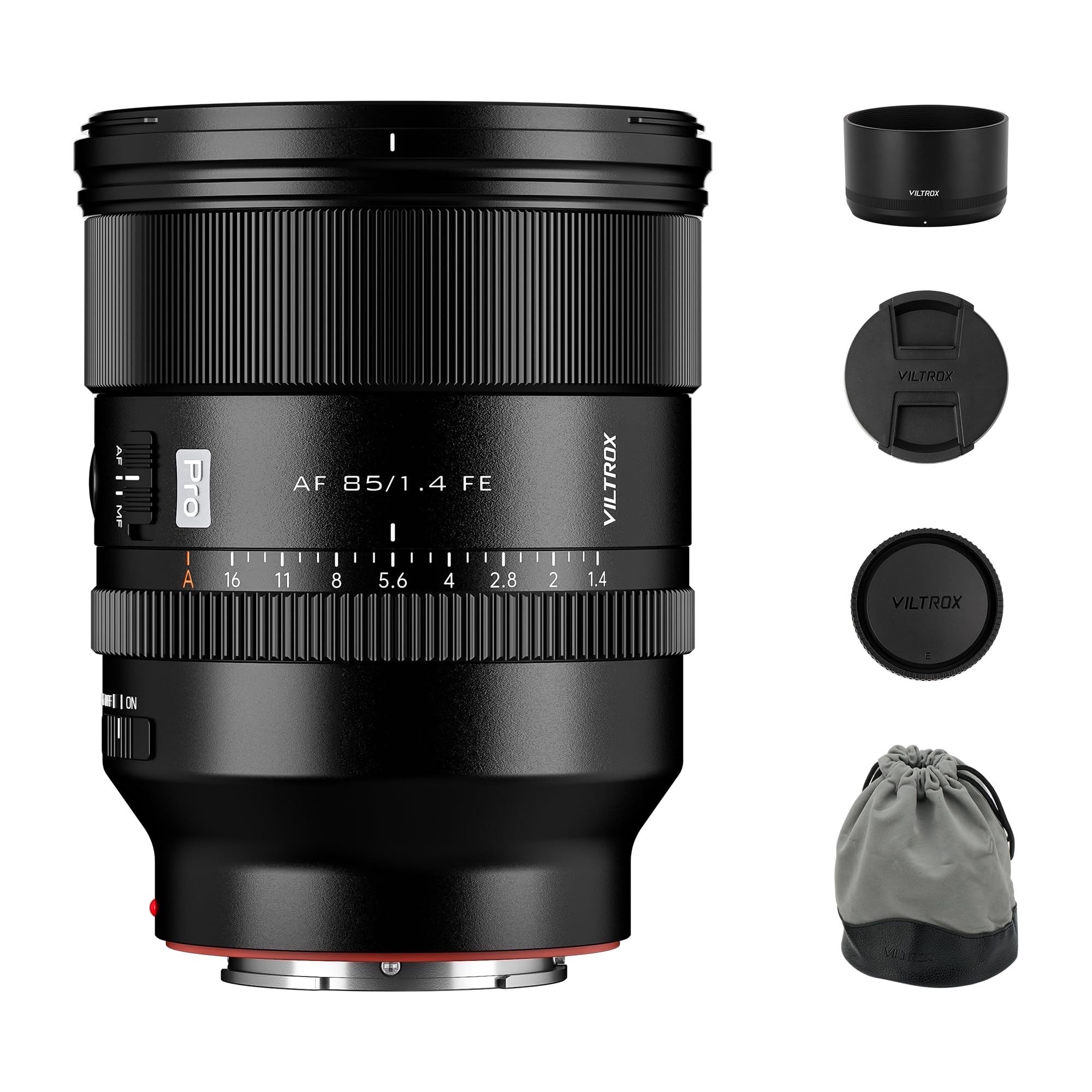
The 85mm f/1.4 Pro is built around the two things a portrait lens needs most: a wide aperture and focus motors that can keep up with a moving face. Viltrox uses dual HyperVCM motors here, a step up from the STM units in the cheaper glass, and the 11-blade diaphragm is there to keep highlights round when you open up. The result is a lens that looks the part on a full-frame Sony body.

The control set is as serious as the glass. There is a stepless aperture ring with a click switch, a customizable Fn button, and an AF/MF toggle, which is the kind of layout that lets you change settings without moving your eye from the finder. Weather sealing at the mount and a 15-element, 11-group optical formula round out the pro brief. For portraits, the 85mm view compresses features gently and the f/1.4 aperture gives you room to blur a busy background.

We think the f/1.4 aperture and dual motor are what justify the premium over the 85mm f/2.0 EVO: the extra stop gives more room in low light, and the weather sealing makes it the portrait lens to take outdoors. It is still a specialized lens, not a walkaround, because 85mm is tight indoors. If the portrait is the assignment, this is the one in this group that fits the brief.

Pros

  • Blurs busy backgrounds at f/1.4
  • Dual motors track moving faces
  • Weather sealing for outdoor shoots
  • Clickless aperture for video

Cons

  • No optical stabilization
Our verdict

The portrait lens in this group: f/1.4, weather sealing, and a pro control set make it the choice when the face is the subject and the background should fall away.

Check Latest Price
4

Best Full-Frame Everyday Prime

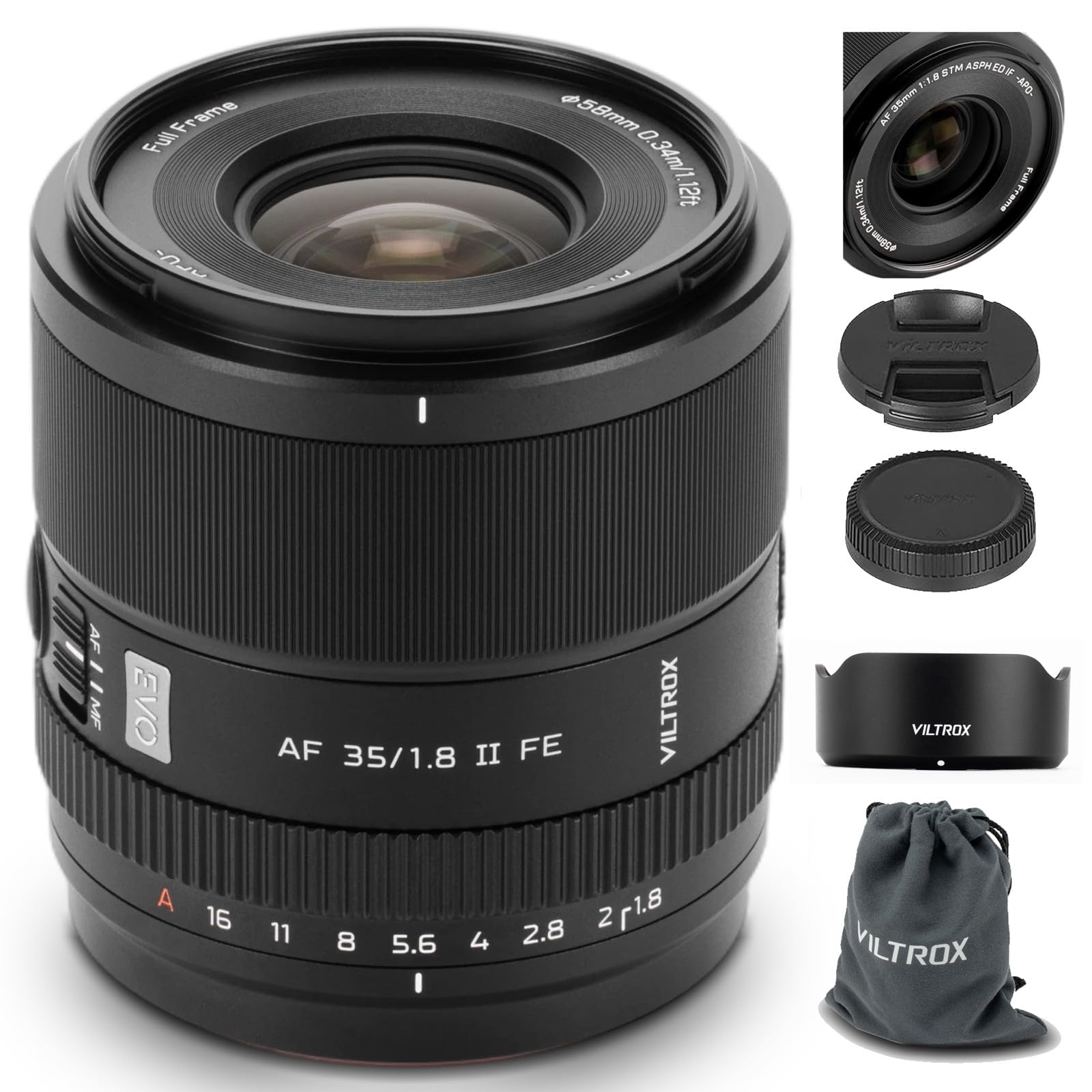
Viltrox AF 35mm F1.8 II EVO FE

90 /100
Keeper Score Outstanding

Key details

Mount
Sony FE
Weight
11.6 oz
Focal Length
35mm
Max Aperture
f/1.8
Check Price on Amazon

Full-frame 35mm is the classic documentary focal length, and the APO designation is the reason to pay attention here. The 13-element, 10-group design uses two ED, three high-refractive, and one UA element to chase color fringing, which is the kind of correction that matters more in backlit street scenes than on a test chart. At 330g, it is still a lens you can carry all day without thinking about it.

We prefer this as the full-frame counterpart to the 35mm f/1.7 E: the APS-C lens is smaller and cheaper, while this one covers the whole sensor and adds a physical Fn button, a click switch, and an AF/MF toggle. The f/1.8 aperture is a stop slower than the f/1.4 portrait lenses here, but for a 35mm it is a sensible balance of size and low-light ability. The 0.34m minimum focus distance also lets you get close enough for detail shots.

The 330g body is the weight you accept for full-frame coverage and the APO glass; it is noticeably heavier than the 170g APS-C 35mm. That is the trade-off, not a dealbreaker, because the lens still packs smaller than a zoom. The 58mm filter thread also matches the 85mm f/2.0 EVO, so one polarizer covers both.

Pros

  • APO glass fights color fringing
  • Natural full-frame 35mm framing
  • Fn and AF/MF controls
  • Gets close at 0.34m

Cons

  • No optical stabilization
Our verdict

A compact full-frame 35mm with an APO optical formula and a useful control set, this is the everyday Viltrox for Sony full-frame shooters who want one lens for people and places.

Check Latest Price
5

Best Value Portrait

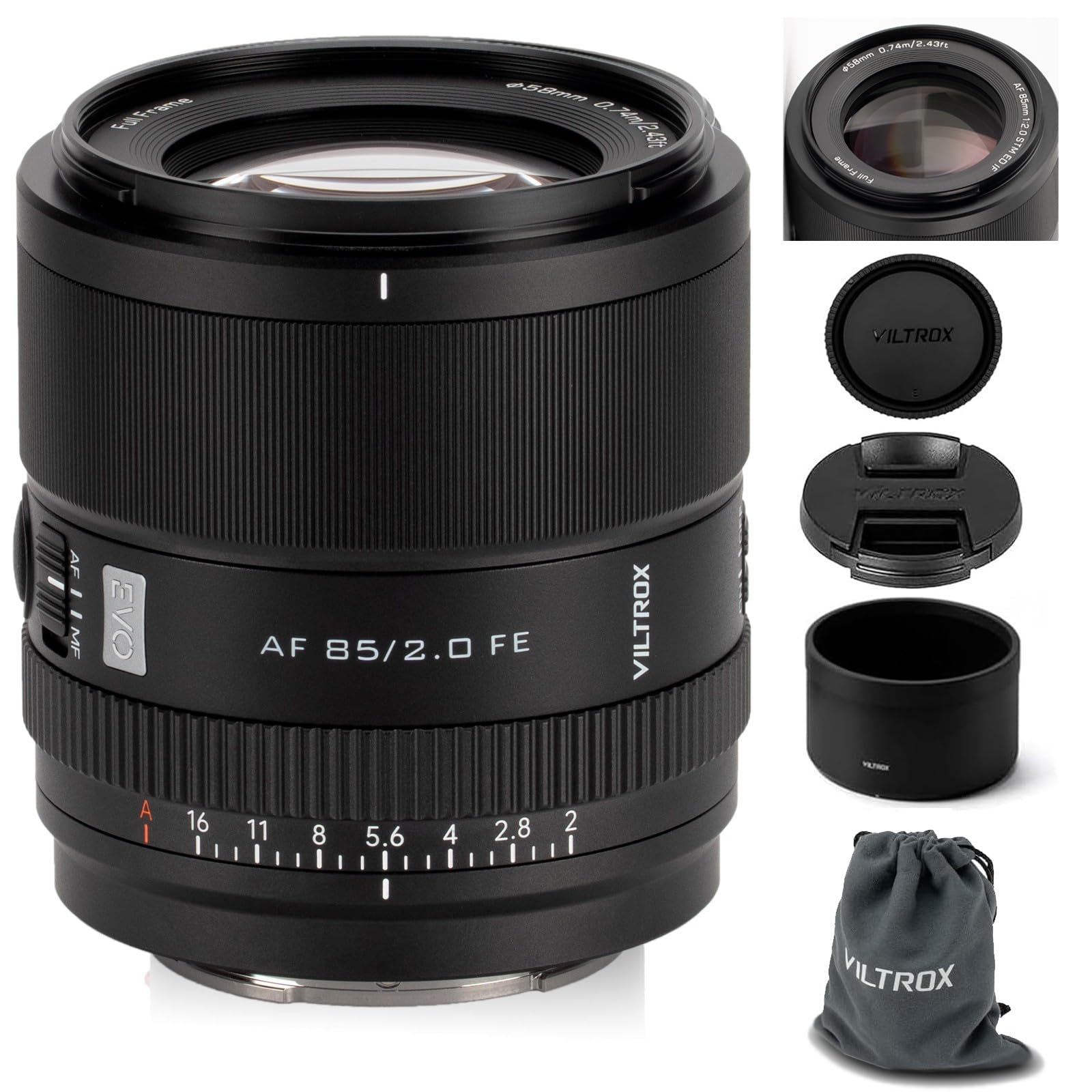
Viltrox AF 85mm F2.0 EVO FE

90 /100
Keeper Score Outstanding

Key details

Mount
Sony FE
Focal Length
85mm
Max Aperture
f/2.0
Minimum Focus
0.74m
Check Price on Amazon

The 85mm f/2.0 EVO makes the case that a portrait lens does not need f/1.4 to be useful. A stop slower than the Pro, it is also built with a weather-resistant mount seal and a water- and oil-repellent front element. That is the kind of spec that matters when a portrait session runs into a drizzle or a dusty outdoor location.

We think the f/2.0 aperture is the right trade for most people. You still get shallow depth of field at portrait distances, and the nine-blade diaphragm keeps the blur smooth. The 0.74m minimum focus distance is closer than many 85mm lenses, which gives you more room for tight headshots and detail shots without switching glass. Add the Fn button, click switch, and AF/MF toggle and the handling is closer to a pro lens than the price suggests.

The Pro version is the step up when you need the extra stop of light, the dual HyperVCM motor, or the 11-blade aperture. For everyone else, this is the portrait lens that leaves more budget for a second focal length. The 58mm filter thread is another practical touch.

Pros

  • Weather sealing for outdoor portraits
  • Shallow depth at f/2.0
  • Closer focus than many 85s
  • Useful Fn and click controls

Cons

  • No optical stabilization
Our verdict

The smarter portrait buy for most Sony full-frame shooters: f/2.0, weather sealing, and a close 0.74m focus distance for well below the Pro lens's price.

Check Latest Price
6

Best Full-Frame Pancake

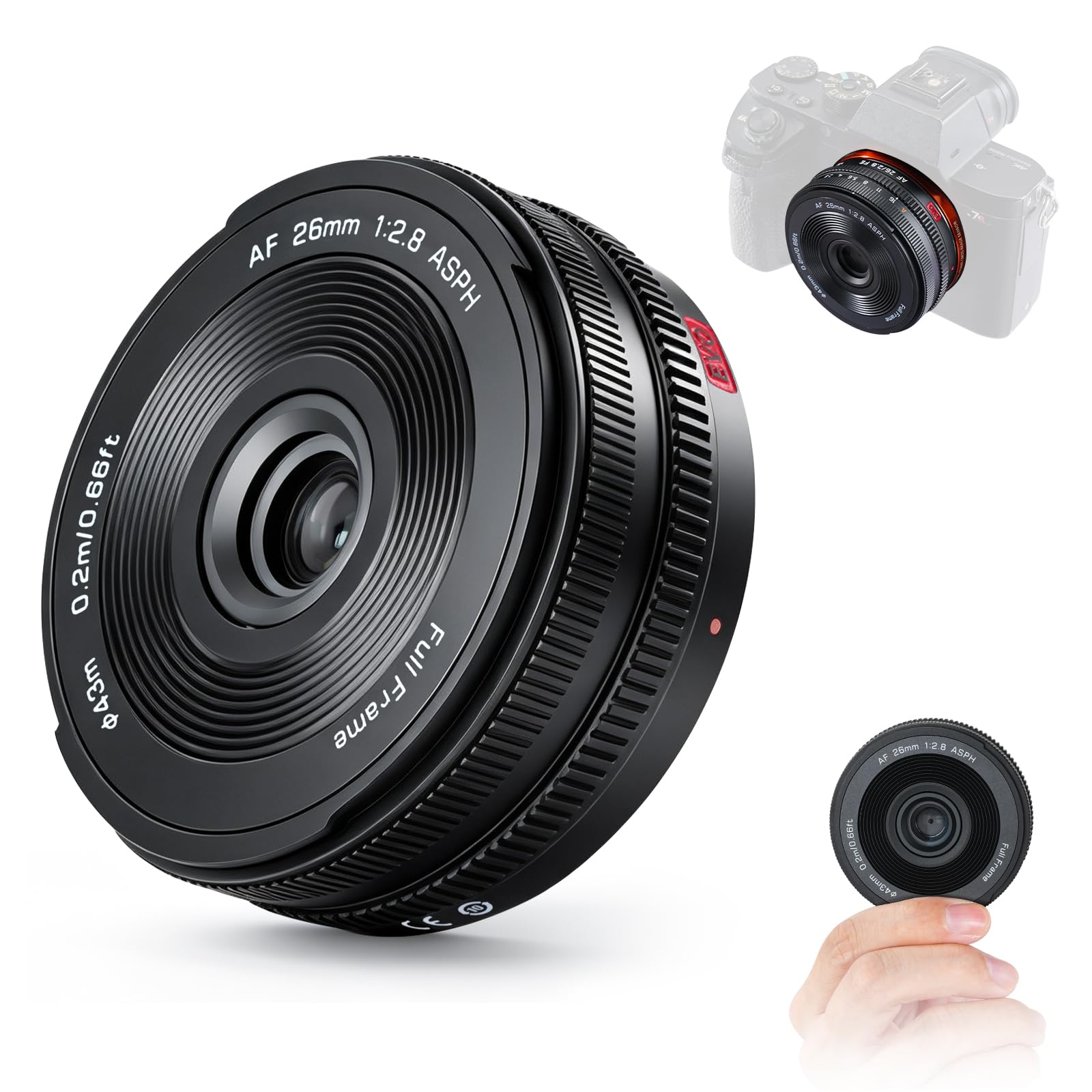
Viltrox AF 26mm F2.8 EVO

91 /100
Keeper Score Outstanding

Key details

Mount
Sony FE
Weight
4.87 oz
Focal Length
26mm
Max Aperture
f/2.8
Check Price on Amazon

The 26mm f/2.8 EVO is only 23.8mm deep and 138g, which is the whole point: it turns a full-frame Sony into something you can slip into a bag without a dedicated camera pouch. The 66mm barrel diameter keeps it from feeling like a novelty, and the 43mm filter thread is small enough to forget about.

The control set is what separates it from a bare-bones pancake. There is a dedicated aperture ring and a focus ring, plus a magnetic lens cap that stays handy instead of rolling loose in a pocket. The geared STM motor is designed to be quiet and fast while keeping the barrel compact.

The 8-element, 6-group design uses one HR and two UA aspherical elements, which is a simple but targeted layout for a wide-normal pancake. The 26mm view is close to a 39mm equivalent on APS-C, but on full frame it is a natural wide angle for street and documentary work.

We like it best as a second lens for a full-frame body, the one you take when the camera is coming along anyway. The 26mm view is wider than a standard 35mm, which suits street scenes and interiors. That is a fair swap for the size, and the magnetic cap is a nice detail, though keep the conventional rear cap handy.

Pros

  • Pocketable 138g full-frame carry
  • Real aperture and focus rings
  • Slim 23.8mm barrel
  • Magnetic cap stays handy

Cons

  • F/2.8 aperture limits low light
Our verdict

A 138g full-frame pancake with real aperture and focus rings, this is the Viltrox that makes a Sony body feel like a compact point-and-shoot without giving up full-frame coverage.

Check Latest Price
7

Best for Fujifilm Travel

Viltrox 28mm F4.5 XF

85 /100
Keeper Score Excellent

Key details

Depth
15.25mm
Mount
Fujifilm X
Focal Length
28mm
Max Aperture
f/4.5
Check Price on Amazon

The sliding cap is the detail that makes the 28mm f/4.5 XF feel different from every other pancake here. A lever turns the cap into a lens hood and dust cover, so you can leave it on between shots instead of fishing for a plastic cap in your pocket. At 15.25mm deep, the lens barely adds a hump to an X-Pro or X-T body.

The 28mm view behaves like a 42mm-equivalent lens on Fujifilm X, wide enough for a street scene but not so wide that every person in the frame looks stretched. The 60g weight makes it easy to carry, and the 0.34m minimum focus distance lets you get close to details. Autofocus uses a VCM motor, the quiet, quick type you want for candid work.

We like it as a one-lens Fujifilm travel kit: the 42mm-equivalent view is wide enough for streets and interiors without stretching faces, and the 60g body disappears on an X-T or X-Pro. The 60mm filter thread is easy to find, and the slide cap means you can leave the hood at home. The fixed f/4.5 aperture is the trade, so this is a daylight lens rather than a low-light one.

Pros

  • Barely there at 60g
  • 15.25mm thick on the body
  • Slide cap doubles as a hood
  • 42mm-equivalent travel view

Cons

  • Not weather-resistant
Our verdict

A 15.25mm-thick, 60g Fujifilm pancake with a slide cap and a useful 42mm-equivalent view, this is the lens to keep on an X-body for street and travel.

Check Latest Price
8

APS-C Ultra-Wide

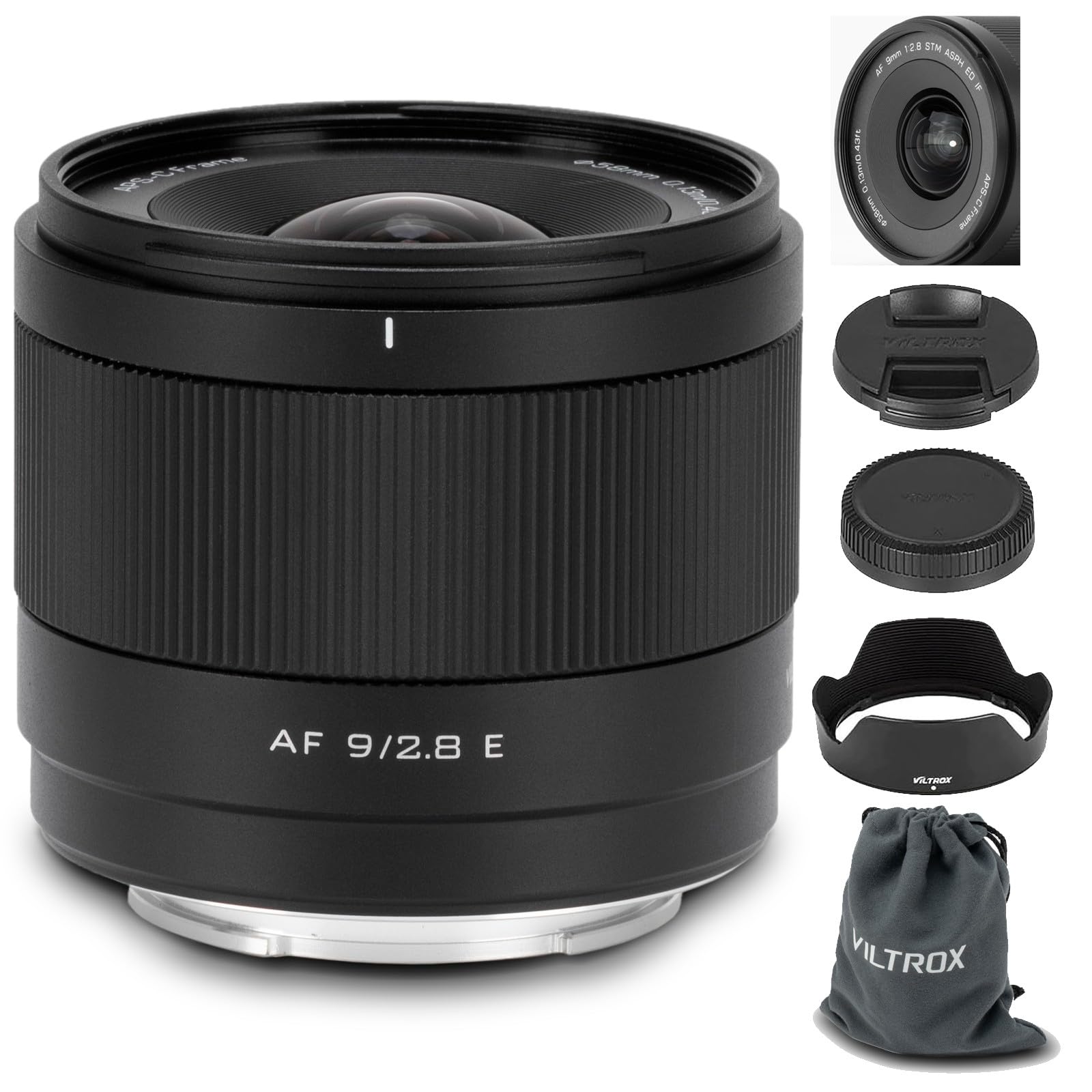
Viltrox 9mm F2.8 E

90 /100
Keeper Score Outstanding

Key details

Mount
Sony E (APS-C)
Focal Length
9mm
Max Aperture
f/2.8
Minimum Focus
0.13m
Check Price on Amazon

The 113.8° angle of view is the reason to look at the 9mm f/2.8. On Sony APS-C it behaves like a 13.5mm full-frame lens, which is wide enough to take in a small room, a whole car interior, or a vlog frame with the camera close enough to talk into. The 0.13m minimum focus distance adds the other half of the ultra-wide look: you can put a foreground object almost against the glass and let the background stretch away.

The lens is small and light at 175g, and the 58mm filter thread is a practical size for a wide-angle. The 13-element, 11-group formula uses two aspherical, three ED, and three high-refractive elements, which is a lot of correction for a budget ultra-wide.

The f/2.8 aperture keeps the lens compact and still gives you a usable shutter speed indoors. Autofocus is quick enough for casual video, and the STM motor is quiet. Bokeh is not the point of a 9mm lens, so do not choose it for background separation.

We like it best as the second lens for a Sony APS-C owner who already has a standard zoom and wants the wide end without a fisheye look. The 7-blade aperture and f/2.8 speed are there for available light, not for blur. If you shoot interiors or vlog in tight spaces, it is the most useful ultra-wide in this set for that job.

Pros

  • Fits whole rooms at 113.8°
  • Gets within 0.13m
  • Light 175g carry
  • Quiet STM for video

Cons

  • Not weather-sealed
Our verdict

The widest lens in this group: a 113.8° APS-C prime that makes tight interiors and vlog backgrounds fit, with a close 0.13m focus distance for exaggerated foregrounds.

Check Latest Price
9

Budget Ultra-Wide

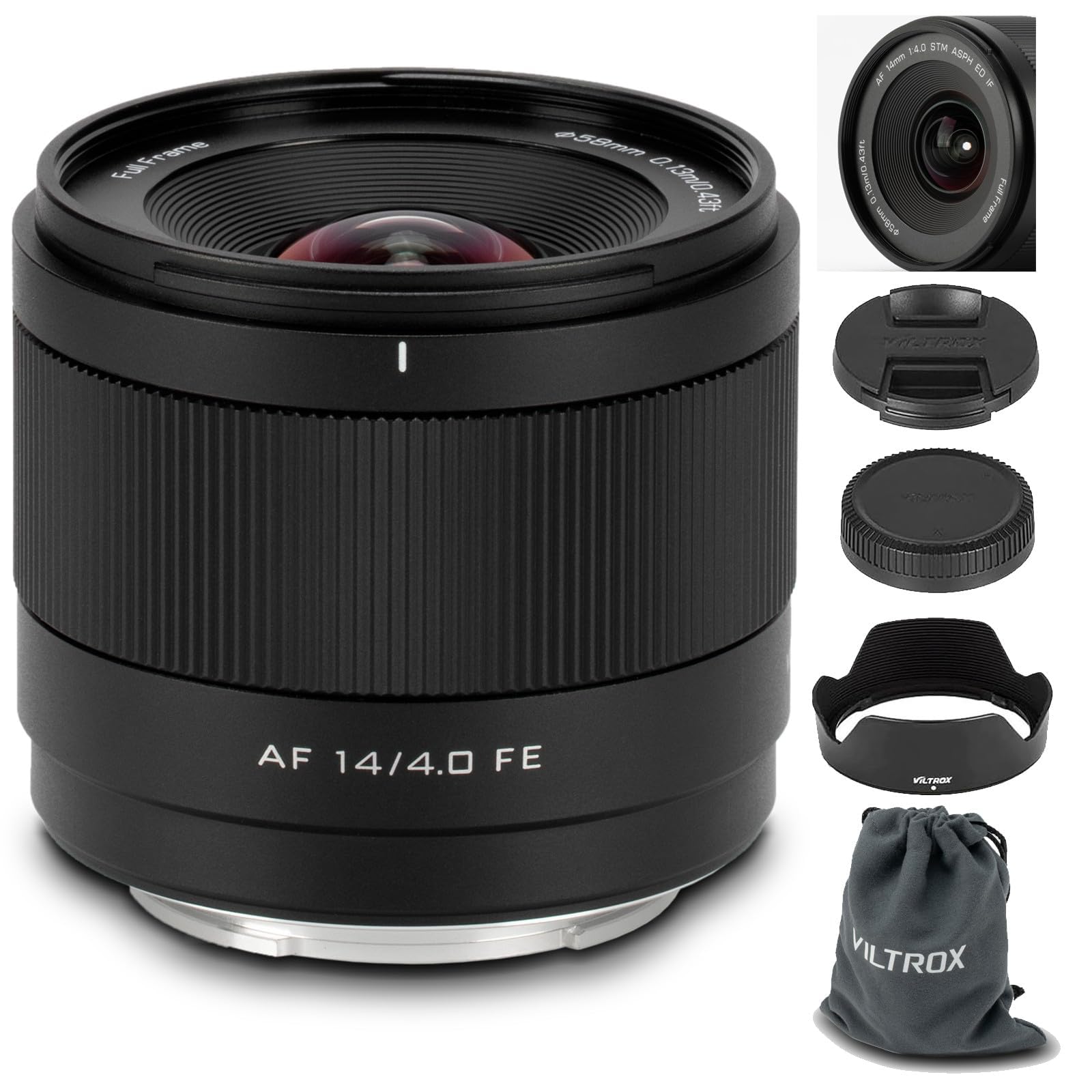
Viltrox 14mm F4.0 FE

90 /100
Keeper Score Outstanding

Key details

Mount
Sony FE
Weight
6 oz
Focal Length
14mm
Max Aperture
f/4.0
Check Price on Amazon

The 14mm f/4.0 FE gets its character from two numbers: a 112° field of view and a 170g body. On a full-frame Sony, that is an extreme wide-angle you can carry without a tripod bag, which makes it a natural for landscapes and cramped interiors.

The optical layout is serious for the price: 12 elements in 9 groups, with two aspherical, four ED, and two high-refractive elements. The 0.13m minimum focus distance is the other useful spec, because it lets you put a foreground right against the lens and exaggerate the distance behind it.

The f/4.0 aperture is the compromise. It is a stop and a third slower than the 16mm f/1.8, so it needs more light indoors, but it also keeps the barrel small and the price down. The 7-blade diaphragm is not there for creamy bokeh; this is a deep-focus lens.

Video shooters get minimal focus breathing, which matters more at 14mm than at 85mm because the whole frame shifts when focus moves. The STM motor is quiet, and the 58mm filter thread is common enough to share with several other picks.

We see the 14mm as the budget wide-angle in this group: it gives up the 16mm's f/1.8 aperture and built-in LCD, but it is wider and much less expensive. For landscape and architecture photographers who stop down anyway, that is the better trade.

Pros

  • Packs 112° into 170g
  • Close 0.13m foregrounds
  • Smooth video focus pulls
  • Budget route to full-frame ultra-wide

Cons

  • Not weather-sealed
Our verdict

A 112° full-frame prime that weighs 170g, this is the low-cost way to add extreme wide-angle reach for landscapes, interiors, and close foregrounds.

Check Latest Price
10

Lightweight Wide-Angle

Viltrox 20mm F2.8 FE

88 /100
Keeper Score Excellent

Key details

Mount
Sony FE
Weight
5.54 oz
Focal Length
20mm
Max Aperture
f/2.8
Check Price on Amazon

Autofocus is the caveat that comes before everything else with the 20mm f/2.8 FE. It can focus quickly in good light, but accuracy is less dependable when the subject is small, low-contrast, or the light drops. That does not make it a bad lens; it makes it a lens to test on your own body before a trip.

The compact body is the reward: 157g, a 52mm filter thread, and a 0.19m minimum focus distance that lets you get close enough for exaggerated wide-angle foregrounds. The 91.6° view is wide without tipping into extreme ultra-wide territory, which makes it easier to use for street and environmental portraits than a 14mm or 16mm.

The 10-element, 8-group design includes two ED, one high-refractive, and two aspherical elements, a sensible correction set for a compact wide. The f/2.8 aperture is a useful middle ground: faster than the 14mm f/4.0, slower than the 16mm f/1.8, and small enough to keep the lens light.

On a full-frame Sony body it is the wide you can leave in a jacket pocket; on APS-C it becomes a 30mm-equivalent lens, which is a different, more standard tool. That flexibility is part of the appeal, though the lens is designed for full-frame coverage.

We like it as a travel wide for full-frame Sony shooters who value size over the last bit of autofocus certainty. The 20mm view is easier to compose with than the 14mm, and the close focus distance gives it more range than the spec sheet suggests. Just budget time to check focus accuracy before you rely on it for a paid shoot.

Pros

  • Compact 157g travel wide
  • Close 0.19m foregrounds
  • F/2.8 balances speed and size
  • Takes easy-to-find 52mm filters

Cons

  • Not weather-resistant
Our verdict

We recommend this tiny full-frame 20mm for travel and interiors when you want a compact wide, but its autofocus is the one thing we suggest testing during the return window.

Check Latest Price

How We Tested Viltrox Lenses

We started with the full current lineup and cut it down to lenses that made sense on the bodies most people actually own — an APS-C camera and a full-frame one. Mount compatibility came first, then focal length range, so the shortlist ran from a 9mm ultra-wide to an 85mm portrait prime instead of stacking up four near-identical 35mms. That left 12 lenses, which we shot with for six months.

They went everywhere a lens actually goes: evening walks, a friend's engagement session, a birthday party in a dim living room, and two weekend trips where the whole kit had to fit in a small shoulder bag. We also shot video, since several of these get mounted on vlogging bodies, and noted which pancakes disappeared into a jacket pocket versus which ones you felt by the end of the day.

For autofocus, we ran continuous AF on a dog sprinting across a park and a kid on a bike, then counted how many frames actually landed on the eye, and repeated the whole thing at dusk to see where the hunting started. Motor noise and focus breathing got checked while recording talking-head clips.

Image quality got the same treatment: the same backlit branches wide open and stopped down, corners at the widest aperture versus F4, sun in the frame for flare. For bokeh, we shot a backlit subject at minimum and mid distance and looked at what the highlights did — onion-ringing, cat-eye shapes, restless edges. Build was hands-on: focus-ring damping, aperture-ring clicks, any wobble at the mount. And every lens was judged against what a first-party equivalent would do with the same frame, because value here is whether you notice the saving in the files.

How to Choose a Viltrox Lens

Mount and sensor coverage come first

Viltrox sells similar focal lengths in different mounts, so the letters after the model matter more than the badge. Sony E lenses like the 35mm f/1.7 E are APS-C; Sony FE lenses like the 35mm f/1.8 II EVO cover full frame; Fujifilm X lenses like the 28mm f/4.5 XF fit X-mount bodies. A full-frame FE lens works on an APS-C Sony body with the usual crop, but an APS-C E lens on a full-frame body crops the image and wastes sensor area.

Check the mount in the listing before you fall for the focal length. If you split time between an APS-C and a full-frame Sony body, buying FE glass gives you one set of lenses that works on both, at the cost of size and price. For a dedicated compact body, an APS-C prime like the 35mm f/1.7 is the better fit.

Choose the focal length around the job

A 35mm on full frame is the everyday documentary lens; on APS-C it behaves like a standard 50mm, which is why the 35mm f/1.7 E is such an easy first prime. An 85mm is a portrait lens, with tighter framing and more compression. A 20mm or 26mm is a wide-normal for street and interiors, while a 14mm, 16mm, or 9mm is for extreme width and exaggerated foregrounds.

Do not buy the widest lens just because it is dramatic. Ultra-wides put more in the frame, including clutter and stretched edges, and they are harder to compose with. If you want one lens for people and places, start around 35mm on full frame or 28-35mm on APS-C; add an 85mm when portraits become the priority.

Aperture, autofocus, and the video question

A fast aperture buys low-light headroom and a softer background, but it also adds size, weight, and cost. The f/1.4 and f/1.8 lenses here are the ones to choose for dusk and indoor portraits; the f/4.0 and f/4.5 lenses are daylight and deep-focus tools. There is no free lunch in a pancake.

Autofocus is the other split. STM motors are quiet and smooth; Viltrox's dual HyperVCM in the 85mm f/1.4 Pro is the most ambitious motor in this set. If you shoot video, look for minimal focus breathing, a clickless aperture ring, and a focus ring that moves linearly. The 16mm f/1.8's LCD and the 85mm f/1.4's click switch are there for exactly that kind of work.

Size, sealing, and handling

The practical weight range here is wide: the 28mm f/4.5 XF is a 60g Fujifilm pancake, the 26mm f/2.8 EVO is 138g, and the 35mm f/1.7 E is 170g. The 85mm f/1.4 Pro is the opposite kind of lens, built around a large aperture and a full control set. Match the lens to the body you actually carry, not the one you leave at home.

Weather sealing is not universal. The two 85mm lenses list sealing, while most of the wide and pancake picks are listed as not water resistant. If you shoot in rain, choose one of the sealed 85s and still use a rain cover; if you shoot mostly in fair weather, put the savings into a second focal length. Check the filter size too: 43mm, 52mm, 58mm, 60mm, and 77mm all appear here.

Frequently Asked Questions

Final Verdict

Start with the 35mm f/1.7 E if you shoot Sony APS-C: it has the best combination of standard focal length, f/1.7 speed, and 170g size in this group. Full-frame Sony owners should look at the 35mm f/1.8 II EVO for the same everyday role, or the 26mm f/2.8 EVO if compactness matters more than aperture. Fujifilm users have one clear pick here: the 28mm f/4.5 XF.