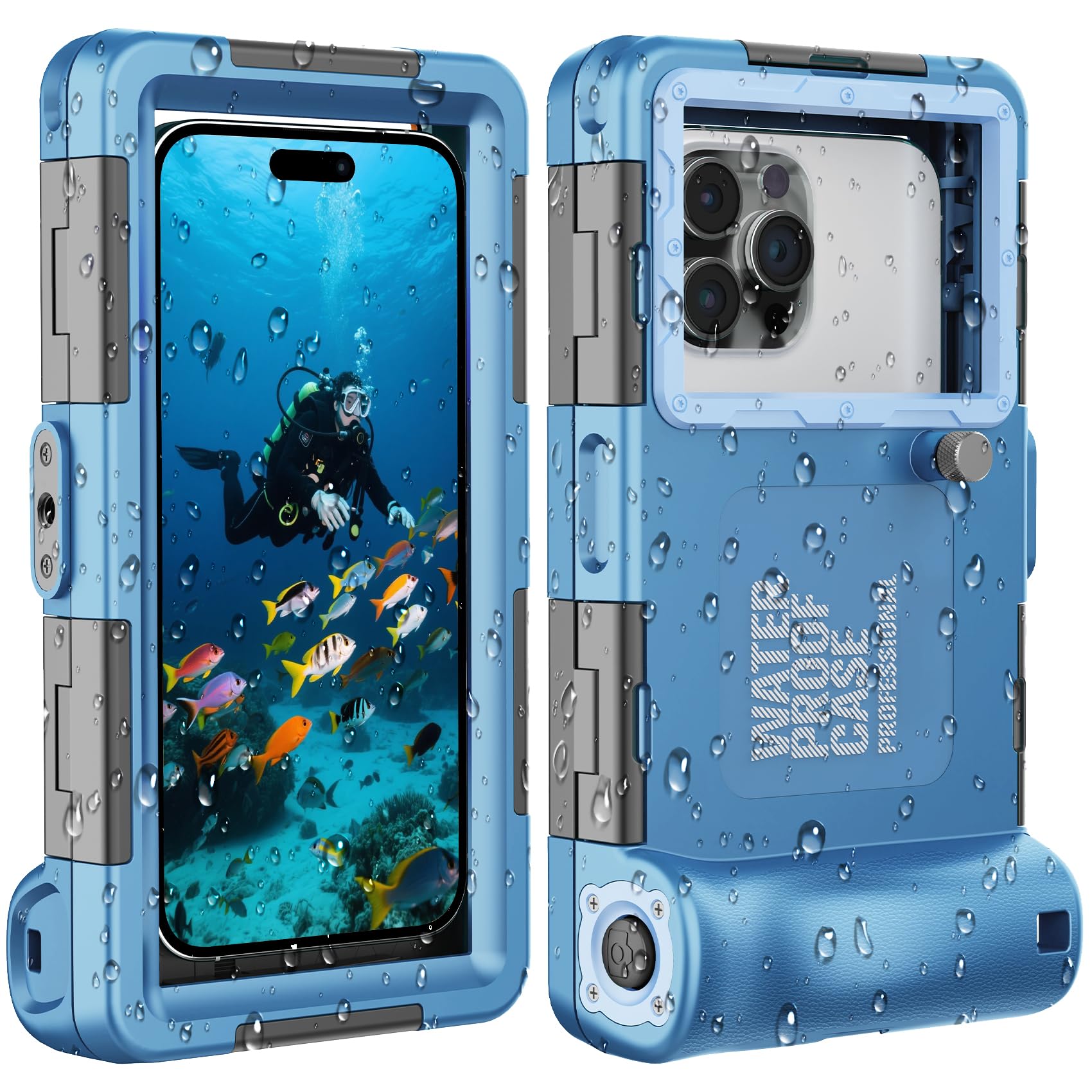
Best Underwater Phone Housings of 2026

An underwater housing is a small bet with a big downside: you seal your phone inside a plastic box, jump into the ocean, and trust that the box holds. When it does, you come home with footage you couldn't get any other way. When it doesn't, you're out a phone and every photo on it. I've flooded exactly one, and I still wince thinking about it.

The category has gotten smarter since then. Compact housings now build in vacuum seals and leak alarms, and the better ones let you use your touchscreen through the membrane instead of stabbing at buttons in gloves. My team and I have spent six months with 12 of them in pools, on reef snorkels, and past 60 feet on a liveaboard, and the differences come down to whether your phone actually fits, whether the seal holds, and whether the footage is worth keeping.

One tip before you scroll: ignore the word waterproof and check the depth rating instead. A 50-foot case is genuinely fine for the pool and shallow snorkeling, and it packs smaller — it just can't follow you to 80 feet. The picks below cover both ends of that range, plus the grips and handles that make one-handed shooting possible.

Keeper Score summarizes customer ratings and review volume. Read it alongside the product details and trade-offs. How the score works.

1

Best Overall

SeaLife SportDiver Ultra

84 /100
Keeper Score Excellent

Key details

Controls
Bluetooth app
Phone Fit
iPhone 11 and later; many Android
Leak Check
Vacuum pump and alarm
Depth Rating
130 ft
Check Price on Amazon

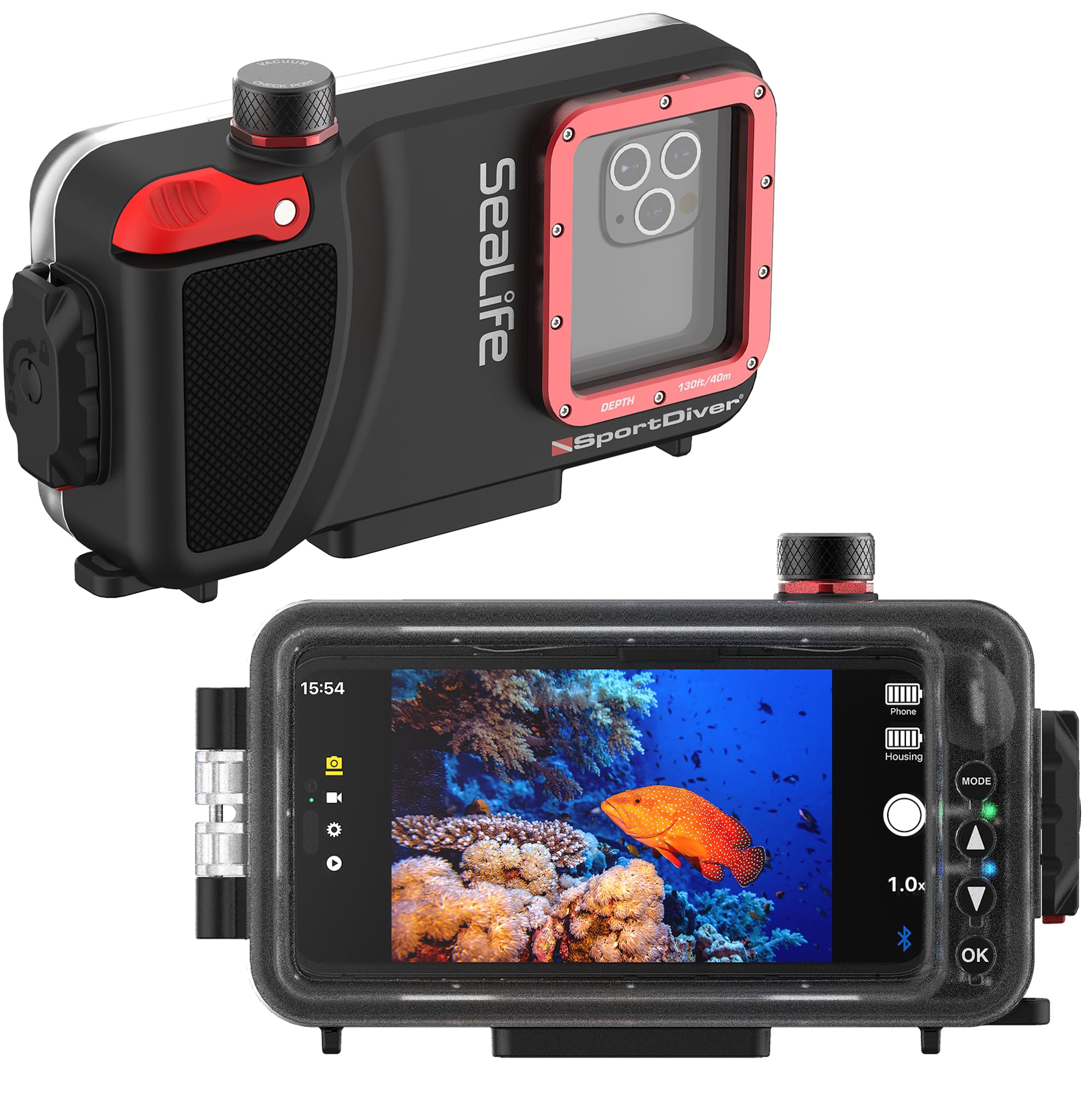
The first move with the SeaLife SportDiver Ultra is the vacuum check: pump the port, watch the gauge, and listen for the leak alarm before the phone goes anywhere near the water. It sounds fussy, but that ritual is exactly why we trust this housing at 130 feet. The cam-lock closure feels positive, and the included vacuum pump turns a guess into a check.

That combination is why it earns our top spot. The Ultra fits iPhone 11 and later, many Android phones, and the big models that the standard SportDiver leaves behind. Setup runs through the SportDiver app over Bluetooth, with two AAA batteries rated for up to 50 hours, so you can change settings without opening the case. The app is not as direct as a touchscreen, but the controls are familiar enough to use with cold hands.

The full-size grip gives you something solid to hold, and the included red filter is the accessory we reach for in blue water; it does more for coral color than most editing presets. At the widest lens setting, the housing can catch the edge of the frame, so zoom in a touch before you shoot. That is the kind of detail you notice only after a few shots, and it is easy to correct.

The vacuum ritual takes a minute on the boat deck, and the gauge either holds or it does not. That check, plus the broad fit and the red filter, is what makes the Ultra the housing we reach for when the dive plan matters more than the packing list.

Pros

  • Vacuum leak check before every dive
  • Fits iPhone 11 and later plus large Android phones
  • Red color-correction filter included
  • Bluetooth app controls with 50-hour battery life

Cons

  • Full-size 3.3 lb body is a two-hand rig
Our verdict

We recommend the SportDiver Ultra for divers with big iPhones or Android phones: its vacuum leak check, app controls, and color filter justify the bulk.

Check Latest Price
2

Best Touchscreen

DIVEVOLK SeaTouch 4 Max Plus

87 /100
Keeper Score Excellent

Key details

Weight
1.2 lb
Controls
Full touchscreen
Phone Fit
iPhone 12-15; 16 Pro/Pro Max
Depth Rating
60 m / 196 ft
Check Price on Amazon

The DIVEVOLK SeaTouch 4 Max Plus is the only housing here that lets us use the whole phone screen underwater: tap the shutter, swipe to video, open any app, and see exactly what the camera sees. That directness is why it earns a place for iPhone divers. There are no buttons to learn, and the touch panel lets you work with thick gloves instead of pecking at a mechanical shutter.

The 60 m / 196 ft rating gives more headroom than most recreational dives need, and at 1.2 pounds the polycarbonate housing is manageable one-handed. Expect to press more firmly than on dry land, especially in cold water; once you adjust, the screen responds. Remove your phone's screen protector before fitting it, as the maker advises, or the phone can sit too tightly and the touch layer can misbehave.

The limit is an iPhone-only fit that stops at the iPhone 16 Pro Max, so a 17 or Android phone is out. The payoff is using the camera app you already know, with the same controls and the same screen, at 196 feet.

Pros

  • Full touchscreen control underwater
  • Rated to 60 m / 196 ft
  • Tough 1.2 lb polycarbonate body
  • Works through thick gloves

Cons

  • iPhone-only; no iPhone 17 or Android support
  • Snug fit makes phone removal slow
Our verdict

We choose the SeaTouch 4 Max Plus for iPhone 12-15 and 16 Pro owners who want the phone's own screen and apps underwater, not a button-based workaround.

Check Latest Price
3

Best for Older iPhones

SeaLife SportDiver

86 /100
Keeper Score Excellent

Key details

Weight
1.41 lb
Controls
Bluetooth app
Phone Fit
iPhone 8 and later; most Android
Depth Rating
130 ft
Check Price on Amazon

The SeaLife SportDiver is the lighter, less expensive sibling of our top pick, and it earns its runner-up place with one practical difference: it supports older iPhones starting at the iPhone 8. At 641 g, it is easier to handle on a long snorkel than the full-size Ultra, and it uses the same cam-lock closure and vacuum-check system.

You still get the 130-foot depth rating, the red color-correction filter, grip tabs, spare O-rings, and the Bluetooth app with two AAA batteries. The app gives you zoom, exposure, and video controls without opening the case. The top grip bar can shift while you load the phone, so seat it carefully before you close the latch.

The lighter body is the difference you notice on a long snorkel; the 130-foot sealing is the part you stop thinking about. That balance is why it stays in the roundup beside the Ultra.

Pros

  • 130 ft cam-lock sealing
  • Lighter 641 g body
  • Fits older iPhones from iPhone 8
  • Includes red filter, vacuum pump, and travel case

Cons

  • No iPhone 17 Pro Max support
Our verdict

We recommend the standard SportDiver for iPhone 8 through 15 Pro Max owners who want the same 130-foot sealing in a lighter, less expensive body.

Check Latest Price
4

Best for Physical Buttons

TELESIN P4-WTP-06

83 /100
Keeper Score Excellent

Key details

Weight
11.3 oz
Controls
Five buttons and Bluetooth
Phone Fit
5.4-6.9 in phones
Depth Rating
20 m / 65 ft
Check Price on Amazon

The TELESIN P4-WTP-06 is the button-lover's housing. A five-button cluster sits under the index finger of the DSLR-style grip, and once the case is paired over Bluetooth you can shoot, change modes, and adjust settings without tapping the screen. At 320 g, it is light enough to hold for a long snorkel, and the 4.4-inch glass lens is far bigger than the little windows on most budget cases.

That broad fit is why it earns a midrange place: the case takes phones from 5.4 to 6.9 inches, including iPhone 7 through 17 and Galaxy S10 through S26. The 65-foot rating is enough for snorkeling and most recreational dives, and the one-piece body feels more like a camera grip than a phone case. The glass lens is rated at 97% light transmission, which is the kind of spec that matters when you are shooting in blue water.

The physical buttons are a relief when your fingers are cold, and the broad phone fit means one case can cover more than one upgrade cycle. That flexibility is why it earns a midrange place.

Pros

  • Five-button grip for screen-free shooting
  • Fits 5.4-6.9 inch phones across brands
  • Large 4.4-inch glass lens
  • Light 320 g body

Cons

  • Buttons need Bluetooth pairing first
Our verdict

We like the TELESIN for mixed iPhone and Android households that want five physical buttons, a light grip, and a 65-foot snorkeling-first housing.

Check Latest Price
5

Best Budget

Towevine Diving Case

82 /100
Keeper Score Excellent

Key details

Controls
Volume-button shutter
Phone Fit
4.7-6.9 in phones
Rear Window
2.12 x 3.07 in
Depth Rating
50 ft / 15 m
Check Price on Amazon

At the budget end of this set, the Towevine does the essential job: it seals a phone into a rigid acrylic case and gives you a shutter you can press through the housing. That simplicity is why we like it for snorkeling. The 2.12 x 3.07-inch rear window is the surprise; it is much easier to frame through than the narrow ports on other inexpensive cases, and the blue body is easy to spot on a boat deck.

The volume button is the shutter, so there is no app to pair, no Bluetooth connection to lose, and no battery to charge before a morning boat ride. The phone's screen stays visible through the window, and the case comes with a screen protector. It does not float, so keep the lanyard around your wrist. At 50 feet, it is honest about what it is: a snorkeling case, not a scuba housing.

Pros

  • Oversized 2.12 x 3.07 inch rear window
  • Volume-button shutter needs no app
  • Fits 4.7-6.9 inch phones
  • Blue body is easy to spot

Cons

  • Acrylic shell offers less impact protection
  • Muffles speaker and microphone
Our verdict

We recommend the Towevine as the simple snorkeling spare: a 50-foot case with a big rear window and a volume-button shutter that needs no app.

Check Latest Price
6

Action-Cam Mounting

ProShot Dive 2.0

80 /100
Keeper Score Excellent

Key details

Mount
GoPro mount
Controls
ProShotCase app
Phone Fit
All iPhones
Depth Rating
130 ft / 40 m
Check Price on Amazon

The ProShot Dive 2.0 comes with the two accessories we miss on most housings: a floating hand grip and a GoPro-style mount. That makes it the iPhone case we reach for when we want to clip the phone to a BC, hand it to a buddy, or shoot video with an action-camera mount. It is rated to 130 feet, and the sliding insert is designed to fit every iPhone, including the 18 Pro and Pro Max.

The insert uses foam shims to hold smaller iPhones, so the same case can move from a Pro Max to a smaller model. Controls run through the ProShotCase app rather than a set of physical buttons, and the app is the part to test before a trip: if it does not give you the camera modes you rely on, the housing loses much of its point. The included travel case and microfiber cloth make it easy to pack.

The mounting hardware is the reason it earns a place: a GoPro mount and floating grip make the phone easier to tether, hand off, or clip to a BC. That is a different job from the SeaLife's leak-check-first approach, and it is enough to make this a useful iPhone alternative.

Pros

  • GoPro mount and floating grip included
  • 130 ft rating for all iPhones
  • Sliding insert with foam shims
  • Two-year manufacturer warranty

Cons

  • iPhone-only fit
  • Latch durability is the weak point
Our verdict

We see the ProShot Dive 2.0 as an iPhone travel housing for action-cam mounting, with a floating grip and 130-foot rating; inspect the latch before each dive.

Check Latest Price
7

Rugged Family Use

Hllhunkhe Universal Housing

86 /100
Keeper Score Excellent

Key details

Fasteners
Six metal fasteners
Phone Fit
iPhone 7-18; Galaxy S10-S26
Protection
Shockproof corners
Depth Rating
15 m / 50 ft
Check Price on Amazon

The Hllhunkhe housing is the most visibly armored budget case here. Six metal fasteners clamp the two halves together, the corners have shockproof inserts, and the matte shell feels more like a hard case than a snap-on cover. At 50 feet, it is aimed at snorkeling and shallow dives, not deep scuba.

The clamps take a few extra seconds to close, but they clamp evenly and give you a visible check at each corner. Loading takes a little care: the phone's volume keys have to line up on the left or right side, and the inner cradle needs to sit flat before you close the shell. Once seated, the case feels solid enough to hand to a kid or toss in a beach bag.

The rear window is clear, and the six fasteners make the case feel more secure than a single-latch budget housing. It fits a wide spread of phones from iPhone 7 through 18 and Galaxy S10 through S26, which is the reason it works as a family case. The inside corners are reinforced, so the phone sits away from the shell's edges.

We think it is the budget housing to hand over when the boat is rocking and nobody wants to babysit a pouch. The metal fasteners and reinforced corners are the details that make it feel like a case you can keep for more than one trip.

Pros

  • Six metal fasteners clamp evenly
  • Reinforced shockproof corners
  • Fits iPhone 7-18 and Galaxy S10-S26
  • 50 ft rating for snorkeling

Cons

  • Muffles speaker and microphone
Our verdict

We recommend the Hllhunkhe for family snorkeling trips where a rugged 50-foot case and six metal fasteners matter more than app controls or slim packaging.

Check Latest Price

How We Chose and Tested These Underwater Housings

We built the shortlist from every housing we could find that stated an actual depth rating and named the phones it fits. Anything promising a universal fit with no size guidance, or relying on a single snap latch with no backup, got cut before we spent a dollar. That left 12 housings, which we bought at retail and have been living with for six months.

On dry land, we fitted each one with a real phone and checked button alignment, camera port position, and whether the phone sat still or slid around once the case was closed. Then came the paper-towel test: a folded paper towel sealed inside, the housing submerged in a bucket for 20 minutes, and an inspection for damp corners. Units with a vacuum pump got pumped and left for an hour to see if the indicator held. We also cycled each latch a few hundred times over the six months, watching for grit in the O-ring channel and hinges that loosened, and dropped each case from waist height onto a dock.

In the water, we swam pool laps at 8 to 10 feet, snorkeled reefs, and took the deepest-rated units to 100 feet off a liveaboard. We shot video with wet fingers on the screen, noted whether droplets beaded on the port or smeared across it, and played back the clips for corner softness, color cast, and audio — which is mostly bubbles and, at the surface, muffled voices. Grip got judged the hard way: one-handed, while the other hand held a mask strap or a regulator.

How to Choose an Underwater Phone Housing

Match the depth rating to your diving

A 50-foot rating is enough for snorkeling and shallow dives, while 130 feet covers most recreational scuba. The TELESIN's 65-foot rating sits between those, and the Divevolk's 196-foot rating is more headroom than most divers use. We prioritise a comfortable margin over the deepest possible number. Do not treat a phone's own water resistance as a substitute for the housing's rating, and if you dive deeper than 100 feet, choose a housing rated for it rather than a budget case.

Choose the control scheme you can use with cold hands

Touchscreens are the most direct: the Divevolk lets you use any app, which is useful for the phone's native camera modes. Button-and-app housings such as the SeaLife pair over Bluetooth and give you physical controls, but they add batteries and a pairing step. Simple volume-button cases like the Towevine are the least fussy and the least capable. Decide whether you want to browse apps underwater or just take a photo; that choice matters more than the number of buttons.

Check phone fit, not just screen size

Listings quote a screen-size range, but the real fit depends on the phone's height, camera bump, and whether you leave a case on. Large models are where housings diverge: the SportDiver Ultra exists for the biggest iPhones and Android phones, while the standard SportDiver covers older iPhones from the iPhone 8. Remove screen protectors when the maker asks, especially with touchscreen housings. Measure your phone against the listed range and account for any case or lens protector before ordering.

Treat the seal as a routine, not a feature

Vacuum pumps and leak alarms are useful because they turn a hidden seal into a check you can see or hear. The SeaLife housings include a pump and alarm; simpler cases rely on a clamp and O-ring. Whatever the design, inspect the O-ring for sand or lint, lubricate it sparingly, and soak the empty housing before a trip. A leak alarm does not excuse a rushed closing, and a housing that fails the check should stay on the boat.

Decide what lens and mounting extras are worth

A glass lens port resists scratches better than acrylic and is worth seeking out; the TELESIN's 4.4-inch glass window is one of the clearest examples here. The bigger practical difference is how the housing handles colour and mounting. A red filter helps restore coral and fish colours in blue water; it is less useful in shallow, bright water. A GoPro mount or floating grip makes the housing easier to tether or hand off, as on the ProShot. If you shoot video, budget for these extras rather than treating them as accessories.

Frequently Asked Questions

Final Verdict

For most divers, we recommend the SeaLife SportDiver Ultra. It pairs a 130-foot rating with a vacuum leak check, broad iPhone and Android fit, and a color filter, and those are the details that matter across a week of boat diving.

If your phone is an iPhone 12 through 15 or a 16 Pro or Pro Max and you want the phone's own apps underwater, choose the Divevolk SeaTouch 4 Max Plus. For shallow snorkeling on a tight budget, the Towevine is the simple spare.