Best Phone Lenses of 2026

Your phone camera is a great everyday camera until you want to count the hairs on a bee, pull a singer’s face out of a stadium crowd, or fit a whole cathedral ceiling into one frame. Phone lenses are meant to close that gap: clip a little glass disc over your camera and you get macro, wide-angle, fisheye, or telephoto reach without carrying a second camera. The catch is that cheap ones can soften the center, smear the corners, or fight your phone case every time you attach them.

Over four months, I tested 16 phone lenses—clip-on kits, single macros, wide-angle and fisheye add-ons, and a couple of telephotos—on walks, in the garden, at a dim restaurant, and at a weekend concert. The mount matters almost as much as the glass: if a lens doesn’t sit flat and centered over the right camera, even a sharp one produces mushy pictures. The best picks below are the ones that made my phone feel more versatile, not just more cluttered.

Keeper Score summarizes customer ratings and review volume. Read it alongside the product details and trade-offs. How the score works.

1

Best Overall

Xenvo Pro Lens Kit

84 /100
Keeper Score Excellent

Key details

Mount
Universal clip
Lenses
0.45x wide + 15x macro
In The Box
LED light, travel case, lanyard
Check Price on Amazon

The barrels are metal, the clip is lined with rubber that grips a phone instead of skating across it, and the whole kit zips into a case with a quick-release lanyard. That reads like packaging detail until you have used a plastic clip-on that rotates mid-shot. The TruView adapter widens the frame by about 45 percent — enough to fit a room, a group, or a skyline into a shot without backing across the street — and the Clarus macro pulls detail out of coins, fabric, and petals at a distance short enough that your phone almost touches the subject.

The macro is the lens we reached for more often. It is the one that changes what your phone can do rather than widening what it already sees, and it rewards patience: brace your elbows, tap to focus, then move the phone toward the subject in small increments instead of hunting for a ring that is not there. The GlowClip light clips anywhere on the phone and recharges over USB, and we have used it as a video-call light as much as a macro light.

Where this kit wins is consistency. Both lenses screw onto the same clip, the coatings keep flare under control, and the video tutorials that come with it are unusually clear for a phone accessory — good enough that a first-timer can be shooting decent close-ups the same afternoon. What it will not do is reach: there is no telephoto here, and the wide is a gentle widening rather than the dramatic sweep of a fisheye.

One quirk to know about: on phones with the camera cluster jammed into a corner, the clip can sit a millimetre off, and the rim of the lens shows in the corner of the frame. Slide it over and the corner clears.

Pros

  • Wide and macro lenses that both get used
  • Metal barrels and a clip with real grip
  • Case, lanyard, and clear video tutorials
  • Rechargeable fill light clips anywhere

Cons

  • Wide adapter widens the view only modestly
Our verdict

Two lenses that both earn their place, a clip that stays put, and a case that survives a bag — this is the phone lens kit we recommend to most people.

Check Latest Price
2

Best for Creative Effects

Godefa 14-in-1 Lens Kit

83 /100
Keeper Score Excellent

Key details

Light
Clip-on selfie ring light
Lenses
14 pieces including CPL and fisheye
Telephoto
2x
Wide Angle
0.63x
Check Price on Amazon

Fourteen pieces is a lot to unpack, and the honest way to read that number is this: what Godefa sells is options, not optical perfection. The case holds a 0.63x wide, a 15x macro, a 2x telephoto, a 198-degree fisheye, 3x and 6x kaleidoscope lenses, a circular polarizer, a starburst filter, a radial filter, and a clip-on selfie ring light. The wide, the macro, and the fisheye are the three that will spend real time on your phone; the rest are for the afternoon you want something strange.

We rate it as the kit for someone who posts for fun and wants to experiment without building a rig. The ring light is the sleeper — clip it over the front camera and evening selfies stop looking like they were taken in a cave. The trade is real, though: every extra element in front of the phone's lens costs a little contrast and fine detail, so a frame shot through the wide looks softer than the same frame taken bare.

The case deserves a mention of its own. Everything has a cutout, nothing rattles, and the lenses come out and go back in one motion, which matters when you are swapping between shots. It is too bulky for a jeans pocket and will live in a bag. If the sharpest possible image from a two-lens kit is the priority, the Xenvo is the better call; if the priority is trying every effect in the box before lunch, this is the one.

Pros

  • Fourteen pieces cover fisheye to polarizer
  • Selfie ring light is genuinely useful
  • Case keeps every lens in its own slot
  • Quick to swap between lenses

Cons

  • Extra glass softens fine detail
  • Case is too bulky for a pocket
Our verdict

We recommend it to anyone who wants to try every look — fisheye, kaleidoscope, polarizer, ring light — and will trade a little sharpness for the variety.

Check Latest Price
3

Best for Concerts and Reach

APEXEL 10X Tele-Macro

86 /100
Keeper Score Excellent

Key details

Mount
Universal clip
Optics
12 elements, multilayer coated
Weight
5.12 oz
Magnification
10x telephoto
Check Price on Amazon

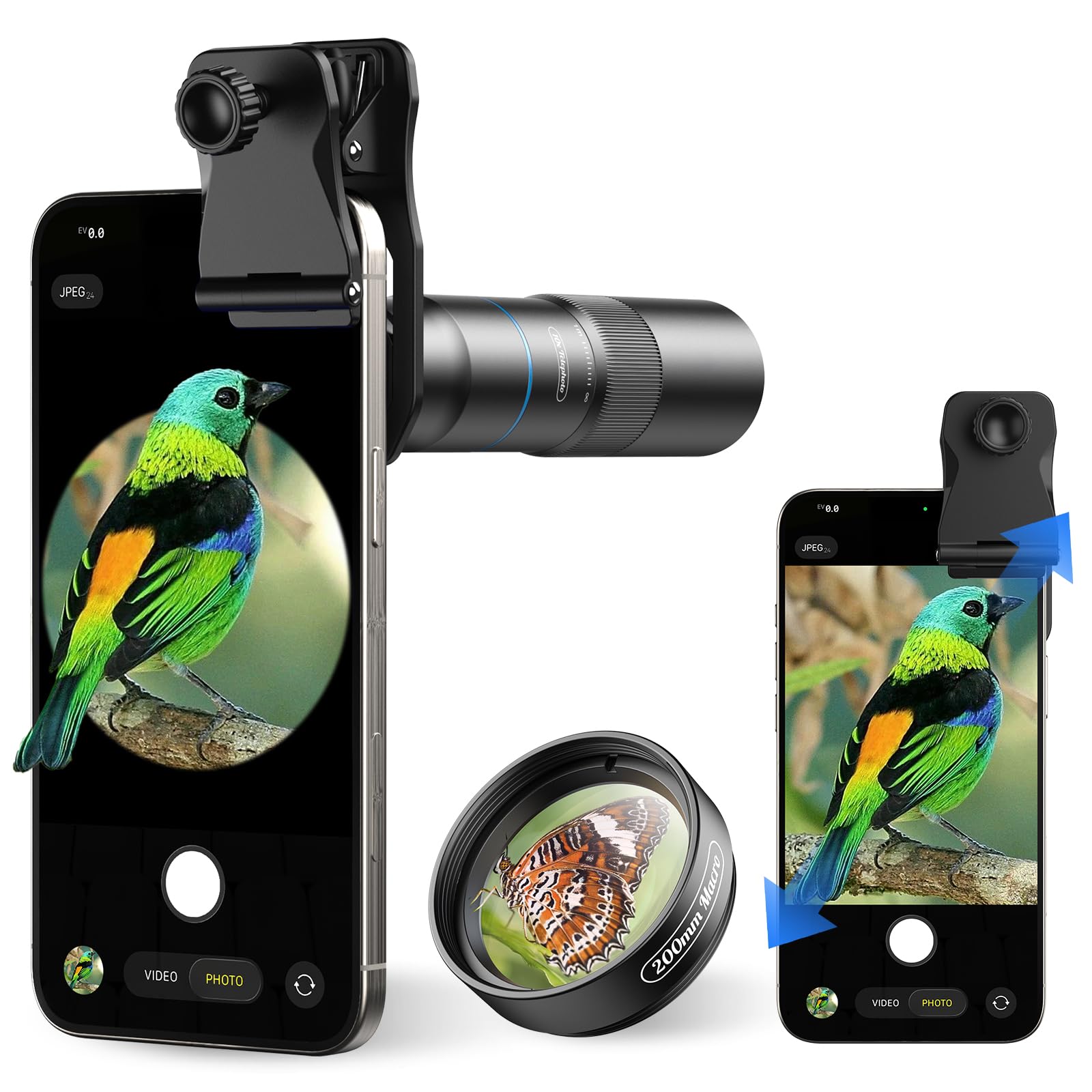
Thirty rows back from a stage, a phone's zoom is mostly cropping and hoping. The APEXEL 10X puts real glass in front of the lens — 12 elements with multilayer coatings in a barrel that weighs about five ounces — so a performer fills the frame instead of dissolving into pixels.

We like it for the one job it does, and we like that it does not pretend to be a general-purpose kit. At 10x every tremor is magnified too, so brace the phone on a rail or your knee, shoot a burst, and expect to keep a fraction of the frames, and check the corners of your first shot to confirm the clip is sitting dead centre over the main camera.

The macro side of the barrel is the bonus you will use more than you expect, and the whole thing disappears into a jacket pocket. If most of your shooting is rooms, streets, and groups, you are paying for reach you will never use — the Xenvo kit is the better spend for that.

Pros

  • 10x reach without a second camera
  • 12 elements with multilayer coating
  • Telephoto and macro in one barrel
  • 5.12 ounces, so it travels easily

Cons

  • Manual focus at 10x takes practice
  • No image stabilization in the lens
Our verdict

For stages, sidelines, and skylines you cannot walk up to, this is the clip-on telephoto we reach for.

Check Latest Price
4

Best for Macro

APEXEL 100Ultra Macro

79 /100
Keeper Score Very Good

Key details

Mount
Universal clip
Aperture
F1.05
Focal Range
50-110mm
Magnification
2.2:1
Check Price on Amazon

It does one thing, and it does that one thing better than anything else in this group. The 100Ultra is a 50-110mm macro lens with no wide, no fisheye, and no zoom, and that longer focal length is the point: you can fill the frame with a bee on a flower without your phone's shadow falling across it, which is the failure that ruins most clip-on macro shots.

The F1.05 aperture does the rest. Backgrounds fall away into a soft blur instead of the busy digital mush a phone's portrait mode produces, and the 2.2:1 magnification puts detail on the sensor rather than cropping for it afterwards. The barrel is metal, the clip is stiff enough to stay where we put it, and the whole thing arrives in a protective case.

Focus is manual and unforgiving. Anything that moves — a bee, a pet, a toddler — will be out of the plane by the time you have it, so this is a lens for still subjects and patience. If you want one attachment that covers a birthday party, keep looking; if you want to photograph the veins in a leaf, this is where the money goes.

Pros

  • Longer working distance than short clip macros
  • F1.05 aperture gives clean background blur
  • Well-machined barrel and a sturdy clip
  • 2.2:1 magnification

Cons

  • Manual focus is slow on moving subjects
Our verdict

If macro is the reason you are buying a lens, this is the one we recommend — a longer working distance and real glass beat a short screw-on attachment.

Check Latest Price
5

Best for Cage Rigs

NEEWER HD 85mm LS-59

88 /100
Keeper Score Excellent

Key details

Optics
8 elements in 6 groups
Focal Length
85mm
Front Thread
72mm
Magnification
2.5x
Check Price on Amazon

The thread is the whole story. The LS-59 twists onto a 17mm threaded backplate — a phone cage or case system from NEEWER or SmallRig — rather than gripping the phone with a spring clip, and that is how a real lens attaches. It also means the lens sits perfectly square over the camera every time, with no millimetre of drift between shots.

Inside are eight elements in six groups and 2.5x magnification; up front there is a 72mm thread that takes the same ND, variable ND, and circular polarizer filters as a camera bag. We thought screwing a filter onto a phone lens sounded fussy until we shot in bright sun and wanted detail in the sky rather than a white rectangle.

Optically this is the cleanest telephoto in the group: contrast holds, edges stay together, and portraits pick up a compression that digital zoom cannot fake. It is also the one that turns a phone into a rig — the anodized shell is heavier than any clip-on here, which makes a bare gimbal a balancing exercise and makes the lens feel planted once it is on a cage.

Pros

  • Threaded mount stays perfectly centred
  • 72mm front thread takes standard filters
  • 8 elements in 6 groups
  • Anodized aluminum body

Cons

  • Backplate or cage sold separately
Our verdict

For a phone already mounted in a 17mm cage, we think this is the sharpest telephoto here; without the backplate it has nothing to grip.

Check Latest Price
6

Budget First Kit

KEYWING 3-in-1 Lens Kit

82 /100
Keeper Score Excellent

Key details

Mount
Universal clip
Lenses
198° fisheye, 120° wide, 20x macro
Macro Focus
1.18-3.54 in
Check Price on Amazon

The cheapest kit here is also the simplest: a 198-degree fisheye, a 120-degree wide, and a 20x macro sharing one clip and a drawstring bag. Of the three, the macro is the one we rate — it focuses between roughly an inch and three and a half inches, close enough to read the date on a coin — and it is the only lens in the set that gives you a picture your phone cannot take by itself.

Expect the wide and the fisheye to soften toward the corners, and expect the fisheye's curve to stop being funny after a dozen frames. That is the bargain at this end of the market: you are buying the effect rather than optical perfection. The clip is light and grips a bare phone well, the lenses are small enough to leave in a jacket pocket, and the whole set costs less than a single dedicated lens from anyone else on this list.

Pros

  • Three lens types for a budget outlay
  • Macro focuses about an inch from the subject
  • Small enough for a pocket

Cons

  • Does not fit iPhone 14 and newer
  • Wide and fisheye soften at the corners
Our verdict

We keep this one for older phones and tight budgets: the cheapest route to fisheye, wide, and macro, and the macro does the heavy lifting.

Check Latest Price

How We Tested Phone Lenses

We started by collecting more than 40 phone lenses from search results and review pages, then narrowed that to 16 that differed in mount style, lens type, price, and promised use—macro for flowers and jewelry, wide-angle and fisheye for group shots and architecture, telephoto for concerts and travel. I ruled out listings that didn’t name their glass or mount, and checked each finalist against several phone sizes and case thicknesses before testing. Over four months, the lenses went on daily walks, into the backyard garden, to a dim restaurant, and to a weekend concert.

For image quality, I shot the same flower, brick wall, and horizon with and without each lens, then zoomed in on the center and corners to see whether detail held up or turned to mush. I checked focus by moving closer until the subject blurred, and noted whether the lens hunted or needed a steady two-handed grip; the heavier telephotos made one-handed phone holding feel tippy, especially at the concert. I also paid attention to the fisheye effect—whether straight lines curved cleanly or the corners smeared—and to the built-in LED and selfie lights, using them in the dim restaurant and at dusk to see if they helped or blew out highlights.

Build quality got its own workout: I tossed every lens into a tote bag, clipped and unclipped it repeatedly, and checked whether mounts loosened, threads cross-threaded, or caps stayed on. Ease of use came down to setup: how quickly I could center the lens over the correct camera, whether it stayed put when I slid the phone into a pocket, and how much fiddling a case required. Value was less about the sticker than about how often I reached for a lens and how many useful pieces came in a kit; a bulky set with one good lens scored lower than a single lens I kept using.

How to Choose a Phone Lens

Start with the lens your phone does not have

Most current phones already shoot an ultrawide, which makes a clip-on wide adapter the least valuable thing in any kit: a 0.45x or 0.63x attachment widens a frame you could already get. Macro is where add-on glass earns its place, because no phone gets genuinely close, and a clip-on macro turns a coin, a leaf, or a fabric weave into a subject. Telephoto attachments sit in between — worth carrying to a concert or a ball game, dead weight at a dinner table. Fisheye and the kaleidoscope-style effects are about a look rather than a situation, so treat them as fun rather than essential.

Clip or thread changes what you can buy

Almost every inexpensive lens uses a spring clip that straddles the phone's camera bump: universal, quick to swap, and the right choice if you shoot on more than one device. A threaded mount — the 17mm backplate that NEEWER and SmallRig cages use — holds the lens perfectly square and centred, but only on the phone it was fitted to. The trap is buying a threaded lens because it looks more professional and discovering the backplate is sold separately. If you are not prepared to build a rig, stay with a clip.

Read magnification and working distance together

A wide adapter's number tells you how much more scene you get; a macro's number tells you how much closer you can go. They are not comparable across brands, which is why a 15x label on one kit and a 2.2:1 on another describe different things. What matters more for close-ups is working distance: a longer focal length lets you fill the frame with the phone further back, so your shadow stays out of the picture. With telephotos, magnification and steadiness trade off — 2.5x is handheld-friendly, 10x wants something to lean on.

What extra glass costs you

Every element in front of the phone's lens takes a little light and adds a little flare, and inexpensive kits show it first in the corners. Two habits follow. Do not stack lenses: some kits ship with the wide and macro screwed together, and they come apart for a reason. And clean the front element before you blame the glass — a fingerprint on a small lens is the most common reason a clip-on shot looks soft. Coatings help, but they cannot fix a smudge.

Frequently Asked Questions

Final Verdict

The Xenvo Pro Lens Kit is the phone lens we point most people toward, because it does the two things add-on glass does well — a wider frame and a genuine close-up — with hardware that keeps its alignment. If your phone already lives in a 17mm cage, the NEEWER 85mm is the better lens and the better use of your budget; just buy the backplate first.