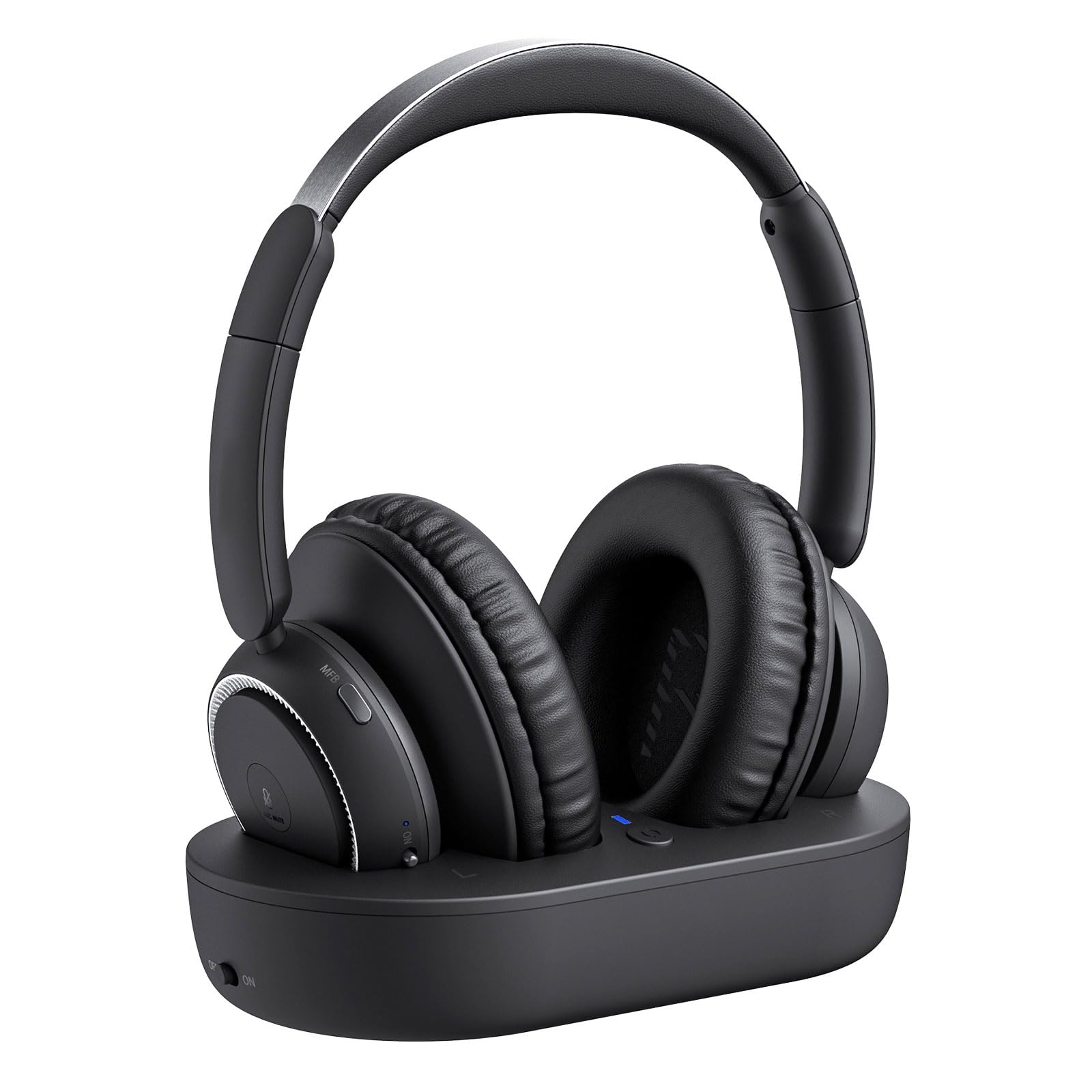
Best TV Headphones of 2026

The fastest way to ruin a movie night is to reach for the volume during a quiet dialogue scene. TV headphones solve that problem: they put the soundtrack and conversation directly in your ears, so the room stays peaceful and you catch every line. But the category has its own traps — a half-second lip-sync delay, a transmitter that refuses to pair, earcups that clamp after forty minutes, or a battery that dies before the credits.

We spent eight months with 12 wireless TV headphone sets, from budget plug-and-play models to digital systems, and the differences came down to clear dialogue, stable connectivity, comfortable fit, and whether the battery survived a binge. We also noted which ones felt built to last, which hissed or leaked sound, and where the price bought better performance.

One thing I didn't expect: an optical or HDMI connection settles lip-sync faster than Bluetooth alone, and a charging base is the difference between a headset that's ready at 9 p.m. and one that's dead in a drawer. The picks below are the ones we kept reaching for.

Keeper Score summarizes customer ratings and review volume. Read it alongside the product details and trade-offs. How the score works.

1

Best Overall

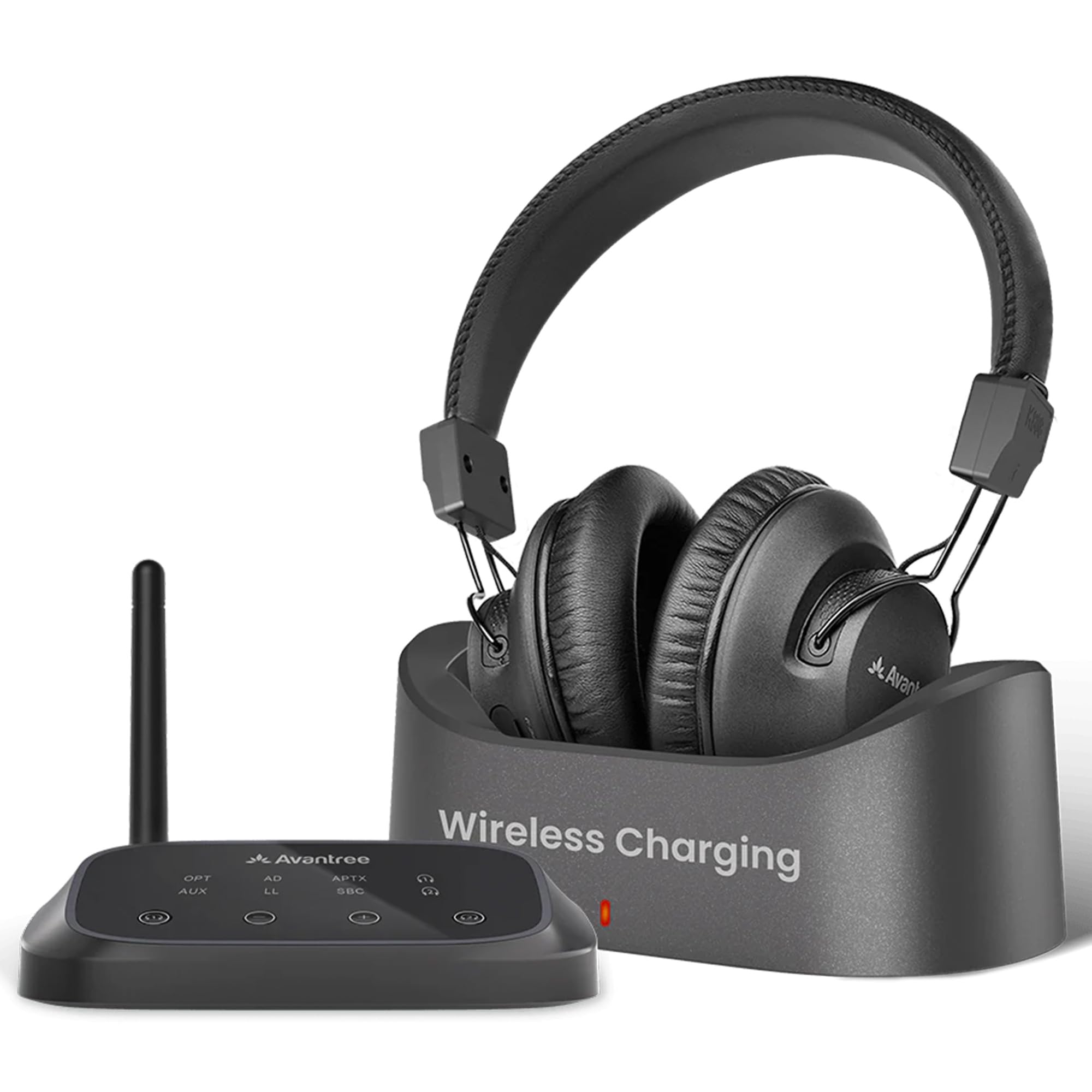
Avantree HT5009 Plus

85 /100
Keeper Score Excellent

Key details

Weight
6.91 oz
Connections
Optical, 3.5 mm AUX, Bluetooth
Battery Life
Up to 50 hours
Dialogue Mode
Clear Voice with volume boost
Check Price on Amazon

The button we pressed most during testing sits on the edge of the right earcup, and it does one job: Clear Voice pulls dialogue forward. On a drama with a murmuring soundtrack it was the difference between following a scene and guessing at it, and it is the main reason this Avantree is the set we point most people toward. Everything around it is quietly competent, from the charging dock to the 24-month warranty to an adjustable headband that holds the setting you give it.

Setup is a cable and a menu: optical into the transmitter, the transmitter into the TV, and the TV's digital audio format set to PCM. That transmitter passes the optical signal through to a soundbar, so the room keeps its audio while you listen privately, and a 3.5 mm cable covers an older set. Pairing over Bluetooth is there for a television that has neither.

Two limits are worth knowing before you order. There is no HDMI ARC input, so a TV with only that output needs the Opera Plus instead. And Avantree is explicit that this is not hearing-aid-level amplification: it clarifies dialogue for mild to moderate loss rather than standing in for an audiologist. The 196 g weight is the figure we check first when a set has to sit on a head all evening, and it is near the light end of this group.

Pros

  • Clear Voice pulls dialogue out of the mix
  • Up to 50 hours per charge with a dock
  • Optical passthrough keeps a soundbar working
  • Light 196 g frame for long evenings

Cons

  • No HDMI ARC input
  • Not hearing-aid-level amplification
Our verdict

This is the one we recommend to most households: Clear Voice lifts dialogue, the dock keeps it charged, and the 196 g frame disappears for an evening.

Check Latest Price
2

Best for HDMI ARC Setups

Avantree Opera Plus

85 /100
Keeper Score Excellent

Key details

Latency
30 ms
Connections
HDMI ARC, optical, 3.5 mm AUX
Battery Life
Up to 35 hours
Soundbar Support
Optical passthrough
Check Price on Amazon

Most TV headphone systems assume an optical socket on the back of your set. That is a fair assumption until it is not: some newer televisions, and plenty of soundbar-first setups, push you toward HDMI ARC and leave you with nothing to plug into. The Opera Plus is the only system on this page that accepts HDMI ARC, which is the entire reason it has a place here.

What we did not expect is how much the volume boost adds on top of that. It is adjustable rather than a fixed jump, and combined with a 30 ms latency figure it kept news broadcasts and fast dialogue in sync rather than smearing the consonants. The headphone also works as an ordinary Bluetooth set with a phone or tablet when the television is off, which is more than most of this group offers.

Plan around two things. The soundbar passthrough is optical only, so an HDMI soundbar will not pass through it; run the bar on HDMI ARC and the headphones on optical, and both keep working. Battery runs 35 hours, roughly two-thirds of the HT5009 Plus. For a modern TV with a soundbar and one viewer who needs dialogue lifted, nothing else here fits the wiring as cleanly.

Pros

  • Only pick here with HDMI ARC input
  • Adjustable volume boost for dialogue
  • Optical passthrough to a soundbar
  • Comfortable over long sessions

Cons

  • Costliest Bluetooth system in this group
  • Not rated for severe hearing loss
Our verdict

Our answer to the HDMI ARC problem, and the only set here that solves it, with an adjustable dialogue boost on top.

Check Latest Price
3

Best for Film Sound

Sennheiser RS 175

88 /100
Keeper Score Excellent

Key details

Range
Up to 100 m
Weight
10.9 oz
Connections
Optical, 3.5 mm AUX, RF
Battery Life
18 hours
Check Price on Amazon

Nearly every set here talks to the television over Bluetooth. The Sennheiser RS 175 does not, and that is the point: it runs on Kleer radio frequency through its charging station, so there is no pairing menu, no codec negotiation, and no re-pairing when someone's phone grabs the connection. You switch on and it plays, every time, with a claimed 100 m of range behind it.

The money goes into sound. Bass boost and a surround mode sit alongside a 17 Hz to 22 kHz frequency range, and film dialogue arrives with weight behind it rather than arriving thin and forward. It is built like a piece of hi-fi rather than a TV accessory, and that is a good part of what the price buys.

What you trade for it is flexibility. At 310 g it is the heaviest headphone on this page and the clamp is firm, so wear it for an hour inside the return window before you commit. Battery runs 18 hours, about a third of the Avantree HT5009 Plus, and there is no Bluetooth at all, which makes this a TV-only purchase. Within those limits, it is the best-sounding set of the group.

Pros

  • RF link with no pairing or re-pairing
  • Bass boost and surround modes
  • Charging station included
  • Claimed 100 m range

Cons

  • Heaviest set here at 310 g
  • No Bluetooth, so TV use only
Our verdict

We think it earns the premium when films matter most: RF wireless with no pairing to break, and bass and surround modes that give a soundtrack weight.

Check Latest Price
4

Best Value

Mutbam TV Headphones

84 /100
Keeper Score Excellent

Key details

Weight
10.9 oz
Pairing
Pre-paired to the dock
Connections
Optical, 3.5 mm AUX, RCA
Battery Life
Up to 65 hours
Check Price on Amazon

Open the box and everything is there: the headset, a transmitter that doubles as a charging base, and optical, 3.5 mm and RCA cables. The headset leaves the factory paired to the transmitter, so the first evening involves one cable and one power lead rather than a pairing menu and a manual.

Sixty-five hours per charge is the figure that stands out. At a couple of hours a night that is roughly a month between charges, and the base tops it up whenever the set goes back on the stand. It is 10.88 oz, heavier than the Avantree on paper, but the headband spreads the load and nothing pinched during a long film.

What we think of it comes down to how little it asks. There is no app, no pairing step, nothing to configure beyond setting the television's audio output correctly, and a cable kit that covers older sets as well as new ones. It is a sensible first TV headset, and the one here that leaves the least to go wrong.

Pros

  • Transmitter dock arrives pre-paired
  • Up to 65 hours per charge
  • Optical, AUX and RCA cables included

Cons

  • Nothing here for an HDMI-only TV
Our verdict

We gave it the value slot because there is nothing to configure, every cable is in the box, and a charge lasts a month of evenings.

Check Latest Price
5

Best Budget

ZUPVIY M98A

85 /100
Keeper Score Excellent

Key details

Charging
Transmitter base
Connections
Optical, AUX, RCA, USB
Wireless Link
2.4 GHz, no pairing
Volume Control
Independent on the headset
Check Price on Amazon

No pairing, no menu: the ZUPVIY M98A links its headset to the transmitter the moment both are switched on, and it does that over a dedicated 2.4 GHz connection rather than Bluetooth. For something that has to work the same way every night, without help and without a phone in the room, that is the right design.

The box covers optical, 3.5 mm and RCA, plus a USB adapter, and the transmitter holds the headset upright while it charges. Volume lives on the headset itself, independent of the TV, so the room's level can stay where everyone else wants it while you go louder or quieter on your own.

Where the saving shows is at the ceiling and in the materials. Maximum volume runs lower than the rest of this group, and the plastics are workmanlike rather than smart. Neither is much of a problem in a bedroom at the volume most people actually watch at, and neither touches the connection, which has been the sturdy part.

At the bottom of the price range it does the whole job: it connects itself, it charges on its base, and it has fewer ways to go wrong than a Bluetooth system that depends on a menu. If you need one set to travel between the television and a laptop, look at the Swiitech instead; for the single screen in the spare room, this is enough.

Pros

  • Auto-connects over 2.4 GHz with no pairing
  • Independent volume control on the headset
  • Charging base included
  • Cheapest set in this group

Cons

  • Maximum volume below the other picks
Our verdict

Cheapest set here, and the one we point to when the goal is a quiet room, clear dialogue and nothing at all to configure.

Check Latest Price
6

Long Battery Life

LEVN LE-HS018

85 /100
Keeper Score Excellent

Key details

Latency
Under 40 ms
Charge Time
2.5 hours
Connections
Optical, 3.5 mm AUX, RCA
Battery Life
Up to 65 hours
Check Price on Amazon

Sixty-five hours of playback from a 2.5-hour charge, a base that both charges and transmits, and three cable options in the box. The LEVN LE-HS018 covers the practical basics at a moderate price, and it does it without asking you to learn anything.

Setup is plug and play in the literal sense: optical, AUX or RCA into the transmitter, the television's audio menu set to match, and you are watching. When the ports line up it takes minutes. When your TV offers only HDMI ARC there is nothing here to plug into, which is the check worth making before you order anything in this category.

Two things are worth flagging. The earcups are protein leather over breathable cotton on 40 mm drivers, and the fit runs snug, so a larger head or a pair of glasses will notice within the first hour. Longevity is the other: the headband and the charging contacts are where sets like this give out, and the 18-month warranty is worth registering the week it arrives.

What keeps it out of the top tier is that pairing of a snug fit with an open question about how long it lasts, set against a battery that matches the longest here and a dock that makes charging automatic. If a month between charges is the thing you care about most, this is a lot of TV headphone for the money.

Pros

  • Up to 65 hours per charge
  • 2.5-hour charge time
  • Under 40 ms latency

Cons

  • Snug fit on larger heads and glasses
  • Volume rocker takes finding by feel
Our verdict

We rate it for the battery, which matches the longest here, though the headband runs snug and longevity is the open question.

Check Latest Price
7

Uneven Hearing Loss

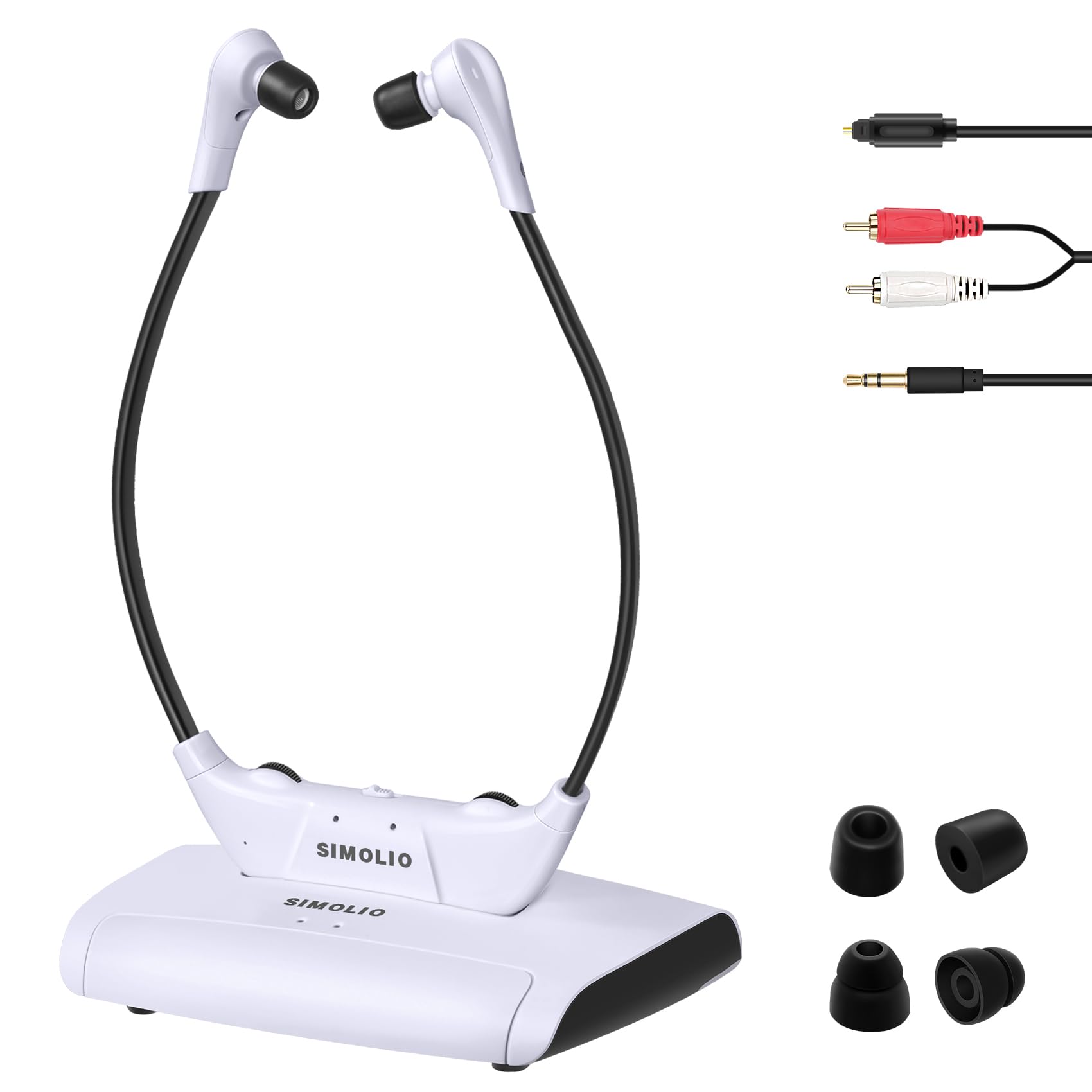
SIMOLIO SM-823D Pro

83 /100
Keeper Score Excellent

Key details

Range
Up to 50 m
Battery Life
Up to 14 hours
Audio Controls
L/R balance, tone, voice clarity
Soundbar Support
Optical bypass
Check Price on Amazon

Hearing loss is rarely symmetrical, and the SM-823D Pro is built around that fact: left and right balance, a tone control and a voice-clarity setting all sit on the headset, so dialogue can be pushed toward the ear that works better instead of raising the whole mix for both.

The other unusual feature is the optical bypass. The transmitter passes the television's optical signal through to a soundbar, so the bar keeps working while you listen privately, and an ambient mode feeds the room back in when you need to hear a doorbell or your own name.

We think the adjustability is the reason to buy this one rather than a bonus feature, because no other set on this page lets you correct for one bad ear. It is less forgiving on compatibility, though: newer smart TVs are where the connection gets shaky, so confirm your set has an optical or RCA output you can switch to PCM before ordering. And the lithium cell is user-replaceable, which is rare here and worth a great deal on a set you plan to keep for years.

Pros

  • Left and right balance control
  • Optical bypass keeps a soundbar running
  • User-replaceable lithium battery
  • Ambient mode lets room sound in

Cons

  • Fourteen hours per charge, shortest here
Our verdict

The pick for uneven hearing: left and right balance plus tone control do what no other set here can, and the cell is replaceable.

Check Latest Price
8

TV and Laptop

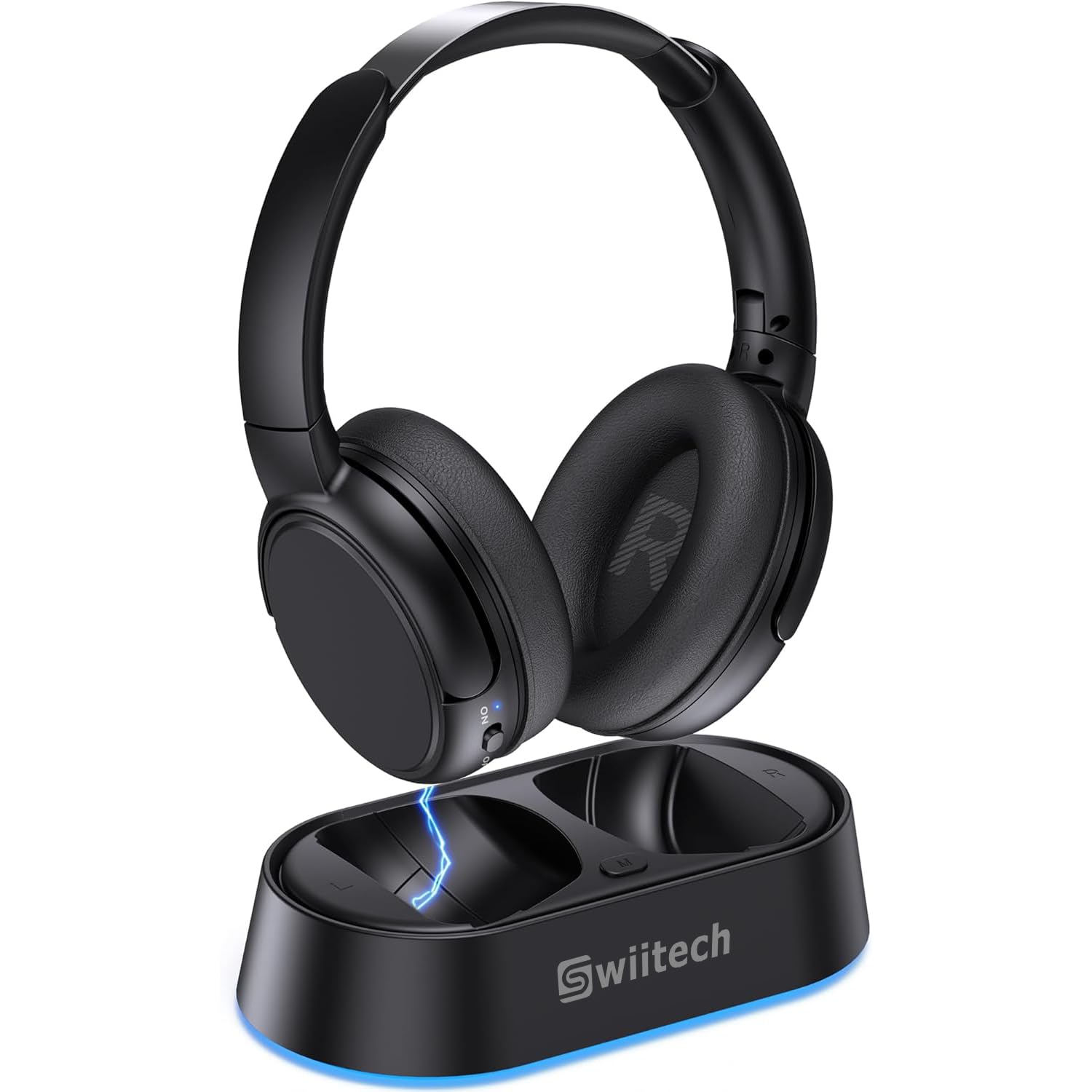
Swiitech CH-211

87 /100
Keeper Score Excellent

Key details

Range
Up to 100 ft
Bluetooth
5.3, pairs with phones
Connections
Optical, 3.5 mm AUX, RCA
Battery Life
Up to 45 hours
Check Price on Amazon

Most of these systems are locked to the television. The Swiitech CH-211 is not: away from the dock the headset pairs to a phone, tablet or laptop over Bluetooth 5.3, then goes back to TV duty with under 40 ms of latency when you sit down again. Forty-five hours of playback covers a lot of both.

What we like is how practical that split turns out to be. The person who wants headphones for the television usually wants them for a laptop call or a podcast too, and this is the only set here that handles both without a second purchase, which stretches the money further than a TV-only system at the same price.

The rest is sensible rather than luxurious: soft breathable earcups, a lightweight adjustable frame, push-button controls and a one-year warranty. The listed 30 m Bluetooth range is generous for moving around a house, and the dock gives the headset somewhere to live other than the arm of the sofa.

Pros

  • Bluetooth 5.3 doubles as a phone headset
  • Up to 45 hours of playback
  • Under 40 ms latency on TV audio

Cons

  • Connections stop at optical, AUX and RCA
Our verdict

We keep it on the list for the double duty: Bluetooth 5.3 for a laptop, low-latency TV audio at the dock, and 45 hours of playback.

Check Latest Price

How We Tested TV Headphones

We started by assembling a shortlist from the specs that actually change daily use: optical, AUX, RCA, HDMI ARC, and Bluetooth inputs; charging docks or bases; clear-voice and volume-boost modes; low-latency claims; and battery ratings. We filtered out duplicates and anything that couldn't connect to a standard TV or soundbar, then brought in 12 sets and used them for eight months.

Each set moved between my living room TV, a soundbar with optical passthrough, and a bedroom screen. I timed setup from unboxing to first sound, paired each transmitter with two different TVs, and played dialogue-heavy scenes, live sports, and action movies to watch for lip-sync drift and dropouts. I also walked from the couch to the kitchen to see where range failed and whether walls caused stutter.

During three-hour movie nights, I noted where the headband pressed, whether glasses broke the earcup seal, and how much sound leaked at normal volume; I also checked for background hiss between tracks. Battery life was tracked from a full charge to shutdown, with charging docks judged on how easy they were to seat in the dark. After repeated docking, cord tugging, and a few accidental drops, we compared build quality and asked whether each set's price matched its performance.

How to Choose Tv Headphones

Start with the ports on the back of your TV

Almost every system here wants an optical (TOSLINK) or 3.5 mm output. Optical is the better of the two: it carries a clean digital signal and on most TVs leaves the built-in speakers running, which matters if someone else is watching with you. The 3.5 mm headphone jack typically silences the TV speakers instead.

Two traps live here. If your TV offers only HDMI ARC, you need a system built for it, and the Opera Plus is the one set on this page that accepts HDMI ARC. And when you use optical, set the TV's digital audio format to PCM; a Dolby or auto setting is the usual reason a new set arrives silent.

Match the boost to the hearing you actually have

These are TV headphones, not hearing aids, and the manufacturers say so plainly: none of the picks here promises hearing-aid-level amplification. What they do is lift dialogue above music and effects, which suits mild to moderate loss and the far more common complaint that everyone on screen mumbles. If a hearing test is overdue, take it first.

Within that group, an adjustable boost beats a fixed one, and left/right balance is worth hunting for when one ear is worse than the other. The SIMOLIO is the only set here with a balance control, which is the single clearest reason to choose it over a better-rounded system.

Why a dedicated link beats Bluetooth for lip-sync

Bluetooth is fine for music and frustrating for video, because compression and re-buffering show up as a half-second gap between a mouth moving and the words arriving. The sets that stay in sync either use a dedicated 2.4 GHz or RF link to their own transmitter, or a low-latency codec, and the good ones land near 30 to 40 ms, roughly a frame.

The rule that matters: connect through the transmitter, not by pairing the headset to the TV's Bluetooth menu. Pairing directly to the TV is where most delay, dropout and re-pairing complaints begin, and it wastes the low-latency hardware you just paid for.

Battery hours and the dock habit

Playtime across this group runs from 14 hours to 65, which is the difference between charging nightly and charging monthly. Every pick here includes a charging base, so the dock itself is not a differentiator; where the base sits is. Put it within arm's reach of the chair, because a set that has to be carried across the room to charge is a set that dies mid-film.

Sealed batteries are the norm, and the cell is usually what retires a headset first. The SIMOLIO's user-replaceable lithium battery is the exception here and the reason it is worth considering for a daily viewer.

Weight, clamp and the three-hour film

Headphone weight is the specification that best predicts whether a set gets worn, and this group spans 196 g to 310 g. Clamp pressure matters as much as the number: a firm fit keeps the earcups sealed and the bass intact, and it is also the first thing glasses-wearers notice after an hour.

For nightly viewing, favour the lighter frame and an adjustable headband that holds its setting. And give yourself an out: wear the set for a full evening inside the return window rather than discovering the clamp three weeks in.

Frequently Asked Questions

Final Verdict

In a category where most sets do the same job with the same three cables, the Avantree HT5009 Plus wins on the parts you use every night: Clear Voice pulls dialogue out of the mix, the dock keeps it charged, and 196 g disappears on your head. Buy it if your TV has an optical or 3.5 mm output, which is the check to make before anything else.

If the only usable output is HDMI ARC, the Opera Plus is the set that connects, and you pay for that convenience. If the whole exercise is about spending as little as possible, the Mutbam does the same job with 65 hours between charges and nothing to configure.