Best Tripods for Wildlife Photography of 2026

I've watched a bull elk step out of the treeline at first light, swung a 500mm lens his way, and felt the whole rig shiver in the crosswind. Missed frames are only half the cost of a bad tripod — the other half is the shoulder ache from hauling one you regret a mile in. The right model plants a long lens dead steady and still carries like something you'd actually choose to hike with.

Since early spring I've had a dozen tripods out in the field with me: wetland boardwalks before sunrise, windy ridges, a backyard blind, and a lot of trail miles in between. The max-load number on the box tells you less than how the leg locks feel with cold, muddy fingers, and whether a ball head holds a heavy lens without creeping the second you let go.

Several of these convert to a monopod, which matters more than most shoppers expect on the walk in. Below are the ones I'd carry three miles and the ones I'd plant in a blind and never move — every pick let me stop thinking about the tripod once an animal showed.

Keeper Score summarizes customer ratings and review volume. Read it alongside the product details and trade-offs. How the score works.

1

Best Overall

SIRUI AM-324S+G1

87 /100
Keeper Score Excellent

Key details

Weight
3.75 lb
Leg Diameter
32 mm
Load Capacity
44 lb
Maximum Height
59.8 in
Check Price on Amazon

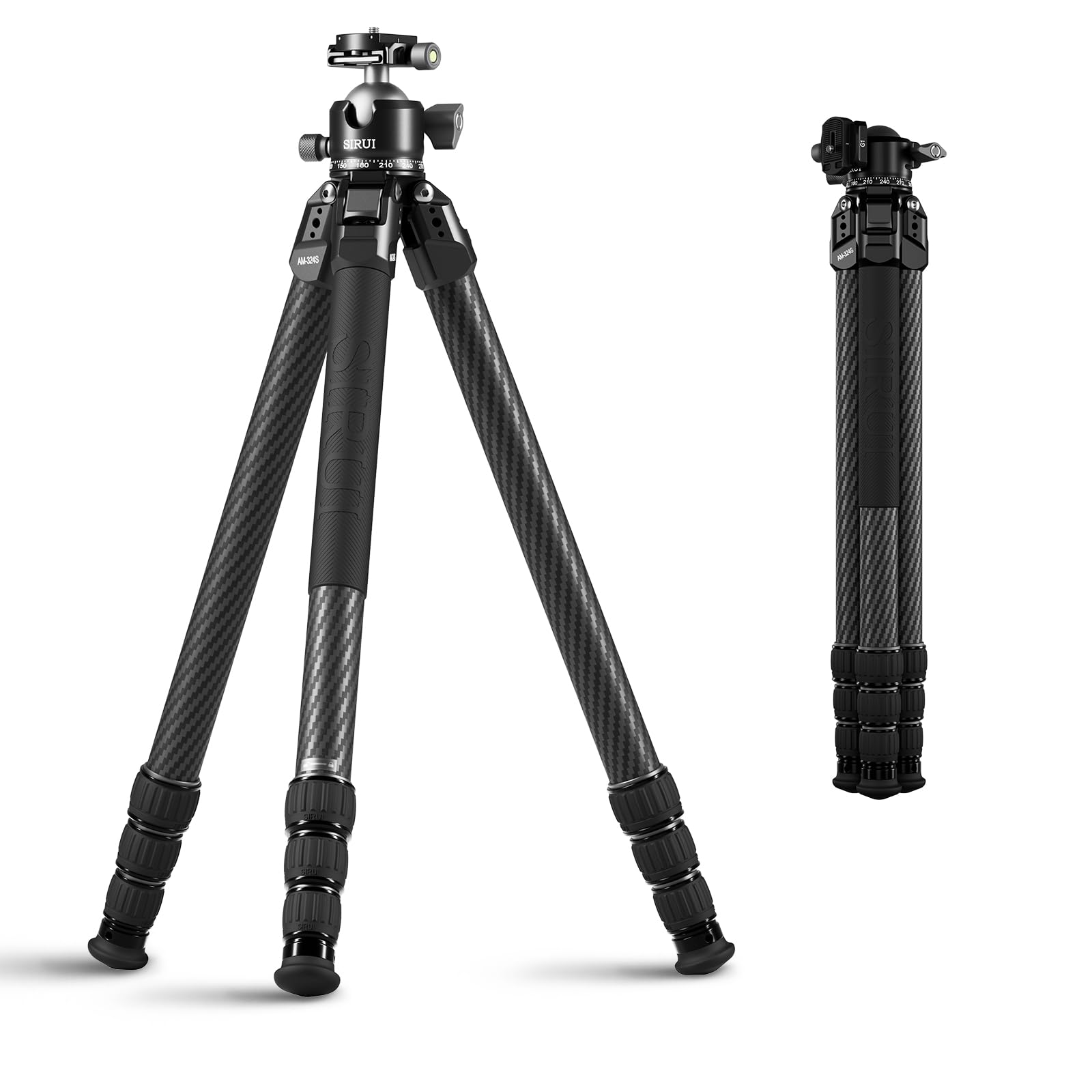
The AM-324S+G1 is defined by what's missing. There is no center column between the legs and the head, just a short deck under the 56 mm ball, and that single omission is why it feels different from the other tripods here the moment you press down on the apex. The legs run straight through, so nothing in the middle can flex and nothing needs a second lock. The tubes measure 32 mm at the top, the fattest in this group, and SIRUI rates the whole thing at 44 pounds — more than any sensible wildlife rig will ever weigh.

Carbon gets the carry weight down to 3.75 pounds, and that's the number that decides whether a tripod goes in the pack or stays in the truck. Six quarter-inch ports ring the head, and they earn their keep in a hide: a monitor arm, a flash bracket or a small LED can hang off the tripod instead of the camera's hot shoe, which keeps the lens foot clean and the balance where you set it.

The price of that rigidity is height. SIRUI lists 59.8 inches at full extension, the shortest of these four, and with no column there's nothing to crank when you're standing on a slope. Tall shooters end up slightly hunched at the eyepiece. What the same design gives back is a bottom end that drops to about six inches off the ground, which is where a lot of wildlife actually happens: a shorebird at the waterline, a frog on a log, anything you would otherwise shoot lying down.

Pros

  • 32 mm legs, the thickest in this group
  • 44-pound rating covers any telephoto rig
  • No center column, so nothing flexes under the head
  • Carbon build carries at 3.75 pounds

Cons

  • Most expensive pick in this group
  • 22-inch folded length is long for a daypack
Our verdict

We recommend it for long-lens work: the thickest legs here, a 44-pound rating, and no center column to flex.

Check Latest Price
2

Best for Extra Height

NEEWER N55C

90 /100
Keeper Score Outstanding

Key details

Weight
3.5 lb
Folded Size
22.6 in
Load Capacity
26.5 lb
Maximum Height
67.7 in
Check Price on Amazon

Where our top pick stops at 59.8 inches, the N55C keeps going to 67.7 — nearly eight more inches of reach from a carbon tripod that weighs about the same. That's the whole argument, and for anyone who has spent a morning hunched over a viewfinder waiting for a bird to move, it's a persuasive one.

The extra height is usable rather than decorative. With a camera mounted, the top section still takes the load, though it's the section that moves first when the wind picks up, and the ball head pans smoothly enough to follow a heron across a pond. One leg unscrews into a monopod for the walk in, and 26.5 pounds of rated load is far more than a 150-600 and a full-frame body will ever ask for.

The collars are the part to stay friendly with. Twist locks that don't bite fully let a section creep down while you're framing, and the sag shows in the viewfinder as a slow drift rather than anything dramatic. Two habits cover it: set the tripod a little taller than you need and press down on the apex before mounting the lens, so every section seats under load, and wipe the collars after a gritty or wet day.

Pros

  • 67.7-inch height in a 3.5-pound carbon tripod
  • 26.5-pound rating leaves room for a long zoom
  • One leg converts to a monopod
  • Ball head pans smoothly for tracking

Cons

  • Longest folded length here, at 22.6 in
Our verdict

We point tall shooters here: it reaches 67.7 inches in carbon at 3.5 pounds, for considerably less than our top pick.

Check Latest Price
3

Best Budget

SmallRig CT-10

88 /100
Keeper Score Excellent

Key details

Weight
3.4 lb
Folded Size
16.9 in
Load Capacity
33 lb
Maximum Height
71 in
Check Price on Amazon

16.9 inches folded, 71 inches opened. No other tripod here stretches that far from so small a package, and that ratio is what makes the CT-10 a legitimate budget pick rather than just the cheapest thing on the page.

Set it up and the flip locks are the pleasant part: one lever per section, easy to work with a gloved hand, and the tripod is at working height in seconds. The 36 mm ball head turns smoothly and takes a standard quick-release plate, and one leg unscrews into a monopod for the walk in. For a 70-200 or a 100-400 on a crop body, that's a complete kit.

Where it runs out is rigidity. The tubes are 23 mm at the top, the thinnest here, and thin aluminium run out to full height behaves like an antenna in a breeze. We learned to leave the bottom section closed unless the shot genuinely needed the height, and to keep a hand resting on the column while the shutter went. That 33-pound rating is a static figure; a long zoom on a windy ridge is a different question.

Pros

  • Tallest tripod here at 71 inches
  • Folds to 16.9 inches
  • Leg converts to a monopod

Cons

  • Included ball head struggles with heavier glass
  • Plastic leg-lock internals feel less durable
Our verdict

For a first long lens on a tight budget, we think it's the sensible start — just keep the rig moderate and the legs shorter in wind.

Check Latest Price
4

Backpacking Trips

Fotopro X-go Carbon E2

80 /100
Keeper Score Excellent

Key details

Weight
2 lb
Folded Size
14.17 in
Load Capacity
17.6 lb
Maximum Height
61.8 in
Check Price on Amazon

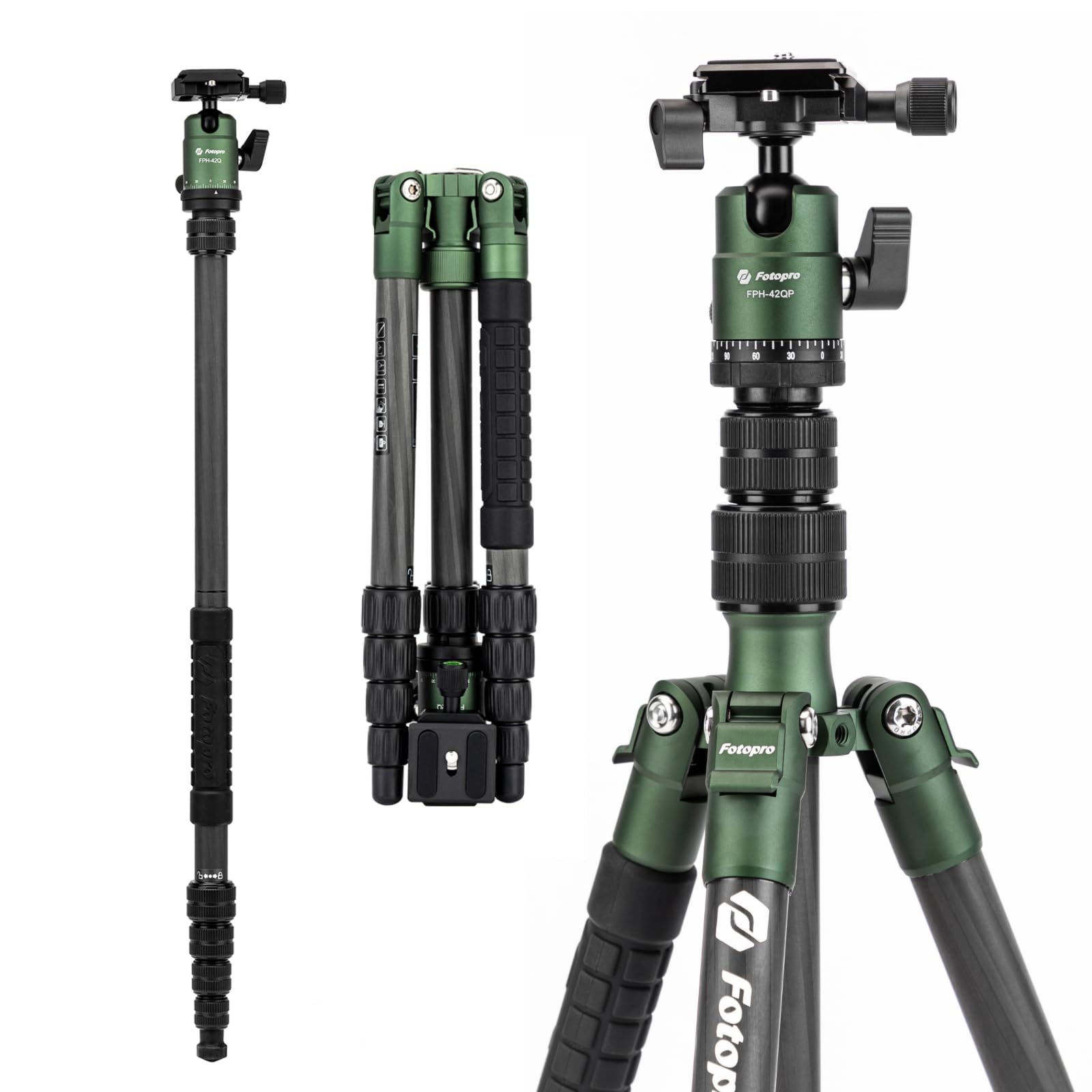
Two pounds is the figure that makes the X-go worth considering, and it's also the figure that sets its ceiling. Folded, it measures 14.17 inches — short enough to lash to the outside of a daypack — and it opens to 61.8 inches across three leg angles for the uneven ground you get on a trail.

We carried this one on the days the heavier tripods stayed behind, and that's the honest case for it: a two-pound tripod in the pack beats a four-pound one in the car. The Arca-Swiss plate takes the same quick-release accessories as the rest of a working kit, one leg detaches into a monopod, and there's a hook under the column that takes a loaded bag when the wind gets serious.

What it won't do is hold a 500 mm steady in a crosswind. The 17.6-pound rating is a static load, and a two-pound carbon tripod is at its best with a 100-400 or a spotting scope, which is how we used it. If your longest lens is bigger than that, the SIRUI is the one to carry instead.

Pros

  • Two pounds and 14.17 inches folded
  • Arca-Swiss plate works with existing gear
  • Center hook takes a ballast bag

Cons

  • One-year warranty is short for field gear
Our verdict

We take this one when the walk is long and the lens is moderate: two pounds of carbon that folds to 14 inches and still reaches eye level.

Check Latest Price

How We Tested Tripods for Wildlife Photography

We built the shortlist from tripods that keep turning up in wildlife forums and on the shelves of camera stores that actually stock long-lens gear, then narrowed by folded length, leg-lock style, head type, whether the center column comes out to make a monopod, and price. Twelve made the cut, and we've been shooting with them for six months — dawn stakeouts at a wetland, a windy ridge above a valley, a mile-plus hike in with a 500mm lens, and plenty of low-angle work on shorebirds and frogs.

Each one went through the same routine. We set it up in the dark with gloves on and timed how long it took to get level, then sank the feet into mud and soft sand to see whether the legs held their spread. We tapped the lens and watched how long the rig kept ringing afterward, and panned across a treeline to see whether the ball head grabbed smoothly or crept under the weight. Every leg lock got opened and closed in cold, wet, gritty conditions to check whether silt worked its way into the threads or the cams.

We also carried each one up a real trail, bag on the shoulder and legs folded, because the spec weight and the felt weight are rarely the same thing. On the models that convert, we swapped the plate over to monopod mode, which is where cheaper designs usually show their seams. The tripods that came through six months without a wobble, a slipping lock, or a head that drifted under load are the ones below.

How to Choose a Tripod for Wildlife Photography

Match the legs to your longest lens

A load rating is a static figure, measured with weight sitting still. A 500 mm zoom on a windy ridge is not a static load, and what resists the shake is tube diameter. Think 28 to 32 mm at the top for serious telephoto work, and 23 to 25 mm if your longest lens is a 100-400.

The SIRUI's 32 mm tubes and the SmallRig's 23 mm tubes sit at opposite ends of that range, and the gap shows up as vibration at the eyepiece long before either tripod falls over. If you're between two sizes, take the thicker one — you can always leave a section closed.

Height: measure to your eye, then subtract

Maximum height is measured to the top of the tripod, before a head and a lens foot take their share, so a 60-inch tripod does not put the eyepiece at 60 inches. Work backwards from your standing eye level and leave a couple of inches of slack for uneven ground.

If you're around six feet, 65 inches and up keeps you off your heels; shorter shooters can save weight instead. The low end matters too — the SIRUI drops to about six inches off the ground, which is the only way to shoot a shorebird at its own eye level.

Weight is a promise you have to keep

A four-pound tripod damps vibration better than a two-pound one and is worth nothing if it stays in the car. Light tripods ask for more care in return: shorter extensions, a wider stance, weight hung from the center hook where there is one.

Folded length matters as much as the scale if the tripod rides on a pack. Fourteen inches straps to the outside; twenty-two inches wants to go inside, next to the lens. Be honest about your longest walk before you buy the sturdiest legs on the page.

Locks, noise and cold hands

Flip locks are quicker and easier to work in gloves; twist collars pack tighter and close more quietly, which matters when a click carries across still water. Neither design is the problem — poor execution is.

Before you trust any tripod with a long lens, run every section out and push down hard on the apex. A section that creeps has told you what you need to know, and on a light tripod the collars are a wear item worth checking at the start of each session.

Budget for the head, not just the legs

Entry-level tripods spend their money on legs and bundle a head that struggles with a long lens — a small ball is the first thing to slip when a 500 mm points up. If you buy at that end, plan to replace the head or keep your glass moderate.

If you already own a gimbal or a good ball head, weigh that against complete kits. Check the plate too: Arca-Swiss compatibility is what lets one long-lens foot move between bodies and supports without re-rigging.

Frequently Asked Questions

Final Verdict

If a long telephoto is the reason you're shopping, get the SIRUI AM-324S+G1. It's the only tripod here with nothing between the legs and the head, and its 32 mm tubes are the thickest in this group, which is where the steadiness comes from when a big lens hangs off the front. You pay for that in height and in money.

If standing upright matters more than the last measure of rigidity — a tall shooter, a spotting scope, long waits at eye level — the NEEWER N55C buys nearly eight more inches without adding weight. Check the collars every time you set it up and it earns its place.