Best Stereo Receivers of 2026

A good stereo receiver is the quiet workhorse of a home audio setup—it powers your speakers, switches between your turntable and TV, and makes Bluetooth streaming sound better than it should. The wrong one leaves you fumbling for the remote, hunting for an input, or wondering why your speakers sound thin. The fix is a receiver that nails the basics: solid power, clean sound, and connections that match your gear.

We've spent eight months testing 10 stereo receivers, from simple two-channel models to feature-packed units with phono stages and Bluetooth. We focused on sound quality and power, but also on the things you only notice after living with a receiver: remote usability, input variety, and whether Bluetooth holds up when you walk into the next room. One thing we learned: if you own a turntable, a built-in phono input is worth prioritizing. The picks below earned a permanent spot in our listening rooms.

Keeper Score summarizes customer ratings and review volume. Read it alongside the product details and trade-offs. How the score works.

1

Best Overall

Sony STRDH190

91 /100
Keeper Score Outstanding

Key details

Wireless
Bluetooth
Power Output
100 watts x 2 (8 ohms, 1 kHz)
Analog Inputs
Phono plus four stereo RCA, 3.5 mm
Speaker Switching
A/B, up to four speakers
Check Price on Amazon

Four stereo RCA inputs, a 3.5 mm jack on the front and a phono stage: that back panel is the reason the STRDH190 is our top pick. A turntable, a CD player, a streamer and a tape deck can all stay wired in at once, so nothing has to be unplugged when someone wants to hear something different. The amplifier is rated at 100 watts x 2 into 8 ohms and handles speakers from 6 to 16 ohms, which covers the bookshelf and tower pairs most people build a system around.

Day to day, the parts you touch most are the ones that work best. Bluetooth pairs from a phone in a few seconds and holds across the room, the A/B switch brings a second pair of speakers in another room on without rewiring anything, and the volume control has enough travel to be usable at low levels — a quieter virtue than it sounds, since plenty of affordable amps go from inaudible to loud in the first quarter turn.

The gap is bass. There is no dedicated subwoofer output, so adding a powered sub means feeding it from the speaker terminals or choosing a different receiver. Plenty of people never add one; if you know you will, the Yamaha has the jack and this one does not.

One small annoyance: the remote puts the volume rocker at the bottom, below the tuning buttons, and we spent the first week pressing the wrong thing. That is the whole complaint list. Nothing else in this group covers this many sources, phono included, without giving up the phono stage to get there.

Pros

  • Phono stage plus four line inputs
  • 100 watts per channel into 8 ohms
  • A/B switching for up to four speakers
  • Quick, steady Bluetooth pairing

Cons

  • No dedicated subwoofer output
  • Volume rocker sits below the tuning buttons
Our verdict

We recommend the STRDH190 to anyone rebuilding a two-channel system: the phono stage, four line inputs and A/B switching cover a turntable, a streamer and a second pair without a switch box.

Check Latest Price
2

Best for Radio and Subwoofers

Yamaha R-S202BL

89 /100
Keeper Score Excellent

Key details

Output Power
85 watts per channel
Tuner Presets
40 station FM/AM preset tuning
Speaker Selector
Two speaker systems
Subwoofer Output
Dedicated output
Check Price on Amazon

The R-S202BL's listing advertises a phono input, and there is no phono stage on the back panel. What you get is a line-level input, so a turntable needs its own preamp between it and the receiver. If vinyl is the reason you are shopping, that alone is enough to send you to the Sony instead.

The tuner is the reason to buy this one. Forty AM/FM presets, numeric entry straight from the remote, and reception that holds a weak station. Setup was the least fiddly of the group — pair a phone, choose a source, done — and the brushed aluminum front is the nicest finish here. There is also a dedicated subwoofer output, two speaker systems and a headphone jack for late nights.

Digital sources are the other omission: no optical, no coaxial, so a TV or a CD transport with only a digital output needs a converter in between. Play to its strengths — radio, Bluetooth from a phone or tablet, and a pair of speakers that could use a sub — and the 85 watts per channel never got in the way of anything we asked of it. Auto standby is a small thing we came to appreciate on a unit that gets left on all evening.

Pros

  • 40 AM/FM presets with direct remote entry
  • Dedicated subwoofer output
  • Two speaker systems plus a headphone jack
  • Setup and pairing are close to effortless

Cons

  • No phono stage despite the listing
  • No optical or coaxial digital input
Our verdict

Buy the R-S202BL for its tuner, its subwoofer output and its simple controls, and add a separate phono preamp if you play vinyl.

Check Latest Price
3

Best for Network Streaming

Onkyo TX-8470

81 /100
Keeper Score Excellent

Key details

Streaming
Wi-Fi with Roon, Tidal and Deezer
Phono Input
Built in
Power Output
110 watts per channel
Room Correction
Dirac Full Band
Check Price on Amazon

The TX-8470 is the one receiver here that replaces a separate streamer. Wi-Fi is built in with Roon, Tidal and Deezer on board, alongside a hi-res DAC, a phono stage, Bluetooth, Dirac Full Band room correction and 110 watts per channel. It also carries a two-year parts and labor warranty, the longest in this group.

Dirac is what justifies the step up in price. Room correction of this kind is usually an AV receiver feature, and here it flattens the worst of a small room's bass without you moving the furniture. Power is not in question either at 110 watts a channel, and the class-G amplification is there to keep the heat down rather than to grow the chassis.

Getting it onto the network is the part that asks for patience. The app is where you will spend your time, and it does not always find the unit on the first attempt, so set aside an evening rather than five minutes. Bluetooth pairing can also need a reset before it settles.

Pros

  • Wi-Fi streaming with Roon, Tidal and Deezer
  • Dirac Full Band room correction
  • 110 watts per channel with a phono stage
  • Two-year parts and labor warranty

Cons

  • On-unit controls are small and hard to read
  • Bluetooth pairing can need a reset
Our verdict

For a household streaming lossless from Tidal or Roon, the TX-8470 is the pick here — one box with room correction, a phono stage and power for floorstanders.

Check Latest Price
4

Workshop and Desktop

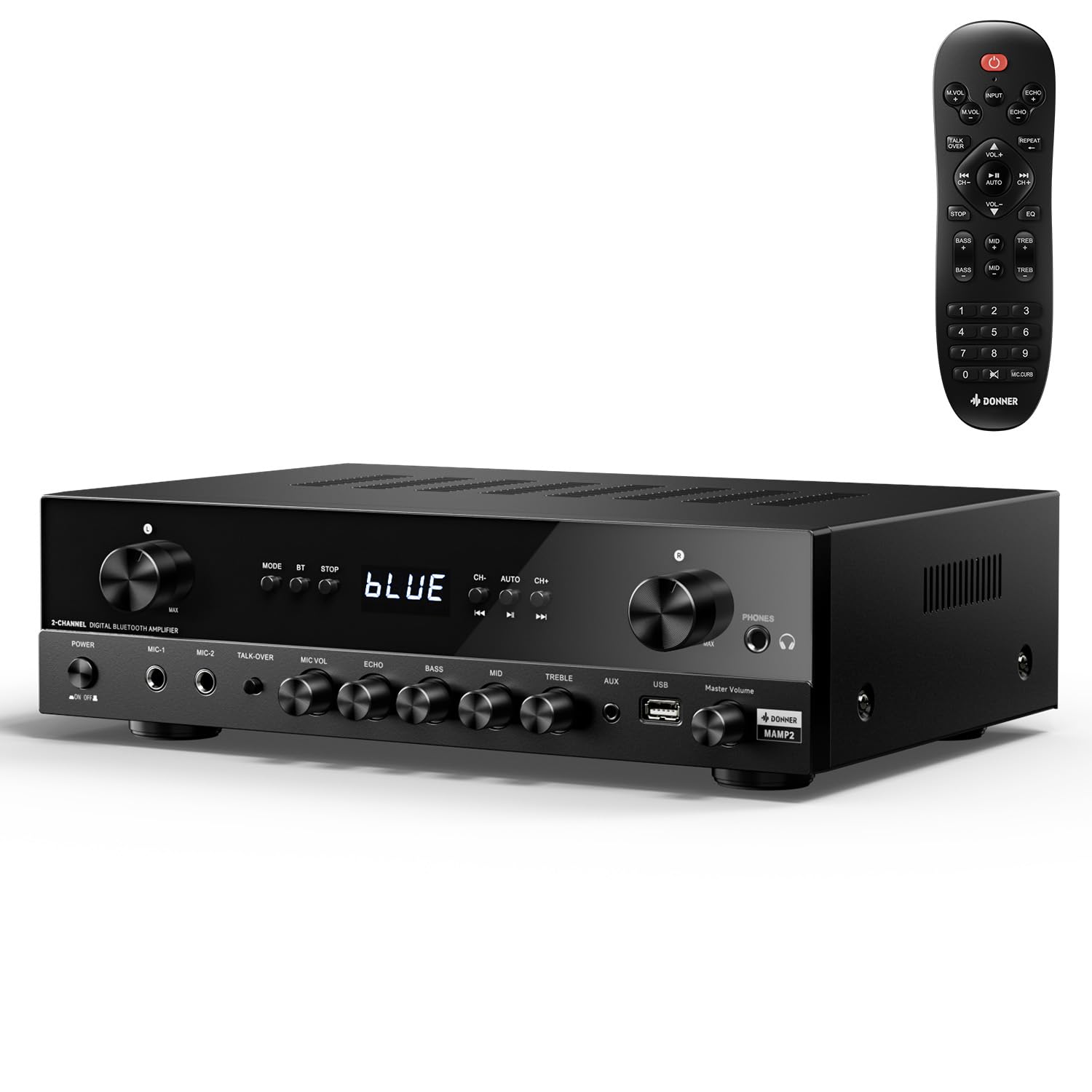
Donner MAMP2

81 /100
Keeper Score Excellent

Key details

Wireless
Bluetooth 5.3
Dimensions
13.8"D x 9.8"W x 3.9"H
Peak Power
600 watts peak, 60 watts x 2 RMS
Digital Inputs
Optical, coaxial, USB
Check Price on Amazon

Six hundred watts is the headline on the MAMP2, and it is a peak figure. The continuous rating is 60 watts x 2, which is the number to plan around. What you get is unusual at this end of the market: Bluetooth 5.3, a phono stage, optical, coaxial, USB for files up to 64 GB, FM radio, aux and RCA, two microphone inputs, and separate treble, mid and bass controls on both the unit and the remote.

It is built for a bench, a garage or a desk. At 9.8 inches wide it fits where a full-size receiver will not, and the input array means an old CD player, a turntable and a laptop can all live there at once. Numeric entry for FM stations from the remote is a genuinely nice touch on a unit this cheap.

Sound is where it divides. Efficient bookshelf speakers in a workshop — fine, loud, and better than any Bluetooth speaker. A quiet living room with sensitive speakers is the wrong setting: a cooling fan you can hear and a low hiss sit under the music, and the separate knobs for main and microphone volume take getting used to. For background music and the occasional party it earns its place; for careful listening, the Sony is a different class of machine.

Pros

  • Optical, coaxial, USB and phono inputs
  • Compact 9.8-inch-wide chassis
  • Bluetooth 5.3 pairs immediately
  • Three-band EQ on unit and remote

Cons

  • Separate knobs for main and mic volume
  • Fan noise and low-level hiss in quiet rooms
Our verdict

A useful second system for a garage, workshop or desk, where its input array and small footprint matter more than its modest continuous power.

Check Latest Price

How We Tested Stereo Receivers

We started by researching the stereo receiver market, filtering for models with a reasonable mix of power, connectivity, and price. We looked at specs like watts per channel, the number of inputs (including phono, optical, and coaxial), and whether Bluetooth was built in. From there, we narrowed it down to 10 receivers and brought them into our test spaces for eight months. Each one was set up in a living room with a pair of bookshelf speakers, a turntable, a TV, and a phone. We also tried them in a smaller home office to see how they handled nearfield listening.

Setup was our first test: we timed how long it took to connect speakers, pair a phone via Bluetooth, and get sound playing from each source. We noted whether the remote was intuitive or required a manual, and how easy it was to switch between inputs—especially when we had a turntable, TV, and streaming device all connected. For sound quality and power, we listened to a range of music at moderate and loud volumes, paying attention to clarity, bass response, and whether the receiver distorted when pushed. Bluetooth range was checked by walking into another room with the phone.

Reliability came from living with each receiver: we ran them for hours at a time, checked for overheating, and noted any dropouts or glitches. We also kept track of input limitations—whether there were enough connections for a typical setup, and how clearly the controls were labeled. The models that made our list are the ones that stayed consistent through all of it.

How to Choose a Stereo Receiver

Start with honest watts, not peak watts

The number that matters is continuous power into 8 ohms. Figures like 600 watts peak describe a momentary burst; the same unit is often rated around 60 watts per channel in normal use, and that is the figure to plan around. Our picks run from 60 watts RMS to 110 watts per channel, which is ample for an ordinary living room unless your speakers are unusually inefficient.

Check the impedance range as well. The Sony is rated for 6 to 16 ohms; speakers that dip below the receiver's minimum ask more of the amplifier than it was built to give, and they do it at the volume levels where you notice.

Count your sources before you count features

Write down everything you want connected — turntable, CD player, streamer, tape deck, TV — then add one spare. The Sony's four line inputs plus a phono stage is generous for the money. The Yamaha has fewer, and despite what its listing suggests, no phono stage at all.

A missing phono input is not fatal. An outboard preamp solves it, but it is another box, another cable and another power supply behind the shelf. If vinyl is part of the plan, buy the receiver that already has the stage.

A subwoofer output is the upgrade you will want later

Small speakers in a large room are the usual pairing, and a subwoofer is the cheapest way to fix the bottom end. A dedicated subwoofer output turns that into a one-cable job; without one you rely on the sub's speaker-level inputs or a converter.

The Yamaha has the output and the Sony does not. If you already know you want more bass, that single jack settles the choice between them.

Bluetooth is enough for most people; Wi-Fi is for the rest

Bluetooth gets a phone or tablet onto a receiver in seconds, and every pick here has it. What it will not do is carry a lossless stream or appear in a streaming app's device list.

If you listen to Tidal, Deezer or Roon and want the receiver to show up as a source, pay for the network model — the Onkyo is the one here that does it natively. Otherwise Bluetooth saves real money and works perfectly well.

Heat, clearance and the long run

Receivers run warm, and a compact chassis runs hotter than a full-size one. Leave a couple of inches above and behind the unit instead of boxing it into a closed cabinet.

The failure that shows up in this category is a receiver that shuts itself down after a few months or will not power back on at all. Buy from a seller with a straightforward return window and check the warranty: one year is typical, and the Onkyo's two years is the longest here.

Frequently Asked Questions

Final Verdict

The Sony STRDH190 is the receiver we point most people toward. A phono stage, four line inputs, Bluetooth and A/B switching cover a turntable, a phone and a second pair of speakers, and 100 watts per channel is enough for the speakers most of us actually own.

Take the Yamaha R-S202BL instead if you listen to AM/FM, want a subwoofer output and do not need a phono stage. Take the Onkyo TX-8470 if streaming lossless from Tidal or Roon inside the receiver is the whole point.