Best XLR Cables of 2026

The cruel thing about a bad XLR cable is that it rarely announces itself. It passes signal at soundcheck, then hums, crackles, or drops out the moment someone walks across the stage. Nearly every cable on the shelf is balanced and shielded, so the real differences hide in unglamorous places: how the connector is soldered and strain-relieved, how the jacket behaves after its hundredth coil, and whether the plug still locks with a click a year in. We've spent the past four months running 14 cables through rehearsals, studio sessions, and a lot of impatient plugging and unplugging, and the gap shows up at the connector first.

Gold-plated pins won't make a mic sound better; they keep the contact clean through humid basements and sweaty stages. What actually shapes what you hear is the shielding and the soldering, and the length has to match the job — a 6-foot patch on a desk, a 25- or 50-foot run to a speaker across a room. Every pick here is a standard 3-pin male-to-female, so compatibility isn't the question. Durability and noise are.

Keeper Score summarizes customer ratings and review volume. Read it alongside the product details and trade-offs. How the score works.

1

Best Overall

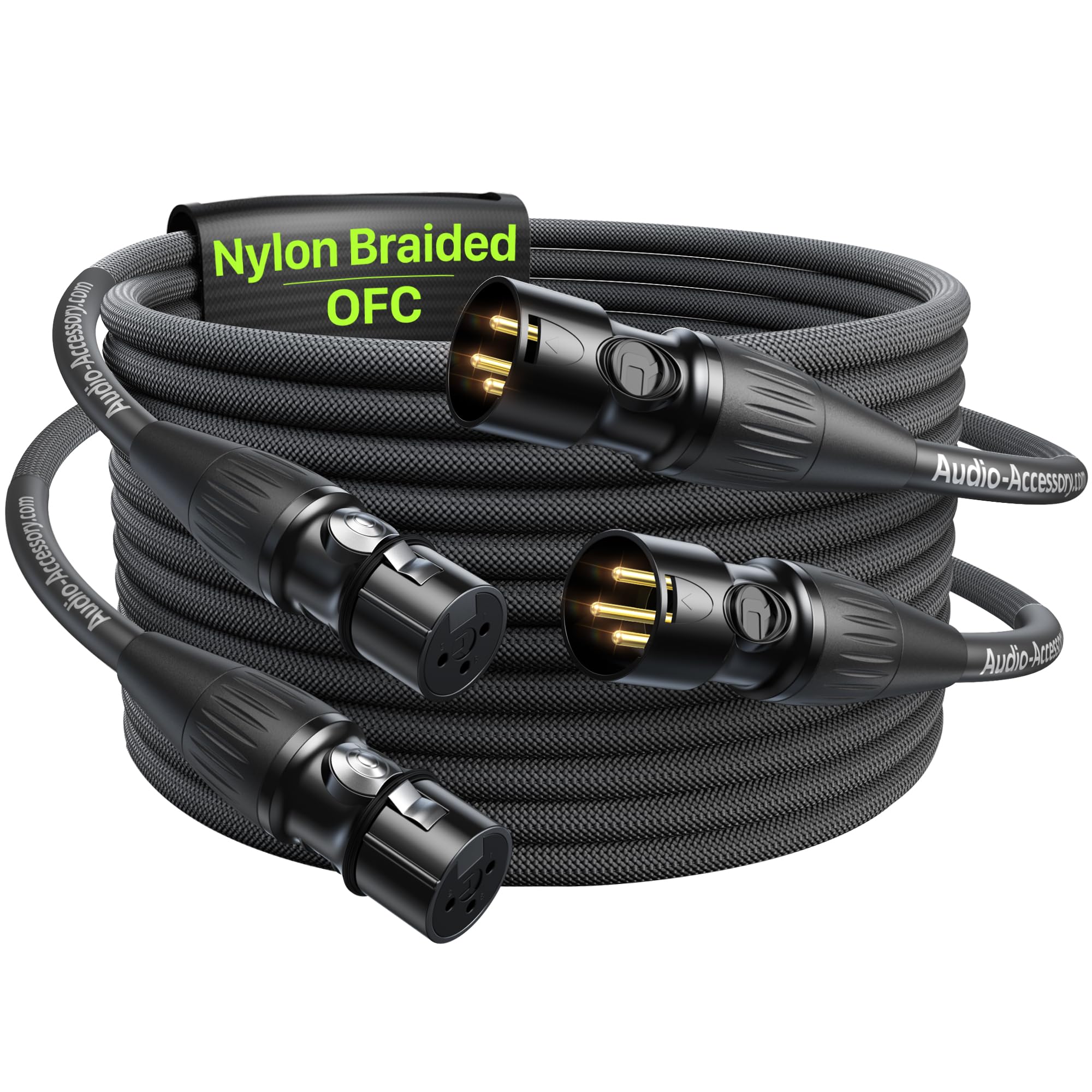
AA Audio Accessory XLR Cable 10 ft 2-Pack

93 /100
Keeper Score Outstanding

Key details

Length
10 ft each
Conductors
21AWG oxygen-free copper
Connectors
REAN by Neutrik, gold-plated
Cables Included
2
Check Price on Amazon

The plug is the first thing we look at on any XLR cable, and it's where this pair separates from the rest of the group. The connectors are REAN, Neutrik's own budget line, which means the shell, the latch, and the gold-plated pins are a known design rather than an anonymous casting. That one choice tells you more about how a cable will hold up than anything printed on the packaging, and it's why this is the pair we hand to most people first.

Behind the connector, the construction is more than we expect at this price. The conductors are 21AWG oxygen-free copper, wrapped in aluminum foil and a copper braid covering better than 98% of the run, with a Kevlar core through the middle to take the pull when someone grabs the cable instead of the plug. The solder joints get two layers of heat-shrink, which is exactly where cheap cables die: the joint bends, the strands work-harden, and one day the channel goes quiet. We appreciate that this one addresses the failure we actually see instead of adding another line of marketing.

Ten feet suits a mic on a desk or a boom beside an interface, and the two-pack means a second mic or a spare without another order. The nylon braid is the one adjustment: it's tougher than plain PVC but doesn't drape as limply, so it takes an extra second to dress behind a desk. Phantom power is no issue either, rated to 48 volts. For a run across a stage, though, look at the GLS pair below — ten feet won't get you to the drum riser.

Pros

  • Genuine REAN connectors from Neutrik
  • Foil plus braided copper shielding, 98% coverage
  • Heat-shrink and Kevlar protect the solder joints
  • Two cables for far less than one premium cable

Cons

  • Ten feet is short for stage and PA runs
Our verdict

This is the pair we recommend first: genuine REAN connectors, dual shielding, and two 10-foot cables that cover a mic, an interface, and a spare.

Check Latest Price
2

Best for Long Runs

GLS Audio XLR Cable 50 ft 2-Pack

96 /100
Keeper Score Outstanding

Key details

Jacket
Heavy-duty rubber
Length
50 ft each
Conductors
21-gauge dual copper
Cables Included
2
Check Price on Amazon

A hundred feet of cable is a commitment. Two 50-foot runs reach from a stage box to a mix position at the back of a room, or across a sanctuary floor to a pulpit mic, with no coupler in the middle. You're also carrying two fat coils to every gig and finding somewhere to put them, which is the honest cost of that reach.

What earns them a place is the build. The connectors are metal with a locking latch, and behind them sit an internal tri-grip strain relief and a rubber grommet, so the pull goes into the shell instead of the solder joint. The jacket is heavy-duty rubber rather than PVC, and it takes being walked on, coiled tight, and dragged across a stage without going shiny at the bends. Of everything here, this is the pair we trust on a long run in a room we don't control.

The 21-gauge dual copper conductors and shielding hold a clean signal over that distance, and each cable arrives with a reusable tie — a small thing that matters more than it sounds, since a 50-footer coiled wrong is a 50-footer with a kink in it. One boundary worth naming: the length is far more than a desk setup needs, and a long cable collects more of a bad room than a short one, so keep these for stage and PA work.

Pros

  • Locking metal connectors with tri-grip strain relief
  • Heavy-duty rubber jacket survives stage abuse
  • Two 50-foot runs plus two reusable cable ties
  • 21-gauge dual copper conductors with shielding

Cons

  • Fifty feet is more cable than a home desk needs
Our verdict

This is the pair we reach for when the run is long: two 50-foot cables with locking connectors and the sturdiest build in this group.

Check Latest Price
3

Best for Permanent Installs

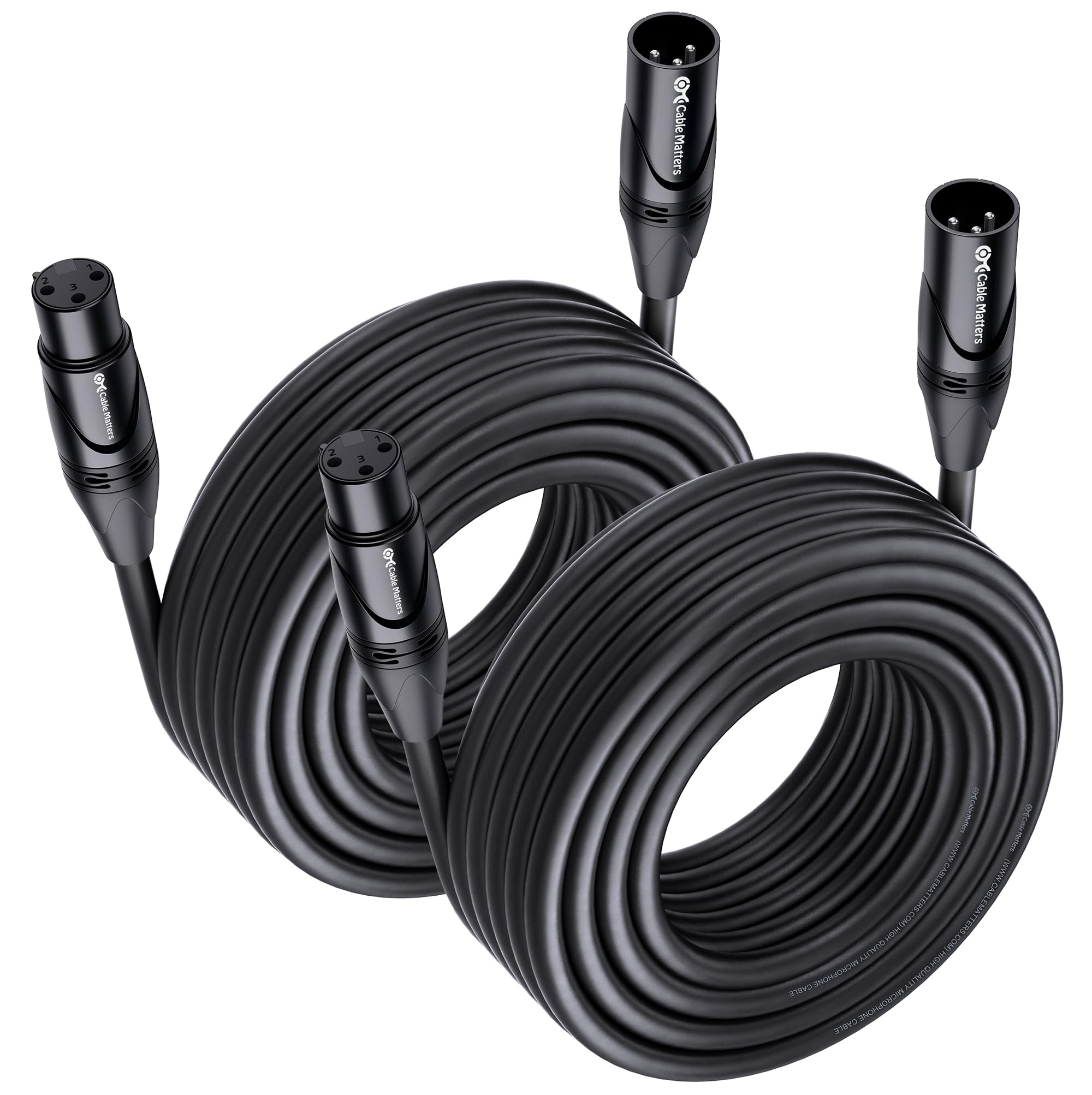
Cable Matters XLR Cable 35 ft 2-Pack

96 /100
Keeper Score Outstanding

Key details

Length
35 ft each
Shielding
Copper braid
Conductors
21AWG oxygen-free copper
Cables Included
2
Check Price on Amazon

Cable Matters builds this one like installed wiring, and that's the right way to read it. The conductors are 21AWG oxygen-free copper, the shield is a copper braid, and the connectors are heavy-duty metal with molded strain relief. Pick one up next to a thin PVC cable and the difference is obvious in the hand: this feels like something that was meant to be pulled through a rack.

We keep it for the run that never moves — monitors to a controller, a rack to a patch bay, drums across the room from the interface. Thirty-five feet covers a small studio without a coupler, and the two-pack means both sides of a stereo pair match. Where it stops being the right cable is on stage. The same jacket that shrugs off a road case holds a memory of its last shape, so it doesn't coil down small and it isn't what you want to wrap up four nights a week.

The pair is part of the insurance as well. If a channel goes quiet mid-session, you swap the cable, prove it in ten seconds, and keep working instead of unsoldering a plug at midnight. That's worth more than the few feet of length you give up against the longer GLS pair.

Pros

  • 21AWG oxygen-free copper with a copper braid shield
  • Molded strain relief at both connectors
  • Two 35-foot cables for matched stereo runs

Cons

  • Stiff jacket resists tight coiling
Our verdict

This is the one we keep for a cable that stays put: thick 21AWG conductors and braided shielding across 35 feet of rack-to-room reach.

Check Latest Price
4

Best Budget

Amazon Basics XLR Cable 25 ft

95 /100
Keeper Score Outstanding

Key details

Length
25 ft
Shielding
Copper spiral
Connectors
Zinc alloy, nickel-plated
Cables Included
1
Check Price on Amazon

Twenty-five feet of balanced cable for less than almost anything else in this group is the reason this one exists, and it does the job. All-copper conductors, a copper spiral shield, zinc alloy connectors with nickel plating, and a 6mm PVC jacket — nothing exotic, nothing missing. For a home studio, a rehearsal room, or a camera bag that needs a long spare, we've had no trouble getting a clean signal out of one.

The 13-ounce coil is light enough to carry and long enough to reach from a mic stand to an interface on the far side of a desk. Because the jacket is only 6mm, it coils down easily rather than holding a shape, which is why it's the cable we leave in the bottom of a bag as the one that doesn't matter if it gets left behind.

What the low price buys is a shorter working life, and the release tab is the part to watch: on some sockets it doesn't click home on the first push, so seat it and give the shell a tug before you trust a take to it. Buying two costs less than one of the premium cables here and removes the whole problem, which is how we'd use it — one in service, one in the bag.

Pros

  • Cheapest way to get a 25-foot run here
  • All-copper conductors with a copper spiral shield
  • Light 13-ounce coil that packs easily
  • Zinc alloy connectors with nickel plating

Cons

  • 6mm jacket is thinner than the rubber and braided cables here
Our verdict

We keep one of these in every bag: it's the cheapest sensible way to get 25 feet of balanced cable with copper conductors and a spiral shield.

Check Latest Price
5

Best Short Cable

Pig Hog PHM6 XLR Cable 6 ft

95 /100
Keeper Score Outstanding

Key details

Jacket
8mm rubber
Length
6 ft
Strain Relief
Heat-shrink protected
Cables Included
1
Check Price on Amazon

Six feet is the length that matches how most people record: a mic on a desk, an arm's reach from the interface, with enough slack to move the stand without pulling the plug. Buy a 25-footer for that job and you spend the session managing a coil instead of listening.

The jacket is 8mm, noticeably thicker than the 6mm PVC on the budget cable here, and the connectors are protected with heat-shrink where the cable enters the shell. That's the joint that fails first on a desk cable, because it's the one that gets bent every time the mic moves. The warranty is listed as a limited lifetime, which is longer cover than most of this group offers.

What you pay for the shortness is a higher cost per foot than any long reel in this group, and nobody buys a 6-footer for value. In exchange you get a cable that behaves: it uncoils without kinks, the connectors click home positively, and it doesn't drag a light stand over when you step back. If your setup lives on a desk and never travels, that's a better match than a longer cable you'll trip over.

Pros

  • 8mm rubber jacket, thicker than the budget cable
  • Heat-shrink protection at the connector joint
  • Limited lifetime warranty
  • Six feet is the right length for a desk

Cons

  • Highest cost per foot in this group
Our verdict

Six feet is the length we think most desk setups actually need, and the 8mm jacket and heat-shrink joints make this the short cable to buy.

Check Latest Price
6

Best Premium

Mogami Gold Studio 10

95 /100
Keeper Score Outstanding

Key details

Length
10 ft
Contacts
Gold-plated
Conductors
Quad (Neglex W2534)
Cables Included
1
Check Price on Amazon

Quad is the whole argument. Where most cables in this group run two conductors plus a shield, the Gold Studio runs four in an X pattern, and the manufacturer rates its noise rejection up to 30dB better than a twisted pair. Add XLPE insulation, a bare copper shield with full coverage, and gold-plated contacts, and you have the most heavily specified cable here by a distance.

The 10-foot length is deliberate: this is a patch cable for the short path between a mic and a preamp, or a preamp and an interface, where the cable is the last thing in the chain you want to wonder about. It's the one we reach for in a room with a dimmer rack on the other side of the wall, or a rack sitting next to a transmitter, where a normal shielded cable has already given someone a hum they couldn't trace.

It's also the most expensive single cable here by a wide margin, and we won't pretend the difference is audible in a quiet home studio — a good 21AWG cable costing far less will sound the same over ten feet. Buy it when you have a problem to solve, when the cable goes into an install you'll never re-cable, or when the rest of the chain is good enough that the cable is the weak link. One thing to settle at checkout: the warranty is described as lifetime in one part of the listing and two years in another, so confirm which applies to you.

Pros

  • Quad conductors rated for better noise rejection
  • Gold-plated contacts resist corrosion
  • Full-coverage copper shield and XLPE insulation
  • Short 10-foot run for mic-to-preamp patching

Cons

  • Most expensive single cable in this group
Our verdict

We think it's worth it only when a specific noise problem is costing you takes: quad conductors and gold contacts for one critical path.

Check Latest Price
7

Best Bulk Pack

EBXYA XLR Cable 25 ft 10-Pack

96 /100
Keeper Score Outstanding

Key details

Jacket
PVC
Length
25 ft each
Conductors
24AWG
Cables Included
10
Check Price on Amazon

Ten cables, 250 feet, one box. If you run a rehearsal room, a church, a school auditorium, or a DJ setup with four vocal mics and a couple of DI lines, this is the shape the purchase takes — you're not buying a cable so much as replacing the drawerful of mismatched ones that have accumulated.

Each is 25 feet, long enough to reach a stage box from most positions without a coupler, and the connectors lock with a proper click rather than a hopeful push. The shielding is a copper braid over the core and the jacket is PVC. Nothing here is exotic, and that's the point: every cable in the room matches, and every one is the same length, which makes troubleshooting a channel a matter of swapping rather than hunting.

The conductors are 24AWG, thinner than the 21AWG cables elsewhere in this group, and that matters more the longer the run gets. At 25 feet from a mic or a line-level source it isn't a problem we've heard; if you're pushing 50 feet or more into your most critical channel, spend the difference on the GLS pair instead.

Where this earns its spot is arithmetic. Ten working cables cost less than replacing the same number one at a time, and with spares in the box a dead cable is a swap rather than a crisis. The set we tested has been coiled and uncoiled by several people, plugged and unplugged night after night, and none has gone noisy. Just don't make one of these the cable on your lead vocal if you can avoid it.

Pros

  • Ten 25-foot cables at the lowest cost per cable here
  • Locking connectors with a positive click
  • Braided copper shielding on every cable
  • One length and one spec across the whole rig

Cons

  • All ten are 25 feet, with no short cables in the box
Our verdict

This is the pack we buy when we're wiring a whole stage: ten 25-foot cables at the lowest cost per cable in this group.

Check Latest Price
8

Fast Teardowns

Shure C25J XLR Cable 25 ft

95 /100
Keeper Score Outstanding

Key details

Design
Hi-flex low-impedance
Length
25 ft
Connectors
Chrome XLR
Cables Included
1
Check Price on Amazon

The C25J is thin — noticeably thinner than anything else in this group — and that's the design rather than a shortcut. Shure calls it Hi-Flex, and the point is a cable that drops into a loose bundle in one movement, lies flat on a stage floor, and doesn't fight a boom arm when you swing it across a set.

The connectors are chrome XLR with a firm latch, and the cable is specified for low-impedance operation, which covers the dynamic and condenser mics most people will plug into it. Twenty-five feet is the practical middle of the range: enough to get from a lectern to a mixer at the side of a room, not so much that you're carrying a coil between positions.

Treat it kindly. The jacket is thin enough that a road case wheel or a chair leg is a real risk, and this isn't the cable we leave lying across a load-out path. Where it pays you back is at the end of the night: it goes into the bag without a fight, doesn't take a set the way a stiff cable does, and hangs straight again the next morning.

So it's a specialist rather than the default. For a boom operator, a podcaster, or a venue that strikes a stage every night, the way this handles is worth more than the extra jacket thickness on the rubber cables here. If the cable is going to live under a drummer's feet instead, the GLS pair is the better buy.

Pros

  • Hi-flex jacket coils small and lies flat
  • Chrome XLR connectors with a firm latch
  • Specified for low-impedance microphones

Cons

  • Thin jacket needs care on load-out
Our verdict

We like it for jobs where the cable has to coil small: a deliberately thin, hi-flex 25-footer for boom arms and fast teardowns.

Check Latest Price

How We Tested XLR Cables

We started by gathering every balanced 3-pin XLR cable we could find in genuinely useful lengths — 6-foot patches, 10-foot studio cables, and 25- and 50-foot runs — and crossed off anything whose listing couldn't tell us what the conductor or the shield was made of. That left 14 cables, which we lived with for four months in a home studio, at band rehearsals, and across a couple of small live gigs.

Each cable got the same treatment. At the desk, I patched it between a condenser mic and an interface, cranked the preamp gain with nothing coming through the mic, and listened for hum, hiss, or radio bleed. Then I wiggled the connector in the jack while recording and tapped the barrel to hear whether any of that reached the track.

At rehearsal, the long runs went across a floor where people walk, so I stepped on them, rolled a chair over them, and pulled the plug out by the cable instead of the release latch — the abuse a cable actually gets. I coiled each one the same way a dozen times and noted which jackets held a stubborn memory and which stayed flat, and whether the locking pins still clicked home after repeated use.

The last check was simpler: the ones that felt cheaper in the hand stayed plugged in on my desk for weeks, and I waited to see which developed a crackle, a loose collar, or a shield that let noise through.

How to Choose Xlr Cables

Match the Length to the Run, Then Add a Little

Length is the decision people get wrong in both directions. A 6-footer is right for a mic on a desk and useless for a stage box at the back of a room; a 50-footer across a small studio is a coil you trip over, and every extra foot is another foot of cable sitting in whatever interference the room has. Measure the real run with the stand and the interface in place rather than estimating it.

Then add two or three feet of slack so a boom arm can move without loading the connector, and no more. If you're between sizes, go shorter for a fixed desk and longer for anything that moves between rooms.

The Plug Fails Before the Cable Does

The dead XLR cables we've pulled out of service almost all failed at one of two places: the solder joint behind the connector, or the latch that holds the plug in the socket. A metal shell with molded or heat-shrink strain relief spreads the pull over an inch of jacket instead of concentrating it on three soldered strands, which is the first thing we check on a new cable.

Gold plating is about corrosion over years rather than tone. When a cable arrives, plug it in, listen for the click, and tug the shell; a latch that needs a second push is the one that will let go mid-take.

Shielding, Balance, and Gauge Do Different Jobs

A 3-pin XLR cable is balanced: two signal conductors plus a shield, with the noise that hits the cable cancelled at the input. Foil gives full coverage, braid survives flexing, and the cables here that use both are the ones for long runs and electrically noisy rooms.

Gauge works the same way. 21AWG loses less signal over distance than the 24AWG in the ten-pack, though at 25 feet into a mic preamp the difference is small. Spend the heavier gauge on your longest and most critical run, and don't overthink the six-foot cable at your desk.

Pack Size and Jacket Tell You Who It's For

Singles, pairs, and ten-packs answer different questions. A pair is the sensible default — one for the mic, one for a spare or a second source — while a ten-pack is for a venue wiring several positions at once and wanting every cable to be the same.

The jacket is the other tell. Thin hi-flex coils small and suits boom work; rubber and braided jackets take being walked on; PVC is the budget option that scuffs first. Past a certain point you're paying for connectors, shielding, and the work behind the joint, not for a sound you'll notice on a short run.

Frequently Asked Questions

Final Verdict

The AA Audio Accessory 10-foot pair is what we recommend to most people: genuine REAN connectors, foil and braid shielding, heat-shrink over the solder joints, and two cables in the length that matches a mic, an interface, and a desk. Buy it if your cables mostly stay in one room.

If they leave the house and cross a stage, go to the GLS Audio 50-foot pair instead. The extra reach, rubber jacket, and locking connectors are worth the bigger coil, and they're the cables we trust in a room we don't control.