Best Canon Zoom Lenses of 2026

A zoom lens is a trade you make on purpose: you give up a stop or two of light, and some of the bite of a prime, and in return you stop missing the frame while you swap glass. The only question worth asking is which trade is worth it for the way you actually shoot.

I shot primes almost exclusively for years, half out of habit and half out of stubbornness. My team and I have now spent nine months carrying eight Canon zooms on R-series bodies — on assignment, at our kids' games, and on hikes we probably should have packed lighter for. Two lessons arrived fast: stabilization saves the handheld shot in a dim room but won't freeze a running subject, and a noisy focus motor can spoil video that otherwise looks fine.

Weight and price cut both ways, too. The lens that was easiest to carry all day wasn't the one that gave us the most keepers after dark, and the priciest option wasn't automatically the best value. The picks below cover a spread of budgets and shooting styles, and the right one depends on where you point it most.

Keeper Score summarizes customer ratings and review volume. Read it alongside the product details and trade-offs. How the score works.

1

Best Overall

Canon RF24-105mm f/4 L IS USM

92 /100
Keeper Score Outstanding

Key details

Weight
1.5 lb
Focal Length
24-105mm
Maximum Aperture
Constant f/4
Image Stabilization
Up to 5 stops
Check Price on Amazon

The 24-105mm range is the reason this is our top pick. It goes from wide street scenes to tight portraits without a lens change, and the constant f/4 aperture keeps exposure steady as you zoom. For a one-lens kit on an R-series body, that flexibility matters more than the extra stop of the f/2.8 standard zooms.

We appreciate how light it feels for an L-series zoom: 1.5 pounds, with 5 stops of optical stabilization and Nano USM autofocus. The control ring gives you a third dial for exposure settings, which we find useful. The 24mm end fits a room or a street scene; 105mm compresses a face without crowding it. Autofocus is quick and quiet enough for video, and the images hold detail across the frame. The lens is compact enough to leave on the camera between shoots.

The f/4 maximum aperture is the trade-off: fine for travel, landscapes, and well-lit events, but less isolating than f/2.8. If most of your work is indoors, the 24-70mm f/2.8 is the better tool. It also gives you more reach than the 24-70mm, which means fewer crops and less lens swapping on a trip. Otherwise, this is the zoom we reach for first.

Pros

  • Versatile 24-105mm range
  • Constant f/4 with 5-stop IS
  • Light 1.5 lb L-series build

Cons

  • Not rated for weather sealing
Our verdict

For most Canon R-series owners, this is the zoom to buy first: a light, sharp 24-105mm that covers everyday shooting without switching lenses.

Check Latest Price
2

Best Low-Light Standard Zoom

Canon RF24-70mm f/2.8 L IS USM

94 /100
Keeper Score Outstanding

Key details

Weight
1.98 lb
Focal Length
24-70mm
Maximum Aperture
Constant f/2.8
Image Stabilization
Up to 5 stops
Check Price on Amazon

A constant f/2.8 standard zoom is the tool for dim rooms, and this one earns its place with edge-to-edge sharpness. The 24-70mm range covers wide group shots through tight portraits, and the nine-blade aperture keeps backgrounds smooth.

We found the autofocus quick and quiet, and the 5-stop stabilization useful for handheld interiors. The 898-gram body is the part we noticed most: it balances well on an R5 or R6, but it is a full-day lens that you feel by evening. The control ring and focus ring have a nice resistance, which makes manual adjustments feel deliberate. It is weather-resistant, and the fluorine coating wipes clean after a dusty shoot.

The minimum focus distance is 0.69 feet at 24mm and 1.25 feet at 70mm, so close-up details are possible without a macro lens. If you shoot mostly at f/4 or narrower, the 24-105mm f/4 L is easier to carry and gives more reach. For low light, the f/2.8 is the reason to pay. The images are crisp at f/2.8, which is not a given for a fast zoom. That makes it a working lens rather than a specialty toy.

Pros

  • Constant f/2.8 across the range
  • Sharp edge-to-edge images
  • 5 stops of stabilization

Cons

  • Premium price compared with the f/4 zoom
Our verdict

For event, wedding, and low-light work, this is the standard zoom we recommend: fast, sharp, and stabilized, with the f/2.8 aperture that makes it worth carrying.

Check Latest Price
3

Best Value Standard Zoom

Canon RF28-70mm f/2.8 IS STM

90 /100
Keeper Score Outstanding

Key details

Weight
1.6 lb
Focal Length
28-70mm
Maximum Aperture
Constant f/2.8
Image Stabilization
Optical
Check Price on Amazon

The 28-70mm f/2.8 IS STM is the standard zoom we point to when the 24-70mm L is more than you want to spend. You keep a constant f/2.8 aperture, optical stabilization, and a much lighter body. For a one-lens kit, that is a compelling balance. It is the lens we hand to a friend who wants one fast zoom and does not want to carry an L-series brick.

We were struck by how close this comes to L-series rendering: two UD elements and two aspheric elements, edge-to-edge sharpness, and weather-resistant construction. The 1.6-pound weight makes it a take-anywhere lens, and the STM motor is quiet enough for video. Colors look natural, and the f/2.8 aperture gives portraits a clean separation from the background. The lens feels solid, not plasticky, and the zoom ring turns smoothly.

Canon calls it a macro lens, but no magnification figure is published, so we treat close-up ability as a bonus rather than the reason to buy. For portraits, street, and everyday carry, the range is a fair trade. If you need the widest end for interiors, the 24-70mm is the better fit.

Pros

  • Constant f/2.8 at a lower price
  • Light 1.6 lb body
  • Weather-resistant construction

Cons

  • Starts at 28mm, not 24mm
Our verdict

A fast, compact standard zoom for Canon R-series shooters who want f/2.8 without L-series money; just know it starts at 28mm.

Check Latest Price
4

Best Telephoto for Portraits and Sports

Canon RF70-200mm f/2.8 L IS USM

93 /100
Keeper Score Outstanding

Key details

Weight
2.6 lb
Focal Length
70-200mm
Maximum Aperture
Constant f/2.8
Image Stabilization
Up to 5 stops
Check Price on Amazon

For a 70-200mm f/2.8, this lens is remarkably compact. It packs into a bag that would not take the old EF version, and the white L-series barrel balances well on an R5 or R6. It is the telephoto we choose for indoor sports and portraits.

We trust the dual Nano USM autofocus for moving subjects: it snaps onto eyes and stays there, and the 5-stop stabilization helps at the long end. The zoom ring takes a long turn from 70 to 200, though, so quick framing changes feel slower than with the 24-105. That is the one handling quirk we noticed. The minimum focus distance of 2.3 feet also lets you fill the frame with flowers or details. The images are sharp wide open, which is what you want when the light is low.

At 2.6 pounds, it is still a lens you notice after a few hours. The payoff is the f/2.8 aperture and the compression that makes portraits and field sports look polished. If you mostly shoot outdoors at f/4 or narrower, the 100-400mm is lighter and gives more reach.

Pros

  • Compact 70-200mm f/2.8 body
  • Fast dual Nano USM autofocus
  • 5 stops of stabilization

Cons

  • Premium price
Our verdict

The telephoto zoom we choose for portraits and indoor sports: compact for an f/2.8, fast to focus, and sharp wide open.

Check Latest Price
5

Best Lightweight Telephoto

Canon RF100-400mm f/5.6-8 IS USM

90 /100
Keeper Score Outstanding

Key details

Weight
1.8 lb
Focal Length
100-400mm
Maximum Aperture
f/5.6-8
Image Stabilization
Up to 5.5 stops
Check Price on Amazon

At 816 grams, the RF100-400mm is the telephoto zoom you can carry all day without thinking about it. It reaches 400mm, which is enough for youth sports, backyard birds, and travel shots where you cannot get closer. The zoom ring is smooth, and the lens stays manageable on a strap.

We appreciate the 5.5 stops of stabilization, or up to 6 stops with an IBIS body, and the close focus is a genuine surprise: 0.41x magnification at 400mm. That makes it useful for flowers and details, not just distant subjects. Autofocus is quick and quiet, and the lens balances well on smaller R bodies. It is not a macro lens, but the magnification is high enough for tight details. The plastic build keeps the weight down, and the lens feels solid enough for travel.

The f/5.6-8 aperture is the catch. At 400mm and f/8, you need daylight or a high ISO. Cloudy afternoons are fine; deep shade is where it struggles. For the size and reach, we still think it is the best lightweight telephoto here.

Pros

  • 400mm reach at 816 g
  • 5.5-stop stabilization
  • 0.41x close focus at 400mm

Cons

  • Not weather-sealed
Our verdict

The best lightweight telephoto here for daylight sports, birds, and travel.

Check Latest Price
6

Best Wildlife Super-Telephoto

Canon RF100-500mm f/4.5-7.1 L IS USM

90 /100
Keeper Score Outstanding

Key details

Weight
3 lb
Focal Length
100-500mm
Maximum Aperture
f/4.5-7.1
Image Stabilization
Up to 5 stops
Check Price on Amazon

The RF100-500mm is the super-telephoto zoom we choose when 400mm is not enough but a prime is too limiting. It reaches 500mm, takes the 1.4x extender, and keeps L-series sharpness through the range. The extra reach makes a real difference with small birds and distant animals.

We found the dual Nano USM autofocus fast enough for birds in flight, and the three IS modes cover static subjects, panning, and exposure-only correction. The 3-pound body is manageable handheld, though it is not a lens you forget on a long hike. The fluorine coating helps with dust and spray. Autofocus tracks reliably enough for quick subjects.

The 100-500mm range is more flexible than a 500mm prime, and the minimum focus distance of 3 feet lets you fill the frame with a small subject. We like the tripod collar and the balance on an R5; it feels like a serious lens without being a boat anchor.

For wildlife and field sports, the extra 100mm over the 100-400mm is worth the weight and reach. If most of your shooting happens in good light and you want a lighter bag, the 100-400mm is the more sensible choice.

Pros

  • 500mm L-series reach
  • Fast dual Nano USM autofocus
  • Three IS modes
  • Sharp through the range

Cons

  • Zoom barrel can creep when carried
  • Premium price
Our verdict

Our pick for wildlife and birds when 400mm is not enough: L-series sharpness, fast autofocus, and a 500mm reach that stays manageable handheld.

Check Latest Price
7

Best Wide-Angle Zoom

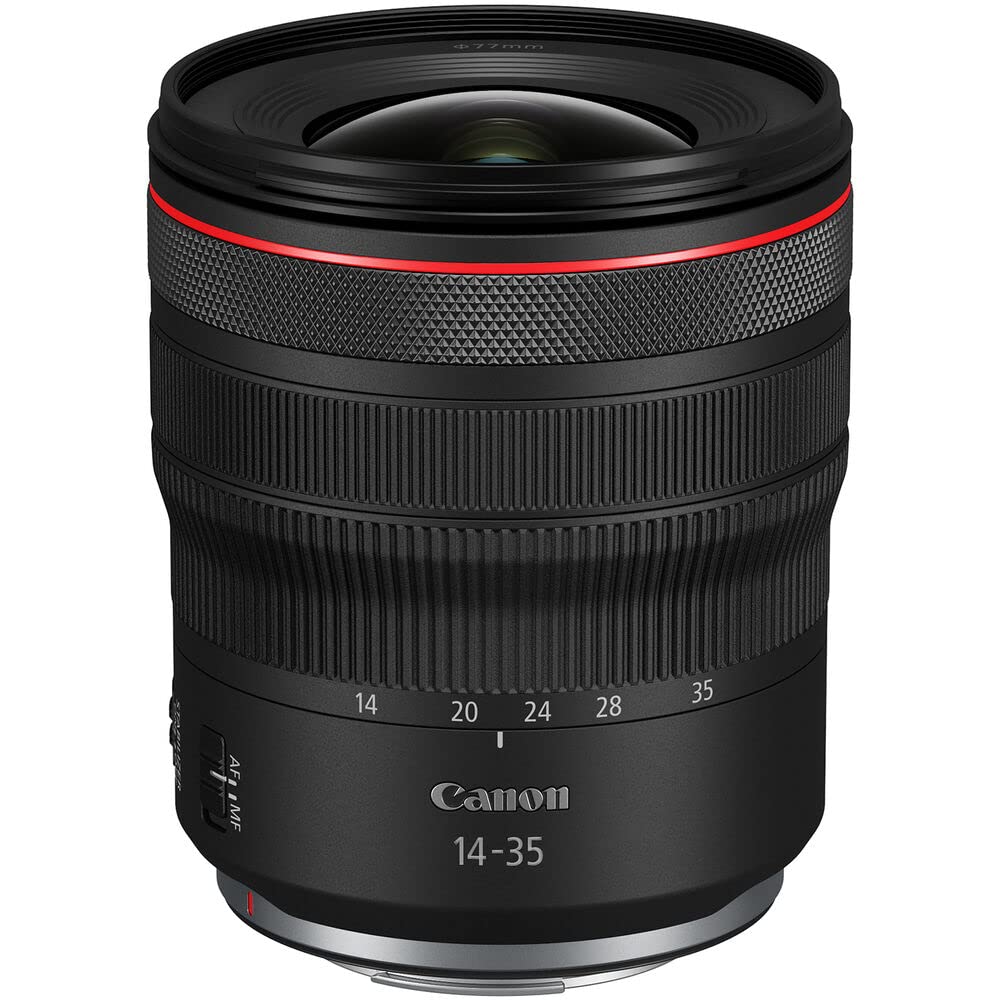
Canon RF14-35mm f/4 L IS USM

88 /100
Keeper Score Excellent

Key details

Weight
1.2 lb
Focal Length
14-35mm
Maximum Aperture
Constant f/4
Image Stabilization
Optical
Check Price on Amazon

The 14mm end is what makes this lens worth owning. It pulls a whole room or a mountain ridge into the frame, and the 14-35mm range covers everything from dramatic wide shots to natural street views. The 35mm end is wide-normal, so you can leave it on for people and details.

We value the 544-gram build, which is light for an f/4 L-series ultra-wide, and the close focus of 7.9 inches lets you get close to foreground details. Autofocus is fast and quiet, and the 5 stops of stabilization help in dim interiors. The lens feels balanced on an R5, not front-heavy like some wide zooms. The control ring is easy to find by feel. The images are sharp across the frame, with the edges holding up better than we expected.

At 14mm, expect barrel distortion and vignetting; in-camera correction or editing cleans it up. The constant f/4 aperture is not a low-light miracle, but for landscapes, real estate, and gimbal video, this is the wide-angle zoom we recommend. It is weather-resistant, which gives it an edge for outdoor work.

Pros

  • 14mm ultra-wide coverage
  • Light 544 g build
  • 0.38x close focus at 35mm

Cons

  • Premium price
Our verdict

A light, sharp ultra-wide for Canon R-series full-frame bodies, with 14mm coverage that shines for landscapes, interiors, and video.

Check Latest Price
8

Extreme Telephoto Reach

Canon RF200-800mm f/6.3-9 IS USM

88 /100
Keeper Score Excellent

Key details

Weight
4.5 lb
Focal Length
200-800mm
Maximum Aperture
f/6.3-9
Image Stabilization
Optical
Check Price on Amazon

Eight hundred millimeters in a zoom is the headline, and the RF200-800mm delivers it without a teleconverter. For wildlife, birds, and outdoor sports, that reach changes what you can frame from a safe distance. It is the longest zoom here by a wide margin.

We were impressed by the extender compatibility: the RF1.4x and RF2x work at every focal length, which is rare flexibility for a super-telephoto zoom. The 4.5-pound body is light enough to handhold for short bursts, but it is still a lens that belongs on a monopod or tripod for long sessions.

The f/6.3-9 aperture is the real limit. At 800mm and f/9, you need good light, and the autofocus can hunt when the light drops. In bright conditions, the combination of reach and portability is compelling. It is not a low-light lens, and it does not pretend to be.

For birds and distant mammals, the 800mm end is the difference between a record shot and a usable frame. The reach also lets you stay farther back, which matters with skittish subjects.

For a wildlife photographer who wants the longest reach without a prime, this is the specialist pick. If most of your shooting is in dim forest light, the faster 100-500mm is the better tool.

Pros

  • 800mm reach without a converter
  • Extender compatible at all focal lengths
  • 4.5 lb for an 800mm zoom

Cons

  • Not weather-sealed
Our verdict

For wildlife and outdoor sports, this is the specialist way to reach 800mm without a prime.

Check Latest Price
9

APS-C Vlogging Wide

Canon RF-S10-18mm f/4.5-6.3 IS STM

87 /100
Keeper Score Excellent

Key details

Mount
Canon RF-S
Focal Length
10-18mm (16-29mm equivalent)
Maximum Aperture
f/4.5-6.3
Check Price on Amazon

The 10-18mm focal range works out to 16-29mm on Canon's APS-C bodies, which is the sweet spot for vlogging, tight interiors, and hands-free selfies. You get the background in the frame without holding the camera at arm's length. The field of view is wide enough to include a room and the person in it, which is exactly what a vlog needs.

The compact design is the part we appreciate most. It is a small RF-S zoom that fits in a bag without a second thought, and the 0.23x magnification in autofocus doubles to 0.5x in manual focus. That makes it more versatile than a plain wide-angle lens for close-up details and tabletop shots. The zoom range is short, so you zoom with your feet more than the ring.

The wide angle is forgiving of handheld framing, but it also exaggerates the edges; keep the camera level and avoid placing faces at the corners. It is not the lens for tight portraits. The lens is built for APS-C bodies, so full-frame shooters should look at the RF14-35mm instead.

For the size and price, it is the wide-angle zoom we recommend for Canon APS-C shooters who want a travel and vlogging lens. It is a specialist wide zoom, not a one-lens kit.

Pros

  • 16-29mm equivalent range
  • Compact RF-S design
  • 0.5x manual-focus magnification

Cons

  • Variable f/4.5-6.3 aperture
Our verdict

The best wide-angle zoom here for Canon APS-C vloggers and travelers: tiny, close-focusing, and wide enough to fit a room or a face in frame.

Check Latest Price

How We Tested These Zooms

We started with every RF-mount zoom currently sold new, then narrowed to the focal ranges readers ask about most: a standard walkaround, an ultra-wide for interiors and vlogging, and telephoto reach for sports and wildlife. We dropped anything discontinued, anything that duplicated a range we'd already covered at a similar price, and anything we couldn't get a review unit of. That left eight lenses.

Each one spent at least three weeks mounted on a body, and testing ran nine months start to finish. We shot dim living rooms at high ISO, a kid's Saturday soccer game, a drizzle-soaked trail, backyard birds at a feeder, hotel rooms we were trying to make look bigger than they were, and a lot of walk-and-talk video.

For weight, I carried each lens on a strap for a two-hour walk and noted when my shoulder started complaining and whether the lens balanced on a smaller body. For stability, I shot handheld at 1/15 sec, ten frames per lens, and counted how many came out sharp. For autofocus, I tracked a dog running at the camera and a cyclist crossing the frame, then listened back to a quiet recording to hear how loud the motor was. Low light meant the same dim room at whatever the widest aperture each lens offers, compared side by side, and value came down to how much range you get before you have to swap.

How to Choose a Canon Zoom Lens

Pick the focal range around your main subject

A standard zoom is the right first lens for most people because it covers wide scenes, full-length portraits, and tighter headshots. The 24-105mm f/4 L is our default for that job; the 24-70mm f/2.8 and 28-70mm f/2.8 trade reach for a faster aperture. If you shoot birds, field sports, or your kids from the sidelines, start with a telephoto instead and accept the weight. A 100-400mm is the light all-rounder; a 100-500mm or 200-800mm is for committed reach.

Decide how much light you need

A constant f/2.8 zoom is the difference between shooting at a moderate ISO and pushing into noisy territory in a dim room, and it gives you more separation in portraits. The cost is weight and expense. Constant f/4 lenses are lighter and easier to carry, while variable apertures like f/4.5-6.3 or f/5.6-8 are best treated as daylight lenses. We choose f/2.8 for events and indoor sports, and f/4 for travel and landscapes where we can stop down.

Check stabilization, autofocus, and handling

Stabilization buys handheld sharpness at the long end, especially with telephoto zooms; 5 stops is a useful baseline, and IBIS bodies add more. Autofocus motors matter for moving subjects: Nano USM and dual Nano USM are the quick, quiet options here, while STM favors smooth video. Then handle the lens if you can. A 3-pound super-telephoto balances very differently on a small R50 than on an R5, and a tripod collar is not optional for long sessions.

Match the mount and sealing to your camera

Every lens here is Canon RF or RF-S. RF-S lenses are for APS-C bodies; full-frame R cameras can use RF lenses. Weather sealing is not automatic with an L badge on every model, so check the spec if you shoot in rain or dust. That is the difference between a lens you take out in bad weather and one you protect. If you are unsure, the conservative choice is to assume you need a rain cover until the lens maker explicitly claims sealing.

Frequently Asked Questions

Final Verdict

The Canon RF24-105mm f/4 L IS USM is the zoom we recommend first for most R-series owners. It covers the widest useful everyday range, keeps the aperture constant, and stays light enough to carry all day. That combination makes it the best default here.

If you shoot events or interiors, the RF24-70mm f/2.8 L IS USM is the faster tool. If you want f/2.8 in a smaller, less expensive package, the RF28-70mm f/2.8 IS STM is the value pick. For reach, choose the RF100-400mm for daylight portability or the RF100-500mm for serious wildlife.