Best Speaker Stands of 2026

The part most people get wrong first isn't the stand — it's the height. A tweeter sitting at knee level on a console sends half its high frequencies into your shins, and no speaker upgrade fixes that. A decent stand lifts the speaker to roughly ear height when you're seated, nudges it away from the wall, and stops the whole thing from walking across the floor when a bass note lands. Everything after that — the finish, the folded-up footprint, whether it disappears behind the couch — is a bonus.

I've had bookshelf speakers parked on upside-down crates and, briefly, on a stack of hardbacks, so I understand the temptation. Over the past six months my team has lived with 10 sets of stands, from tripod legs that collapse into a carry bag to squat fixed-height pedestals, and the things that actually decide whether you keep them rarely match what's printed on the box. Assembly is where most sets lose people. Fit and cable routing are what make you stop noticing them. The picks below are the ones that held up.

Keeper Score summarizes customer ratings and review volume. Read it alongside the product details and trade-offs. How the score works.

1

Best Overall

Rockville RVES1 Stand Pair

94 /100
Keeper Score Outstanding

Key details

Mount
35 mm socket
In The Box
Pair with carry bag
Height Range
40 to 71 in
Load Capacity
100 lb per stand
Check Price on Amazon

Two steel tripods, a carry bag, and a 100-pound rating on each stand is the whole offer, and it's why this pair is our default. Height runs from 40 to 71 inches, which covers a PartyBox on a patio, a PA speaker either side of a small stage, or a pair of studio monitors at head height, and the legs splay to a 32-inch spread for a base that stays put on uneven ground.

What we appreciate is how little stands between the bag and a working setup: the legs fold into a bundle that drops into the included carry bag, and the collars adjust without tools. One quirk belongs to every 35mm stand rather than this one, but it's worth knowing: the pole fits the socket, not the speaker. On a cabinet with a slightly wide socket the box sits a touch loose and swivels a few degrees, and a wrap of tape or a thin sleeve settles it.

The finish is where the saving shows. This is painted steel that scuffs, and a light tripod doesn't shrug off a season of loading in and out of a van the way a heavier one does. Left in one place, or moved in its bag, it is a lot of stand for the money.

Pros

  • Two stands and a carry bag in one buy
  • 100-pound rating on each stand
  • Wide 32-inch tripod spread
  • 40 to 71 inches covers most jobs

Cons

  • Sways with a heavy speaker near full height
Our verdict

For a PA, a DJ rig, or a pair of monitors, this is the pair we recommend: two 100-pound stands, a carry bag, and a height range that covers the whole job.

Check Latest Price
2

Best Single Stand

Amazon Basics Tripod Stand

96 /100
Keeper Score Outstanding

Key details

Warranty
1-year limited
Load Capacity
99.2 lb
Shaft Diameter
1.4 in (35 mm)
Stands Included
1
Check Price on Amazon

One stand arrives, not a pair, and that single fact decides who this is for. Buy two and you have the bones of a PA rig; buy one and you have a genuinely solid 35mm tripod for a PartyBox, a rehearsal-room monitor, or the speaker that keeps moving between rooms.

What we make of the stand itself is close to unreserved. The upper shaft measures 1.4 inches — the standard 35mm — the rating is 99.2 pounds, and the thing weighs 8.5 pounds, so it feels substantial in the hand without turning setup into a chore. It comes assembled, and a safety pin takes the doubt out of the height you set. Of the tripods here, this is the one we trust most with a heavy box at moderate height.

The price is per stand, so a stereo pair costs meaningfully more than the Rockville pair — if you need two stands for the same money, the math flips. Otherwise there is very little to plan around, which is the compliment it sounds like.

Pros

  • Substantial 8.5-pound steel build
  • Safety pin secures the set height
  • Arrives assembled and ready to use

Cons

  • Height clamp can slip under a heavy speaker
Our verdict

If you need one stand, this is the pick: a 99.2-pound steel tripod that arrives assembled, holds its height on a safety pin, and feels heavier than it looks.

Check Latest Price
3

Best for Surround Sound

Mounting Dream MD5402

89 /100
Keeper Score Excellent

Key details

Base Size
11 x 11 in
Height Range
33 to 43 in
Floor Options
Pads and carpet nails
Load Capacity
22 lb per stand
Check Price on Amazon

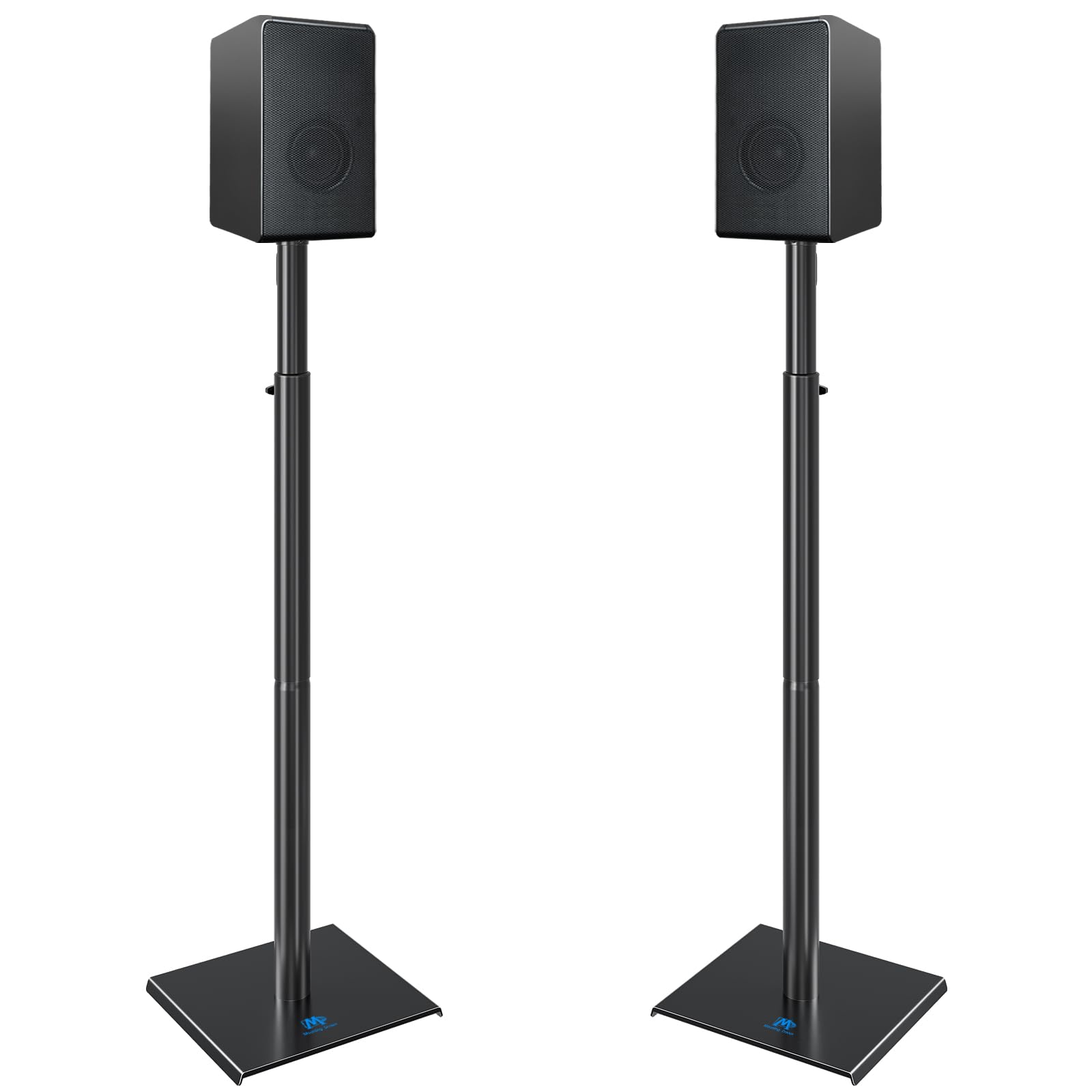
Rear speakers are the awkward part of a surround setup: on the floor the effects disappear, high on the wall the room sounds wrong, and a stand is the compromise most living rooms can live with. This pair adjusts from 33 to 43 inches — about ear height from a sofa — and it's the one we suggest for most 5.1 and 7.1 upgrades.

Each stand carries 22 pounds, which is generous for satellites and enough for small bookshelf speakers. The base is an 11-inch square and the top plate 4.7 inches, with an adjustable bracket that picks up a keyhole or a threaded insert. Two sets of feet come in the box, plastic pads and carpet nails, so the stand doesn't rock on a rug, and a hole in the column takes the speaker wire down to the floor.

Two things to check before you order. The cable hole is sized for bare wire, so pre-terminated plugs have to run up the outside and get clipped. And 33 inches is the floor of the range — if your sofa sits low, measure, because the stand doesn't go shorter.

Pros

  • 22-pound rating per stand suits real satellites
  • Wide 11-inch square base
  • Pads and carpet nails for either floor
  • Hidden cable route down the column

Cons

  • Bracket hardware doesn't suit every speaker shape
Our verdict

For surround speakers up to 22 pounds, start here: a wide-based pair that lifts satellites to seated ear height and runs the wire down the pole.

Check Latest Price
4

Best for Small Satellites

Sanus HTBS Stand Pair

89 /100
Keeper Score Excellent

Key details

Mount
L-bracket and keyhole adapter
Warranty
5-year
Height Range
28 to 38 in
Load Capacity
3.5 lb per stand
Check Price on Amazon

Three ways to attach a speaker — an L-bracket, a keyhole adapter, and the screws for both — make this the most accommodating stand here for surround satellites. It is emphatically not a stand for bookshelf speakers with real cabinets: this is the pair you buy when the rears are palm-sized.

Within that job we rate it highly. The column is heavy-gauge steel, the base is weighted, and the powder coat hides fingerprints better than the painted finishes here. The collar gives 10 inches of travel between 28 and 38 inches, enough to put a small speaker at seated ear height, and the five-year warranty is the longest on this list.

Check the mounting pattern before ordering. A few soundbar-brand rears have no matching bracket and need drilling, which defeats the point of a bolt-on stand; the hardware covers keyhole and threaded inserts, not everything else on the market.

Pros

  • Three mounting options cover most satellites
  • Five-year warranty, longest here
  • Heavy-gauge steel with a weighted base

Cons

  • Cable channel takes bare wire only
  • 3.5-pound ceiling rules out most bookshelf speakers
Our verdict

For palm-sized surround satellites, this is the pair we trust: three mounting options, 10 inches of height adjustment, and a five-year warranty behind it.

Check Latest Price
5

Best for Heavy Speakers

Monolith 24-Inch Stand

91 /100
Keeper Score Outstanding

Key details

Feet
Adjustable spikes
Height
24 in fixed
Load Capacity
75 lb
Stands Included
1
Check Price on Amazon

Set this beside the tripods on the list and it's a different species: a 24-inch powder-coated steel column that doesn't fold, doesn't adjust, and weighs enough that you place it once and think hard before moving it.

What the weight buys is stillness. The rating is 75 pounds, more than twice what most bookshelf speakers ask for, and the column sits on adjustable spikes that level it on carpet. The tubes are hollow, so shot or sand can go in if you want more mass — the old hi-fi trick for keeping bass out of the floor.

We like it most for the jobs where a tripod is the wrong shape: a heavy center channel under a screen, a pair of large bookshelf speakers flanking a console, a turntable setup where nothing should shift when someone walks past. In that role it's the most solid stand here, and the powder coat reads as furniture rather than stage gear.

The spikes are meant for carpet, so on hardwood plan on felt pads or a rug underneath, and work out where the tweeter lands against your chair before you commit to a 24-inch column.

Pros

  • 75-pound rating holds large bookshelf speakers
  • Adjustable spikes level it on carpet
  • Hollow columns accept added mass
  • Looks like furniture, not stage gear

Cons

  • Sold one at a time, so a pair doubles the cost
  • Fixed 24-inch height leaves nothing to adjust
Our verdict

For a heavy bookshelf speaker or a center channel that must not budge, this is the one: 75 pounds of steel and spikes, sold one stand at a time.

Check Latest Price
6

Best for Tight Spaces

futrue-wolker Tripod Pair

87 /100
Keeper Score Excellent

Key details

Mount
35 mm insert
In The Box
Pair with two bags
Height Range
24 to 50 in
Load Capacity
55 lb
Check Price on Amazon

Twenty-four inches is lower than most tripods go, and that's the reason to look at this pair. Collapsed, each stand folds to 17 inches, short enough for a closet shelf or a car footwell, and the two come with separate bags rather than one shared sleeve.

Raised, they run to 50 inches on a 35mm insert with a 55-pound rating. The legs are steel with rubber pads and a plastic joint, and the stands are light enough to carry one in each hand along with the speakers — which is what a solo acoustic set, a classroom, or a conference room actually asks for.

We like it best in the middle of its range, with a small powered speaker at seated height. It folds smaller and sits lower than the other tripods here, which makes it the easiest of the lot to live with in an apartment. Push a heavy box toward the top of the range and the narrow footprint gives you less margin than the wider stands; that's the price of the folded size.

Pros

  • Folds to 17 inches with two carry bags
  • 24 to 50 inches suits seated playback
  • 55-pound rating in a compact tripod
  • Rubber pads protect indoor floors

Cons

  • 50-inch top height won't clear a standing crowd
Our verdict

For small powered speakers, tight rooms, and a car boot, this is the pair to beat: it folds to 17 inches, carries in two bags, and still rates 55 pounds.

Check Latest Price
7

Best-Looking Pair

Rimous Wood Stand Pair

87 /100
Keeper Score Excellent

Key details

Finish
Wood grain
Top Plate
12.2 x 9.1 in
Height Range
18 to 28 in
Load Capacity
50 lb
Check Price on Amazon

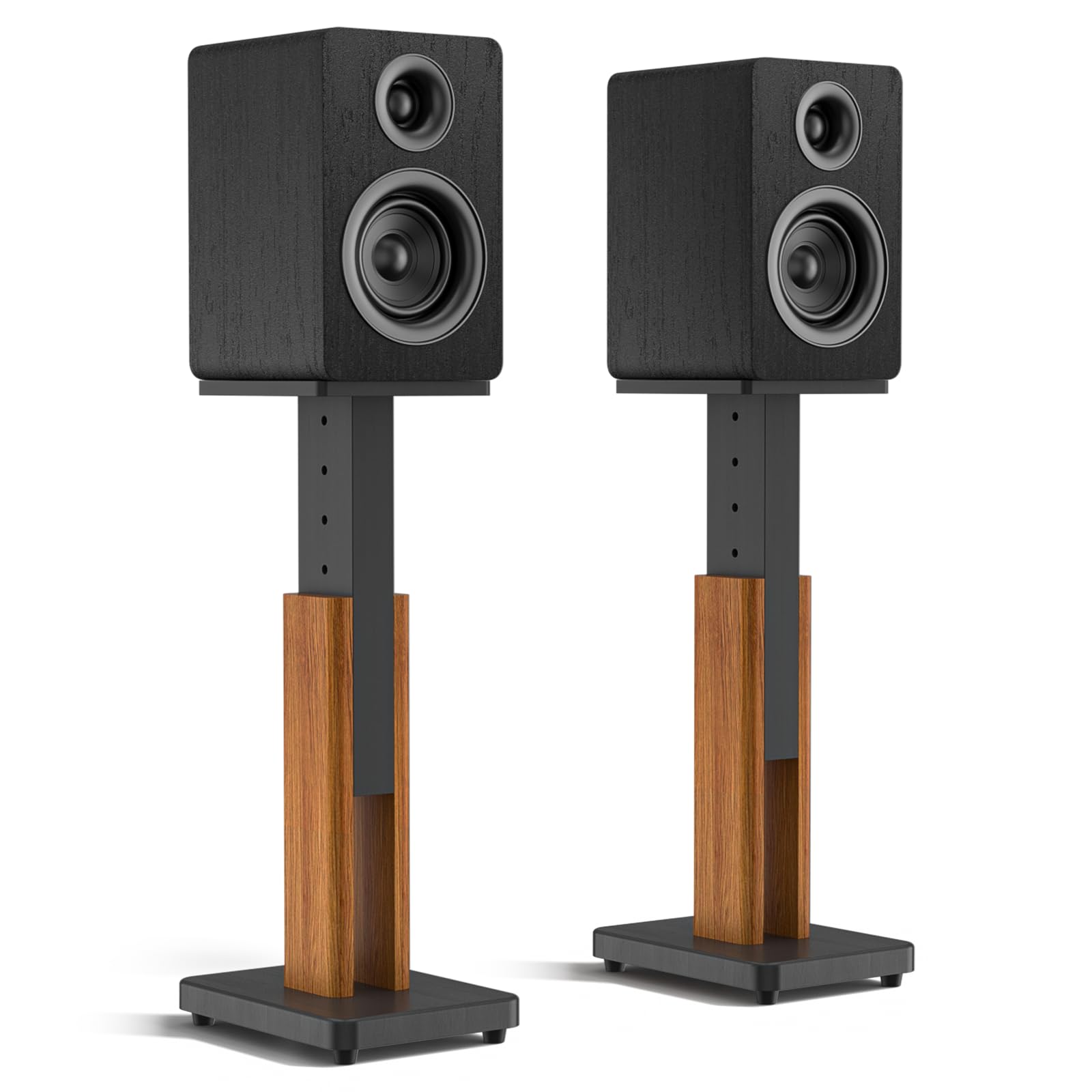
A wood-grain column and a broad top plate make this the only pair here that looks like furniture rather than stage equipment. The stands sit between 18 and 28 inches, roughly console height, which puts a bookshelf speaker's tweeter at seated ear level in a low chair or on the sofa opposite.

The build is solid wood, the top plate measures 12.2 by 9.1 inches, and the rating is 50 pounds — enough for a Klipsch RP-600M or an Edifier R1700BT without the cabinet overhanging. Six settings click in across the height range, leveling feet take out a crooked floor, and cable clips keep the run tidy behind the stand.

Assembly is straightforward and the hardware comes in the box. Start each bolt by hand and stop when it seats: the wood is the part worth protecting, and one cross-threaded insert is the difference between a solid stand and a wobbly one.

Where these earn their keep is a room where the stands stay on show — a den, a studio apartment, a living room with low seating, where the top setting lands at ear height and the finish does the rest. Behind a tall sofa or beside a dining chair, the height stops short, and no finish makes up for a tweeter at knee level.

Pros

  • Wood-grain finish reads as furniture
  • Six height settings from 18 to 28 inches
  • Wide 12.2-inch plate holds real bookshelf speakers
  • Leveling feet and cable clips included

Cons

  • Pricier than the steel tripods here
Our verdict

For a living room where the stands stay on show, this is the best-looking pair here: solid wood, 18 to 28 inches, and a plate wide enough for a proper bookshelf speaker.

Check Latest Price
8

Pro PA Rigs

JBL Speaker Stand Set

89 /100
Keeper Score Excellent

Key details

Mount
35 mm and 38 mm
In The Box
Pair with double bag
Height Range
48 to 81 in
Load Capacity
60 lb
Check Price on Amazon

A dual-diameter pole is the detail that separates this set from every other tripod here: the inner tube steps from 35mm to 38mm, so it fits both socket sizes without a sleeve. If your speakers have the larger socket — common on bigger PA boxes — that alone narrows the field to this one.

Aluminum keeps the weight down. Each stand carries in one hand, the pair collapses into a compartmented double bag so poles and legs don't tangle, and height runs from 48 to 81 inches, the tallest here, on a 60-pound rating. The feet wear removable red safety trim you can leave on for visibility at a gig or take off for a wedding.

Finish is where this set feels its price: matte black, evenly coated, with a collar that locks on a firm twist instead of a hopeful one. Packed down, it's a bundle you sling over a shoulder and forget about until load-in.

One fit exception is worth checking before you order: the JBL name doesn't guarantee a JBL fit, and the PartyBox 310 is the model to measure against the pole. For a rig that goes up and down every week, the aluminum and the bag justify the premium.

Pros

  • Dual 35mm and 38mm pole fits both sockets
  • Reaches 81 inches, the tallest here
  • Aluminum keeps each stand light
  • Two-compartment carry bag included

Cons

  • 60-pound rating is modest for the height
Our verdict

For 38mm sockets, tall trim, and a rig that travels weekly, this is the set: a light aluminum stand that reaches 81 inches and packs into a proper double bag.

Check Latest Price

How We Tested Speaker Stands

The shortlist started with boring math: how high each stand actually reaches, what weight the top plate is rated for, what mounting hardware ships in the box, and how much of that you're paying for. Stands that topped out below seated ear height, or that only accepted one speaker footprint, didn't make the cut. That left us with 10 sets, which we've lived with for six months across a living room, a small studio desk, and a garage setup that gets broken down and rebuilt most weekends.

I assembled every set alone, using only the tools in the box, and timed it — one came together in four minutes, another needed a second person to hold the pole steady while a collar got threaded. Then I bumped each loaded stand with a shoulder, leaned on it, and shoved it across both carpet and hardwood to see how much the base skated. At full extension I checked whether the locking collar and safety pin held, and whether the whole thing shimmied under a heavier bookshelf monitor.

For fit, I mounted small satellites and heavier monitors on the same stands and noted whether the keyhole slots and L-brackets lined up without drilling. I then ran speaker cable down the pole and watched whether it pinched in the channel, rattled loose inside, or ended up dangling behind the base. Six months of moving stands between rooms, knocking them with a vacuum, and re-adjusting height every few weeks showed which finishes scuffed and which collars started to slip.

How to Choose Speaker Stands

Start With the Socket, Not the Brand

Most PA and powered speakers have a 35mm (1-3/8 inch) socket in the bottom, which drops onto a tripod pole. Bigger boxes sometimes use 38mm, and only a dual-diameter pole covers both without an adapter sleeve. Bookshelf speakers and surround satellites usually have nothing to clamp onto, so they need a top plate, an L-bracket, or a keyhole adapter — which is why a stand built for satellites won't hold a real bookshelf speaker, however sturdy it looks.

Measure the socket and the spacing of the threaded insert before you order, and don't trust the badge. A JBL speaker and a JBL stand can still miss each other; pole diameter and bracket pattern are the only things that decide it.

A Weight Rating Is Quoted at the Base

A 100-pound rating assumes the legs are spread on level ground and the load is sitting still. Raise that speaker to 70 inches and the stand becomes a lever: what felt planted at chest height starts to sway. That's why heavy boxes belong low on a tall tripod, and why the widest leg spread you can get away with is worth having.

If you're near the limit, add mass — shot or sand in hollow columns, a sandbag over the tripod hub outdoors. A high rating is not a promise of stability at full extension.

Height Ranges Do Different Jobs

Surround stands live between 28 and 45 inches, because the tweeter should land at your ear height while you're seated — roughly 36 to 40 inches off the floor for most adults. PA tripods run from about 48 to 81 inches so the horn clears standing heads. Fixed stands around 24 inches suit center channels and speakers flanking a low console.

Check the bottom of the range as carefully as the top. A stand that bottoms out at 33 inches is fine behind a sofa and wrong beside a low chair, and no amount of adjustment fixes it.

Pairs, Singles, and What's in the Box

Read the count before anything else. Several stands here are sold one at a time even though the listing reads like a pair, and two singles can cost more than a pair that comes with a bag. The bag matters more than it sounds if the stands leave the house; a stand that lives in a living room never needs one.

Bracket stands should include a spread of hardware — keyhole adapters, machine screws, pads. If your speaker isn't on the short list those brackets were designed around, budget for a hardware-store run.

Cable Routing, Collars, and the Small Parts

An internal cable channel is only as useful as its diameter. Bare speaker wire makes the bend through a hollow pole; terminated plugs, banana connectors, and thick gauge usually don't, and they end up clipped to the outside instead. Size the hole against your actual cable, not against the idea of hiding wire.

Then look at the collar. A stand you adjust twice a year can live with a stiff clamp; one that goes up and down weekly needs a collar that locks hard, with a pin as backup. Spikes belong on carpet, pads on hardwood — and for satellites at head height, a strip of foam under the cabinet does more for the sound than a heavier base.

Frequently Asked Questions

Final Verdict

If you want one answer, it's the Rockville RVES1 pair: two 100-pound stands, a carry bag, and 40 to 71 inches of adjustment that covers a patio, a small stage, and a pair of studio monitors. Nothing else here does as much for as little.

Change the requirement and the pick changes with it. Needing one stand instead of two points to the Amazon Basics tripod, which is the more solid single. Rear speakers behind a sofa want the Mounting Dream pair and its 22-pound brackets. And if the stands are going to sit in a living room looking like furniture, the wood-grain Rimous pair is the one to measure your sofa against.