Best Rokinon Lenses of 2026

Fast glass for cheap nearly always comes with a catch: the autofocus is you. That tradeoff runs through this whole lineup — a few lenses snap into focus on their own, while the rest ask you to turn a ring and trust your eye. What you get in exchange is light, the kind of f/1.4 or f/2 aperture a kit zoom can't give you, and wide views that fit an entire room into the frame.

Over eight months, my team and I shot with 12 of them, on full-frame and crop bodies, in flat noon light and long after sunset. Here's what first-time buyers tend to get backwards: the aperture number matters less than whether the lens actually covers your sensor. A 14mm on a crop body frames like a 21mm, and nobody mentions that at checkout.

Sharpness and value were the easier things to judge — the good ones are crisp where it counts and priced like something you'll genuinely carry. Below, the picks are grouped by what each lens does best, so start with the way you shoot.

Keeper Score summarizes customer ratings and review volume. Read it alongside the product details and trade-offs. How the score works.

1

Best Overall

Rokinon AF 35mm F1.8

89 /100
Keeper Score Excellent

Key details

Mount
Sony E (full frame)
Weight
7.4 oz
Focal Length
35mm
Max Aperture
f/1.8
Check Price on Amazon

Every other lens in this guide makes you focus by hand. This one doesn't, and that single difference is why it's the Rokinon we point most people to first. The linear stepping motor is quick and quiet enough that the camera's own subject tracking and eye detection still do their jobs. At 7.4 ounces and 2.5 inches long, it stays on the body between shoots instead of going back in the bag.

It is more than a convenience lens. Ten elements in eight groups, including two aspherical and two high-refractive-index elements, and the center is sharp wide open at f/1.8 — the aperture you actually bought it for. The 63.6-degree view is the classic documentary angle: wide enough for a street corner, tight enough that faces don't stretch at the edges. Nine blades keep the out-of-focus highlights round.

Two small design choices we appreciate. The custom switch lets the focus ring control aperture instead, which turns a plain 35mm into a usable video lens without extra gear, and the barrel is sealed against dust and moisture. It also takes 58mm filters, the smallest thread in this group, so a polarizer for it costs a fraction of what the 77mm lenses here need.

The honest caveats: chromatic aberration shows up on hard high-contrast edges, and the motor is audible in a quiet room. Neither changes the recommendation. If you shoot events or family and want one lens that stays on the camera, this is the one.

Pros

  • Fast, quiet autofocus on Sony bodies
  • Sharp wide open at f/1.8
  • 7.4 ounces with weather sealing
  • Focus ring can control aperture

Cons

  • Chromatic aberration on hard contrast edges
  • Focus motor audible in quiet rooms
Our verdict

The Rokinon we recommend without an asterisk: autofocus, a 7.4-ounce body, and sharpness at f/1.8 that make the manual-focus savings unnecessary.

Check Latest Price
2

Best for Astrophotography

Rokinon 14mm F2.8

87 /100
Keeper Score Excellent

Key details

Focus
Manual
Mount
Canon EF (full frame)
Focal Length
14mm
Max Aperture
f/2.8
Check Price on Amazon

Point this at the night sky and the appeal is immediate: 115.7 degrees of view and an f/2.8 aperture, enough to frame a whole arc of the Milky Way and still gather light at a sensible shutter speed. It is the lens that got a lot of Canon shooters to try Rokinon in the first place.

Inside are 14 elements in 10 groups, and sharpness holds across the aperture range rather than only in the middle of it, which matters when you shoot wide open at night and stopped down for a landscape in the same session. On a full-frame Canon body this is a landscape lens, an interior lens, and an astro lens in one barrel.

Distortion is the trade you make for that width. Straight lines near the corners bow outward in a mustache shape, and architecture with strong horizontals is where it shows most. It corrects in software, but plan on a pass through a lens profile before you deliver anything with a horizon in it. There are also no electronic contacts on the mount, so the camera neither focuses nor sets aperture, and it will not record the f-stop you used.

We keep it for the sky. For Canon full-frame night work it is the pick here, and at 14mm the depth of field is so deep that focusing is nearly set-and-forget. If you shoot a crop-sensor Canon, the 16mm f/2.0 does the same job with a stop more light and a much less extreme field.

Pros

  • 115.7-degree field of view
  • Sharp across the aperture range
  • Solid, substantial barrel
  • Lowest-priced full-frame ultra-wide here

Cons

  • Mustache distortion in the corners
  • No electronic communication with the camera
Our verdict

For Canon full-frame night skies and wide landscapes, this is the one: 115.7 degrees, sharp across the aperture range, and you focus it once.

Check Latest Price
3

Best for Sony Crop Bodies

Rokinon 12mm F2.0

89 /100
Keeper Score Excellent

Key details

Mount
Sony E (APS-C)
Focal Length
12mm
Max Aperture
f/2.0
Angle Of View
98.9 degrees
Check Price on Amazon

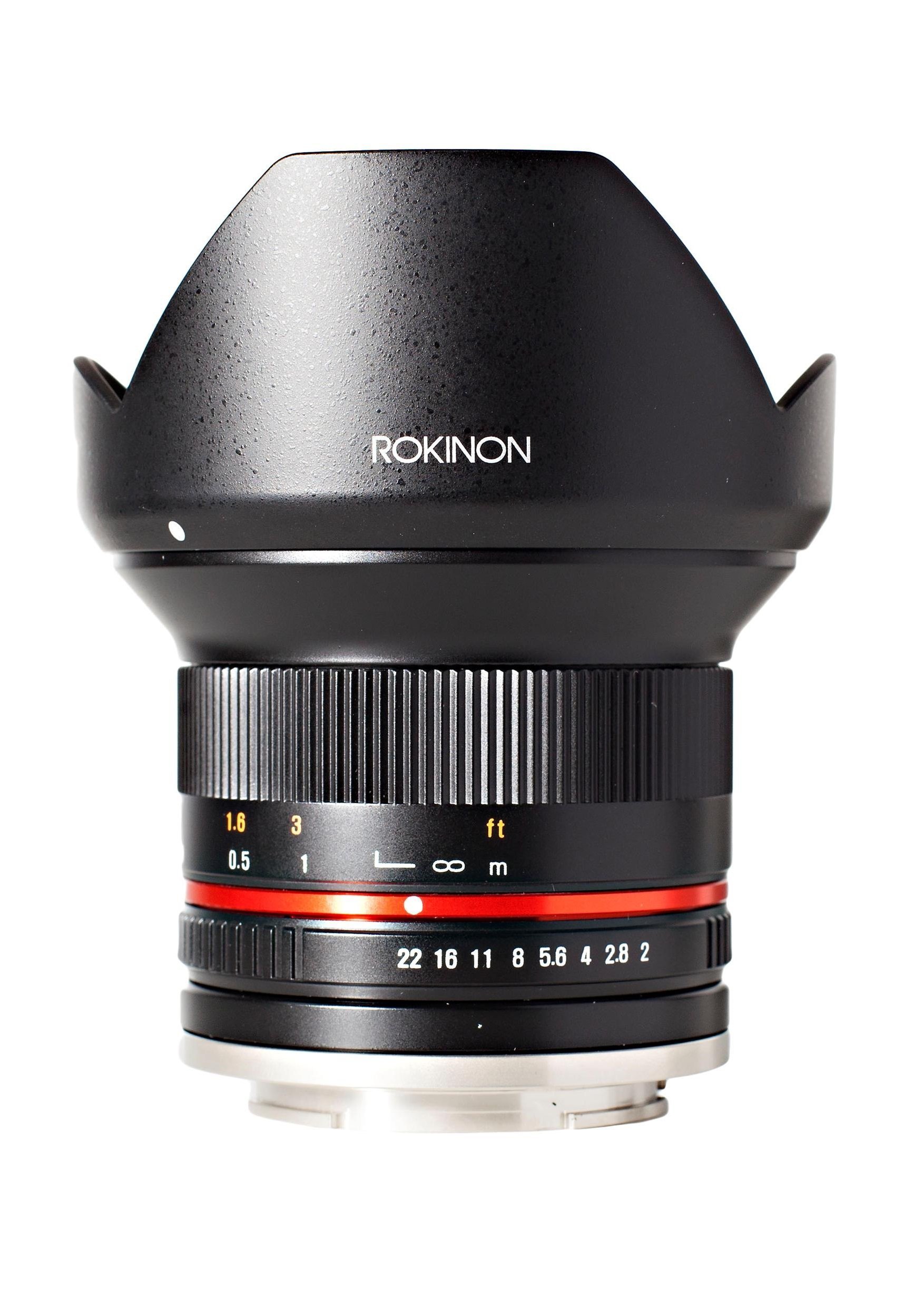
Ninety-eight point nine degrees on a Sony APS-C body is wide enough that focus almost stops being a decision: set the ring near infinity, stop down a little, and depth of field swallows the error. That forgiving geometry is what makes a manual lens a reasonable first Rokinon rather than a frustrating one.

For the money the formula is ambitious: twelve elements in 10 groups, three extra-low-dispersion and two aspherical elements, plus a nano coating that keeps flare and ghosting down when the sun is in frame. We think it is the best value in this guide. The center is sharp even wide open at f/2.0, the aperture that makes it useful after dark, and it holds up for ridgelines and room interiors alike.

The 67mm filter thread is a practical advantage over the 77mm lenses here — a decent ND or graduated filter costs noticeably less in that size, and a holder system is easier to justify. The barrel is compact and feels well made, though there is no weather sealing anywhere on it.

Manual focus is the one place to be careful. The infinity mark can sit past true infinity, so focus on a bright star with magnification rather than trusting the stop; on a Sony body with peaking that takes seconds. It is an APS-C design, so it belongs on an a6000-series body rather than a full-frame Alpha.

Pros

  • 98.9-degree view on APS-C
  • Sharp wide open at f/2.0
  • 67mm filters keep a kit affordable
  • Compact, well-made barrel

Cons

  • Infinity mark can sit past true infinity
  • No weather sealing
Our verdict

The least expensive way into wide, fast glass here, and the one we hand Sony crop-body shooters first: 98.9 degrees, f/2.0, and focus forgiving enough to learn on.

Check Latest Price
4

Best for Portraits

Rokinon 135mm F2.0

92 /100
Keeper Score Outstanding

Key details

Mount
Canon EF (full frame)
Focal Length
135mm
Max Aperture
f/2.0
Minimum Focus
2.6 ft
Check Price on Amazon

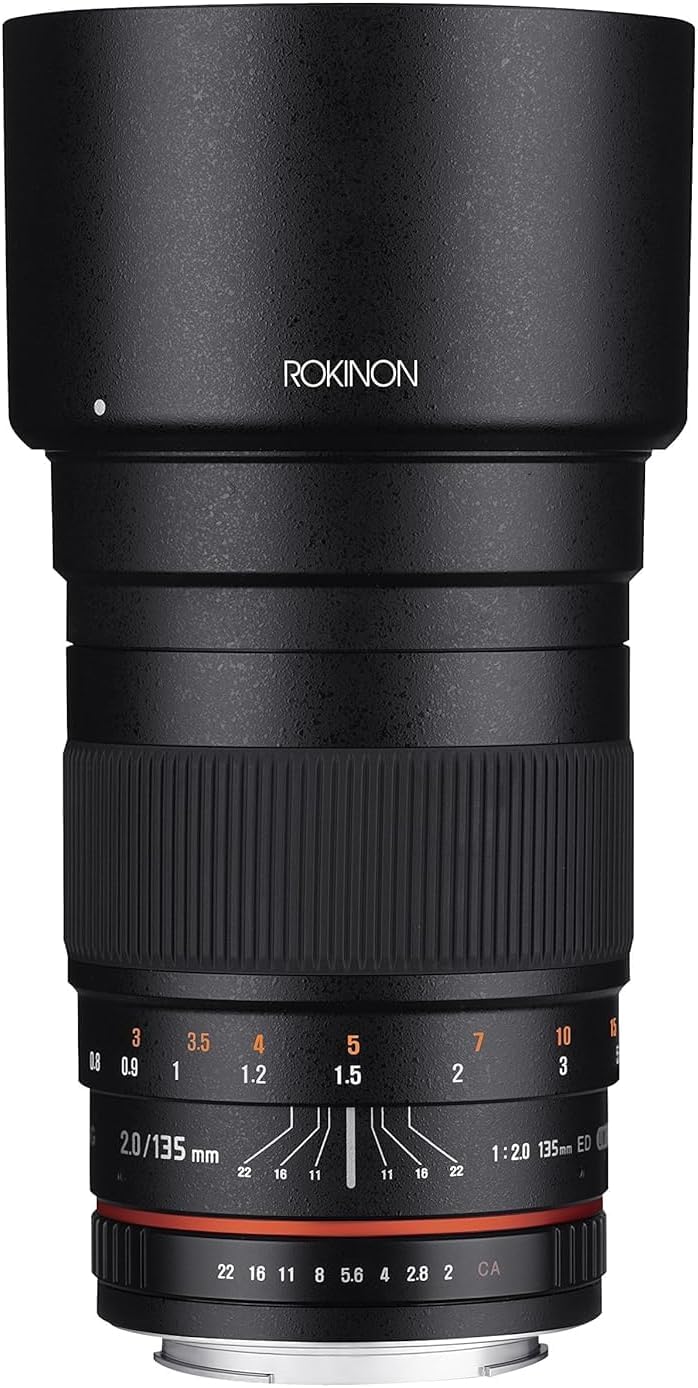
At 1.8 pounds, this 135mm is light enough to hang off a strap for a whole portrait session, which is the first thing that surprised us about it. The 18.8-degree view on full frame compresses the way a portrait lens should, and 2.6 feet of minimum focus is close enough for a tight head-and-shoulders frame without crowding anyone.

Optically it is the sharpest of these lenses wide open. One extra-low-dispersion element and ultra-multi-coating give clean color and contrast, nine blades keep the background round rather than busy, and at f/2.0 the subject separates instead of blending into what's behind it. Wide-open sharpness with a soft background is the whole argument for a fast telephoto, and this lens makes it.

Focus is manual, but the ring is firm rather than tight and the infinity position is bracketed, which is the difference between a night-sky lens you trust and one you tape down. On a crop body the field narrows to around 200mm equivalent, so it doubles as a short telephoto for tight landscapes and wide-field astro.

The cost is speed of working. At f/2.0 the depth of field is thin enough that a millimeter of ring travel moves the plane of focus, and a toddler or a dog will beat you to it every time. For still portraits and for stars, that is a fair trade for the look.

Pros

  • Sharp wide open at f/2.0
  • 1.8 pounds for a 135mm f/2.0
  • Round, smooth background blur
  • Infinity bracket helps at night

Cons

  • Manual focus at f/2.0 is unforgiving
  • Not weather sealed
Our verdict

If you shoot portraits on a Canon body, this is the one: the sharpest wide-open result here, a light 1.8-pound barrel, and background blur worth the manual focus.

Check Latest Price
5

Best Fast Standard for Canon

Rokinon 35mm F1.4

83 /100
Keeper Score Excellent

Key details

Mount
Canon EF (full frame)
Focal Length
35mm
Max Aperture
f/1.4
Filter Thread
77mm
Check Price on Amazon

The focus ring is the first thing you notice. It is long-throw, smoothly damped, and heavy enough that small adjustments at f/1.4 are easy to make by feel — closer to a cinema lens than to a typical autofocus ring. On a lens this fast, that feel is not a luxury; it is how you land focus.

Twelve elements in 10 groups, nine blades, and a metal barrel that feels dense at 660 grams. At f/1.4 the background melts rather than smears, color comes out rich straight from the camera, and the 63.1-degree view is the one that makes a room look like a room and a person look like a person.

The compromise is the aperture ring. With no electronic coupling, an SLR's finder goes dark as you stop down — past about f/5.6 it is a couple of stops dimmer than the picture will be — so you focus wide open and stop down before the shot, or switch to live view. We take that deal for the f/1.4 rendering, because on a Canon body there is no autofocus option in this guide to choose instead.

One practical note before you commit: 77mm filters on a 35mm prime means a bigger front element than you might expect, so a polarizer and an ND set is a real line item. Worth pricing out before you decide the lens is the whole purchase.

Pros

  • f/1.4 for available light
  • Smooth, long-throw focus ring
  • Solid metal build at 660 grams
  • Creamy background blur and rich color

Cons

  • Manual focus only, with no electronic aperture control
Our verdict

Canon shooters who want a fast standard and don't mind focusing it themselves should buy this one: the rendering at f/1.4 is worth the work.

Check Latest Price
6

Best Wide for Canon Crop Bodies

Rokinon 16mm F2.0

85 /100
Keeper Score Excellent

Key details

Mount
Canon EF-S (APS-C)
Focal Length
16mm
Max Aperture
f/2.0
Filter Thread
77mm
Check Price on Amazon

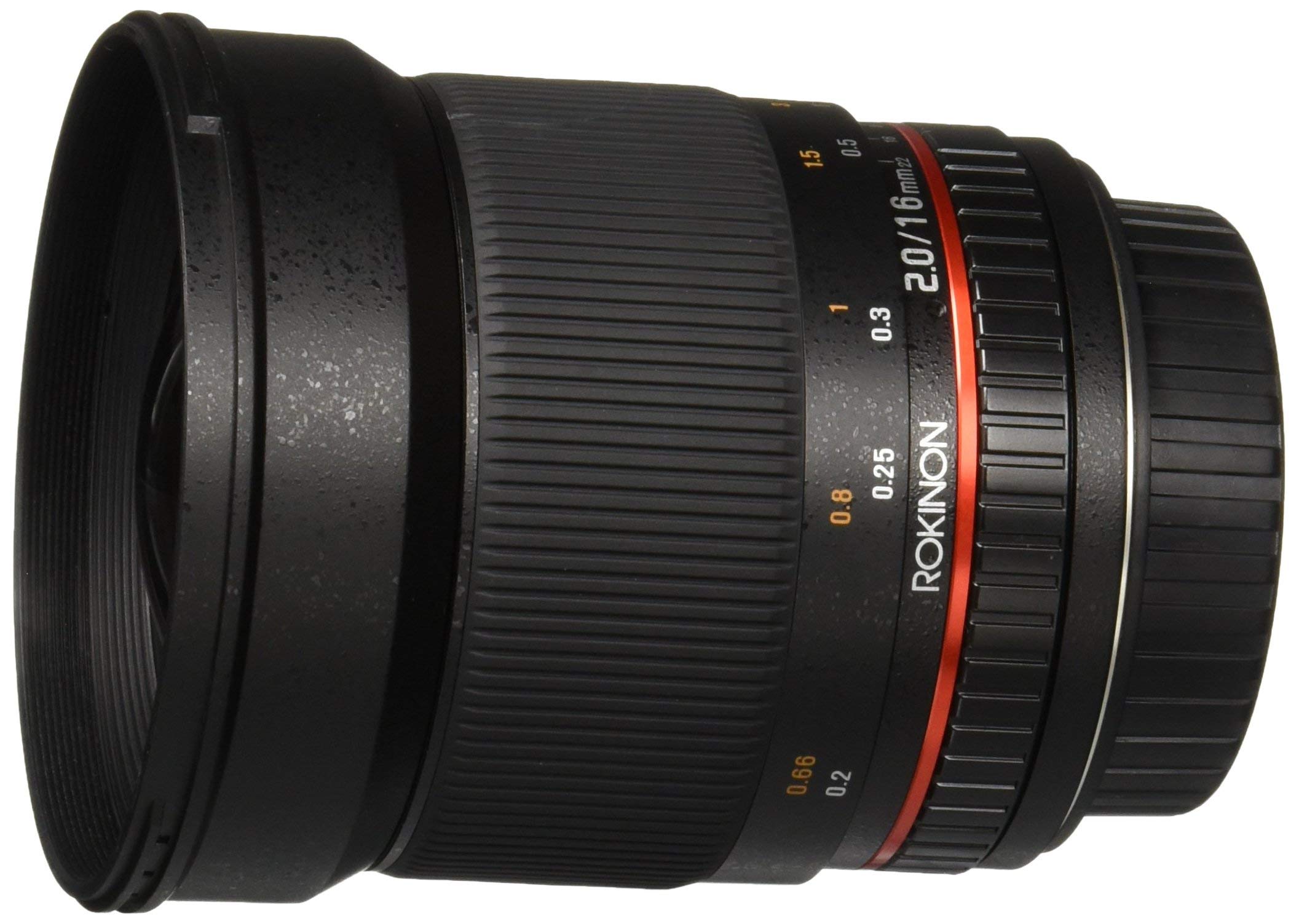
Seven point nine inches is unusually close for an ultra-wide, and it changes how you shoot: a fence post, a rock, or a hand can sit right at the front of the frame while an 83.1-degree view holds everything behind it. That minimum focus distance is the most interesting thing about this lens.

On a Canon crop body, 16mm at f/2.0 is the fast wide that APS-C shooters usually do not get. Thirteen elements, eight blades, and a 77mm filter thread — the same size as the 35mm f/1.4, so one filter kit serves both lenses. Vignetting is visible wide open and eases as you stop down, which is normal for a lens this wide and this fast.

Build is the part we keep coming back to. The barrel is solid, the focus ring is well damped, and there is no autofocus or electronic aperture — the usual Rokinon arrangement, and at 16mm it costs you very little, since depth of field covers most focusing mistakes. The one hard limit is the mount: it is an EF-S lens and will not fit a full-frame Canon body.

For Milky Way work on a crop body it is a stop faster than the full-frame 14mm, at the cost of a narrower field — on a 1.6x body it frames like a 26mm. That is a useful compromise when you want sky and landscape in one frame rather than sky alone.

Pros

  • Focuses down to 7.9 inches
  • f/2.0 on an APS-C wide
  • Solid build and damped focus ring
  • 77mm filters shared with the 35mm f/1.4

Cons

  • EF-S mount rules out full-frame Canons
  • No electronic communication with the camera
Our verdict

For Canon crop-body shooters who want a fast wide that can almost touch the foreground, this is the one we recommend: 7.9 inches of close focus and f/2.0 in a solid barrel.

Check Latest Price
7

Best Autofocus Ultra-Wide

Rokinon AF 14mm F2.8

81 /100
Keeper Score Excellent

Key details

Focus
Autofocus
Mount
Sony E (full frame)
Focal Length
14mm
Max Aperture
f/2.8
Check Price on Amazon

Autofocus on an ultra-wide is what this lens has that nothing else here does, and it is worth being precise about how much you get. The motor works and it is accurate once it locks, but it is not quick, and the corners stay soft at f/2.8 until you stop down. For real estate work — tripod, f/8, time to spare — neither matters. For chasing a moving subject, the manual lenses here are no worse off.

The formula is serious: 14 elements in 10 groups with three aspherical and two extra-low-dispersion elements, and the center is sharp when you give it light. A 1.1-pound aluminum body with a built-in petal hood keeps the front element protected and the bag small, and a built-in hood is one less thing to lose.

Seven blades, f/2.8 to f/22, and a 113.9-degree view — a touch narrower than the Canon-mount 14mm's 115.7 degrees, close enough that you will not notice in a room and wide enough that you will need to keep your feet out of the frame.

We treat it as a working lens rather than a star lens. For night skies the manual 14mm and the 12mm both give sharper corners and no motor to argue with; for client interiors on a Sony body, this is the one that focuses itself.

Pros

  • Autofocus on a full-frame Sony body
  • 113.9-degree field of view
  • Built-in hood protects the front element
  • 1.1-pound aluminum body

Cons

  • Corners soft until stopped down
  • Autofocus is slow to lock
Our verdict

Sony shooters who need a 14mm that focuses itself for interiors and events will find this the only option here, and a capable one once it is stopped down.

Check Latest Price
8

Fisheye Effects

Rokinon 8mm Fisheye

86 /100
Keeper Score Excellent

Key details

Mount
Canon EF (full frame)
Focal Length
8mm
Max Aperture
f/3.5
Minimum Focus
12 in
Check Price on Amazon

There is no subtle way to use this lens. An 8mm fisheye bends every straight line in the frame, and the result is either exactly the picture you wanted or a photo nobody asked for. We keep it in the bag for the first case: tight interiors, a crowd shot from the middle of the crowd, anything where the curvature is the point.

Ten elements in seven groups with aspherical glass, a removable hood, and a 12-inch close focus — put the front element near someone's face and it swells while the room wraps around behind them. Six blades, f/3.5 to f/22, and 16 ounces, so it is easy to carry on the chance you will want it.

Focus is manual and forgiving: at this width almost everything is in focus anyway, so the ring matters far less than it does on the 35mm or the 135mm. The trade is aperture. f/3.5 is slow, and interior frames need either light or a steady hand.

It is the least general-purpose lens in this guide, and we are recommending it anyway because nothing else here makes this picture. If you need straight lines, the 14mm and the 16mm do that job; if you want one lens that changes how a place looks, this is it.

Pros

  • Distinctive fisheye rendering
  • 12-inch close focus
  • 16 ounces and easy to pack
  • Removable hood

Cons

  • f/3.5 is slow for dim interiors
  • Manual focus and aperture only
Our verdict

Buy it for the look, not for versatility: an 8mm fisheye that is sharp in the middle, light enough to carry, and unlike anything else here.

Check Latest Price

How We Chose and Tested These Lenses

We built the shortlist from the mounts our readers actually shoot — Sony E and Canon EF — then filtered by sensor coverage, aperture, and price so we weren't comparing a $200 fisheye against a fast prime. That left 12 lenses, from an 8mm fisheye up to a 135mm telephoto, which we shot with for eight months.

Testing happened where lenses get used: dusk street walks, a night-sky session on a moonless weekend, a friend's indoor wedding reception, a couple of hikes, and a lot of handheld video. We mounted each one on both a full-frame and a crop-sensor body to see how much the field of view really changed.

For sharpness, we shot the same brick wall and a sheet of newsprint at every aperture and compared centers against corners at 100 percent — several lenses were crisp wide open in the middle and soft at the edges until we stopped down a bit. For distortion, we framed a straight horizon and a doorway square-on and checked whether the lines bowed; the fisheye got judged as intent rather than error. With the manual-focus lenses, we timed how long it took to nail focus on a moving subject and counted the frames we threw away, while the autofocus ones tracked a dog running at the camera. We also handed each lens to a friend who'd never used manual glass and watched how quickly they got comfortable.

Value came last and bluntly: what the images looked like wide open, weighed against what the lens asks you to pay.

How to Choose a Rokinon Lens

Start With the Mount, Not the Focal Length

Five of the eight lenses here are Canon mount and three are Sony, and the wrong one will not fit at all. Canon EF lenses go on full-frame bodies and crop bodies alike; Canon EF-S lenses are the reverse — they fit APS-C cameras only and can foul the mirror of a full-frame body if you force them on. Sony E covers both Sony formats, though an APS-C design like the 12mm uses only the middle of a full-frame sensor.

The practical move is to read the model badge on the camera rather than the headline on the listing. If you shoot both systems, buy for the body you use most. There is no adapter-free way across here, and a lens that lives in a drawer helps nobody.

Decide Whether You'll Focus by Hand

Most Rokinon lenses have no electronic contacts on the mount, which means no autofocus, no aperture set from the camera, and no focus confirmation in the finder. For landscapes, architecture, night skies, and tripod interiors that costs you almost nothing, because depth of field is deep enough that focus is close to set-and-forget. For children, dogs, and receptions it costs you the frame.

Two lenses here autofocus, both Sony: the 35mm f/1.8 and the 14mm f/2.8. On a Canon body everything here is manual, and the fast ones are the least forgiving — at f/2.0 on a 135mm, a millimeter of ring travel moves the plane of focus. If autofocus is non-negotiable, that decides the purchase before anything else does.

Match the Field of View to Your Sensor

A focal length only means something next to a sensor size. On a full-frame body the 14mm gives 115.7 degrees; on a 1.5x or 1.6x crop body the same lens frames roughly like a 21mm or 22mm — still wide, no longer dramatic. The 12mm and the 16mm are crop designs and frame like an 18mm and a 26mm respectively.

So work backward from the picture. The 8mm fisheye is a look rather than a width, 10 to 16mm covers interiors and skylines, 35mm is the everyday angle, and 135mm is for portraits and compressed landscapes. On a crop body, discount any framing you see from a full-frame review, because yours will be tighter.

Expect to Correct Some Lines and Corners

Fast, wide, and inexpensive do not arrive together without compromise. The 14mm's mustache distortion and the soft corners on the autofocus 14mm are the visible ones here, and vignetting wide open is normal on the fast crop wides. Most of it goes away with a lens profile; the rest improves a stop or two down.

Filters are the hidden line item. Threads on these lenses run from 58mm to 77mm, and a holder system for a wide often costs more than the polarizer that goes in it. If you already own filters, choose the lens that matches them — the 16mm and the 35mm f/1.4 share a 77mm thread, so one kit serves two very different lenses.

Frequently Asked Questions

Final Verdict

The AF 35mm F1.8 is the Rokinon we recommend without a caveat: it focuses itself, weighs 7.4 ounces, and stays sharp at f/1.8, which is more than most people need from a first prime.

If you shoot Canon, go a different way. The 135mm f/2.0 is the portrait lens, the 14mm f/2.8 is the night-sky lens, and both ask you to focus by hand — at those focal lengths and apertures, that is a fair trade for the glass.