Best RGB LED Lights of 2026

Color-changing LEDs are the cheapest way to make a room feel like a different room: a warm amber wash for movie night, a slow fade to dim blue for a kid who won't settle, the full rainbow for a birthday. The catch is that the colors are almost never what separates a good set from an infuriating one. It's whether the adhesive is still holding in week three, whether the app finds the lights on the first try, and whether "warm white" is actually warm. My team and I spent four months living with 15 of these — strips taped along ceilings and kitchen cabinets, bulbs screwed into lamps and a hallway fixture — and the differences showed up fast.

I'm not a maximalist about this stuff; what I want is lighting I don't have to think about. Two things I wish someone had told me earlier: on strips, brightness per foot matters more than total length (a long roll stretched across a whole room glows dimmer than a short run), and if you plan to use these as everyday light rather than party light, look for a set that produces a real warm white alongside the color, or the "white" reads faintly green after dark. The sets that made the list are the ones I stopped noticing within a week.

Keeper Score summarizes customer ratings and review volume. Read it alongside the product details and trade-offs. How the score works.

1

Best Overall

Govee RGBIC Strip Light 32.8 ft

89 /100
Keeper Score Excellent

Key details

Length
32.8 ft
Scenes
64+ presets
Control
Bluetooth app
Color Type
RGBIC, several colors per run
Check Price on Amazon

Most LED strips light a whole run in one color at a time — choose blue and the entire wall turns blue. The Govee RGBIC is different in a way you notice the moment it's up: a single 32.8-foot run can fade from teal to violet to pink along its length, so a wall reads as a gradient instead of a line. That's why it's our top pick. It's the only strip here that shows more than one color at once, and color is the whole reason you're buying an RGB light.

The rest of the kit is built for the way these actually get installed. There are 180 LEDs across the 32.8 feet, enough for an even wash rather than a dotted string, and the tape is the good kind — on flat, painted drywall ours stayed where we put it, which we can't say for every roll in this guide. On brick, textured wallpaper, or dusty trim, plan on clips instead.

Control runs through the Govee Home app: 64 preset scenes, a DIY mode with a shared library of other people's effects, and 11 music modes driven by a mic in the controller. The sync follows the sound in the room rather than the audio signal itself, so it's better for a party than for a beat-matched video edit.

The trade-off is the radio. This strip is Bluetooth only, with no WiFi, no Alexa, and no Google, so you can change colors from the couch but not from the office — and there's no remote in the box, which leaves the phone as your only controller. For a bedroom or a living room, that's a fair swap for an effect nothing else here can produce.

Pros

  • Several colors on one run at once
  • Adhesive held on flat painted walls
  • 64 preset scenes plus DIY effects
  • Music modes react to sound in the room

Cons

  • Bluetooth only, so no Alexa or Google
  • No remote in the box
Our verdict

The strip we recommend for most rooms: it's the only one here that paints several colors along a single run, and the tape and the app are good enough to live with.
Check Latest Price
2

Best Smart Bulbs

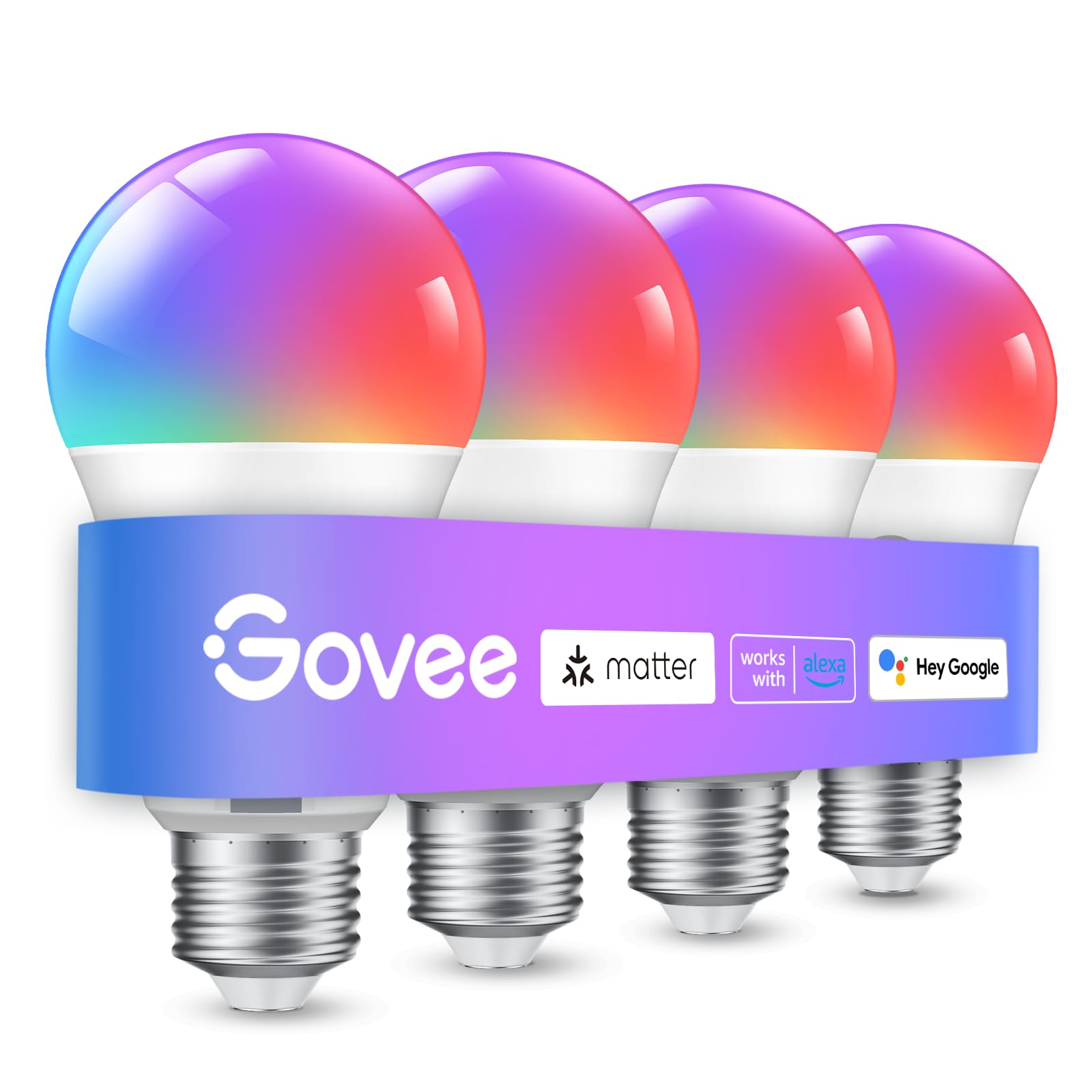
Govee Smart Bulbs H6008

93 /100
Keeper Score Outstanding

Key details

Base
E26 (A19)
Pack
4 bulbs
Control
Wi-Fi, Bluetooth, voice
Brightness
800 lumens
Check Price on Amazon

Not every room needs tape around the ceiling. If the color is going to come out of a lamp, a ceiling fan, or the fixture over a kitchen counter, the answer is a bulb — and the Govee H6008 four-pack is the smart set we recommend first. They're standard A19 bulbs on E26 bases, so they screw into what you already own, and they put out 800 lumens of white when you just want the room lit.

Setup is quick: screw one in, open the app, and it pairs over Bluetooth before joining your 2.4GHz network. Group all four and a single command moves the whole room; add Alexa or Google and you can skip the app entirely. Saying "set the living room to blue" from the doorway is the sort of thing that stops feeling like a gimmick after a week.

What makes these worth it is the system rather than any single bulb: 16 million colors and 54 scenes sound like filler until four lamps change together and the room actually looks staged. Where they give ground is holding the connection — a bulb can drop off the network and need re-adding, and the app is busier than it needs to be. Put them on a 2.4GHz band you leave alone and most of that goes away.

Brightness is where expectations split: 800 lumens at 80 CRI is fine in a lamp and unremarkable as a room's main light, so treat these as the color layer rather than the light you read by.

Pros

  • Voice control through Alexa and Google
  • 800 lumens of usable white light
  • Group control moves four bulbs at once
  • Sets up fast over Bluetooth

Cons

  • Requires a 2.4GHz WiFi network
  • 80 CRI leaves whites looking flat
Our verdict

The easiest route to color in the lamps you already own — four bulbs that set up in minutes, answer Alexa, and change together on one command.

Check Latest Price
3

Best Budget Bulbs

ILC RGB LED Bulbs 4-Pack

95 /100
Keeper Score Outstanding

Key details

Base
E26 (A15)
Pack
4 bulbs, 2 remotes
Control
Infrared remote
Brightness
450 lumens
Check Price on Amazon

There's no app here, no WiFi pairing, and no account to create — just four bulbs and two infrared remotes in the box. Point a remote at a bulb and it changes color. That sounds minor until you've spent twenty minutes coaxing a smart bulb onto a 2.4GHz network, and it's why these ended up in porch lights, ceiling fans, and the lamp beside the reading chair.

For accent light, the simplicity is worth more than any feature list. You get 12 colors, three brightness levels, flash and smooth modes, and a warm white that reads like a normal 2700K bulb rather than a tinted imitation. The memory function holds your last setting through a wall switch, and the sync feature keeps several bulbs in one fixture changing together — the detail that makes a chandelier look deliberate instead of confused.

At 450 lumens these are 40-watt-equivalent bulbs, and that's the honest ceiling: in a lamp they're plenty, as the only light in a room they'll feel dim. The remote is infrared, so it has to see the bulb — behind a dense shade, it won't. The 24-hour cycle timer is the sleeper feature: set it once and the porch light comes on every evening without a hub, a phone, or a schedule to maintain.

Pros

  • No app, WiFi, or account needed
  • Two remotes in the box
  • Warm white that works as everyday light
  • Syncs multiple bulbs in one fixture

Cons

  • Infrared remote needs a clear line of sight
  • Only 12 preset colors, no fine control
Our verdict

Four bulbs and two remotes, no app or network to fight with — the simplest way to put color into accent fixtures and porch lights.

Check Latest Price
4

Best for White Light

Linkind Smart Bulbs 4-Pack

91 /100
Keeper Score Outstanding

Key details

Pack
4 bulbs
Brightness
800 lumens
Color Rendering
90 CRI
Color Temperature
1800K~6500K
Check Price on Amazon

Most color bulbs treat white as an afterthought — a cool, faintly green approximation you tolerate while the color is off. The Linkind set is the exception here: a 90 color rendering index and a range from 1800K candlelight to 6500K daylight, so the same bulb that goes magenta for a party can light a desk for work without looking wrong. That range is why these are our pick when white light matters as much as color.

At 800 lumens they replace a 60-watt bulb in a living-room lamp or a ceiling fixture, and the AiDot app adds 104 preset scenes, group control, schedules, and music sync through the phone's microphone. Alexa and Google both work, and the DIY light show lets you build a custom sequence and keep it — more entertaining than we expected from a color bulb.

The app is where they lose ground. It's the only way in, with no remote in the box, and the connection isn't always steady: a bulb can drop off WiFi and sit there needing to be re-added, and the interface takes a few sessions to learn. It's 2.4GHz only, like nearly everything here, so a router that hides that band behind one merged network name is the usual place setup stalls.

Pros

  • 90 CRI whites that look natural
  • 1800K to 6500K color temperature range
  • 800 lumens, bright enough for a main lamp
  • 104 preset scenes and DIY effects

Cons

  • Bulbs can drop off WiFi and need re-pairing
  • No remote; AiDot app is the only control
Our verdict

Our pick when the white light matters as much as the color: 90 CRI, a warm-to-daylight range, and 800 lumens of genuinely usable light.

Check Latest Price
5

Best for Whole-Room Coverage

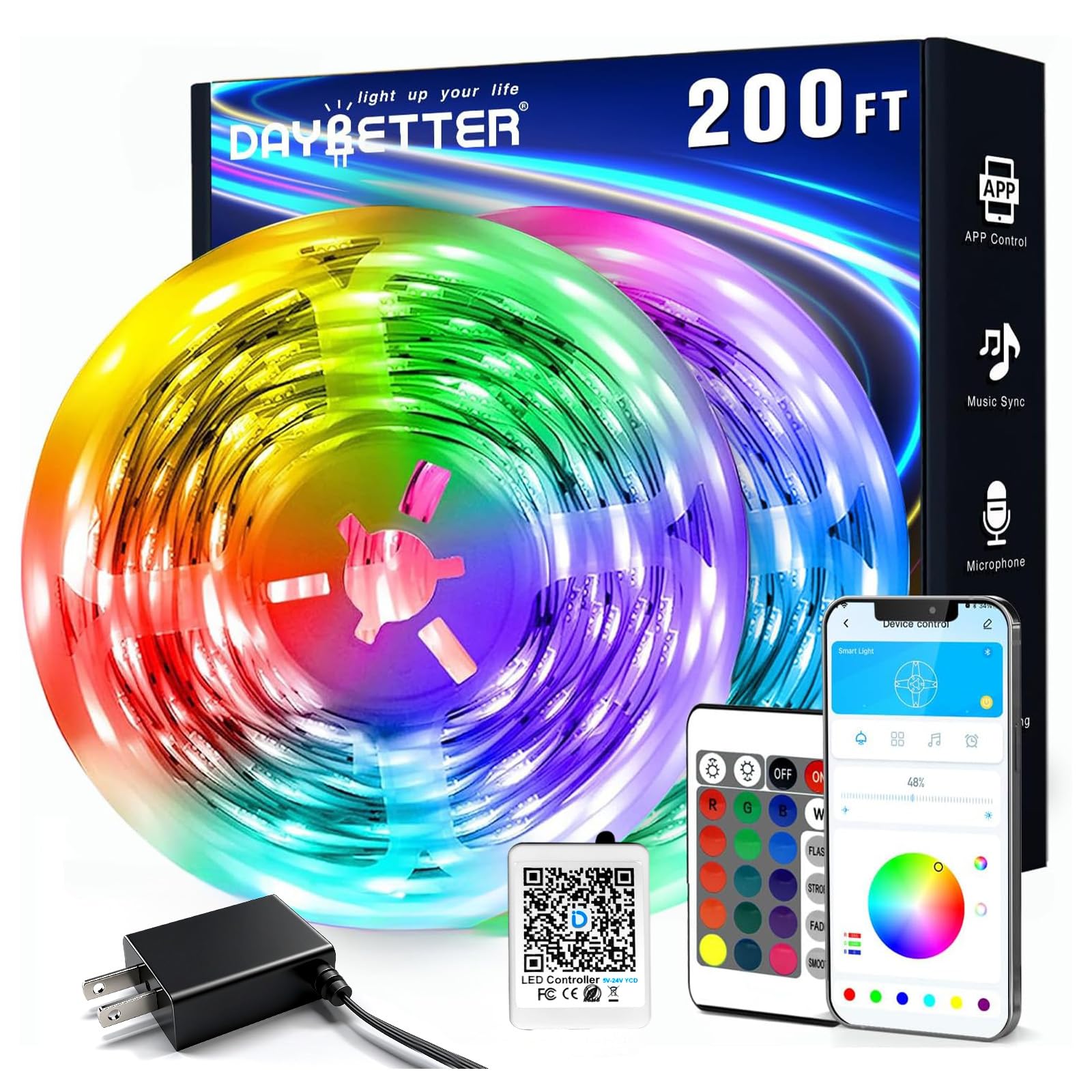
DAYBETTER LED Strip Lights 200 ft

89 /100
Keeper Score Excellent

Key details

LEDs
300
Length
200 ft (2 rolls)
Control
App and IR remote
Water Resistance
Not water resistant
Check Price on Amazon

Two hundred feet is a different kind of project from a desk strip. Two rolls of 100 feet will run the perimeter of a large bedroom ceiling with enough left over for a hallway or the back of a TV wall, and having that much on hand is the difference between decorating a room and rationing light around it. If the plan is a whole room rather than one wall, this is the kit to look at.

Control is the app plus a 24-key infrared remote, with music sync, timers, and color memory in the app. The backing is ordinary double-sided tape: it holds on clean, flat paint and gives up on brick, textured wallpaper, and dusty trim, so budget for clips or mounting tape at the corners and anywhere the strip changes direction.

Longevity is the honest trade. These are budget rolls, and the pattern at this end of the range is that a run can lose a section or a color channel after a few months — the inexpensive controller and the thin strip that make the coverage affordable are also what make it disposable. On a ceiling you'll need a ladder to redo, that's a real cost; in a teenager's room where coverage matters more than longevity, it's the sensible spend.

Pros

  • 200 feet covers a whole-room perimeter
  • App and infrared remote both included
  • Music sync and timers in the app
  • Color memory holds your last setting

Cons

  • Sections can fail within months
  • Indoor only; not water resistant
Our verdict

Two 100-foot rolls that cover a whole room's perimeter, as long as you accept budget-strip longevity along with the coverage.

Check Latest Price
6

Desks and Accents

DAYBETTER LED Strip Lights 20 ft

91 /100
Keeper Score Outstanding

Key details

Colors
20 colors, 8 modes
Length
20 ft
Control
44-key IR remote
Wattage
12 watts
Check Price on Amazon

Twenty feet is one wall, a desk edge, or the underside of a cabinet run, and that's exactly the job this roll is built for. It's 5050 RGB strip with a 44-key remote in the box and no app anywhere in the process — you clean the surface, peel the backing, and you're finished in about the time it takes to rearrange the desk.

The remote does more than we expected: 20 colors, 8 modes, dimming, and a speed control for the flash and fade patterns, all without opening a phone. It's infrared, though, so it has to see the receiver — mount the control box where you can point at it, not behind a curtain or above a door frame where the signal dies.

Adhesion is the weak point, as it is on most tape-backed strips: smooth painted drywall holds, textured or dusty surfaces don't. The colors are preset rather than continuous, so you get a fixed set of shades and no spectrum to slide through. For a first strip, a kid's room, or a quick desk upgrade, both are reasonable compromises — just unroll it and check every color on the floor before it goes up.

Pros

  • 20 feet suits a desk or single wall
  • 44-key remote with 20 colors
  • Dimmable with pattern speed control
  • Easy to put up on smooth surfaces

Cons

  • Remote needs a clear line of sight
  • Preset colors only, no app for custom shades
Our verdict

A 20-foot roll, a remote, and no app to set up — the low-effort way to try colored strip light over a desk or along one wall.

Check Latest Price
7

Ceiling Runs

KSIPZE LED Strip Lights 100 ft

89 /100
Keeper Score Excellent

Key details

Colors
16 million (app)
Length
100 ft
Control
App and IR remote
Connection
Bluetooth
Check Price on Amazon

A hundred feet on a single roll means fewer joins, and joins are where long strip runs usually go wrong. Run it around a ceiling perimeter in one pass and the light stays even instead of stuttering at every connector block, which is the difference between a room that looks finished and one that looks assembled.

Control is the app plus an infrared remote, with 16 million colors in the app, a built-in mic for music sync, and a timer that switches the strip on and off on a schedule you set once. In practice the phone is the better half of that pair: the remote has to be aimed at the receiver, and if the receiver ends up behind furniture you'll stop reaching for it.

Two things show up close. Color drifts along the run — the far end doesn't always match the near end — and the LEDs stay individually visible when you're a few feet from the wall, so it reads as a string of lights rather than a continuous glow. The adhesive is ordinary as well, which is fine on smooth paint and unreliable on brick or textured wallpaper.

From across a room, where a ceiling strip is actually seen, none of that ruins the effect, and the length is the reason to consider it. What we suggest is testing before you commit: unroll the whole strip, plug it in, and cycle the colors on the floor. A dead section or a stuck color is much easier to catch there than above a doorway.

Pros

  • 100 feet on one roll, fewer joins
  • App control with 16 million colors
  • Built-in mic for music sync
  • Timer and schedule in the app

Cons

  • Color drifts along the length of the run
  • Adhesive is ordinary on textured walls
Our verdict

A hundred feet on one roll means fewer joins and an even line of light, if you can live with visible LED spacing and average tape.

Check Latest Price

How We Chose and Tested These LED Lights

The shortlist started with research: we read through listings and customer reviews, then filtered on the things that actually break the experience — whether a strip can be trimmed to fit, whether the app needs a separate hub, whether the white diodes are separate from the color diodes, and what you get in length or lumens for the money. Anything hub-dependent, or that quietly required a 2.4GHz network, got cut early. That left 15 units, which we lived with for four months.

Strips went onto painted drywall, under a kitchen cabinet, behind a TV, and around a bedroom ceiling perimeter; bulbs went into table lamps, a floor lamp, and a hallway fixture. We timed the first setup — box open to a light actually changing color — and noted whether the app discovered the device on its own or needed a reset and a second try. For adhesion, each strip was pressed onto a wiped-down wall and the corners checked at one week, one month, and again in month four, with notes on any curl, sag, or peel.

In a dark room we set every light to white at full power and compared them on the same wall, watching for whether the warm white turned yellow, neutral, or green. Brightness got checked two ways: a light meter held at a fixed distance, and standing in the room to see how evenly the glow spread. We paired each smart model with Alexa, ran a week of scheduled on-and-off commands to see whether they fired, and ran music sync against a speaker at normal volume to judge the lag. For color selection, we picked a deep red, a true green, and a soft pink and noted which came out muddy.

How to Choose Rgb Led Lights

Start with what you're lighting

Strips light architecture — a wall, a ceiling line, the back of a desk, the space behind a TV — because they can follow an edge for thirty feet without a break. Bulbs light fixtures: table lamps, ceiling fans, porch lights, anything with a socket. If the room already has the fixtures and you just want them to change color, buy bulbs and skip the tape entirely. If there's nothing to screw a bulb into, a strip is doing a job a bulb physically cannot.

That single question settles more of the decision than any specification. It also explains why our list splits the way it does: the strips earn their place on coverage and effects, the bulbs on convenience and white-light quality.

Match the length to the path, not the room

Rolls are quoted in total length, not in how much of a particular wall they cover. Sixteen feet is a shelf, a bed frame, or a desk run. About thirty-three feet handles one long wall or a ceiling perimeter in a small bedroom. A hundred feet and up wraps a full room with leftovers for a second space.

Corners, doorways, and window frames eat length faster than a straight run, so measure the path you plan to follow and add roughly a tenth. A kit that runs out two feet from the corner is the most avoidable disappointment in this category.

One color, or several at once

Most RGB strips show a single color across the entire run: choose blue and the whole strip is blue. RGBIC strips divide the run into addressable segments that can display different colors, which is what makes gradients, rainbows, and effects that travel along a wall possible. Behind a TV or under a cabinet, where you want a uniform wash, plain RGB is fine and costs less.

For a wall you want people to look at, the segmented version is worth the step up. It's the main reason our top pick is the Govee RGBIC: one run can hold teal at one end and pink at the other, which is a completely different effect from a solid line of color.

Decide how you want to control it

A remote is the lowest-friction route: no network, no account, no app — but it needs line of sight and it can't turn the lights on while you're out. App control adds scenes, schedules, and music sync, and it's the only way to reach the multi-color effects, but it usually means a 2.4GHz WiFi band rather than the 5GHz one most routers prefer.

Voice control exists only on the smart bulbs in this group; none of the strips we recommend answer Alexa or Google. Bluetooth-only strips, our top pick included, need you within range — fine at home, useless from the office.

Adhesion and lifespan are where these fail

The tape on the back is a pressure-sensitive adhesive, and it is only as good as the surface. Clean, flat, painted drywall holds. Brick, textured wallpaper, dusty trim, and freshly painted walls do not. Wipe the surface first, press firmly along the whole run as you go rather than at the end, and use clips at corners and anywhere you'll want to remove the strip later.

Lifespan is the other soft spot. Budget rolls can lose a section or a color channel within months, so buy where returns are easy, test the full length before anything touches the wall, and expect to pay more for the kits that last.

Frequently Asked Questions

Final Verdict

The Govee RGBIC strip is the one we point most people to. It's the only pick here that paints several colors along a single run, and the two things that usually let these lights down — the tape and the app — are the two things it does well. You give up WiFi and voice control to get there, which is a fair trade for a bedroom or living room.

If the color has to come out of a lamp or a ceiling fixture, take the Govee H6008 bulbs for voice control or the Linkind set if good white light matters as much as the color. And if the job is a whole room's perimeter on a tight budget, the DAYBETTER 200-foot rolls cover more wall than anything else here, with a shorter working life built into the price.