Best Overall
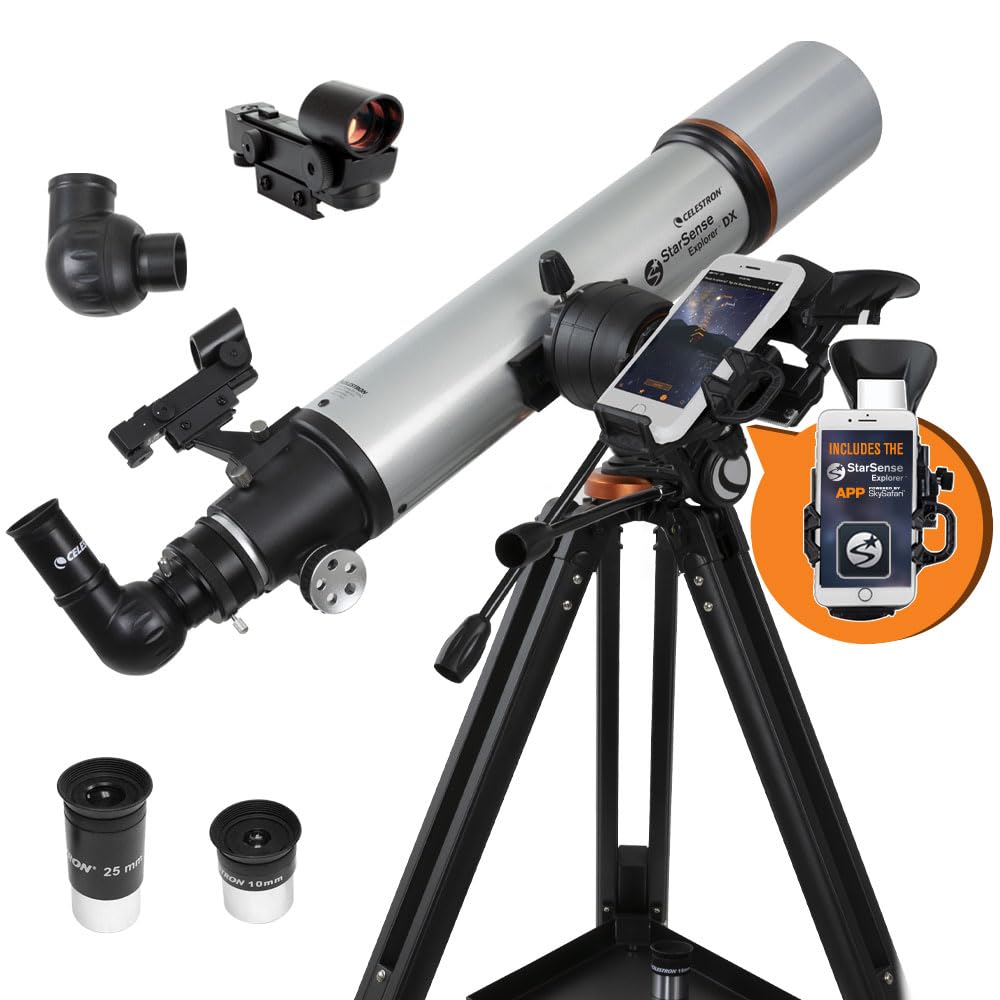
Celestron StarSense Explorer DX 102AZ
Key details
- Mount
- Altazimuth with dual-axis slow motion
- Weight
- 14.2 lb
- Aperture
- 102mm
- Focal Length
- 650mm
The phone dock is the part to understand first. Clamp a smartphone into the StarSense cradle and the app reads the star field in front of the tube, then draws arrows across the screen until the target circle turns green. That replaces the step that ends most first nights out: the sky is full of stars and none of them are labeled.
We put it at the top of this list because it's the only scope here that pairs the largest aperture in the group with real help finding things. At 102mm it collects about 60 percent more light than the 80mm travel kit, which is the difference between a smudge and a resolved ball of stars. The dual-axis slow-motion knobs do the rest: nudging the tube by hand gets you close, and the knob lets you follow a planet as it drifts without knocking the tripod off target.
The app is only as good as the sky it's looking at. Under heavy light pollution, or with a phone camera that struggles, the plate-solving can stall; the fix is darker ground or a short drive, with the red-dot finder as the fallback. Align that finder in daylight on a distant chimney before your first session and the whole evening goes more smoothly.
At 14.2 pounds the scope comes out in one trip, tripod and all, which matters more than the spec sheet suggests. And the 1.05-degree field with the 25mm eyepiece is roughly twice the width of the full Moon, so even a rough aim lands you on target with room around it.
Pros
- Most aperture in this roundup at 102mm
- Dual-axis slow-motion controls hold a target
- App-guided pointing beats star-hopping for beginners
Cons
- Mount feels stiff and shaky at high power
Our pick for most people: the most aperture here, dual-axis slow-motion controls that hold a planet steady, and an app that tells you where to point it.