Best Prime Lenses of 2026

The day I traded my kit zoom for a cheap 50mm f/1.8, my photos changed — not because the glass was nicer, but because I finally had light to work with indoors. That's what a good prime fixes: it opens wide, it holds detail at that aperture, and it lets the background fall away from your subject. The catch is that nothing zooms, so you compose with your feet.

Over the past six months my team and I have shot with 12 primes, from a 9mm wide-angle to an 85mm portrait lens, on both DSLR and mirrorless bodies. We compared sharpness wide open against stopped down, watched how out-of-focus highlights held their shape behind a backlit fence, and listened for focus motors during quiet indoor shots.

Worth knowing before you buy: a 50mm is a normal lens on full frame and a short portrait lens on a crop sensor, so the focal length you need depends on the body in your bag. Below are the primes we kept reaching for, whatever your budget.

Keeper Score summarizes customer ratings and review volume. Read it alongside the product details and trade-offs. How the score works.

1

Best Overall

Canon EF 50mm f/1.8 STM

96 /100
Keeper Score Outstanding

Key details

Mount
Canon EF
Weight
5.6 oz
Focal Length
50mm
Max Aperture
f/1.8
Check Price on Amazon

Of the eight lenses here, this is the one we put in a first-time prime buyer's hands, and not because it is the sharpest or the fastest. It weighs 5.6 ounces, so it disappears on the camera, and at f/1.8 it does the thing a kit zoom cannot: it pulls the background out of focus and lets you shoot indoors without a flash. On a full-frame body you get the classic 50mm view; on an APS-C body it behaves like an 80mm, which is why so many people end up shooting portraits with it.

Sharpness is not where it gives ground. The center is crisp wide open, and by f/2.8 it is crisp almost everywhere, with a seven-blade diaphragm that keeps background highlights round instead of busy. The detail we did not expect at this price is close focus: 1.15 feet, with 0.21x magnification. That turns it into a real lens for food, flowers and small objects rather than only for people.

The motor is the compromise. Canon's stepping drive is smooth enough for video and quick in good light, but aim it into a dim room and it hunts, and focus noise climbs with it. We noticed it most at night indoors, which is exactly when the f/1.8 aperture is the reason you brought the lens. If you shoot moving subjects in low light, plan around it. Everyone else gets a lens that stays mounted because it weighs nothing.

Pros

  • 5.6 ounces, so it stays on the camera
  • Sharp wide open with soft, round bokeh
  • Focuses to 1.15 feet for close-up detail

Cons

  • Hunts and gets noisy in dim light
Our verdict

If you shoot a Canon DSLR, this is the easiest lens purchase to justify: light, sharp, gorgeous at f/1.8, and only slow to focus in dim rooms.
Check Latest Price
2

Best for Nikon Z

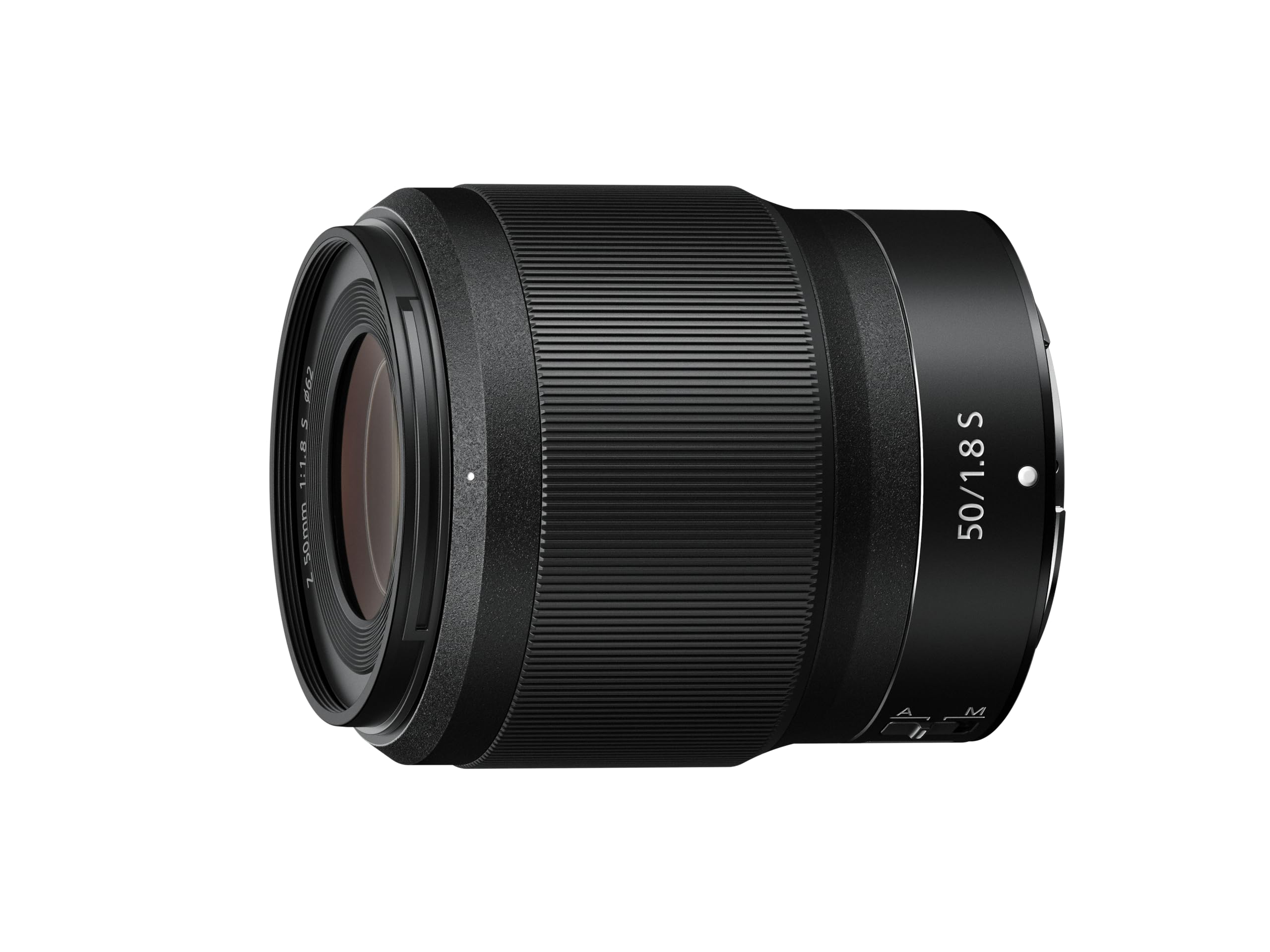
Nikon NIKKOR Z 50mm f/1.8 S

94 /100
Keeper Score Outstanding

Key details

Mount
Nikon Z
Weight
14.6 oz
Focal Length
50mm
Max Aperture
f/1.8
Check Price on Amazon

Fourteen and a half ounces is a lot for a 50mm f/1.8 — about two and a half times what the Canon weighs — and on a small Z body you feel it by the end of a long walk. Nikon spends that weight on glass, and it shows the moment you look at a file at full size.

Wide open at f/1.8 this is the sharpest standard lens in the group, corner to corner, with almost no distortion to correct afterward. We kept looking for the softness that usually turns up at maximum aperture and did not find much of it. For landscape and architecture the near-zero distortion matters as much as the resolution: vertical lines stay vertical, so you spend less time straightening a building in post.

The stepping motor is genuinely quiet — the thing we appreciated most when shooting video — and there is optical stabilization on board for handheld work. What it asks in return is money and bag space, and it is the heaviest standard lens here. If you print large, crop hard, or shoot at f/1.8 all day, that trade is easy to make.

Pros

  • Sharp corner to corner at f/1.8
  • Very quiet stepping motor for video
  • Almost no distortion to correct

Cons

  • Heavy for a 50mm at 14.56 ounces
Our verdict

The sharpest standard lens in this guide, and the quietest — worth the extra weight and money if you shoot Nikon Z and want detail above all.

Check Latest Price
3

Best Wide-Angle Walkaround

Sony FE 35mm f/1.8

93 /100
Keeper Score Outstanding

Key details

Mount
Sony E
Weight
11.2 oz
Focal Length
35mm
Max Aperture
f/1.8
Check Price on Amazon

Thirty-five millimeters is the focal length that turns a camera into something you carry without a plan. It is wide enough for a street corner or a table full of people, tight enough that faces near the edges do not smear, and it does not announce itself the way an 85mm does.

The lens itself is 318 grams and takes 49mm filters, so it balances on a small body and shares accessories with the rest of a light kit. Sony's linear motor makes it one of the quicker-focusing lenses here, and the dust and moisture resistant barrel plus a fluorine coating on the front element mean you do not have to baby it outdoors. Close focus is 22 centimeters — near enough for a menu, a flower, or a detail shot.

Two caveats, and neither is a dealbreaker. On an APS-C body the 35mm view becomes a 52mm-equivalent: a perfectly good normal lens, but not the wide street lens you thought you bought. And this is the premium end of this group. We think the focal length is the justification — for full-frame Sony owners who photograph people at arm's length and places they walk through, this is the lens that never comes off the camera.

Pros

  • 318 grams with 49mm filters
  • Dust and moisture resistant barrel
  • Close focus of 22 centimeters
  • Fast linear-motor autofocus

Cons

  • Becomes a 52mm-equivalent on APS-C
Our verdict

For full-frame Sony shooters who want one lens for a whole day out, this 35mm is the pick: light, sealed, and quick to focus.

Check Latest Price
4

Best Portrait Lens

Sony FE 85mm f/1.8

94 /100
Keeper Score Outstanding

Key details

Mount
Sony E
Weight
10.4 oz
Focal Length
85mm
Max Aperture
f/1.8
Check Price on Amazon

The first thing you notice is what happens behind the subject. At f/1.8 the background does not just blur, it goes soft and even, and the nine-blade aperture keeps point highlights round instead of polygonal. Of the lenses here, this is the one we reach for when the picture is about a person.

It is sharp wide open, helped by an ED element, and the double linear motor is fast and quiet enough that focus stopped being something we thought about. At 10.4 ounces it is light for an 85mm, and it focuses close enough for 0.13x magnification — not macro, but enough for hands, rings and details at a wedding.

The one thing to watch is chromatic aberration, which can show against a bright edge wide open; stop down a third of a stop and most of it goes. Set that against the background rendering and it is a small tax. For portraits, events and any frame where the background has to get out of the way, this is the glass we keep on the body.

Pros

  • Creamy, round bokeh at f/1.8
  • Fast, quiet double linear motor
  • 10.4 ounces, light for an 85mm

Cons

  • Chromatic aberration wide open at bright edges
Our verdict

If you photograph people on a full-frame Sony body, this is the lens to buy: creamy at f/1.8, sharp, fast to focus, and light enough to carry all day.

Check Latest Price
5

Best for Sony APS-C

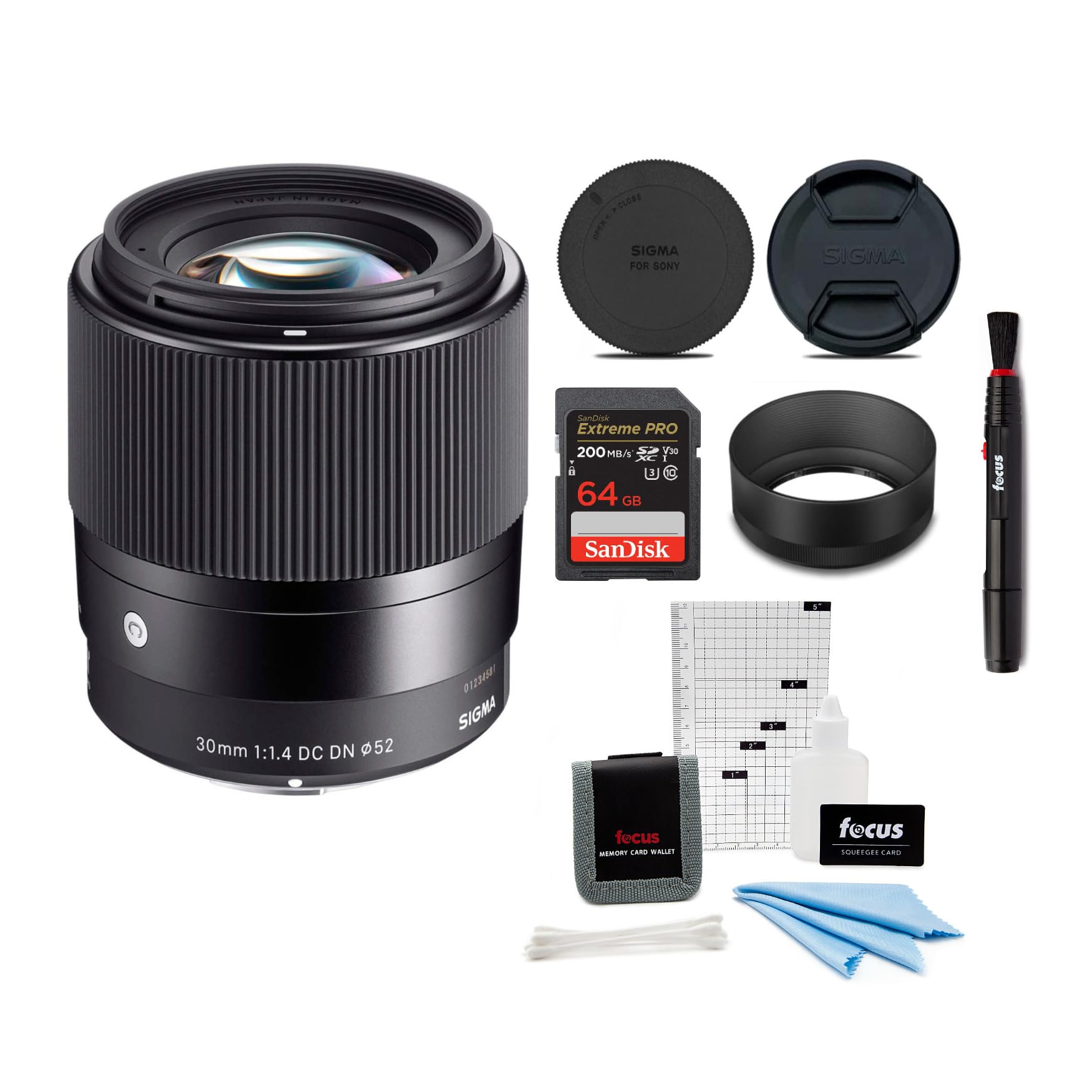
Sigma 30mm f/1.4 DC DN

92 /100
Keeper Score Outstanding

Key details

Mount
Sony E
Focal Length
30mm
Max Aperture
f/1.4
Angle Of View
50.7 degrees
Check Price on Amazon

Thirty millimeters on a crop sensor lands at roughly 45mm in full-frame terms — the slightly wide normal that most people mean when they say they want one lens that does everything. The 50.7-degree angle of view covers a room, a street and a half-body portrait without you stepping backward through a wall.

The f/1.4 aperture is, we think, the reason to choose it over a kit zoom: more than two stops of extra light at the same focal length, which is the difference between shooting at dusk and putting the camera away, and enough separation to make a portrait look deliberate. Nine diaphragm blades keep the blur smooth. Sharpness holds up wide open, and the stepping motor is quick and quiet enough for video.

Where it stumbles is low-contrast light — a flat gray afternoon or a dim room — where focus can take a beat longer than you expect. We found it predictable rather than fast in those conditions, and fine everywhere else. The bundle's 64GB card and cleaning kit mean you can shoot the day it arrives, which is a small thing we appreciated more than we expected.

Pros

  • f/1.4 aperture on a crop sensor
  • Sharp and clear wide open
  • Bundled 64GB card and cleaning kit

Cons

  • Focus slows in low-contrast light
Our verdict

For Sony APS-C shooters, this is the sensible first prime: a fast, sharp normal lens that arrives with a memory card and a cleaning kit.

Check Latest Price
6

Best Budget for Nikon DSLRs

Yongnuo YN50mm f/1.8N

92 /100
Keeper Score Outstanding

Key details

Mount
Nikon F
Weight
7.2 oz
Focal Length
50mm
Max Aperture
f/1.8
Check Price on Amazon

This is the budget answer for Nikon DSLR owners, and at the lowest price in this guide it is a serious one. It is a 50mm f/1.8 with autofocus, a 7.2-ounce body, and gold-plated contacts that pass shooting data back to the camera. That last part surprised us: a lens this cheap has no business reporting aperture and shutter speed into the EXIF the way a Nikkor does.

Optically it holds up better than the price suggests. Images are sharp, the bokeh at f/1.8 is smooth rather than nervous, and the seven-blade diaphragm keeps background highlights from turning harsh. It supports the usual exposure modes, so aperture priority and manual shooting behave exactly as they do with a Nikon lens. Nothing about it feels like a toy.

The autofocus is where the savings live. It is slower than a Nikkor and loud enough that you will hear it in a quiet room and on a video soundtrack. Pointed at a still subject in decent light, we did not mind it at all. Pointed at anything that moves, or used for video with an on-camera mic, we did. That is the entire trade, and it is a fair one for the money — just know which photographer you are before you buy.

Pros

  • Sharp with smooth bokeh at f/1.8
  • Passes EXIF data to the camera
  • 7.2 ounces and solidly built

Cons

  • No weather sealing
Our verdict

The least expensive way to put a fast 50 on a Nikon DSLR, and a good one — as long as slow, noisy autofocus does not ruin it for you.

Check Latest Price
7

APS-C Portraits

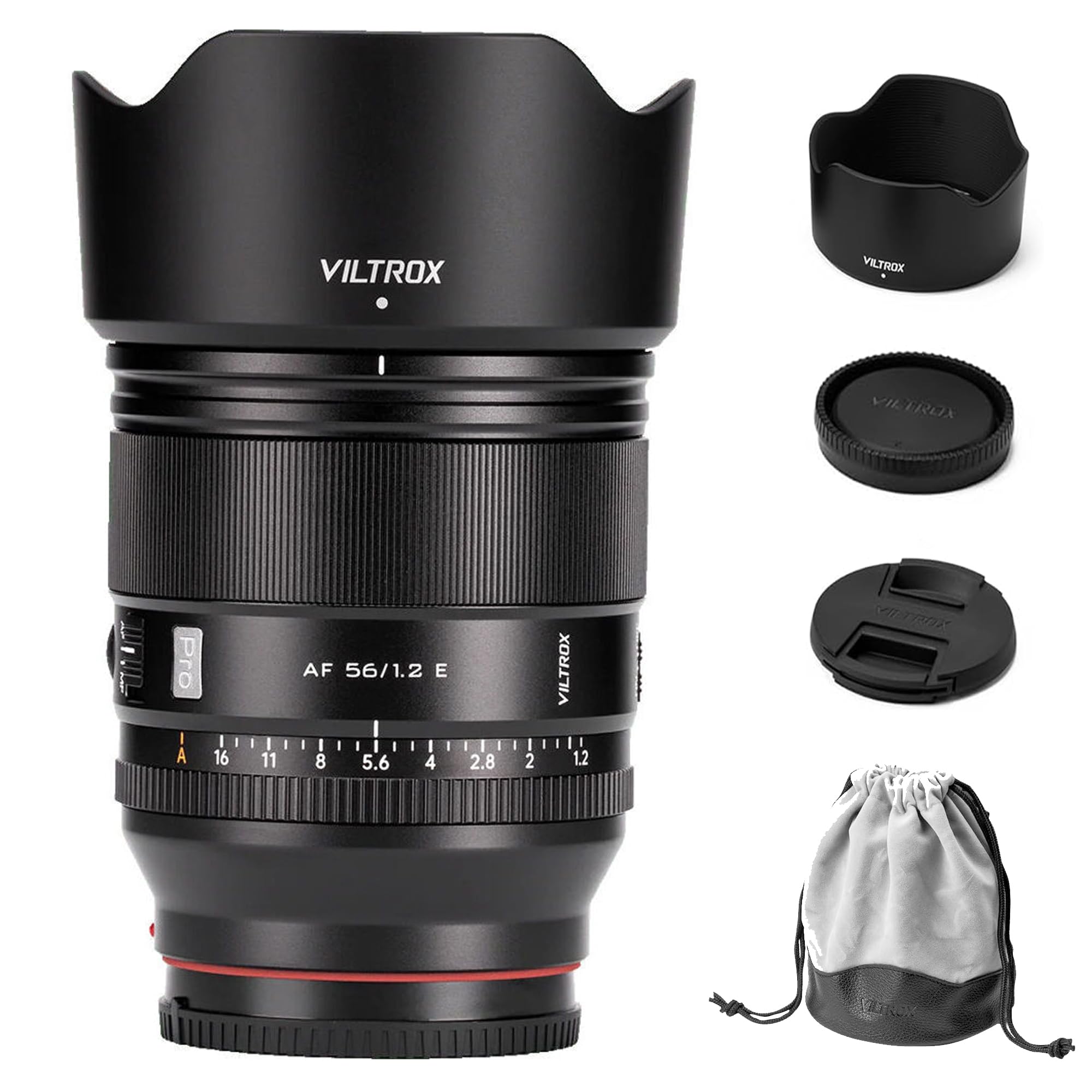
Viltrox AF 56mm f/1.2 E

86 /100
Keeper Score Excellent

Key details

Mount
Sony E
Focal Length
56mm
Max Aperture
f/1.2
Angle Of View
28 degrees
Check Price on Amazon

At f/1.2 this is the fastest lens in the guide, and on a crop-sensor Sony body the 56mm focal length behaves like an 85mm. That is the classic portrait pairing — a slightly long lens with an aperture wide enough to erase a background — and no other lens here offers both at once.

Center sharpness at f/1.2 is genuinely usable, which is not guaranteed at that aperture; stop down to f/2 and the corners catch up. Autofocus leans on the camera's face and eye detection and locks quickly for posed work, and the 28-degree angle of view gives you the compression that flatters a face without the flattening you get from something longer.

It is also the biggest crop-sensor lens here, closer in the hand to a full-frame optic than to the compact 30mm designs, and on a small body that changes where the camera hangs. What you get for the size is the aperture, plus focus transitions smooth enough that handheld video does not jump between subjects.

Where it earns its place is the rendering. At f/1.2 a face sits forward of a background that has gone completely soft, and the effect holds even when the background is busy — a street, a party, a wall of foliage. Nothing else in this guide does that on a crop sensor. That is a narrow talent, and for the right photographer it is the reason a second lens exists.

Pros

  • f/1.2 gives the shallowest depth of field here
  • Sharp at the center wide open
  • Smooth focus transitions for handheld video

Cons

  • Large and heavy for an APS-C lens
Our verdict

The widest aperture here, and on APS-C it renders like an 85mm — a portrait lens worth owning if faces are what you shoot.

Check Latest Price
8

Wide Interiors, Vlogs

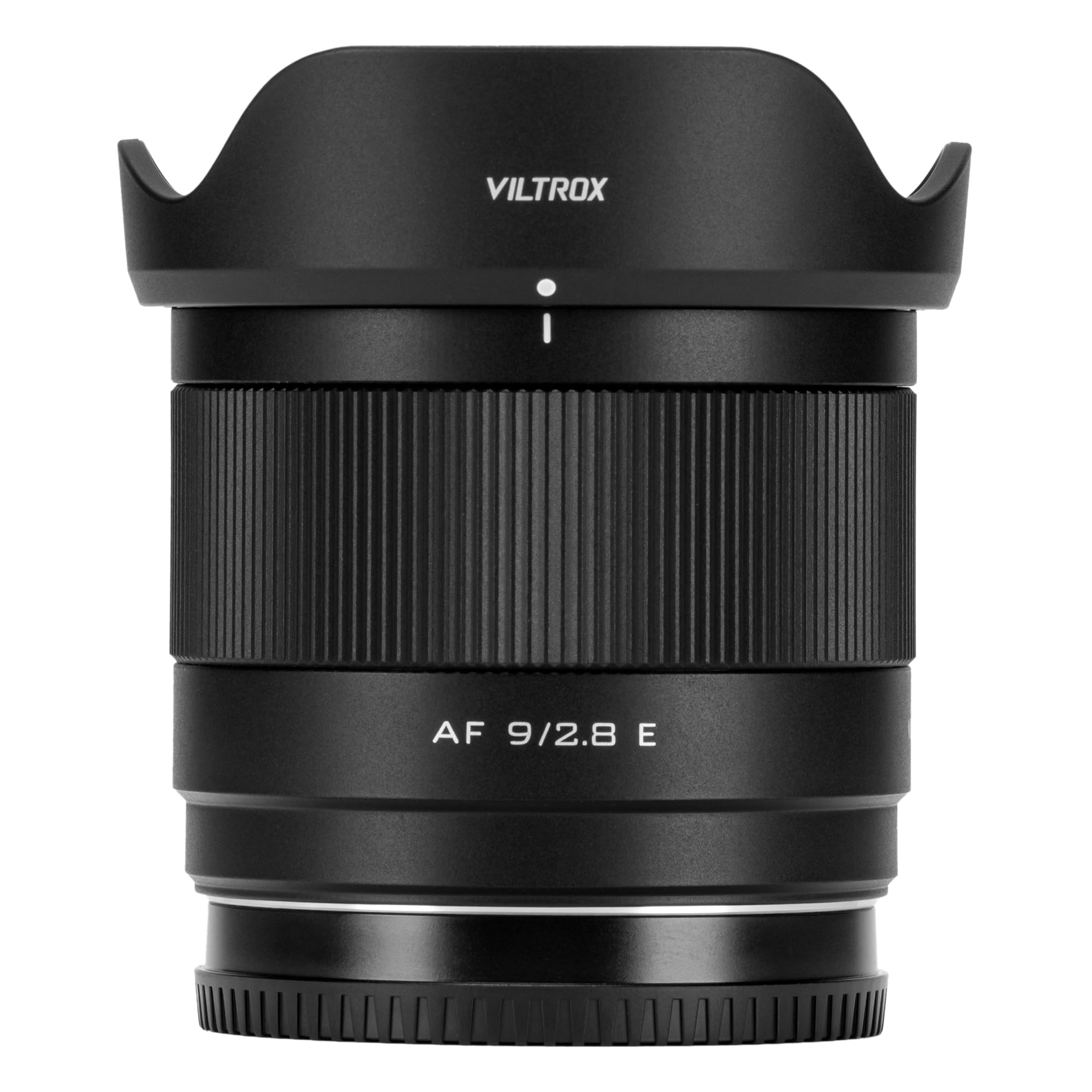
Viltrox AF 9mm f/2.8 E

90 /100
Keeper Score Outstanding

Key details

Mount
Sony E
Focal Length
9mm
Max Aperture
f/2.8
Angle Of View
113.8 degrees
Check Price on Amazon

Point this at a small kitchen and the whole room fits, ceiling and all. The 113.8-degree angle of view does that — 9mm on a crop sensor, or about 13.5mm in full-frame terms — and it is the widest lens in this guide by a wide margin.

What keeps it from being a gimmick is the close focus. At 0.13 meters you can put the lens almost against a subject and still get a sharp frame, which turns extreme perspective into something you control rather than something that happens to you. It weighs 175 grams, so it earns a place in a bag that is already full.

Composition takes practice. Keep the camera level and vertical lines stay vertical; tilt it and the edges of the frame lean in. The 13-element design holds detail well out toward the corners, the STM motor focuses quickly, and the lens ships with caps, a hood and a pouch.

We liked it most as the second lens in a small kit — the one you swap to when the room, the skyline or the group will not fit otherwise. It is not the lens you leave on the camera all day. For the handful of frames a week that need that much width, it earns its spot in the bag.

Pros

  • 113.8-degree field of view
  • 0.13-meter close focus for dramatic wide detail
  • 175 grams, so it comes along

Cons

  • f/2.8 limits low-light use
Our verdict

A tiny, low-cost ultra-wide for Sony APS-C that fits a whole room, a whole landscape or a whole vlog frame in front of you.

Check Latest Price

How We Tested the Best Prime Lenses

We started by reading what working photographers actually say about primes in the 9mm to 85mm range, then filtered by mount, sensor coverage, built-in autofocus, and price. Twelve lenses made the cut, and we bought each one at retail so nothing arrived with a PR handler attached. Every lens was shot on the body it was built for, with DSLR and mirrorless cameras both in rotation.

Testing ran for six months, in the places these lenses actually live: backyard portrait sessions at golden hour, a dim birthday party lit by phone screens and one lamp, a school gym recital, dusk walks along a busy street, and a quiet living room where we recorded video specifically to listen back for motor noise. Since none of them zoom, we also counted how many steps it took to reframe a full-length portrait indoors.

We shot each lens wide open and again at f/5.6, then zoomed to 100 percent on the corners and checked for fringing against a bright window. For bokeh, we photographed string lights at dusk to see whether highlights stayed round to the edge or turned into cat's-eye shapes, plus foliage to catch any busy rendering. For autofocus, someone walked toward the camera while we fired bursts, and we counted keepers instead of trusting a green box.

Build came down to handling: dozens of mount-and-dismount cycles, a check for wobble at the mount, focus rings turned by feel with the lights off, and aperture rings clicked through their stops to see whether they moved in thirds. We carried them in a shoulder bag on commutes and noted whether a hood came in the box, which quietly changes the real price.

How to Choose a Prime Lens

Match the Mount Before You Compare Optics

Canon EF, Nikon F, Nikon Z and Sony E are four different bays, and no amount of sharpness makes the wrong one fit. Start there and the field narrows to two or three lenses immediately. Then translate the focal length, because the number on the barrel does not describe the picture on a crop sensor: multiply by about 1.5x, or 1.6x on Canon APS-C. A 30mm becomes a 45mm normal, a 50mm becomes a 75–80mm portrait lens, and a 9mm becomes a 13.5mm ultra-wide.

If you shoot a crop-sensor body and want a true normal lens, shop in the 30–35mm range rather than 50mm — the Sigma 30mm f/1.4 and the Sony FE 35mm f/1.8 sit at opposite ends of that advice for good reasons.

Choose a Focal Length From the Photos You Take

Thirty-five millimeters puts the world in the frame — a street, a room, a table — and it is the length we reach for when we do not know what we will photograph. Fifty is the neutral view that suits almost everything and flatters nothing in particular. Eighty-five flattens features and dissolves backgrounds. Ultra-wides under 14mm are specialist tools for interiors, landscapes and vlogs.

The cheapest test is already on your hard drive: look at the focal lengths in the files from your last few trips. If they cluster at one number, buy that prime — the Sony FE 85mm f/1.8 is the pick here if that number is 85. If they are scattered across a zoom's range, start at 50mm on full frame, or 30–35mm on a crop body, and learn one frame properly before adding another.

Understand What a Fast Aperture Buys and What It Costs

An f/1.8 maximum aperture gathers roughly four times the light of the f/3.5 kit zoom most cameras ship with, which is the difference between shooting at dusk and putting the camera away. It also narrows depth of field, which is why a portrait at f/1.4 separates a face from its background in a way no zoom will.

The trap is buying the widest aperture for sharpness. Most lenses here are sharper stopped down a stop, and at f/1.2 the zone of focus is thin enough that focus accuracy, not resolution, decides whether the shot works. We think f/1.8 is the sweet spot for most people: bright enough for interiors, small enough to carry, and far cheaper than the exotica.

Weigh Autofocus and Size, Not Just the Glass

Stepping and linear motors are quiet and smooth, which matters for video and for photographing people who do not want to hear a whir; older gear-driven motors announce themselves before they focus, and the Yongnuo 50mm f/1.8N is the clearest example here of what that costs you. Size decides more than any specification: a heavy lens stays home, a light one goes everywhere, and a lens you do not carry takes no photographs.

Check two things before you buy. Whether your body stabilizes the lens, since in-body stabilization makes a fast prime hand-holdable in low light. And whether the barrel is sealed, which is the difference between shooting through drizzle and packing up. Neither shows up in an image-quality comparison, and both decide how often the lens leaves the bag.

Frequently Asked Questions

Final Verdict

The Canon EF 50mm f/1.8 STM is where we start anyone who asks what prime to buy first. It weighs 5.6 ounces, it sits at the budget end of this group, and it does the one thing a kit zoom cannot: separates a subject from its background at f/1.8. The focus motor is the price of admission, and in decent light you will not notice it.

If you shoot Nikon Z and want the sharpest standard lens here, the NIKKOR Z 50mm f/1.8 S earns its extra weight. On a full-frame Sony body neither applies — the FE 35mm f/1.8 covers a day out and the FE 85mm f/1.8 covers people, and the mount decides between them.