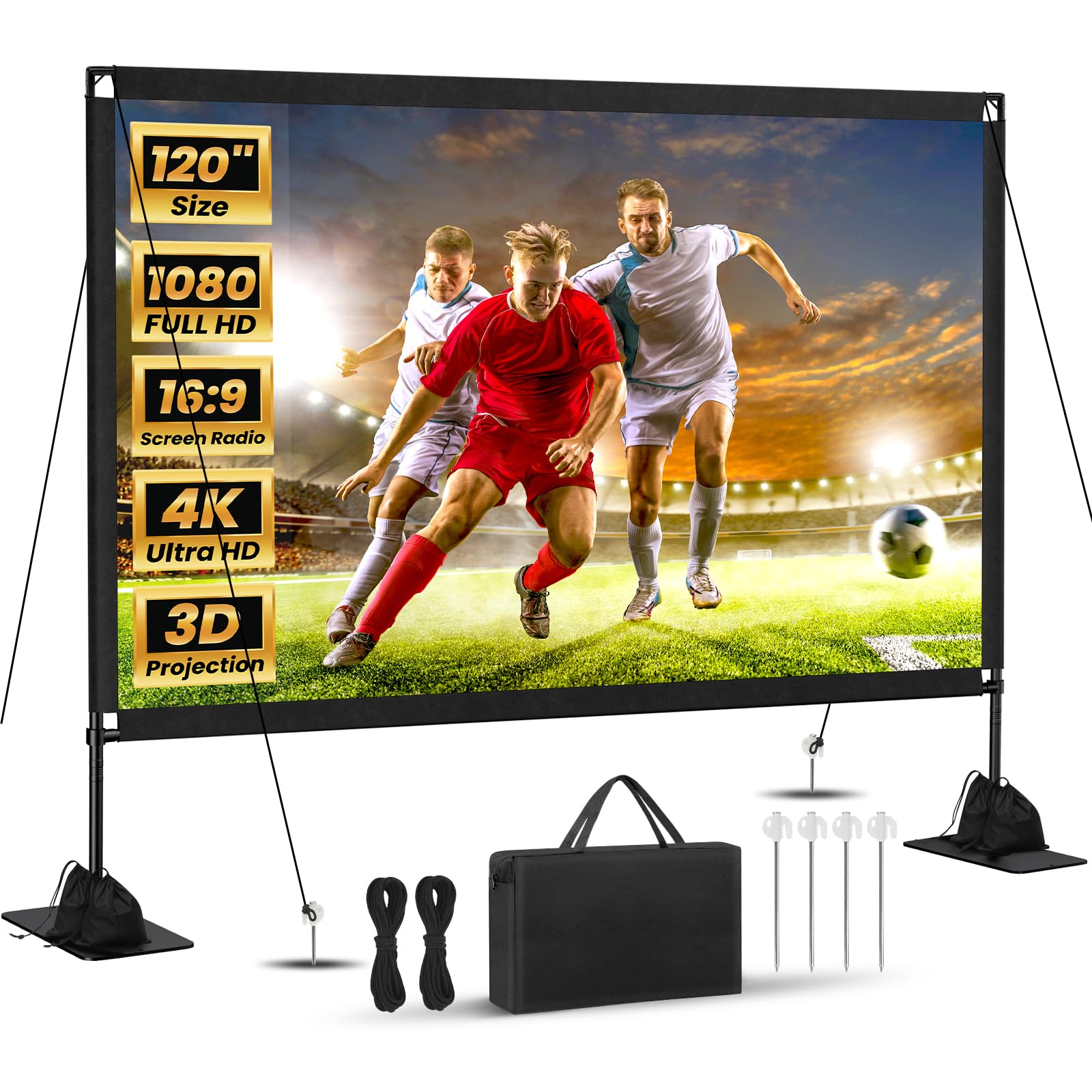
Best Portable Projector Screens of 2026

Every backyard movie night starts with the same optimism: a projector, a white bedsheet, and a plan that holds for about ten minutes. I've watched a sheet tear loose from a fence in a light breeze, and I've watched a folding frame sag halfway through the second act. A real screen fixes both — taut fabric, a frame that stands on its own, and a bag you can carry in one hand.

We spent six months raising and striking 12 portable screens in a backyard, on a campsite, and at a park fundraiser, and the fabric was almost never what decided it. The stand was, along with the small parts: stakes that bite into dry ground, sandbags you can fill on site, poles that click together without a fight. One thing first-timers miss is that listed sizes are diagonal — a 120-inch screen is only about 59 inches tall — so match the height to where your chairs will sit, not the number on the box.

The ones below are still going up easily in month six, and that's the only endorsement that matters by August.

Keeper Score summarizes customer ratings and review volume. Read it alongside the product details and trade-offs. How the score works.

1

Best Overall

Paris Rhône 100-Inch Screen with Stand

89 /100
Keeper Score Excellent

Key details

Weight
12.9 lb
Surface
1.5 gain PVC
Image Size
100 inches
Stand Height
64" to 85"
Check Price on Amazon

Height is the detail that separates this screen from the tripod kits around it. The stand runs from 64 to 85 inches, so the bottom of a 100-inch image can sit well above a row of camp chairs instead of disappearing behind them. Fixed-height tripods are fine in a living room and awkward in a yard; this one moves between both without you rebuilding anything.

The surface is the second good decision. Paris Rhône uses a 1.5-gain PVC with a multi-layer coating, and that extra gain is what we want for backyard use: it returns more of the projector's light, so color holds as dusk turns to dark. Higher gain narrows the sweet spot, so keep the seating roughly in front of the screen rather than off to the side. Setup is three stepped sections and about two minutes of work, and one person can manage it without a helper.

Weight is what you pay for the sturdier stand. At 5.85 kg it lives in a garage or a trunk rather than a backpack, and rolling the PVC back into its bag takes more patience than putting the frame up did. For a screen that stays home most weekends and travels occasionally, that's a fair trade.

Pros

  • Tripod rises from 64 to 85 inches
  • 1.5-gain PVC holds color as light fades
  • One person can raise it in minutes
  • Ground nails and reinforced X-frame

Cons

  • 5.85 kg is too heavy for hiking
Our verdict

For most yards and living rooms, this is the one we recommend: a bright, color-accurate 100-inch image on a tripod tall enough to clear a seated row.
Check Latest Price
2

Best for Windy Backyards

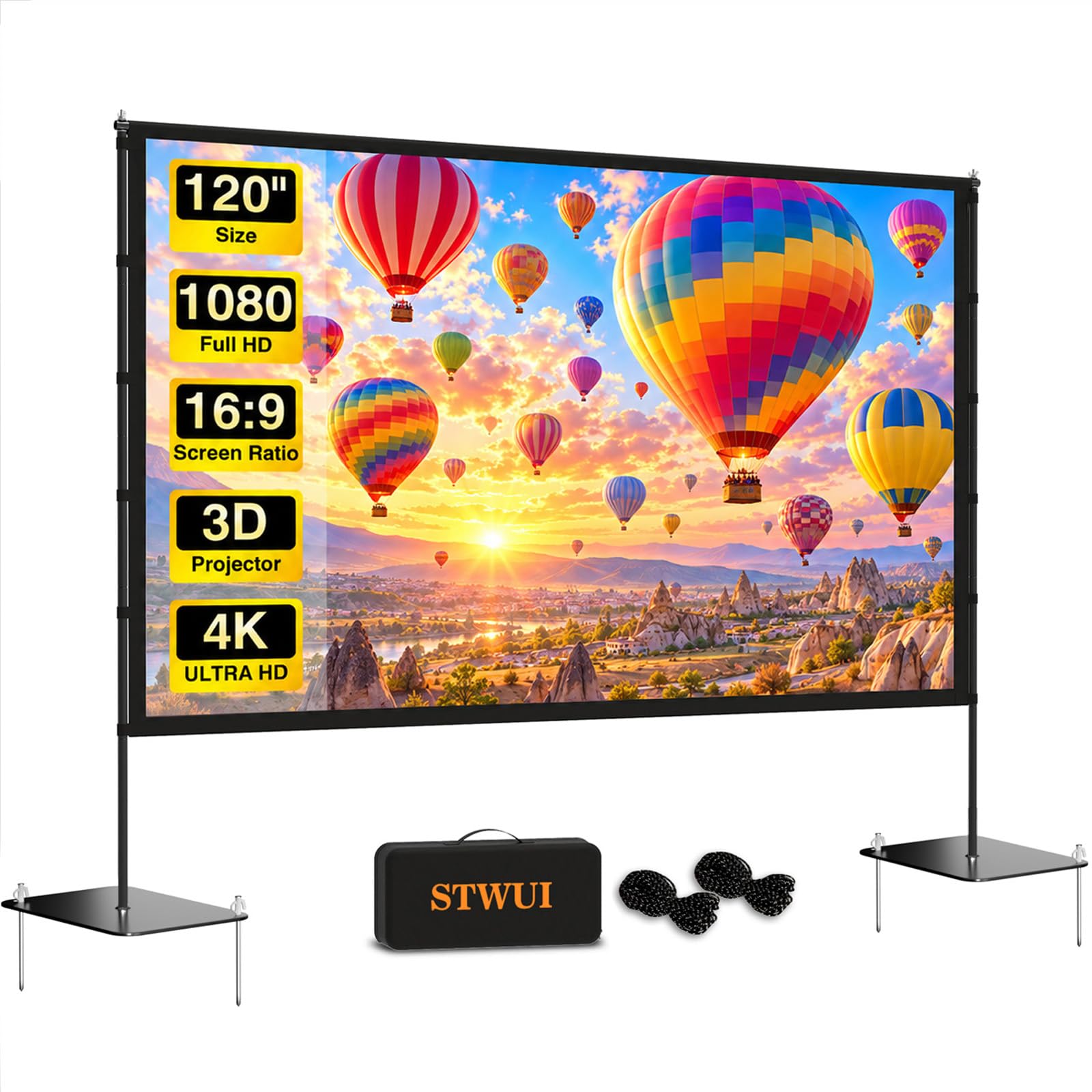
STWUI 120-Inch Screen with Stand

85 /100
Keeper Score Excellent

Key details

Base
Stake-down weighted plate
Frame
All-steel bracket
Assembly
Tool-free splicing tubes
Image Size
120 inches
Check Price on Amazon

If your movie nights happen on grass and the breeze has opinions, start here. The base is a widened, thickened plate that stakes into the ground, and the bracket above it is steel rather than the light aluminum several kits in this group use. On a lawn, that combination is the difference between a screen that stands through the evening and one you spend the evening chasing.

The image is a full 120 inches at 16:9 on a milk-silk fabric that stretches elastic and stays flat. The surface works for front or rear projection, which is useful if you want to shoot from behind a garage opening or a window, and the wide viewing angle keeps the people at the edges of the party with a usable picture.

Assembly is tool-free: matched splicing tubes slot together and the whole frame breaks down into one bag in about the time it takes to fill a cooler. Our reservation is the one every big screen shares. A 120-inch surface is a sail, so if gusts pick up, take it down and put it back after the weather passes. On a deck or patio where you can't drive stakes, weight the base plates with sandbags, because the stakes are the difference between stable and merely standing.

Pros

  • Stake-down weighted base plate grips grass
  • All-steel bracket resists bending
  • Front and rear projection both work
  • Tool-free tubes and a carry bag

Cons

  • Stakes need soft ground; decks need ballast
Our verdict

The screen we point to for exposed, grassy yards: a stake-down steel base and a full anchoring kit that keep 120 inches upright when the wind arrives.

Check Latest Price
3

Best Without a Stand

Mdbebbron 120-Inch Foldable Screen

91 /100
Keeper Score Outstanding

Key details

Weight
1.7 lb
Mounting
Hooks, rope, or tape
Image Size
120 inches
Viewing Area
104" x 58"
Check Price on Amazon

At 1.7 pounds, this is the screen you can genuinely forget you packed. There's no stand, no tube sections, no bag of stakes, just a 104-by-58-inch sheet of polyester you hook, tape, or rope to something solid. For camping, a rental cabin, or a wall that has to go back to being a wall the next morning, that simplicity is worth more than any frame.

The fabric is better than the price suggests. It's a heavier weave than the flimsiest hanging screens, it survives a wash, and the creases from folding pull out once you stretch it taut, which is the whole trick with this style. Hung flat against a solid wall it gives the cleanest picture; strung between two trees it will billow, and a ripple through the middle of a dark scene is impossible to ignore.

The weak point is the hardware. The included adhesive hooks are the first thing to fail, especially on textured or dusty surfaces. Plan on your own screws, eye hooks, or a couple of nails, and treat the tape as a template rather than a mount. Measure the wall before you commit, because a 120-inch screen is bigger than most people picture.

Pros

  • Packs to 1.7 pounds with no stand
  • Big 104-by-58-inch image for the lowest price here
  • Washable polyester pulls flat when taut
  • Hangs from hooks, rope, or tape

Cons

  • Hanging only, with no stand or frame
  • Shows light and shapes from behind
Our verdict

We keep coming back to this one for travel: 120 inches of polyester at 1.7 pounds, as long as you bring your own hooks.

Check Latest Price
4

Best Value Large Screen

ZUVMITG 120-Inch Screen with Stand

85 /100
Keeper Score Excellent

Key details

Weight
12.5 lb
Surface
Washable milk silk
Image Size
120 inches
Anchoring Kit
Sandbags and ground stakes
Check Price on Amazon

Twenty inches more diagonal than our top pick, for less money, is the deal this screen offers. If you have the wall or the yard for 120 inches, it's a good trade, because the picture is the part that doesn't suffer.

The surface is a washable milk silk that stretches flat and stays that way, and the wide viewing angle keeps the corners of a broad seating area usable. What we noticed most is how clean the image looks at the edges: the screen runs taut on four sides, so there's no ripple drifting down the middle of a dark scene. Front and rear projection both work, which makes it flexible for a window or a garage doorway.

Stability is conditional. Indoors, with the base plates on a hard floor, the frame sits still. Outdoors, the sandbags and the four ground stakes aren't optional extras, they're the installation. Weight it properly and the 12.5-pound frame holds; skip that step and a 120-inch screen becomes a kite. Treat the anchoring as part of setup rather than a chore you get to later and this is the value pick of the group.

Pros

  • 120 inches for less than the 100-inch picks
  • Washable milk silk stays flat on four sides
  • Sandbags and ground stakes in the box

Cons

  • Frame needs the sandbags outdoors
Our verdict

We hand this one to anyone who wants the most screen for the least money: a flat 120-inch surface that behaves once you use the sandbags and stakes in the box.

Check Latest Price
5

Best for a Big Crowd

FvcDmik 150-Inch Screen with Stand

83 /100
Keeper Score Excellent

Key details

Frame
Tool-free steel tube
Surface
Anti-crease polyester
Included
Carry bag and ground nails
Image Size
150 inches
Check Price on Amazon

A 150-inch diagonal is a different kind of evening. It's the biggest image in this group by a wide margin, large enough that a projector's picture stops feeling like television and starts feeling like an event, and it still collapses into a single bag.

The surface is an anti-crease polyester, thick enough to be opaque, which matters more at this size: any light passing through the fabric gets magnified along with the picture. The frame is steel tube that snaps together without tools, and ground nails and rigging ropes come in the kit for soft ground.

Squaring the frame is the part that takes patience. The tubes are held in tension by the screen, and the corners need to be worked even before the picture lines up, so the first assembly takes longer than the ones after it. Once it's anchored and square the stand is steady, but the frame itself is the flexy part, and a twist at one corner shows up as a soft edge on screen.

For a graduation party, a block party, or a yard with a long wall and a guest list, the size is worth the fiddling, because nothing else here fills a space like it. For a screen that goes up every Friday, the 100-inch Paris Rhône is easier to live with and far easier to square alone.

Pros

  • 150 inches, the largest image here
  • Opaque anti-crease polyester screen
  • Tool-free steel frame
  • Carry bag, ground nails, and ropes included

Cons

  • Fussy to square before the picture lines up
  • Needs a tall, wide space and long throw
Our verdict

When the guest list is the point, we think 150 inches justifies the extra setup time; this is the party screen of the group.

Check Latest Price
6

Indoor Presentations

excelimage 80-Inch Tripod Screen

89 /100
Keeper Score Excellent

Key details

Weight
8.5 lb
Surface
1.2 gain glass fiber
Mounting
Tripod or wall
Image Size
80 inches
Check Price on Amazon

Set this 80-inch screen up in a spare room and it's excellent. Set it up in a yard with any breeze and the tripod rotates a few degrees, which is exactly the kind of drift you notice the moment a scene slides sideways.

The surface is the reason to look at it anyway. It's a 1.2-gain glass fiber with a black backing, and the four aluminum tubes carry spring tension at their ends, so the fabric pulls flat instead of hanging with a sag across the middle. An 8.5-pound kit with a travel bag that a presenter can carry in one hand is a genuinely useful thing.

For indoor use, a classroom, a basement with a low ceiling, a spare room that doubles as a cinema, it's the strongest 80-inch option in this group, and the black backing keeps the picture from washing out against a pale wall. Outdoors, take one of the staked frames instead and leave this one for the room where it shines.

Pros

  • 1.2-gain glass fiber with black backing
  • Spring-tension tubes hold the surface flat
  • 8.5 pounds with a travel bag

Cons

  • Arrives creased and takes time to relax
Our verdict

Our pick indoors: a 1.2-gain glass-fiber surface that hangs flat and packs to 8.5 pounds, as long as the tripod isn't asked to hold in a breeze.

Check Latest Price
7

First Screen

AODIOU 80-Inch Screen with Stand

88 /100
Keeper Score Excellent

Key details

Weight
5.49 lb
Surface
Washable polyester
Mounting
Tripod
Image Size
80 inches
Check Price on Amazon

Two people make this screen easy; one person makes it interesting. The frame goes together without tools, but the tubes and the 70-by-40-inch fabric want a second pair of hands to hold the tension while the corners are clipped on. That's the honest cost of a kit this inexpensive, and it's a five-minute problem if you've got a helper.

What you get is a complete 80-inch setup: an aluminum frame, a 16:9 polyester screen with a wide viewing angle, a tripod mount, and a carry bag. The fabric is washable, which matters more than it sounds, because an outdoor screen gets dusty and being able to rinse it and hang it to dry beats spot-cleaning it on the frame.

Weight is the other trade. At around five and a half pounds the whole kit is easy to carry and easy to knock about, so treat the stand as something to secure rather than something to lean on. As a first screen, a second one for the kids' camping trip, or a backup that lives in the car, it does the job without asking much of you.

Pros

  • Cheapest stand-included kit here
  • Washable polyester screen
  • Light aluminum frame and carry bag

Cons

  • Light base needs ballast on decks
Our verdict

We recommend it as a first screen: the cheapest stand-included kit here, with an 80-inch washable surface on a light aluminum frame.

Check Latest Price

How We Chose and Tested Portable Projector Screens

We started with every screen on the market that ships with its own stand, then filtered by size range, packed weight, and whether the box included the three things that decide an outdoor night: a carry bag, ground stakes, and sandbags. That cut the field to 12 screens spanning 80 to 150 inches, which we bought at retail so nothing arrived pre-assembled or special-cased.

Each screen got the same first test: I carried it outside alone, unzipped the bag, and timed setup from first part out to a straight picture, counting every piece and noting whether anything needed a tool or a second set of hands. Mounting hardware got a close look — poles that clicked or had to be forced, frames that pin together versus ones that need threading. Sturdiness came next: I pressed on the top rail, nudged the stand with my hip the way a kid or a dog will, and watched how far the frame swayed before it settled.

Outdoors, we staked each screen into grass, loose dirt, and gravel, filled and hung the sandbags, and pointed a box fan at the fabric on low and high to see what tipped, bowed, or held. Wrinkles got their own protocol: fold it, bag it, leave it a week, then project a white grid and count the creases before and after a light stretch. For picture quality, we compared brightness with a porch light on and off and checked how much detail survived in a dark scene, and on the models that advertise it, we projected from behind to see if the image flipped cleanly. One screen went camping in a trunk and on a quarter-mile walk to a picnic table, because packed weight only reveals itself when you're the one carrying it.

How to Choose a Portable Projector Screen

Pick the image size your space can take

Sizes here run from 80 to 150 inches diagonal, all 16:9. The diagonal is marketing; the viewing area is what you have to fit. An 80-inch screen gives you roughly 70 by 40 inches of picture, and a 120-inch screen about 104 by 58, which is the number to check against your fence panel, garage door, or living-room wall.

Height catches people out. A 120-inch screen on a stand puts the top edge well above head height, which is fine against a fence and wrong under a porch ceiling. Bigger also asks more throw distance from the projector, so measure the room before you talk yourself into the 150.

Match the stand to where you'll set it up

Three designs cover this category. A tripod is quick and height-adjustable, and it's the right call for a deck, a patio, or a room where the screen moves between spaces. A staked base plate is what you want on grass: it drives into the ground and holds far better in a breeze, but it's useless on concrete. A fabric screen with no stand hangs from hooks or rope and packs smallest, and it asks you to supply the wall.

The trap is buying for the fabric when your problem is the footing. An exposed yard will humble a lightweight tripod no matter how good the screen surface is, and a staked frame on a hardscape is just a screen lying on the ground.

Read the surface, not the resolution badge

Polyester and milk silk are the packable options: light, washable, and flat only once pulled taut. Fiberglass and PVC carry gain, 1.2 to 1.5 in this group, which returns more of the projector's light for a brighter image at the cost of a narrower sweet spot, so seat people in front rather than off at an angle. A black backing matters if you'll hang the screen against a light wall or in front of a window.

Ignore the 4K in a screen listing. Every surface here passes whatever resolution the projector sends; what changes the picture is gain, flatness, and how much light leaks through from behind.

Weigh setup against how far you'll carry it

A 120-inch frame with a steel base runs around 12 pounds; a fabric screen can be under 2. That gap decides the purchase. A 12.5-pound kit is a car-to-yard carry, and a 1.7-pound screen goes in a backpack.

Assembly style matters as much as weight. Slot-together tubes with matched connectors go up squarer and faster than a bundle of loose poles, and a frame that needs two people is a frame you stop using when nobody's around to help.

Plan around the light

A portable screen is passive: it reflects what the projector sends, and no fabric makes a picture in daylight. Evening is the realistic window, with shade helping at the edges of the day. Higher-gain and black-backed surfaces hold up better against a lit patio or a streetlight, and rear projection lets you park the projector behind a window while the audience stays outside.

If most of your viewing is indoors, a matte white surface with a black border gives the most natural color, and a smaller screen keeps the image bright from a modest projector.

Frequently Asked Questions

Final Verdict

Our pick for a backyard that doubles as a living-room cinema is the Paris Rhône. The 100-inch PVC image is the best balance of size and color in this group, the tripod rises high enough for a seated crowd, and one person can raise it in a couple of minutes.

Choose the STWUI instead if your yard is open to wind and the screen will stay on grass. Choose the Mdbebbron if the screen has to disappear into a backpack.