Best Photography Hides for Wildlife of 2026

A pop-up blind is fine until you have to carry it a mile and a half to where the birds actually are. What many wildlife photographers end up with instead is lighter and stranger: a few square yards of mesh or leafy fabric you wear, drape over yourself, or throw over the lens, then wad into a pocket when the light shifts. It still has to erase your outline and let you see, breathe, and shoot through it.

I've spent plenty of cold mornings crouched behind a bush, and how a hide looks in a listing photo tells you almost nothing. We put 14 of them through real mornings over five months — netting, veils, ponchos, leafy suits, a lens hide — and the good ones share unglamorous traits: mesh you can honestly see through, fabric that stays quiet when the wind picks up, and a cut that fits over a jacket without binding.

Thin material and cheap material aren't the same thing, either; some of the lightest hides were also the quietest and the toughest. The picks below are grouped by how you carry them.

Keeper Score summarizes customer ratings and review volume. Read it alongside the product details and trade-offs. How the score works.

1

Best Overall

LensCoat LensHide

81 /100
Keeper Score Excellent

Key details

Weight
1.6 oz
Material
Poly/cotton
Camo Pattern
Realtree Max5
Viewing Window
Expanded mesh
Check Price on Amazon

Most of the concealment here is built around a person. This one is built around a lens, and that difference is the reason it is our top pick for photography rather than hunting. The LensHide drapes over a camera on a tripod and over the back of your head, with an expanded mesh window where your eye goes, so the rig stays covered while you are actually shooting.

In use it is close to what we want on a hedge line. An elastic cinch cord pulls the hem around the lens barrel, and a hook-and-loop closure at the back of the head keeps the rest from sliding off when you lean in to the viewfinder. There is no frame or wire in it, so a 1.6-ounce poly/cotton hide folds down to nothing and does not knock against the tripod every time you shift.

We also like that it lives on your belt instead of in the pack. The integrated pouch has belt loops, two D-rings, and an internal pocket for a card or a lens cloth, so the hide and the small things travel together and you are not digging for either.

Two things to weigh. It covers your lens and your head, not your body, so if you are standing in the open rather than tucked behind a tripod, a poncho does more for your outline. And before you commit, check the opening against the outside of your lens hood — with a long prime and a rigid hood, that is the measurement that decides whether it fits.

Pros

  • Mesh window you can shoot through
  • 1.6 ounces, packs into its own pouch
  • Elastic cinch holds it on the lens barrel

Cons

  • Covers the lens and head, not your body
Our verdict

If you photograph wildlife from a tripod, this is the hide that keeps both the lens and your face covered while you are actually working.

Check Latest Price
2

Best for Camera and Head

Fousam Sniper Veil

92 /100
Keeper Score Outstanding

Key details

Form
Camo mesh net scarf
Weight
6 oz
Packed Size
6.1 x 2.95 x 2.4 inches
Check Price on Amazon

No frame, no zipper, no pocket: this is a printed square of mesh, and that is the point. Drape it over your head and the camera and you have broken up the two shapes that give you away, the round of a face and the straight line of a lens.

As a photography tool it punches well past its place in the price order. It is large enough to cover a camera and your upper body at once, and the mesh is open enough to spot through, so you can keep it over the lens and still find the bird. This is the one for a walk-around kit: it lives in a jacket pocket and comes out when something moves.

Two things to know. The print fades with long sun exposure, which matters more if you are matching a particular hedgerow than if you just want to break a silhouette. And at 6 ounces packed into 6.1 x 2.95 x 2.4 inches, it takes less room than a water bottle. It also works as a neck cover for sun and insects, which is why it tends to stay in the bag even when the camera does not.

Pros

  • Covers camera and head in one drape
  • Mesh open enough to spot through
  • Six ounces, packs to bottle size

Cons

  • Print fades in long sun exposure
Our verdict

The best first hide here: one mesh square that covers your head and camera together, for a fraction of what a dedicated hide costs.

Check Latest Price
3

Best Lightweight Poncho

Ginsco 3D Leafy Poncho

90 /100
Keeper Score Outstanding

Key details

Style
Hooded leafy poncho
Weight
4.8 oz
Packed Size
11.81 x 8.66 x 0.87 inches
Check Price on Amazon

At 4.8 ounces this is the lightest wearable hide in the guide, and that is the number that decides whether it comes with you. Packed, it is roughly 12 by 9 by an inch — a corner of a daypack rather than a decision.

The design is a poncho rather than a suit, and that is the part we appreciate most. You pull it over whatever you are already wearing, a rain shell in October or a T-shirt in May, and you are done: no zipper to fight in the dark, no trousers to pull on over boots. The polyester mesh breathes, which is what makes it wearable through a long warm-weather sit instead of a fifteen-minute dash.

Coverage is generous. It drapes over a bulky jacket and a full pack, and the 3D leaves give it enough depth that it does not read as a flat sheet of print at a distance. The hood covers your head and neck, which is the part that gives most people away when they turn.

What it does not give you is somewhere to put the camera. There is no window, so with a tripod you are lifting the hem to shoot, and that movement costs you. Sitting on a stool with a handheld lens poking out from under the front edge, it works well; set up and waiting on a perch, a hide with a mesh panel does the job better.

Pros

  • Under five ounces and packs small
  • Pulls on over layers in seconds
  • Breathable through warm sits
  • Covers a large frame and a full pack

Cons

  • Snaps are the weak point
  • 3D leaves catch on brush
Our verdict

Our favorite for sitting still: it goes on in seconds, weighs under five ounces, and covers a big frame without cooking you.

Check Latest Price
4

Best Full-Body Suit

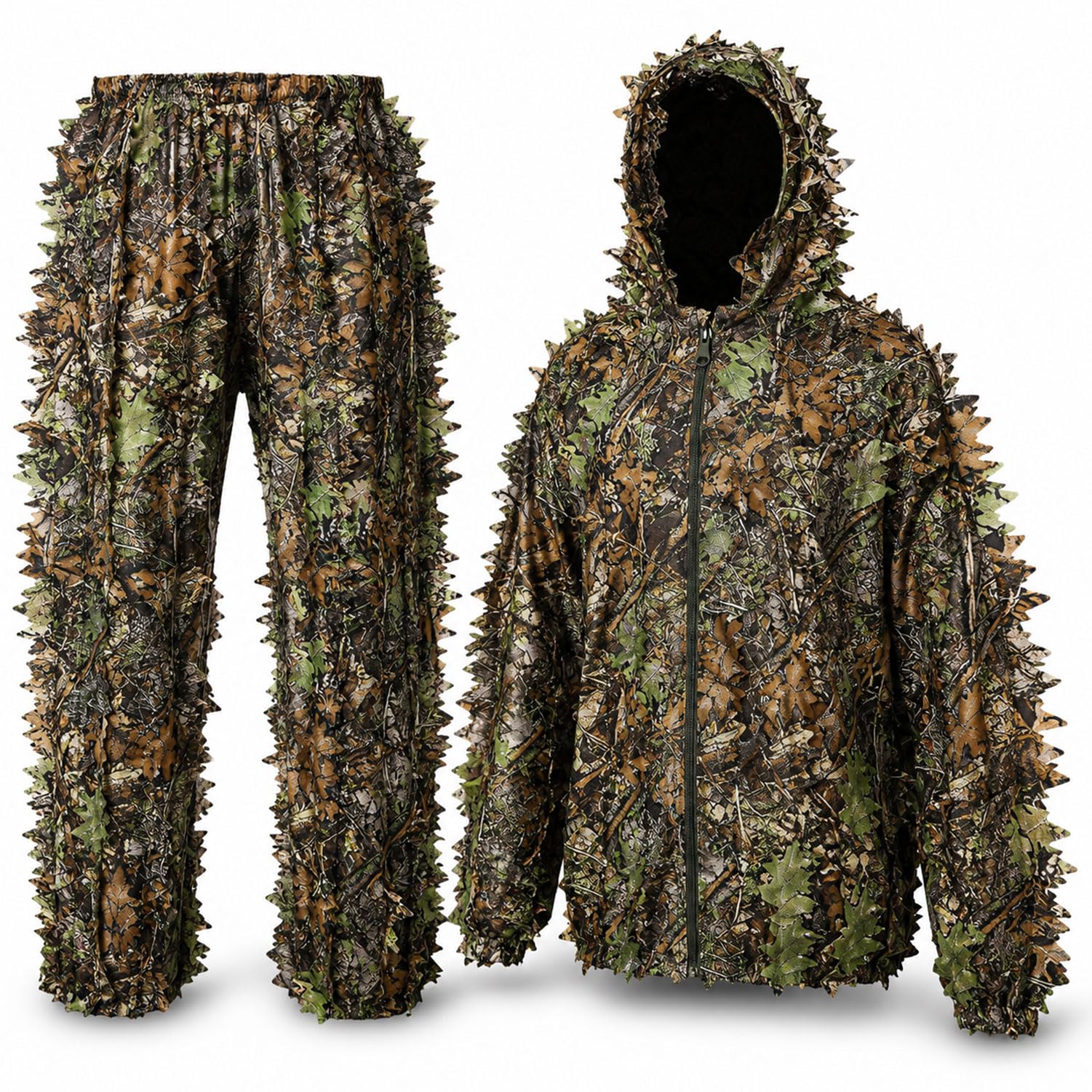
Favuit 3D Leafy Ghillie Suit

86 /100
Keeper Score Excellent

Key details

Size
Height 5.4-5.9 Ft
Pieces
Jacket and pants
Weight
7.68 oz
Material
Polyester mesh
Check Price on Amazon

Favuit sells this suit by height band, and this variant is listed for 5 feet 4 to 5 feet 9. Take that seriously: it runs small, so if you are near the top of the band or planning to layer a jacket underneath, go up a size.

The design is what makes it usable for stalking rather than sitting. The leaves are cut low-profile, so they catch less on briars and bark when you push through cover to a spot, the front zipper gets you in and out fast, and elastic at the cuffs, ankles, and waist keeps the jacket where you put it when you crouch. Jacket and pants together weigh 7.68 ounces, which layers over a base layer without turning a September morning into a sauna. Care is easier than the look suggests: machine wash, tumble dry low, no iron.

Where it needs care is the leaves themselves. The stitching holding them on is where this suit wears out, so treat it as a replaceable piece of kit rather than a lifetime purchase — the mesh body will outlast the decoration. For a photographer who wants full coverage and moves between positions rather than sitting one out, that is a fair trade.

Pros

  • Low-profile leaves snag less
  • Front zip for fast on and off
  • Elastic cuffs and waist stay put
  • Jacket and pants under eight ounces

Cons

  • Runs small for the listed height band
  • Leaf stitching is the first thing to fail
Our verdict

The full-coverage choice for moving through cover, as long as you size up and treat the leaves as replaceable.

Check Latest Price
5

Best Netting for a Hide

Camohute Camo Netting

88 /100
Keeper Score Excellent

Key details

Weight
1.01 lb
Material
Polyester mesh
Packed Size
8.66 x 6.69 x 2.36 inches
Check Price on Amazon

Quiet is the whole job here. This is a soft, tightly woven polyester that does not crackle when you reposition it, and that one property makes it more useful for wildlife than a tougher net that sounds like a crisp packet every time the wind shifts.

It is genuinely see-through in flat light, so you can sit behind it and watch a hedge line, but it darkens as the light drops, and early and late are exactly when the watching happens. Backlit by a low sun it also brightens from the animal's side. Hang it, then walk round to the front and look at it in the light you will actually be shooting in before you commit to a position.

The other gap is arithmetic. The packed dimensions are listed but the spread is not, so check the panel size against the hide you are fronting before you plan around it. It cuts easily, which is what makes it a build material rather than a drape: trim it to the opening and tie it off.

Pros

  • Quiet, soft polyester that does not rustle
  • See-through enough to watch from behind
  • Cuts cleanly to fit an opening

Cons

  • Darkens the view as light drops
Our verdict

The net we recommend for building a hide: soft, quiet polyester that does not announce every move you make.

Check Latest Price
6

Fixed Hide Panels

Yeacool Camo Netting

87 /100
Keeper Score Excellent

Key details

Size
10ftx13ft(3m*4m)
Color
Woodland Camo
Material
150D polyester oxford
Water Resistance
Waterproof
Check Price on Amazon

Yeacool treats this net to kill glare, and for wildlife photography that is the specification worth caring about. A dead-flat finish is the difference between a dark mass in the treeline and something that flashes white when the sun crosses it.

The panel is 10 by 13 feet, enough to front a small hide or screen a tripod setup, and it is meant to be cut and tied — zip ties through the weave, trim the overhang. It arrives vacuum-packed and needs stretching out, and Yeacool suggests soaking it in water with a little detergent and letting it dry naturally to take the rustle out, which is a half-hour job worth doing before it goes in the field.

The finish is what goes first. Sustained sun fades the print toward tan and brown, and the oxford weave is a heavier, more rustle-prone material than a soft polyester net, so it suits a hide you leave standing rather than one you carry in and re-hang every trip.

That is the use case it is built for: a fixed position on ground where it can stay up, fronted and forgotten. Carry a net in and out of a rucksack and the weight and the noise start to argue with you, which is where the Camohute earns its place instead.

Pros

  • Treated to kill glare and shine
  • Big 10-by-13-foot panel
  • Cuts and ties to any frame
  • Listed as waterproof

Cons

  • Print fades in sustained sun
Our verdict

A large, glare-free panel for a hide you can leave standing, though sun will soften the color and the weave is loud.

Check Latest Price
7

Two-Person Setups

Runpon Ghillie Poncho

88 /100
Keeper Score Excellent

Key details

Style
3D leafy poncho
Weight
12 oz
Packed Size
12.4 x 10.28 x 1.85 inches
Check Price on Amazon

Two adults can disappear under this one. It is the widest poncho in the set, cut generously enough to cover a photographer and a companion, or a photographer, a tripod, and a bag, and it is the pick when the hide has to cover more than you.

It is also the one that turns into something else. Strung between two branches it makes a serviceable temporary blind, which none of the wearable hides here can claim, and the leaves are dense enough to break a silhouette without a frame behind them. For a trip where you are not sure what you will need — a poncho on the walk in, a hide when you stop — that flexibility is worth more than a lighter weight.

The compromises are weight and finish. At 11.99 ounces it is the heaviest thing here after the big nets, and the fabric carries a slight sheen that reads brighter than it should in low sun. It is also shorter than the height suggests: fine seated on a stool, short on a tall wearer standing up.

Being careless with it is fine, which counts for a lot at the end of a long day: the leaves stay attached when it is bundled into a pack, and nothing about it needs folding neatly. It is the cape that lives behind the seat rather than the one that goes up a mountain.

Pros

  • Covers two people or a person plus kit
  • Doubles as a makeshift blind
  • Leaves stay attached when stuffed away

Cons

  • Heavier than the light ponchos here
  • Slight sheen in low sun
Our verdict

The pick when a hide has to cover two people or double as a temporary blind, and weight is not the priority.

Check Latest Price

How We Tested Photography Hides

We started with everything a photographer might realistically carry — netting rolls, mesh veils, ponchos, full leafy suits, and lens covers — and cut the field on specs rather than claims: how small each one packed, how much area it covered once unfolded, whether the mesh was described as see-through, and what it cost. Fourteen made the cut, and we've lived with them for five months.

Testing happened where these things get used. I sat against a white oak before sunrise on four turkey-season mornings, spent a handful of dawns at a pond waiting on herons, and shot from a stool nine feet from my own birdfeeders with a long lens. Several hides also went on hikes and into a steady drizzle, and one August afternoon in real heat, which is where the thin ones earned their keep.

Each hide got shaken and brushed past at ten feet to hear whether it crinkled like a chip bag — a few did, and those stayed home. I mounted a camera behind every mesh to see whether the netting read as a soft blur in frame, and looked through each into the same treeline at dusk to judge how much detail survived. Setups got timed in the dark with cold hands, and I checked whether I could get the camera to my eye without peeling the whole thing off.

Patterns — green-, brown-, and gray-dominant — were laid on dead grass, cedar bark, and green undergrowth, then photographed from 15 feet and judged at thumbnail size. We snagged each one deliberately on twigs, stuffed it back into its sack a dozen times, and checked seams, grommets, and whether the 3D leaves stayed attached. Fit came down to two of us, 5-foot-4 and 6-foot-2, wearing the same ponchos.

How to Choose a Photography Hide

What Has to Disappear First

A hide that covers your body and a hide that covers your lens solve different problems. A poncho or a leafy suit breaks up the human outline, but you still have to break cover to shoot. A lens-first design puts a mesh window where your eye goes, so the camera stays concealed while you are working. A net panel does neither on its own: it gives you somewhere to build.

Match the product to how you actually shoot. A tripod and a long wait point to a window; roaming and stalking point to a wearable; a spot you return to points to netting. Most wildlife photographers end up owning two of the three, which is worth knowing before you spend the whole budget on one.

Quiet and Dull Beat Realistic Print

Pattern gets the attention, but noise and shine give you away first. A printed mesh that looks right in the packet can flash bright when a low sun catches it, and a stiff oxford net rustles every time the wind moves. Soft, tightly woven polyester drapes quietly; heavier weaves are tougher and louder, and that trade is the one that decides most purchases.

None of it substitutes for staying still. Camouflage buys you the first few seconds after an animal looks your way, and movement spends them. Buy the quietest thing you can carry and then practise not fidgeting behind it.

Sizing, Coverage, and What You Carry

Wearables run small more often than they run large. Leaf suits are sold by height band rather than chest size, so read the band and go up if you are near the top of it or plan to layer a jacket underneath. A poncho is more forgiving than a two-piece suit because it hangs from your shoulders instead of fitting them.

Netting has the opposite problem. The figure in the listing may be the cut size before stretching, and vacuum-packed panels arrive smaller than they finish. Measure the opening you are fronting — height and width — and add a foot of slack for tying off. Packed weight is the other number to read: a pound of net is a deliberate carry, six ounces of veil is not.

What a Hide Won't Do

None of these keeps you dry. Leafy mesh is thin and breathable and about as waterproof as a T-shirt, so a poncho is concealment rather than rain gear; the coating in this category belongs to the oxford nets. Scent and sound stay on you as well — a hide changes your outline, not your footsteps.

Plan the rest of the kit around that: a separate rain cover for the camera, a dry bag for anything coated, and a setup you can put up without standing in the open for five minutes.

Frequently Asked Questions

Final Verdict

We recommend the LensCoat LensHide first, because it is the only hide here that solves the photographic problem rather than the hunting one: it covers the lens and your head without covering your viewfinder. That single design decision is what separates a hide you shoot from and a hide you sit behind.

If a dedicated hide is more than you want to spend, the Fousam veil covers camera and head together for a fraction of the cost and lives in a jacket pocket. And if you are fronting a position you will return to, the Camohute net is the quietest way to build it.