Best Photo Paper of 2026

You hit print on a photo you love, and what comes out is a paler, duller version of it — gray skies, chalky skin tones, a surface that takes a thumbprint before you've even picked it up. Usually the paper is the culprit, not the printer. I print constantly at home, and over the past three months my team and I ran 15 different papers through our own inkjet printers, from glossy 4x6 snap packs to letter-size luster, to see which ones held up.

The part first-time buyers miss is that finish matters more than weight. High gloss pumps up color and contrast, which flatters birthday snapshots, but it also holds fingerprints and bounces a lamp right back at you; satin and luster soften the shine and hide handling marks, which is why framed prints usually want them. Paper also has to agree with your printer — a heavy sheet that feels wonderful in the hand can jam a simple feed tray. The picks below are the ones that survived real handling and real frames.

Keeper Score summarizes customer ratings and review volume. Read it alongside the product details and trade-offs. How the score works.

1

Best Overall

Canon Photo Paper Plus Glossy II 4x6 (400 Sheets)

96 /100
Keeper Score Outstanding

Key details

Finish
Glossy
Sheet Size
4 x 6
Sheet Count
400
Paper Weight
70
Check Price on Amazon

Four hundred sheets changes how you print. We stopped saving the glossy stock for occasions and started running the ordinary stuff through — the birthday batch, the prints for grandparents, the good picture of the dog — because a box this size takes the arithmetic out of pressing print.

The print itself holds up. Colors come out saturated rather than flat, black-and-white keeps its contrast, and the 70-weight sheet has enough body to feel like a photograph rather than office paper. Brightness sits at 92, and the sheets feed without the curl thinner gloss picks up; Canon rates this paper for all inkjet printers, and we had no feed trouble in the machines we ran it through.

What earns it the top spot is the combination: standard 4x6 size, color that looks right on the first try, and enough sheets on hand that you'll actually use them. Two things are worth knowing before you commit. The back is single-sided and carries a Canon watermark, so it's wrong for a double-sided card or a long handwritten note. And this box doesn't exist in letter size. For the way most people print snapshots, neither matters.

Pros

  • Low per-print cost in a 400-sheet box
  • Rich, saturated color on gloss and black-and-white
  • Feeds cleanly without curl on the inkjets we used
  • Standard 4x6 size for albums and frames

Cons

  • Single-sided back carries a Canon watermark
  • No letter-size sheets in this 4x6 box
Our verdict

The box we tell most people to buy: 400 glossy 4x6 sheets that print rich color on any inkjet, at a per-print cost that makes casual printing feel free.

Check Latest Price
2

Best for Quick Handling

HP Advanced Photo Paper Glossy 4x6 (100 Sheets)

96 /100
Keeper Score Outstanding

Key details

Finish
Glossy
Sheet Size
4 x 6 in
Sheet Count
100
Paper Weight
30
Check Price on Amazon

Humidity is the quiet enemy of home printing. Damp air slows how fast glossy stock takes ink, and a print that's still tacky when someone picks it up collects a thumbprint. HP's Advanced paper is built against that: it dries fast enough to stack and pass around immediately, and HP names humid environments as the condition it was formulated for. Of the sheets here, this is the one we hand out at a party.

Color is the other half of the case. HP's Auto Sense reads the sheet and sets the driver for you, which removes a step most people get wrong — at the cost of only working on an HP printer. On another brand's inkjet you get the paper without the handshake, so set the media type to glossy photo yourself.

The stock is lignin-, calcium carbonate-, and acid-free, the formulation behind HP's fade-resistance claims, and prints come out with true-to-life color and clean blacks that don't bleed into the white. It's a lighter sheet in the hand than the Canon box, closer to a good drugstore print than a card, and that's the paper we reach for when prints will be handled rather than framed.

Pros

  • Prints dry fast enough to stack and pass around
  • Bright, true-to-life color with clean blacks
  • Acid- and lignin-free stock aimed at fade resistance

Cons

  • Auto Sense settings only work on HP printers
Our verdict

If your prints get handled within minutes of leaving the printer, or you live somewhere humid, this instant-dry paper is the one we put in front of a group.

Check Latest Price
3

Best for Framing

Epson Ultra Premium Photo Paper Glossy 5x7 (20 Sheets)

96 /100
Keeper Score Outstanding

Key details

Finish
Glossy
Brightness
96
Sheet Size
5 x 7 in
Sheet Count
20
Check Price on Amazon

Pull a sheet of this out of the pack and the difference is immediate. Epson calls it the heaviest consumer glossy it makes, and it has the body of a print that came back from a lab rather than out of a desktop printer. The high-gloss surface carries deep blacks and saturated color, and the bright white base keeps highlights clean instead of gray.

This is the paper for the print that is the point — a 5x7 for a frame, a card for a grandparent, anything people will look at closely rather than stick to the fridge. It dries fast and takes a thumb without smearing, which is the thing we checked first on a sheet that gets handed around before it goes behind glass.

Plan around two things. The pack holds 20 sheets, so this is a project paper rather than an everyday one, and 5x7 is a size your printer has to support — look for a 5x7 media setting, and on a printer with both paths use the rear feed, since heavy stock is where feed problems show up first.

Pros

  • Heaviest consumer glossy here, with real body
  • Dries fast and resists smudges and fingerprints
  • Deep blacks and clean highlights for framing

Cons

  • Only 20 sheets per pack
Our verdict

The print you frame or hand to someone belongs on this: Epson's heaviest consumer glossy dries fast, shrugs off fingerprints, and looks lab-made.

Check Latest Price
4

Best Luster Finish

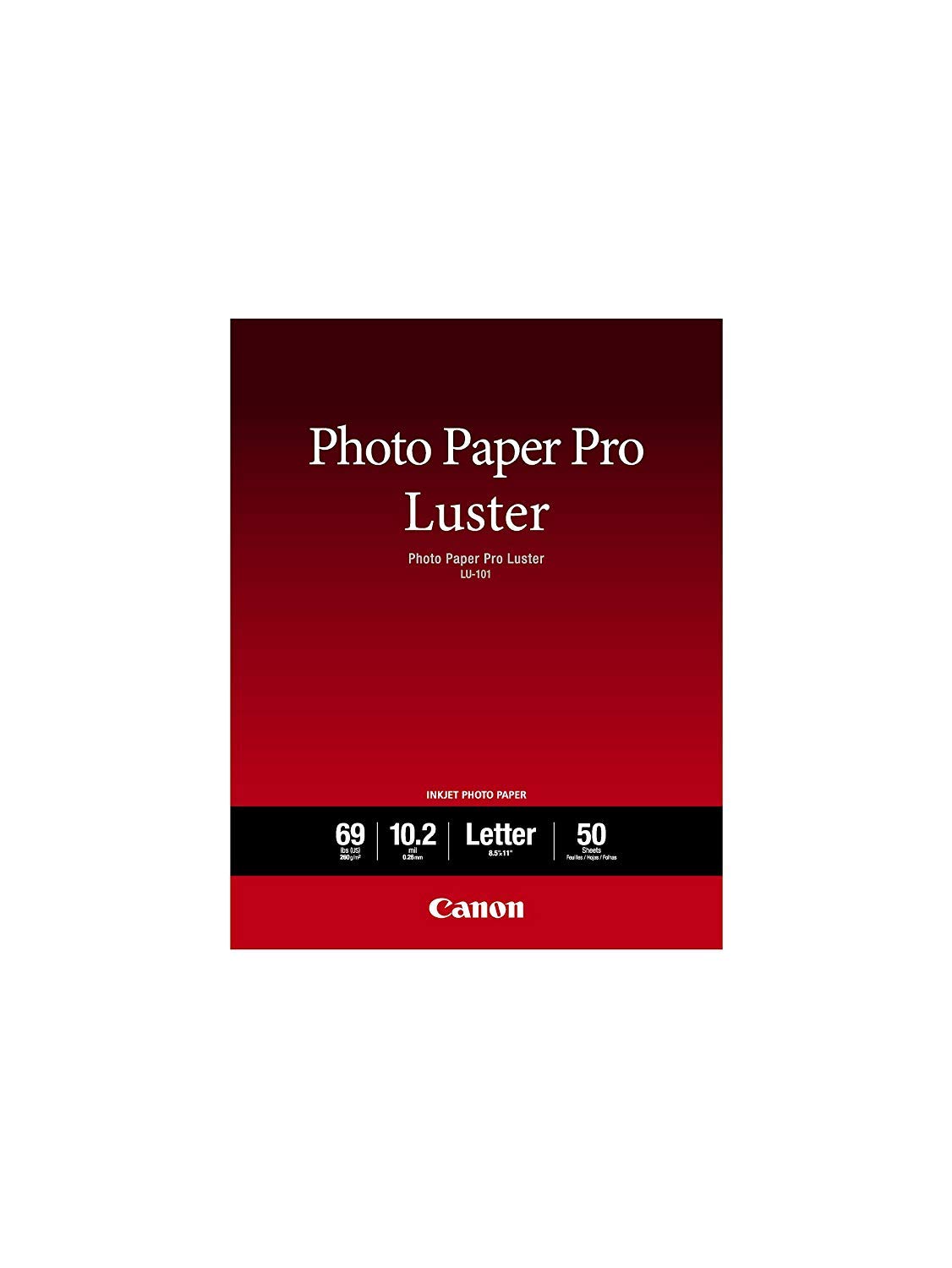
Canon LU-101 Luster Photo Paper Letter (50 Sheets)

95 /100
Keeper Score Outstanding

Key details

Finish
Luster semi-gloss
Sheet Size
Letter
Sheet Count
50
Paper Weight
69
Check Price on Amazon

Hang a glossy print behind glass in a room with a window and you've hung a mirror. Luster is the fix, and Canon's LU-101 is the most convincing version of it here: a semi-gloss surface with just enough tooth to break up reflections, and a finish that resists fingerprints instead of collecting them.

Color is where it surprised us. Canon builds this paper for its own ink set, and in a color-managed workflow prints landed close to what the screen showed — saturated where they should be, neutral grays, and black-and-white that doesn't pick up a color cast.

Letter size makes it the sheet here for a portrait you intend to mat, a portfolio page, or a print for someone else. At a 69 weight it's substantial without tipping into cardstock, and nothing about the sheet ties it to Canon hardware.

So: if the print goes in a frame and the frame lives in a lit room, this is the one, and the luster surface is the whole reason. If you want maximum gloss and maximum punch, the Plus Glossy II does that better and for less per sheet. The pack is 50 sheets and letter only, which is the other thing to weigh before committing.

Pros

  • Luster surface cuts glare behind glass
  • Fingerprint-resistant finish for handled prints
  • Faithful color and neutral black-and-white
  • Substantial 69-weight stock for matting

Cons

  • Letter-only pack of 50 sheets
Our verdict

For portraits and anything going behind glass, this luster stock kills reflections and fingerprints while keeping color faithful — our pick for prints that have to look serious.

Check Latest Price
5

Best for Large Prints

HP Premium Plus Photo Paper Satin Letter (50 Sheets)

95 /100
Keeper Score Outstanding

Key details

Finish
Satin (soft gloss)
Sheet Size
Letter
Sheet Count
50
Paper Weight
80
Check Price on Amazon

Print the same file on a glossy sheet and on this, and the difference isn't color — it's where the light goes. HP's soft-gloss satin swallows reflections, which is what you want from an 8.5x11 that will hang on a wall, and it holds highlight detail that a high-gloss surface can wash over.

HP bills this as its highest-quality photo paper, and the 80-weight stock backs that up: it feels like something worth mounting. The color is rich and the contrast is strong without the plastic sheen that makes a framed glossy print look like a poster — this is the paper we reach for when a print has to hold a wall.

Two practical notes. Satin is not gloss: side by side, the glossy papers here look punchier on high-contrast images, and this one looks more like a gallery print. And 80 weight is thick enough that a printer with a sharply angled feed path can balk, so use the rear feed if yours has one.

Pros

  • Satin surface kills glare on large prints
  • 80-weight stock feels gallery-grade
  • Rich color with detail held in highlights

Cons

  • Less punch than gloss on contrasty images
  • 50-sheet packs limit long print runs
Our verdict

HP's best photo paper, and the satin surface is the reason: large prints with rich color and almost no glare, without the plastic look of gloss.

Check Latest Price
6

Best Budget

Epson Value Photo Paper Glossy 4x6 (100 Sheets)

95 /100
Keeper Score Outstanding

Key details

Finish
Glossy
Sheet Size
4 x 6 in
Sheet Count
100
Paper Weight
24
Check Price on Amazon

Most of what comes off a home printer isn't precious. It's the snapshot for the fridge, the school project, the extra copy for a relative who asked. Epson's Value line exists for that volume, and it's the paper we kept loaded when we didn't want to think about what each print cost.

The numbers explain why: a mid-weight, bright-white sheet at 24 weight and 97 brightness, glossy on one side, rated for all inkjet and Supertank printers, and covered by Epson's paper satisfaction guarantee. Color comes out clean and the gloss is even — a good snapshot, without the depth or stiffness of the Plus Glossy II or HP Advanced.

The honest trade is the stock. A 24-weight sheet feels light between your fingers, and it's the one here most likely to feel insubstantial once it's in an album sleeve. For the fridge and the school folder that's irrelevant. For anything headed into a frame, step up to the Canon box — this paper is about quantity, and it does that job well.

Pros

  • Lowest per-sheet cost among the 4x6 picks
  • Bright white base with an even gloss
  • Rated for all inkjet and Supertank printers

Cons

  • Light 24-weight stock feels flimsy in the hand
Our verdict

The cheapest way to keep a 4x6 habit going: bright white, glossy, and rated for all inkjets, as long as you don't expect lab heft.

Check Latest Price
7

Craft Projects

Koala Glossy Inkjet Photo Paper 8.5x11 (100 Sheets)

93 /100
Keeper Score Outstanding

Key details

Finish
Glossy
Sheet Size
8.5 x 11 in
Sheet Count
100
Paper Weight
180 gsm / 48 lb
Check Price on Amazon

Size and count tell you what this is for. A hundred letter-size glossy sheets in one pack is a working stack rather than a display paper, and that's how we use it — invitations, cake toppers, photo-wall grids, the projects that get handled, trimmed, and thrown away.

At 180 gsm (48 lb) it's card-weight rather than paper-thin, with a smooth flat gloss, a 98 brightness, and enough stiffness to cut cleanly and stand up in a folded card. Photo prints come out crisp, and color sits well on the bright base; the single-sided sheet also gives you a blank back to write on.

The catch is ink chemistry. Koala specifies dye ink, and the sheet behaves differently depending on what your printer lays down — pigment-ink machines are the wrong match here. Buy it for volume and craft work with a dye-ink printer, and keep a luster or a premium gloss for anything that has to last.

Pros

  • 100 letter-size sheets suit volume projects
  • 180gsm stock cuts, folds, and stands up
  • Bright 98 brightness with a smooth gloss

Cons

  • Dye ink only
  • Ink can rub off on some printer setups
Our verdict

Letter-size gloss for projects rather than portraits: 100 bright, card-weight sheets that suit volume work, as long as your printer runs dye ink.

Check Latest Price

How We Tested Photo Paper

We started by gathering every paper we could find in the sizes people actually print — 4x6 for snapshots and cards, 5x7 for small frames, letter for portfolios and wall pieces — and filtered out anything not clearly labeled for inkjet use, plus anything priced so high per sheet that it made no sense for everyday printing. That left 15 packs, which we ran through our own printers over three months.

Testing happened where printing happens: at the kitchen table on a Sunday, batch-printing 4x6s for thank-you cards and mailings to the grandparents, and at the desk pulling letter-size sheets for frames and a portfolio. We handled every print with slightly damp fingers straight off the output tray, then checked for smears after a minute, an hour, and the next day. Each sheet got bent, curled, and slid into an album to see whether corners flared or the surface scuffed.

Color was judged against the same image on screen: skin tones, shadow detail in dark hair, a blue sky that turns purple on bad paper. We tilted each print under a lamp to see how much glare it threw and how fast it showed fingerprints, and we taped a few to a sunny windowsill for the full three months to watch for fading and yellowing. Finally, we counted sheets per pack against what we paid, because a paper that ruins one print in five isn't a bargain at any price.

How to Choose Photo Paper

Match the finish to where the print ends up

Glossy gives the deepest blacks and the punchiest color, and it's what most people picture when they think photo paper — but behind glass in a lit room it turns into a mirror, and every fingerprint shows. Luster and satin sit between gloss and matte: a soft sheen that keeps color rich while scattering reflections.

Our rule is simple. Albums, hands, and fridge doors get gloss; frames in daylight get luster or satin. If you print both, keep a small pack of each rather than committing to one.

Pick the size you actually print

Most home printing is 4x6, and it's the size where a big pack pays off: a 400-sheet box of Canon Plus Glossy II turns into a couple of years of snapshots. 5x7 suits a frame on a shelf and is worth buying in small packs because you print it less often. Letter is for wall prints, portfolios, and anything you'll mat.

Check that your printer lists the size before you buy, and remember that borderless printing is a printer capability, not something the paper provides.

Weight changes how a print feels and how it feeds

Paper weight is the difference between a print that feels like a photograph and one that feels like a printout. Heavier stock — roughly 68 to 80 weight, or 180 gsm and up — holds its shape in the hand, mounts and frames better, and doesn't ripple when the printer lays down heavy ink. It's also the stock that complains in a tightly curved feed path, so use the rear or straight feed where your printer has one.

Very light stocks, around 24 weight, keep costs down but feel thin and pick up a curl sooner.

Dry time and smudge resistance decide how fast you can handle prints

Two papers with identical color can behave completely differently in the hand. Instant-dry formulations let you stack and pass prints straight from the output tray, which matters in humid weather and when children are involved. Dye inks on a glossy surface can stay soft longer, and a sheet that still feels cool and tacky will smear.

Give a fresh print a minute before stacking it and a few hours before it goes behind glass. If you print for events or hand prints out, dry time is worth more than a marginal gain in gloss.

Brand matching and per-print cost

Paper and ink from the same maker is the safest pairing: the driver already carries a profile for the sheet, and features like HP's Auto Sense only work in-house. Third-party paper still prints well — you just set the media type yourself instead of letting the printer guess.

Cost works the way bulk buying always does. A 400-sheet box beats a 20-sheet pack on cost per print by a wide margin, but only if you'll use it. Buy small, confirm the finish suits you, then buy the big box.

Frequently Asked Questions

Final Verdict

If you print snapshots, buy the Canon Plus Glossy II 4x6 box. It's the paper that makes home printing feel free rather than precious, the color lands on the first try, and the size matches what most of us actually print. Everything else here answers a more specific requirement.

Print in a humid house or hand prints out straight from the tray, and the HP Advanced sheets are the swap. If the print is going in a frame, buy Epson's Ultra Premium in 5x7 — and if that frame hangs where daylight reaches it, buy the Canon luster instead, because the finish is the whole decision.