Best Pancake Lenses of 2026

A pancake lens is a promise: a few centimeters shaved off your camera so it slides into a jacket pocket instead of a bag. The catch is that flat glass usually costs you something — a slower aperture, softer corners, a focus motor with opinions. Those trade-offs show up in use, not on a spec sheet, which is why my team and I spent the past six months shooting with 12 pancake primes.

Two things surprised me. Field of view shapes a photo more than sharpness does: a wide pancake swallows a whole room from where you stand, while a normal one makes you back through a doorway to fit the same scene. Autofocus noise is the other one — some of these motors are silent, and others chatter loudly enough that people turn around in a quiet room. The lenses that stayed on my camera had solid mounts, smooth focus rings, and clean corners wide open, which is what value actually looks like in this category. The picks below run from ultra-wide to normal, across full-frame and crop bodies.

Keeper Score summarizes customer ratings and review volume. Read it alongside the product details and trade-offs. How the score works.

1

Best Overall

Canon RF 28mm f/2.8 STM

91 /100
Keeper Score Outstanding

Key details

Mount
Canon RF
Weight
2.08 oz
Focal Length
28mm (about 45mm on APS-C)
Maximum Aperture
f/2.8
Check Price on Amazon

Fifty-nine grams is the sort of figure that sounds like marketing until you mount the lens and pick the camera up. The RF 28mm f/2.8 STM barely changes the balance of a full-frame R body, which is the difference between a camera that goes in the bag and one that stays in the drawer. Nothing about the barrel asks for attention.

Of the pancake lenses we recommend here, this is the one we hand to someone with a single camera and a habit of leaving it at home. Twenty-eight millimeters is wide enough for a street corner, a restaurant table or a whole room, and on an APS-C body like the R50 it becomes a 45mm that flatters faces. The leadscrew STM motor was built with video in mind, so focus moves smoothly and quietly rather than snapping.

Close focus is the detail that changes how you use it. Nine inches gets you to 0.17x, which covers food, flowers and the small things you would otherwise photograph with a phone, and Canon's in-camera corrections straighten the barrel distortion before you ever see the JPEG. Sharpness held up wide open at f/2.8 in our shots, and by f/4 there was nothing left to think about.

What you give up is sealing, and a little light. There is no weather resistance here, so a wet afternoon means a bag or a sleeve. And f/2.8 is only f/2.8, a stop and a bit behind the Micro Four Thirds pancake on this list, which matters if you shoot after dark more than you shoot in the rain.

Pros

  • 59g, barely noticeable on a full-frame body
  • Sharp wide open at f/2.8
  • Quiet STM focus that suits video
  • Focuses to 9 in. for close-ups

Cons

  • No weather sealing
Our verdict

If you want one lens to live on a full-frame Canon, this is it: 59g, quietly sharp, and wide enough to make an ordinary walk worth photographing.

Check Latest Price
2

Best for Fujifilm Shooters

Fujifilm XF 27mm f/2.8 R WR

90 /100
Keeper Score Outstanding

Key details

Mount
Fujifilm X
Weight
2.96 oz
Focal Length
27mm (41mm equivalent)
Weather Resistance
Weather resistant
Check Price on Amazon

The aperture ring is why this feels like a Fujifilm lens and not merely a small one. Click it to f/5.6, set the shutter, and the camera becomes an object you can operate without taking your eye off the finder. At 84g it disappears on an X-Pro or an X-T body, and the 39mm filter thread means the filters you already own still fit.

Twenty-seven millimeters on APS-C works out to 41mm equivalent, the narrow side of normal, close to how a street scene actually looks. The R WR version brings weather resistance and a real aperture ring, which is what separates it from the budget end of this list. It is the finished version of the idea.

The field takes a day to learn. It is tighter than the 23mm you probably started with, so you step back more than you expect, and then the frames get calmer: less clutter at the edges, people filling the frame without you having to get close enough to be noticed. For street work that is not a limitation, it is the point.

Pros

  • Aperture ring you can set by feel
  • Weather-resistant barrel
  • 84g on an X-T or X-Pro body
  • 41mm-equivalent view for street work

Cons

  • Focus motor is audible when it hunts
  • Priced above the other everyday picks
Our verdict

The pancake we keep on a Fujifilm body: weather-sealed, 84g, and controlled by an aperture ring you can find by feel.

Check Latest Price
3

Best for Sony Full-Frame

Viltrox 26mm f/2.8 EVO

90 /100
Keeper Score Outstanding

Key details

Mount
Sony E (full-frame)
Weight
4.59 oz
Focal Length
26mm (81.2° view)
Maximum Aperture
f/2.8
Check Price on Amazon

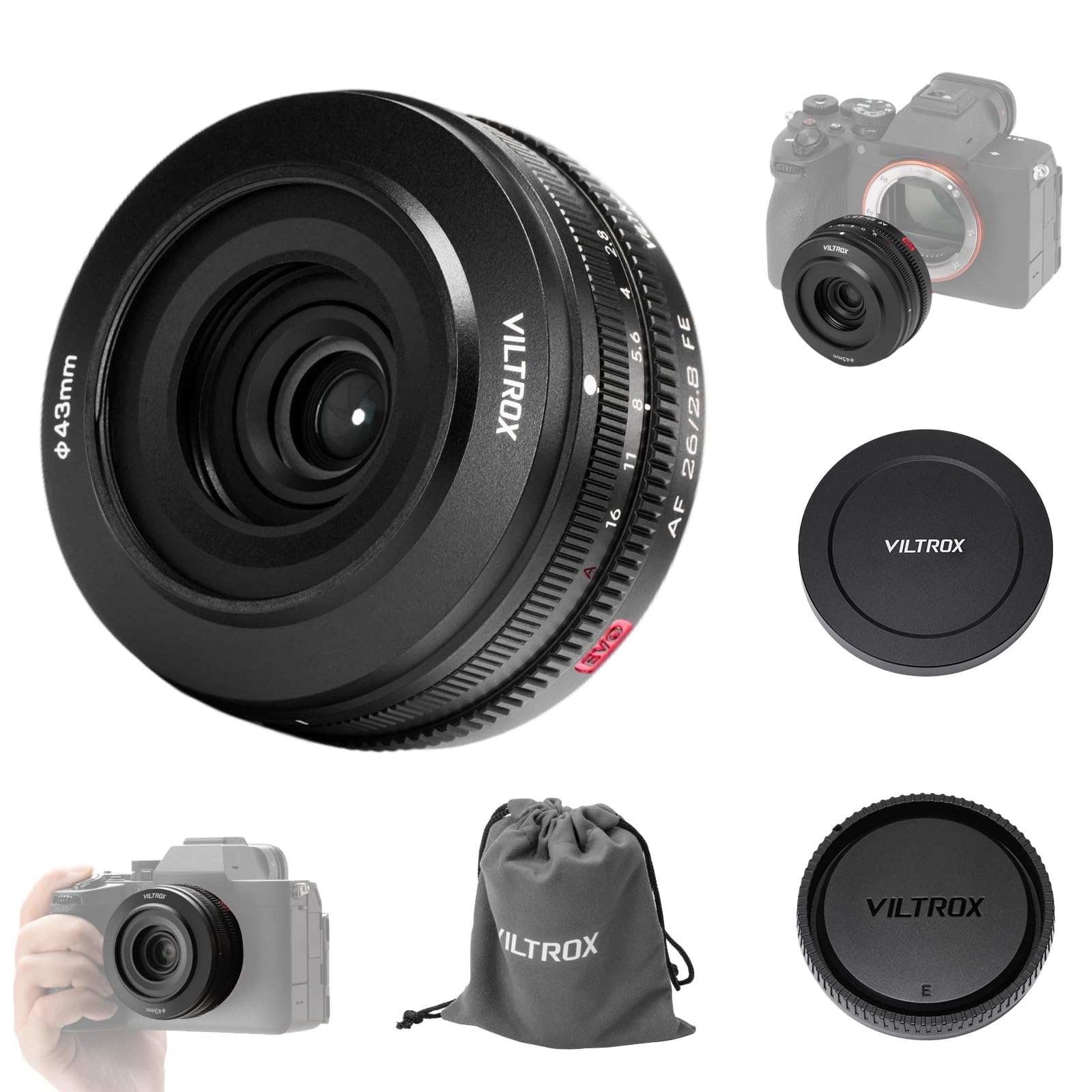
Where the 28mm f/4.5 is a lens you keep in a pocket, the 26mm f/2.8 EVO is a lens you leave on the camera. It is heavier and considerably more expensive, and it earns both by being the one you can still shoot with once the sun goes down.

Eight elements in six groups, two of them aspherical and one high-refractive, with 0.2m close focus and a 43mm filter thread. The barrel is 23.8mm long, so it barely changes the silhouette of an A7C II, and the stepping motor is near-silent, the kind of autofocus you stop noticing after a day.

Sharpness is where it surprised us. Edge-to-edge clarity at f/2.8 is not what we expect from a lens in this bracket, and the distortion control is good enough that a building facade stays straight to the frame edge. Bokeh is soft rather than spectacular, but f/2.8 on a 26mm was never going to blur a background into cream anyway.

The 26mm view is a useful compromise, wider than a 28 without the drama of a 24, and on an APS-C Sony it becomes a 39mm that suits an a6700 nicely. If you want one small lens for a full-frame Sony and you shoot indoors, in the evening and a bit of video, this is the one we point at. The f/4.5 Viltrox is the better travel lens; this is the better everyday lens.

Pros

  • f/2.8 with edge-to-edge sharpness
  • 130g and 23.8mm long
  • Near-silent STM autofocus
  • Close focus to 0.2 m

Cons

  • Costs considerably more than the 28mm f/4.5
Our verdict

The full-frame Sony pancake we reach for after dark: f/2.8, near-silent focus, and sharpness that runs to the edges.

Check Latest Price
4

Best Budget Full-Frame

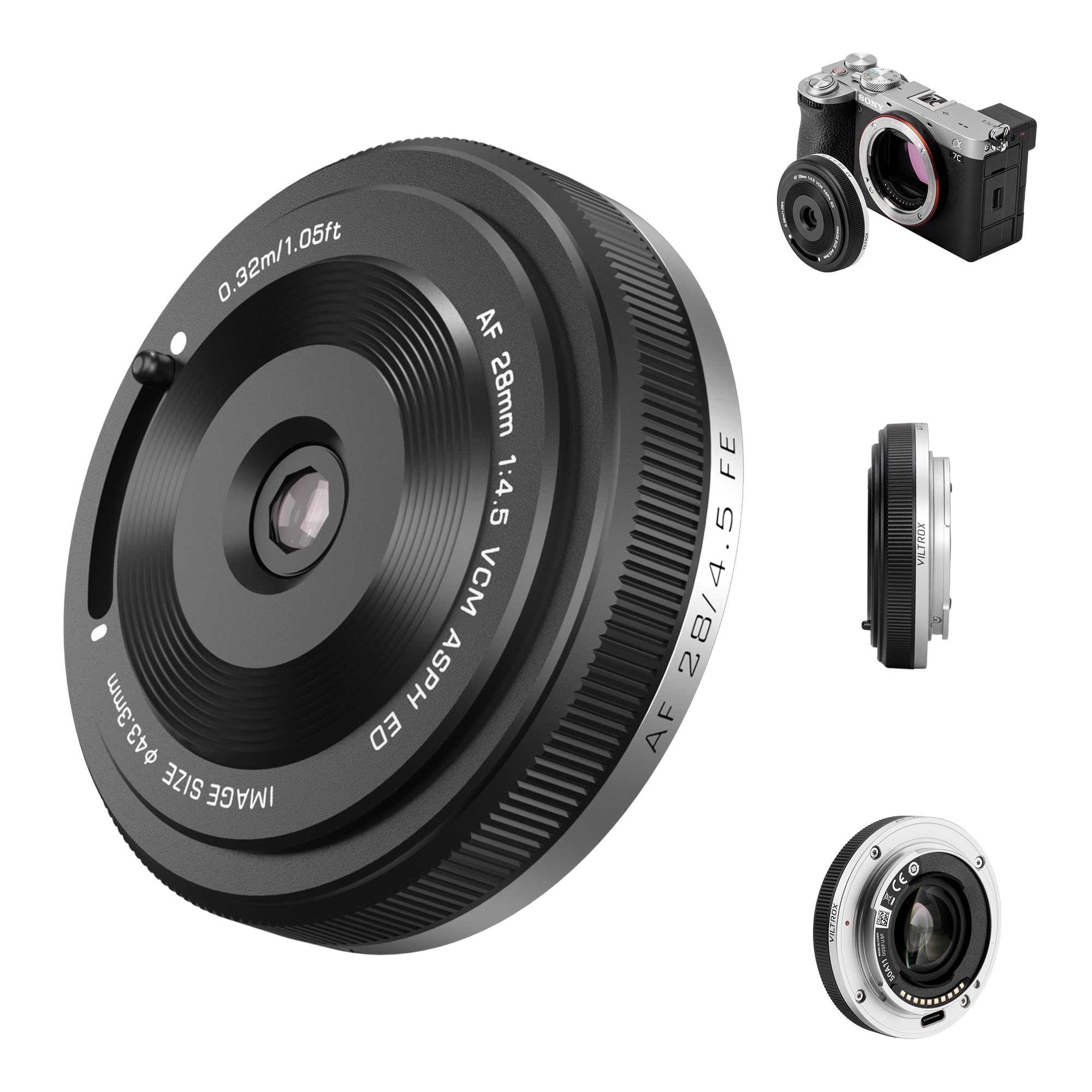
Viltrox AF 28mm f/4.5 FE

89 /100
Keeper Score Excellent

Key details

Depth
15.3mm
Mount
Sony E (full-frame)
Focal Length
28mm (73.4° view)
Maximum Aperture
f/4.5
Check Price on Amazon

Fifteen point three millimeters deep and 60g: the Viltrox AF 28mm f/4.5 is the lens you keep in a jacket pocket in case something happens. It is also the least expensive way into full-frame Sony on this page, which is a strange thing to say about a lens with an aluminum mount and a sliding front cap.

Six elements in six groups, two ED and two aspherical, with a front element shaped to throw starbursts at small apertures. The 28mm view covers 73 degrees of a full-frame sensor, wide enough for a street, an interior or a whole facade, and wide enough that you will want the camera level, because the edges punish a tilted horizon.

We think of it as a daylight lens, and the aperture is the reason. f/4.5 is dim, so this is an outdoor, good-light, travel-and-street tool rather than something for a dim bar; the VCM motor handles face and eye detection and is quick enough for video. If you shoot in daylight and want the smallest possible full-frame kit, this is the one. If you shoot at night, the 26mm f/2.8 is worth the extra.

Pros

  • 60g and 15.3mm deep
  • Least expensive full-frame option here
  • Sharp, clean images in good light
  • VCM autofocus with face and eye detection

Cons

  • f/4.5 is limiting indoors and at night
Our verdict

For daylight travel on a full-frame Sony, nothing here is smaller or less expensive, as long as f/4.5 is a trade you can live with.

Check Latest Price
5

Best Budget Autofocus

TTArtisan AF 27mm f/2.8

84 /100
Keeper Score Excellent

Key details

Mount
Fujifilm X
Weight
3.28 oz
Focal Length
27mm (41mm equivalent)
Maximum Aperture
f/2.8
Check Price on Amazon

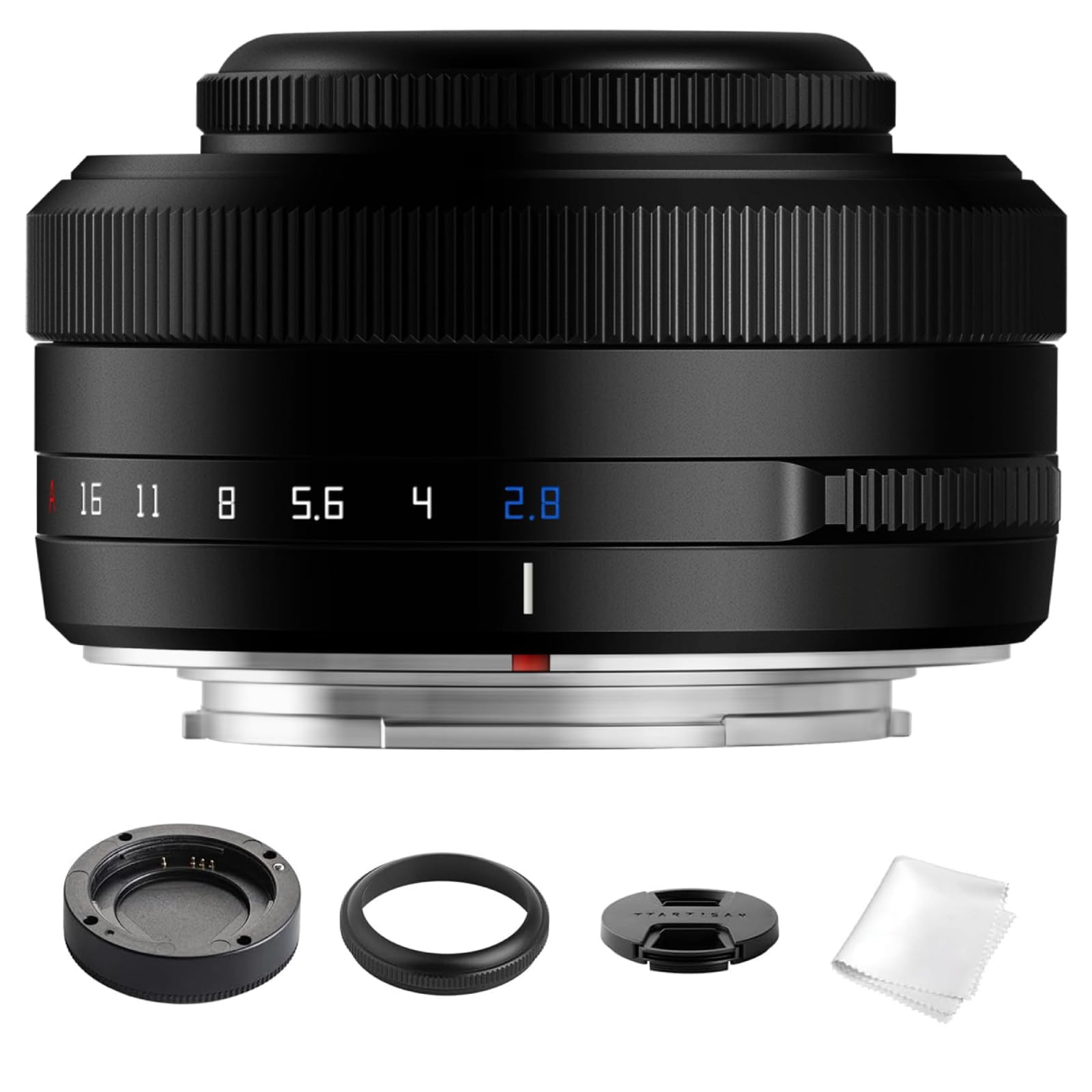
For a fraction of what the Fujinon costs, the TTArtisan 27mm f/2.8 asks an obvious question: what are you giving up? On paper, less than you might think, because you get the same 27mm focal length, the same f/2.8, a clicked aperture ring and a stepping motor that handles eye and face detection.

Having shot both, the answer is mostly in the feel. The TTArtisan is the heavier of the two at 93g, the aperture ring is clickier and less damped, and the hood is a simpler piece of plastic. None of that shows up in the files, which come out sharp and clean, and the autofocus finds faces reliably in good light. We think it is the best value in this guide for a Fujifilm body that needs autofocus.

Low light is where the budget shows. Focus gets less certain when the light drops and the subject is small in the frame, and it is worth switching to a smaller AF box or zone focusing rather than letting the lens hunt. The flip side is a lens you can afford to take anywhere, which is most of the battle with a pancake.

Build is better than the price suggests, and the rear cap hides a USB-C port for firmware updates, an odd little feature that makes a budget lens feel supported. The 39mm filter thread matches the Fujinon's, so filters carry over. It is the lens you take when you would rather not risk the expensive one.

Pros

  • Autofocus with eye and face detection
  • 41mm-equivalent view at 93g
  • Sharp files for the money
  • USB-C firmware updates in the rear cap

Cons

  • Not weather-sealed
Our verdict

Autofocus, a 41mm view and a clicky aperture ring for a fraction of the Fujinon's price: the best value on a Fujifilm body.

Check Latest Price
6

Best for Micro Four Thirds

Panasonic Lumix G 20mm f/1.7

89 /100
Keeper Score Excellent

Key details

Mount
Micro Four Thirds
Weight
3.53 oz
Focal Length
20mm (40mm equivalent)
Maximum Aperture
f/1.7
Check Price on Amazon

An f/1.7 aperture in a barrel this short is the trick Micro Four Thirds keeps pulling off. The Lumix G 20mm weighs about 100g, covers 57 degrees, which is 40mm equivalent and the classic normal, and gathers roughly a stop and a half more light than the f/2.8 lenses that dominate this list. We rate it as the lens that makes a small MFT body a genuine low-light camera rather than a daylight one.

Two aspherical elements and multi-coating keep ghosting and flare down, and the metal mount is the sort of thing that matters after a few years of swapping lenses in the field. Forty millimeters equivalent is a quietly useful place to stand: close enough for a portrait across a table, wide enough for a street, and short enough that perspective stays natural.

The focal length is its own compromise. It is not wide enough for architecture and not long enough to compress a face the way an 85mm does, which means it asks you to move rather than zoom. If your favorite photographs are taken at arm's length, this is the lens; if you want vistas, look at a wider prime in the system.

Pros

  • f/1.7 in a 100g pancake
  • 40mm-equivalent normal view
  • Metal mount and multi-coated elements
  • Native contrast-AF support

Cons

  • Contrast-detect focus is slower to lock on movement
Our verdict

If you shoot Micro Four Thirds, this is the pancake to own: 40mm equivalent at f/1.7, and small enough to stay on the camera.

Check Latest Price
7

Wide Sony APS-C

Sony E 20mm f/2.8

82 /100
Keeper Score Excellent

Key details

Mount
Sony E (APS-C)
Weight
2.43 oz
Focal Length
20mm (30mm equivalent)
Maximum Aperture
f/2.8
Check Price on Amazon

Twenty millimeters on APS-C is 30mm equivalent, wide but not so wide that faces stretch at the edges of the frame. That is a useful place to stand with an a6000-series body, and it is a view Sony's own lineup does not otherwise offer in a pancake.

At 69g with a 49mm filter thread, it is the sort of lens you leave mounted and forget about. Close focus reaches 0.2m at 0.12x, which covers the odd detail shot, and the stepper motor is quick enough for the family photos this lens is clearly built for.

Image quality is where it divides people, and we see both sides. The center is crisp; toward the corners at f/2.8 it softens and vignetting creeps in, both of which in-camera correction cleans up on JPEGs. Stop down to f/4 and it settles. Against the third-party pancakes here it is the more expensive, less sharp choice, and what you are buying is Sony's own autofocus behavior and a 30mm view nothing else on this page offers.

Pros

  • 69g with a 30mm-equivalent view
  • Fast, quiet stepper autofocus
  • Close focus to 0.2 m
  • Compact and portable on a small body

Cons

  • Costs more than the third-party pancakes here
Our verdict

Sony's own wide pancake for APS-C: tiny and quick to focus, worth it only if you want the 30mm view and first-party autofocus.

Check Latest Price
8

Manual-Focus Practice

TTArtisan 25mm f/2

85 /100
Keeper Score Excellent

Key details

Mount
Sony E (APS-C)
Focal Length
25mm (37.5mm equivalent)
Minimum Focus
0.25 m
Maximum Aperture
f/2
Check Price on Amazon

There is no autofocus here, and that is the point. The TTArtisan 25mm f/2 is a manual lens with a clicked aperture ring and a damped focus ring, and on an APS-C Sony body it frames like a 37.5mm, close to the 40mm compacts people used to carry everywhere.

The aperture ring clicks at each stop, which makes it easy to count your way from f/2 down to f/8 without lowering the camera. Focus damping is heavy enough that the ring stays where you leave it, and 0.25m close focus puts flowers and plates within reach. It is a nice object to use, which counts for something on a lens this inexpensive.

Image quality is good rather than great. Wide open there is vignetting and some color fringing against bright backlight, and the corners do not catch up to the center until you stop down. By f/4 it is a sharp little lens and the bargain is easy to see, which makes the flick of the aperture ring feel less like a chore.

We keep this one in the bag for days when the camera is a toy rather than a tool. It is small, it is cheap, and it slows you down in a way that is genuinely useful when you are learning to see a frame. If you need autofocus for kids, dogs or events, it is the wrong lens, and no amount of practice changes that.

Pros

  • Clicked aperture ring with smooth focus damping
  • 0.25 m close focus
  • Sharp by f/4
  • Compact enough to leave mounted

Cons

  • Manual focus only
Our verdict

A manual-focus pancake for learning and slow afternoons: clicked aperture, smooth ring, and sharp files once you stop down.

Check Latest Price

How We Tested 12 Pancake Lenses

We built the shortlist by combing the major mirrorless mounts for primes that stay genuinely flat once mounted, then filtered by depth, weight, and price, cutting anything that needed a bag to carry comfortably. That left 12 lenses — autofocus and manual focus, wide-angle through normal, full-frame and APS-C. Each one lived on a camera for six months.

They went where small lenses actually go: lunch-hour walks, a crowded farmers market, a dim restaurant table, a weekend hike, a cramped rental kitchen. We noted whether the camera still slid into a jacket pocket, whether it sat flat on a table without tipping forward, and, on lenses fitted with an aperture ring, whether it could be turned by feel without looking away from the finder.

For image quality we shot the same brick wall, backlit treeline, and bright window at every aperture, comparing center and corner sharpness wide open. Standing on the same corner, we framed the identical scene through each field of view to see what actually fit in the frame. Then we looked for purple fringing against a bright sky, bowed lines along building edges, and dark corners against a flat white wall.

Autofocus got its own pass: racking between a near chair and a far doorway in low light, tracking a dog running at the camera, and recording video with the lens close to the microphone to hear how much noise the motor made. We judged build by hand — mount play, focus-ring wobble, a front element that spins behind a polarizer — and priced every lens against the kit zoom it would replace. A lens only earned its spot if it was still on the camera at the end of the month.

How to Choose a Pancake Lens

Match the mount first

Pancakes are mount-specific, and the gap between first-party and third-party glass shows up in autofocus behavior more than in sharpness. Full-frame lenses work on APS-C bodies as well, turning a 28mm into a 45mm on Canon and a 39mm on Sony, but APS-C-only lenses never cover a full-frame sensor. Check what you're buying, too: some listings are imports sold without a manufacturer warranty, which is a risk decision rather than an optical one.

Choose the view you actually shoot

Crop factor turns one focal length into several different pictures. Twenty-eight millimeters on full-frame is a wide-normal; the same lens is a 45mm on Canon APS-C, and 20mm on Sony APS-C lands at 30mm. Instead of guessing, look at the EXIF of the photos you like most and see where you were standing. If most of them sit near 40mm equivalent, a 27mm on Fujifilm or a 20mm on Micro Four Thirds will feel like home.

Treat aperture as the real trade

Size comes out of the glass, and aperture is where the glass goes. An f/1.7 pancake gathers roughly a stop and a half more light than an f/2.8, and an f/4.5 is a daylight lens by design. Depth of field at 26 or 28mm is generous anyway, so the honest question is light rather than bokeh: if you shoot indoors, in the evening, or at events, pay for f/2.8 or faster. If your photography happens outdoors, f/4.5 buys a lens the size of a stack of coins.

Listen to the focus motor

Autofocus is where budget pancakes separate. A stepping motor or a VCM is quiet enough for video and confident in low light; an older DC motor or a contrast-detect design is fine for stills and audible on a soundtrack. If you shoot video, test focus in a quiet room before you commit, because motor noise lands straight on the built-in mic. If you shoot only stills, save the money and spend it on aperture.

The details you live with

Close focus, filter thread and sealing decide whether a lens stays mounted. A 0.2m minimum distance covers food and flowers; 0.3m often doesn't. A 39mm or 43mm thread keeps the filters you already own in play, and a 55mm thread usually means buying a new set. Sealing matters if the camera lives outdoors, and it is rare at this size, with only the Fujifilm rated for it here.

One trap worth naming: compact in a listing means a short barrel, not a camera that slides into a jeans pocket. Measure the body-and-lens pair before you plan on carrying it that way, and remember that a hood adds depth back at the worst moment.

Frequently Asked Questions

Final Verdict

The Canon RF 28mm f/2.8 STM is the pancake we point most people to, and not because it is the flashiest lens here. At 59g with quiet focus and a 28mm view that handles a street, a table and a room without you backing through a wall, it is the one that gets a full-frame Canon out of the house.

On a Fujifilm body the XF 27mm is the better answer, with the same idea plus an aperture ring and weather sealing. And if you are on a full-frame Sony and shoot after dark, the Viltrox 26mm f/2.8 earns its extra cost over the f/4.5.