Best PA Speakers of 2026

Loud enough to fill the room, light enough to carry in one trip — that's the fight every PA speaker picks, and most lose one side of it. A 15-inch cabinet pushes sound to the back of a rented hall, then punishes your back on the second trip to the car. A battery-powered 8-inch you can sling over one shoulder may die right as the toast starts.

I've set up sound in backyards, basements, and one spectacularly echoey community center, and which compromise you can live with is the whole decision. Over six months, my team and I ran nine of these through their paces, from a palm-sized monitor to a line array.

The wattage on the box is the least reliable number in audio; a well-tuned 8-inch can embarrass a cheap 15 quoting peak power. What separates these is how they behave when pushed, whether the mixer makes sense without a manual, and whether the Bluetooth holds once fifty people and their phones are in the room. Below are the ones that kept their sound, their battery, and their footing.

Keeper Score summarizes customer ratings and review volume. Read it alongside the product details and trade-offs. How the score works.

1

Best Overall

Bose S1 Pro+

91 /100
Keeper Score Outstanding

Key details

Weight
14.4 lb
Channels
3-channel mixer
Battery Life
Up to 11 hours
Output Power
150 watts
Check Price on Amazon

With the S1 Pro+ in front of us, the feature that settled the decision was not the wattage, it was the way the speaker changes role with its position. Stand it upright for a small room, tilt it back for a floor monitor, lay it on its side, or put it on a 35 mm stand. The auto EQ follows the orientation, so we did not have to dive into menus when we moved it from a tabletop to the floor. That flexibility is why it leads this group for solo performers and mixed-use events.

At 14.4 pounds, it is light enough to carry with one hand using the top handle, and the three-channel mixer gives you two mic or instrument channels plus one for music. The 150-watt output is modest on paper next to the 15-inch boxes here, but it stays clean at the volumes a coffee shop or a small ceremony asks for. The rechargeable battery is rated at up to 11 hours; loud outdoor sets will shorten that, so plan a top-up before a long day.

The optional wireless mic and instrument transmitters are the clever part: they pair with the built-in receivers and store inside the cabinet, which means one less cable to forget. They are sold separately, and we still keep a wired mic cable in the bag for the moments when Bluetooth is doing the work. The S1 Pro+ costs more than the budget systems here, but it replaces a small mixer and a monitor in one box, and that is the trade we keep coming back to.

Pros

  • Four positions with automatic EQ
  • Light 14.4-pound body with handle
  • Three-channel mixer for mic and music
  • Up to 11 hours of battery

Cons

  • Wireless transmitters sold separately
  • Premium price for the output
Our verdict

Our top pick for solo performers and small events, the S1 Pro+ sounds clear, moves easily, and adapts to four positions without extra gear.

Check Latest Price
2

Best for Larger Rooms

JBL EON715

87 /100
Keeper Score Excellent

Key details

Weight
46.5 lb
Woofer
15 inches
Bluetooth
Bluetooth 5.0
Output Power
1,300 watts
Check Price on Amazon

At 46.5 pounds, the EON715 is the speaker here that makes you plan the lift before you plan the setlist. The dual handles help, one on each side, and the cabinet is balanced enough for a two-person carry, but this is not a box you toss onto a stand alone. If you have ever tried to raise a 15-inch speaker over your head while balancing on a chair, the handles are the feature you will appreciate most.

The payoff is headroom. The 15-inch woofer and 1,300-watt amplifier give drums, low synths, and a loud DJ set a weight that the compact boxes here cannot match, and the waveguide keeps vocals from disappearing behind the kick. We found the three-channel digital mixer straightforward, and the backlit LCD is readable when the stage lights go down. Bluetooth 5.0 is a convenience for walk-in music; stereo pairing with a second EON is the more useful trick for a wider room.

The EON715 rewards a band with a van or a fixed install where the speaker stays put; it is a burden for a solo act carrying everything up a flight of stairs. That is the trade: more room-filling power, less convenience. For the jobs that need a real 15-inch cabinet, the extra effort is easier to justify than the extra features.

Pros

  • 1,300 watts of headroom
  • 15-inch woofer for low end
  • Backlit LCD is easy to read
  • Bluetooth 5.0 and stereo pairing

Cons

  • Corded only
Our verdict

We reach for the EON715 when a larger room needs headroom: its 15-inch driver and 1,300 watts go beyond what the compact picks here can do.

Check Latest Price
3

Best Weatherized Battery PA

Electro-Voice Everse 8

91 /100
Keeper Score Outstanding

Key details

Weight
16.8 lb
Woofer
8 inches
Battery Life
Up to 12 hours
Weather Resistance
Water resistant
Check Price on Amazon

A battery-powered PA that can handle a surprise shower is a narrow brief, but the Everse 8 is the pick here for it. The cabinet is weatherized, the input panel has a cover, and the battery is rated for up to 12 hours. At 16.8 pounds, it is light enough to move alone and tough enough that we did not baby it on the way to an outdoor setup.

The sound is more balanced than a party box: vocals sit forward without sounding thin, and the 8-inch woofer gives acoustic instruments and small ensembles enough body. The onboard mixer and studio-quality effects are useful, but the feedback suppression is the feature we reached for first with a handheld mic. Music ducking also makes announcements easier, because when you speak, the backing track steps back without you riding a fader.

The QuickSmart app moves the fiddly settings off the rear panel, which is a real convenience once the speaker is on a stand. The Everse 8 is priced like the premium tool it is, and the battery rating assumes sensible volume. For a wedding ceremony, a pool party, or a busking spot where power is uncertain, those are easier to accept than a dead outlet.

Pros

  • Weatherized cabinet and input cover
  • Up to 12 hours of battery
  • Feedback suppression and music ducking
  • 16.8 pounds with app control

Cons

  • Small screen is hard to read in sun
  • Premium price
Our verdict

The Everse 8 is the one we take outdoors, where its weatherized build and 12-hour battery make a dead outlet or a passing shower less of a disaster.

Check Latest Price
4

Best Budget Party Pair

PRORECK Party 15

90 /100
Keeper Score Outstanding

Key details

Woofer
15 inches
RMS Power
200 watts
Peak Power
2,000 watts
System Weight
81.6 lb
Check Price on Amazon

The Party 15 is less a single speaker than a starter rig in a box: an active 15-inch cabinet, a passive partner, two stands, a wired mic, a speakon cable, and a remote. For a backyard party, a school event, or a hall with no house system, that completeness is the appeal. You are not hunting for a stand or a second speaker the week before the event.

The headline power numbers need translating. The 2,000-watt figure is peak power; the 200-watt RMS rating is the more useful guide to continuous output. The 15-inch woofer and compression driver get loud enough for a party, and because the pair spreads sound across the room, it covers a wider area than a single box at the same volume. Bluetooth, USB, SD, and FM cover the sources most people bring.

Setup is manageable with two people: the stands and speakon cable are included, and the rear wheels help with the cabinet. The system is listed at 81.6 pounds, so it is a two-trip load-in rather than a one-hand carry. The 1/4-inch mic input is the spec to plan around, so if your mic is XLR, bring the right cable or adapter.

For a wedding, a barbecue, or a family karaoke night, we think the combination of volume, coverage, and included gear is the reason it earns a spot here. It is not the system we count on for a weekly paid gig, but it does not pretend to be. The Party 15 is the value pick for the events you can plan, not the ones you need to survive a tour.

Pros

  • Complete pair with stands and mic
  • 200W RMS and 15-inch woofer
  • Wheels help with transport
  • Bluetooth, USB, SD, and FM

Cons

  • Long-term durability is the weak spot
Our verdict

When the budget has to cover the whole party rig, we point to the Party 15: two speakers, stands, and a mic in one package.

Check Latest Price
5

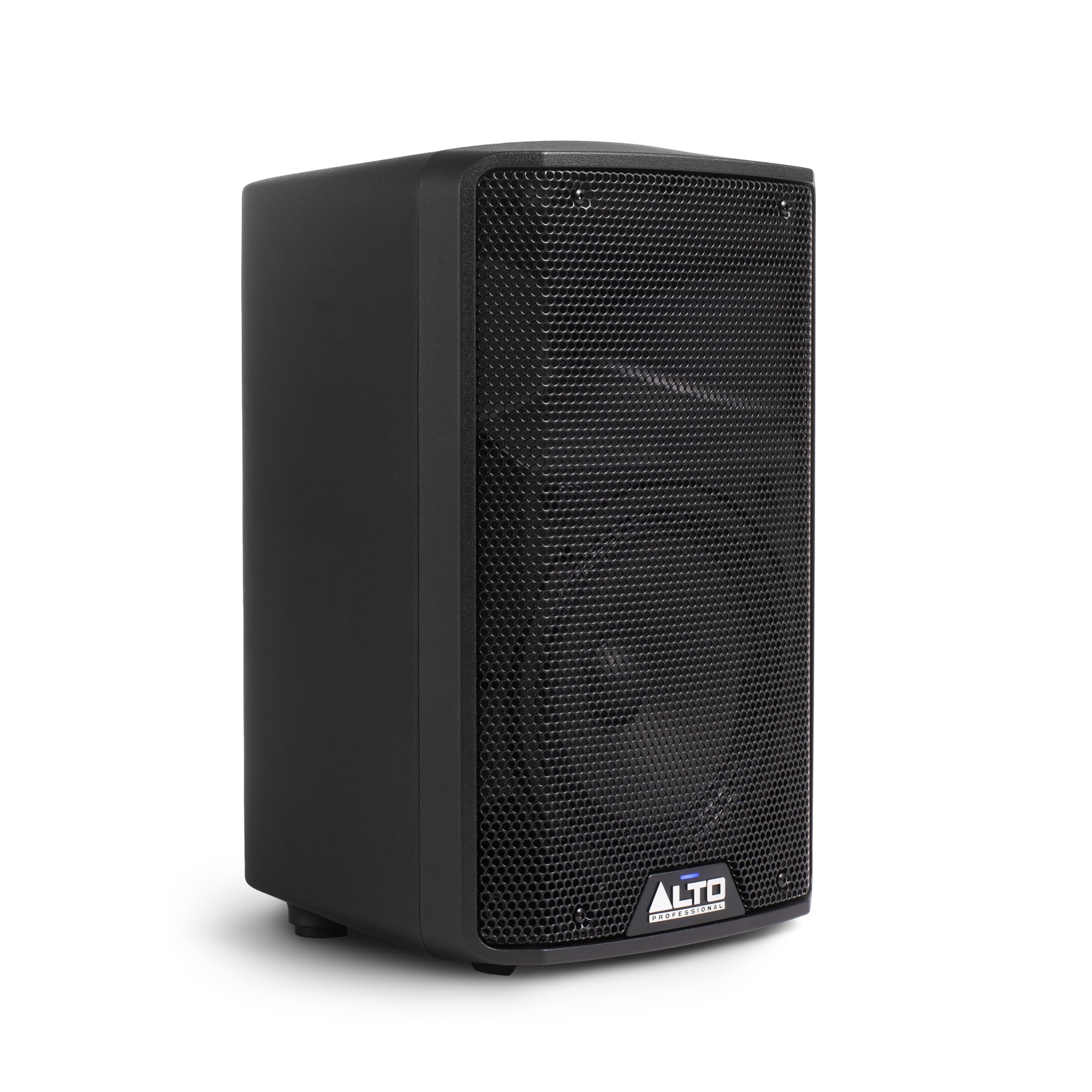
Best Compact Monitor

Alto TX408

91 /100
Keeper Score Outstanding

Key details

Weight
13 lb
Woofer
8 inches
Mounting
36 mm pole and wedge
Output Power
350 watts
Check Price on Amazon

The TX408 is the smallest speaker here, and that is the point. At 5.9 kg, about 13 pounds, it is a one-hand carry that can sit on a 36 mm pole or angle back as a wedge monitor. For a solo singer, a keys player, or a small combo, that makes it more useful than a bigger box that stays in the van.

We treat it as a monitor first and a small-room speaker second. The 350-watt bi-amplified output is enough for a coffee shop, a rehearsal, or a small patio; the two-channel mixer takes a mic and a line source, and Bluetooth with true wireless stereo lets two units stream as a pair. Vocals come through cleanly, and the box stays quiet at idle. The contour EQ helps fill in the low end at lower volumes.

What we like most is the focus: it does a small job without asking for a van or a second person. The 8-inch format keeps the weight down, and the wedge shape makes it useful as a monitor even when the room is tight. If you need a personal monitor you can walk in with, this is the one.

Pros

  • Light 13-pound body
  • Wedge monitor and pole mount
  • 350 watts with clean vocals
  • Bluetooth TWS stereo pairing

Cons

  • Corded only
  • 8-inch woofer limits deep bass
Our verdict

The TX408 is our choice for a compact monitor or small-room speaker, as long as deep bass and battery power are not on your list.

Check Latest Price
6

Best for Small Venues

Bose L1 Pro8

88 /100
Keeper Score Excellent

Key details

Array
Eight 2-inch drivers
Channels
3-channel mixer
Coverage
C-shape line array
Subwoofer
7 x 13 inches
Check Price on Amazon

The L1 Pro8 is a different shape of PA: a slim column of eight 2-inch drivers over a compact subwoofer, with the whole thing breaking down into a base, an extension, and an array. It is the system for a singer-songwriter in a coffee shop or a small ceremony where a conventional box would look and sound out of place.

Setup is genuinely quick: the pieces slide together and the carry bags make it a one-trip load-in. The line array spreads sound more evenly across a small room, so the front row is not blasted while the back row strains. The three-channel mixer and app cover the basics, and the integrated 7 x 13-inch subwoofer adds more low end than the slim column suggests.

What we did not expect was how much the L1 Pro8 disappears into the room. The bass has weight without boom, and vocals sit naturally above it. For a small venue, the system earns its keep by making setup and coverage feel easy. It is not the box for a loud band, but it is a lovely tool for a solo or duo act.

Pros

  • Even coverage from a line array
  • Breaks down for one-trip transport
  • Integrated subwoofer adds bass
  • Three-channel mixer and app control

Cons

  • Column joint needs careful handling
  • Bluetooth can be finicky
Our verdict

We like the L1 Pro8 for small venues because its line array spreads sound evenly and the system packs down for a one-trip load-in.

Check Latest Price
7

Best Personal Monitor

Behringer B205D

89 /100
Keeper Score Excellent

Key details

Driver
5.25 inches
Weight
7.05 lb
Channels
3-channel mixer
Output Power
150 watts
Check Price on Amazon

The B205D looks like a stage monitor that shrank in the wash, and that is exactly how it works best. At 7.05 pounds it fits in a backpack, and the angled cabinet can sit on the floor or a table aimed at the performer.

The 150-watt Class-D amp and 5.25-inch driver will not fill a club, but for a vocalist, acoustic guitarist, or keyboard player who needs a personal monitor, the feature set is unusually complete: three channels, a 3-band EQ, phantom power for a condenser mic, and an instrument-ready input. That is a lot of control in a box this small.

The first time we used it as a vocal monitor, the useful surprise was how much control sits on the back: two mic preamps and an instrument input in something you can carry in one hand. It is not the speaker to carry a whole room, but as a side monitor or a tiny announcement system it makes a strong case.

Pros

  • 7.05 pounds and backpack-friendly
  • Three channels with phantom power
  • Instrument-ready input
  • Angled monitor cabinet

Cons

  • AC power only
Our verdict

For singers and acoustic players who need to hear themselves, we keep coming back to the B205D's tiny, clear, well-equipped monitor.

Check Latest Price
8

Tight Budgets

Rockville BPA10

88 /100
Keeper Score Excellent

Key details

Weight
18.5 lb
Woofer
10 inches
RMS Power
100 watts
Peak Power
400 watts
Check Price on Amazon

The BPA10 is the budget single-box option: a 10-inch woofer, a 1-inch compression driver, and a proper XLR output in an 18.5-pound cabinet. It is the speaker you buy when the job is a small room, a keynote, or a backup box, and you do not want to spend on a system you will use twice a year.

The 100-watt RMS rating is the honest number; the 400-watt peak figure is marketing math. For a small room, a conference announcement, or a backup speaker, that is enough, and the 2-band EQ lets you dial back boominess when the speaker is close to a wall.

The flyable enclosure is the detail that makes it more flexible than most budget boxes: you can hang it overhead when floor space is tight. The rear panel has XLR, 1/4-inch, RCA, and aux inputs, plus Bluetooth for phone music, and the XLR line output lets you feed another speaker.

For a tight budget, it is a useful spare or a first PA that leaves room for stands and cables. We reach for it when the job is simple and the van is already full.

Pros

  • Flyable cabinet adds placement options
  • XLR, 1/4-inch, RCA, and aux inputs
  • Light 18.5-pound body
  • XLR output for another speaker

Cons

  • Remote feels unreliable
  • 100W RMS limits large rooms
Our verdict

We send budget buyers to the BPA10: it puts real PA inputs and a flyable cabinet within reach for simple small-room jobs.

Check Latest Price

How We Chose and Tested These PA Speakers

We pulled every powered speaker someone might realistically buy for a small venue, a house of worship, a mobile DJ rig, or a backyard party, then cut anything that couldn't take a microphone and a phone at the same time. Cabinet size, weight, input array, and whether it ran on a battery or a wall outlet shaped the shortlist, and value got judged on output per dollar rather than spec-sheet numbers. Nine made it to the test.

Testing ran six months, across a sixty-person backyard birthday, a basement band rehearsal, a rented hall with terrible acoustics, and a farmer's market booth. We played the same three tracks through every speaker — something bass-heavy, something acoustic, and a plain voice memo — then walked the room front to back to hear where the sound fell apart.

We pushed each one until it distorted and noted where that happened, plugged a mic, a guitar, and a phone in at once to see if the mixer made sense without a manual, and paired each over Bluetooth from across a parking lot to find the dropout point. Every speaker got carried a block from the car, one-handed where possible, and weighed again in its case.

Battery models ran at party volume until they died, with the clock going. We left cabinets in sun, dust, and a light rain, bumped the stands to see how easily they tipped, and laid them on their sides in monitor mode to check the angle.

How to Choose Pa Speakers

Match the system to the room, not the peak wattage

Peak wattage is the number sellers put in the biggest type, and it is the least useful for comparing systems. Look for continuous or RMS power, then match the speaker size to the space: an 8-inch cabinet like the Alto TX408 or Everse 8 is for close listening, a coffee shop, or a monitor position; a 15-inch box like the JBL EON715 or PRORECK Party 15 is for a room that needs weight and coverage. We compare RMS when it is listed, and treat a peak-only figure as a ceiling rather than a promise.

Choose battery or corded power before anything else

Battery power buys placement freedom, not unlimited volume. The Bose S1 Pro+ and Electro-Voice Everse 8 can run without an outlet, but their runtime ratings assume sensible levels; a loud outdoor set shortens them. Corded systems such as the JBL EON715 and PRORECK Party 15 give you more output for the same money because they do not pay for a battery and charger. Decide where you will play first: if an outlet is within reach, put the budget into driver size and power; if it is not, pay for the battery.

Count the channels and inputs you actually use

A solo singer with a guitar needs two live channels plus music playback; a DJ needs a line input and Bluetooth; an announcement setup needs a mic input that is easy to reach. A built-in mixer saves carrying a separate box, but only if it has the right connections. The Bose S1 Pro+ gives you three channels, the Behringer B205D adds phantom power for a condenser mic, and the Rockville BPA10 covers XLR, 1/4-inch, RCA, and aux. Check the mic input type before you buy, especially if your mic is XLR.

Plan the load-in and the mounting

PA speakers fail in the car park as often as they fail on stage. A 46.5-pound JBL EON715 is a two-person lift onto a stand; an 81.6-pound PRORECK Party 15 rig with two speakers is a two-trip load-in. Look for handles, wheels, and a pole socket that matches your stand. If the speaker will also serve as a monitor, check that it can angle back or has a dedicated monitor mode; the Alto TX408 and Behringer B205D are built around that second job.

Treat weather protection as a specific feature

A plastic cabinet is not the same as a weatherized one. If you will play outdoors, look for a covered input panel and a stated water-resistance rating, as on the Electro-Voice Everse 8. Otherwise, plan a dry spot and a cover. For indoor use, put the money into drivers, mixer channels, and a cabinet you can carry rather than outdoor claims you do not need.

Frequently Asked Questions

Final Verdict

For most performers and small-event organizers, the Bose S1 Pro+ is the PA speaker we recommend first. It is light enough to carry alone, runs on battery when the outlet is far away, and its three-channel mixer covers a mic, an instrument, and walk-in music without extra gear. If your gig is a bigger room with mains power, the JBL EON715 is the headroom choice; if weather and outlets are the worry, the Everse 8 is the better outdoor tool.