Best Overhead Camera Mounts of 2026

You know the shot you want: fabric swatches arranged just so, a hand cracking an egg into a pan, a circuit board seen from directly above. Then you look for somewhere to put the camera and realize a tripod can't get over the desk without standing in the middle of the workspace. An overhead mount solves exactly that — a clamp bites the edge of the table, an arm reaches out over the work, and a head holds the camera pointing straight down at it.

I've filmed enough flat lays to know the arm is the easy part; the clamp and the joints decide whether the shot survives a take. Over the past six months my team and I have put 12 of these mounts through their paces, and the differences show up fast. Arms that felt rock-solid out of the box started creeping halfway through a shoot; others held their position all afternoon without a second thought.

One thing first-time buyers tend to overlook: reach and load capacity aren't the same number. A mount that carries a camera easily when it's close in can visibly droop at the end of a long arm, so the setups that work best for tall overhead framing are the ones with rigid joints rather than the longest stretch. Here are the mounts we'd happily clamp to our own desks again.

Keeper Score summarizes customer ratings and review volume. Read it alongside the product details and trade-offs. How the score works.

1

Best Overall

TARION TitanRig Lite Z

85 /100
Keeper Score Excellent

Key details

Threads
1/4" and 3/8"
Arm Length
18.9 in (48 cm)
Clamp Type
Double C-clamp
Maximum Load
17.6 lb (8 kg)
Check Price on Amazon

Two C-clamps, not one, is the whole argument for the TitanRig Lite Z. They bolt to a desk edge, a two-section pole rises from the pair, and an 18.9-inch arm carries the camera out over the work. Spreading the grip across two points is why a 6.9-pound aluminum frame can be rated to 17.6 pounds without the base twisting when you swing the arm.

That rating is why we put it first. Only the JUSMO pole kit here is rated higher, and it takes seven poles and two clamps to get there; the rest of this group is a 2 kg to 4 kg proposition. This one takes a mirrorless body with a zoom and doesn't flinch. We also appreciate the small stuff: dual 1/4-inch and 3/8-inch threads, a spare adapter, and a tablet holder in the box, so a phone or a small monitor can hang alongside the camera without a second mount.

Reach is the compromise. At 48 cm the arm is shorter than the ULANZI's 98 cm, so the camera sits closer to the clamp than a wide flat-lay spread might want. Fine framing takes tweaking as well — the arm swings 360 degrees vertically and 180 horizontally, but the lock is a set-once knob rather than something to nudge between takes.

And it needs a desk edge to bite, which rules out a table pushed flush against a wall. What you give up for the capacity is portability: 6.9 pounds of aluminum does not go in a drawer, and the design only makes sense if the rig stays assembled over the same work surface.

Pros

  • Double C-clamp resists twisting under load
  • 17.6 lb rating covers a mirrorless or DSLR with lens
  • Tablet holder and 1/4"-3/8" adapters included

Cons

  • 48 cm arm is short for wide flat-lay spreads
  • Fine positioning takes tweaking before it locks
Our verdict

If you're hanging a real camera over a desk, this is the mount we hand people: two clamps, 17.6 pounds of rated load, and joints that stay where you put them.

Check Latest Price
2

Best Free-Standing Rig

NEEWER ST100

87 /100
Keeper Score Excellent

Key details

Stand Size
36.4" W x 22.6" D
Height Steps
14 positions per column
Maximum Load
10 lb (4.5 kg)
Minimum Desk Length
3.3 ft (1 m)
Check Price on Amazon

NEEWER's ST100 doesn't clamp anything — it stands over your work. Two columns with 14 spring-loaded height positions each rise from a T-base, and a steel crossbar spans between them; set the whole thing over a table at least 3.3 feet long and the camera hangs face-down from a 1/4-inch screw on the bar. That's why we keep recommending it for flat-lay: nothing grips the desk, so the entire edge stays free for your hands, your cutting board, or your fabric.

The steel bar earns its place a second time. Small LED panels can stick to it magnetically instead of being clamped on, the 10-pound rating is honest about what a crossbar that size carries, and the 14-position columns let you raise or lower the whole platform in quick steps. At 36.4 by 22.6 inches, though, this is furniture rather than an accessory, and 12.6 pounds doesn't get moved aside for dinner.

The width doesn't adjust, and that's the number to take to your table before ordering. On a narrow desk the columns can't sit outside the work area and the stand won't straddle it — the one thing that sends this mount back. Height moves in steps rather than continuously, which suits a fixed top-down framing and frustrates anyone changing the shot twice an hour. Measure your table length first; if it's short, the clamp-mount TARION above is the answer instead.

Pros

  • Keeps the whole desk edge clear
  • Steel crossbar carries 10 lb and takes magnets
  • 14 height positions in each column

Cons

  • Fixed 36.4-inch width needs a desk at least 3.3 ft long
  • 12.6 lb frame stays where it's put
Our verdict

Buy it when the camera lives in one spot and you have a meter of desk to straddle: nothing else here holds a load without gripping the edge.

Check Latest Price
3

Best for Large Desks

ULANZI ZJ02

88 /100
Keeper Score Excellent

Key details

Maximum Load
4.4 lb (2 kg)
Clamp Opening
1.89 in (48 mm)
Maximum Height
25.6 in (65 cm)
Extended Length
38.6 in (98 cm)
Check Price on Amazon

Four sections take the ZJ02 out to 98 cm — about 38.6 inches — with a maximum shooting height of 65 cm. On a deep desk that reach is the difference between a camera perched at the front edge and one genuinely centred over the middle of your work. The clamp opens to 48 mm with a silicone pad, and the mount itself weighs 2.2 pounds.

ULANZI uses serrated toothed joints on the arm rather than ball heads. Teeth mesh and lock, so the angle you set stays put instead of relying on a friction knob tightened by feel. For flat-lay work, where the camera stays level and the height does the adjusting, that's the right mechanism.

What we noticed in use is how little fuss the arm makes once it's positioned: a compact camera sits still, where a long friction arm would slowly creep. The 2 kg / 4.4-pound rating is the honest boundary — a small mirrorless with a compact lens, a phone, or a light. A full-frame body with a 70-200 is outside it, and no amount of careful tightening fixes a capacity problem.

Check two things on arrival: that the arm seats fully into the clamp base and that the clamp handle is tight on its shaft, because a lever this long puts its stress there. After that it's the mount we leave clamped over a work table and forget about, which is about the best thing you can say about an overhead rig.

Pros

  • 98 cm reach centres the camera on a deep desk
  • Toothed joints hold their angle without creeping
  • Padded clamp grips desks up to 48 mm

Cons

  • 2 kg cap limits it to small cameras
Our verdict

For a wide desk and a small camera, this is the mount we reach for: 38.6 inches of reach, a clamp that bites, and joints that hold their angle.

Check Latest Price
4

Best for Multi-Device Builds

JUSMO LS15 Pro

85 /100
Keeper Score Excellent

Key details

Weight
8.8 lb (4 kg)
Maximum Load
22 lb (10 kg)
Poles Included
7
C-clamp Opening
3.54 in (90 mm)
Check Price on Amazon

Seven aluminum poles, two fixed bases, two C-clamps with tubes, and a super clamp: the LS15 arrives as a kit rather than a finished mount. You decide the height, the overhang, and where the camera, the light, and the mic sit relative to each other, then rebuild it when the shot changes. The rated load is 10 kg / 22 pounds, the highest of any clamp-mounted rig here.

The C-clamps open to 90 mm / 3.54 inches, which clears most desktops including thick workbenches, and the poles are corrugated with laser-etched ticks and secondary locking screws so a section doesn't slide once it's set. Extra poles are sold separately, which is the point of a system like this: it grows with the table.

Flexibility has a bill attached. Every joint you add is a joint to snug, and the assembly is only as rigid as the last screw you tightened — a loose collar shows up as a wobble you then chase for an hour. The photos also promise more than the box contains; the extra grips and arms shown are add-ons, so plan for them if you're copying a picture exactly.

For one webcam this is far more rig than anyone needs, and the DImotliyor does the same job with a fraction of the assembly. For a table that has to hold a camera, a key light, and a microphone over the same board — specimen shots, stop motion, a two-camera build — the modularity is the reason to choose it. We haven't seen another mount in this group that lets you re-plan the geometry instead of buying a different product.

Pros

  • 22 lb rated load across the pole system
  • Super clamp plus 90 mm C-clamps hold multiple devices
  • Corrugated poles and locking screws resist slipping

Cons

  • Assembly and constant tightening at every joint
  • Extra grips and arms in the photos are sold separately
Our verdict

A rig for people who want to build one: 22 pounds of rated load, seven poles, and a super clamp that can sit anywhere along them.

Check Latest Price
5

Best for Phones and Webcams

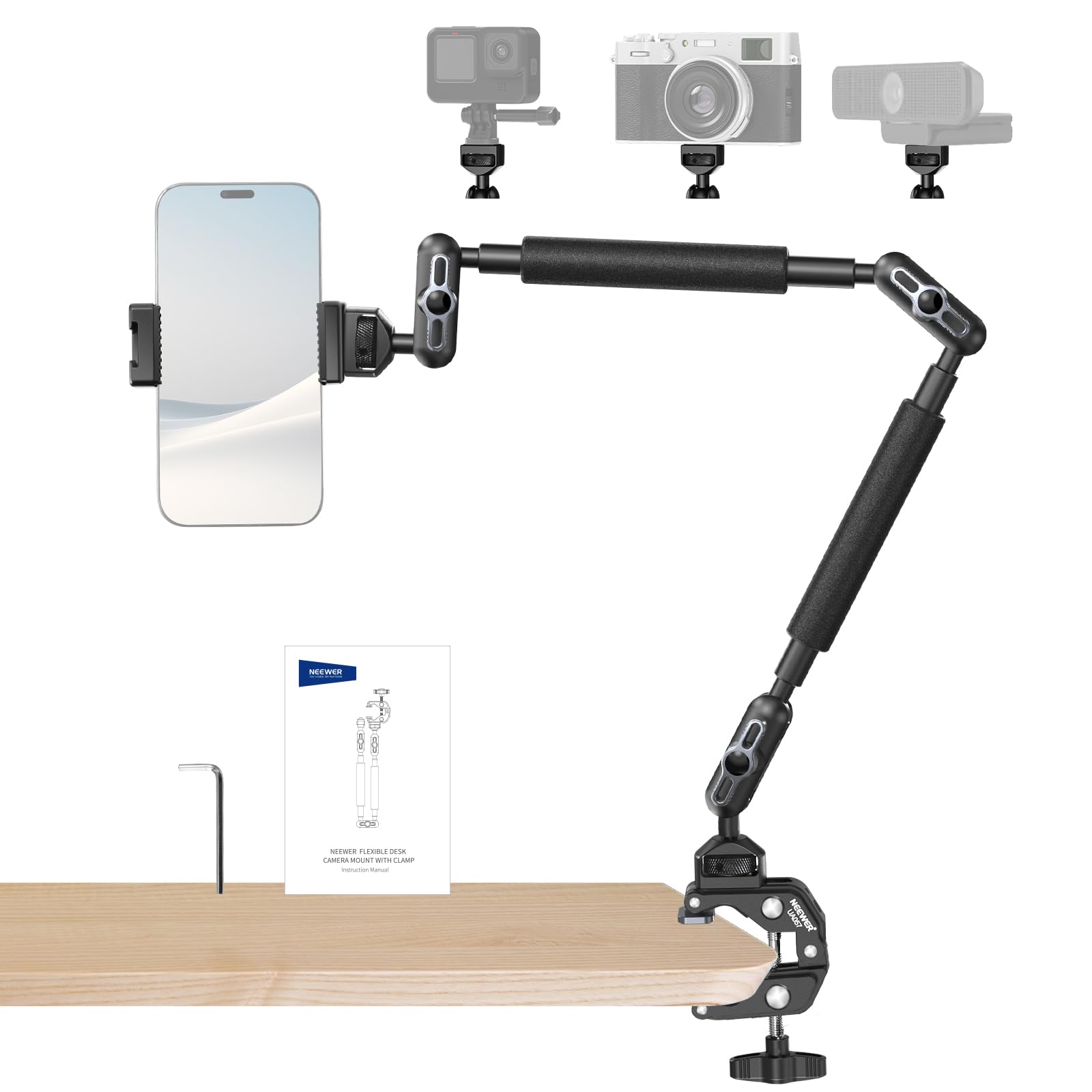
NEEWER UA057

89 /100
Keeper Score Excellent

Key details

Weight
14.1 oz (400 g)
Arm Length
22 in (55 cm)
Maximum Load
17.6 oz (500 g)
Clamp Opening
2 in flat, 1.6 in round
Check Price on Amazon

NEEWER states the UA057's limit plainly: 500 g / 17.6 ounces. That's a phone, a webcam, an action cam, or a small light — not a mirrorless body. Inside that limit it's a genuinely useful arm: 55 cm of friction boom, three sets of dual 360-degree ball heads, and a super clamp that grips flat surfaces to 50 mm and round tube to 40 mm.

We like it most for the job it doesn't oversell. The anti-twist pins at each mounting interface are the detail that matters day to day — without them a phone rotates slowly out of level — and the whole thing weighs 400 grams, light enough to leave clamped to a shelf bracket or a monitor riser. The ball heads need a firm hand: they hold when locked, but they don't have the set-and-forget feel of a toothed joint.

The phone holder is included, the 1/4-inch and 3/8-inch threads take standard accessories, and the one part that wears is small: the adhesive anti-slip padding inside the phone holder softens and peels after a few months of daily clamping. A strip of gaffer tape solved it for us. For a phone-and-webcam setup that stays in one place, that's a fair trade for the price of entry.

Pros

  • 22-inch jointed arm with three dual ball heads
  • Super clamp grips flat surfaces and round tube
  • Phone holder and standard threads included

Cons

  • 500 g limit excludes mirrorless and DSLR bodies
Our verdict

If a phone or a webcam is what you're hanging, this jointed arm puts it overhead with a firm grip — just stay inside its 500-gram limit.

Check Latest Price
6

Best Mid-Budget Arm

DImotliyor Desk Mount

88 /100
Keeper Score Excellent

Key details

Weight
2.2 lb
Threads
1/4", 3/8", 5/8"
Maximum Load
6 lb
Clamp Opening
2.4 in (6 cm)
Check Price on Amazon

Same three-section idea as the arms around it, with a wider clamp: the DImotliyor opens to 2.4 inches / 6 cm, which clears thick benchtops and counters that stop most desk mounts. You also get a 360-degree ball head, a phone holder, and 1/4-, 3/8-, and 5/8-inch threads — the broadest thread choice in this group short of the pole kits. The stated load is six pounds.

Each pole has its own angle adjustment point, so the arm breaks down into different shapes for a side view as easily as a top-down one, and assembly takes minutes with nothing beyond what's in the box. The aluminum is machined cleanly and anodized, and the padded clamp leaves the desk alone.

Where it settles is the middle. The arm bodies are metal and the adjustment points are plastic, and the load rating doesn't survive full extension — hang weight on the far end and the arm sags visibly before you compensate. Keep the overhang short, or keep a phone or a compact camera on it, and it behaves. That's still a lot of mount for what it costs, and it's the one we suggest when someone wants an overhead shot set up in ten minutes.

Pros

  • 2.4-inch clamp clears thick benchtops
  • Three thread sizes plus ball head and phone holder
  • 2.2 lb frame sets up in minutes

Cons

  • Arm sags at full extension with weight on the end
  • Plastic adjustment points alongside metal arms
Our verdict

The three-section arm we point people to for phones and compact cameras: a wide clamp, three thread sizes, and a ball head in the box.

Check Latest Price
7

Changing Heights

Ailight TS6101

85 /100
Keeper Score Excellent

Key details

Clamp Range
0.2"-1.97"
Height Range
15.75"-33.45"
Maximum Load
8.8 lb (3.99 kg)
Horizontal Reach
11.8"-20"
Check Price on Amazon

Twist locks instead of pins. The TS6101's three vertical sections adjust continuously from 15.75 to 33.45 inches, and a second two-section arm extends 11.8 to 20 inches horizontally. If you shoot the same desk at different heights — a wide flat-lay one day, a close-up of your hands the next — that's faster than counting detents on a spring-loaded column, and we think it's the feature worth paying for here. The clamp spans 0.2 to 1.97 inches of desk thickness, the tubes are 18.6 to 25.7 mm aluminum, and the rating is 3.99 kg / 8.8 pounds.

Everything rests on those collars, so check them before each session; one that isn't fully snug lets the arm rotate under the weight of a camera. There's some flex at full extension with weight on the end, and at 2.1 pounds the mount is light for the load it claims — the trade for a stand that adjusts in seconds and stows in a drawer. For overhead work at one fixed height, a pinned column is the surer bet; for anything that changes, this is easier to live with.

Pros

  • Continuous twist-lock height from 15.75 to 33.45 in
  • 8.8 lb rated load from a 2.1 lb mount
  • Second arm extends 11.8 to 20 in horizontally

Cons

  • Some flex with weight at full extension
Our verdict

Pick it when the height changes often: twist-lock tubes adjust continuously instead of stepping between fixed positions.

Check Latest Price
8

Travel and Tight Spots

SMALLRIG 4766

86 /100
Keeper Score Excellent

Key details

Weight
10.9 oz (310 g)
Threads
1/4"-20 with 3/8"-16 adapter
Arm Length
22 in (56 cm)
Clamp Opening
2.5 in (63.5 mm)
Check Price on Amazon

At 310 grams, this is the magic arm that goes in the bag rather than staying clamped to the desk. It's 56 cm / 22 inches long, folds down to 13.4 inches, and the whole kit — arm, crab clamp, phone holder, thread adapter — takes less room than a lens.

The clamp is the interesting part. It opens to 63.5 mm and its rotating friction pads narrow to 50 mm so it can bite a round tube as well as a desktop edge. An anti-deflection 1/4-inch-20 interface seats the arm on the clamp so it can't rotate free, and there are silicone pads at the balls and at both ends.

The phone holder is sized for 5.5 to 8.5 cm of width. That's fine for a bare phone and tight for a large handset in a chunky case — if yours is a Max-sized model with a case on, the clamp is the part that disappoints, and a holder you already own on the 1/4-inch thread is the workaround.

What keeps it in our kit is the packing. It locks down firmly for the compact gear it's rated for, and unlike the heavier mounts here it doesn't need a particular desk: clamp it to a shelf edge, a monitor-arm post, or a chair back and the camera is over your work in a minute. The SMALLRIG is the one that travels.

Pros

  • 310 g kit folds small enough for a camera bag
  • Crab clamp grips desktops and round tube
  • Anti-deflection interface keeps the arm from rotating

Cons

  • Phone holder is tight for large phones in cases
  • Rated for compact devices only
Our verdict

The one to keep in a camera bag: 310 grams of arm and clamp that will hold a phone or an action cam almost anywhere you can clamp it.

Check Latest Price

How We Tested Overhead Camera Mounts

We started with roughly 40 mounts and cut the list on paper first: a clamp opening wide enough for a real desk edge, standard 1/4-inch and 3/8-inch threads, and a listed load rating that could plausibly carry a mirrorless body with a lens and a small light. That left 12 mounts, which we then lived with for six months.

They were clamped to a kitchen island during overhead recipe videos, to a home-office desk during streaming sessions, and to a folding table while filming product flat lays. We noted how much of the arm actually cleared the work surface, whether the clamp pads left marks on oak or pine, how far the jaws opened on thick butcher block versus a thin plywood top, and how much reach was usable before the arm needed re-tightening.

For the load test we hung a camera body, a lens, and a small LED panel, marked the frame's position on a taped target, and checked it again an hour later to see whether it had drifted. We adjusted height and angle one-handed mid-shoot to mimic reaching for a knob while the camera is rolling, swapped the same arm between a camera, a phone, and a light to see how the hardware handled a mixed setup, and timed setup and breakdown on each one. Last, we collapsed and reset every arm repeatedly to see which knobs and friction joints loosened up and whether the aluminum or steel sections stayed tight. Value, in the end, had less to do with price than with how much of each mount's hardware we actually reached for.

How to Choose an Overhead Camera Mount

Match the Mount to What You're Hanging

Add up the weight at the end of the arm — body, lens, adapter, and holder — and compare that total with the rating, not with the photos. The spread here is wide: the NEEWER UA057 is a 500-gram arm for phones and webcams, the ULANZI and DImotliyor carry a compact camera, and the TARION and JUSMO are built for a body with a lens on it.

Ratings assume a balanced load pulled in close to the clamp. Hang the same weight at full extension and you'll see the difference in sag, which is why a mount that feels overbuilt on paper is the right answer for a heavy rig.

Clamp, Free-Standing Stand, or Magic Arm

Three shapes cover most overhead work. A C-clamp mount needs a desk edge of the right thickness — 1.9 inches on the ULANZI, 2.4 on the DImotliyor, 3.5 on the JUSMO — and gives back the surface it grabs. A free-standing stand like the NEEWER ST100 straddles the whole table, so nothing touches the edge, but it needs roughly a meter of clear desk and stays where you put it.

A magic arm is the light, cheap option for a phone or webcam, and it's the only type here that will also clamp to a shelf, a monitor post, or a chair back. Watch the word compact in a listing: it usually describes the folded length, not a small footprint on your desk.

Reach and Working Height Are Different Numbers

A 98 cm arm doesn't put the camera 98 cm up. Length is how far the camera travels sideways from the clamp; height is a separate figure, and on the ULANZI it tops out around 25 inches. Read both, then measure from the clamp to the middle of your work — the camera should hang over the centre with a little to spare.

The last few inches of any arm are where the flex lives, so a short overhang on a stiff arm beats a long overhang on a flexible one for sharp overhead footage.

How Often You'll Move It

Set-once rigs and everyday rigs are different purchases. Toothed joints and pinned columns — the TARION and the NEEWER ST100 — hold an angle and expect you to leave it, which rewards a dedicated filming desk and punishes constant re-aiming. Ball heads and magic arms like the NEEWER UA057 and SMALLRIG reposition in seconds and drift more readily. Twist-lock tubes on the ailight sit in between: continuous adjustment without the pinned-column steps.

Be honest about which you are. A mount that takes two minutes to adjust ends up in one position anyway.

The Holder Matters as Much as the Arm

A 1/4-inch screw holds the camera; the holder decides whether your phone stays level. Clamp widths are quoted for bare phones, and a large handset in a case is wider than most jaws expect — the SMALLRIG's 5.5 to 8.5 cm span is the tightest here, while the NEEWER UA057 and DImotliyor include a holder sized for typical phones.

Check the padding before you tighten anything onto a veneer or glass top. Rubber pads protect the desk and also stop the mount creeping sideways under a long arm.

Frequently Asked Questions

Final Verdict

The TARION TitanRig Lite Z is the mount we point most people to, because two clamps and a 17.6-pound rating cover the cameras people actually own, and the arm holds its angle once it's set. If your table has no free edge to clamp, or you need both hands in the frame, the NEEWER ST100 straddles the desk instead and leaves the whole edge clear.

And if a phone is the camera, the NEEWER UA057 does the same overhead job at a fraction of the bulk — as long as you stay inside 500 grams.