Best Overall
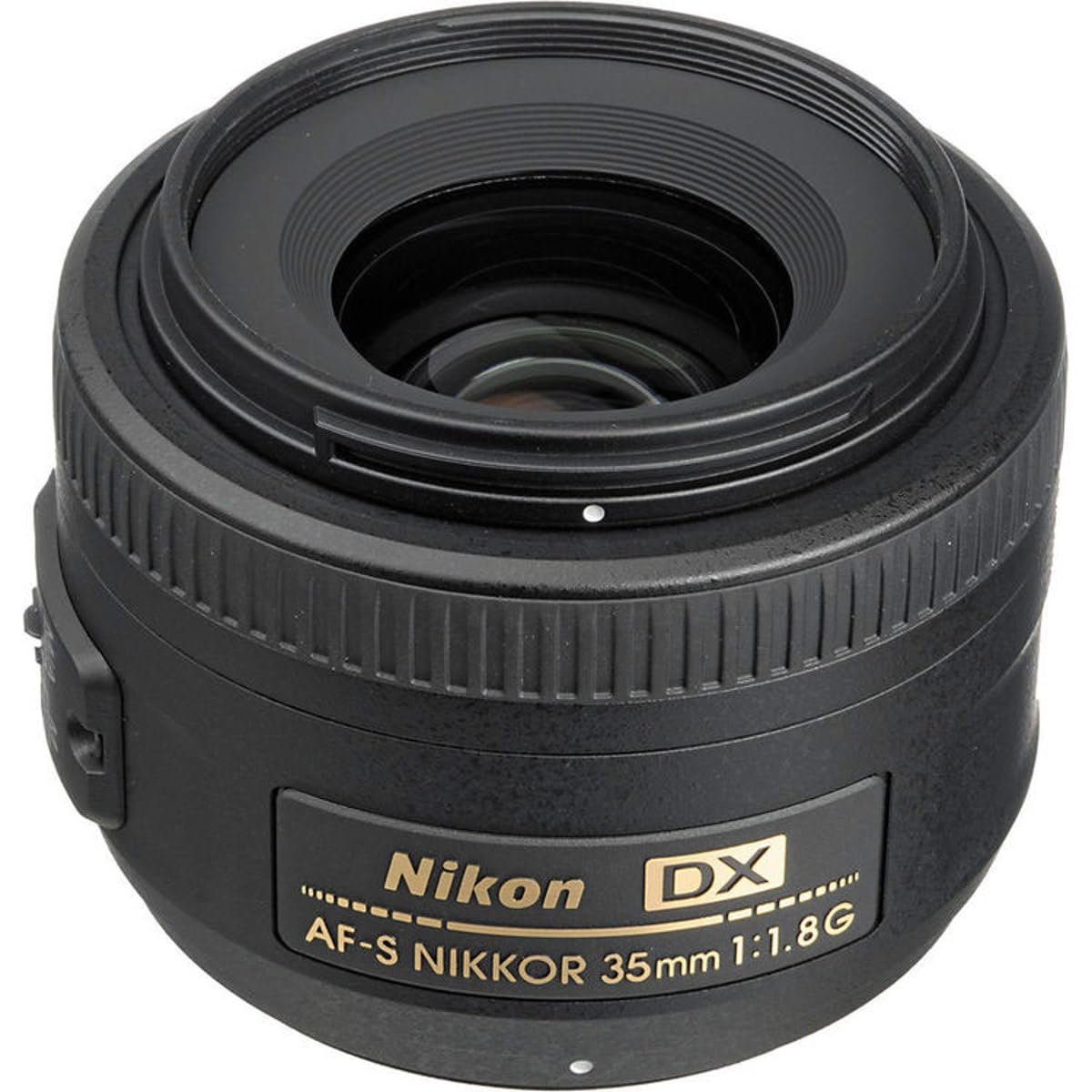
Nikon AF-S DX 35mm f/1.8G
Key details
- Format
- DX
- Weight
- 7.04 oz
- Focal Length
- 35mm
- Max Aperture
- f/1.8
On a DX body, the 35mm f/1.8G behaves like a 52.5mm lens, which is the angle we reach for when we want a scene to look the way our eyes saw it. That normal view is why this is the lens we recommend first: it handles street scenes, food, family snapshots, and indoor available-light shots without the perspective stretch of a wide zoom. The f/1.8 aperture is the other half of the case. It gathers enough light to keep the shutter speed up in a dim room and throws a soft, creamy background behind a close subject, two things a kit zoom simply cannot do.
We like the size as much as the speed. At about 7 ounces, it balances on a D3500 or D7500 without making the camera feel front-heavy, and the silent wave motor focuses quietly enough for candid work. The 35mm focal length is not wide enough for tight interiors and not long enough for distant wildlife, but those are jobs for other lenses. As a first prime, it replaces the kit lens for most of what we shoot.
The catch is coverage: this is a DX lens, so it is not the full-frame choice. On an FX body you get a cropped image or a dark corner, which is why the 50mm f/1.8G below is the better call for full-frame owners. For everyone else, the 35mm is the lens we leave on the camera and forget about until the light gets interesting.
Pros
- Normal 52.5mm-equivalent view on DX
- f/1.8 aperture for low light and blur
- Light 7-ounce build balances well
- Quiet autofocus with manual override
Cons
- Autofocus can be slower than expected
We recommend the 35mm f/1.8G as the first lens for most DX Nikon DSLR owners: it turns ordinary scenes into sharp, low-light photos without adding bulk.