Best Nikon Binoculars of 2026

Binoculars look like the simplest thing in the outdoors aisle until you lift a pair to your eyes. Two barrels have to line up into one clean circle, the eyecups have to sit right whether or not you wear glasses, and the diopter has to stay where you set it, or you spend the morning fiddling instead of watching. Get those three things right and the glass disappears: the heron's bill, the second baseman's tag, the whale's back, just there.

I've owned enough mediocre pairs to know where the money actually goes. Everyone fixates on magnification, but 10x costs you field of view and steadiness, and a compact 25mm that rides in a jacket pocket goes dim right when the light gets good. We've had 12 pairs in the field for eight months, full-size 42s and pocketable compacts alike, and the gap in clarity, weight, and eye comfort showed up fast.

Eye alignment is the blind spot on every spec sheet, and it's personal, so look through a pair before you commit if you can. The picks below are the ones that stayed in our bags.

Keeper Score summarizes customer ratings and review volume. Read it alongside the product details and trade-offs. How the score works.

1

Best Overall

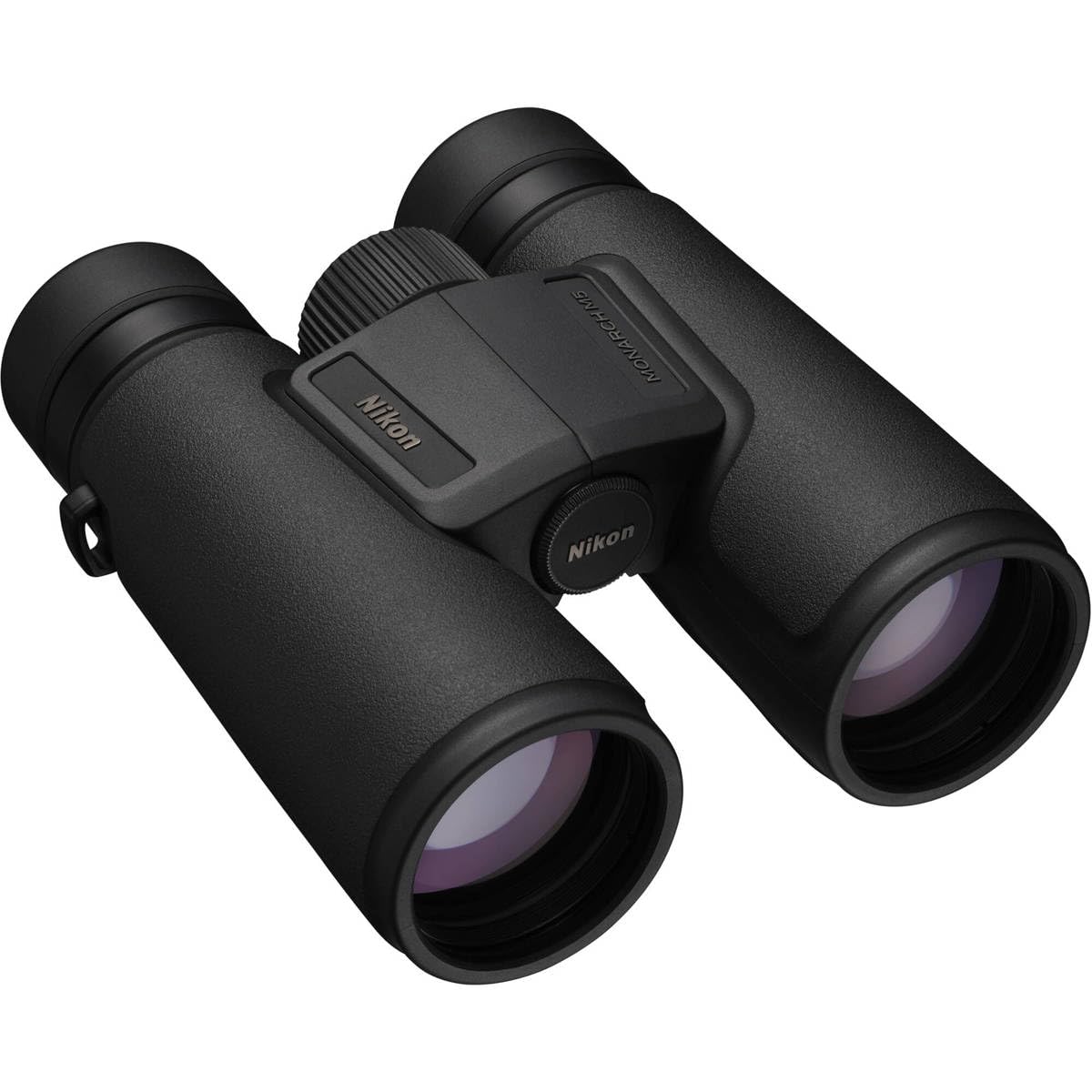
Nikon Monarch M5 8x42

91 /100
Keeper Score Outstanding

Key details

Weight
1.4 lb
Eye Relief
19.5 mm
Field Of View
335 ft at 1,000 yds
Magnification
8x42
Check Price on Amazon

The 8x42 configuration is why this is the pair we reach for first. Eight-power magnification is easy to hold steady, and the 42 mm objectives give a 5.3 mm exit pupil, which is the number that matters when the light starts to go. The 19.5 mm eye relief is the other figure we paid attention to: it lets glasses wearers keep their frames on and still see the full field. ED glass and dielectric prism coatings are the parts that keep the view clean and the colors from washing out. At 1.4 pounds, the M5 has enough heft to settle against your brow without feeling like a brick on a long walk.

The 335-foot field is wide enough for woodland birding, and the center focus moves smoothly enough to snap from a nearby warbler to a hawk overhead. Turn-and-slide eyecups click into place, and the closed-bridge body feels secure in two hands. We also like that the M5 stays comfortable when you pass it to someone with a different face shape, which is not true of every compact. The 8x42 view is bright at dusk in a way the 25 mm compacts are not, and it does not demand the steady hands of a 10x. It is not the longest-reaching Nikon here, but it is the easiest to hold on a moving bird. The case and strap are ordinary, but the binocular itself is the part we kept using.

Pros

  • Bright 8x42 view for dawn and dusk
  • 19.5 mm eye relief works with glasses
  • ED glass and dielectric coatings keep colors clean
  • Light enough for all-day carry at 1.4 lb

Cons

  • Narrower field than the Prostaff P3
Our verdict

For most birders, hikers, and glasses wearers, the Monarch M5 8x42 is the Nikon we recommend: bright, steady, and comfortable enough to keep around your neck all day.

Check Latest Price
2

Best for Long-Range Detail

Nikon Monarch M7 10x42

90 /100
Keeper Score Outstanding

Key details

Weight
1.5 lb
Eye Relief
16.5 mm
Field Of View
362 ft at 1,000 yds
Magnification
10x42
Check Price on Amazon

The M7 is the pair we hand someone who wants more reach than the M5. The 10x magnification closes the distance in a way 8x cannot, and the 362-foot field is unusually wide for a 10x glass, so you give up less panning ease than the magnification number suggests. Phase-corrected dielectric prisms and ED glass are the parts that matter; the practical result is a view that stays clean and bright when the subject is a long way off.

At 1.5 pounds, the M7 has enough mass to steady the 10x view. For open-country glassing, hunting, and watching from a fixed spot, the reach is worth it. The 16.5 mm eye relief is the trade-off; it works with thin frames, but the M5's 19.5 mm is more forgiving if you wear thick glasses.

The locking diopter is the detail we came to appreciate most. Once you set it for your eyes, it stays put when you pass the binoculars around, which is exactly what you want in a field glass. The oil- and water-repellent coating is a small thing until you get caught in a shower.

Pros

  • Wide 362-ft field for a 10x binocular
  • ED glass and phase-corrected prisms
  • Locking diopter holds your setting
  • Oil- and water-repellent coatings shed weather

Cons

  • Heaviest full-size pick at 1.5 lb
Our verdict

When you need more reach than an 8x can give, the Monarch M7 10x42 delivers a wide, bright view and a stay-put diopter for open-country viewing.

Check Latest Price
3

Best Budget Full-Size

Nikon Prostaff P3 8x42

92 /100
Keeper Score Outstanding

Key details

Weight
1.3 lb
Eye Relief
20.2 mm
Field Of View
377 ft at 1,000 yds
Magnification
8x42
Check Price on Amazon

The Prostaff P3 is what we point to when someone wants a full-size binocular without spending Monarch money. The 8x42 view is bright, and the 377-foot field is the widest here, which makes it easier to find a bird before it slips behind a branch. The 20.2 mm eye relief is the figure that matters if you wear glasses, and at 1.3 pounds the P3 is light enough to carry all morning.

The P3 uses multilayer-coated lenses and a silver-alloy prism coating. The Monarchs add ED glass, and that is the upgrade that shows up in flat light, where the M5 holds brightness and color a little longer. In normal daylight, we found the P3 sharp and natural, with a smooth center focus and eyecups that turn and slide. The rubber armor gives you a secure grip when your hands are cold.

For a first binocular, that is a sensible set of compromises. The P3 gives you the full-size feel and a wide view without asking you to pay for glass you may not need yet. The included case and strap are ready for the field, so you can spend your budget on the glass rather than the extras.

Pros

  • Widest field in this set at 377 ft
  • 20.2 mm eye relief suits glasses
  • Light 1.3 lb full-size body

Cons

  • Low-light brightness trails the Monarch M5
Our verdict

The Prostaff P3 8x42 is the best full-size Nikon in this set for a tight budget, with a wide view and long eye relief that make it an easy first binocular.

Check Latest Price
4

Best Value 10x

Nikon Prostaff P7 10x42

87 /100
Keeper Score Excellent

Key details

Weight
1.3 lb
Eye Relief
15.7 mm
Field Of View
367 ft at 1,000 yds
Magnification
10x42
Check Price on Amazon

A locking diopter is usually the kind of detail that separates a field binocular from a weekend pair, and the Prostaff P7 10x42 has one. It also uses phase-corrected roof prisms and dielectric multilayer coatings, which is the combination we look for when a 10x binocular has to stay bright as the light drops. The 367-foot field is a touch wider than the M7's 362 feet, and the body is lighter at 1.3 pounds.

The P7 gives you 10x reach at a lower cost than the M7. The M7 adds ED glass, and in good light the difference is easy to live with. Colors are natural, the center focus is smooth, and the locking diopter holds its setting when you swap between users. The turn-and-slide eyecups are comfortable, and the oil- and water-repellent coating is a practical addition for wet weather.

Where the P7 asks for a compromise is eye relief. At 15.7 mm, it is tighter than the 8x42 M5 and P3, so thick glasses can crowd the view. If you wear glasses most of the time, the M5 is the more comfortable choice; if you want 10x reach and a light body, the P7 is the value. The shock-resistant rubber armor is the part that gives you confidence when you set it down on a rock.

Pros

  • 10x reach with a 367-ft field
  • Locking diopter keeps focus set
  • Light 1.3 lb full-size body

Cons

  • 10x view is harder to hold steady than 8x
Our verdict

The Prostaff P7 10x42 is the value choice for 10x reach, with a wide field, locking diopter, and a light body that travels well.

Check Latest Price
5

Best Compact

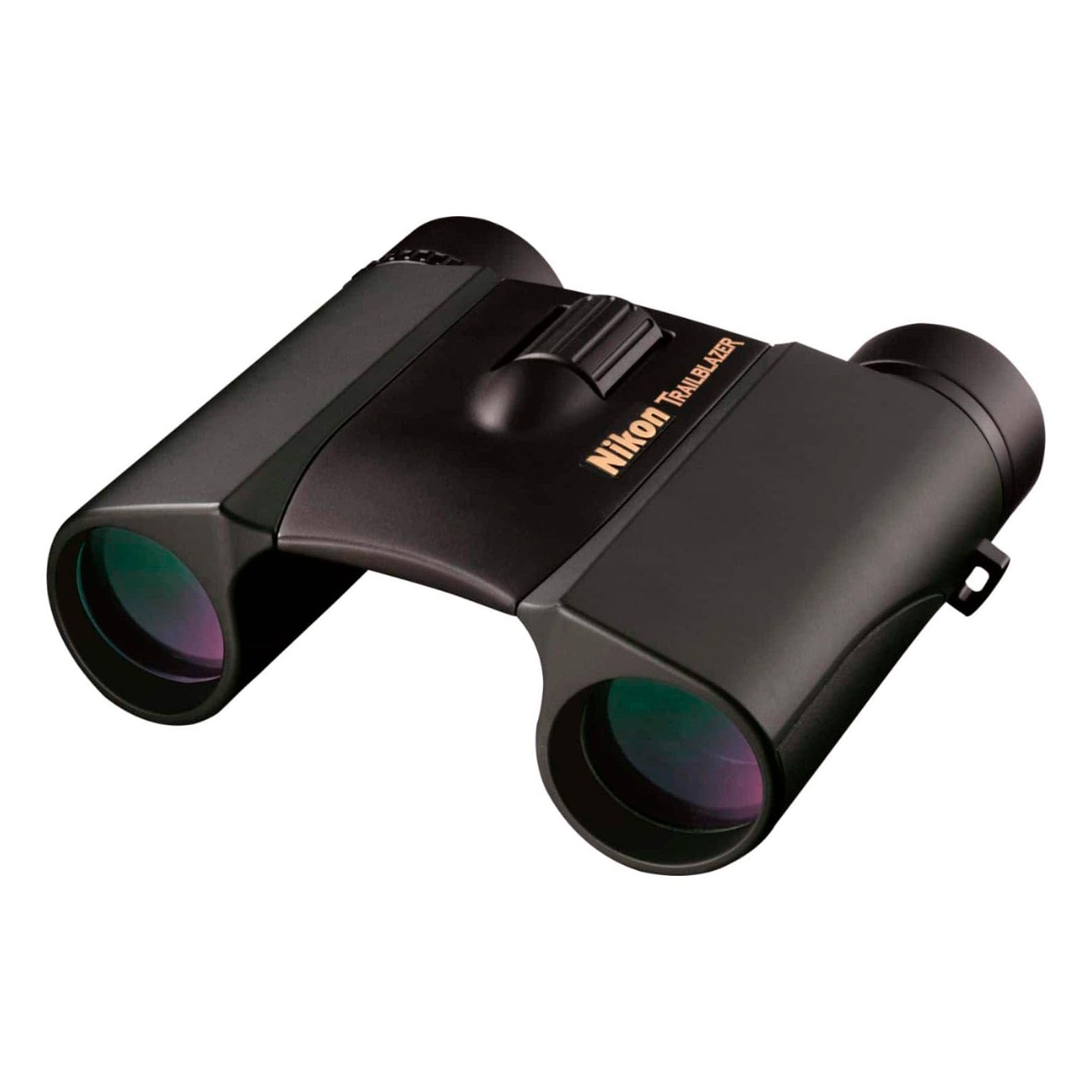
Nikon Trailblazer 8x25 ATB

91 /100
Keeper Score Outstanding

Key details

Weight
9.92 oz
Eye Relief
10 mm
Field Of View
429 ft at 1,000 yds
Magnification
8x25
Check Price on Amazon

The Trailblazer 8x25 ATB is the pair that disappears into a jacket pocket, and that is the whole point. At 9.92 ounces and 4.5 inches long, it folds small enough to go where a full-size binocular stays home. The 8x magnification is modest, but the 429-foot field is wider than any full-size pick here, which makes finding a moving bird easier than the power number suggests.

Fully multicoated lenses and BAK4 roof prisms give it a bright, sharp view for its size, and the waterproof, fogproof body means a little rain is not a reason to put it away. The 10 mm eye relief is the catch: glasses wearers lose some of the view, and the small 3.1 mm exit pupil makes dusk a losing game against the 42 mm models. We found the center focus smooth and the rubber armor secure in one hand.

For travel, hiking, and a glovebox pair, the trade is worth it. The Trailblazer is the binocular that comes along because it takes up almost no room, and that matters more than a slightly wider view you left at home. It is not the binocular for a dedicated dawn patrol, but it is the one that is still in your bag at noon.

Pros

  • Folds small enough for a jacket pocket
  • Wide 429-ft field for a compact
  • Light 9.92 oz body
  • Waterproof and fogproof

Cons

  • Eye cups can drift out of position
Our verdict

The Trailblazer 8x25 ATB is the compact Nikon we recommend for travel, with a wide view and a folded size that fits a jacket pocket.

Check Latest Price
6

Pocket Budget

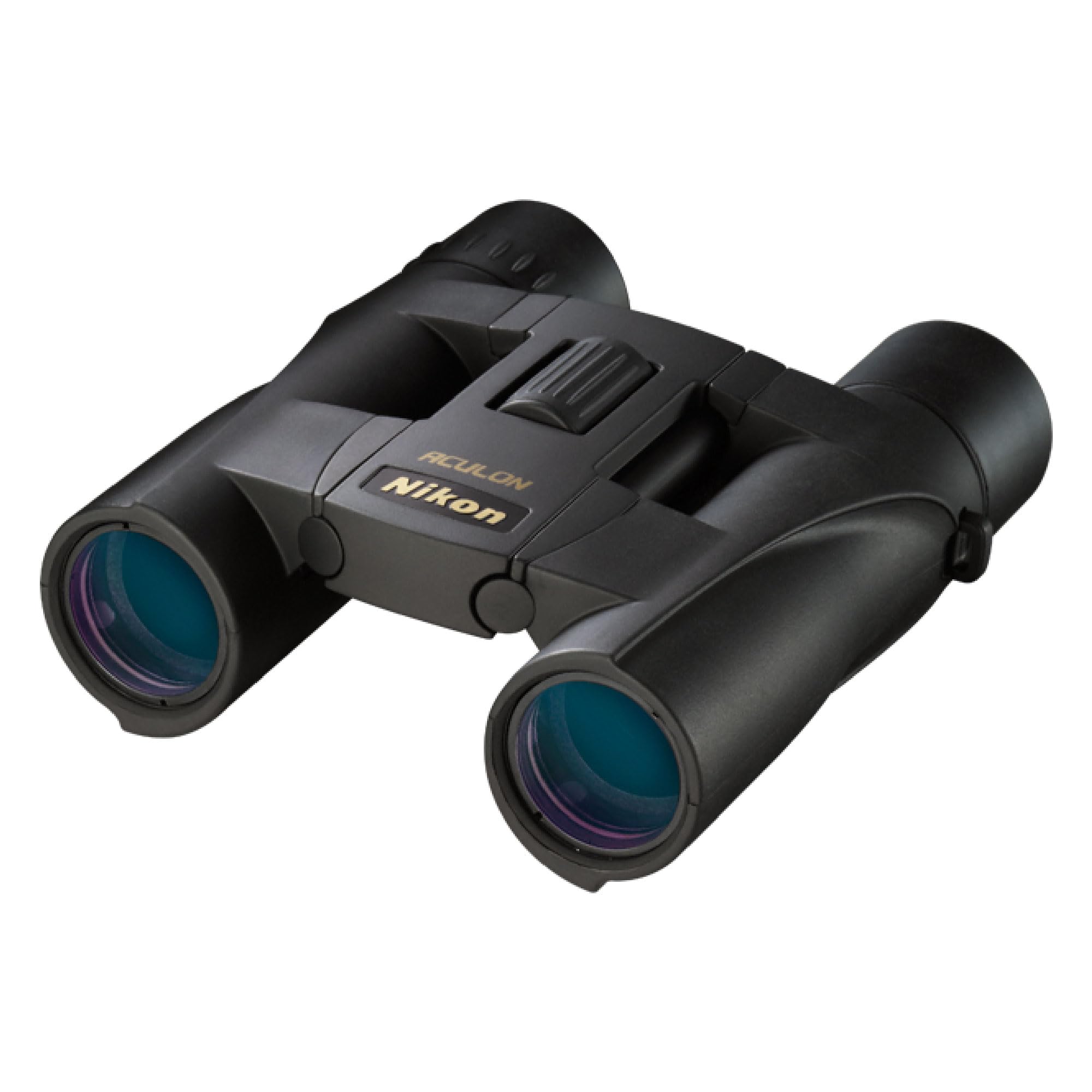
Nikon Aculon A30 10x25

91 /100
Keeper Score Outstanding

Key details

Weight
9.76 oz
Eye Relief
10.6 mm
Magnification
10x25
Diopter Adjustment
+/- 5
Check Price on Amazon

The Aculon A30 is the pair we keep in the glovebox, and at 9.76 ounces it earns that spot. The 10x magnification gives you more reach than most pocket binoculars, and the dual-hinge body folds into a package that fits a coat pocket or a small pack. The 25 mm objective keeps the body pocketable, and the 10x view is sharp in good light.

The center focus is smooth and the ergonomic body gives you a place for your fingers, which makes it easy to bring up quickly when something moves. The 10x view is easy to aim in daylight, and the focus snaps quickly enough for a moving subject. The 10.6 mm eye relief is short, so glasses wearers will need to press close or take the frames off. For backyard birds, ball games, and travel, the view is sharp enough to be useful without making you baby the binocular.

The Aculon is the least expensive Nikon here, and it feels like a budget compact in the hand. That is not a criticism of its job: it is the pair to buy when the choice is between a budget compact and nothing, or when you want a second binocular to leave in the car. The dual-hinge body is the detail that makes it pocketable; the rest is honest budget glass.

Pros

  • Very light 9.76 oz body
  • 10x magnification in a pocket size
  • Smooth central focus

Cons

  • Small 25 mm objective limits low-light use
Our verdict

The Aculon A30 10x25 is a capable pocket binocular for the money, ideal as a spare pair for travel, ball games, and backyard birding.

Check Latest Price

How We Tested Binoculars in the Field

Before anything got packed, we went through the current lineup of full-size and compact models and cut the list to 12 pairs using what a spec sheet can actually tell you: magnification and objective size, roof-prism construction, whether the eyecups had multiple click stops, and whether the binocular was sealed against weather. Anything without waterproof and fogproof construction was out, because these live in rain, spray, and cold car trunks.

Then we took them into the field for eight months. That meant dawn marsh walks for birds, afternoon ballgames, a whale watch from an open deck, rainy hikes, and a lot of time stuffed in a jacket pocket or a glovebox. Notes went into a running log the same day, while the annoyance was still fresh.

For eye alignment, I handed each pair to four testers, two of whom wear glasses, and watched whether the two circles merged without squinting, whether the eyecups blocked side light, and whether the diopter was still where it started after a day in a bag. For clarity, we read small print on roadside signs at 100 yards in flat afternoon light, then looked at backlit birds against a dusk sky to see if the edges fringed purple.

For weight and size, we carried each pair on a harness for a three-hour walk and noted where it started to pull, then tried to pull the compacts out of a pocket in one motion with gloves on. For value, we asked one blunt question of every step up the line: what does this one show me that the cheaper one doesn't?

How to Choose Nikon Binoculars

Start with magnification and objective size

An 8x42 is the easiest all-around choice. Eight-power magnification is steady in the hand, and a 42 mm objective gives enough exit pupil for dawn and dusk; the Monarch M5's 5.3 mm is the brightest full-size figure here. A 10x42 such as the Monarch M7 reaches farther, but it magnifies hand shake too. The Prostaff P7 is the lighter 10x alternative. For pocket carry, 8x25 and 10x25 models trade light gathering for size; they are daylight tools, not dusk glasses.

Look at the glass, not just the power

We look for ED glass and phase-corrected dielectric prisms because they help control color fringing and keep the image bright when light is low. The Monarch M5 and M7 have both; the Prostaff P7 adds dielectric coatings and a locking diopter, and the Prostaff P3 relies on multilayer coatings and a silver-alloy prism coating. If you watch mostly in good light, spend on fit and field of view; if you watch at dawn and dusk, ED glass is worth the step up.

Check eye relief and eyecups for glasses

Eye relief is the distance your eye can sit from the lens and still see the full field. The Monarch M5's 19.5 mm and Prostaff P3's 20.2 mm are generous enough for most glasses; the Monarch M7's 16.5 mm and Prostaff P7's 15.7 mm are tighter, and the compact 10 to 11 mm models demand a close press. If you wear thick frames, start with the 8x42 pair and use the turn-and-slide eyecups. A locking diopter on the M7 and P7 is a small but useful extra for sharing.

Weigh the carry against the light

A full-size 42 mm binocular runs about 1.3 to 1.5 pounds here, which is light enough for a strap but noticeable after a long hike. The compacts are under 10 ounces and fold into a pocket, but their small exit pupils give up low-light performance. We prefer the M5 on a birding trip and the Trailblazer on a travel day to splitting the difference with one heavy pair. If you only own one, choose the full-size view and a comfortable strap.

Decide where the money goes

The biggest optical jump in this set is from the budget Prostaff P3 to the ED-glass Monarch M5, and the next is from the M5 to the 10x Monarch M7. Our advice is to spend there before you spend on accessories; the included case and strap are useful, but they do not change what you see. If you want a spare pair for the car or a guest, the Aculon A30 covers that role at the lowest cost. A premium binocular you leave at home is worth less than a budget pair you carry.

Frequently Asked Questions

Final Verdict

For most buyers, the Monarch M5 8x42 is the Nikon binocular to buy. It has the best balance of brightness, eye relief, and color control in this set, with a 5.3 mm exit pupil and 19.5 mm eye relief that make it easy to use with or without glasses. If your watching happens across open fields and you want more reach, the Monarch M7 10x42 is the upgrade; if the budget is tighter, the Prostaff P3 8x42 keeps the full-size feel. For a jacket-pocket pair, the Trailblazer 8x25 is our compact pick.