Best Binoculars for Birding of 2026

A warbler moving through the canopy is a hard target — by the time you get glass on it, it's three branches over and showing its back. That's why birders care about field of view: a wider window finds a moving bird faster, and clean glass turns a silhouette into an identification.

I've carried the same scuffed pair for years, but over the past eight months my team and I have had 12 pairs out at dawn, on hawk watches, and around backyard feeders to see which ones actually deliver a view worth carrying. Weight mattered as much as clarity — a pair that's lovely for ten minutes gets heavy by hour three.

First-time buyers shop magnification, but the 8x42 most birders settle on gives a wider view and a brighter image in shade, while 10x42 buys reach at the cost of a narrower, shakier window. Coatings and prism glass decide more than the number on the box — the picks below run from budget-friendly to buy-once.

Keeper Score summarizes customer ratings and review volume. Read it alongside the product details and trade-offs. How the score works.

1

Best Overall

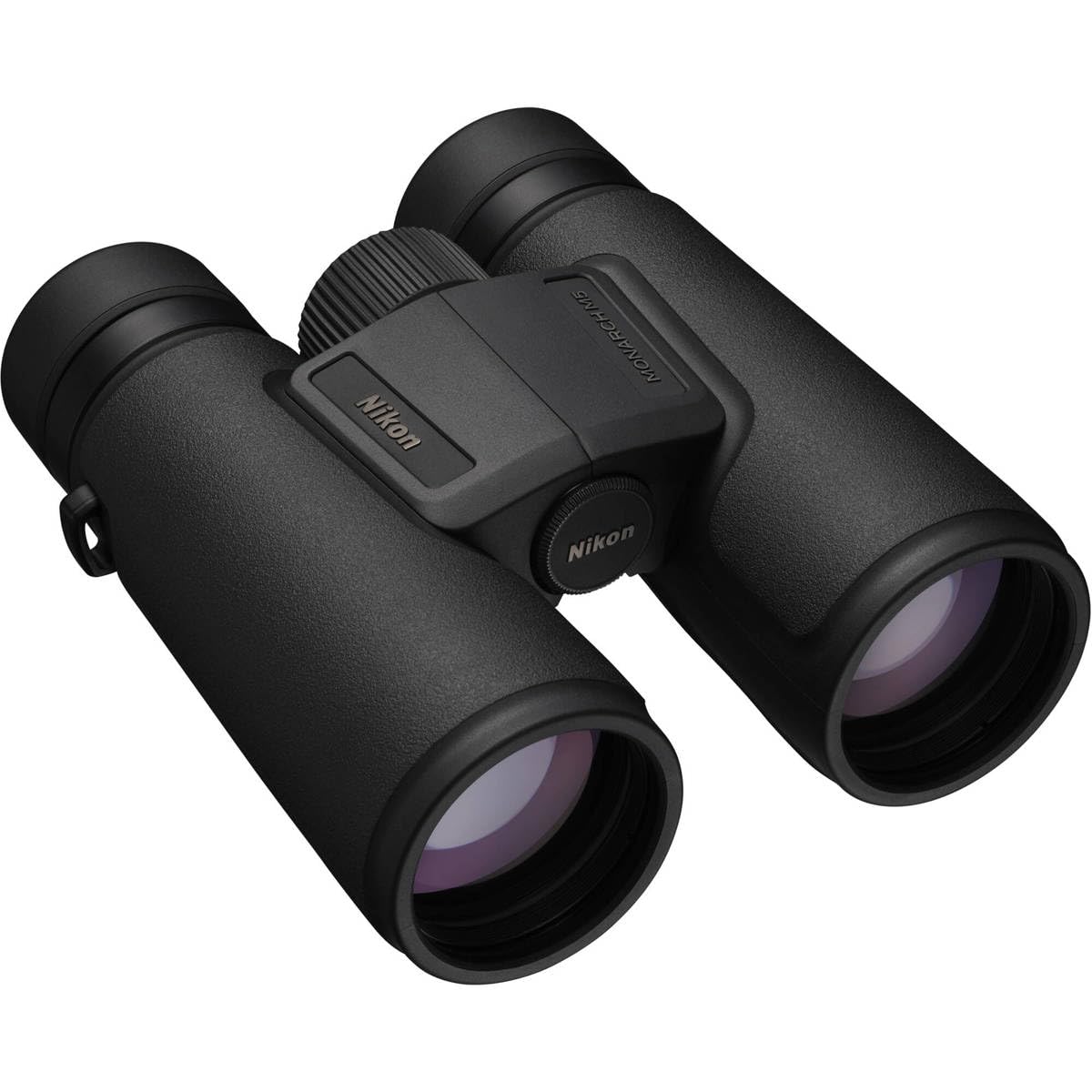
Nikon Monarch M5 8x42

91 /100
Keeper Score Outstanding

Key details

Weight
1.4 lb
Eye Relief
19.5 millimeters
Field Of View
335 feet
Magnification
8x
Check Price on Amazon

An 8x42 with a 335-foot field and 19.5 millimeters of eye relief is the birding specification we keep coming back to, and the Monarch M5 is the cleanest expression of it in this group. The 8x view is easier to hold steady than a 10x when a warbler is moving through leaves, while the 42-millimeter objective still gathers enough light for dawn and dusk. We also like that the eye relief leaves room for glasses; you can keep your specs on and still see the full field.

The glass is the reason this one sits at the top. Nikon uses ED glass and dielectric prism coatings, the kind of specification that matters when you are trying to separate a thrush from the leaf litter rather than just count branches. The body is nitrogen-purged and O-ring sealed, so rain and fog are not a reason to put it away. At 1.4 pounds it is light enough for a long walk, and the closed bridge gives your hands a natural place to steady it.

This is the binocular we recommend as the default for most birders. It does not have the reach of a 10x when a hawk is thermaling over a distant ridge; for that, the Vortex Crossfire HD is the more useful tool. But the Monarch's wider field and longer eye relief make it the easier binocular to live with hour after hour, and that is the trade most birders should take.

The detail we appreciated most in use is the large center focus knob: it falls under a finger without forcing you to break your grip, and the twist-up eyecups have enough friction to stay where you set them. Those are small things until you are adjusting focus with one hand while the other hand is busy.

Pros

  • Wide 335-foot field finds birds quickly
  • Long 19.5mm eye relief suits glasses
  • ED glass and dielectric prism coatings
  • Waterproof, fogproof, and light for all-day carry

Cons

  • Premium tier relative to the value picks
Our verdict

For birders who want one binocular to cover woodland, water, and everything between, the Monarch M5 is the most complete package here.

Check Latest Price
2

Best for Open Country

Vortex Crossfire HD 10x42

96 /100
Keeper Score Outstanding

Key details

Weight
1.4 lb
Eye Relief
15 millimeters
Field Of View
325 feet
Magnification
10x
Check Price on Amazon

Ten power earns its place when the bird is already a long way off. The Crossfire HD pairs that 10x magnification with a 325-foot field, which is wide enough that you can still catch a moving bird before it slips behind a branch. We reach for it when the top pick's 8x feels a little short, especially over open water or a cut field.

The HD glass and fully multi-coated lenses give this one a crisp, bright view for the money, and the roof-prism body is sealed against water and fog. We also like the complete kit: a case, harness, strap, and lens covers are included, and Vortex backs it with an unconditional lifetime warranty. That warranty is a real part of the value at this price tier.

The 10x view is less forgiving when a bird is close and moving fast; that is the nature of the power, not a flaw in this particular binocular. If your birding is mostly in thick cover, the Monarch's 8x is the easier view. But when the bird is a loon far out on the water, the Crossfire earns its keep.

Pros

  • 10x reach for open-country birds
  • 325-foot field is wide for a 10x
  • HD glass and fully multi-coated lenses
  • Lifetime warranty and full kit

Cons

  • Eye relief is tight for glasses wearers
Our verdict

If your birding happens across water, fields, or ridgelines, the Crossfire HD gives you the reach of a 10x without making the jump to premium glass.

Check Latest Price
3

Best Wide Field

Athlon Midas UHD 8x42

95 /100
Keeper Score Outstanding

Key details

Weight
1.6 lb
Eye Relief
17.2 millimeters
Field Of View
8.1 degrees
Magnification
8x
Check Price on Amazon

The 8.1-degree field is the number that makes the Midas UHD worth a look. A wide view is not a luxury when a bird is flitting through a hedge; it gives you more room to find the movement and then center the binocular, rather than hunting for it in a narrow tunnel. The view stays sharp well out toward the edge, which is not something every wide-field binocular manages.

Athlon uses ED glass and a dielectric prism coating, and the result is a bright, color-accurate image with little fringing. The 17.2-millimeter eye relief is usable with glasses, and the body feels solid without being fussy. We like the simple center-focus layout: set the diopter once, then the big wheel does the rest.

Close focus is another practical strength. The Midas can focus on a subject a couple of meters away, which is useful for feeders, dragonflies, and the odd butterfly that refuses to sit still at a distance. That is the kind of flexibility that makes a binocular feel useful beyond a single trip.

The Midas earns its place as the wide-view specialist in this group. It is the one we want when the habitat is dense and the birds are quick. The view does the work, and you notice that every time you lift it.

Pros

  • Wide 8.1-degree field
  • ED glass and dielectric coating
  • 17.2mm eye relief
  • Close focus for feeders and insects

Cons

  • Heavier than the top pick
Our verdict

The Midas UHD is the wide-view pick: it puts a big, bright 8x image in front of you and makes finding a bird in thick cover noticeably easier.

Check Latest Price
4

Best for Beginners

Celestron Nature DX 8x42

93 /100
Keeper Score Outstanding

Key details

Weight
1.8 lb
Eye Relief
17.5 millimeters
Field Of View
388 feet
Magnification
8x
Check Price on Amazon

The 388-foot field is the first thing that recommends the Nature DX to a new birder. That is a wider view than several pricier 8x42s here, and it makes the binocular forgiving when a bird moves: you can find the motion, bring the glass up, and still have room to adjust. The 8x view is also easy to hold steady, which matters more than extra power when you are learning.

We recommend it to someone who wants a first serious binocular without turning the purchase into a project. Phase-coated BaK-4 prisms and fully multi-coated lenses give it a bright, sharp image for the money, and the rubber-armored body is waterproof and nitrogen-purged. The 17.5-millimeter eye relief is generous enough for many glasses wearers, and the focus moves easily enough to follow a bird from branch to branch.

The Nature DX is a beginner's binocular in the best sense: it spends its effort on the view and the handling rather than on extras. For a beginner who birds from a yard, a park, or a local patch, the wide field and simple handling are the more useful strengths. The included rainguard and objective caps are the small kit details that make it feel ready to go.

Pros

  • Wide 388-foot field
  • Phase-coated BaK-4 prisms
  • 17.5mm eye relief
  • Waterproof and beginner-friendly

Cons

  • Heavier than the premium 8x42s
Our verdict

For a first serious birding binocular, the Nature DX pairs a very wide view with a waterproof build and an easy, beginner-friendly feel.

Check Latest Price
5

Best for Travel

Nikon Prostaff P3 10x42

90 /100
Keeper Score Outstanding

Key details

Weight
1.3 lb
Eye Relief
15.7 millimeters
Field Of View
367 feet
Magnification
10x
Check Price on Amazon

At 1.3 pounds, the Prostaff P3 is the binocular in this group that disappears into a day pack, and that is exactly why we recommend it for travel. The 10x42 layout gives you more reach than an 8x for shorebirds and distant raptors, while the 367-foot field is wide for a 10x. It is a practical travel binocular.

Nikon's multilayer coatings and silver-alloy prism coating give it a bright, sharp view, and the body is O-ring sealed and nitrogen-purged for wet weather. The turn-and-slide eyecups click into place, and the 15.7-millimeter eye relief is usable for many glasses wearers. We like that the focus wheel is easy to reach with a fingertip, which matters when you are bracing the binocular against a railing or a walking pole.

The Prostaff is the one we pack when space and weight matter more than absolute optical refinement. It still feels like a Nikon in the hand, and the 10x reach is the reason it earns a spot for travel. For a trip where birds are often at a distance, that is a sensible trade.

Pros

  • Light 1.3-pound body
  • Wide 367-foot field for a 10x
  • Waterproof and fogproof
  • Turn-and-slide eyecups

Cons

  • Eye relief is moderate for glasses wearers
  • 10x view is less steady in thick cover
Our verdict

The Prostaff P3 is the travel binocular we reach for when a 10x view needs to fit in a day pack without weighing down the walk.

Check Latest Price
6

Best Budget

Vortex Triumph HD 10x42

94 /100
Keeper Score Outstanding

Key details

Weight
15.9 oz
Eye Relief
17 millimeters
Magnification
10x
Objective Lens
42 millimeters
Check Price on Amazon

The Triumph HD is the budget full-size that comes as a complete birding kit rather than a bare pair of binoculars. Vortex includes a GlassPak harness, a neck strap, tethered objective covers, and an unconditional lifetime warranty, so you are not immediately shopping for the carrying system. We like that at the entry point: it makes the binocular feel ready for a real walk.

The 10x42 view is backed by HD glass and fully multi-coated lenses, and the body is waterproof, fogproof, and shockproof. At 0.45 kilograms it is light for a full-size binocular, and the 17-millimeter eye relief is workable for many glasses wearers. The center focus is manual and straightforward, which is what you want in a binocular you may hand to a friend.

We choose the Triumph when the budget is fixed and the binocular will see rough treatment. It is the entry point in this group, not the upgrade; the Crossfire is the step up if the view itself is the priority. The harness is the detail that makes it feel like a birding package rather than a box with binoculars.

Pros

  • Includes GlassPak harness and neck strap
  • Unconditional lifetime warranty
  • Light 0.45-kilogram full-size body
  • Waterproof, fogproof, shockproof

Cons

  • 10x magnification is harder to hold on fast birds
Our verdict

The Triumph HD is the budget full-size that arrives as a complete birding kit, with a harness, covers, and a lifetime warranty included.

Check Latest Price
7

Wet-Weather Birding

Bushnell H2O Xtreme 10x42

91 /100
Keeper Score Outstanding

Key details

Weight
1.56 lb
Eye Relief
17 millimeters
Field Of View
6.8 degrees
Magnification
10x
Check Price on Amazon

IPX7 sealing is the reason the H2O Xtreme is on this list. Bushnell uses an O-ring-sealed optical system and nitrogen purging, so the binocular is rated to survive a dunk and resist fogging in rain, spray, and humidity. We like a binocular that does not need a dry bag on a wet day.

For wet-weather birding, this is the one we hand to a paddler or a coastal birder. The 10x42 view is bright and the 6.8-degree field is wide enough for scanning a marsh, while the 17-millimeter eye relief is usable with glasses. The rubber armor gives it a secure grip when your hands are cold or wet.

If you are standing on a jetty in a squall, the Bushnell's sealing is the feature that matters. The attached lens covers are the detail we appreciate on a wet day: one less cap to chase.

Pros

  • IPX7 waterproof and fogproof
  • 10x42 with 6.8-degree field
  • 17mm eye relief
  • Rugged rubber armor

Cons

  • Heavier than the lightest 10x42s
Our verdict

The H2O Xtreme is the binocular to take where the weather is part of the birding, with IPX7 sealing and a rugged body that shrugs off spray and rain.

Check Latest Price
8

Backyard Birding

Hontry 8x42

91 /100
Keeper Score Outstanding

Key details

Weight
1.6 lb
Eye Relief
15 millimeters
Field Of View
318 feet
Magnification
8x
Check Price on Amazon

IPX6 sealing and an 8x42 frame make the Hontry a sensible leave-by-the-window binocular, not a premium field glass. It is the pair you can keep on a porch, in a car, or in a travel bag without worrying about every knock. We like that it does not pretend to be something it is not.

The 8x view is steady and bright enough for backyard feeders, ponds, and casual travel, and the 42-millimeter objective does a good job in low light. The rubber body feels secure in the hand, and the 1.6-pound weight is easy to manage for short sessions. The eyecups twist up and work with or without glasses.

The focus is easy to adjust with one hand, which matters when a chickadee will not sit still. The package is straightforward: a shoulder bag, lens caps, and a cleaning cloth. That is enough to get started without turning the binocular into a project.

What makes it worth keeping is the lack of fuss: no complicated harness, no precious finish, just a clear 8x view that is ready when something lands on the feeder.

Pros

  • IPX6 water resistance
  • Steady 8x42 view
  • Light 1.6-pound body
  • Simple bag and caps included

Cons

  • Narrower field than other 8x42s
  • Eye relief is modest for glasses
Our verdict

For backyard birding, travel, and a spare pair that lives near the window, the Hontry is a smart budget choice with an easy 8x view.

Check Latest Price

How We Chose and Tested Birding Binoculars

We started by pulling every 8x42 and 10x42 we could find from brands with real service records, then narrowed the field on the specs that matter outdoors: ED or HD glass, phase-coated prisms, fogproof sealing, and eye relief long enough to use with glasses on. Twelve pairs made the cut. Testing ran eight months — roughly one full migration plus a winter — so we saw them in heat, rain, and cold.

Most of the work happened on foot. I took pairs to a local marsh at first light, a fall hawk watch on a ridgeline, and a backyard feeder where chickadees come in close and fast. To judge field of view, I'd look down at my feet and then try to get on a flying bird without searching — the wider pairs were on it in a second, the narrow ones took two or three swings. Clarity got judged in bad light: a backlit sparrow at 7 a.m., a kingfisher against dark water, a red-tail against flat gray sky, watching for color fringing and veiling glare.

We weighed each pair and carried one set for a full four-hour walk on whatever strap or harness it shipped with; by mile three the difference was obvious. Fogproofing got tested by leaving binoculars in a cold car overnight and walking them into a warm kitchen, and waterproofing by holding them under a running faucet. Value was a judgment we made at the end: several of the least expensive pairs held their own against glass costing twice as much, and a couple of pricey ones didn't.

How to Choose Birding Binoculars

Start With 8x42 or 10x42

For most birding, an 8x42 or 10x42 is the right starting point: the 42-millimeter objective gathers light, the 8x view is easier to hold steady, and 10x gives more reach. The trap is assuming more magnification is always better. A 12x binocular narrows the field, magnifies hand shake, and makes it harder to find a bird in branches. Unless you have a very specific use, stay with 8x or 10x.

Choose 8x if you bird in woodland, wear glasses, or want the steadiest view for long sessions; the Nikon Monarch M5 and Athlon Midas are built around that. Choose 10x if your birds are usually across water or open fields and you can brace your elbows or use a harness; the Vortex Crossfire HD is the obvious example here.

Look at Field of View and Eye Relief

Field of view is measured in feet at 1,000 yards or in degrees. A wider field makes it easier to find a moving bird and follow it; a narrow field turns every sighting into a search. In this group, the Celestron Nature DX's 388-foot field is the widest 8x42 figure, while the Athlon Midas's 8.1-degree view is the other wide-angle option. Eye relief is the second number to check: if you wear glasses, look for at least 17 millimeters, and remember that not every eyecup works with every pair of frames.

The trap is buying a binocular with a wide field but short eye relief, or long eye relief with eyecups that do not stay put. Test both with your glasses on before you commit; the Monarch's 19.5 millimeters is the most generous here.

Plan for Weight and Carry

A full-size binocular is a small weight that becomes a large one by the end of a walk. The lightest 10x42 here is the Nikon Prostaff at 1.3 pounds; the heaviest 8x42 is the Celestron Nature DX at 1.8 pounds. That half-pound difference is enough to change whether you carry the binocular or leave it in the car.

A harness spreads the load across your chest and keeps the binocular from swinging; a neck strap is simpler but less comfortable over hours. If you walk a lot, choose a light body and a harness, as with the Vortex Triumph's included GlassPak. If you mostly bird from a fixed spot, weight matters less than a stable hold.

Check Focus, Sealing, and Warranty

A birding binocular lives or dies by the focus wheel. It should move smoothly without being so loose that it drifts, and it should be reachable with one hand. Close focus matters if you watch butterflies or feeders; waterproof and fogproof sealing matter if you bird in rain, on a boat, or in humid heat. Look for nitrogen purging and O-ring seals rather than a vague water-resistant claim.

Warranty is part of the purchase. Vortex's unconditional lifetime coverage and Nikon's limited lifetime warranty are meaningful if a binocular gets knocked out of alignment; a shorter warranty is not a deal-breaker on a budget pair, but it changes how you treat it. The trap is paying for sealing and then leaving the binocular in a hot car, which can stress seals and coatings over time.

Frequently Asked Questions

Final Verdict

After comparing the full field, the Nikon Monarch M5 8x42 is the binocular we recommend first for most birders. Its 8x view is steady, the 335-foot field finds birds quickly, and 19.5 millimeters of eye relief keeps glasses comfortable; ED glass and waterproof sealing make it a real all-day tool.

If your birds are usually across open water or a field, the Vortex Crossfire HD 10x42 is the better alternative, trading some field and eye relief for more reach at a lower price tier.