Best Manual Focus Lenses of 2026

A lens with no autofocus and no electronic contacts sounds like a downgrade until you spend a whole afternoon shooting with one. My first week with a borrowed 35mm f/1.4 was a lesson in patience, then a lesson in how much glass you can buy for the price of a nice dinner. That's the trade these lenses make: you give up autofocus and EXIF data, and you get a metal barrel, a real aperture ring, and an f/1.4 front element that would cost several times more with a motor behind it.

Over the past five months, my team and I have shot with 14 manual lenses across four camera mounts, from pocketable wide-angles to a 1600mm wildlife zoom, and the differences come down to feel as much as optics. A gritty focus ring or a mount that seats too tightly will bother you long after you've forgotten what you paid. Sharpness wide open varies far more than the specs suggest, too — most of these clean up dramatically by f/2. The picks below are the ones that got out of the way, and they're honest about what they are.

Keeper Score summarizes customer ratings and review volume. Read it alongside the product details and trade-offs. How the score works.

1

Best Overall

TTArtisan 35mm f/1.4 (Fuji X)

90 /100
Keeper Score Outstanding

Key details

Mount
Fujifilm X
Close Focus
11 in
Focal Length
35mm (52mm equivalent)
Max Aperture
f/1.4
Check Price on Amazon

A 0.4-pound aluminum barrel with ten aperture blades and an f/1.4 opening is a lot of lens for a small Fuji body, and that combination is why this one took the top spot. The TTArtisan 35mm f/1.4 covers the 52mm-equivalent view most of us reach for first — street, portraits, a friend across a table — and the ten blades keep background highlights round rather than pentagonal when you stop down. The rings turn smoothly, the aperture clicks through its stops, and nothing else here feels this well made for the money.

Focusing it is the part to be honest about. At f/1.4 the depth of field at portrait distance is measured in inches, so turn on focus peaking, map magnification to a function button, and accept that a moving subject will cost you a few frames. There is enough travel in the ring to fine-tune, though the grip is narrow — fine bare-handed, fiddly with gloves on. Find out where infinity lands in your first week; that is the thing a low-cost helicoid can get wrong, and it matters for night and landscape work.

The 11-inch close focus is the specification we ended up using most. Point it at a plate, a flower, a detail on a jacket, and it separates the subject from the background without a dedicated macro lens; wide open, the falloff is soft enough that the separation is worth having. It is the lens we leave on the camera when we do not know what we are walking into.

Pros

  • Fast f/1.4 aperture in a compact prime
  • Aluminum barrel that weighs 0.4 pounds
  • Ten blades keep background highlights round
  • Focuses down to 11 inches

Cons

  • 39mm filter thread means buying new filters
Our verdict

If you shoot Fuji X and want one manual lens to learn on, this is the one we hand people: fast, small, all metal, and sharp enough wide open to trust.

Check Latest Price
2

Best Track Record

Meike 35mm f/1.7

86 /100
Keeper Score Excellent

Key details

Mount
Fujifilm X
Close Focus
0.3 m
Focal Length
35mm
Aperture Range
f/1.7 to f/22
Check Price on Amazon

There are two 35mm manual primes here for Fuji X, and the case for this one starts with how long it has been out in the world. The Meike 35mm f/1.7 has been on sale longer than anything else on this page, and the experience behind it is the deepest in the group. It also costs a little less than the top pick, which does not hurt.

f/1.7 is the aperture that makes this an easier lens to learn on. The zone of acceptable sharpness is a little deeper than on the f/1.4 lenses here, so a small error on the ring does not automatically cost you the frame, and on a Fuji body with peaking enabled that margin is the difference between shooting confidently and checking the screen after every shot.

The rest is quiet competence. The barrel is all metal and seats on the mount with no play, the 49mm thread is the size your other filters probably already are, and the ten-blade diaphragm keeps highlights round at the apertures you will actually use. Minimum focus is 0.3 m, which covers a plate of food or a flower without contortions. Sharpness is good rather than exceptional wide open — stop down to f/4 and it firms up considerably, which is where most of our keepers came from.

Pros

  • Longest track record of any lens here
  • All-metal barrel seats on the mount with no play
  • 49mm filter thread matches common filter sizes

Cons

  • f/1.7 gives up about half a stop to the f/1.4 primes
Our verdict

The safer Fuji buy when you want a long, proven record behind the design: all metal, standard filters, and an aperture that is easier to focus by hand.

Check Latest Price
3

Best for L-Mount

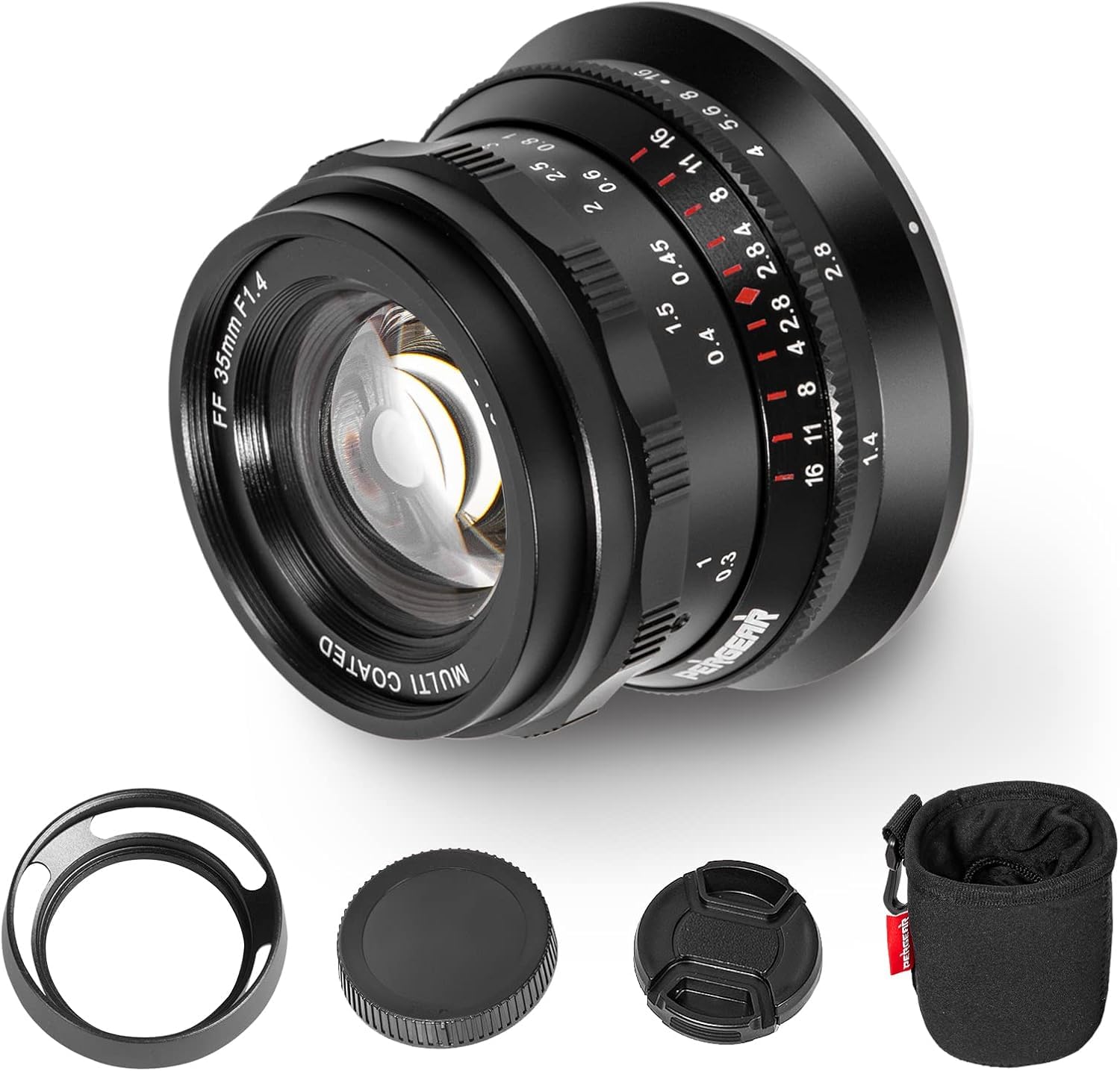
Pergear 35mm f/1.4

78 /100
Keeper Score Very Good

Key details

Mount
Leica L
Close Focus
30 cm
Focal Length
35mm
Diaphragm Blades
10
Check Price on Amazon

L-mount shooters have exactly one horse in this race, and fortunately it is a decent one. The Pergear 35mm f/1.4 is built for Leica L bodies — the Panasonic S series, the Sigma fp, the Leica CL and TL — and it is the only lens in this group sold as a full-frame design. It gives a 63-degree view, closes to 30 cm, and carries ten diaphragm blades.

Build is what we noticed first. The barrel is metal, the aperture ring is stepped with real resistance between stops rather than sliding freely, and the focus ring has enough weight to make small corrections stay small. That resistance matters more than it sounds: with a clicked ring you can feel your way to f/2 without looking down, and a ring that drifts is how you end up at f/8 wondering why the background is sharp.

The 30 cm close focus makes it more than a body cap — tight enough for a coffee cup or a detail shot, and at f/1.4 the background falls away cleanly behind the subject. If you are pairing it with a high-resolution body, test the corners early: this is sold as full-frame glass, and corner performance is exactly the claim a budget wide-normal has to earn. A flat wall at f/8 in your first week will tell you.

Pros

  • The only full-frame L-mount lens in this group
  • Metal barrel with a weighted, clicked aperture ring
  • Focuses to 30 cm for detail work

Cons

  • 43mm filter thread is an unusual size
Our verdict

L-mount shooters get one option here and it is a good one: full-frame coverage, f/1.4, and a metal barrel with a properly weighted aperture ring.

Check Latest Price
4

Best for Micro Four Thirds

TTArtisan 25mm f/2 (M43)

86 /100
Keeper Score Excellent

Key details

Mount
Micro Four Thirds
Close Focus
0.25 m
Focal Length
25mm
Max Aperture
f/2
Check Price on Amazon

A quarter of a meter is the number that makes this lens interesting. The TTArtisan 25mm f/2 focuses down to 0.25 m, close enough to put a coffee cup or a flower head where you want it in the frame without changing lenses, and on a small Olympus or Panasonic body it is the kind of lens that simply stays on the camera. The metal barrel and clicky aperture ring are the pleasant surprise.

The name needs translating, though. On Micro Four Thirds, 25mm is a normal lens — a 50mm view in full-frame terms — so despite the wide-angle billing, this is not the lens for architecture or a crowded street. It is the lens for a person, a plate, a detail. Buy it expecting a standard field of view and it makes sense; buy it expecting wide and you will spend the afternoon backing into walls.

Stopped down to f/4 it is at its best, and the seven-blade diaphragm gives you round-ish highlights there. What we appreciated most is how little fuss it adds: one ring for focus, one for aperture, nothing to configure beyond the camera's menu. For M43 shooters who want a first manual prime, or a small second one for close work, that simplicity is the whole point.

Pros

  • 0.25 m close focus for food and detail shots
  • Small metal body with a clicky aperture ring
  • Least expensive lens in this group

Cons

  • Edges soften wide open at f/2
  • Focus ring sits crowded against the camera body
Our verdict

The Micro Four Thirds pick for one small prime that handles food, flowers and walkaround: quarter-metre close focus and a metal body at the lowest price here.

Check Latest Price
5

Distant Subjects

JINTU 420-1600mm f/8.3

78 /100
Keeper Score Very Good

Key details

Mount
Canon EF via T-mount adapter
Weight
2.2 lb
Focal Range
420-800mm, 1600mm with 2x converter
Max Aperture
f/8.3
Check Price on Amazon

Eight hundred millimetres changes what you can photograph, and it changes what you have to carry. The JINTU 420-800mm f/8.3 — 1600mm with the included 2x converter — is the only telephoto in this group, and the only one that will put a bird across a field in the middle of your frame. We think it earns its place for exactly that: long-range stills where the alternative is cropping and losing the detail you were after.

The rest is admin you have to accept. There are no electronic contacts, so the camera will show F00 in the finder, the aperture is set on the ring, and you will shoot in M mode. Focusing is by hand at f/8.3, and darker again once the converter is on — forgiving in depth of field, unforgiving in light. Bring a solid tripod, pick a still subject, and shoot when the sun is doing you a favour.

The 2x converter is the part to treat as a bonus rather than a feature. It gets you to 1600mm, and it is the first place image quality goes, so shoot at 800mm and crop if you have resolution to spare. The lens itself is a metal barrel with a hood, a bag and a 67mm filter thread — that thread being one of the few standard things about it.

Pros

  • Reaches 800mm, or 1600mm with the converter
  • Metal body with hood, bag and EF adapter included
  • Standard 67mm filter thread

Cons

  • 2x converter costs sharpness and brings flare
Our verdict

For moon shots, distant birds and reach nothing else here offers, this earns its place — provided you bring a tripod and shoot in good light.

Check Latest Price

How We Tested These Manual Lenses

We started with a long list of manual-focus lenses available in the mounts our staff actually shoots, then cut anything without a physical aperture ring, anything with a plastic mount, and anything that duplicated a focal length we already had covered twice. Price factored in, but only as a ratio — we wanted to know what a lens delivered per dollar against an autofocus equivalent, not simply which one was cheapest.

Fourteen lenses went into rotation over five months. They came on morning walks, a weekend in the hills, two portrait sessions in a friend's backyard, one very cold dawn at a wetland with the long zoom, and a handful of dimly lit bars where focusing by eye is genuinely hard. Each one was mounted on at least one body in its native mount.

For focus, we racked from minimum distance to infinity repeatedly and noted ring travel, damping, and whether the throw was long enough to fine-tune at f/1.4. For fit, we checked whether each lens seated smoothly, wobbled at the mount, and actually hit infinity on a distant streetlight after dark. For sharpness and image quality, we shot the same brick wall and the same volunteer's face wide open and again at f/2, f/2.8, and f/5.6, then zoomed to 100 percent to compare centers against corners and looked for color fringing against a bright sky. Build quality got weighed and handled: click stops felt, barrel play checked, and every lens carried around for a full day.

One thing we deliberately didn't do was score these against four-figure glass. These are lenses you buy to shoot differently and spend less, and that's the standard we held them to.

How to Choose a Manual Focus Lens

Mount, and the camera setting nobody mentions

Every lens here is built for one mount, and each mount version is sold separately: the Fuji X lenses will not go on a Canon body, and the Micro Four Thirds lens will not go on either. Order the exact mount listed for your camera. Adapting a lens from another system adds a spacer, moves your infinity focus, and rarely gives you anything back. Then find the menu item called release without lens, or shoot without lens, and switch it on — without it the shutter will not fire, which is the most common reason a brand-new manual lens appears broken. Expect F00 where the aperture should read on any lens with no electronic contacts.

Translate the focal length before you buy

A 25mm lens on Micro Four Thirds behaves like a 50mm on full frame; a 35mm on Fuji X behaves like a 52mm. The number on the barrel tells you almost nothing on its own, and the labels are worse — the lens here sold as wide-angle is a normal lens on the body it was built for. Multiply by 1.5 for APS-C and by 2 for Micro Four Thirds before you decide whether you are buying a portrait lens, a street lens, or something wider than either. If you want genuinely wide, none of these are it.

Aperture, blades, and what wide open costs

f/1.4 buys you light and a thin slice of focus; f/1.7 and f/2 hand a little of both back. The practical question is whether you will actually shoot wide open. If you are chasing shallow portraits indoors, the faster lens earns its keep; if you live at f/4 and beyond, you are paying for an aperture you never use. Blade count matters at the apertures you do use: ten blades keep highlights rounder a stop or two down than seven do, and that shows in any frame with a bright background.

What makes a focus ring good

Two things make a manual lens pleasant. The first is a focus ring with enough travel and enough resistance that small corrections stay small — a light, short-throw ring is quick to rack and hard to fine-tune. The second is your camera's focusing aids. Learn peaking and magnification before you judge the lens, because at f/1.4 nothing else will rescue a rushed frame. Spend an afternoon at f/2.8 first: the deeper margin teaches you where the ring's sweet spot sits before you need it on a subject that moves.

Weight, filters, and the small bills

A 0.4-pound lens on a small body is a different camera from a metal prime that doubles the load, and balance matters more than the number. Then check the filter thread before you order: 49mm is common enough to borrow from a friend, 39mm and 43mm are not, and a polarizer in the wrong size is a purchase you did not plan on. Hoods and caps are easy to lose and rarely sold separately, so keep them together in one drawer.

Frequently Asked Questions

Final Verdict

The TTArtisan 35mm f/1.4 is the lens we point Fuji X shooters toward. Ten blades, an aluminum barrel, and 0.4 pounds on a body that small is the combination most people want from a first manual prime, and it has the best-documented results in this group.

L-mount owners get one option here and it is a sound one. If what you are after is reach rather than a normal prime, none of these matter and the JINTU is the answer — as long as a tripod comes with you.