Best Laowa Lenses of 2026

Laowa lenses are a swap. You give up autofocus — usually — and get a focal length or a magnification nobody else builds at this size: a 9mm that keeps straight lines straight, a macro that reaches twice life size without a bellows. Shoot with one for an afternoon and the compromise starts to look like a shortcut.

The questions I hear about them are always the same: is it actually sharp, is the distortion real, and can I live without autofocus? Fair questions, all three. Over the past eight months we've had six of these lenses in rotation — full-frame, APS-C, and Micro Four Thirds — on hikes, in cramped interiors, and at the kitchen table.

Here's what first-time buyers don't know: at 9mm or 10mm, depth of field is so deep that manual focus barely matters, so size and weight become the real cost of carrying one. It's the fast primes and the 2x macro where your hand on the ring decides the shot. The picks below earned their place on image quality, build, and what you get for the money — not on a spec sheet.

Keeper Score summarizes customer ratings and review volume. Read it alongside the product details and trade-offs. How the score works.

1

Best Overall

Laowa 10mm f/2.8 Zero-D AF

85 /100
Keeper Score Excellent

Key details

Focus
Autofocus
Mount
Sony E (full-frame)
Angle Of View
130.4°
Minimum Focus
12 cm
Check Price on Amazon

A 130.4-degree view is not subtle. Aim the 10mm down a narrow hallway or into a small bedroom and the walls run away from you, the ceiling opens up, and the whole space lands in one frame. What makes it usable rather than a novelty is the Zero-D correction: doorframes, window frames, and cabinet edges stay vertical instead of bowing outward, so the picture reads as wide-angle architecture. In our interior shots, verticals came out straight enough that we rarely touched the correction slider.

It's the autofocus that put this lens at the top of our list. Every other Laowa here is manual focus, and at 10mm — handheld in a dim room, following a subject through a doorway, or shooting video — letting the lens do the focusing is worth real money. The body is only about 7 cm long and 0.93 lb, which for a full-frame lens this wide is close to jacket-pocketable.

Then there's the 12 cm minimum focus distance. Push the front element toward a glass, a plant, or a table setting and the foreground object swells while the room sweeps out behind it, a look that's hard to get any other way. What we noticed at this width is that anything close to the corners gets stretched, so keep faces toward the middle of the frame and let floors and walls take the edges.

Pros

  • 130.4-degree view that keeps verticals vertical
  • The only autofocus lens in this group
  • Focuses to 12 cm for dramatic foregrounds
  • Compact, light body for its focal length

Cons

  • Sony E full-frame bodies only
  • The most expensive pick here
Our verdict

For full-frame Sony shooters who want the widest lens here with straight lines and autofocus, this is the one to buy.

Check Latest Price
2

Best Macro

Laowa 65mm f/2.8 2X Ultra Macro APO

90 /100
Keeper Score Outstanding

Key details

Mount
Fujifilm X
Aperture
f/2.8
Minimum Focus
6.69 in
Maximum Magnification
2x
Check Price on Amazon

Two-to-one magnification is the number worth understanding. At 2x, something the size of a fingernail fills the frame, and the 6.69-inch minimum focus distance leaves just enough room in front of the lens to light it. Most macro lenses stop at 1x, which means cropping or adding extension tubes. Here the extra magnification is built in, and on a Fujifilm APS-C body the 65mm behaves like a 97.5mm lens.

What surprised us is how little the lens gives up to get there. Fourteen elements in ten groups, three of them ED, and the chromatic fringing that usually shows up on high-contrast edges at this magnification stayed out of our way. The all-metal barrel feels denser than its size suggests, the nine-blade diaphragm rounds out background highlights, and at f/2.8 the 97.5mm equivalent makes a genuinely good short portrait lens — the shallow depth of field that complicates macro is exactly what you want on a face.

Focus is manual, and at 2x that shapes the whole session: depth of field collapses to a millimeter or two, so you set the shot up rather than chase it. The long focus throw rewards small adjustments, and a tripod with focus peaking turns a fiddly hour into a productive one. Our best results came from stopping down a little and lighting the subject properly — at this magnification, light matters more than aperture.

Pros

  • True 2x magnification at 6.69 inches
  • APO glass with three ED elements
  • All-metal build that stays compact
  • Doubles as a short portrait lens

Cons

  • No autofocus and no electronic contacts
  • Fujifilm X mount only
Our verdict

For Fujifilm shooters who want real 2x magnification in a small, sharp, all-metal lens, this is our macro pick.

Check Latest Price
3

Best Budget

Laowa 17mm f/1.8 MFT

90 /100
Keeper Score Outstanding

Key details

Mount
Micro Four Thirds
Aperture
f/1.8
Minimum Focus
5.9 in (15 cm)
Maximum Magnification
0.2x
Check Price on Amazon

If you shoot Micro Four Thirds, the appeal is immediate: a 17mm f/1.8 that turns a small body into a low-light camera you can carry all day. The view lands around 34mm equivalent — wide enough for a street or a café table, tight enough that faces near the edges stay natural. At f/1.8 you get shutter speed indoors that a kit zoom simply can't find.

Optics are why it earns a place rather than just a price. Nine elements in seven groups, and in our use it was sharp wide open in the center with color that needed very little work. Close focus of 5.9 inches and 0.2x magnification are a bonus on a wide prime: menus, flowers, and small details fill the frame without a lens change. The seven-blade diaphragm keeps background highlights round.

There's a touch of barrel distortion at the edges, visible on doorframes and horizons, and it corrects cleanly in post or in-camera. We happily trade that for the handling: the focus ring is smooth with real resistance, the metal barrel feels like a lens that costs more than it does, and at 17mm the depth of field is generous enough that scale focusing is easy. It's the gentlest introduction to manual focus on this list.

Pros

  • f/1.8 aperture on a very small body
  • Sharp wide open with clean color
  • Focuses to 5.9 inches for close details
  • Smooth, well-damped manual focus ring

Cons

  • Micro Four Thirds mount only
Our verdict

For Micro Four Thirds shooters who want a small, fast, sharp everyday prime without spending much, this is the easiest recommendation here.

Check Latest Price
4

Best for Working Distance

Laowa 100mm f/2.8 2X Ultra Macro APO

84 /100
Keeper Score Excellent

Key details

Mount
Canon EF
Weight
1.41 lb
Minimum Focus
0.25 m
Maximum Magnification
2x
Check Price on Amazon

No autofocus, no stabilization, and a manual aperture ring — on paper the 100mm macro looks like a step backward. In practice, 2x macro is manual work anyway: you set the magnification, then move the camera a few millimeters until the plane of focus lands where you want it. What the longer focal length actually buys is distance. At the same 2x magnification you're farther from your subject than the 65mm allows, and with live subjects that distance is the whole game.

The glass earns the bulk. Twelve elements in ten groups with an apochromatic design, and at 2x the results are crisp with the edge definition that makes the magnification worth using instead of a party trick. It holds up as a short telephoto too — 100mm is a comfortable portrait length — and the nine-blade diaphragm keeps backgrounds smooth. At 638 g it's the heaviest lens in this group, which steadies it on a tripod and reminds you about it on a long walk.

The practical wrinkle is the mount. This is the EF version, so on a Canon RF body you need an adapter, and it's worth checking that the listing's mount matches your camera before you order. Beyond that the lens asks for tripod discipline: stop down to f/8 or so, focus by moving the camera, and use a diffused flash to freeze the subject and kill the shadow you're casting. Do that and the sharpness is there.

Pros

  • 2x magnification with longer working distance
  • Apochromatic glass that stays crisp at 2x
  • Solid, all-metal construction
  • Works as a 100mm portrait lens

Cons

  • Heaviest lens in this group at 638 g
  • Needs an adapter on Canon RF bodies
Our verdict

For Canon shooters who want 2x macro with more breathing room from their subjects, this is the pick — as long as manual focus and a tripod suit how you work.

Check Latest Price
5

APS-C Sony Wide

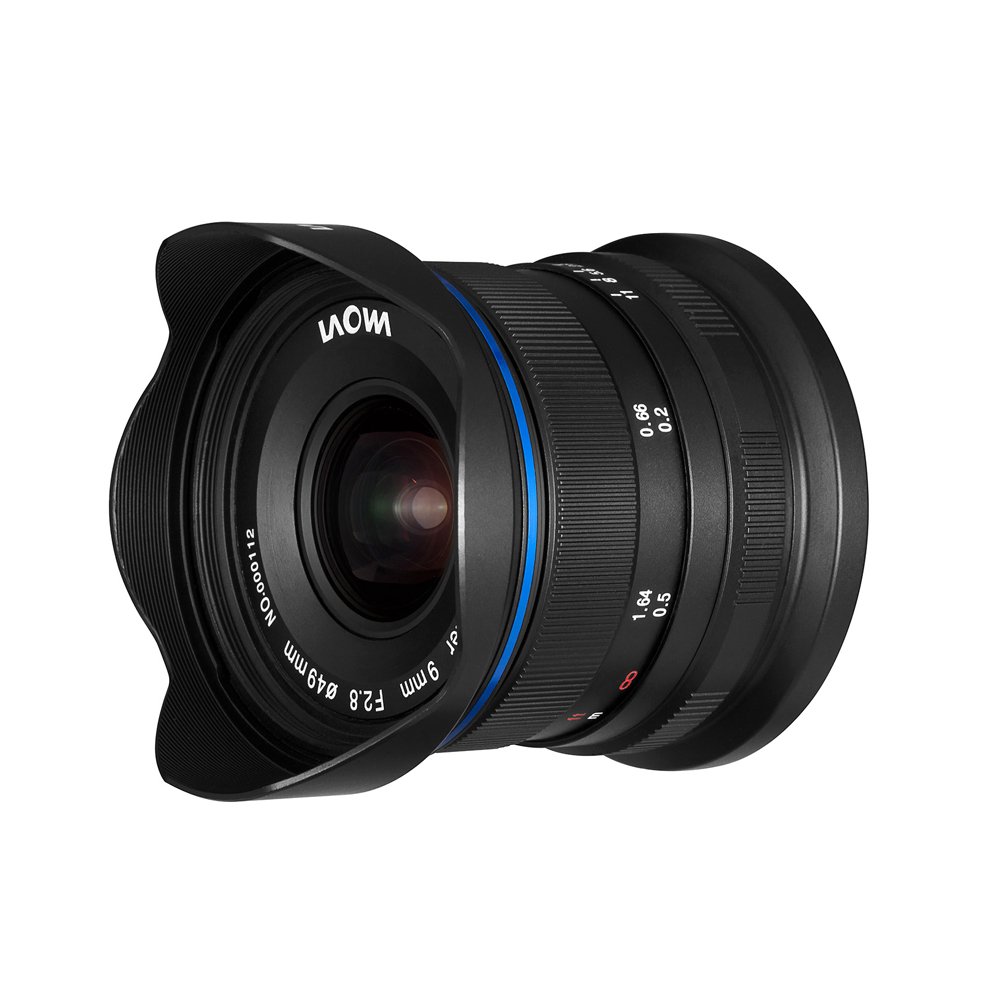
Laowa 9mm f/2.8 Zero-D

84 /100
Keeper Score Excellent

Key details

Focus
Manual focus
Mount
Sony E (APS-C)
Angle Of View
113°
Filter Thread
49 mm
Check Price on Amazon

Set next to our top pick, the 9mm makes a different trade. You give up the full-frame view and the autofocus, and in exchange you get a lens that weighs 215 g, takes standard 49mm filters, and sits naturally on a Sony APS-C body. It covers 113 degrees — 13.5mm equivalent — which is still wide enough to swallow a room, and like the 10mm it keeps straight lines straight.

The rendering holds up: two aspherical elements, and in our frames the sharpness was there from the start rather than needing a stop down. At f/2.8 it's usable indoors, and at this width manual focus costs you less than you might expect — past a few feet nearly everything is in focus, so you can set the ring and shoot.

Where it gives ground is flexibility. There's no autofocus for handheld interiors or video, and it's built for APS-C bodies, so a full-frame Sony isn't the place for it. For a crop-frame Sony shooter who wants the widest view that still looks like a photograph and not a fisheye, neither of those will matter much — and it costs considerably less than the full-frame option.

Pros

  • 113-degree view in a 215 g body
  • Sharp results at f/2.8
  • Takes standard 49mm filters

Cons

  • Manual focus only
  • Built for APS-C bodies
Our verdict

For Sony APS-C shooters who want an ultra-wide that fits a small bag and a small budget, this is a solid, sharp choice.

Check Latest Price

How We Tested Six Laowa Lenses Over Eight Months

We built the shortlist by pulling every Laowa we could mount on a body we already had — full-frame mirrorless, APS-C, and Micro Four Thirds — then cutting the overlaps so the six that remained each did something the others didn't. Six lenses, eight months, and every one of them left the house.

Most of the shooting was deliberately boring. I photographed brick walls, door frames, and the straight edge of a bookcase at the widest focal lengths, then opened the files and checked whether vertical lines bowed near the corners; tight stairwells and small rooms told the same story more honestly than a test chart. For the macro lenses I worked a kitchen table with coins, stamps, and flower stamens, shooting at 1:1 and again at 2x to see whether the extra magnification held up or went soft.

Size and weight got checked the unglamorous way: each lens was carried in the same small shoulder bag on a full day out and weighed against whatever it replaced. Depth of field I watched at the widest apertures — portraits at f/1.8 and f/2.8, noting how much of a face stayed sharp and how harsh the falloff looked. Focusing meant timed drills: nailing a static subject, then a friend walking toward me, with and without peaking and magnification. Only one lens in the group autofocuses, so I tracked a dog on that same path to see whether it kept up. Value came last, judged on what each lens does that a first-party equivalent can't.

How to Choose a Laowa Lens

Start With the Mount, Then the Format

Nothing else matters if the lens won't fit. Laowa builds the same focal lengths in several mounts, so the model number is the thing to check, not the headline on the page. Then check the format: the 9mm is made for Sony's APS-C bodies and the 10mm for full-frame E-mount, and a crop lens on a full-frame camera drops you into crop mode and throws away resolution you paid for.

Write down your mount and your sensor size before you shop and stay inside them. An adapter can rescue an EF lens on a newer Canon body; it can't make a Micro Four Thirds lens into a Sony lens.

Decide How You Feel About Manual Focus

Most of the lineup is manual focus, and several of these lenses have no electronic contacts at all — you set the aperture on the barrel and nothing is written into the file. For landscapes, architecture, and macro that's often better, because you place focus exactly where you want it. For handheld interiors, video, and moving subjects it's a real cost in time and missed frames.

If autofocus matters to how you shoot, pay for it. The 10mm is the one lens in this group that has it, and it's the reason that lens carries our top recommendation.

Choose an Angle of View You'll Use

The range here runs from 130.4 degrees on the 10mm to roughly a 34mm-equivalent view on the 17mm, and wider is not automatically better. Past about 115 degrees, anything near the corners stretches and subjects at the edge of the frame lean. Extremely wide lenses are for tight rooms, architecture, and foregrounds that loom; a 34mm-equivalent prime is for walking around.

If you're unsure, shoot for a week with the widest lens you already own and count how often you're backing into a wall to fit something in. That number tells you whether you need 113 degrees or 130.

For Macro, Weigh Magnification Against Working Distance

Two-to-one magnification is the headline on both macro lenses here, and it earns its keep: at 2x you fill the frame with a subject the size of a fingernail instead of cropping into it later. But minimum focus distance is measured from the image sensor, not the front of the lens, so a shorter figure doesn't always put you closer to your subject.

At the same magnification, a longer focal length gives you more room to light the subject and less chance of scaring it off. Static subjects on a bench don't care how close the lens sits; live ones very much do.

Budget for What Comes After the Lens

Three costs follow the purchase. Filters: small front elements are cheap to fit and large ones aren't, so check the thread and use a step-up ring to reuse what you already own. Support: a 2x macro wants a tripod and a diffused flash, and a 638 g lens wants a head that won't droop. Adapters: an EF lens on a Canon RF body needs one, and that belongs in the real price of choosing that mount.

Frequently Asked Questions

Final Verdict

The 10mm f/2.8 Zero-D is the Laowa to start with. It pairs the most extreme view in this group with the one thing the rest of the lineup can't offer — autofocus — and it keeps verticals straight while doing it, which makes it a working lens for interiors and architecture rather than a curiosity.

If you shoot Fujifilm and care about small subjects instead, the 65mm is the better buy: 2x magnification, APO sharpness, and a body you'll actually carry. On Micro Four Thirds, the 17mm is the value pick that makes a small camera feel complete.