Best Floorstanding Speakers of 2026

The hardest part of buying floorstanding speakers isn't choosing a sound—it's living with the size. A tower claims real floor space, needs breathing room behind it, and has to look intentional next to the couch. Get that right, though, and a good set can anchor a room's music and movie sound without a clutter of extra boxes.

I spent eight months living with seven models, moving them between a living room stereo setup and a movie-night system. The differences showed up in dialogue clarity, stereo image, bass weight, and whether the cabinets felt solid when I knocked on them. I noted finish quality, grille fit, and how easily each one settled into balance; some were heavy enough that placement became a two-person job. Atmos-ready towers add another layer—up-firing modules or top grilles can create overhead effects, but only if your ceiling and seating cooperate.

Value wasn't about price alone; it was about what the cabinet, drivers, and finish justified. The picks below are the ones that earned their floor space.

Keeper Score summarizes customer ratings and review volume. Read it alongside the product details and trade-offs. How the score works.

1

Best Overall

Klipsch Reference R-26FA

92 /100
Keeper Score Outstanding

Key details

Drivers
Dual 6.5 in. woofers, 1 in. tweeter
Configuration
Pair
Height Effects
Built-in Dolby Atmos elevation
Power Handling
100W continuous / 400W peak
Check Price on Amazon

Two extra drivers sit on top of each cabinet, angled at the ceiling, and they are the reason this pair leads our list. Klipsch calls them elevation speakers; in practice they put Dolby Atmos height effects overhead without in-ceiling speakers, as long as your receiver has height channels and your ceiling is flat rather than vaulted. We ran them as the front stage of a 5.1.2 system, and the part that surprised us was how much weight the overhead layer carried — effects crossed the ceiling instead of hovering up there in a separate, thinner layer.

Below that is a conventional Klipsch tower: a 1-inch aluminum tweeter in a 90 by 90 degree Tractrix horn, two 6.5-inch copper-spun IMG woofers, a front-firing port, and 100W continuous with 400W peak power handling. The horn is the piece we came to rely on. Dialogue stays intelligible at low volume, which is why these handled far more late-night television in our room than the pricier towers here, and the front port lets you push the cabinet closer to a wall than a rear-ported design allows.

The height layer is what needs thought at setup. A flat, hard ceiling gives the upward drivers something to bounce off; a ceiling fan sitting directly over the listening seat, or a vaulted ceiling, blunts the effect noticeably. If your room is shaped that way, treat the Atmos drivers as a bonus rather than the reason to buy and judge these as a very capable pair of towers on their own.

They are heavy, and getting them out of the box and into position is a two-person job, so settle where they go before you lift. As a pair they sit in the middle of this group on price, and nothing else here includes height channels at all — that combination is the trade we keep coming back to.

Pros

  • Built-in Dolby Atmos elevation drivers
  • Horn keeps dialogue clear at low volume
  • Front-firing port eases wall placement

Cons

  • One-year warranty is shorter than most here
  • Treble-forward horn is unforgiving of harsh recordings
Our verdict

The pair we recommend first for films and music: built-in Atmos height drivers, a horn that keeps dialogue clear, and enough bass that a subwoofer can wait.
Check Latest Price
2

Best Budget Single

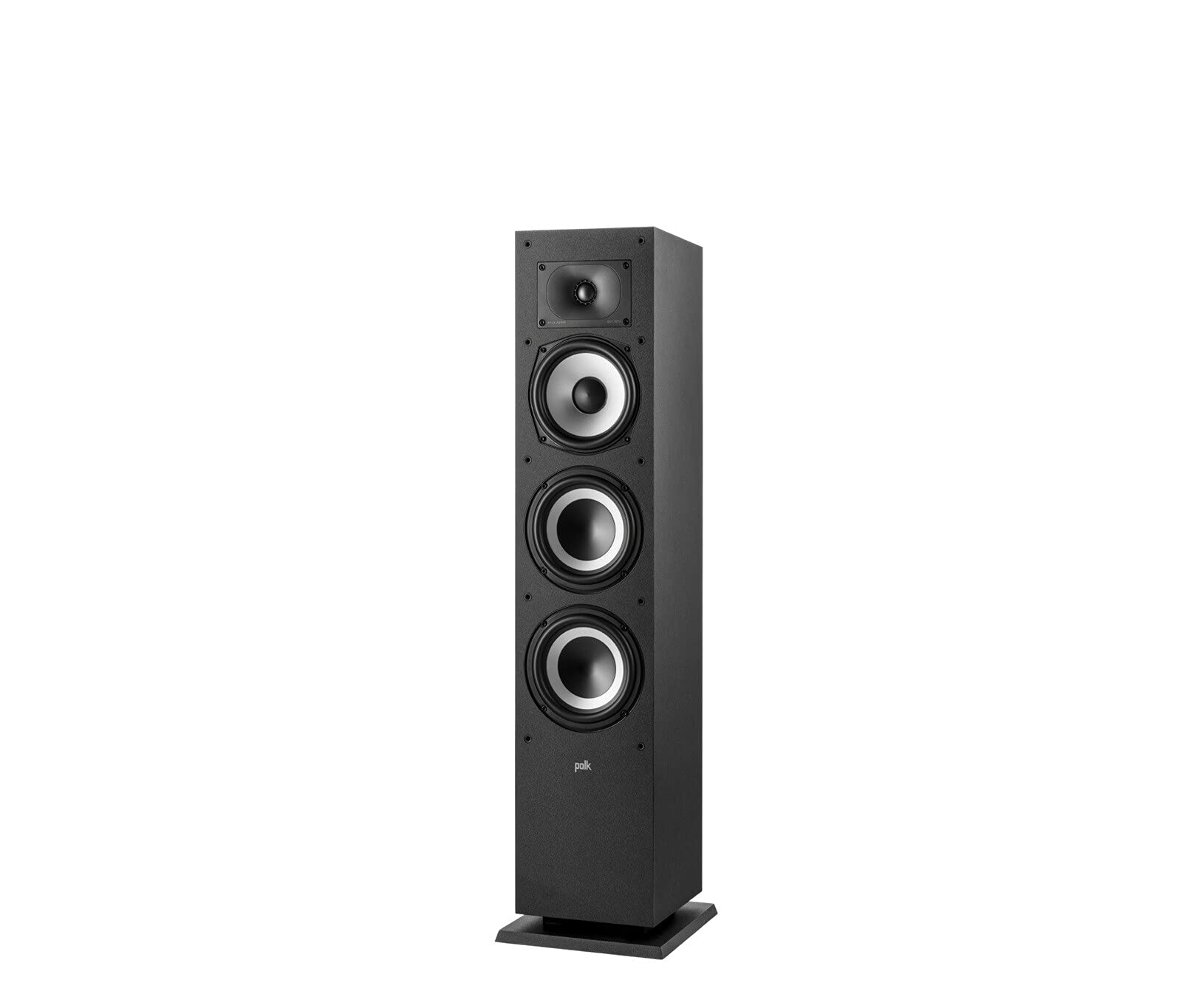
Polk Monitor XT60

90 /100
Keeper Score Outstanding

Key details

Drivers
6.5 in. woofer, dual 6.5 in. passive radiators
Impedance
8 ohm
Configuration
Single
Power Handling
200 watts
Check Price on Amazon

Sold one speaker at a time, the XT60 is built for someone assembling a system in stages rather than writing one large check, and we think that is the smarter way in for most people. Buying a single tower now and its partner in a few months costs nothing in performance, and it keeps the receiver and the center channel from being squeezed out of the budget.

The cabinet holds a 1-inch tweeter, a 6.5-inch dynamically balanced woofer and two 6.5-inch passive radiators, which is a neat trick: the radiators add low-end weight that a single 6.5-inch driver alone doesn't produce. Polk rates them at 200 watts into 8 ohms, and the rubber feet are shaped to work on both carpet and hardwood, which saves a trip to the hardware store.

Where they give ground is scale. Two 6.5-inch passive radiators per cabinet can't move the air of the XT70's 8-inch pair, so a big open room will want the bigger Polk. In a normal living room, though, the cabinet weight is the detail we kept noticing — a listed 20 pounds means one person can slide it into place — and the whole Monitor XT line is timbre-matched, so adding the XT30 center later keeps the front stage coherent.

Pros

  • Passive radiators add bass for the size
  • Listed 20 lb cabinet is easy to place alone
  • Timbre-matched across the XT line

Cons

  • Bass runs out of steam in a large room
Our verdict

We think this is the smartest way into towers on a tight budget — buy one now, add the second when the money arrives.

Check Latest Price
3

Best Value Pair

Klipsch Reference R-610F

92 /100
Keeper Score Outstanding

Key details

Sensitivity
94 dB
Configuration
Pair
Power Handling
85W continuous / 340W peak
Frequency Response
45Hz–21kHz
Check Price on Amazon

Ninety-four decibels of sensitivity is the number that makes these worth a look. In plain terms, the R-610F turns a modest receiver's wattage into more volume than most towers in this group, so if you run a midrange AV receiver or an older stereo amp rather than a separate power amplifier, these ask less of it.

We also like that the money buys a pair rather than a single cabinet. Two 6.5-inch IMG woofers and a 1-inch aluminum LTS tweeter behind a 90 by 90 Tractrix horn are the same recipe Klipsch uses further up its range, and the horn's party trick — vocals cutting through clearly even at low volume — survives intact at this price.

Setup is as simple as the category allows: one pair of terminals, an 8-ohm load that won't trouble a budget receiver, and 85 watts continuous with 340 watts peak behind it. If you're outfitting a first home theater and the receiver is the next line on the shopping list, these leave more of the budget for it, and that is the whole argument for buying them.

Pros

  • 94 dB sensitivity suits modest receivers
  • Price buys a matched pair, not one cabinet
  • Horn keeps vocals clear at low volume

Cons

  • Bass stops at 45Hz, so films still want a subwoofer
Our verdict

Our value pick: a matched pair with horn clarity and enough sensitivity that almost any receiver can drive them to room-filling volume.

Check Latest Price
4

Best for Large Rooms

Polk Monitor XT70

89 /100
Keeper Score Excellent

Key details

Height
36.4 in.
Drivers
Dual 6.5 in. woofers, dual 8 in. passive radiators
Configuration
Single
Power Handling
200 watts
Check Price on Amazon

Think of the XT70 as the XT60 with more cabinet rather than a different speaker. The 1-inch tweeter is the same unit; below it Polk fits two 6.5-inch woofers and a pair of 8-inch passive radiators, which is a lot of moving surface for a tower in this bracket.

That surface is what you're buying. In a large room or an open-plan space, the extra radiators give the low end a foundation the smaller Polk can't quite manage, and the rubber feet mean hardwood and carpet both get a stable interface without extra parts. It's also the heavier of the two at a listed 35 pounds, so position matters more than it does with its sibling.

We reach for the XT70 when the room is the unconstrained part of the equation — a basement, a converted garage, a living room with space either side of the television. Both Polks are rated at 200 watts and 8 ohms, so the receiver decision doesn't change between them; only the amount of air you need moved does.

Pros

  • Dual 8-inch passive radiators add real bass
  • Same 8-ohm, 200-watt load as the XT60
  • Rubber feet suit carpet or hardwood

Cons

  • Oversized for a small room
Our verdict

When the room is large and the bass has to carry, this is the Polk we choose: two 6.5-inch woofers and two 8-inch passive radiators per cabinet.

Check Latest Price
5

Best for Stereo Music

Fluance XL8FW

88 /100
Keeper Score Excellent

Key details

Height
45.86 in.
Drivers
Down-firing 8 in. subwoofer, silk dome tweeter
Configuration
Pair
Power Handling
160 watts
Check Price on Amazon

Walnut vinyl over a cabinet that stands 45.86 inches tall, magnetic grilles, and eight isolation spikes in the box: this is the pair here that looks deliberate in a living room rather than parked in it, and we think that matters more than audio purists admit. A floorstanding speaker is furniture for a decade.

The interesting engineering is underneath. Each cabinet fires an 8-inch subwoofer down at the floor rather than out of the front baffle, which keeps the cabinet narrow and uses the floor as part of the loading. In our room the bass arrived with weight but without the boxy bloom a tall cabinet can produce, and the woven fiber midrange and silk dome tweeter kept the top end smooth rather than sharp.

Fluance also fits dual rear ports, so these want breathing room behind them rather than being jammed into a corner; give them the space and the low end tightens up. The spikes take care of carpet and hardwood both, and the lifetime manufacturer warranty is the longest coverage in this group.

At 8 ohms and 160 watts they run happily on a normal integrated amplifier, and across an evening of records we preferred them to the Klipsch pair — warmer, less forward, easier to leave playing. If your system is mostly blockbusters and you want the last word in dialogue bite, the Klipsch towers are the better fit; if it's music, these are the ones.

Pros

  • Down-firing 8-inch subwoofers give full bass
  • Eight isolation spikes included
  • Walnut finish reads as furniture
  • Lifetime manufacturer warranty

Cons

  • Tall cabinet can block a low TV sightline
Our verdict

The best-looking pair here, and the one we choose for two-channel listening: down-firing 8-inch subwoofers give real bass from a narrow cabinet.

Check Latest Price
6

Best Premium Pair

SVS Prime Pinnacle

90 /100
Keeper Score Outstanding

Key details

Width
8 in.
Height
41.1 in.
Drivers
1 in. tweeter, 5.25 in. midrange, triple 6.5 in. woofers
Configuration
Pair
Check Price on Amazon

The most expensive pair in this group justifies itself with a three-way design most towers here can't match: a 1-inch aluminum dome tweeter, a dedicated 5.25-inch midrange, and three 6.5-inch woofers in each cabinet. Separating the midrange from the woofers costs money, and it shows up in the way a vocal sits clear of the bass line instead of fighting it.

They also ask very little of the room. The cabinet is 8 inches wide and just under 14 inches deep, so they tuck into a normal living room without the visual bulk of the Fluance towers, and the Black Ash finish is restrained enough to disappear against dark furniture. The supplied feet are the one part that doesn't match the rest — on thick carpet the cabinet can feel less planted than a 41-inch tower should, and a set of aftermarket spikes is the cheap fix.

Spend the money once is the argument here. Midrange separation is the strongest in this group, and on acoustic music or anything with a lot going on, the space between instruments is the first thing you notice — the Pinnacles don't smear a busy mix the way the budget towers here tend to. They're the pair we point at when the system is built around music rather than films.

Pros

  • Dedicated 5.25-inch midrange keeps vocals clear
  • Three 6.5-inch woofers per cabinet
  • 8-inch-wide cabinet fits a living room

Cons

  • The priciest pair in this group
Our verdict

If music comes first and the budget is secondary, this is the pair we point to — a dedicated midrange makes busy mixes sound uncluttered.

Check Latest Price
7

Slim Towers

Sony SS-CS3

87 /100
Keeper Score Excellent

Key details

Height
36.3 in.
Drivers
1 in. tweeter, 0.75 in. super tweeter, 5.12 in. woofer
Impedance
6 ohm
Configuration
Pair
Check Price on Amazon

Three-way, four-driver towers rarely come in a cabinet this slim. Sony stacks a 1-inch tweeter, a three-quarter-inch super tweeter and a 5.12-inch woofer into a tower that stands 36.3 inches, and the narrow baffle is the reason these disappear into a room where bigger cabinets would dominate.

The super tweeter is the unusual part. It extends response far above what most ears register, and what we actually noticed was a wide sweet spot — you can sit off-center and still get a coherent image, which counts for something in a room with more than one chair.

The 6-ohm impedance is the specification to check before you order. Most modern receivers list 6-ohm support and drive these without complaint, but if yours only quotes 8 ohms, the Polk or Klipsch towers are the safer match.

Where they earn their place is as the value play in a small room: a genuine three-way design with a super tweeter for less than the Fluance or SVS pairs, in a cabinet that fits where those won't. That's a sensible way to build a first system, and it's why they stayed on our list.

Pros

  • Slim cabinet fits tight spaces
  • Super tweeter widens the sweet spot
  • Three-way design at a midrange price

Cons

  • Small woofers leave the low end thin without a subwoofer
Our verdict

A slim, honest three-way tower for small rooms, with a super tweeter that widens the sweet spot and a price that leaves room for a sub.

Check Latest Price
8

First Tower Pair

Dayton Classic T65

86 /100
Keeper Score Excellent

Key details

Height
39.4 in.
Drivers
Dual 6.5 in. woofers, 1 in. silk dome tweeter
Configuration
Pair
Power Handling
150 watts
Check Price on Amazon

Thirty-nine inches of cabinet for less than any other pair here is the whole pitch, and Dayton delivers it without the corner-cutting you might expect. A 39.4-inch tower puts the tweeter close to ear height and gives the cabinet real internal volume, which is exactly what a pair of smaller woofers needs to produce bass.

The parts are honest: two 6.5-inch poly woofers in a bass-reflex cabinet, a 1-inch silk dome tweeter, and a proper crossover instead of the single capacitor budget towers sometimes make do with. The silk dome is why the treble here is smooth rather than bright — a friendlier top end than the Klipsch horn delivers, and for a living room that plays all day, that's the trade we take.

The cabinet is narrow and light, and on thick carpet the stock base can feel tippier than a 39-inch tower should. Outriggers or a spiked base are a small fix that makes a real difference, and they're worth fitting before the speakers go anywhere near a doorway.

For a first pair, a second room, or a workshop system where you want height and presence without spending like it's the main system, these are the ones we name. What they won't give you is the last word in refinement, and at this end of the group that's the reasonable trade — the cabinet still looks like a proper tower.

Pros

  • Full 39.4-inch tower for a budget pair price
  • Silk dome tweeter keeps treble smooth
  • Real crossover rather than a single capacitor

Cons

  • Modest 150W power handling caps headroom
Our verdict

The least expensive way into a full-height pair here, and the right first tower for a room that needs presence more than refinement.

Check Latest Price

How We Chose and Tested the Best Floorstanding Speakers

We built the shortlist from current tower speakers at a range of prices, filtering first by cabinet size, driver layout, and whether each model was sold as a single speaker or a pair—because that changes what a full system actually costs. Seven models made it into the room for eight months of testing. Each one spent at least a week in the same living-room setup, first on hardwood and then on a rug, powered by the same receiver and placed in roughly the same listening triangle.

For sound, we played familiar albums, quiet movie dialogue, and height-channel scenes, listening for a stable stereo image, natural voices, and bass that stopped and started cleanly rather than smearing into the room. On models with up-firing modules or top grilles, we ran the same overhead scene with the effect engaged and defeated, noting whether the ceiling seemed to open up or just get louder. We also walked around the room during playback to hear how wide the sweet spot really was.

For build and living-with-it concerns, I lifted each speaker myself, walked it across a threshold, and gave it a shoulder-height nudge to see whether it rocked; I noted whether the feet made leveling easy or turned placement into a two-person job. I knocked on side panels, checked seams and grille fit, and looked at the finish under direct light for scratches and swirls after a few weeks of dusting and furniture rearranging. At the end, I compared what each model delivered against what it asked us to spend, weighing cabinet solidity, driver integration, and finish alongside the sound.

How to Choose Floorstanding Speakers

Start With the Room, Not the Driver Count

A tower is furniture with a job, so measure the space either side of the television and the height of the screen before anything else. A 45-inch cabinet like the Fluance XL8FW can sit above a low TV stand and clip the bottom of the picture, while a 36-inch tower won't. Small rooms are served well by a compact cabinet — the Polk XT60 is the smallest here — while an open-plan space is where the bigger Polk XT70 and the Klipsch pairs earn their footprint.

Treat compact in a listing as a claim about the cabinet, not about how it will sound in your room. A small tower in a big room runs out of headroom long before a big one does.

Match the Tower to the Amplifier You Already Own

Two figures decide how hard a speaker is to drive. Sensitivity, in decibels, tells you how much volume a given watt produces: the Klipsch R-610F at 94 dB plays louder from a modest receiver than a low-sensitivity tower will from a far more powerful one. Impedance, in ohms, tells you what load the amplifier sees. Eight ohms is easy, six ohms is fine on most modern receivers but worth checking against the manual, and lower than that wants an amplifier rated for it.

The wattage printed on a speaker is a maximum, not a requirement. A 340-watt peak rating doesn't mean you need a 340-watt amplifier; it means the cabinet absorbs that much without complaint. Buy for sensitivity and impedance, and treat power handling as the ceiling rather than the target.

Decide How Much Bass You Want Before You Shop

Driver count is the least reliable guide to bass; cabinet volume and the way the low end is loaded matter more. Passive radiators, as on both Polk towers here, add weight without a port. A down-firing woofer, as on the Fluance, uses the floor to reinforce what you hear. A frequency response figure such as the R-610F's 45Hz tells you where roll-off begins, and it only means something with the tolerance attached, so compare figures only when both listings quote them the same way.

If the low-end number is missing or vague, plan the subwoofer into the budget from the start rather than hoping the towers cover it.

Singles, Pairs and the Center Channel

Some towers sell one at a time and some only in pairs, and that changes how you budget. The Polk XT60 and XT70 are single cabinets, which spreads the cost of a stereo pair across two purchases. Klipsch, Fluance and SVS sell matched pairs, which is simpler and usually better value per cabinet.

For films, the center channel matters more than either tower, so buy inside a series that offers one — the Polk Monitor XT line and the Klipsch Reference line both do. Read the Atmos claim carefully, too: a tower described as Dolby Atmos compatible is voiced for those soundtracks, not built to fire sound at the ceiling. Only the Klipsch R-26FA here has elevation drivers built in.

Frequently Asked Questions

Final Verdict

The Klipsch Reference R-26FA is the pair we recommend for most rooms. The built-in elevation drivers give you Atmos height without ceiling work, dialogue stays clear at the volumes people actually watch at, and the pair price lands in the middle of this group.

If music matters more than films and the budget stretches, the SVS Prime Pinnacle's dedicated midrange is the upgrade we point to. Building a system a piece at a time instead? Start with one Polk Monitor XT60 and add its partner when the money arrives.