Best Bookshelf Speakers of 2026

Bookshelf speakers are the rare audio upgrade that doesn't ask for a whole wall. The first fork in the road isn't brand or wattage — it's whether the pair comes powered, with amplification built in, or passive, which means you supply the amp. That one choice sets your budget, your cable count, and how much shelf space the system really eats.

I've kept a pair on my media console for years, and I've learned that what sounds huge in a demo room can turn boomy three feet from a wall. So my team spent six months living with ten pairs — records on a Saturday morning, a laptop desk through the workweek, movie nights where dialogue matters more than explosions — moving them between rooms and swapping amps in and out. We judged sound first, then how quickly each made music out of the box, how the finish held up to a real living room, and whether the tone controls and placement tweaks actually bought us anything. The picks below are the ones I'd happily keep.

Keeper Score summarizes customer ratings and review volume. Read it alongside the product details and trade-offs. How the score works.

1

Best Overall

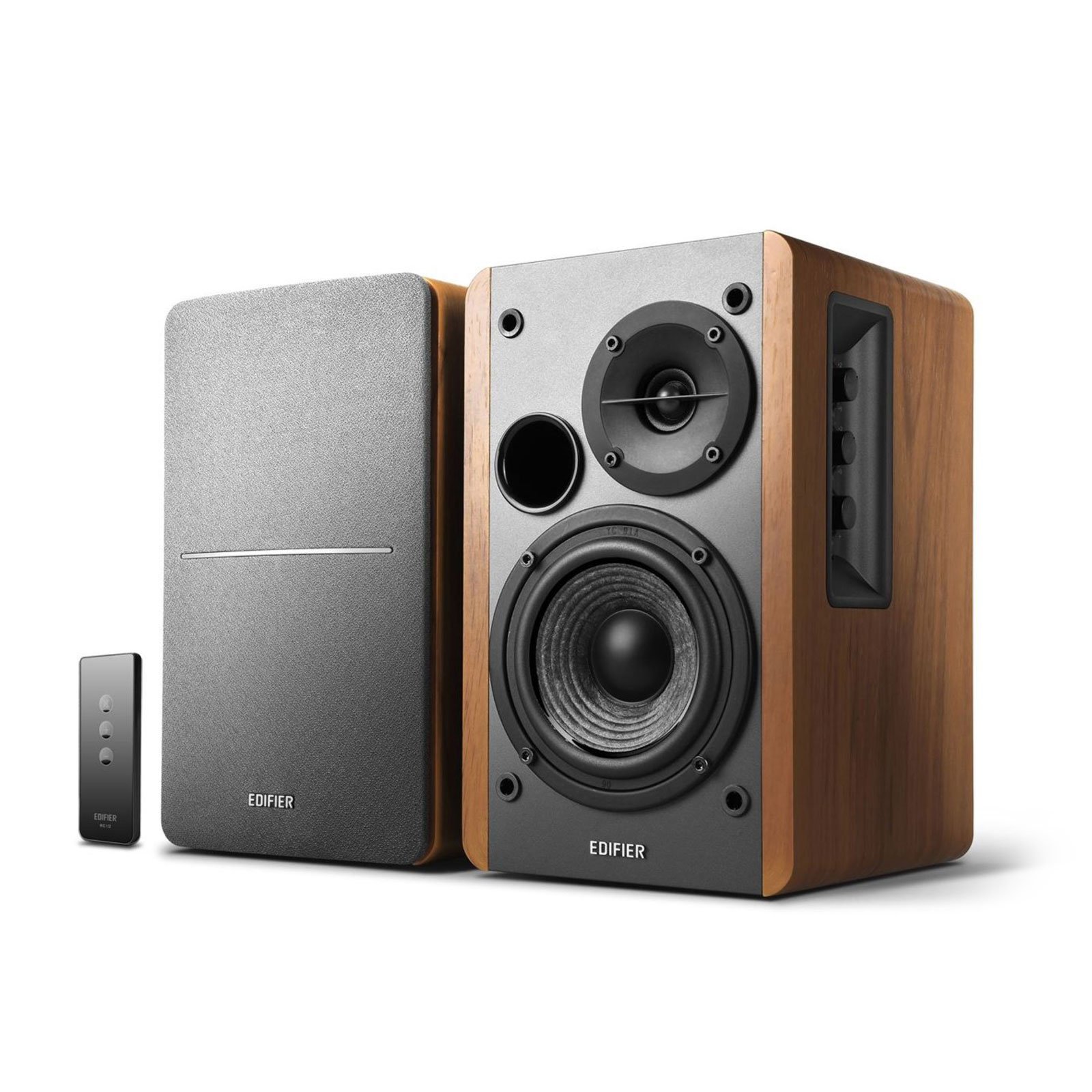
Edifier R1280T

93 /100
Keeper Score Outstanding

Key details

Power
42 W RMS, powered
Inputs
Dual RCA and 3.5 mm AUX
Drivers
4 in. woofer, 13 mm tweeter
Controls
Side-panel EQ knobs, remote
Check Price on Amazon

If you don't already own an amplifier, the R1280T removes that problem entirely. The left cabinet carries the amplification, a single cable runs to the right one, and RCA or 3.5 mm leads take a turntable, a TV or a laptop. Five minutes after the box is open you're listening, with no receiver to buy, match or find shelf space for.

It's the pick we hand to most people, and the sound is why. A 4-inch woofer and 13 mm silk dome tweeter give a warm, slightly forgiving presentation that flatters streaming and vinyl alike, and 42 watts RMS fills a living room or home office without strain. We were also impressed by how little plumbing it needs: both inputs stay live, so moving from a record player to a phone is a matter of pressing play, not swapping cables.

The side-panel knobs are the detail we appreciated most after a week. Bass and treble are physical dials that stay where you put them, so a speaker sitting close to a wall or on a hollow shelf can be tamed without an app or a menu. The remote handles volume from across the room, which sounds minor until the speakers are wired to a TV.

The wood-effect vinyl looks better than that phrase suggests, and the cabinets read as furniture rather than computer gear, which matters if these are going in a living room instead of a den. Set them up with a little air around them and the bass stays tidy rather than boomy.

Pros

  • Amplification built in, no receiver needed
  • Two inputs stay live at the same time
  • Physical bass and treble knobs hold their setting
  • Wood-look cabinets that pass as furniture

Cons

  • Runs out of volume in a large room
Our verdict

If you want better sound than a soundbar without buying an amplifier, we think this is the easiest yes on the page.

Check Latest Price
2

Best Passive for Home Theater

Polk Audio T15

95 /100
Keeper Score Outstanding

Key details

Type
Passive pair, 8 ohm
Drivers
5.25 in. woofer, 0.75 in. tweeter
Mounting
Wall-mountable keyhole slot
Power Handling
100 W
Check Price on Amazon

The T15 pair makes no sound on its own. There's no amplifier inside, so a receiver or a small integrated amp is part of the purchase, and if you already own one, that's precisely why these belong on your shortlist. Polk builds them for the front or rear channels of a surround system, and the integrated keyhole slot on the back means they can hang on a wall instead of eating shelf space.

As a first home-theater pair, nothing else here does the job as cleanly. The 5.25-inch Dynamic Balance driver gives dialogue and explosions real body, and 100 watts of power handling means an ordinary AV receiver has headroom to spare. Polk sells a matching center channel and tower pair, so these can grow into a 5.1 system rather than being replaced by one.

Placement is where they earn their keep. At 6.5 inches wide, they slot onto a bookshelf, sit on stands, or hang beside a TV without dominating the room, and the black cabinet disappears behind its grille. Aim them slightly inward toward the listening seat, because the 0.75-inch tweeter is small and angling the pair at your ears is what pulls voices into focus.

Get the amplifier right and the rest follows. At 8 ohms they're an easy load for almost any receiver, and money saved on the speakers is better spent there than on cables. Hook them to a decent receiver and they'll outlast the television they're sitting under.

Pros

  • Easy load for almost any AV receiver
  • Hangs on a wall with a built-in keyhole slot
  • Grows into a matched 5.1 system
  • Compact enough for a bookshelf or stand

Cons

  • Bass stops short without a subwoofer
Our verdict

A receiver is the price of entry here, and if you already have one, we'd start a surround system with this pair.

Check Latest Price
3

Best Premium Passive

Klipsch RP-600M II

93 /100
Keeper Score Outstanding

Key details

Type
Passive pair, 8 ohm
Cabinet
MDF with vinyl finish
Drivers
6.5 in. woofer, 1 in. titanium tweeter
Power Handling
400 W max
Check Price on Amazon

Klipsch's Tractrix horn is the most divisive thing in this guide. A 90 by 90 degree silicone composite horn sits in front of a 1-inch titanium tweeter, and it pushes detail forward, so guitars, cymbals and film dialogue arrive with an immediacy some listeners find thrilling and others find relentless.

That character rewards good recordings and punishes bad ones. Compressed streaming files and harsh masters get shown up, so pair these with a warm, reasonably powerful amplifier rather than the cheapest one on the shelf. Feed them well and the horn stops sounding like a spotlight and starts sounding like space around the instruments.

With the right amp, this is the best-sounding passive pair here for music and movies alike. The 6.5-inch Cerametallic woofer gives kick drums and low strings genuine weight, the MDF cabinet feels dead and solid when you knock on it, and the rear terminals are substantial enough to take serious cable without a fight.

Efficiency is the quieter advantage. The horn design swings dynamics out of modest amplification, which is why the RP-600M II works so well with a small integrated amp and a turntable. If you're building a two-channel system and want to hear what your records are actually doing, this is the pair we reach for.

Pros

  • Deep, weighted bass from a 6.5-inch woofer
  • Horn tweeter pulls out detail and dynamics
  • Dead-sounding cabinet that resists resonance
  • Plays loudly on modest amplification

Cons

  • Heavy cabinets want stands rather than shelves
  • Vinyl wrap rather than real wood veneer
Our verdict

Pair these with a warm amplifier and good recordings and we think you'll stop shopping for speakers for a long time.

Check Latest Price
4

Best for Small Rooms

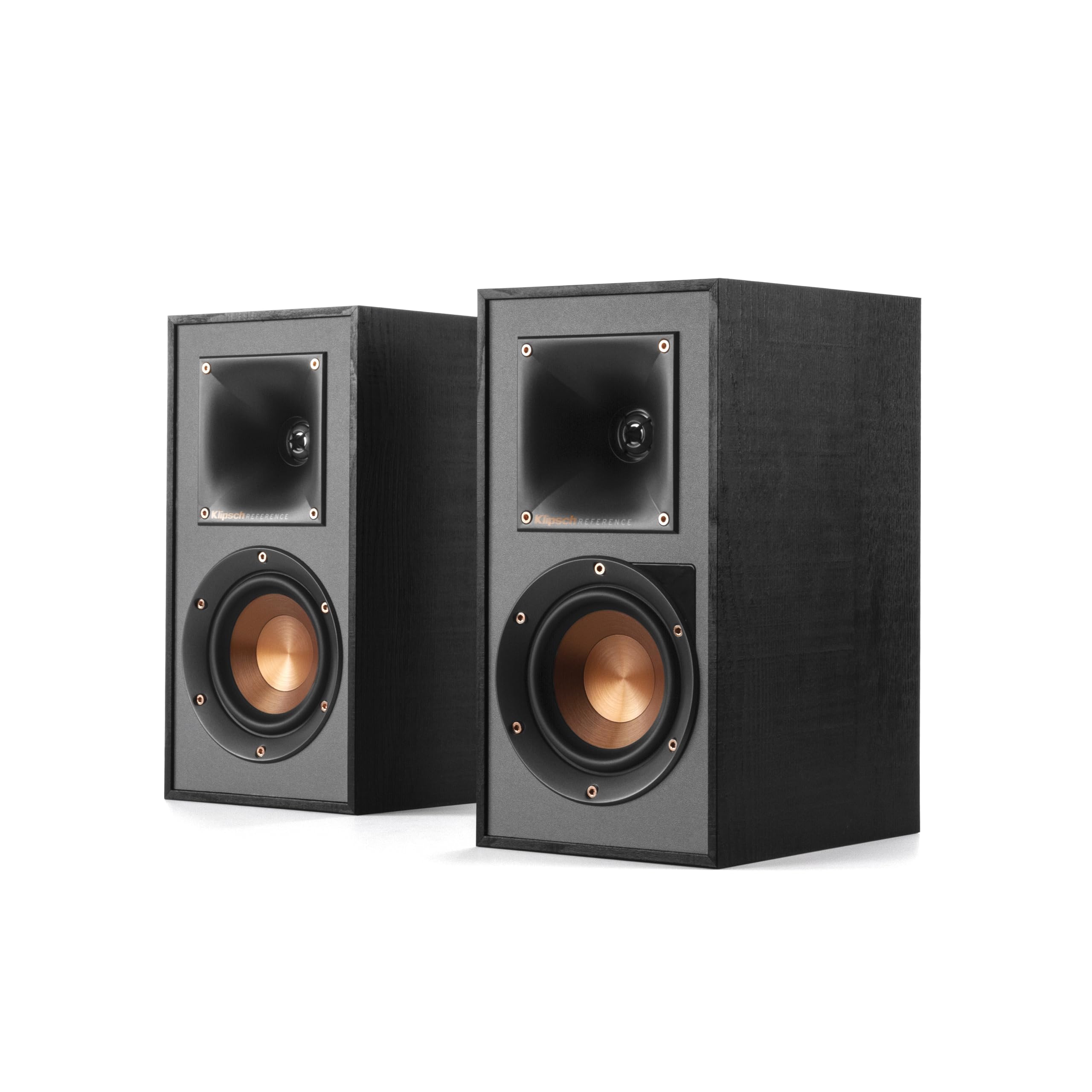
Klipsch R-41M

95 /100
Keeper Score Outstanding

Key details

Type
Passive pair, 8 ohm
Drivers
4 in. woofer, 1 in. aluminum tweeter
Sensitivity
90 dB
Power Handling
50 W cont., 200 W peak
Check Price on Amazon

The R-41M is the RP-600M II's smaller sibling, and you feel the difference the moment you pick one up. A 4-inch spun-copper woofer replaces the 6.5-inch unit, the cabinet stands 11.3 inches tall, and what survives the downsize is the horn, the same 90 by 90 degree Tractrix profile in front of a 1-inch aluminum tweeter.

The number that matters is 90 dB. That sensitivity figure means these get loud on very little power, so a compact desktop amp or the surround channel of an AV receiver can drive them without strain. In a small room, that's a bigger practical advantage than another twenty watts of handling capacity.

They also disappear more gracefully than anything else here. At 5.75 inches wide and under 8 inches deep they fit between books on a shelf, on a monitor riser, or on a wall bracket, and the blacked-out cabinet with its copper woofer is the only decoration you get. If your room is already busy, that restraint is a feature.

We keep coming back to these for small spaces. The treble is forward, as the horn implies, and a bare room with hard floors will tell you so, but a rug and a couple of soft chairs settle it. What you're buying is clarity at low volume and genuine output when a modest amp has nothing else to give.

Pros

  • Loud on very little amplifier power
  • Very small footprint for tight shelves
  • Copper woofer and black cabinet look understated
  • Easy 8-ohm load for receivers

Cons

  • Bass rolls off early without a subwoofer
Our verdict

If your room is small and your amplifier is modest, start here: nothing else in this group gets this loud on this little power.

Check Latest Price
5

Best for Desk and Studio

Edifier MR3

89 /100
Keeper Score Excellent

Key details

Power
18 W x 2 RMS, powered
Extras
Headphone output, app EQ
Inputs
Balanced TRS, RCA, AUX, Bluetooth 5.4
Drivers
3.5 in. mid-bass, 1 in. tweeter
Check Price on Amazon

Set the MR3 pair either side of a laptop and the near-field idea clicks. The 3.5-inch mid-bass drivers and 1-inch tweeters are aimed at a head a couple of feet away, and at that distance the sound holds together well before you reach the limit. Of the powered pairs here, this is the one we put on a working desk.

The connectivity is why. Balanced TRS, RCA and AUX inputs sit alongside Bluetooth 5.4 with multi-point, plus a headphone output, so an interface, a phone and a set of headphones all have a home without a switcher. There's also no external power brick to lose under the desk, which sounds trivial until you've kicked one loose halfway through a session.

The sound is flat and honest rather than flattering, which is the point of a monitor. Music, Monitor and Custom modes plus the app EQ let you add warmth for casual listening, and the cabinets look better in person than the listing photos suggest, with a copper ring around each driver. The volume knob has no markings, so a repeatable level takes a glance at the app.

Pros

  • Balanced TRS, RCA, AUX and Bluetooth in one pair
  • Headphone output saves a separate interface
  • Flat response suits editing and listening
  • No external power brick under the desk

Cons

  • Maximum output suits near-field use only
  • App EQ is fiddlier than the on-board controls
Our verdict

For a desk that mixes work and music, we think the MR3 is the most useful powered pair here.

Check Latest Price
6

Best High-End

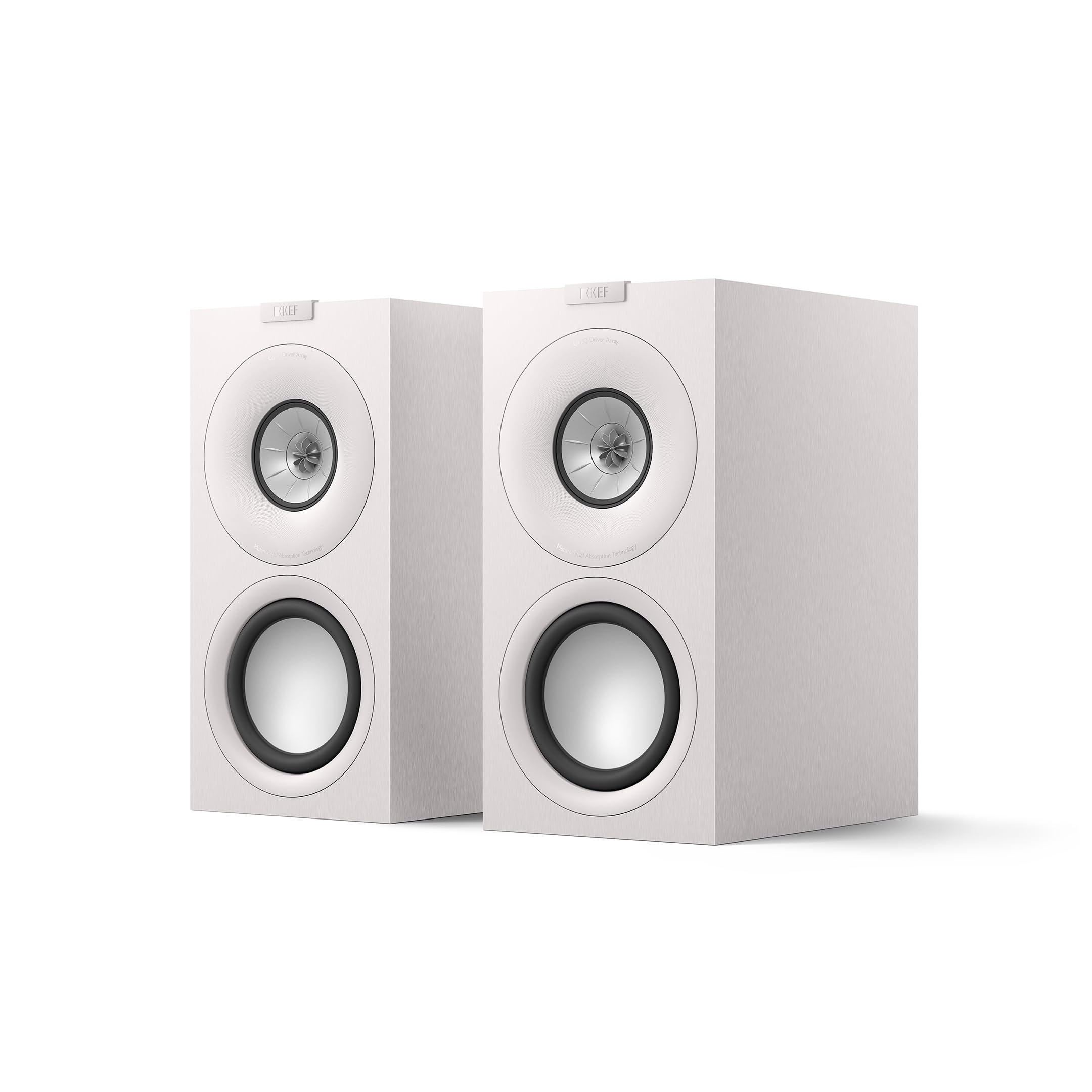
KEF Q Concerto Meta

88 /100
Keeper Score Excellent

Key details

Type
Passive pair, 4 ohm
Drivers
6.5 in. bass driver, 3-way Uni-Q
Dimensions
12.4 D x 8.3 W x 16.3 H in.
Power Handling
180 W
Check Price on Amazon

The Q Concerto Meta assumes you've already sorted the rest of the chain: a good integrated amplifier, a source worth hearing, and a room where you can leave space behind the cabinets. Nothing about this pair is plug-and-play, and that's rather the point.

What the outlay buys is a true three-way design: a 6.5-inch hybrid aluminum bass driver, a dedicated midrange, and KEF's 12th-generation Uni-Q array with the tweeter mounted at the acoustic center of the midrange so both radiate from one point. Metamaterial Absorption Technology sits behind the tweeter and soaks up unwanted rear energy.

In use, the result is calm rather than fireworks. Voices stay anchored between the speakers, the cabinets seem to vanish, and the bass has weight without a subwoofer in the chain. With 180 watts of power handling on tap, the pair will take a serious amplifier, and it will also tell you quickly whether the amplifier is serious.

This is the best-engineered speaker on the page, and the one we're most careful about recommending. It's a substantial purchase, it wants stands and breathing room, and it rewards a listening chair more than a sofa in the corner. Build a system around it that you intend to keep for a decade and it's the pick that ends the upgrade itch.

Pros

  • True three-way design with dedicated midrange
  • Pinpoint imaging from a single acoustic source
  • Takes serious amplifier power
  • Bass weight without a subwoofer

Cons

  • Wants a 4-ohm-capable amplifier
  • Exposes a weak source or recording
Our verdict

This is the pair for someone who has already invested in the rest of the system and wants the speakers to be the last upgrade.

Check Latest Price
7

Detailed Stereo

Sony SS-CS5M2

90 /100
Keeper Score Outstanding

Key details

Type
Passive pair, 6 ohm
Drivers
5.12 in. woofer, 3-way
Dimensions
8.7 D x 7 W x 13.2 H in.
Power Handling
100 W
Check Price on Amazon

Three drivers in a cabinet this size is unusual. The SS-CS5M2 pairs a 5.12-inch woofer with a 0.98-inch tweeter and a super tweeter, splitting the work with a proper crossover instead of asking two drivers to cover everything.

The payoff is a wide, tall soundstage. Strings and cymbals occupy their own space rather than smearing into the midrange, and detail survives at low volume, which is exactly where a lot of budget speakers give up. We were struck by how much of a recording came through with the volume barely above a background level.

We rate the Sony higher on detail than the Polk T15 and lower on value, and which one you want comes down to what you're listening to. For stereo music at a desk or in a study, the extra driver earns its keep. In a surround system where a subwoofer handles the bottom end, the difference matters less than the money left over for the receiver.

Pros

  • Three-way array gives a wide soundstage
  • Detail holds up at low volume
  • Bass reflex cabinet adds low-end weight

Cons

  • Asks more money for detail a surround setup won't reveal
Our verdict

For stereo music at a desk or in a study, we think the extra driver earns its keep; for surround, the money is better spent elsewhere.

Check Latest Price
8

TV and Desk

Saiyin DS6701S

88 /100
Keeper Score Excellent

Key details

Power
30 W x 2, powered
Inputs
Bluetooth 5.3, optical, coaxial, RCA, AUX
Drivers
3.75 in. woofer, 0.5 in. tweeter
Controls
Remote and on-board buttons
Check Price on Amazon

Count the inputs: Bluetooth 5.3, optical, coaxial, RCA and 3.5 mm, plus a remote and a pair of cabinets 8.5 inches tall. The DS6701S is the least expensive way here to connect several sources at once, and the optical input is the one that matters if a television is involved.

We treat it as a convenience-first speaker, and on those terms it delivers. The 3.75-inch woofers and 30 watts per channel give a warm, bass-forward sound that's genuinely fun with television and background music, and one cable from a TV replaces the usual scramble for a headphone jack.

The remote is the weak link. It handles volume and input switching, and it doesn't always land on the first press; the buttons on the speaker cover the same jobs, so the fallback is an arm's length away. Set the pair up expecting to use those buttons now and then and nothing about it will annoy you.

Pros

  • Optical, coaxial, RCA, AUX and Bluetooth in one pair
  • One optical cable handles TV sound
  • Small enough to sit either side of a screen

Cons

  • Treble hardens at higher volume
Our verdict

If you need one inexpensive pair to handle a TV, a phone and a turntable, we think this is the practical answer.

Check Latest Price

How We Tested: Six Months, Ten Pairs, Three Rooms

The shortlist came from spec sheets and long owner threads, sorted by amplification type, input selection, cabinet size, and price band, then trimmed to pairs that could plausibly carry a normal living room without a subwoofer doing the heavy lifting. That left ten pairs, which we ran for six months rather than an afternoon.

Each one spent time in the same three spots: on a media console flanking a TV, on a desk either side of a laptop, and on a kitchen counter wired to a turntable. We played the same short set — a bass-heavy track, a sparse vocal recording, a dialogue-dense movie scene — at late-night volume and again as loud as an apartment reasonably allows, listening for where the low end smeared and when a cabinet started to buzz.

Setup was timed. Powered pairs went from box to first song with a stopwatch running, and passive pairs got dinged for the extra cabling and amp matching they demanded. We swept every tone and volume control through its full range to hear whether the adjustment did anything useful, paired phones over Bluetooth where it was offered, and plugged in the sources we actually own. Placement got its own pass: we shoved each pair back against the wall to hear how much boominess crept in, then toed and pulled them forward until the center image locked.

Last, we looked at them the way a guest would, under lamplight and next to real furniture. A pair that sounds wonderful but reads as a black plastic brick in a small room loses ground, and so does a finish that scuffs the first time you dust it.

How to Choose Bookshelf Speakers

Powered or Passive Comes First

A powered pair like the Edifier R1280T carries its amplification inside one cabinet: one purchase, one power lead, and nothing to match. A passive pair like the Polk T15 needs a receiver or integrated amplifier, which costs more up front but lets you change the electronics later, spread the speakers across a surround system, and keep the speakers when the amp ages out.

If you own no amplifier and want music this weekend, buy powered. If you already have a receiver or you're planning a 5.1 setup, buy passive and put the difference into the electronics, which is where most of the sound quality actually comes from.

Match the Amplifier, Not the Wattage

Impedance and sensitivity decide more than the power figure on the box. An 8-ohm speaker is an easy load for nearly any receiver, while a 4-ohm design like the KEF Q Concerto Meta needs an amplifier rated to drive it. Sensitivity tells you how loud a speaker gets for a given watt, which is why the Klipsch R-41M's 90 dB rating lets a small amp fill a small room.

Before you buy a 4-ohm speaker, check your amplifier's manual for its 4-ohm rating. If it doesn't list one, that speaker is the wrong match for it, however good the speaker is.

Measure the Shelf Before the Driver

Cabinet size tracks bass extension closely. A 4-inch woofer in a compact box gives midrange and a hint of low end, a 5.25-inch driver adds body, and a 6.5-inch design like the Klipsch RP-600M II digs properly into the bass, at 15.75 inches tall and 13 inches deep.

Compact in a listing means it fits a shelf, not that it fits yours. Measure height, width and depth, leave a little space behind the cabinets, and accept that anything much over 15 inches tall is realistically a stand speaker rather than a bookshelf one.

Count Your Sources and Decide About Bass

Inputs are where inexpensive pairs get caught out. If a TV is one of your sources, an optical input or a receiver is the clean path; a 3.5 mm lead from a headphone jack works, but you end up using the TV's volume control rather than the speaker's. Bluetooth is fine for background listening, though a wired connection is better for anything you care about.

For films, budget for a subwoofer as part of the system. No bookshelf pair at this size replaces one, though the larger cabinets here get close enough for music in a normal room.

Frequently Asked Questions

Final Verdict

For most people, the Edifier R1280T is the answer: built-in amplification, two live inputs, and a warm, room-filling sound in a single purchase, with a remote that keeps volume within reach. It's the pair we point to first, and the one that leaves the least to get wrong.

If you already own a receiver, or you're building a surround system, the Polk T15 is the better use of the same money because it hands the amplification decision to you. And if your amplifier is already the best part of your system, the KEF Q Concerto Meta is where this list ends.