Best Cutting Mats of 2026

A cutting mat is the one surface in a sewing room that's meant to take abuse: rotary blades, utility knives, pins pushed in harder than they need to be. The good ones are built like a sandwich — a stiff core, a printed grid, and a top layer that lets a blade pass through and then closes back over the slit. That's all "self-healing" really means, and it's also the claim mats exaggerate most.

I've been cutting on these for years, mostly on a kitchen table I had no intention of replacing, and over the past six months my team and I ran 12 mats through real projects — quilting, leather, paper. Size mattered more than any label: if you can't rotate a yard of fabric on it, you'll be back to scissors by the second block. The thicker mats also carry a PVC smell for the first week or so, and color isn't purely cosmetic — a soft gray is easier to work on under a bright lamp than a saturated green.

Everything below earned its table space; which one suits you comes down mostly to how big a mat your setup can hold.

Keeper Score summarizes customer ratings and review volume. Read it alongside the product details and trade-offs. How the score works.

1

Best Overall

Fiskars 18 x 24 Mat

96 /100
Keeper Score Outstanding

Key details

Grid
Double-sided; 30/45/60-degree bias lines
Size
18 x 24 inches
Weight
1.5 lb
Warranty
Lifetime
Check Price on Amazon

The 18 x 24-inch Fiskars is the mat we recommend first because it fits the way most people actually cut: a fat quarter, a pattern piece, a stack of paper, or a small quilt block, with enough room to move a ruler without clearing the whole table. The grid is printed on both sides, one light gray and one dark, and the 30-, 45-, and 60-degree bias lines are the detail we use most. We found the white markings stayed legible against both dark fabric and pale paper, which is not true of every mat in this size.

The surface behaves best with a sharp rotary cutter and a light pass. Fine lines close reasonably well, and the mat does not grab the blade or leave a fuzzy edge on fabric. The 1.5-pound weight is the other practical advantage: we can lift it off a dining table and stand it behind a door without needing a second pair of hands. The reversible gray faces are a small pleasure, too—the light side is easier for dark fabric, the dark side for pale paper.

What keeps it in our rotation is the combination of a usable size, a readable grid, and a lifetime warranty. It is not the mat for someone who cuts full-width yardage every day; a 24 x 36 mat earns that space. What we trust most is the consistency of the grid: when the light side gets scuffed, the dark side gives you the same measurements on a fresh surface.

Pros

  • Fits common tables at 18 x 24 inches
  • Readable grid and bias lines on both sides
  • Light 1.5-pound body is easy to move
  • Lifetime warranty adds long-term cover

Cons

  • Deep utility-knife scores remain visible
Our verdict

For most sewers and crafters, the Fiskars 18 x 24 is our default: it fits a real table, the grid reads on both sides, and 1.5 pounds is easy to move.
Check Latest Price
2

Best Large Premium

Dahle Vantage 10673

95 /100
Keeper Score Outstanding

Key details

Grid
22 x 34 inches
Size
24 x 36 inches
Color
Black
Construction
1/8-inch PVC, 5 layers
Check Price on Amazon

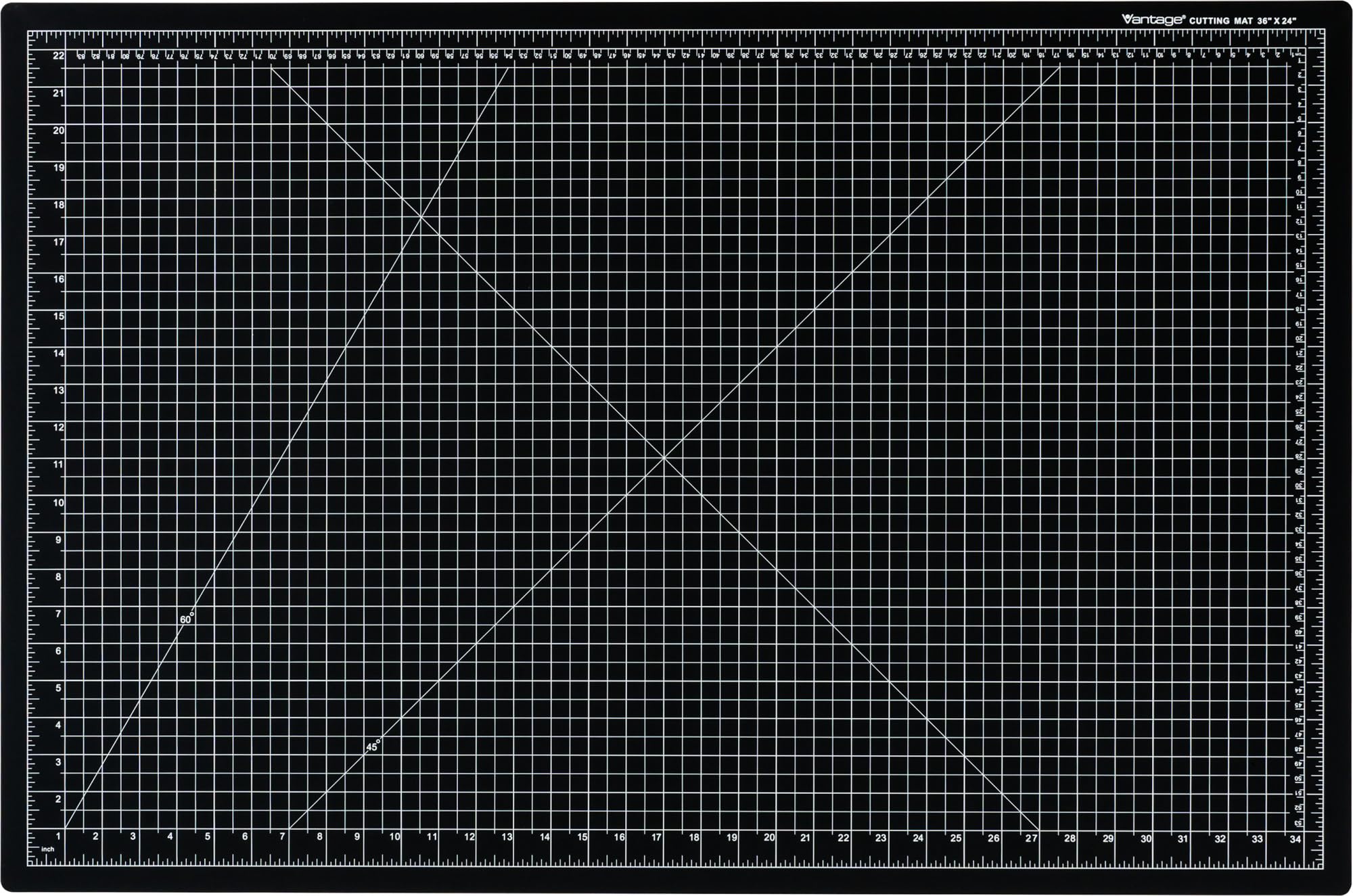
The Dahle Vantage is what a cutting mat looks like when it is built to stay on a table. The 24 x 36-inch sheet is large enough for a full width of fabric, and the five-layer, 1/8-inch PVC has a dense, slightly matte surface that absorbed the pressure of our rotary cutter without bowing at the edges. It is the kind of mat you set up once and leave in place.

We noticed the 22 x 34-inch grid leaves a useful border, and the white markings on black are easy to read for long sessions. The black color also makes small cut pieces and light fabric edges easier to see. It is a premium mat, and it feels like one: heavy, flat, and unlikely to slide when you press down on a ruler.

The practical catch is storage. At 2.27 kg, this is not a mat you move from table to shelf every evening, and it wants to stay flat rather than be folded away. The reward is a surface that feels stable under a full quilt sandwich. If you have a dedicated cutting table, the Dahle is the mat that will make you stop shopping for another one.

Pros

  • Thick 1/8-inch, five-layer PVC
  • Full 24 x 36-inch cutting area
  • Black surface keeps white markings clear

Cons

  • Grid is printed on one side only
Our verdict

For full-width yardage on a dedicated table, we choose the Dahle Vantage: a thick, stable 24 x 36 surface that stays put and reads clearly in black.

Check Latest Price
3

Best for Rotary Cutting

OLFA RM-MG Rotary Mat

94 /100
Keeper Score Outstanding

Key details

Grid
One side gridded, one plain
Size
24 x 36 inches
Blade Use
Rotary cutters only
Thickness
1.5 mm
Check Price on Amazon

The OLFA RM-MG is built for rotary cutting, and that focus shows. The 24 x 36-inch surface is only 1.5 mm thick, so it lies low on a table and lets a rotary cutter glide without the blade feeling like it is climbing onto a cushion. We used it for long strips and half-square triangles; the cuts came away clean, and fine blade lines closed enough that they did not steer the next pass. The size also gives you room to keep a long ruler steady across multiple layers of fabric.

One side is printed with the grid, and the other is plain. The plain face is useful for tracing, laying out fabric without lines, or giving yourself a clean surface when the printed side starts to show wear. The green color is easy on the eyes over a long session, and the white grid stays visible under a clear ruler. The 2.3-pound sheet still lifts off a table when you need it to.

Pros

  • Thin 1.5 mm surface lets a rotary blade glide
  • Large 24 x 36-inch area for yardage
  • Plain reverse gives a second work surface

Cons

  • Not for fixed-blade utility knives
Our verdict

For large rotary-cutting projects, the OLFA RM-MG is the specialist we trust: a clean 24 x 36 surface and a thin sheet that lets the blade glide.

Check Latest Price
4

Best Large Budget

WORKLION 24 x 36 Mat

95 /100
Keeper Score Outstanding

Key details

Grid
Double-sided inch/metric; 30/45/90 degrees
Size
24 x 36 inches
Color
Green/blue
Layers
5-layer PVC
Check Price on Amazon

The WORKLION is the large mat for someone who wants the 24 x 36-inch working area without paying premium prices. The five-layer PVC is firm enough to support a rotary cutter, and both sides carry inch and metric grids with 30-, 45-, and 90-degree guides. We found it especially good for laying out a whole pattern piece or cutting several strips at once, where the extra room saves more time than a fancy surface would.

The grid is clear, the green and blue faces are easy to tell apart, and the mat has enough heft to keep from skating when you press down. It is not the last word in refinement—the edges are simple, and the surface has a slight new-PVC smell—but those are fair trade-offs for the size.

What we keep coming back to is the usable area. A mat this size gives you room to cut a full skirt panel or a quilt backing without repositioning, and the double-sided grid means you can flip it when one face gets scuffed. The mat's real luxury is not the surface; it's not having to move the fabric.

Pros

  • Large 24 x 36-inch area for less
  • Double-sided grids with 30/45/90-degree guides
  • Five-layer PVC feels firm under a rotary cutter

Cons

  • Deep cuts can leave visible tracks
Our verdict

The WORKLION is our budget route to a full 24 x 36 mat: a double-sided grid, five-layer PVC, and enough room for whole pattern pieces.

Check Latest Price
5

Best Compact Heavy-Duty

Idemeet A3 Mat

95 /100
Keeper Score Outstanding

Key details

Grid
Double-sided inch/metric; angle guides
Size
12 x 18 inches (A3)
Density
1.32 lb
Thickness
0.28 inch
Check Price on Amazon

Compact mats usually feel like placemats. The Idemeet A3 does not. Its 600-gram density-upgraded build gives the 12 x 18-inch sheet a solid, slightly weighty feel, and the 0.28-inch thickness keeps it flat when you press a ruler down at the edge. We noticed the difference most when cutting small pieces: the mat stayed put instead of trying to follow the blade.

The grid is printed on both sides with inch, metric, and angle marks, and the pink face is a nice change from the usual green—easy to spot in a pile of fabric and pleasant to work on. The density is what makes the mat feel different: it sits still under a ruler, even when you are cutting close to the edge.

It is still a 12 x 18 mat, so it is not the one for cutting a full width of backing or a long border strip. For a desk, a class, or a small sewing station, the smaller footprint is the point. The thicker build is what makes it worth choosing over the cheap A3 mats that flex at the corners.

Pros

  • Dense 600-gram build stays flat
  • Double-sided inch, metric, and angle markings
  • Compact 12 x 18 size fits a desk

Cons

  • Working area is limited to 12 x 18 inches
Our verdict

When desk space is tight, we reach for the Idemeet A3: a dense, flat-lying 12 x 18 mat that feels more substantial than most compact mats.

Check Latest Price
6

Best for Precision Detail Work

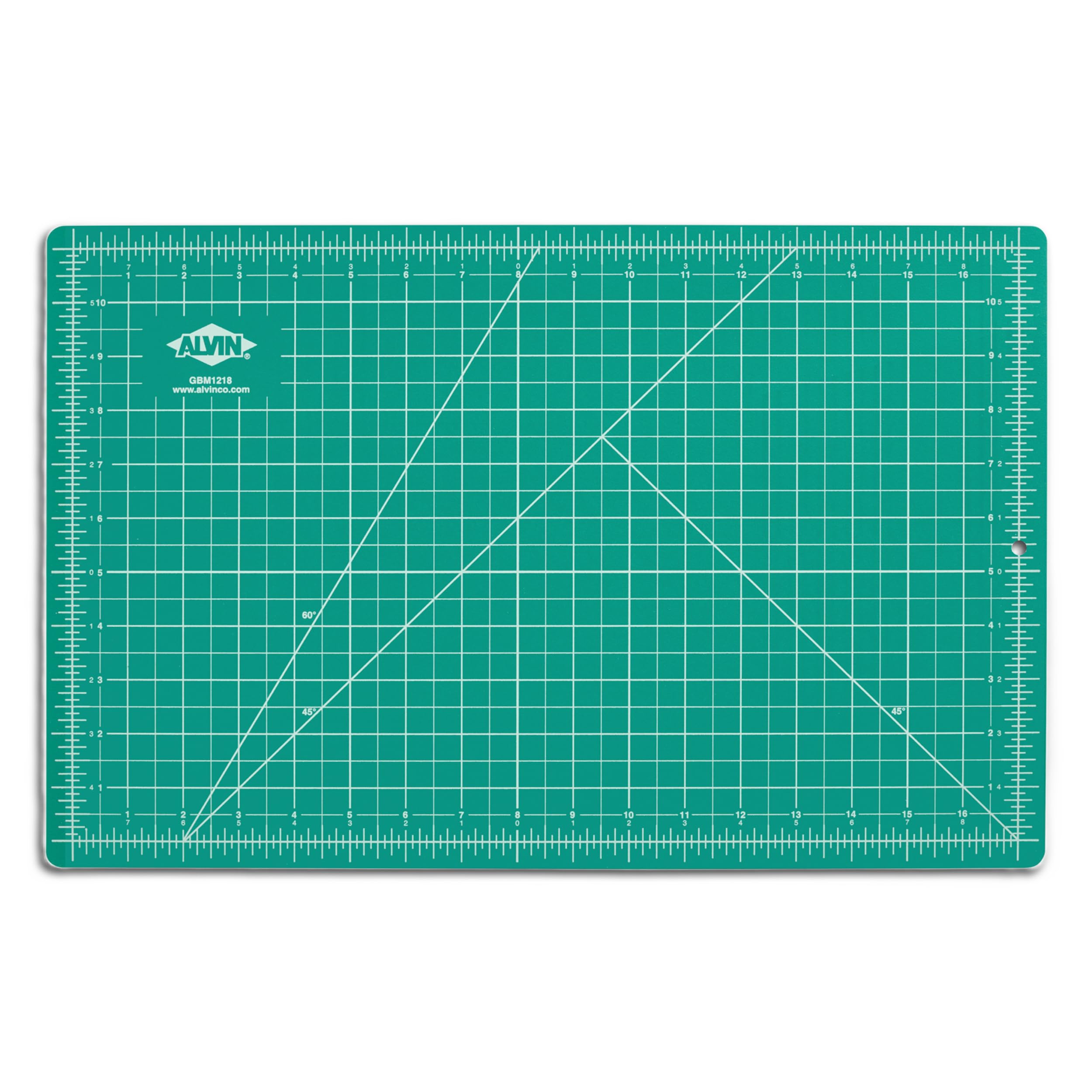
ALVIN GBM1218 Mat

95 /100
Keeper Score Outstanding

Key details

Grid
1/2-inch; 45/60-degree guides
Size
12 x 18 inches
Sides
Green/black, both gridded
Thickness
3 mm
Check Price on Amazon

The ALVIN GBM1218 has the feel of a drafting-shop tool rather than a hobby mat. It is a 12 x 18-inch sheet of 3 mm composite vinyl, green on one side and black on the other, and both faces are gridded with half-inch lines and 45- and 60-degree guides. We liked the black side for white paper and pale fabric; the white markings are crisp, and the dark background makes edges easier to see.

At 8 ounces, it is light enough to move around, but it does not behave like a floppy sheet. The surface has enough texture to hold a ruler a little better than a glossy mat, which matters when you are cutting small pieces or trimming a seam allowance. We kept it on a desk for model parts and paper templates, where the small size is an advantage rather than a limitation.

The green side is the one we use for fabric, since the lighter background makes dark threads and cut lines easier to see. Both sides are gridded, so a scuffed face does not retire the mat. The half-inch grid does the quiet work: it makes trimming a seam allowance or squaring a small block feel deliberate.

Pros

  • 3 mm vinyl with a rigid feel
  • Both green and black faces are gridded
  • Half-inch grid and 45/60-degree guides

Cons

  • Can warp when exposed to heat
Our verdict

For precise small-scale work, we like the ALVIN GBM1218: a rigid 3 mm vinyl mat with a fine half-inch grid on both sides.

Check Latest Price
7

Light Crafting

Anezus A3 Rotary Mat

95 /100
Keeper Score Outstanding

Key details

Grid
Double-sided inch/metric; angle guides
Size
12 x 18 inches (A3)
Layers
5-ply PVC
Thickness
0.28 inch
Check Price on Amazon

The Anezus is the mat we leave out for quick jobs: trimming a pattern, squaring a small block, cutting vinyl, or protecting the table while the kids use paper. It is 12 x 18 inches, five-ply PVC, and listed at 0.28 inch thick, but at 200 grams it is one of the lighter mats here. That lightness makes it easy to pick up and turn, which is exactly what you want at a small desk.

The double-sided grid is the reason to choose it over a no-name mat. Inches, metric, and angle lines are printed clearly, and the green surface gives good contrast against pale fabric and white paper. We do not make it the only mat for a serious quilter—it is best for light, occasional cutting—but it covers the basics without making you feel like you settled.

The reverse side doubles the useful life: when one grid gets scuffed, flip it over and keep going. The mat is light enough to live in a drawer, and that is its real talent—it is ready when you need a clean surface, not a production table.

Pros

  • Clear double-sided inch, metric, and angle grid
  • Light 200-gram body is easy to move
  • Five-ply PVC construction

Cons

  • Can flex when carried by one corner
Our verdict

For light crafting on a budget, we recommend the Anezus A3: clear double-sided markings in a light, easy-to-move mat.

Check Latest Price
8

Small Workspaces

Headley Tools A3 Mat

93 /100
Keeper Score Outstanding

Key details

Grid
Double-sided metric and imperial
Size
12 x 18 inches (A3)
Layers
5-layer PVC
Thickness
3 mm
Check Price on Amazon

The Headley Tools mat is a 12 x 18-inch sheet with a 3 mm, five-layer PVC build and a gray side and a black side. We found the gray face easier for pencil layouts and light fabrics, while the black side made white card stock and pale paper stand out. The two-tone design is more useful than it sounds: it gives you a visual change when you flip the mat, not just a fresh surface.

It stays flat on a desk, which is the main thing for a small-format mat. At 16 ounces, it has enough weight to resist sliding without being a chore to move, and the metric and imperial grid is printed on both faces. We used it for model parts and paper templates, where a stable surface matters more than a huge cutting area.

The self-healing surface is best treated as a working surface. It recovers from light cuts, and a fresh blade keeps the lines finer. The 3 mm edge gives it a more substantial feel than the thin mats that flex as soon as you lift them. For paper craft and model work, that flatness matters more than a perfect erase.

Pros

  • Flat-lying 3 mm, five-layer build
  • Gray and black faces with metric and imperial grids
  • 16-ounce weight resists sliding

Cons

  • Deep scores can remain visible
Our verdict

For modelers and paper crafters with a small desk, we like the Headley Tools A3: a flat-lying, dual-color mat with a clear metric and imperial grid.

Check Latest Price

How We Tested Cutting Mats

We started with the mats that turn up again and again in quilting shops and sewing forums, then narrowed by construction: how many layers, whether the grid is printed on both sides, which sizes a maker can actually buy, and cost per square inch. Twelve mats came in. Testing ran six months across two setups — a dedicated sewing desk and a dining table that gets cleared for dinner every night.

Most of the work was ordinary: trimming quilt blocks, cutting bias strips with a rotary cutter and acrylic ruler, squaring up leather straps, scoring cardstock with a utility knife. We rotated a full yard of fabric on each mat to see how much of it we could turn without lifting the ruler, and checked whether the mat could sit beside a machine without swallowing the whole desk.

Durability got the harshest treatment. We ran a blade over the same two-inch strip dozens of times, then tilted the mat under a raking lamp to look for scoring that never closed up. Each mat spent a week folded at one corner to see whether it sprang back or stayed curled. We sniffed every mat straight out of the wrapper and again two weeks later, noting which ones off-gassed quickly and which kept that PVC smell. For appearance, we cut under a bright task lamp at night to judge whether the grid lines stayed legible against glare and against dark fabric.

Value came last: cost per square inch, weighed against how the surface looked after the blade tests. The mats that held up are still flat, still readable, and still free of scars.

How to Choose a Cutting Mat

Start with the working area

A 12 x 18-inch mat is the portable choice: enough for small quilt blocks, paper, and model parts, and easy to tuck beside a desk. An 18 x 24 mat is the best all-round size for most sewers because it handles a folded width of fabric without taking over the room. A 24 x 36 mat earns its space only if you regularly cut yardage or full quilt backs. Measure the table, too—an overhanging mat can bow and throw off a long cut. Check the printed grid: a 24 x 36 sheet may have a 22 x 34 grid, as the Dahle does.

Match the surface to the blade

Self-healing mats are formulated for different cutting tools. A rotary cutter needs a surface that lets the blade pass and then closes the fine line; a utility knife needs a thicker mat that can absorb a deeper score. The OLFA RM-MG is a rotary-only design, while the thicker PVC mats here suit cardboard, foam board, and mixed crafts. Use a sharp blade and light passes. Pressing hard shortens any mat's life and leaves tracks that do not close, no matter what the label promises.

Read the grid like a tool

Half-inch lines are standard for quilting, but the details decide whether a mat is pleasant to use. Look for inch and metric markings, 45- and 60-degree bias lines if you cut angles, and numbers that sit close enough to the edge to be useful. A double-sided grid doubles the working life, which is why we favor mats such as the Fiskars and WORKLION for mixed sewing and crafts. If you work mostly with dark fabric, a light grid is easier to see; for pale paper, a dark face can be better.

Thickness, weight, and storage

A five-layer mat around 3 mm thick is a sensible middle ground: thick enough to buffer a rotary blade, thin enough to lie flat and store easily. Heavier mats stay put but are awkward to move; lighter ones suit a shared table. Store any PVC mat flat and away from heat and direct sunlight—warping is the most common way a good mat stops being accurate. If a new mat has a chemical smell, air it in a ventilated room before you use it on fabric; a hot car is the wrong place to speed that up.

Frequently Asked Questions

Final Verdict

Our default is the Fiskars 18 x 24. For most sewers, quilters, and crafters it hits the useful middle: a readable grid on both sides, a surface that works with a rotary cutter, and a weight that lets you clear the table when dinner is ready.

Choose the Dahle Vantage if you cut full-width yardage on a dedicated table and want the densest, most stable surface here. Choose the OLFA RM-MG if rotary cutting is the whole job. The small 12 x 18 mats make sense when space, not capability, is the constraint.