Best Car Phone Chargers of 2026

A car charger only proves itself the day your phone drops to 4 percent with twenty minutes of navigation left. That's when you find out whether the thing in the console does what the box promised — and plenty don't, since the big wattage number is usually the total across all ports, not what your phone actually gets. A good one fixes both: every phone in the car charges at a decent clip, and nobody's untangling a cable nest at a red light.

My team and I have spent five months living with 15 of these on commutes, weekend road trips, and a few long summer drives where the console got too hot to touch. The retractable models earned their keep, but only the ones whose cords reeled back cleanly after several hundred pulls.

The bigger surprise was how differently they handled two phones at once; plenty that flew with one device slowed to a trickle with a passenger plugged in. The picks below are the ones that held their speed.

Keeper Score summarizes customer ratings and review volume. Read it alongside the product details and trade-offs. How the score works.

1

Best Overall

LISEN Retractable 84W

91 /100
Keeper Score Outstanding

Key details

Total Output
84W
Built-in Cables
USB-C and Lightning, 31.5 in
Charging Points
2 cables plus 2 USB ports
Peak USB-C Output
45W PD
Check Price on Amazon

Two charging cables live inside this plug: one USB-C, one Lightning, both pulling out to 31.5 inches and winding back when you let them. That is the reason it is our top pick. Loose cords are what make a car console messy, and this is the only design we tested that removes them at the source instead of asking you to tidy up after them.

The rest of the hardware carries its weight. There are four charging points in total — the two built-in cables plus a pair of USB ports for a passenger's own cord — and the USB-C side is rated to 45W PD, which moves a modern phone quickly rather than merely holding its charge. Two phones plugged in at once both keep climbing, which is what we watched for on longer drives.

The built-in cords are the part to watch. A cable that coils into a reel has a harder life than one that hangs loose, and the USB-C cord is the piece most likely to stop making contact first. The pair of spare ports is what saves it: if a reel cable gives up, the unit keeps working as an ordinary adapter with your own cord.

LISEN backs it for two years, the longest warranty of the eight here, and the price sits in the middle of the group — about what a decent cable and a plain adapter cost bought separately. The reels also keep the cables with the car, which is the part nobody plans for until the good cord walks off in someone's bag.

Pros

  • USB-C and Lightning cables built in
  • Four charging points with 45W USB-C PD
  • Cables retract instead of dangling
  • Two-year warranty, longest in this group

Cons

  • Charging only, with no CarPlay or data
  • Heavy body can sag in a worn socket
Our verdict

This is the one we hand people who charge more than one phone in the car: two built-in cables, four charging points and nothing dangling into the cupholder.
Check Latest Price
2

Best for a Single Phone

KENHAO 67W 3-Port

95 /100
Keeper Score Outstanding

Key details

In The Box
3 ft USB-C to USB-C cable
Total Output
67W
USB-A Output
30W QC
USB-C Output
37W PD
Check Price on Amazon

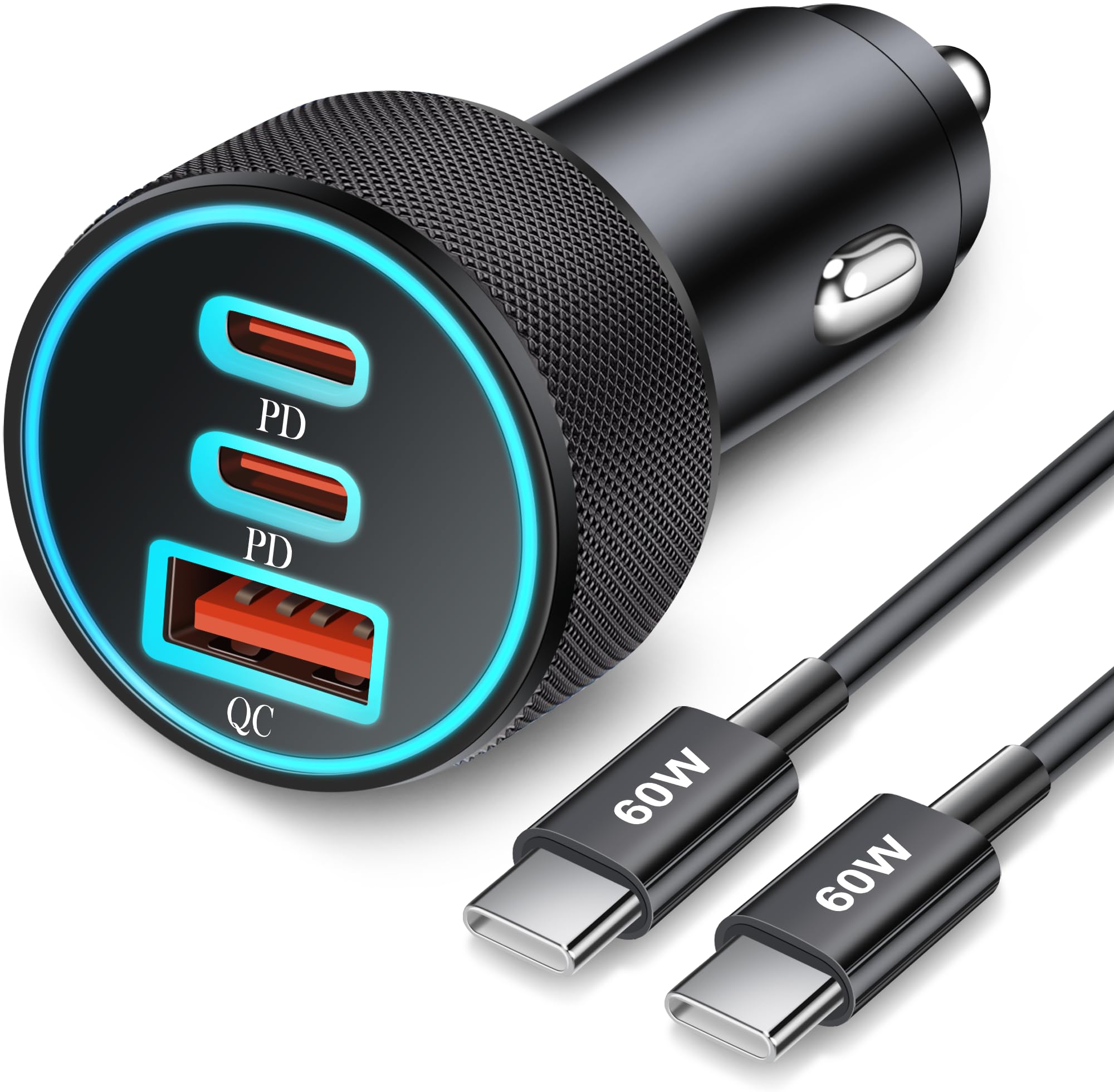
No reel, no display, no cable built in: the KENHAO is a short metal plug with three ports and a three-foot USB-C cable in the box. It is the smallest thing here and the least fussy — push it into the socket and the body almost disappears against the dash.

We rate it the best plain adapter of the group. The USB-C port is rated 37W PD and the USB-A side 30W QC, with 67W across the three ports, so a phone fast-charges while a second device charges at a normal rate. A tablet will trickle rather than race, which is the honest limit of a plug this size. What it has going for it is that nothing in the design can break except the plug itself. The included cable matters more than it sounds, too: the port's speed needs a C-to-C cable to reach it, and this one comes in the box.

Pros

  • Three ports and a cable in the box
  • Small metal body sits close to the dash
  • Steady fast charging for a phone

Cons

  • 37W ceiling will not fast-charge a tablet
  • No cable built into the body
Our verdict

Our pick for a single phone and a cable you already own: the simplest adapter here, with the cable included and no mechanism to wear out.

Check Latest Price
3

Best for a Full Car

SUPERONE 99W Retractable

93 /100
Keeper Score Outstanding

Key details

Total Output
99W
Exposed Height
3.17 in
Built-in Cables
USB-C and Apple, 31.5 in
Charging Points
6
Check Price on Amazon

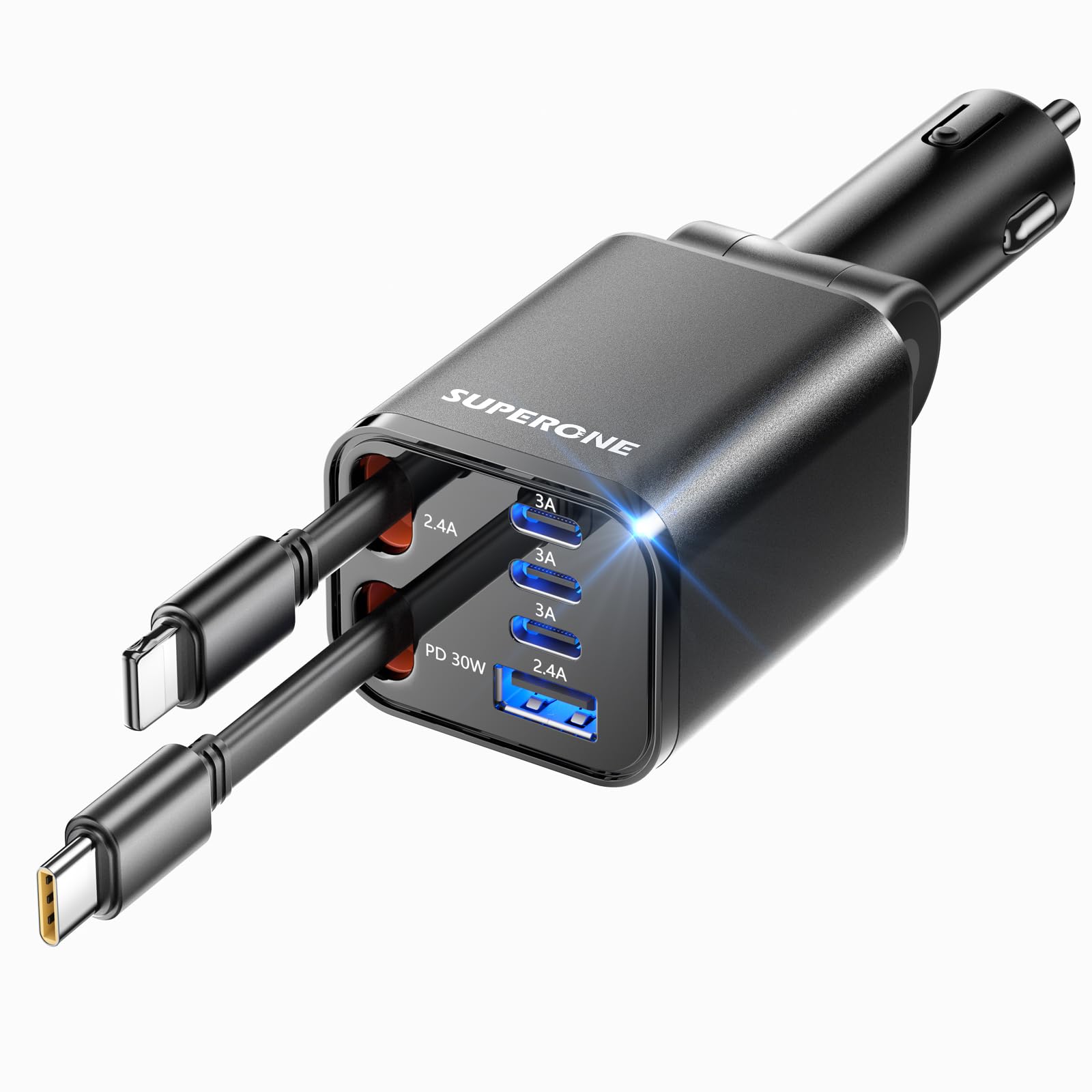
Six charging points is the number to hold onto: two built-in retractable cables, three USB-C ports and a USB-A, all fed from one socket. The cables run about 31.5 inches — one is a 30W PD USB-C, the other an Apple cable rated 12W — and the plug pivots 180 degrees so you can aim them away from the gear lever.

The body is small for what it holds, 2.14 inches long and 1.31 wide, though it stands 3.17 inches proud of the socket. That is more than a bare adapter and enough to notice under a shallow console lid.

Where it lands is a car that is regularly full. Four people can charge at once without anyone unplugging anyone else, and the retractable pair means the two front seats do not need their own cords. Retraction is the bit that gives us pause — a reel that stops winding leaves a cable hanging out permanently, which turns the neatest design here into the messiest. Even so, it does more at once than anything else in this group for the money.

Pros

  • Six charging points from one socket
  • Cables cover USB-C and Apple devices
  • Plug pivots 180 degrees

Cons

  • Cables can stop retracting
  • Stands 3.17 inches out of the socket
Our verdict

For a car that is regularly full, this is the one: six charging points, two retractable cables and a pivoting plug that keeps cords off the console.

Check Latest Price
4

Best Four-Port Value

JUNVANG 90W 4-Port

92 /100
Keeper Score Outstanding

Key details

Ports
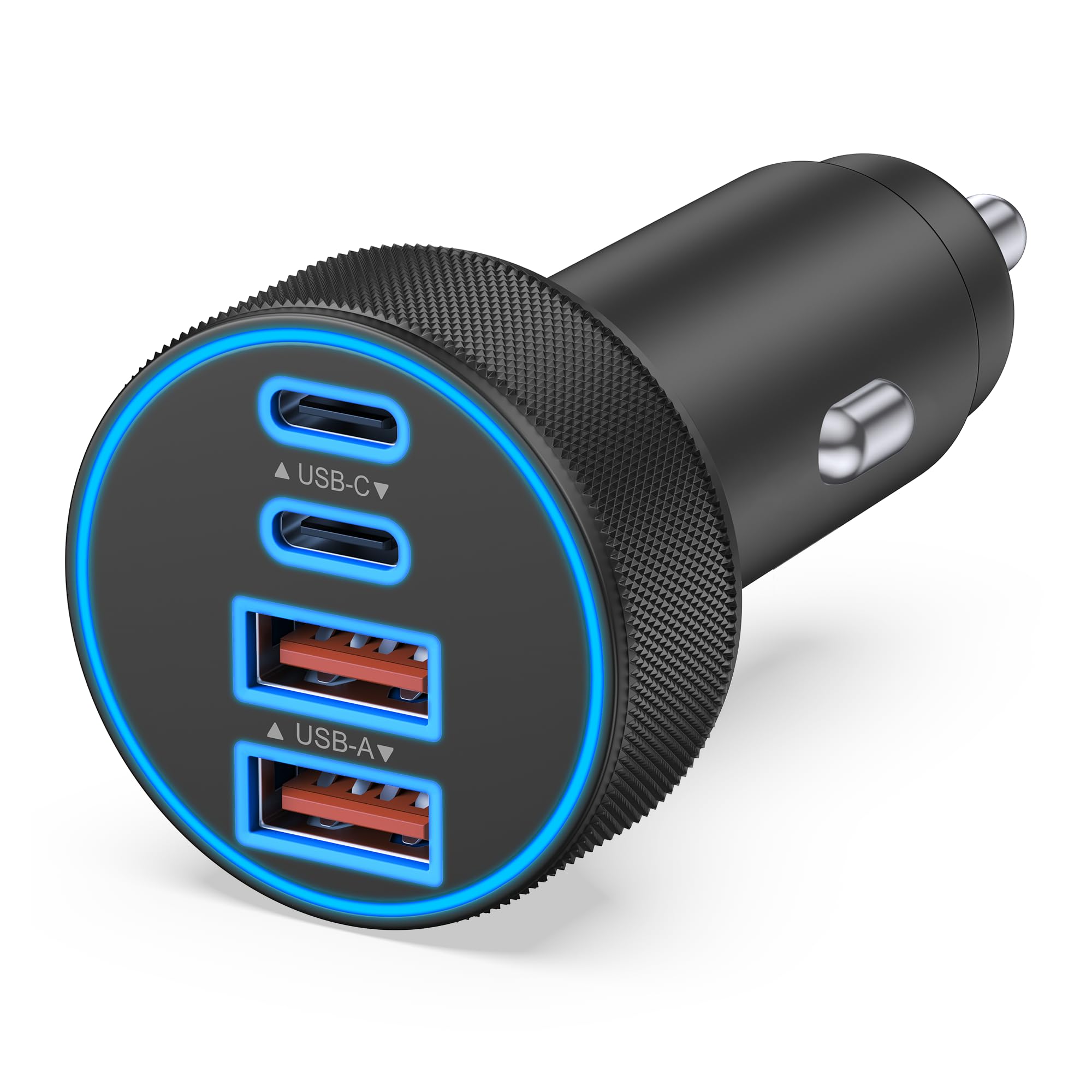
2 USB-C, 2 USB-A
Body Size
2.71 × 1.56 in
Total Output
90W
Peak USB-C Output
45W
Check Price on Amazon

Ninety watts sounds generous until you divide it. This is a four-port adapter — two USB-C, two USB-A, 45W maximum on each USB-C — and the total is a budget shared across whatever is plugged in, so the fourth device is where the maths starts to bite. We rate it the best value here for getting several people charged at once, as long as nobody expects a full-speed port to themselves.

Read the split rather than the headline: two phones and a tablet together charge more slowly than either would alone, which is true of every multi-port unit here. What we noticed is the layout. At 2.71 inches long and 1.56 wide with a metal body, four cables fit side by side without fighting, and the whole thing stays clear of the console lid.

Longevity is the open question. The body and the port connections are what give out, so treat this as a good-value workhorse rather than something you buy once and keep for a decade. For road trips with a couple of tablets and a pair of phones, it earns its place anyway.

Pros

  • Four ports, two of them 45W USB-C
  • Compact metal body
  • Gives four people their own socket

Cons

  • Four ports share one 90W budget
  • Ports and body are the weak point over time
Our verdict

The value pick for a car full of devices: four ports, 45W on each USB-C, and a small metal body that stays out of the way.

Check Latest Price
5

Best for Tablets and Laptops

JUNVANG 130W Voltage Display

92 /100
Keeper Score Outstanding

Key details

Ports
2 USB-C, 1 USB-A
Display
Voltage readout
Total Output
130W
Included Cable
240W USB-C, 3 ft
Check Price on Amazon

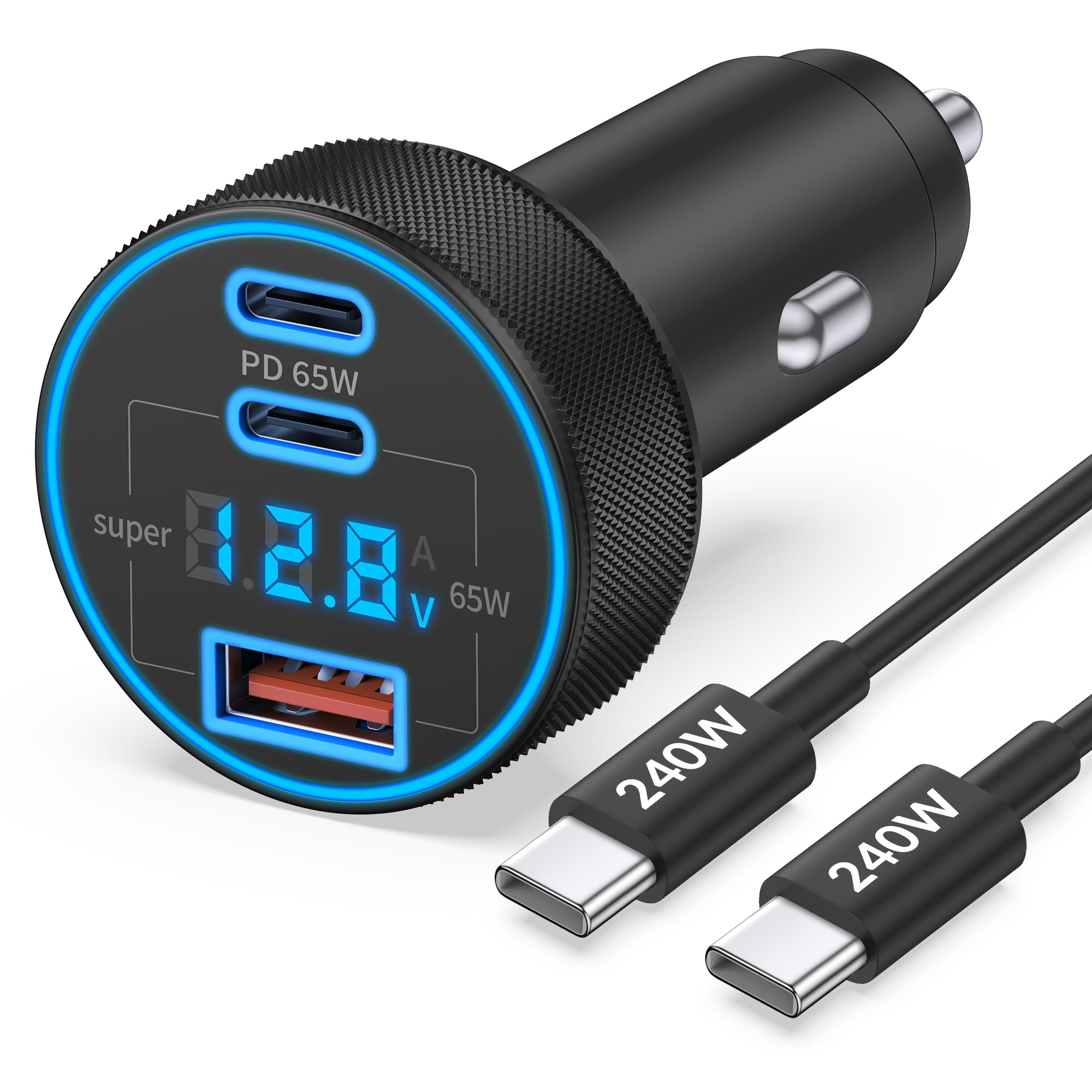
A voltage readout is the sort of thing you do not know you want until a cold morning turns the engine over slowly. This adapter puts the number in an LED display on the body, so you can watch what the battery is doing with the engine off — the only one of the eight that tells you anything about the car rather than the phone.

We think the hardware underneath justifies the display. There is 130W across three ports, a 240W-rated USB-C to USB-C cable in the box and a metal body, which is headroom enough for a tablet or a smaller USB-C laptop next to a phone.

It is the pick here for anyone charging more than phones, and the price reflects it — this is the most expensive adapter in the group by a clear margin. The 130W is also a combined figure: one device gets its port's share rather than the headline number, so check what your laptop actually draws before counting on a full-speed top-up.

Pros

  • Voltage display for watching the battery
  • 130W across three ports
  • 240W USB-C cable included

Cons

  • The most expensive adapter here
  • 130W is shared, not delivered to one device
Our verdict

Buy it if you charge tablets, a laptop or a dash cam: the voltage display alone makes it the most useful adapter in this group.

Check Latest Price
6

Best Low-Profile Two-Pack

LISEN 69W 2-Pack

93 /100
Keeper Score Outstanding

Key details

Body
Aluminum, flush-fit
Pack Size
2 chargers
USB-A Output
18W QC
USB-C Output
36W PD
Check Price on Amazon

Flush is the whole idea here. The aluminum body is thumb-sized and sits nearly level with the socket surround, so nothing catches on a knee and nothing holds a console lid open.

Power is split modestly: 36W PD on the USB-C side, 18W QC on the USB-A, and no cable in the box. That is enough to fast-charge a phone on the C port while a second device charges steadily alongside, and it is why the thing stays this small — no reel, no display, no extra ports.

We rate it the best low-profile option of the eight, and the two-pack is the practical part: one for the daily driver, one for the weekend car or a travel bag. The grip is firm enough that ours took a deliberate pull to remove from a well-worn socket, which is a better problem than a loose one. Two ports each is the ceiling, so a household with three phones will want more sockets.

Pros

  • Sits flush with the socket
  • Aluminum body with USB-C PD and USB-A
  • Two chargers in the pack

Cons

  • Two ports and no cable included
  • Durability is the weak point
Our verdict

The one to leave in the socket and forget about: flush, aluminum, small enough to ignore, and you get a spare for the other car.

Check Latest Price
7

Budget Retractable

EloBeth 75W Retractable

91 /100
Keeper Score Outstanding

Key details

Body
ABS, 4.13 oz
Display
Voltage readout
Built-in Cables
Apple and USB-C, 31.5 in
Charging Points
4
Check Price on Amazon

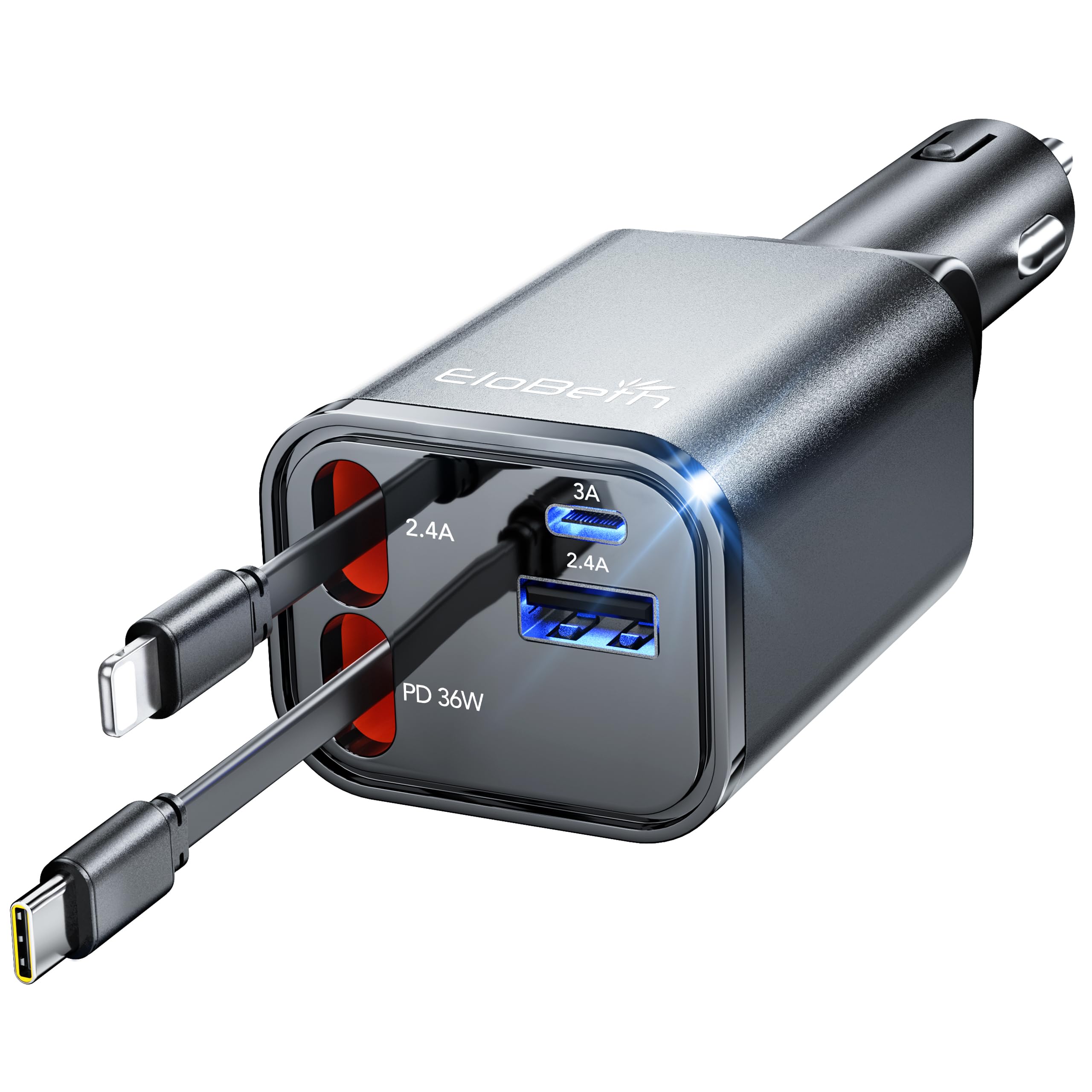
If the LISEN retractable is the one we reach for first, this is the one that does most of the same job for less. Two cables coil inside — one Apple, one USB-C — both extending about 31.5 inches, with a USB-C and a USB-A port on the body alongside them.

There is a small voltage readout on the face, which is a nicer touch than the price suggests: it shows what the socket is delivering rather than just glowing to say it is on.

The cables are the part that decides how long you keep it. A cord on a reel is asked to bend and straighten thousands of times, and the ends are where these units give out — the body usually outlives the cable. It is the same trade every retractable here makes, and the reason the cheapest of them is not automatically the best buy.

As a value proposition it still earns its place: four charging points, both cable types and a voltage display, for less than the retractable we recommend first. Buy it for a second car or a commute rather than the vehicle that does the long-haul miles.

Pros

  • Four charging points and two cable types
  • Voltage readout on the body
  • Cheaper than our top retractable

Cons

  • Cord retraction can jam
  • Charging only, with no CarPlay or data
Our verdict

A sensible budget retractable: both cable types, four charging points and a voltage readout, as long as you do not need it to last for years.

Check Latest Price
8

Two-Car Budget

power-7 70W 2-Pack

90 /100
Keeper Score Outstanding

Key details

Ports
1 USB-C, 2 USB-A
Pack Size
2 chargers
Total Output
70W
USB-C Output
40W PD
Check Price on Amazon

Two chargers, three ports each, and one of the lowest prices in this group. As a way to put a usable socket in two cars at once, nothing here gives you more sockets for the money.

Each unit carries a 40W PD USB-C port and two 30W QC USB-A ports, 70W in total, in a body small enough to sit comfortably in the socket, with an LED ring around the C port to show it is live. The layout suits a household with one newer phone and a couple of older devices on USB-A.

Speed is where we hesitate. Some units deliver a proper fast charge and others do not seem to negotiate it at all, so the first week is worth watching: if a phone reports slow charging on the C port with nothing else plugged in, the unit is the problem rather than the cable.

For a spare in the second car, a travel bag or a work van, that is a fair trade at this price, and the two-pack means a failure is not a disaster. It is not the pair we point people at for a main car — the flush LISEN does that job better — but as cheap redundancy it works.

Pros

  • Two three-port chargers
  • 40W PD USB-C plus two USB-A
  • Fits snugly in the socket

Cons

  • Only one USB-C port per charger
  • Charging speed varies between units
Our verdict

Our budget answer for two cars: three ports each, two chargers in the pack, and no great loss if one eventually dies.

Check Latest Price

How We Tested 15 Car Chargers (and What Broke First)

We started by rounding up every car charger we could find that claimed fast charging, then cut the pile down by port count, cable situation, and plug shape — anything too tall for a console lid to close over got eliminated early. That left 15 models, from plain two-port adapters to retractable units with cables built into the body, and we ran them for five months.

Testing happened where these things actually live: a 40-minute commute, weekend drives with two people plugged in, a rental car in the heat, and the inevitable back-seat request for a charge. We began each run by draining a phone to 10 percent and logging the battery level after 30 minutes on a single device, then repeated the whole thing with a second phone added. That second number is where the marketing claims usually fell apart.

The retractable units got their own abuse. I extended and reeled in each cord several hundred times over the test period, noting whether the pull stayed smooth, whether the cord hesitated on the way back in, and whether the jacket started to fray or kink near the base. To judge durability in real conditions, we left them plugged in over speed bumps and rough pavement to see if the adapter worked loose in the socket, and felt around the console to check whether a charger blocked the cupholder or snagged the lid.

For value and accuracy, we compared each one's stated output against what our phones actually drew, and noted which boxes oversold. Some chargers also needed a specific cable before a phone would recognize them at all, which we counted against them. Cables included in the box got used every day; the ones that only played nice with one particular cord did not.

How to Choose a Car Phone Charger

Wattage Is a Budget, Not a Promise

A 90W four-port adapter does not send 90W to your phone. It divides that total among whatever is plugged in, and each port carries its own ceiling — 45W on the USB-C side of the JUNVANG four-port, 37W on the KENHAO. Your phone then sets a ceiling of its own, usually well below either number.

So shop by the single-port rating for the device you charge most, and read the headline figure as a count of how many devices you can keep fed at once. Our 130W pick earns its price on tablets and laptops; a phone will not charge any faster through it than through the 37W adapter.

Built-In Cables or Loose Ones

Retractable units solve the problem you actually have, which is cable management rather than power. If your household mixes USB-C and Lightning, a dual-cable adapter such as the LISEN or the SUPERONE means nobody digs through the glovebox.

The trade is that a cable on a reel wears faster than a loose one, and when it dies the unit is only as good as the ports left over. That is why we favour retractable designs that also carry two or three plain ports. If you change phones every year, buy ports and use your own cable.

Port Mix and the CarPlay Trap

Check both ends of the cable you plan to use. A USB-A port with an A-to-C cable will not deliver the same speed as a USB-C PD port, so put the phone that needs the fastest top-up on USB-C and give the older device the USB-A socket.

The trap is data. The retractable chargers here are charging-only, with no data passthrough, so wired CarPlay will not run through them. If you rely on wired CarPlay, confirm data support on the listing before you buy, or keep the car's own USB port for that and use the adapter purely for power.

Fit, Grip and Where It Sits

A charger that stands three inches out of the socket can foul a console lid or catch a knee. Bare adapters like the LISEN two-pack sit nearly flush; anything with a reel inside has to stand proud, and the SUPERONE's 3.17 inches is enough to notice under a shallow lid.

Look at the angle of your socket before you buy — a plug that pivots 180 degrees helps in a vertical or under-lid position. Expect a heavy body to sag in a worn socket, too: a charger that wobbles loses contact on bumps, so check the socket still grips before blaming the adapter.

Frequently Asked Questions

Final Verdict

Start with the LISEN retractable. It is the only pick here that removes the cable problem rather than tidying around it, it covers both USB-C and Lightning without anyone hunting for a cord, and the two spare ports mean a failed built-in cable does not end its life.

If you charge one phone and want the simplest thing that works, the KENHAO is our second call. If the back seat is full of tablets, the six-point SUPERONE gets more devices charging at once, at the cost of a bulkier body and a reel that may stop winding.