Best Canon Macro Lenses of 2026

Every macro lens in this group reads nearly identically on paper: one fixed focal length, an f/2.8 maximum aperture, 1:1 magnification. The spec sheet won't tell you whether the focus ring moves finely enough to nudge the plane of focus by a millimeter, whether autofocus grabs a beetle's shell or slides past it, or whether the motor is loud enough to send your subject packing. Those are the things that decide whether a lens lives on your camera or in a drawer.

I've spent the better part of a year shooting with eight of these, crouched in a garden before work and hunched over watch gears at the kitchen table after dinner. What separated them had less to do with sharpness charts than with control — how quickly you can go from a portrait to a coin, and how confidently the lens locks on when the light drops.

One thing worth settling before you shop: your mount. The newer mirrorless designs only fit mirrorless bodies, while the DSLR-era glass needs an adapter to work on those same cameras, and that single fact narrows the field faster than any review. Past that, it's about how close you're willing to get and how steady your hands are. The picks below are grouped by what each one is genuinely best at.

Keeper Score summarizes customer ratings and review volume. Read it alongside the product details and trade-offs. How the score works.

1

Best Overall

Canon RF 100mm f/2.8 L Macro IS USM

91 /100
Keeper Score Outstanding

Key details

Mount
Canon RF
Weight
1.61 lb
Focal Length
100mm
Maximum Magnification
1.4x
Check Price on Amazon

Life-size, or 1:1, means a subject lands on the sensor at its actual size. The RF 100mm goes further, to 1.4x, and it is the only autofocus lens in this group that does. In practice that is the difference between a bee filling the frame and a bee's eye filling it, and it is why we keep coming back to this one.

For anyone shooting an EOS R body, it is the macro we recommend without a caveat. The mount is native RF, so there is no adapter in the chain, and the stabilization was designed around close work: Canon's hybrid system corrects the shift movement you generate by leaning in, not just the angular shake an ordinary stabilizer sees. Handheld at minimum distance, it did more for us than the five-stop claim suggests.

The 100mm focal length does quiet work too. It keeps the front element back far enough that a diffused flash does not throw the lens's own shadow across the subject, which is the practical reason most insect shooters end up at this length. Off the macro range it is a fast, sharp 100mm for portraits and product shots. Then there is the spherical aberration ring, which softens or cleans up background rendering as you turn it; we found the effect subtle and the ring easy to ignore, which is the right outcome for a control you may never touch.

The price is the other consideration, because this is the premium option in the group. If portraits and the odd flower are the real workload, the RF 85mm f/2 below does most of that for much less. What the RF 100mm buys is range: a beetle at 1.4x, a wedding ring, and a headshot from the same slot in the bag.

Pros

  • 1.4x magnification goes beyond life-size
  • Native RF mount, no adapter needed
  • Hybrid IS built for handheld close-ups
  • Doubles as a fast 100mm portrait lens

Cons

  • Focus can hunt before locking at close range
  • Heaviest of the RF lenses here at 730 g
Our verdict

We recommend the RF 100mm as the macro for EOS R bodies: native mount, 1.4x magnification, and stabilization tuned for handheld close-ups.

Check Latest Price
2

Best for DSLR Bodies

Canon EF 100mm f/2.8L IS USM Macro

94 /100
Keeper Score Outstanding

Key details

Mount
Canon EF
Weight
1.38 lb
Maximum Magnification
1:1
Minimum Focus Distance
0.99 ft
Check Price on Amazon

If your camera still takes EF glass natively, a 5D, a 6D or a 90D, this is the macro to buy. The EF 100mm f/2.8L IS USM is as sharp as anything in this group, its out-of-focus rendering is genuinely creamy, and its close-up results hold up when you zoom to 100 percent.

The specifications explain the reputation. It is a true 1x macro that focuses to 0.99 feet, with a nine-blade aperture that keeps background highlights round instead of pentagonal, and a four-stop hybrid stabilizer that still earns its keep on a DSLR body. At 625 g it is lighter than the photos suggest, and it sits comfortably on a full-frame camera for a long session.

The detail that changes how you shoot is the three-position focus limiter. Park it in the close range and the lens stops sweeping the whole scale every time it loses a low-contrast subject, which is the single biggest difference between a macro designed by people who shoot macro and one that merely focuses close. On an R body it needs Canon's adapter, and it is not sealed against weather, but neither of those bothers a DSLR owner.

Pros

  • True 1x macro focusing to 0.99 ft
  • Crisp detail and creamy nine-blade bokeh
  • Four-stop hybrid stabilization
  • Native fit on EF-mount DSLRs

Cons

  • Requires Canon's adapter on EOS R bodies
  • No weather sealing
Our verdict

For anyone still shooting an EF-mount DSLR, this is the macro that ends the search: 1:1, gorgeous bokeh, and as sharp as anything here.

Check Latest Price
3

Best Value 1:1 Macro

Sigma 105mm f/2.8 EX DG OS HSM Macro

91 /100
Keeper Score Outstanding

Key details

Mount
Canon EF
Weight
1.6 lb
Maximum Magnification
1:1
Closest Working Distance
12.3 in
Check Price on Amazon

If you want true 1:1 on an EF body without L-series money, the Sigma 105mm is where the search stops. It is stabilized, it reaches 1:1, and it delivers the two things a macro gets judged on, sharpness and smooth background blur, without the Canon price.

The specifications are boringly sensible. A 105mm focal length gives you a little more breathing room from the subject than a 90mm, the listed 12.3 inches of closest working distance leaves space for a flash, and the nine-blade diaphragm keeps specular highlights round. On a crop body it behaves like roughly a 150mm, which makes it a surprisingly good insect lens, and the four-year warranty is longer than Canon offers.

Autofocus is the part that feels its age. It is the least certain of the 1:1 lenses here once the light drops or the contrast goes flat, and it is why we shoot this one manually more often than the Canons. For macro that costs you little; for a wedding portrait it costs you more. Everything else, the 725 g of it, the 62 mm thread, the solid barrel, reads as a working tool rather than a cheap one.

Pros

  • True 1:1 with room for a flash
  • Optical stabilization built into the lens
  • Four-year warranty, longer than Canon's
  • Budget route to stabilized 1:1

Cons

  • Autofocus is less certain than the Canon 100mms
Our verdict

Our pick when you want stabilized 1:1 macro on an EF body for the least money, with autofocus as the one real trade-off.

Check Latest Price
4

Best Lightweight 100mm

Tokina atx-i 100mm f/2.8 FF Macro

84 /100
Keeper Score Excellent

Key details

Mount
Canon EF
Weight
1.14 lb
Focal Length
100mm
Maximum Aperture
f/2.8
Check Price on Amazon

At 515 g the Tokina is the lightest 100mm here, and that is not a footnote, it is the whole argument. A macro lens spends much of its life held out in front of you while you rock back and forth hunting the plane of focus, and a couple of hundred grams decides whether you keep shooting or put the camera down.

The second reason is the one-touch focus clutch. Push the ring forward for autofocus, pull it back for manual with hard stops, from any position, without hunting for a switch. Close-up work makes that the control that matters most, and nothing else in this group offers it.

Images come out crisp and contrasty, and the three-year warranty is the longest of the 100mms. Two practical notes: it is not weather-sealed, and its 55 mm filter thread is smaller than the 62 and 67 mm threads on the Sigma and Canon options, so a ring-flash adapter bought for those will not screw straight on. A step ring solves it. Buy this one for the weight and the clutch; those are the parts you notice every time you pick it up.

Pros

  • Lightest 100mm here at 515 g
  • Pull-ring clutch switches to manual instantly
  • Three-year warranty
  • Sharp, contrasty rendering

Cons

  • Not weather-sealed
Our verdict

We like the Tokina for the weight and the focus clutch: a 100mm macro you can carry all day and switch to manual in a heartbeat.

Check Latest Price
5

Best for Extreme Magnification

Canon MP-E 65mm f/2.8 1-5x Macro

84 /100
Keeper Score Excellent

Key details

Focus
Manual only
Mount
Canon EF
Focal Length
65mm
Maximum Magnification
1x to 5x
Check Price on Amazon

The MP-E 65mm cannot focus on anything at a distance. Its range starts at life-size and runs to 5x, so it will not photograph a person, a landscape or a whole flower. It is a second lens, never a first one.

What it does, nothing else here does. At 5x you are resolving structures the naked eye reads as texture, and the tripod collar lets the camera hang off the lens rather than the mount while you work. Point it at something small and perfectly still and the results are extraordinary.

The work is in the setup. Depth of field at 5x is a sliver, so you stop down, which eats light, which means flash and diffusion. Beyond about 3x the rig wants a solid tripod and a focusing rail rather than your hands, and manual focus means you move the camera to find the plane, not the ring.

We rate it as a specialist's second lens. The photographers who get the most from it already own a 100mm macro and have run out of magnification. If that is you, budget for light as seriously as for glass, because a twin flash and a diffuser are part of this purchase rather than accessories you add later.

Pros

  • Reaches 5x, far beyond any other pick
  • Tripod collar balances the rig
  • Extraordinary detail when the setup is steady

Cons

  • Manual focus only, with no autofocus fallback
  • Impractical to handhold beyond 3x
Our verdict

Buy the MP-E 65mm only if you already own a macro lens and need to go past life-size; nothing else here reaches 5x.

Check Latest Price
6

Close-Up Portraits

Canon RF 85mm f/2 Macro IS STM

92 /100
Keeper Score Outstanding

Key details

Mount
Canon RF
Weight
1.1 lb
Maximum Magnification
0.5x
Minimum Focus Distance
1.15 ft
Check Price on Amazon

Canon puts Macro on the barrel, but the RF 85mm f/2 stops at 0.5x, half life-size. That is a real limit: it will fill the frame with a large flower or a plate of food, and it will not fill the frame with a coin. We like it enormously as a lens; we just do not want anyone buying it expecting 1:1.

What it is, is a compact, bright 85mm that happens to focus very close. The f/2 aperture and five stops of stabilization make it the best of these for available-light work: restaurant tables, museum cases, dim rooms. At 499 g it disappears into a bag, and the rendering flatters skin and product surfaces alike.

Autofocus is the compromise. The STM motor is slow and audible at close range next to the USM lenses here, and it takes its time finding a lock in low light. For still subjects that is a shrug; for anything moving it is a reason to look at the RF 100mm. One useful overlap: the 67 mm filter thread matches the RF 100mm, so a ring light or filter set carries over if you end up owning both.

Pros

  • Bright f/2 aperture for low light
  • Five stops of stabilization at 499 g
  • Sharp rendering for portraits and products
  • Costs much less than the RF 100mm

Cons

  • Half life-size at 0.5x, not true 1:1
  • Autofocus is slow and audible at close range
Our verdict

We rate the RF 85mm highly as a compact, bright 85mm that focuses close; just don't expect it to replace a true 1:1 macro.

Check Latest Price
7

Street and Travel

Canon RF 35mm f/1.8 Macro IS STM

93 /100
Keeper Score Outstanding

Key details

Mount
Canon RF
Weight
10.9 oz
Maximum Magnification
0.5x
Minimum Focus Distance
0.56 ft
Check Price on Amazon

This is the lens that lives on the camera while you walk around a city, and the macro capability is the bonus rather than the point. At 10.88 oz it adds nothing to a day bag, and 35mm is wide enough for streets, food and interiors without you stepping backwards into traffic.

Focus down to 0.56 ft and it becomes a close-up lens, though not a true macro one. Magnification tops out at 0.5x, so small subjects stay small in the frame. What it will do is get close enough for a coffee cup, a flower or a piece of jewellery on a market stall, with the background falling away behind it.

The f/1.8 aperture is the part no dedicated macro here offers, and with five stops of stabilization it handles light the f/2.8 options would struggle in. Canon also lists it as compatible with its Macro Twin Lite and Macro Ring Lite, which is more than most everyday primes can claim.

Our advice is to buy it as a walk-around lens that happens to focus close, not as a macro you will grow into. If close-up work is genuinely occasional, it saves you a second lens and a lot of bag space. If you are chasing insects, or you want a stamp to fill the frame, it is the wrong tool and the RF 100mm is the right one.

Pros

  • Tiny and light at 10.88 oz
  • Focuses to 0.56 ft for close-ups
  • f/1.8 with five stops of stabilization
  • Accepts Canon's macro ring and twin lights

Cons

  • Autofocus can be slow and audible
Our verdict

A light, bright everyday 35mm with close focus as a bonus, and the one we take when the macro lens stays home.

Check Latest Price
8

Lightweight Macro

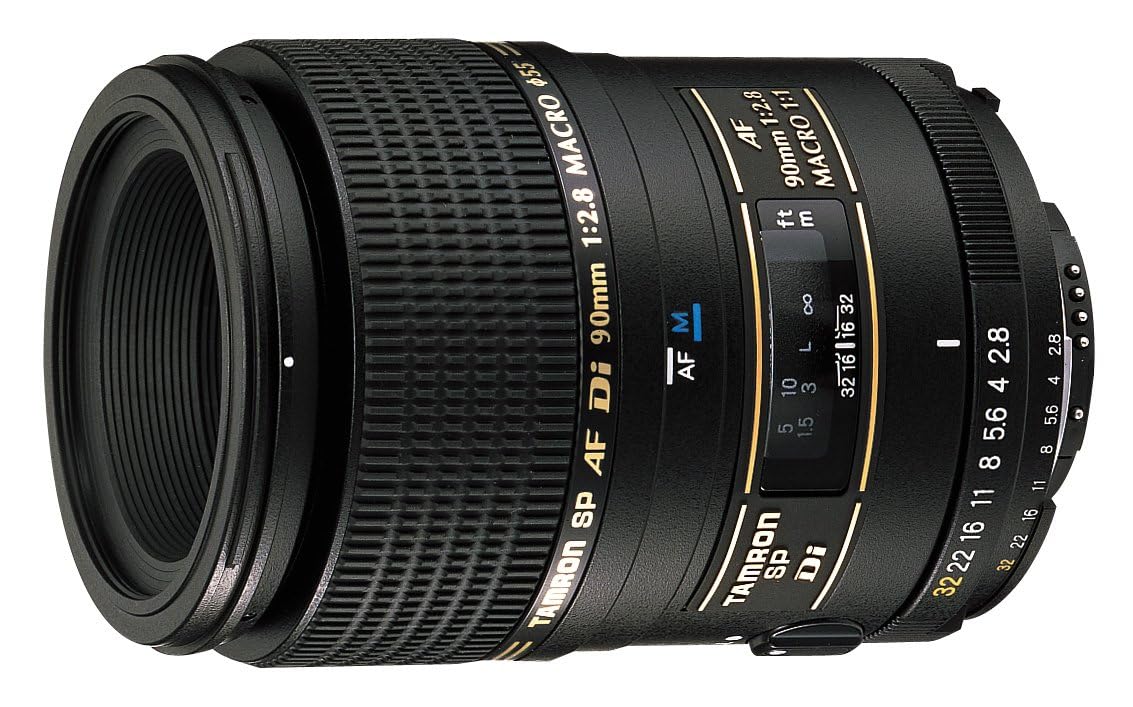
Tamron SP 90mm f/2.8 Di Macro

84 /100
Keeper Score Excellent

Key details

Mount
Canon EF
Weight
14.3 oz
Minimum Aperture
f/32
Maximum Magnification
1:1
Check Price on Amazon

At 405 g the Tamron 90mm is the lightest lens in this roundup, and 90mm is the classic length for a reason: long enough to flatter a face, short enough to work in a small room. Photographers have been buying this focal length as a first macro for decades.

It is a true 1:1 lens, it stops down to f/32 for the depth of field you need at close range, and the Super Protect coating on the front element is there to be wiped clean. The rendering is the part people stay for: sharp where it counts, with backgrounds that go creamy rather than busy.

Autofocus is the compromise. A micromotor that is slow and audible is why we treat this as a manual-focus macro in practice, and that is not much of a hardship when you would be rocking focus by hand anyway. What you do notice is the working distance: at the same magnification a 90mm puts you closer to the subject than a 105mm, which helps indoors and hinders you with anything that flies away.

Pros

  • Lightest lens here at 405 g
  • True 1:1 with an f/32 minimum aperture
  • Creamy bokeh and sharp detail
  • Low-cost entry into macro

Cons

  • Micromotor autofocus is slow and audible
Our verdict

The Tamron is our light, inexpensive route into 1:1 macro, provided you are happy to focus by hand most of the time.

Check Latest Price

How We Tested the Macro Lenses

We started by pulling every macro lens currently sold for Canon bodies, then filtered out anything discontinued, back-ordered, or impossible to get a second copy of for comparison. Both mounts stayed in the running, so the shortlist covered compact wide-angle macros through medium-telephoto designs. Eight lenses made the cut, and we shot with each of them for ten months.

Testing happened where macro photography actually happens. In a garden at dawn, we chased dew and any insect patient enough to sit still, noting how close we could stand before the subject bolted. At the kitchen table, each lens went on a tripod over coins, printed text, and watch parts. We also carried them on ordinary portrait walks and, on rainy days, shot handheld in a dim living room.

Focus was the axis we returned to most. We turned each ring in the smallest increments we could manage and watched whether the plane of focus crept or jumped, then half-pressed on low-contrast targets — white petals, brushed metal — and counted how many times the lens hunted before locking. A phone set beside the barrel recorded motor noise, and we timed how fast each lens recovered after racking through its full range. To judge image quality, we shot the same flat target at f/2.8, f/5.6, and f/8 and compared center against corners at 100 percent on a calibrated monitor.

Steadiness got its own pass: handheld frames at 1/30 in low light, stabilization on and off, tallied for keepers. Ease of use came down to how much the lens weighed after an hour of chasing bugs and whether we could switch from close-up to portrait without fumbling a switch. Value was the last question — what each lens did beyond macro work. The ones we reached for without thinking earned the top spots.

How to Choose a Canon Macro Lens

Start With Magnification, Not the Badge

1:1, or life-size, means the subject is rendered on the sensor at its actual size. Half life-size, 0.5x, is exactly what it sounds like, and the RF 100mm goes the other way at 1.4x. Canon sells three RF lenses with Macro on the barrel and two of them stop at 0.5x, so read the figure rather than the name.

If you want a coin, a stamp or an insect to fill the frame, you need 1:1 or more. If your close-ups are flowers, food and details, half life-size is plenty, and it usually comes attached to a lighter and faster lens.

Match the Mount Before You Fall in Love

RF lenses fit only EOS R bodies. EF lenses fit DSLRs and, with Canon's mount adapter, R bodies as well. That makes the mount the first filter rather than the last: if you shoot a DSLR, the EF 100mm and the third-party EF macros are your whole shortlist.

On an R body, native RF glass avoids the adapter and the extra length it adds, while adapted EF glass opens up cheaper routes to 1:1. The adapter is a convenience question, not an image-quality one.

Focal Length Sets Your Working Distance

At the same magnification, a longer lens puts more air between the front element and the subject. That matters twice: live subjects spook, and lights need somewhere to sit without the lens casting its own shadow.

Ninety to 105mm is the practical sweet spot for most close-up work. A 65mm gets you very close indeed, which is fine for stamps and documents and awkward for insects, while a 35mm is really an everyday lens that happens to focus near.

Plan for Light Before You Plan for Glass

At 1:1 the depth of field is a sliver, so you stop down, and stopping down costs light. Stabilization helps with your own sway, and Canon's hybrid system also corrects the shift you create by leaning in, but it does nothing about a subject that moves.

In practice a diffused flash or a ring light is part of the macro budget rather than an accessory. The MP-E 65mm makes that explicit: past 3x you want a tripod and a focusing rail too.

Treat Autofocus as a Bonus

Most close-up work is manual, because at high magnification you set focus by moving the camera a fraction of an inch, not by turning a ring. What matters is how easily a lens lets you do that: a pull-ring clutch, a focus limiter or a well-damped ring all help.

Autofocus still earns its place for portraits, products and anything you shoot at arm's length, so don't dismiss it. Just don't pay a premium for it if your subjects sit still.

Frequently Asked Questions

Final Verdict

For an EOS R body, the RF 100mm f/2.8 L Macro is the lens we recommend: native mount, 1.4x magnification and stabilization that accounts for the way you actually move when you are close. If you are still on a DSLR, the EF 100mm f/2.8L is the same decision in a different mount, with the deepest record of sharpness in this group behind it.

And if your close-up work is occasional, be honest about it. The RF 85mm f/2 or the RF 35mm f/1.8 will cover flowers, food and details for a fraction of the money and make better everyday lenses besides. The MP-E 65mm is the exception in the other direction: buy it only once 1:1 has stopped being enough.