Best Camera Straps of 2026

The strap that comes in the camera box is a placeholder — thin webbing, a hard plastic buckle, a logo printed exactly where it presses on your neck. It's fine until the afternoon it isn't: a strap sliding off your shoulder on a crowded platform, a lug working loose, that half-second where the weight leaves your hand. A decent strap is the cheapest insurance your gear will ever get, and it's also what decides whether the camera actually comes out of the bag.

My team and I have spent the past six months carrying 12 different straps, on everything from a featherweight mirrorless to a DSLR with a long zoom hanging off it. What separated them wasn't padding thickness, which is what I expected — it was whether the strap stayed where I put it. A wide soft pad does nothing if the whole thing slides off your shoulder every time you lean forward, and quick release only earns its place when a second connection does real work if the first one lets go. Length and fit matter more than most people think, too.

Keeper Score summarizes customer ratings and review volume. Read it alongside the product details and trade-offs. How the score works.

1

Best Overall

Peak Design Slide Lite

96 /100
Keeper Score Outstanding

Key details

Attachment
Quick-release cord anchors
Carry Style
Neck or cross-body sling
Length Adjustment
One-handed while worn
Check Price on Amazon

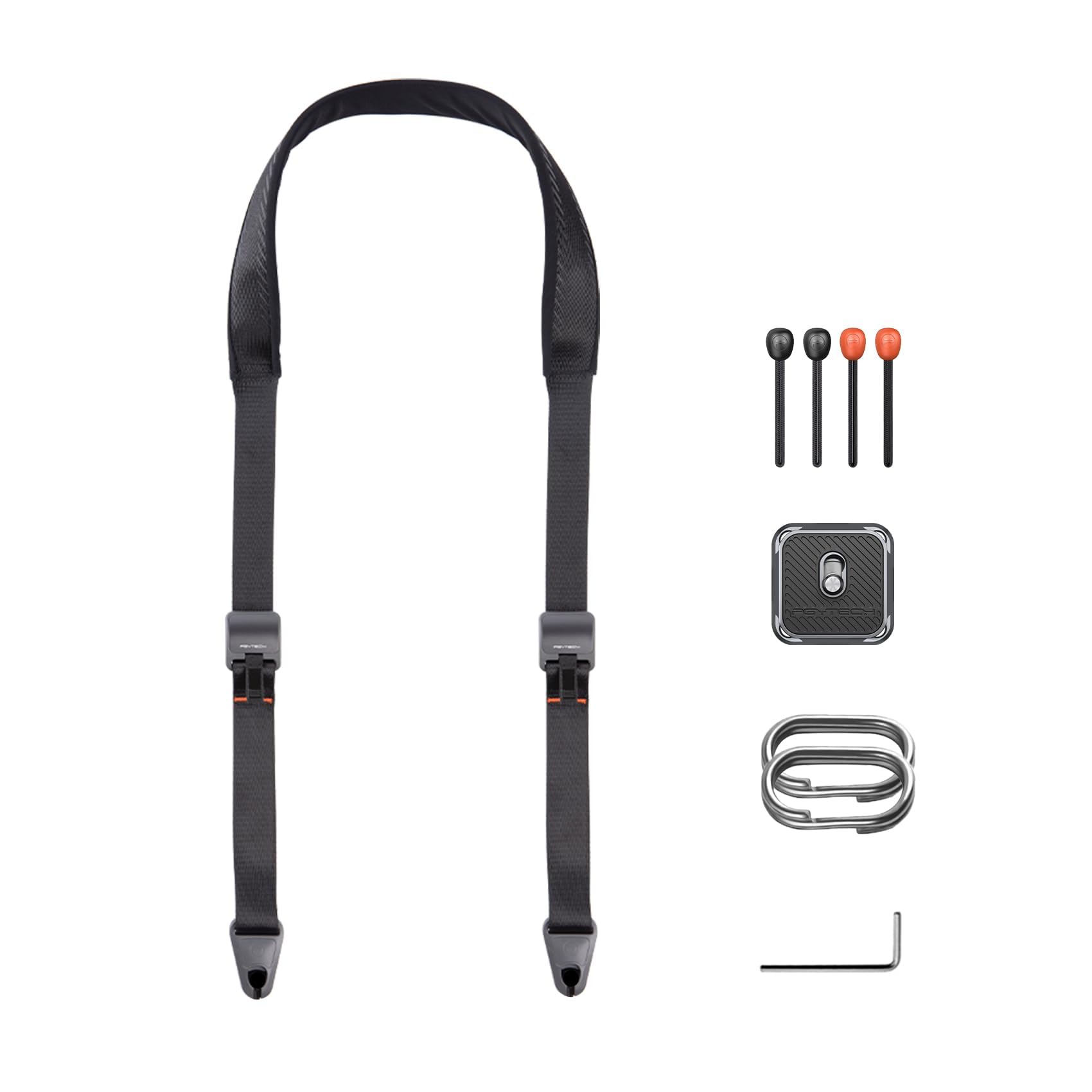
Four short cords stay looped through the camera's lugs, and the strap clips onto them, so it comes off in a second when the camera goes on a tripod. That anchor system is why the Slide Lite ended up on our cameras more often than anything else here. The clips are solid, and after weeks of clipping and unclipping with a full-frame body and a zoom attached, we never had one work loose.

The length adjuster is the other half of the argument. A tug on the tab takes up or lets out slack while the strap is on your shoulder, which turns a neck strap into a cross-body sling when you want the camera at your hip and both hands free. We wore it that way on long walks — slung across the chest on the move, shortened to the neck for a shot.

Comfort holds up with a full-size body. The webbing is flat, so it sits still against a jacket instead of rolling into a cord, and the pad spreads the load well enough that a long day doesn't end with a sore shoulder. If you shoot a gripped body with a 70-200 all day, the wider version of this strap is the better bet; for anything up to a standard zoom, this is the one.

Pros

  • Anchors let you swap straps without tools
  • One-hand length adjustment while worn
  • Wears as a neck strap or crossbody sling
  • Flat webbing sits still on the shoulder

Cons

  • Premium price against the budget picks here
Our verdict

Our default pick: the anchors let you strip the strap off in a second, and the one-hand adjuster turns it from neck strap to sling whenever you want your hands free.
Check Latest Price
2

Best for Heavy Camera Rigs

PGYTECH Wide Padded Strap

94 /100
Keeper Score Outstanding

Key details

Pad Width
1.8 in
Attachment
Locking quick connector
Load Capacity
198.4 lb
Stated Length
43.3 to 59.8 in
Check Price on Amazon

Set it beside the Slide Lite and the PGYTECH gives away a little elegance and takes on a lot of pad. At 1.8 inches wide with a grippy underside, it covers more of your shoulder, and the assembly is rated to 90 kg — a figure that says less about what you will hang on it than about how the hardware is built.

What we noticed first was the connector. It locks down dead centre with no play, so the strap doesn't rotate at the lug and the webbing doesn't bow into a stiff loop that swings at your face when you lift the camera. Anyone who has fought a strap that twists at the attachment point will feel the difference immediately. Quick adjusters at both ends mean you can take up length from whichever side is closer to hand.

The range runs from 43 to almost 60 inches, enough to wear it across the body over a winter coat, and the pad stays where you put it. On a heavy rig — a gripped body, a fast prime, a 70-200 — the extra width and that locked connector are worth the bulk. It has become the strap that lives on our heavy kit, while the Slide Lite takes the small bodies.

Pros

  • 1.8-inch pad spreads a heavy rig's weight
  • 90 kg stated load capacity
  • Quick adjusters at both ends
  • Connector resists twisting at the lug

Cons

  • Long range leaves a strap tail on shorter users
Our verdict

If your camera wears a grip and a fast zoom, buy this one — the wide pad and locked-down connector carry a heavy rig with noticeably less shoulder ache.

Check Latest Price
3

Best Budget Padded Strap

JJC Neoprene Neck Strap

92 /100
Keeper Score Outstanding

Key details

Attachment
Quick-release clips and hooks
Stated Size
2.36 in W x 19.29 in L
Pad Material
Neoprene with anti-slip backing
Carry Options
Neck strap or hand strap
Check Price on Amazon

Soft neoprene, wide enough to spread a DSLR's weight, is the whole argument for the JJC. It sits against the back of your neck rather than cutting into it, and the body-side face has an anti-slip texture that keeps the pad from creeping around your shoulder mid-shot. If your camera came with a ribbon-thin stock strap, this is the most affordable meaningful upgrade in the group.

The two quick-release clips do more than let you take the strap off. Unclip the neck section, join the ends, and it becomes a short hand strap — which we used more than we expected when working close to the camera and not wanting a pad swinging off an elbow.

The small hooks that attach to the camera are the fiddly part. On a body with tight, recessed lugs, give yourself a few minutes and some patience the first time; after that they stay put and the clips take the wear. Two buckles set the length once and then you forget about them. It is a neck strap first and foremost, and a simple one, which is exactly why it works.

Pros

  • Soft neoprene pad is easy on the neck
  • Anti-slip backing keeps the pad in place
  • Clips convert it into a short hand strap

Cons

  • Padded body is bulky to stow
Our verdict

We recommend it to anyone who just bought a DSLR: the soft neoprene pad fixes the neck-cutting problem for very little money.

Check Latest Price
4

Best Sling for Long Lenses

waka Camera Sling Strap

89 /100
Keeper Score Excellent

Key details

Mount
1/4 in tripod stud with tether
Extras
Zippered storage pocket
Carry Style
Cross-body sling with underarm strap
Stated Length
28.3 to 37.8 in
Check Price on Amazon

The photographer this is built for is the one with a long lens hanging off a full-frame body — the rig that turns a neck strap into punishment after an hour. The waka moves that weight into a sling across the body and adds an underarm strap that pins the whole assembly against your ribs, so the camera stays put when you lean over a railing or crouch for a low angle.

It is sturdier than the price suggests. The webbing is substantial, the hardware feels solid, and the neoprene pad is broad enough to sit on a shoulder for a full day. We carried a long lens on it and the rig stayed where we put it, which is the whole job.

The mounting is the part to understand before you buy. The camera screws onto the strap through its tripod socket, and a safety tether backs that up, so the rig can't go far even if the screw works loose. What you give up is the socket itself — your quick-release plate comes off every time you switch. In exchange there is a zippered pocket on the pad that swallows a spare battery and a couple of cards, the kind of small thing that saves you constantly once you are used to it.

Pros

  • Underarm strap stops the camera swinging
  • Handles a long lens without neck strain
  • Zippered pocket holds a battery and cards
  • Safety tether backs up the socket mount

Cons

  • Can slip off a smooth shoulder
  • Runs out of adjustment on small frames
Our verdict

A sensible buy for a long lens: the underarm strap keeps a heavy camera pinned to your side instead of swinging, and the price stays modest.

Check Latest Price
5

Best Lightweight Rope Strap

K&F Concept Nylon Rope Strap

89 /100
Keeper Score Excellent

Key details

Weight
2.12 oz
Material
Nylon rope with leather
Attachment
Double-ended metal O-rings
Strap Length
100 cm
Check Price on Amazon

Rolled up, the K&F is about the size of a small coil of paracord — the rope design collapses into a bag instead of holding the stiff ribbon shape a padded strap keeps. At 60 grams it adds almost nothing to the camera, and the leather ends and metal O-rings stop it from looking like climbing kit.

It is the strap we keep on a small mirrorless body, where a slim rope is all the support the camera needs and anything wider feels like overkill. It sits on the shoulder without slipping and doesn't bunch up at the back of the neck. Put a full-frame body and a heavy zoom on it and it is out of its depth — this is a street and travel strap, not a workhorse.

The length is fixed at 100 cm with no adjuster, so it hangs where it hangs: fine on an average frame, high on a tall photographer, and awkward over a thick winter coat. The O-rings thread straight through standard lugs, so you fit it once and leave it there. For a camera that lives in a small bag and comes out for an hour at a time, that simplicity is the appeal.

Pros

  • Rolls up small for any bag
  • 60 g adds almost nothing to the neck
  • O-rings thread onto standard lugs

Cons

  • Fixed 100 cm length with no adjuster
Our verdict

Best for a small mirrorless body that travels: it rolls up small, weighs almost nothing, and looks better than the price suggests.

Check Latest Price
6

Best Vintage Look

Padwa Lifestyle Cotton Strap

92 /100
Keeper Score Outstanding

Key details

Material
Embroidered cotton, leather ends
Strap Width
2 in (5 cm)
Length Range
41 to 56 in (104 to 143 cm)
Check Price on Amazon

Embroidered cotton, suede-soft padding underneath and double-layer leather at the ends — the Padwa is the strap you buy because you like looking at your camera. The weave is a long way from the black webbing most bodies ship with, and it gives a modern camera some character without dressing it up like an antique.

The practical part is the width. Two inches of cotton spreads a DSLR across the shoulder in a way thin stock straps don't, and the length runs from 41 to 56 inches, which covers a cross-body carry on most adults. We have handled plenty of good-looking straps that turned out to be a one-inch ribbon with a nice print; this one is wide enough to do the work.

It is not the strap for a gripped body and a 70-200 — cotton weave has less give than neoprene, and you feel the difference on a long day. On a mirrorless body or a film camera, it looks like it was made for that camera rather than supplied with it.

Pros

  • Two-inch cotton spreads weight across the shoulder
  • Leather ends and embroidered cotton look the part
  • Adjusts from 41 to 56 inches

Cons

  • Wide cotton pad is bulky to pack
Our verdict

Buy it if you want your camera to look like something you chose rather than something that came in the box, and the two-inch width keeps it practical.

Check Latest Price
7

Compact Leather Look

SMALLRIG Leather Camera Strap

88 /100
Keeper Score Excellent

Key details

Material
Leather with suede backing
Max Load
10 kg (22 lb)
Adjustable Length
39 to 43 in (100 to 110 cm)
Check Price on Amazon

Forty-three inches is where the SMALLRIG stops, and that number decides who should buy it. The leather is genuinely good — soft, with a suede backing that grips a shoulder — and the whole strap is light enough to forget on a compact body. But the adjustment tops out well short of what most adults want for a cross-body carry, so think of it as a neck or shoulder strap for a small camera.

We tried the full extension as a cross-body strap and it simply doesn't get across a full-height adult; as a neck strap it sits right. The one part to change is the pair of split rings that connect the strap to the camera. They are the flimsiest thing in the package, and swapping them for heavier rings is cheap insurance before you hang a real camera on them.

Where it is at home is a compact mirrorless body — the kind of camera you carry on a walk rather than to work. The leather dresses up a modern body, the 10 kg rating leaves plenty of margin for anything that mounts on APS-C, and it lies flat in a bag because there is nothing rigid in it.

Pros

  • Genuine leather with a soft suede backing
  • Light enough to forget on a compact body
  • 10 kg rated load for a small rig

Cons

  • Adjusts only to 43 inches
Our verdict

Worth it for a compact body if you are happy with a neck or shoulder carry — the leather is lovely and the adjustment is genuinely limited.

Check Latest Price
8

Two-Camera Shoots

C Coiro Dual Camera Harness

92 /100
Keeper Score Outstanding

Key details

Type
Dual-camera shoulder harness
Hardware
Metal buckles and clasps
Material
Leather
Check Price on Amazon

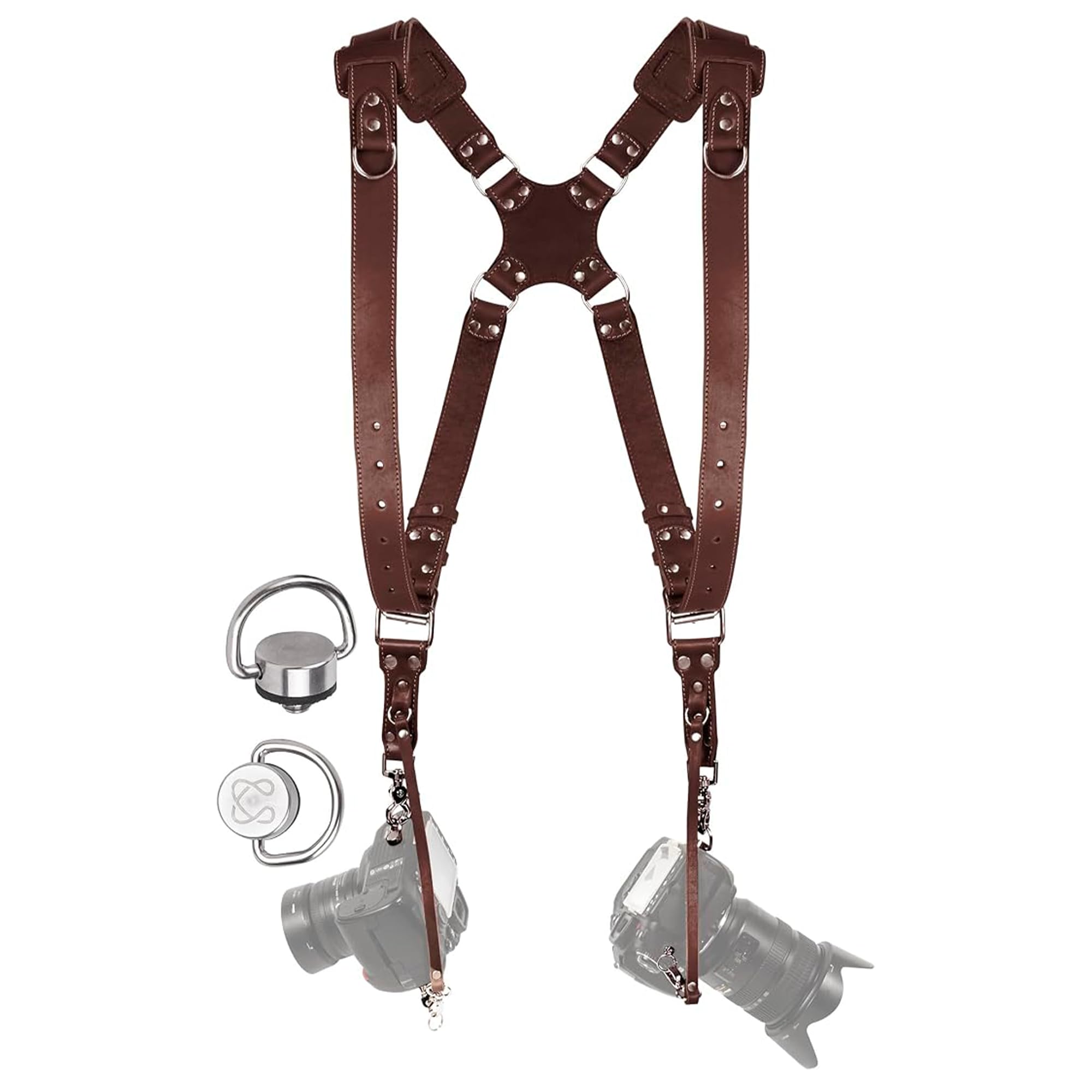
Carrying two bodies is a different problem from carrying one: the weight doubles, and a neck strap becomes a bad idea somewhere around the second hour. The C Coiro puts both cameras on a leather harness across the shoulders, spread wide enough that a pair of full-frame bodies with zooms stops feeling like a yoke. We were struck by how soft the leather is for something this heavy-duty, and the metal buckles look like equipment rather than an accessory.

The clasps are the part to watch. They can work loose over a long day of shooting, and a loose clasp means a dropped body, so check them between setups — especially at a wedding or an event where you are moving fast and lifting a camera every thirty seconds.

What it does well is the thing you bought it for. Two cameras ride at hip height, ready to lift, and the load sits on your shoulders instead of your neck — the difference between shooting a full day and giving up at the reception. It is the only strap here built for two bodies, and it solves that problem properly.

Pros

  • Carries two bodies without neck strain
  • Thick leather and metal buckles
  • Load sits across both shoulders

Cons

  • Clasps can work loose on a long day
  • One size; adjustment runs out on larger frames
Our verdict

The pick for anyone shooting two bodies: it moves the weight onto your shoulders and off your neck, though the clasps need watching.

Check Latest Price
9

Spare Strap

WANBY Canvas Camera Strap

92 /100
Keeper Score Outstanding

Key details

Weight
1.41 oz
Material
Cotton canvas, PU leather
Strap Width
1.5 in (3.8 cm)
Strap Length
28 in (71 cm)
Check Price on Amazon

It is the least expensive strap here, and it still gets you canvas webbing, PU leather ends, quick-release clips and a strip of elastic at the neck that softens the pull of a light body. It looks better than it needs to, and it goes on in under a minute.

Where it earns a place is as a spare. A second body, a backup at the bottom of the case, a cheap way to stop a new camera's stock strap from sawing at your neck. The buckles move between cameras in seconds, and we found the anti-slip lining on the inside face really does keep it from sliding off a jacket shoulder.

The clips are where the savings show. Plastic quick-release hardware is the part that lets go under a heavy body, and when a strap fails the camera goes with it. Keep this one on a mirrorless body or a film camera and it does everything you ask; put a gripped DSLR and a long zoom on it and you are asking for trouble.

Pros

  • Canvas and PU leather look the part
  • Quick-release clips swap between cameras
  • Elastic neck section softens the pull

Cons

  • Plastic quick-release clips are the weak point
Our verdict

Treat it as a spare or a first strap: it costs the least here and looks fine, but plastic clips do not belong under a heavy rig.

Check Latest Price

How We Tested Camera Straps

We started by gathering every strap sold as a genuine step up from the pack-in one — reading listings, checking how each attaches (lug loops, a plate that screws into the tripod socket, or both), how much length adjustment is on offer, and what the maker claims it will hold. Anything with a fixed length that wouldn't clear a winter coat on a tall shooter got cut, as did anything that only mounted one way.

Twelve straps made the cut and lived on our cameras for six months: full days walking city blocks, an outdoor event where a body hung at hip level for eight hours straight, a couple of hikes, and a week of street shooting where the camera went up and down constantly. Two of us shot side by side so a rope-style strap and a wide padded one could be judged on the same afternoon.

We measured each strap at its shortest and longest settings and noted where the padding actually landed on a 5-foot-4 and a 6-foot-1 shooter, then counted how many times we had to re-adjust one during a walking hour. We loaded every quick release with a body and lens, hung it, tugged the buckles at awkward angles, and popped them open over a padded table to see whether the safety tether or backup connection caught. At the end of six months we checked stitching and webbing at the attachment points for fraying, looked at whether leather ends had softened or cracked, and noted which buckles had crept loose on their own — the quiet failures that don't show up in the first week.

How to Choose a Camera Strap

Match the pad to the weight

A strap doesn't make a camera lighter; it spreads the same weight over more of your shoulder. That's why a 1.8-inch pad like the PGYTECH's makes a gripped body tolerable while a thin rope makes the same camera miserable by lunchtime. Go too far the other way and a two-inch cotton pad on a compact mirrorless is just bulk in your bag.

The wider and softer the pad, the heavier the rig it belongs on. If you carry more than a body and a standard zoom, treat pad width as the first thing you check rather than the last.

Choose the carry style first

Neck, cross-body sling, and two-camera harness are three different tools. A neck strap is quickest to use and the worst option for a heavy body. A sling moves the load onto one shoulder and across the chest, which keeps a long lens out of the way, but it needs an underarm strap or the camera swings forward every time you lean.

A harness splits two bodies across both shoulders and is the only sensible way to carry a pair. Decide which of those describes your shooting day before you compare materials.

How it attaches, and what that costs you

Most straps thread through the camera's lugs, either directly or through split rings and clips. Quick-release hardware — cord anchors, clips, locking connectors — lets you strip the strap off for tripod work in seconds, and it is where the money goes in the better straps here.

The trade is that the clip becomes the part that can fail. Buy from a maker who states a load rating, and check that the gate snaps shut every time. A sling that screws into the tripod socket, like the waka, works well but takes that socket away from your plate.

Length: check the top of the range

Cross-body carry needs more strap than most people expect, and the number that matters is the maximum, not the minimum. In this group the ranges top out at 43 inches on the SMALLRIG and almost 60 on the PGYTECH, and that spread is the difference between a strap that crosses your body and one that sits under your chin.

Fixed-length rope straps are the exception: 100 cm is a deliberate choice for a small body and a poor one for a tall photographer. If you already own a strap you like, measure it at the length you wear it and compare that with the top of the range before ordering.

Materials and looks

Webbing is lightest and packs smallest; neoprene pads best; cotton and leather look best and take up more room. Leather ends and embroidered cotton, as on the Padwa, give a camera some character, and none of that hurts function as long as the strap is wide enough for what you hang on it.

Neoprene is warmest against the neck in summer and the most forgiving on a heavy body. Pick the material you will enjoy carrying, because the best strap is the one that stays on the camera.

Frequently Asked Questions

Final Verdict

The Peak Design Slide Lite is the strap we recommend to most people, because the anchors and the one-hand adjuster cover more situations than anything else here: tripod one minute, sling the next, neck strap when you're standing still.

If your camera lives on a grip and a fast zoom, take the PGYTECH instead — the wider pad and locked connector are built for that weight. And if you're outfitting a first DSLR, the JJC's neoprene pad handles the essential job for a fraction of the money.