Best Rolling Camera Bags of 2026

The moment a camera bag earns its wheels is usually the moment your shoulder quits — the far end of a terminal, the third flight of a parking garage stairwell, the quarter-mile load-in to a venue. Wheels fix that, then send you the bill: the frame adds pounds before you've packed a single lens, and the hardware eats interior inches you were counting on for a second body.

I hauled gear in shoulder bags for years and watched a roller tip off a curb, so my team spent seven months with eight rolling camera bags — soft rollers, hard shells, and 2-in-1 convertibles that unclip into backpacks — packing the same kit into each one. What separated them wasn't wheel count. It was foam that held a lens still over cobblestones, zippers and latches that stayed shut in a crowded aisle, and interior dimensions that matched the ones on the listing.

Size and weight were the quiet dealbreakers. A bag can be carry-on legal by the numbers and still be miserable once it's loaded, so we weighed each one empty and again fully packed, then checked both against what airlines enforce at the gate. The eight below are the ones I never resented carrying.

Keeper Score summarizes customer ratings and review volume. Read it alongside the product details and trade-offs. How the score works.

1

Best Overall

NEEWER Convertible Rolling Camera Backpack

91 /100
Keeper Score Outstanding

Key details

Wheels
4 in-line skate
Capacity
50 liters
Empty Weight
9.1 lb
Exterior Dimensions
13.8 x 10.2 x 21.7 in (L x W x H)
Check Price on Amazon

Fifty liters and 11 adjustable dividers give this the biggest, most flexible interior in this group, and that's the reason it's our top pick. Two bodies, four or five lenses, hoods, and strobes each get a slot, with four small pockets and four mesh pockets taking cards, batteries, and cables so the small stuff doesn't end up in one heap at the bottom. For a wedding or event shooter packing a full day's kit, no other bag here organizes that much.

It earns the spot on travel grounds too. The foam-padded shoulder straps turn it into a backpack for stairs and gravel, the telescopic handle and four in-line skate wheels handle the terminal floor, and the water-resistant nylon arrives with a rain cover in the box. At 21.7 by 13.8 by 10.2 inches it sits on the carry-on line rather than safely inside it — that 10.2-inch depth is over what several domestic carriers allow, so measure before you count on the overhead.

What we keep coming back to is the value: this much capacity, in a bag that converts, for less than the premium rollers here. What we keep an eye on is the fabric. A split seam in the first month is the failure to watch for, and the one-year manufacturer warranty is the backstop. If your gear travels between a car, a hotel room, and a venue rather than a cargo hold, that's a risk worth taking.

Pros

  • Largest interior here at 50 liters
  • 11 adjustable dividers plus eight small pockets
  • Converts to a backpack with padded straps
  • Rain cover included

Cons

  • About 9 pounds before you load it
  • 10.2-inch depth exceeds some airline limits
Our verdict

For most photographers this is the one: the most room and the most dividers in this group, at a mid-range price, with a backpack mode for stairs and gravel.

Check Latest Price
2

Best for Smooth Rolling

PGYTECH 2-in-1 Roller Camera Backpack

85 /100
Keeper Score Excellent

Key details

Wheels
4 removable spinners
Empty Weight
7.9 lb
Storage Volume
20 liters
Expandable Front
10 liters
Check Price on Amazon

The wheels come off. A release catch separates each double spinner from the frame, so a cracked wheel doesn't retire the bag, and while they're on they roll across a concourse with so little effort that you feel the difference after a day alongside one of the heavier rollers here. On a long transfer through a big airport, that's the feature we care about most.

It's the bag we take on a city trip where the camera bag doubles as hand luggage. The front compartment zips open for another 10 liters, the padded sleeve takes a 16-inch laptop, and the shell is splash-proof PU with YKK zippers, so a drizzle on the walk from the station isn't a crisis. The main compartment is 20 liters, though — less than half the NEEWER's — so you're paying for organization and rolling quality rather than volume.

Organization is where it justifies the price. The divider system is fully configurable, there are five pockets plus two deep side pockets, and a hidden compartment is sized for a tracker — a small thing we appreciated more than we expected. The harness tucks away behind a panel when you want to roll and comes back out for stairs. What you're paying for is the hardware, not the capacity.

Pros

  • Removable double spinner wheels
  • 10-liter expandable front compartment
  • Fits a 16-inch laptop
  • Hidden compartment sized for a tracker

Cons

  • Heavy for its size at 7.9 pounds empty
Our verdict

Worth the premium if you want the best-rolling bag here and a place for every small thing; just don't expect big-kit volume.

Check Latest Price
3

Best for Small Regional Jets

Think Tank Airport Advantage

81 /100
Keeper Score Excellent

Key details

Capacity
17 liters
Laptop Fit
Up to 15 in
Empty Weight
5.9 lb
Exterior Dimensions
12.7 W x 19.5 H x 7.3 D in
Check Price on Amazon

Five point nine pounds empty buys you options. Regional jets have smaller overheads than the aircraft most packing advice assumes, and the Airport Advantage was drawn around that bin: 19.5 inches tall on the outside, with a 17-liter interior that holds a gripped body, a second camera, and three or four lenses. Flying a commuter route with a full kit, this is the bag we reach for.

One detail worth knowing before you buy: loading the laptop sleeve can push the bag past the external dimensions it was designed to meet. On a regional jet, where the bin is the constraint, that's the difference between boarding and gate-checking, so leave the 15-inch machine at home on tight flights. Otherwise the package is complete — a rain cover and a tripod strap are in the box, the padded sleeve is genuinely protective, and the two wheels track straight enough to pull one-handed.

It isn't the easiest roller to steer once it's loaded; two wheels want to go where they want to go. What you get for the premium is a bag that fits where others don't, and for anyone who flies small aircraft regularly, that's the trade that matters.

Pros

  • Light at 5.9 pounds empty
  • Built around commuter-aircraft overhead bins
  • Rain cover and tripod strap included
  • Padded 15-inch laptop sleeve

Cons

  • Shallow interior rules out long telephotos
Our verdict

Choose it if your trips start on a regional jet — 19.5 inches tall, 5.9 pounds empty, built around a small-aircraft overhead bin.

Check Latest Price
4

Best Hard Case

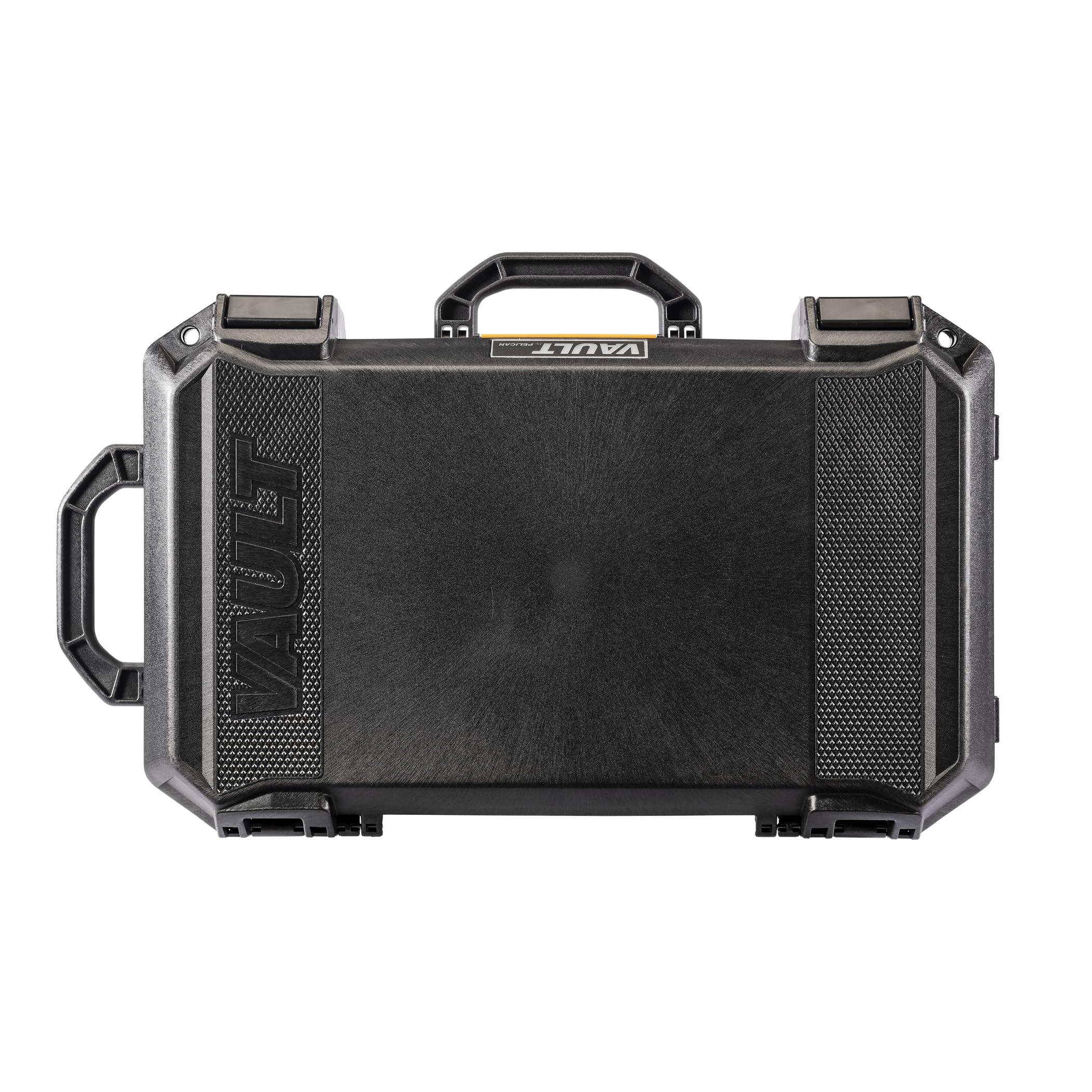
Pelican Vault V525 Hard Case

94 /100
Keeper Score Outstanding

Key details

Weight
12.1 lb
Exterior Dimensions
22.25 x 14.5 x 9 in
Pressure Relief Valve
Yes
Check Price on Amazon

The shell is the whole point. Set this down in slush, stack it under a bus, or hand it to someone else to lift, and the gear inside doesn't care. The Vault is a molded hard case with a watertight seal and a pressure-relief valve, so it survives weather and altitude changes that would have you fretting over a soft roller, and it's the case we hand to anyone who is hard on equipment.

It rolls and pulls like a suitcase, and at 22.25 by 14.5 by 9 inches it sits inside the usual domestic carry-on envelope. Two bodies, a long zoom, and a couple of shorter lenses fit with battery and card cases tucked around them, and the shallow depth is what makes the overhead work.

We recommend it to anyone whose glass is worth more than the trip. Sort out two things before ordering. It arrives with Pelican's standard foam rather than padded dividers, so confirm what your listing includes if you want compartments. And the rigid shell gives no slack — this is a case for the kit you've planned, not for the extra lens you hope to squeeze in.

Pros

  • Watertight shell with a pressure valve
  • 22.25 x 14.5 x 9 inches fits carry-on limits
  • Rolls on wheels with a telescopic handle

Cons

  • 12.1 pounds before you pack it
Our verdict

Gear that has to come out the other side intact belongs in this case: watertight, crush-resistant, and still small enough for the overhead.

Check Latest Price
5

Best Budget Hard Case

Amazon Basics Hard Camera Case with Wheels

90 /100
Keeper Score Outstanding

Key details

Shell
Hard, watertight
Capacity
1660.5 cubic inches
Empty Weight
14.5 lb
Exterior Dimensions
21.9 x 13.7 x 9.8 in
Check Price on Amazon

Pre-cut foam squares you pluck out by hand are the oldest trick in case design, and they're still the best way to make one box fit one kit. Pull the squares around your bodies and lenses, leave the grid intact everywhere else, and the gear sits in its own cutouts with nothing sliding around. Underneath is the Pelican formula at the bottom of the price range here: molded shell, watertight seal, pressure-equalization valve, wheels.

We think it's the right first hard case for anyone who wants real protection without paying for a name. The outside measures 21.9 by 13.7 by 9.8 inches, which clears most domestic carry-on limits, and a fold-down side handle means lifting it into a trunk isn't an event. The inside is smaller than the numbers suggest, though: 1660.5 cubic inches sounds generous until the shell walls and a layer of foam take their share, so lay the kit out and cut around it rather than assuming.

Latching wants the lid pressed down squarely — a corner that isn't seated will fight you, and that's the difference between a case that closes with a snap and one that needs a shove. Set against that, this is the cheapest watertight hard case in this group, and it does the same core job as cases costing considerably more.

Pros

  • Watertight hard shell with a pressure valve
  • 21.9 x 13.7 x 9.8 inches suits domestic carry-on
  • Pluck foam customizes to your kit

Cons

  • Heaviest bag here at 14.5 pounds
Our verdict

If you want hard-shell, watertight protection and don't want to pay for a Pelican, this is the case we point to.

Check Latest Price
6

Best Lightweight Convertible

SLINGER 2-in-1 Wheeled Camera Backpack

87 /100
Keeper Score Excellent

Key details

Wheels
2 in-line skate
Laptop Fit
Up to 15 in
Empty Weight
4.6 lb
Exterior Dimensions
14 x 10 x 21 in
Check Price on Amazon

Thirteen dividers, soft and stiff together, is more customization than any other soft bag here offers, and it's how the SLINGER is built to swallow two pro bodies, seven lenses, a 400mm f/5.6 mounted, and two flashes. The stiff panels do the real work: they hold their shape so lenses don't slump into each other when the bag is on its side in a trunk.

The harness hides away behind a panel when you want to roll, which makes this a genuinely two-mode bag rather than a roller with decorative straps. At 14 by 10 by 21 inches and 4.6 pounds empty it's barely more than a daypack, and a padded 15-inch laptop sleeve sits in the front. The telescopic handle and two in-line skate wheels are unremarkable, and in this company that's a compliment — nothing about the rolling gets in the way.

Where it lands for us is the value slot. It carries more glass than anything here except the NEEWER, for less money than most of this group, and it converts. If your priority is lenses per dollar and you don't need four wheels, this is the one.

Pros

  • 13 dividers, both soft and stiff
  • Hide-away backpack harness
  • 4.6 pounds empty
  • Padded 15-inch laptop sleeve

Cons

  • No water resistance at all
Our verdict

For a shooter hauling a lot of glass, this is the most capacity per dollar here, and it still works as a backpack.

Check Latest Price
7

Budget Capacity

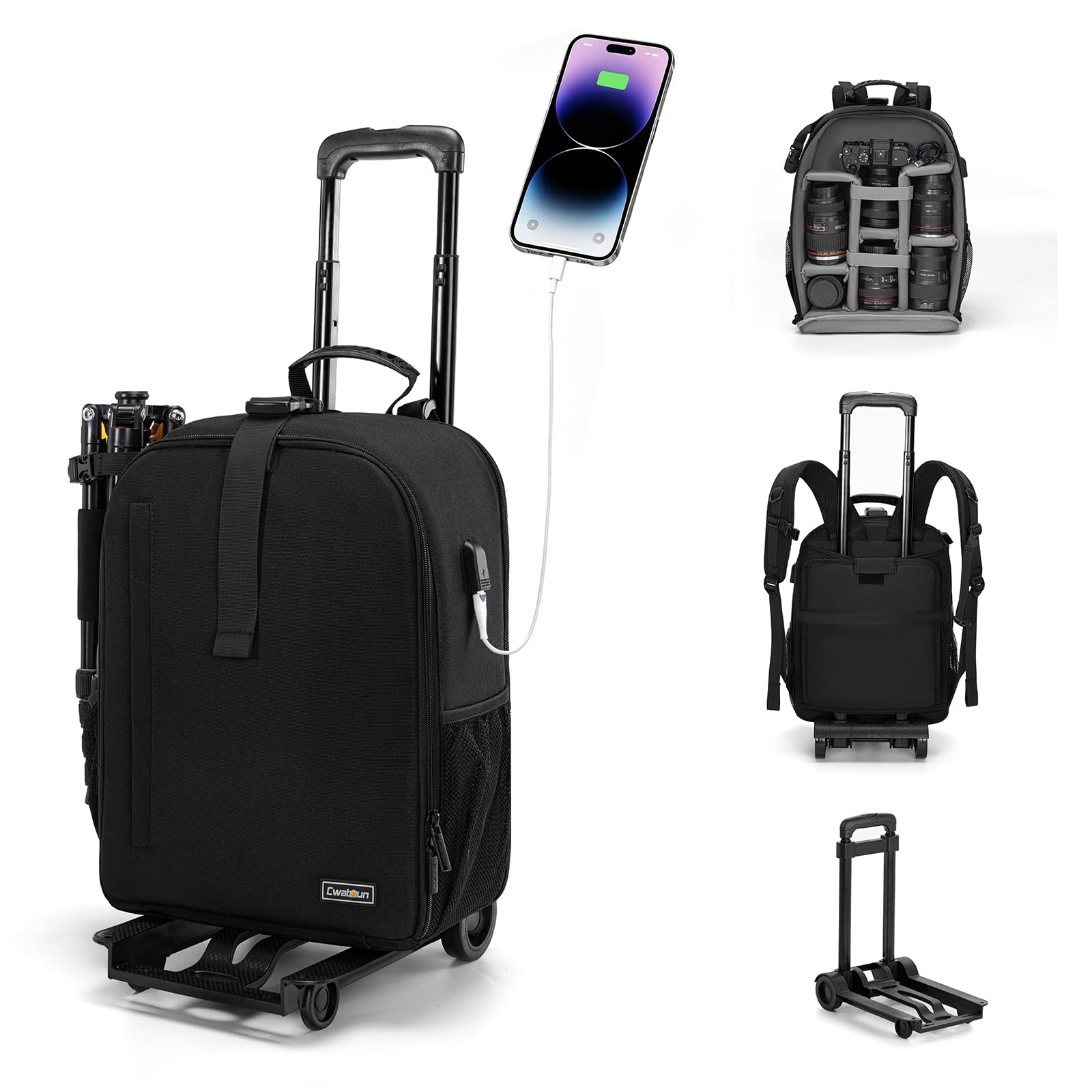
Cwatcun Camera Trolley Bag

92 /100
Keeper Score Outstanding

Key details

Capacity
35 liters
Dividers
5 removable
Laptop Fit
Up to 15.6 in
Exterior Dimensions
17 x 12.6 x 17 in
Check Price on Amazon

The least money of any soft bag here buys 35 liters, five removable 18mm dividers, a 15.6-inch laptop sleeve, and nine compartments. The layout is the straightforward kind: two bodies and three to five lenses in the main compartment, flash and cards in the pockets, a tripod strapped outside. Nothing clever, everything accounted for.

The fabric is 900D polyester with a water-repellent finish — enough for a drizzle or a splash on a ferry — and Cwatcun fits alloy zippers and backs the bag with a one-year replacement warranty, a more concrete promise than most at this price.

Seventeen inches tall is short for a roller. That's closer to a large backpack on a frame than a suitcase, which is good news for the overhead bin and less good if you were planning to stand a long zoom upright. The cart is described as removable, so the bag can be separated from the frame when wheels become a liability on stairs or sand.

Budget decides this one. Thirty-five liters and nine compartments for the least money here is a fair trade for a short record on long-term durability and a bag that's more backpack than suitcase. If the kit is insured and the trip is domestic, we see no reason to spend more.

Pros

  • 35 liters with five removable dividers
  • Fits a 15.6-inch laptop
  • One-year replacement warranty
  • Lowest price of any soft bag here

Cons

  • No rain cover in the box
Our verdict

If the budget is fixed and the kit isn't precious, this is the most room you can roll away with for the least money.

Check Latest Price
8

Spinner Maneuverability

VANGUARD ALTA Fly 58T

85 /100
Keeper Score Excellent

Key details

Wheels
8
Capacity
27 liters
Empty Weight
10.5 lb
Exterior Dimensions
13.6 x 11 x 23.25 in
Check Price on Amazon

At 23.25 inches tall this is the biggest bag here by exterior height, and that number is the first thing to hold against your airline. VANGUARD says the ALTA Fly meets the strictest carry-on restrictions and then notes that regulations vary by carrier — so measure, because half an inch over is the difference between the overhead and a gate-check tag.

The eight wheels are why you'd put up with the size. It rolls upright beside you on four sets of doubles, turns in a narrow aisle without a three-point maneuver, and takes a push and keeps going — the smoothest roller in this group. Tuck the harness out and it carries on your back when the floor turns to gravel, and the tripod mount keeps the load balanced.

Twenty-seven liters is what fits inside that 23-inch shell, and the frame and padding are where the rest of the space went. There's room for one or two pro bodies, four to six lenses up to a 300mm f/2.8, and a flash — a working kit, not a full studio. The compartments run snug, so a chunky 70-200 takes arranging rather than dropping in.

Our take: this is the bag for someone who wants spinner maneuverability on a long airport day and is willing to pay the most in this group for it. The two-year warranty is the longest here, which softens the price. If you fly mainline carriers and want the smoothest roll, it earns its keep; if you're on regional jets, the Think Tank is the safer bet.

Pros

  • Eight-wheel spinner rolls and turns easily
  • Tuck-away backpack harness
  • Two-year warranty
  • Fits 1-2 bodies and 4-6 lenses

Cons

  • Heaviest soft bag here at 10.5 pounds
  • Deepest shell here at 11 inches
Our verdict

The best-rolling bag here, and the pick if you want spinner maneuverability and a backpack harness in one case.

Check Latest Price

What We Put Every Rolling Camera Bag Through

We started with every rolling camera bag we could find that published real interior dimensions, then filtered out anything that couldn't swallow a two-body, three-lens kit plus a 15-inch laptop, or that blew past common carry-on limits. That cut the field to eight models across three formats: soft-sided rollers, hard shells, and convertibles with removable harnesses or carts.

Testing ran seven months, mostly in the places these bags actually live — airport terminals and jet bridges, hotel carpet, cobblestones downtown, a gravel trailhead, a car trunk, and one wedding-season load-in that involved a service elevator. I also did the unglamorous part: stairs, curbs, and lifting a fully packed bag one-handed by its top handle.

Each bag got weighed empty on a luggage scale, then weighed again with the identical kit inside, so we could see what the wheels and frame were costing us. After twenty yards of cobblestone I opened every bag to check whether a lens had shifted, and I pressed each divider between thumb and forefinger to feel whether the foam was actually dense or just thick. Zippers and latches got opened and closed fifty times, looking for skipped teeth, snagged pulls, or a clasp that popped under a full load. I timed the switch from roller to backpack and back, wobbled every telescoping handle, and rolled each bag over carpet, gravel, and rough pavement to feel which wheels caught and which dragged.

Value came last: we compared what each bag actually swallowed against what it cost, because roomy but thinly padded isn't a bargain — it's a repair bill with a handle.

How to Choose a Rolling Camera Bag

Soft roller, hard case, or convertible backpack

A soft roller is the default for most photographers: padded, divided, light enough to lift into an overhead, and forgiving of odd-shaped kit. A hard case trades that give for crush and water resistance, which is worth it if your bag rides in a van, a boat, or a hold. A convertible adds backpack straps, and that's often the difference between a bag you can carry up four flights and one you drag.

We default to convertibles for exactly that reason — our top pick is one — but the hard case wins the moment the gear is worth more than the trip. Decide which failure you're insuring against: a scuffed lens hood, or a flooded kit.

Check the depth, not just the height

Manufacturers quote outside dimensions and airlines measure the same thing, but the number that catches people is depth. A common domestic allowance is 22 by 14 by 9 inches, and several bags here run 10 to 11 inches deep, because that extra inch is where the capacity lives. Decide which you're optimizing for before you fall for a roomy interior.

And treat "carry-on size" in a listing as a manufacturer's claim rather than a boarding pass. Note the number, then check it against the specific airline you're flying — the gate agent measures the bag, not the description.

Dividers, foam, and how your kit is held

Adjustable dividers suit a kit that changes week to week; pluck foam suits one that doesn't. The divider count matters far less than the depth of the compartment — a shallow interior holds standing lenses beautifully and refuses long glass, whatever the liter rating says. Counts here run from five dividers to 13, and the 13 include stiff panels that hold their shape when the bag lies on its side.

Pack your tallest lens first and build the dividers around it. If you're buying a hard case, check whether the listing includes padded dividers or only the standard foam, because that changes what arrives.

Two wheels, four, or eight

Two in-line wheels track straight and cope with rough pavement; a four-wheel spinner turns in place and lets you push the bag beside you, but the wheels stick out where they can be damaged — which is why the removable ones on the PGYTECH are worth paying for. Eight wheels, as on the ALTA Fly, is the most maneuverable arrangement and the most hardware to break.

Deep carpet is the great equalizer. Spinners bog down; a two-wheel roller you can tilt onto its wheels keeps moving. Think about the floors you actually meet — concourse tile, hotel carpet, gravel car park — before you pay for the smoothest roll.

Empty weight decides more trips than capacity

An empty bag at 14.5 pounds has already spent a chunk of a regional jet's cabin allowance before a single lens goes in. Weigh the bag, then weigh what you plan to put in it: a 5.9-pound roller filled with 20 pounds of gear is a different proposition from a 12-pound case with the same contents.

If you'll ever carry it rather than roll it, add the harness into that calculation. The heaviest bags here are the ones you least want on your back, and a tuck-away harness you never use is just extra grams.

Frequently Asked Questions

Final Verdict

For most photographers we'd skip the agonizing and take the NEEWER: 50 liters, 11 dividers, four wheels, and a backpack harness for a mid-range price, with the fabric as the one thing to keep an eye on. If your trips are city breaks where the bag doubles as hand luggage and you care how it rolls, the PGYTECH is worth the premium — you give up volume and gain the best-organized, best-rolling bag here.

And if the gear is the expensive part, or the bag rides in a van, a boat, or a hold, skip soft shells entirely. The Pelican Vault is the case that comes out the other side intact and still fits the overhead.