Best Camera Sliders of 2026

A camera slider is the cheapest way to make a shot look expensive: glide the camera a few inches along a rail and a static frame gains depth. What separates a good one from an aggravating one rarely shows on the spec sheet — it's whether the carriage moves without a hitch at crawl speeds, and whether the motor stays quiet while you record sound. We've spent six months with 10 of them, hand-pushed rails and app-controlled rigs alike.

Weight matters more than I expected. A slider you don't want to carry is one you stop using — I've lugged a long aluminum rail up three flights for a four-second shot, and I've also left a heavier one in a closet for a year. The keepers are light enough to grab one-handed and stiff enough that the rail doesn't flex at the midpoint.

Mounting is the other quiet dealbreaker: most ship with a phone clamp or action-camera adapter beside the standard tripod threads, and the good ones hold a gimbal steady without sagging. The picks below are the ones that held up.

Keeper Score summarizes customer ratings and review volume. Read it alongside the product details and trade-offs. How the score works.

1

Best Overall

IFOOTAGE Shark Nano II 660

85 /100
Keeper Score Excellent

Key details

Weight
6.8 lb
Control
Touchscreen and app
Max Payload
15.4 lb
Rail Length
26 in (17 in travel)
Check Price on Amazon

A 26-inch slider that pans a full 360 degrees is doing more than sliding. The Shark Nano II 660 pairs 17 inches of carriage travel with a motorized pan axis, six shooting modes, and a touchscreen that also talks to a phone app. On a gimbal rig, that turns a straight track into an orbit or a parallax move without rebuilding the shot.

What sold us is how completely it fits a one-person gimbal workflow. The included DJI RS adapter and the single PD 60W cable let the slider, gimbal, and camera share power, and the 15.4-pound payload covers a serious camera-and-lens combo. We set waypoints on the touchscreen and adjusted speed without digging into a menu. It is the most capable motorized slider here for repeatable multi-axis moves, and the one we trust when a shot has to come back from a shoot intact.

The trade-off is reach. With 17 inches of travel, it handles a medium push or a tight parallax move; it will not replace a 48-inch rail for a full-room slide. The kit arrives ready for a mixed camera bag, with a carrying bag, six shutter cables, phone adapter, and quick-release plate.

For solo shooters who want panning and gimbal control in one unit, that trade is easy to accept. The single-cable power detail is the one we kept coming back to.

Pros

  • 360° pan and dual-axis motion
  • 15.4 lb payload handles gimbal rigs
  • Single-cable PD 60W charging
  • Touchscreen and app with 8 waypoints

Cons

  • 6.8 lb body is heavy for travel
  • Premium price
Our verdict

Buy the Shark Nano II 660 if you want a premium motorized slider that can pan, integrate with a DJI gimbal, and handle a heavy camera; it is the strongest multi-axis option here.

Check Latest Price
2

Best Value Motorized

GVM 48-Inch Motorized Slider

82 /100
Keeper Score Excellent

Key details

Control
App
Max Payload
20 lb
Rail Length
48 in / 120 cm
Battery Life
2 hours
Check Price on Amazon

The 48-inch rail is the reason this GVM earns its place. It covers a full dolly move across a room, and the 20-pound payload means a built camera can stay mounted while you frame the next setup. At 4 kilograms, it is not the slider you carry on a hike, but it is the one we choose when the shot needs distance.

The carbon-fiber rail and app control do the practical work. Tracking, time-lapse, video capture, and start and end points are all set from the phone, and the 120-degree panoramic mode adds a move that a plain rail cannot make. We appreciated the six shutter cables and the extension cable because they let the same slider work with a mixed set of cameras.

The app is the main control surface, and the start-and-end workflow rewards planning. We liked that the rail can be moved by hand, which is useful for roughing in a shot before you program it. On a long rail, support at both ends makes the movement more stable. The whole package is aimed at a planned sequence rather than a quick grab.

Pros

  • Long 48-inch rail for room-scale moves
  • 20 lb payload supports larger rigs
  • App control with tracking and time-lapse
  • Strong value for a motorized long rail

Cons

  • Belt tension needs checking before shoots
  • About 2 hours of battery
Our verdict

Choose the GVM 48-inch if you need the longest motorized move here at a midrange price; it delivers app control and a 20-pound payload for planned shots.

Check Latest Price
3

Best Budget Manual

Zecti 24-Inch Camera Slider

84 /100
Keeper Score Excellent

Key details

Drive
Manual
Weight
1.4 lb
Max Payload
4.4 lb
Rail Length
24 in / 60 cm
Check Price on Amazon

At 1.4 pounds, the Zecti 24-inch slider is built for the bag, not the studio. It is a manual rail, so you push the carriage by hand; the carbon-fiber body, carrying bag, and multiple 1/4 and 3/8 mounting holes are aimed at travel and quick b-roll.

We like it for exactly that job. The 24-inch length is long enough for a short push or a reveal across a subject, and the light body is easy to mount on a travel tripod. The tension screws are the first thing to set: too tight and the carriage drags and gets noisy; a small adjustment brings back the glide. Support both ends when you can, because a rail this light will flex if you cantilever it.

The 24-inch rail also limits you to short accents, so this is not the pick for a full-room slide. For travel and quick work, that is an acceptable trade. The carrying bag and the simple screw mounts make it easy to keep in a camera bag and set up without extra hardware.

Pros

  • Very light at 1.4 lb
  • 24-inch rail fits in a backpack
  • 1/4 and 3/8 mounting points
  • Simple manual operation

Cons

  • 4.4 lb payload is the ceiling
Our verdict

Pick the Zecti if you want a light manual slider for travel and short moves; it is the easiest one here to carry and simple to set up.

Check Latest Price
4

Best Compact Motorized

GVM 27-Inch Motorized Slider

81 /100
Keeper Score Excellent

Key details

Weight
5.2 lb
Control
Wired controller
Max Payload
5.51 lb
Rail Length
27 in
Check Price on Amazon

The GVM 27-inch is the motorized slider here without an app, and that tells you most of what it is for. A wired controller handles time-lapse, video, and round-trip moves; the aluminum rail has adjustable non-slip feet and a bubble level.

For interview push-ins, that simplicity works. The 27-inch rail is short enough to set on a single tripod, and the 2.5-kilogram payload covers a small mirrorless rig. We liked the bubble level and adjustable feet because they let you level the rail on uneven ground without shimming a tripod. The programming takes a few passes to learn, but the sequence is easy to repeat once it is set.

We see this as a starter motorized slider rather than a long-term workhorse. It is best when you keep the camera low and the tripod heavy, and when a two-point push-in is all the move you need. The round-trip mode is the feature that makes the wired controller worthwhile: set two points and let the carriage run. For a first motorized slider, that is a clear brief.

Pros

  • 27-inch rail suits interview push-ins
  • Adjustable feet and bubble level
  • Time-lapse, video, and round-trip modes
  • 2.5 kg payload for small rigs

Cons

  • Wired controller feels fragile
  • Slight vibration can appear at 24p
Our verdict

Get the GVM 27-inch if you want a basic motorized slider for interview push-ins and do not need app control; it is compact, simple, and ready for two-point moves.

Check Latest Price
5

Light Long Rail

NEEWER ER1 Motorized Slider

87 /100
Keeper Score Excellent

Key details

Weight
5.51 lb
Battery
4400mAh NP-F750
Control
App
Rail Length
47.2 in / 120 cm
Check Price on Amazon

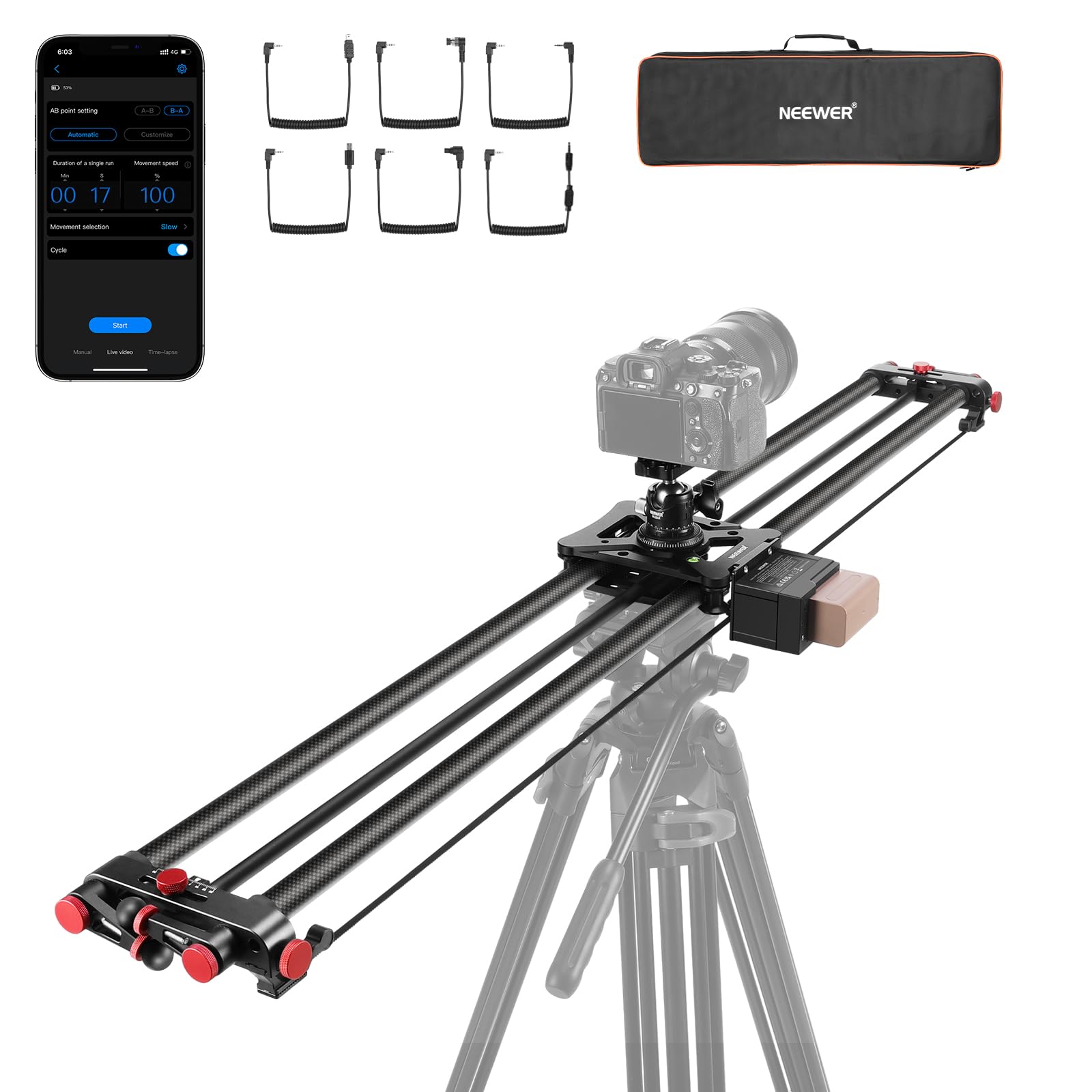
A 47.2-inch motorized rail that weighs 2.5 kilograms is a useful combination: it gives you the reach of a long slider without the heft of the GVM 48-inch. The ER1 uses a carbon-fiber rail and a silent stepper motor, and the side knobs let you set opposite angles for tracking or a 120-degree panorama.

The app handles manual, video, and time-lapse modes, with speed and interval settings, and the included NP-F750 battery is a common video battery that you can swap on a long day. The side knobs make the 120-degree panorama a physical setup rather than a menu dive, which we preferred for repeatable angles.

The 47-inch rail is still a long object to pack, even at this weight; the light body helps on a hike, not in a small bag. For a travel shoot that needs a long motorized move, that is the trade we accept. The carbon-fiber body and the battery are the reasons it stays on our short list.

Pros

  • 47.2-inch rail at 2.5 kg
  • App control with time-lapse and video
  • Includes NP-F750 battery
  • Side knobs for 120° panoramas

Cons

  • Charger and remote not included
Our verdict

Consider the NEEWER ER1 if you want a 47-inch motorized rail that is easier to carry; at 2.5 kg it is the lightest long motorized slider here, and the app and NP-F750 battery suit travel.

Check Latest Price
6

Tabletop Video

NEEWER CS1M Camera Slider

80 /100
Keeper Score Excellent

Key details

Mounts
Phone clamp and action-camera mount
Weight
21.7 oz / 615 g
Max Payload
4.4 lb horizontal
Rail Length
16 in / 40 cm
Check Price on Amazon

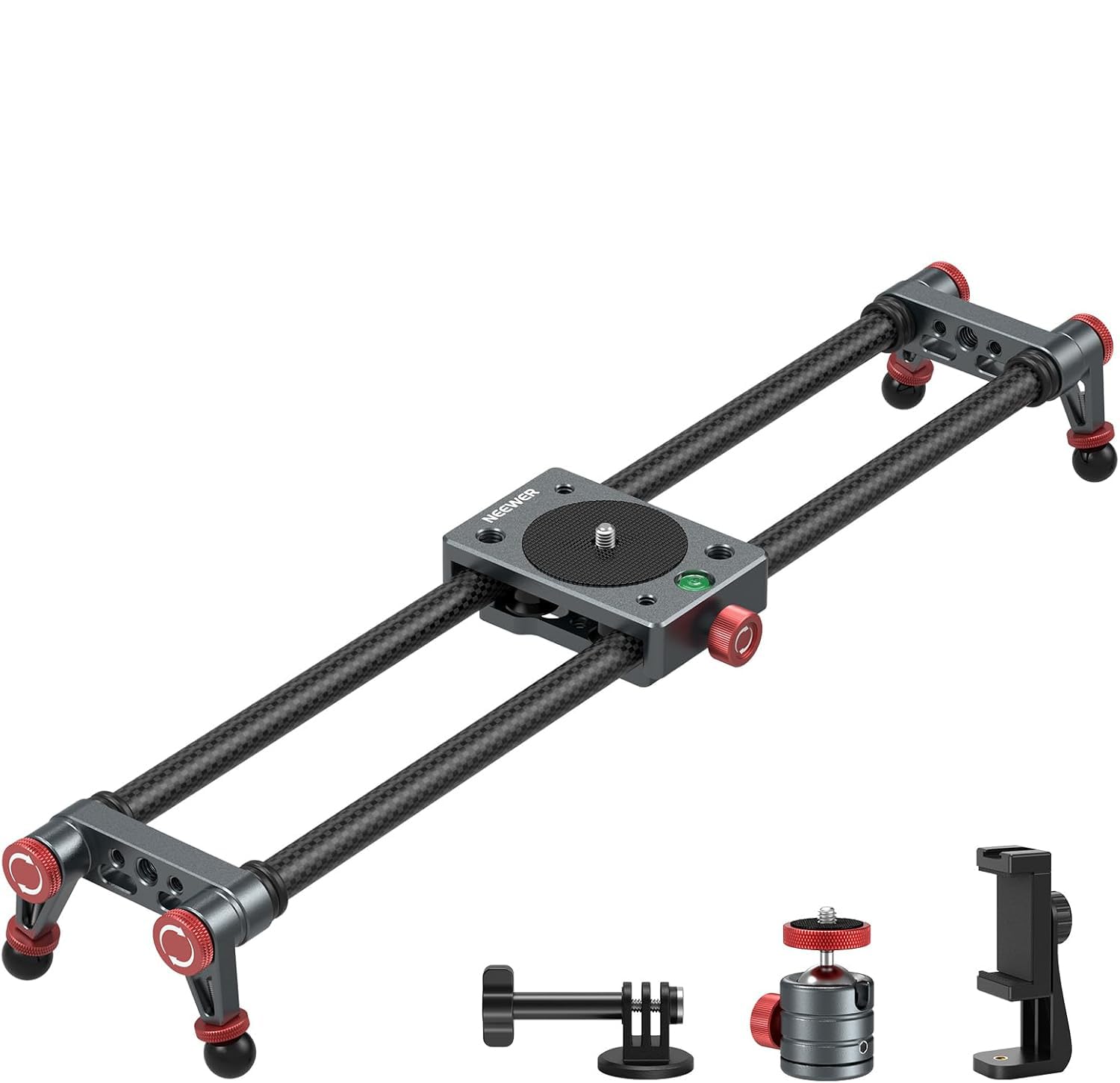
The 16-inch CS1M is less a miniature version of a full slider than a tabletop tool. The carbon-fiber and aluminum rail has four bearings, adjustable legs, a ball head, and mounts for a phone or an action camera, all in a 615-gram package.

We like it for phone and action-camera work because it does not demand a tripod. The adjustable legs let you set it on a table or a wall ledge, and the ball head adds 360-degree rotation and 90-degree tilt. The phone clamp fits 2.2- to 3.4-inch phones, and the cold shoe gives you a place for a small light or mic. Keep a heavy camera low and centered.

For a quick product shot or a travel video, the short rail is an advantage: it packs in a camera bag and sets up in seconds. We see it as the slider you add to a phone kit, not the one you build a video rig around. The carrying bag and action-camera mount make it useful beyond a phone, and the extra 1/4-inch thread plus cold shoe let you grow the kit without replacing the rail.

Pros

  • Fits phones and action cameras
  • Adjustable legs help on uneven surfaces
  • Ball head adds 360° rotation and 90° tilt
  • Only 615 g with carrying bag

Cons

  • 4.4 lb horizontal payload is the ceiling
Our verdict

Buy the NEEWER CS1M if you want a tiny manual slider for phone or action-camera shots; it is light, stable on a table, and ready to mount either camera type.

Check Latest Price

How We Tested These Camera Sliders

We started with the sliders drawing the most consistent owner feedback, then cut anything without a standard tripod thread, with a vague payload claim, or long enough that it wouldn't fit in a backpack. That left 10: short hand-pushed carbon rails, long aluminum dolly tracks, and motorized rigs with app control. We shot with them for six months, on paid jobs and weekend projects alike.

Most of the testing happened where sliders actually live — a one-person interview in a living room, product b-roll on a kitchen counter, a sunset time-lapse from a fire escape, a walk-through of an empty apartment, and a couple of hikes where the rail had to ride in a pack. We set each one up alone and timed it, then weighed it on a kitchen scale with the case on, because a slider you won't carry is a slider you won't use.

With a three-pound camera mounted, we ran each carriage at its slowest speed and watched the footage back frame by frame; stutter that feels like nothing under your hand shows up immediately on screen. We recorded the motor from three feet away and again with a mic inches from the rail, listening for anything that would sit under dialogue. Each slider got a gimbal, a phone clamp, and an action camera in turn on the same tripod, and we knocked the legs mid-move to see how much wobble reached the frame.

By the end, they'd ridden in car trunks, been caught in the rain once, and been assembled and broken down dozens of times; we checked the bearings for grit and the legs for play. Value was the final filter — what each one could actually do against what it cost.

How to Choose a Camera Slider

Match rail length to the move

Start with the move, not the spec sheet. A 48-inch rail gives you room for a full-room push or a long parallax; a 24- to 27-inch rail is better for a short accent or an interview push-in. The quoted number is often the total rail length, not the carriage travel: the IFOOTAGE Shark Nano II 660 is 26 inches long but has 17 inches of slide. Measure the path you want, add clearance for the camera and head, and choose the rail that covers it without making you carry excess metal.

Choose manual or motorized control

Manual sliders are lighter, simpler, and suit short travel and handheld-style b-roll. Motorized models add repeatability: app or wired control, time-lapse, start and end points, and hands-free moves. The control method matters more than the label. An app is useful for time-lapse and multi-point moves; a wired controller is fine for a simple push-in but can be the weak link. Motorized rails also need power, so check battery runtime and whether the charger is included. We prefer app control when the shot needs repeatability and a manual rail when the shot is quick and close.

Respect payload and support the rail

Payload ratings are not decoration. A 20-pound rating lets a built camera stay mounted; a 4.4-pound rating is for a small mirrorless or phone rig. The camera is only half the load, because the head, cage, and lens add up. Long or light rails also flex, especially when you mount them at one point. Support both ends with tripod stands or a center bracket, and keep the camera low when the rail is narrow. A stable rail matters more than a long feature list.

Check mounts and the small extras

We check the mounts before the specs: a 1/4-inch screw covers most cameras, a 3/8-inch thread helps with tripod heads, and a phone clamp or action-camera mount saves adapters. A ball head adds tilt and rotation, while a cold shoe gives you a place for a light or mic. For motorized rails, confirm whether the remote and charger are included, and check that the app or controller supports the modes you use. The extras are where a slider becomes a system rather than a rail.

Frequently Asked Questions

Final Verdict

IFOOTAGE Shark Nano II 660 is the slider we recommend first because it combines 17 inches of motorized travel with 360-degree pan and DJI gimbal integration, and it handles a 15.4-pound rig without turning the shot into a two-person job.

If your priority is a long rail on a tighter budget, the GVM 48-inch is the alternative: it reaches farther and carries 20 pounds, though its belt and battery ask for more planning. For a light travel kit, the Zecti remains the easy manual choice.