Best Bookbinding Kits of 2026

A bookbinding kit is really a promise: that a stack of paper and a spool of thread can become something with a spine. The listing photos all look alike — a fan of folders, an awl, a needle, a spool — so the details that decide it don't show up until you open the box: whether the bone folder is genuine bone or soft plastic, whether the thread is waxed linen, whether the instructions go past 'fold and sew.' I've spent the past four months binding 14 of these kits into journals, sketchbooks, and one memorably lopsided photo album.

What a kit actually solves is the two things that stall a first project: a missing awl, and instructions that assume you already know what a signature is. For a beginner, completeness beats tool count — five pieces that work together will take you further than twenty that don't — and durability is what decides whether you're still binding a year from now or already shopping for a second bone folder. A handful of these kits I'd buy again at twice the price; those are the ones below.

Keeper Score summarizes customer ratings and review volume. Read it alongside the product details and trade-offs. How the score works.

1

Best Overall

VENCINK Bookbinding Kit

93 /100
Keeper Score Outstanding

Key details

Pieces
21
Bone Folders
Two, genuine bone
Waxed Thread
Four rolls, 164 ft each
Also Included
Steel ruler, brush, 79-inch cotton ribbon
Check Price on Amazon

Two things decide whether a starter kit gets used: a folder that creases without bruising the paper, and thread that pulls through a signature without fraying. The VENCINK set gets both right, which is why it's our top pick. The two folders are genuine bone rather than the plastic stand-ins that turn up in cheaper kits, and they have the density that makes a fold stay sharp instead of slowly relaxing. Four rolls of waxed polyester thread, 164 feet each, mean you aren't rationing the thing you'll use most.

The rest of the set is chosen with the same logic. Needles come in three sizes, two of each, plus curved needles for working inside a spine, and the wood-handled awl pushes through a folded signature and a card cover in one go. We reached for the steel ruler more often than we expected — it's the difference between cover boards that match and boards that nearly match — and the 79-inch cotton ribbon covers a couple of exposed-spine projects.

What's absent is everything that isn't a hand tool: no press or pressing boards, no paper, no board or cloth for covers. The thread is polyester rather than linen, which is strong and smooth but lacks linen's softer hand — a detail that matters if you're working toward a traditional binding and not at all if you're making notebooks.

Nothing here is filler, which is rarer than it should be. The brush is for glue, the ribbon reinforces a spine, the thimble earns its keep on a long sewing session, and the needles arrive in clear bags rather than loose in the bottom of a box. You can start a book the day it lands and only stop to buy paper.

Pros

  • Two genuine bone folders that crease cleanly
  • Four 164-foot rolls of waxed thread
  • Straight and curved needles in three sizes
  • Steel ruler, brush, and 79-inch cotton ribbon

Cons

  • No press, paper, or cover board included
Our verdict

We recommend it as the default kit: two genuine bone folders and four full thread rolls cover both halves of the craft, with no filler to sort through.

Check Latest Price
2

Best Value

KOOTIKO Bookbinding Kit

92 /100
Keeper Score Outstanding

Key details

Pieces
24
Bone Folder
Six-inch genuine ox bone
Waxed Thread
Six colors, 1 mm
Also Included
Glue brush, thimble, binder clips, zip pouch
Check Price on Amazon

Twenty-four pieces arrive in a zip pouch about the size of a pencil case, and the pouch is part of the appeal: everything stays together between projects instead of migrating across a desk. Inside are a six-inch folder made from genuine ox bone, needles in three sizes, four curved needles for working inside a spine, a wood-handled awl, a glue brush, a thimble, and binder clips.

Six rolls of 1 mm waxed thread are what sold us. The colors run from beige and khaki through brown and royal blue to black, and colored thread is the least expensive way to make an exposed-spine binding look deliberate — you can match a cover instead of settling for white. The glue brush is the other piece we were glad to see, because pasting a spine with a finger and optimism is how beginners end up with glue where the text block should be.

What you give up is capacity. This is a tools-and-thread kit: no press, no paper, no board or cloth, so your first flat spine will come from a stack of heavy books or a press you buy later. It's the cheapest kit here, and for journals, junk journals, and a first Coptic notebook, that's a fair trade to make.

Pros

  • Six thread colors for exposed-spine work
  • Genuine six-inch ox bone folder
  • Glue brush, thimble, and clips included
  • Zip pouch keeps all 24 pieces together

Cons

  • No press or paper
Our verdict

This is our value pick — six thread colors and a real bone folder in a pouch that keeps all 24 pieces together.

Check Latest Price
3

Best with a Book Press

pamctry Book Binding Kit

90 /100
Keeper Score Outstanding

Key details

Pieces
50
Book Press
11.6 x 7.8 in wood
Waxed Thread
Five spools
Also Included
12 needles, scissors, ruler, brush, book cloth
Check Price on Amazon

Pressing is the step beginners skip and then wonder about. A sewn text block left under weight overnight is what makes a book open flat instead of springing shut, and this is the one kit here that ships the press — a wooden one with 11.6 by 7.8 inch boards — alongside 50 pieces of tooling: five spools of waxed thread, 12 needles, an awl, scissors, folders, a brush, a ruler, and three pieces of book cloth.

The cloth is the sleeper item: three pieces, easy to trim, and the thing that makes a repair look deliberate rather than patched over. The press assembles from cross-boards and screws and does the two jobs that matter, flattening a sewn block and holding a glued spine square while it dries. Set up once, it stays set up, which is more than you can say for a stack of cookbooks.

We found the manual's limits easier to work around than the press's. The booklet walks you through assembling the press rather than through a binding, so line up a video before your first glue-up and you're fine. The boards are the real ceiling: books around 6 by 9 inches sit comfortably inside them, and anything larger overhangs. For journals, zines, and repairs, that covers nearly everything you'll make in a first year.

Pros

  • Wooden press for flattening and nipping glued spines
  • 50 pieces including 12 needles and five thread spools
  • Three book cloth pieces for spine repairs

Cons

  • Press boards suit books around 6 by 9 inches
Our verdict

We reach for this one when pressing matters: it's the only kit here with a wooden press, and it suits journals and repairs more than large formats.

Check Latest Price
4

Best for Making a Whole Book

Jupean Book Binding Kit

90 /100
Keeper Score Outstanding

Key details

Pieces
139
Book Cloth
Five colors
Instructions
Printed manual plus video tutorials
Paper Included
100 sheets, A5
Check Price on Amazon

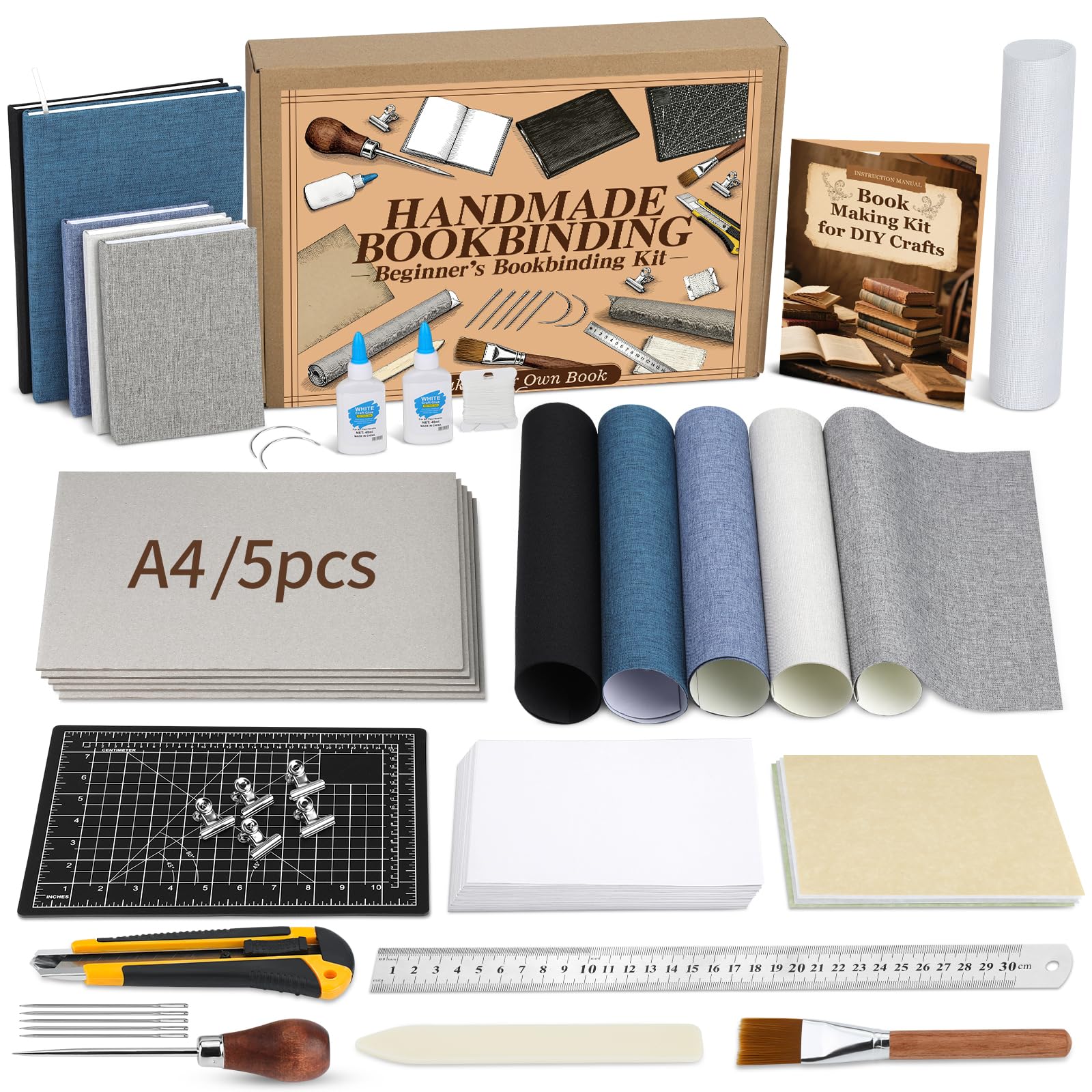
A hundred sheets of A5 paper is the first sign this kit means for you to finish a book, not just sew one. Alongside the tools — seven needles, white waxed thread, a leather awl, a folder — the 139-piece set adds what most kits leave out: A4 cardboard for covers, gauze for the spine, and book cloth in five colors. We think that's the right way to sell a beginner kit, because the second shopping trip is where a lot of first books stall.

The materials are decent rather than luxurious: text paper you can print on, board stiff enough for a cover, and cloth meant for the job. The folder is plastic rather than bone, and a plastic edge that goes rough will mark a sheet instead of burnishing it, so plan on replacing that one part once you're binding regularly. Needle eyes are the other soft spot, and steady pressure beats a hard pull through a dense signature.

Instructions are the reason this one earns a place over a plain tool set. There's a printed manual and video tutorials you reach by scanning a code in it, and watching someone case in a book before you try it is worth more than another ten pieces of equipment. The single white thread is the trade-off: clean and traditional, but no help if you wanted colored sewing on an exposed spine.

Pros

  • Includes 100 sheets of A5 paper
  • Book cloth in five colors, plus board and gauze
  • Printed instructions with video tutorials

Cons

  • White thread only, with no color options
Our verdict

We like it for a first book you can actually finish — it ships the paper, board, cloth, and gauze the others leave you to buy.

Check Latest Price
5

Trying the Craft

Goiio Bookbinding Kit

94 /100
Keeper Score Outstanding

Key details

Pieces
11
Folders
Two, plastic
Needles
Six, three sizes
Waxed Thread
50 m spool
Check Price on Amazon

Eleven pieces, and the two you'll handle most are plastic. The Goiio kit is the smallest set here: six large-eye needles in three sizes in a little bottle, a wood-handled awl, 50 meters of waxed polyester thread, and two folders with creasing tips. It's a try-the-craft kit rather than a build-a-library kit, and it's priced like one.

For a first notebook, that's enough. The awl is the standout — sharp, and able to push through a signature of roughly ten sheets plus a card cover in one go — and 50 meters is more sewing than most beginners finish in a year. What we noticed is how little the missing pieces matter at this stage: you don't need a rainbow of thread to learn a kettle stitch, and you don't need a press to learn tension.

The folders are the weak point. Plastic creases paper acceptably at first but can roughen at the edge and start scoring the sheet, and these two are thin. If you keep binding, a bone folder is the first thing to buy separately. The little bottle keeps all six needles in one place, which counts for something the first time you drop one.

Pros

  • Sharp awl that clears a signature in one push
  • 50 m of waxed thread, plenty to start
  • Needle bottle keeps six needles together

Cons

  • One thread color, so exposed-spine variety is limited
Our verdict

Our take: a cheap, honest way to find out whether you enjoy bookbinding, as long as plastic folders and one spool don't put you off.

Check Latest Price
6

Stab-Bound Booklets

We R Memory Keepers Punch Guide

91 /100
Keeper Score Outstanding

Key details

Size
14.5 x 4.75 x 1.13 in
Pieces
6
Includes
Awl, straight and curved needles, waxed thread
Stitching Template
Japanese stab binding
Check Price on Amazon

Stab bindings, Coptic notebooks, and zines all depend on one thing: holes that line up. This six-piece set is built around a punch guide — a cradle you lay the signature into so the awl goes through at consistent spacing — and it comes with an awl, a straight and a curved needle, waxed thread, a Japanese stitching template, and storage built into the guide. Closed, it measures 14.5 by 4.75 inches and lives in a drawer.

The template is the part we used most. Set the spacing once, punch a whole signature, and the pages stay square without measuring every hole — the difference between a neat spine and a wandering one. It suits someone making the same size of booklet over and over: a run of zines, a stack of journals, a fan-binding project.

Where it gets fiddly is size changes. The knobs have to be unscrewed and reset for each new spacing, and the top has to go back on between passes, so the useful habit is to lock in one spacing and work through a batch rather than resetting between books.

It's also a plastic tool doing a metal tool's job: light in the hand, and the guide can flex if you lean on it. None of that matters for softcover booklets. If your plan is a hardcover with board, cloth, and a cased-in spine, this won't get you there — the punch guide is an accessory to a kit, not a replacement for one.

Pros

  • Punch guide keeps hole spacing even
  • Japanese stitching template included
  • Awl, two needles, and waxed thread in the set

Cons

  • Shallow channel lets thick signatures ride up
  • Light plastic body can flex under a heavy hand
Our verdict

We keep it for thin stab-bound booklets, where the punch guide holds hole spacing that a ruler and hope never will.

Check Latest Price
7

Square Covers

Sthmeyue Aluminum Template Set

90 /100
Keeper Score Outstanding

Key details

Pieces
5
Weight
5.11 oz
Material
Aluminum, 3-5 mm thick
Templates
T-ruler, corner miter, spine spacer, divider, angled
Check Price on Amazon

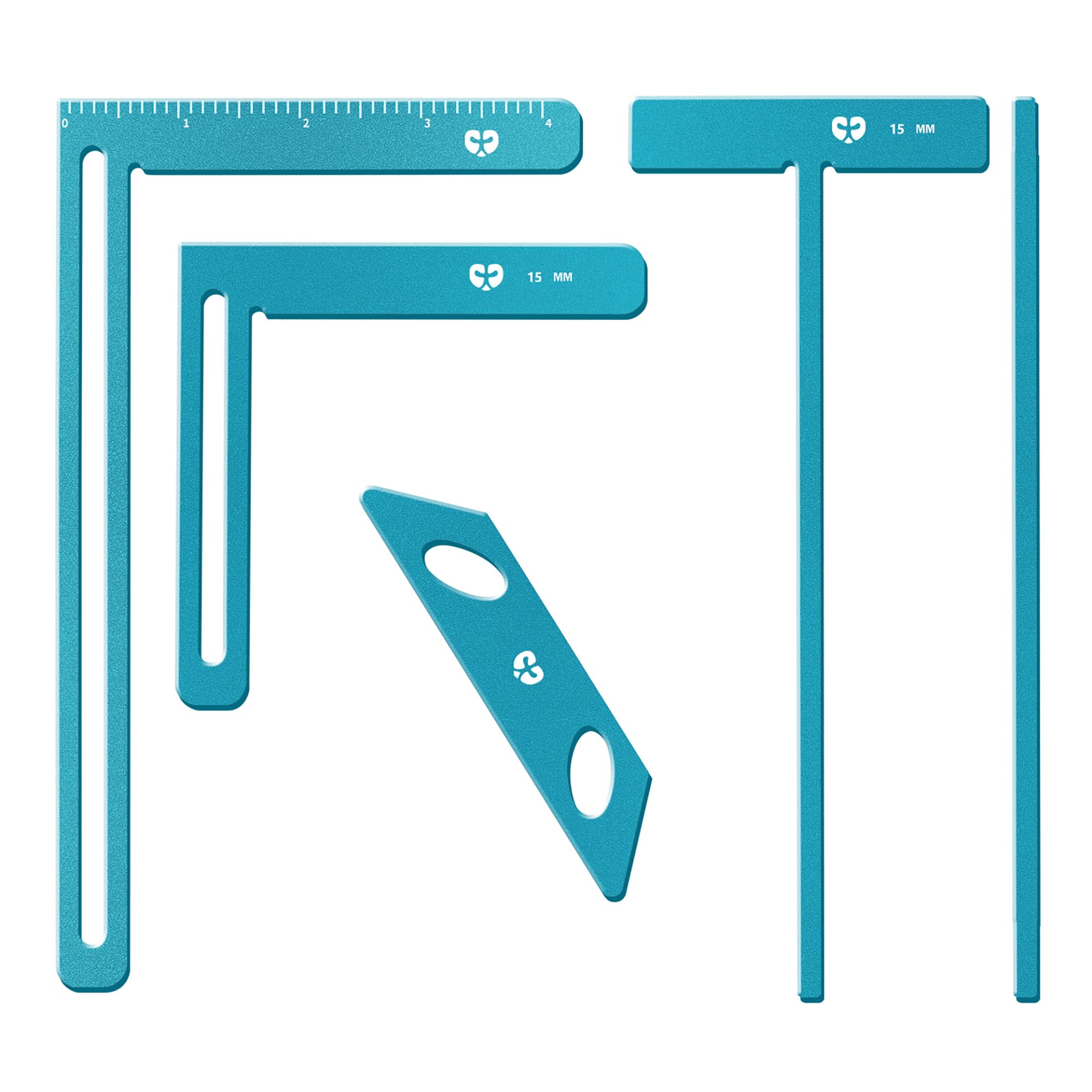
Metal changes how a template behaves. These five plates — a T-ruler, a corner miter, a spine spacer, a divider, and an angled template — are aluminum, 3 to 5 mm thick, and they don't shave or scar when you run a knife along the edge. The set weighs 145 grams and comes in a drawstring mesh pouch.

The corner miter earns the set. Laying it into a cover corner and cutting against it gives you 45-degree angles that match on all four corners, which is the difference between a book that looks homemade and one that looks handmade. The spine spacer does the same job for setting board gaps before you glue, and the divider holds spacing while you mark.

Two limits come with it. The plates are compact, which is fine for journals and small albums but cramped on a full-size trade paperback cover, where you'll want a longer ruler alongside. And this is measuring and marking only — no thread, needles, awl, or folder — so it's an addition to a kit, not a substitute for one.

We think it justifies its place only if alignment is where your books actually go wrong. If your corners come out square and your spines sit straight, the pamctry press is the better purchase. If they don't — and if you've been cutting against plastic templates and watching them score — the aluminum is a difference you'll feel on every cover you make.

Pros

  • Aluminum plates resist knife scoring
  • Corner miter gives matching 45-degree corners
  • 145 g set with a mesh carry pouch

Cons

  • Compact plates are cramped on full-size covers
  • Templates only
Our verdict

We rate it for crooked covers: aluminum templates hold a line plastic can't, and they'll outlast the kit they support.

Check Latest Price

How We Chose and Tested Bookbinding Kits

We started with every kit we could find, then filtered by what the reviews kept repeating: tools that bent on first use, boxes that arrived missing needles, instructions photocopied onto a single page. Kits that were mostly folders with no thread got cut. That left 14, which my team and I used over four months.

Testing happened where the hobby actually happens — my kitchen table on Sunday afternoons, and a friend's dining room when I handed her a kit and a stack of paper and said nothing else. Each kit got at least three projects: a simple pamphlet-stitch notebook, a stab binding using whatever stitching template came in the box, and a hardcover journal with book cloth and board.

Along the way we noted how each bone folder creased — a crisp fold or a soft rounded one — and whether its edge mushed after a dozen signatures. We punched through stacks of paper with every awl to check whether the holes were clean or torn, watched for waxed thread that frayed or knotted mid-sew, and rinsed the glue brushes to see if the bristles shed. Stitching and spacing templates got held against a square, since a guide off by a millimeter shows up in the finished book.

Instructions got their own pass. I built each kit's cover using only what came in the box, no video and no searching, and wrote down where I stalled and what I had to look up. Kits with printed guidance or a tutorial link, and templates cut for standard paper sizes, separated quickly from the ones that assumed I already knew.

How to Choose a Bookbinding Kit

Start With the Folder, Not the Piece Count

Kits are sold by the piece, and the number is a poor guide: needles and thread rolls inflate it while the two tools you handle constantly stay the same. Check the folder material first. Genuine bone is dense, smooths with use, and burnishes a fold without marking the sheet. Plastic works on light paper but can roughen at the edge and start scoring instead of smoothing. If a listing doesn't say bone, assume plastic and weigh the rest of the kit accordingly.

The Four Things Every Kit Needs

Whatever the branding, you need thread, needles, an awl, and a folder. Straight needles in two or three sizes cover most sewing; curved needles help when you're working inside a spine. An awl should be sharp enough to punch a signature in one push and comfortable enough that you aren't fighting it. Ribbon, clips, thimbles, and a glue brush are the conveniences that make a kit pleasant rather than merely sufficient. A set that skips the awl or ships only plastic folders is a sampler, not a starter kit.

Thread: How Much, What Kind, Which Colors

Thread arrives waxed and pre-wound, usually polyester, sometimes linen. Polyester is strong and smooth; linen has a softer hand and is the traditional choice. Length matters more than shoppers expect — a single small spool runs out mid-project, while four 164-foot rolls or six 1 mm rolls carry you through a long stretch of books. Color is a design decision: neutral thread disappears into a traditional binding, and a second or third color turns an exposed spine into the feature rather than the construction.

When a Press Is Worth It

A press does two jobs: it flattens a sewn text block overnight, and it holds a glued spine square while the adhesive sets. The first you can fake with a stack of heavy books. The second is much harder to fake. Press kits add cost and weight, and their usefulness is capped by their boards — a press that opens 11.6 by 7.8 inches suits books around 6 by 9 inches, so measure the project you have in mind before you pay for one.

Tools, Materials, or Both

Most kits stop at tools and thread, which means your first finished book also needs paper, cover board, cloth, and gauze — a second order before you've made anything. Kits that bundle materials trade some tool quality for that completeness, and if you want the momentum of finishing a book the week the box lands, the trade is worth making. If you already own paper and board, put the money into the better tool set instead.

Frequently Asked Questions

Final Verdict

Buy the VENCINK set. Two genuine bone folders and four full rolls of thread cover both halves of the craft, and nothing in the box is filler — which is why we point beginners to it ahead of the prettier, more expensive sets here.

If you want to press your first text block flat, the pamctry kit is the only one here with a press, as long as your books stay around 6 by 9 inches. Binding journals on a budget, the KOOTIKO set covers nearly the same ground with more thread colors.