Best Binoculars for Kids of 2026

Most binoculars sold for kids are either plastic toys with lenses or real optics scaled down for small faces. You know which one you're holding about four seconds after a child raises them: one gives a single bright circle, the other looks like two fogged worlds overlapping. The right pair turns a bird feeder, a trail, or the moon into something worth standing still for.

We spent four months with 15 pairs, from chunky toddler designs to compact 8x21 and 10x25 models adults will quietly borrow. They came to bird feeders, zoo trips, a camping weekend, and the driveway after dark. The winners got the basics right: clear glass, a focus knob small hands can turn, and a strap short enough that nothing dangles at a kid's knees.

The mistake first-time buyers make is chasing magnification. A 12x pair sounds like more binocular than an 8x, but a 6-year-old can't hold that steady, and the narrow view makes finding a bird harder than identifying it. A compass is a nice extra — just spin it before you count on it.

Keeper Score summarizes customer ratings and review volume. Read it alongside the product details and trade-offs. How the score works.

1

Best Overall

Think Peak 8x21 Kids Binoculars

93 /100
Keeper Score Outstanding

Key details

Focus
Center focus knob
Weight
8 oz
Body Size
4.4 x 4 x 1.5 inches
Magnification
8x21
Check Price on Amazon

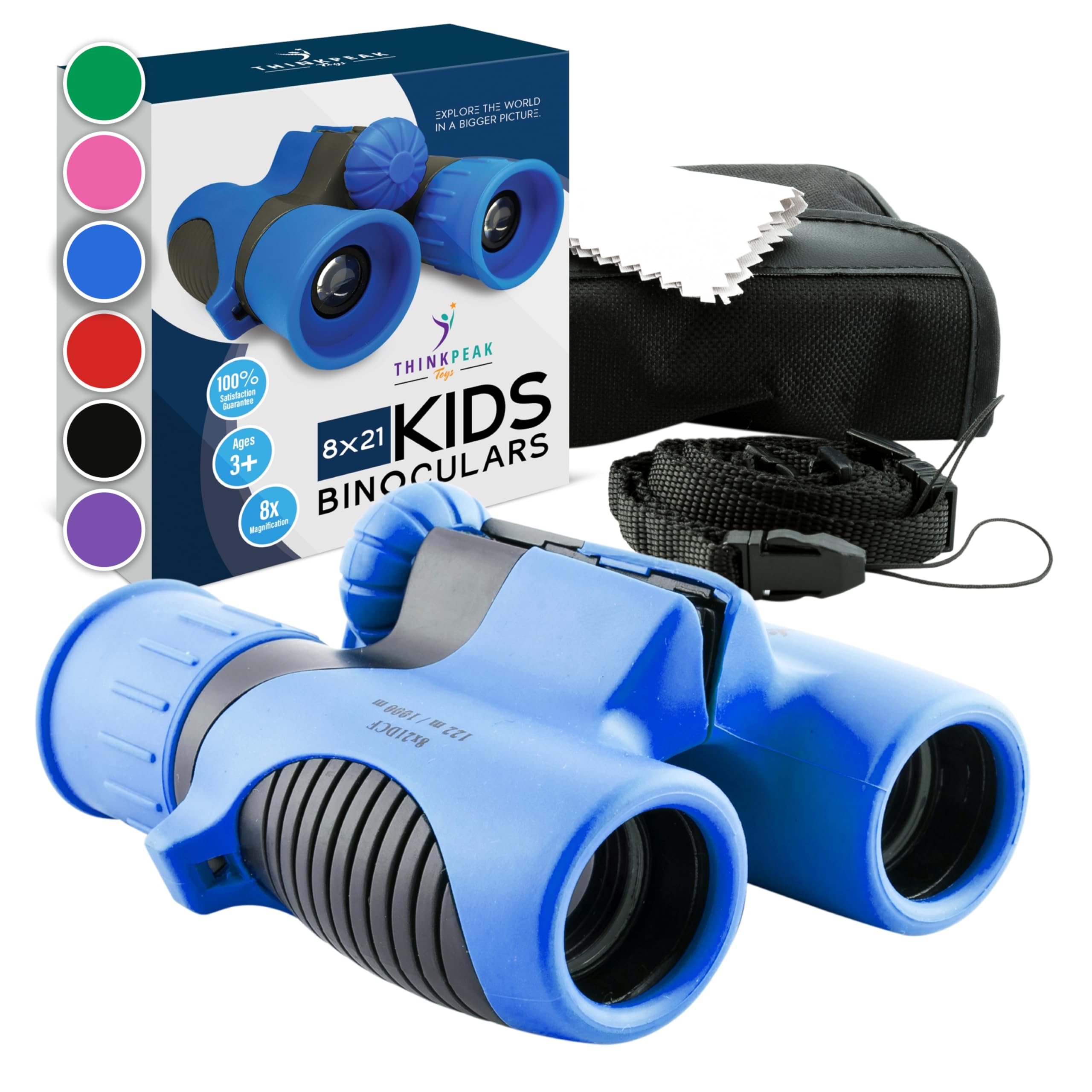
The textured rubber band around the Think Peak focus knob is what made this our top pick. It sits proud of the bridge, wide enough for a small thumb and forefinger, and a child can find it without looking away from what they're watching. The eyepieces measure about 1.5 inches across on a 4-by-4-inch body, and the barrels swivel so the gap between them closes down to a child's face.

Eight power on a 21 mm lens is the right amount of magnification for this age group: strong enough to pull a bird out of a hedge thirty feet away, not so strong that the image shivers apart in small hands the way 10x and 12x do. What we noticed in use is how little effort the focusing takes. The knob turns with a light touch and settles, so a child can hunt for sharpness without overshooting it and giving up.

The body is built to take a knock: rubberized armor, a solid hinge, and glass set back from the edges. At 8 ounces it's light enough to wear on a strap all afternoon, which matters more than any coating, because the pair a child keeps around their neck is the pair that gets used.

What you're paying for, more than accessories or a logo, is glass and fit: the Bak-4 lenses, the hinge that closes to a small face, the knob a child can work alone. Set the eyepiece width for them the first few times and they'll take it from there. After that the only maintenance is remembering where they left it.

For a child of about five and up who is genuinely curious, the one who asks what that bird is and then wants to see it, we think this is the pair to buy. It has enough reach to stay interesting through elementary school, and the controls are laid out so a kid can work them without an adult standing behind them. That combination is rarer here than it should be.

Pros

  • Focus knob sized for small hands
  • 8x power a child can hold steady
  • Barrels swivel to fit a small face
  • Light enough to wear all afternoon

Cons

  • Priciest pair in this group
Our verdict

We recommend the Think Peak pair as the default: real 8x optics a child can focus alone, in a drop-resistant 8-ounce body that will last from kindergarten to middle school.

Check Latest Price
2

Best Value

Obuby 8x21 Kids Binoculars

91 /100
Keeper Score Outstanding

Key details

Weight
6 oz
In The Box
Case, velvet bag, lens cloth
Color Options
13
Magnification
8x21
Check Price on Amazon

If the top pick's price feels like a lot for something that will spend half its life in a coat pocket, the Obuby 8x21 does most of the same work for a good deal less. Same magnification, same 21 mm objective, Bak-4 prisms and a 7.2-degree field, and at 6 ounces it's the lightest 8x pair here. We think it's the best value in this group.

What we appreciated most is the kit. A hard case, a velvet drawstring bag, a lens cloth and a neck strap come in the box, which solves the real failure mode for kids' binoculars: a scratched lens from riding loose in a backpack. The rubber eyecups are soft against the brow, the center knob focuses smoothly enough for a child to do it alone, and thirteen colors means a child can pick a pair they'll actually want to carry.

Where it lands is the sensible middle. A child who's past the toddler stage, a family that wants a spare pair in the car, a first purchase you won't wince at when it's left on a picnic table — it's the pair we suggest to anyone who isn't certain their kid will stick with it.

Pros

  • Complete kit with case, pouch and cloth
  • Six-ounce body for small necks
  • Thirteen colors to choose from
  • 8x21 optics at a modest price

Cons

  • Dim view in low light
Our verdict

Our value pick matches the top pick's magnification and adds a hard case, in a body light enough for a five-year-old to forget they're wearing it.

Check Latest Price
3

Best for Sharing

Hontry 10x25 Compact Binoculars

91 /100
Keeper Score Outstanding

Key details

Weight
9.6 oz
Field Of View
362 ft at 1,000 yds
Magnification
10x25
Interpupillary Range
60 to 75 mm
Check Price on Amazon

Interpupillary distance is the number almost nobody checks before ordering and the one that decides whether a pair of binoculars works for a family. The Hontry 10x25 closes to 60 mm and opens to 75, which spans a child's face and most adults', so a parent can hand them over and take them back without anyone starting from scratch.

The rest of the specification is strong for the size: fully multi-coated Bak-4 prisms, a 362-foot field of view at 1,000 yards, waterproofing and a three-year warranty. We were struck by how much adult-oriented design carries over. This is a real compact binocular that happens to fit small faces rather than a kids' model scaled up, and the glasses wearer gets a workable setup too: 10 mm of eye relief with fold-down eyecups is enough, if not generous.

What that adds up to is a family pair — the one to leave in the glovebox, the one that goes on the boat, the one a ten-year-old graduates into before getting something full-size. It's a genuinely good little binocular that a child is simply allowed to use.

Pros

  • Eyepieces adjust from 60 to 75 mm
  • Waterproof, with a three-year warranty
  • Fully multi-coated Bak-4 glass
  • Fits a jacket pocket at 9.6 ounces

Cons

  • 10x needs steadier hands than young children have
Our verdict

Buy this one if the binoculars will be shared: the eyepieces spread from 60 to 75 mm to fit small faces and most adults, and the body is waterproof.

Check Latest Price
4

Best Gift Set

Noptix Kids Binoculars

92 /100
Keeper Score Outstanding

Key details

Extras
40-species bird sticker book
Weight
6.08 oz
Magnification
8x21
Water Resistance
Waterproof
Check Price on Amazon

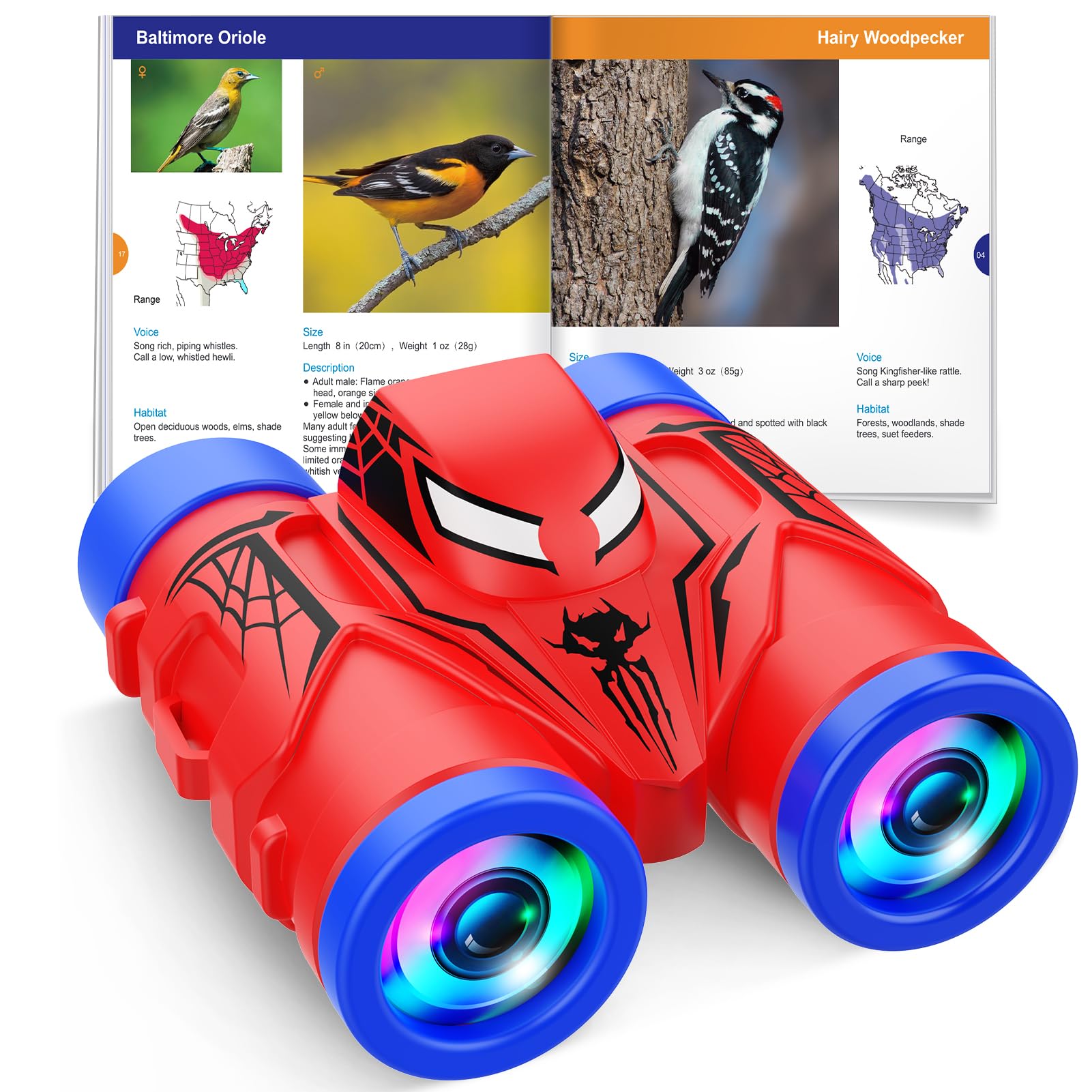
A pair of binoculars only gets used if a child has something to point them at, and Noptix's answer is a sticker book: forty-odd bird species, each sticker labelled with the name, which turns a window and a feeder into a checklist. It's the sort of extra that looks like marketing on a product page and turns out to be the thing that gets a seven-year-old off the couch.

The optics underneath are respectable: 8x21 roof prisms with lens coatings, a center focus wheel, and a diopter that covers plus or minus 5. At 6.1 ounces and about 4 inches across, the pair disappears into a jacket pocket, and the rubber-coated body is rated shockproof.

Little things are done right. The focus wheel turns smoothly enough for small fingers, the eyecups are soft, and the pair ships with a case and a lens cloth. The pink-and-blue colorway is loud enough that it won't vanish into the bottom of a bag.

As a first proper pair for a child who has shown real interest, we rate it highly. The optics are real, the grip suits small hands, and the sticker book gives the whole thing a purpose beyond the object itself. It arrives as a gift with an activity attached.

Pros

  • Forty-species bird sticker book included
  • Coated 8x21 roof-prism optics
  • Shockproof, rubber-coated body
  • Comes with a case and lens cloth

Cons

  • Six-degree field takes practice to aim
Our verdict

A gift that gives a new birder a job: 8x21 optics plus a forty-species sticker book, in a shockproof body that survives being carried by one barrel.

Check Latest Price
5

Best for Toddlers

GeoSafari Jr. Kidnoculars

93 /100
Keeper Score Outstanding

Key details

Focus
Fixed focus
Weight
7 oz
Age Range
3 years and up
Magnification
2x
Check Price on Amazon

Two times magnification reads like a misprint next to the 8x pairs here, and for a seven-year-old it would be. Hand a pair to a three-year-old and the number makes sense: there's no focus wheel to turn and no eyepiece spacing to set, so a child who can't yet line up two barrels still gets a magnified view on the first try. The oversized rubber eyecups find a small face without help, the whole thing weighs 7 ounces, and for the preschool years we think that's exactly the right trade.

What 2x does is pull the bird feeder a few feet closer, which is genuinely exciting when you're small and everything is new. The 35 mm objective and multi-coated glass make the most of the available light, and the neck strap is designed to break away under a snag, which is the detail that matters on a preschooler's neck. It's also the pair least likely to end up in a drawer, because there's nothing on it a child can set wrong.

Pros

  • Nothing to focus or adjust
  • Oversized eyecups suit small faces
  • Breakaway neck strap
  • Seven ounces with a 35 mm objective

Cons

  • 2x view won't hold a child past about five
Our verdict

For a three- or four-year-old, this is the pair we hand over: two oversized eyecups, nothing to focus, and a strap that releases if it snags.

Check Latest Price
6

Older Kids

Occer 12x25 Compact Binoculars

89 /100
Keeper Score Excellent

Key details

Weight
13.8 oz
Eye Relief
20 mm
Field Of View
273 ft at 1,000 yds
Magnification
12x25
Check Price on Amazon

Twelve power in a 4.4-inch body is the headline, and it's why this pair sits near the bottom of our list for small children and near the top for older ones. A 25 mm objective with fully multi-coated Bak-4 glass gives a 273-foot field at 1,000 yards, a plus-or-minus 5 diopter range, and a body that weighs 13.8 ounces.

Where the Occer earns its place is around the eyepieces. Twenty millimeters of eye relief and rubber cups that pull down make this the friendliest pair here for a child who wears glasses; most kid-sized binoculars leave you pressed right against the glass. The focus wheel is quick, and the diopter adjustment corrects a difference between the two eyes, which is more control than most of this group offers.

So this is the pair for the ten- or twelve-year-old who already knows how to plant their elbows and hold still, or for the adult who wants something in the glovebox. Hand it to a five-year-old and the shake will frustrate everyone involved. Hand it to a kid who has been birding for a season and it's the most capable optic on this page.

Pros

  • Twenty millimeters of eye relief
  • Twelve power reaches further than the rest
  • Diopter corrects for uneven eyesight
  • Folds into a shirt pocket

Cons

  • Low-light view is dim with a 25 mm objective
Our verdict

We keep this one for the older kid who can already hold binoculars still, and for the adult who borrows them; nothing else here reaches as far.

Check Latest Price
7

Gift-Ready Kit

Promora Kids Binoculars Set

90 /100
Keeper Score Outstanding

Key details

Weight
9.2 oz
Warranty
2 years
In The Box
Compass and magnifying glass
Magnification
8x21
Check Price on Amazon

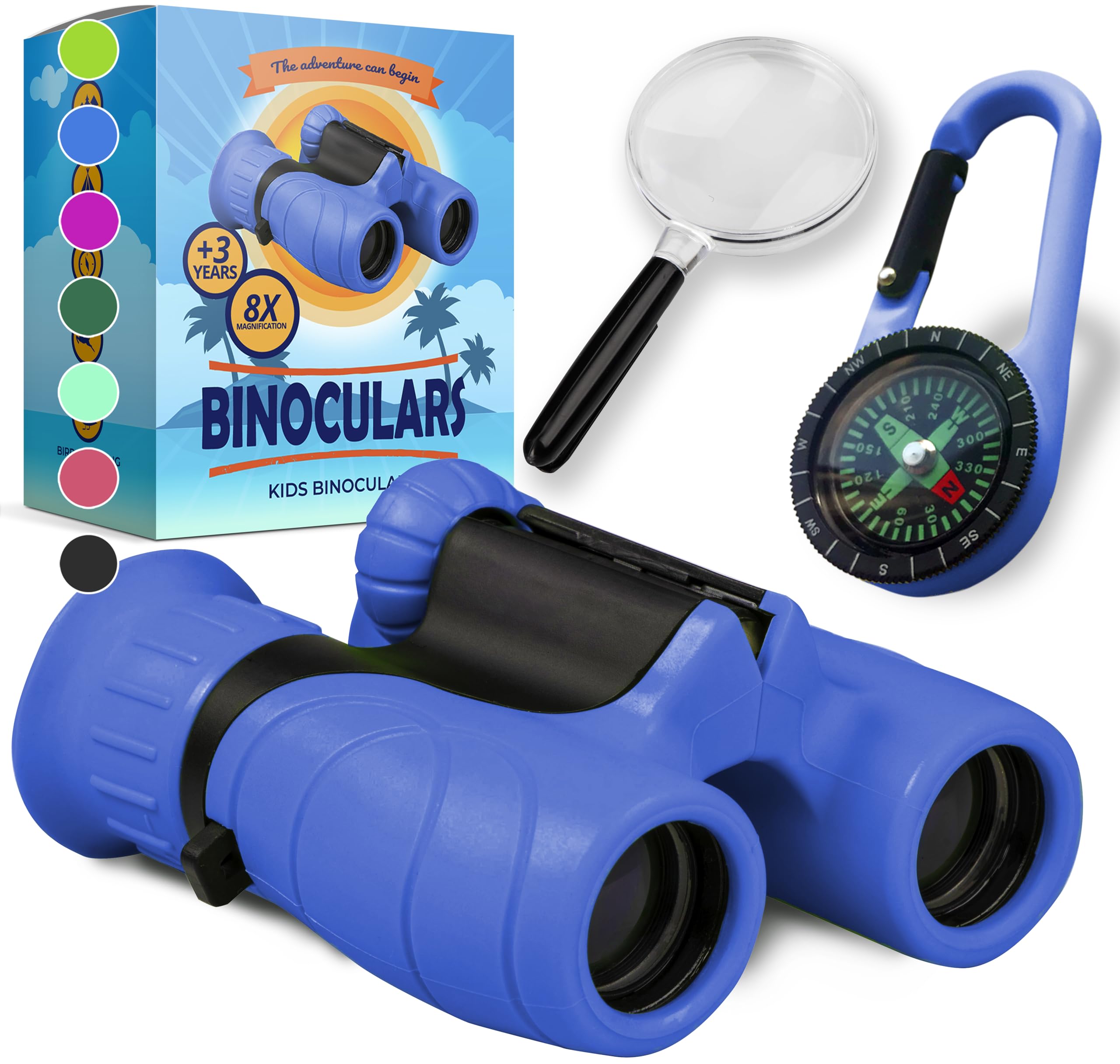
The binoculars are the substantial part of this adventure set: 8x21 optics with a center focus wheel, a diopter adjustment and a central hinge that opens and closes to fit different faces. The rubber coating grips well in small hands, and at 9.2 ounces it's comfortable on a neck strap for a long walk. A compass on a clip, a magnifying glass and a cloth bag come along, and there's a two-year warranty behind it.

What we like is that the binocular is the substance here. Hinge, diopter, focus: a five- or seven-year-old can be taught the sequence in an afternoon, and the size is right for a child who has outgrown a toddler pair but isn't ready for something costly. The extras give the unwrapping some theatre, so the whole thing reads as a gift rather than a piece of equipment.

Pros

  • Adjustable hinge, diopter and center focus
  • Rubber grip suited to small hands
  • Two-year manufacturer warranty

Cons

  • Heavier than the six-ounce pairs here
  • Compass and magnifier are tiny add-ons
Our verdict

A tidy gift for a five- to seven-year-old who needs a reason to head outside: real 8x21 binoculars with a compass and magnifier along for the walk.

Check Latest Price
8

First Real Pair

JovialToyz 4x30 Kids Binoculars

90 /100
Keeper Score Outstanding

Key details

Body Size
4.92 x 4.92 x 2.28 inches
In The Box
Compass, canvas bag, neck strap
Magnification
4x30
Recommended Ages
3 to 8 years
Check Price on Amazon

Thirty millimeters of objective glass behind only four power is an unusual combination, and it's what makes this the easiest pair here to look through. The exit pupil works out wide, so a child doesn't have to line an eye up precisely to get a full circle of view — the thing that makes first-timers give up on smaller binoculars. The body is 4.9 inches square, comes in red, and ships with a compass, a neck strap and a canvas bag.

Four power is gentle magnification: it brings the feeder or a squirrel on the fence closer without demanding a steady hold. The hinge folds to fit small faces, the rubberized handle is easy to grip, and the compass makes it feel like a set rather than a single gadget.

For a three- to five-year-old who will drop them within the hour, we think this is a sensible first pair: sturdy enough to survive a season, genuinely usable rather than pretend, and cheap enough that losing one isn't a disaster.

Pros

  • Wide exit pupil makes it easy to look through
  • Folds to fit small faces
  • Compass, bag and strap included

Cons

  • 4x runs out of reach for older children
Our verdict

Four power behind a 30 mm lens makes this the most forgiving pair here to look through, which is exactly what a four- or five-year-old needs.

Check Latest Price
9

Night Play

Little Experimenter Night Vision Binoculars

93 /100
Keeper Score Outstanding

Key details

Focus
Fixed focus
Power
3 LR44H batteries
Magnification
2x
Recommended Ages
3 to 6 years
Check Price on Amazon

What the Little Experimenter pair actually does after dark is throw a green beam out of the front, lighting up whatever it's pointed at. It is not image intensification, and a child expecting to see in pitch black will be disappointed for about a minute, then switch it on again, because pressing the button and watching the world turn green is the whole appeal.

That part goes over well on evening walks and campouts. The binocular side is a fixed-focus 2x with a 36 mm objective and rubber eyecups that mold to a small face, so there's nothing to adjust and nothing to break. Three LR44H batteries run the light, and a single button is easy for a small thumb.

The shape is the other good decision: 8.8 ounces, a grip a preschooler can hold one-handed, and no loose parts beyond the battery door. It's rated for ages three to six, which is honest about what it is.

As a night-time companion to a first pair of binoculars, we like it. As the only pair a child owns, it isn't enough: 2x won't show them a bird's beak. Buy it for the child who already has a daylight pair, or for the three-year-old who mostly wants a light to shine.

Pros

  • Built-in light for evening play
  • Fixed focus with nothing to adjust
  • Comfortable rubber eyecups

Cons

  • Batteries are an ongoing cost
  • ⚠️ Beam can catch someone in the eyes at close range
Our verdict

We reach for this one after dark: the green beam turns an evening walk into an expedition, and at 2x it's a toy first and an optic second.

Check Latest Price

How We Chose and Tested Kids Binoculars

We started by reading listings for roughly 40 pairs, then cut anything that listed a magnification above 12x, used plain plastic lenses, or shipped without a strap, and kept the mix to what a grandparent would spend on a birthday present. That left 15 pairs, which went home with six families and stayed in rotation for four months.

Testing happened where kids actually are: at a backyard feeder before school, at the zoo, on a camping weekend, in the back seat of a car, and on the driveway after dark. We looked through every pair at a roofline across the street to check for a ghosted double image, then at a license plate and a sparrow at the feeder to see whether lettering and feather detail came out sharp or soft. Each child was handed a pair cold and timed on how long it took to go from blurry to sharp; the good focus knobs turned with two small fingers, and the bad ones needed an adult's grip.

Size mattered more than the specs suggested. We weighed every pair and had a 4-year-old wear one through a 30-minute walk, which is where heavy barrels and long straps exposed themselves, then checked whether the eyecups sat against a small face or left the kid hunting for a circle. We inventoried the box, since a strap and case are half of what separates two pairs with the same glass. Durability got tested partly by accident — grass drops, one pavement drop — and we checked the hinges and eyecups afterward. At dusk we pointed them at the moon, where a crisp crater edge meant the glass was doing its job, and we judged the curious night-vision claims on what we could actually see rather than what the packaging promised. Compasses got spun against a phone compass, and on day 10 we asked parents whether the binoculars had come back out unprompted, which told us more about enjoyment than any first-impression reaction.

How to Choose Binoculars for Kids

Match the magnification to the child

Power does two things at once: it brings the subject closer and it magnifies every wobble in the hands holding it. Four or five power suits a preschooler, who mostly wants the thing on the fence a little bigger and won't stand still long enough for more. Eight power is the sweet spot from about six to twelve, enough to make a warbler identifiable thirty feet away and still steady in small hands. Ten power and up belongs to a patient ten-year-old or an adult. When you're torn, go lower: a child who can hold the image still keeps looking.

Check the fit at the eyes

Two numbers decide whether a child can actually see through a pair. The first is interpupillary distance, the gap between the eyepieces: the Hontry's 60-to-75 mm range covers a child's face and most adults', while a pair that won't close down leaves a small child seeing two circles instead of one. The second is eye relief, how far the eye can sit from the lens and still see the full view. Ten millimeters is workable, twenty is comfortable, and a glasses wearer wants fold-down eyecups plus as much of it as the design allows.

Fixed focus or adjustable

Toddler models skip the focus wheel entirely: the eyepieces are large, the focus is set at the factory, and a child can't knock anything out of alignment. That's the right call below about five, because a child that age cannot turn a wheel and track a bird at the same time. From six up, a center focus wheel and a hinge that adjusts to the face are what turn a toy into a tool. A diopter adjustment, which corrects a difference between the two eyes, is worth having on any pair a child will use for years.

What survives a drop

The pair that gets used is the pair a child will carry, and that comes down to ounces as much as optics: the six-ounce models here disappear into a jacket pocket, while a fourteen-ounce pair needs a strap and a cooperative child. Look for rubber armoring and a hard case, and leave a breakaway strap exactly as designed rather than knotting it shut, since it's there to release if something catches. A case does more for longevity than any lens coating, because the usual end of a kids' binocular is a scratched lens in a backpack, not a broken prism.

Frequently Asked Questions

Final Verdict

The Think Peak 8x21 is the pair we point most families toward: real magnification, controls a five-year-old can work alone, and a body that will survive the drop it's going to take. If the budget is tighter, the Obuby does the same daytime job for less and throws in a case.

And if the child is still three, start with the GeoSafari Kidnoculars instead. The right first pair is the one they can actually see through, even if it only magnifies twice.