Best Action Camera Mounts of 2026

The worst thing an action camera mount can do is let go—not loosen, not wobble, but actually drop your camera onto pavement. I’ve had a suction cup give up on a hot windshield, and once a sticky helmet pad started peeling at the edge after a sweaty ride. The right mount is the opposite of dramatic: it disappears between you and the shot, holds tight through vibration, and still lets you adjust the angle without a tool hunt.

Over the past three months, I tested 16 mounts across the main styles: adhesive helmet pads, suction cups, magnetic quick-release plates, a neck mount, and 1/4-inch tripod adapters. I used them on a bike helmet, a car windshield, a walking POV rig, and a tripod, paying attention to magnetic strength, adhesive tack, suction grip, adjustability, and camera fit—plus whether each one felt built to survive a season outdoors. Value mattered too: a low price means little if you have to buy an extra adapter to make the mount useful. The picks below are the ones that stayed put when I tried to shake them loose.

Keeper Score summarizes customer ratings and review volume. Read it alongside the product details and trade-offs. How the score works.

1

Best Overall

Sametop 12-in-1 Helmet Mounts

93 /100
Keeper Score Outstanding

Key details

Pieces
12
Weight
4.94 oz
Adhesive
3M VHB 4991
Mount Type
Adhesive, flat and curved
Check Price on Amazon

Every quick-release buckle in this set has a small rubber plug that presses over the release tab, so a branch, a ski pole, or a clumsy glove can't knock the camera off its shoe. That sliver of rubber is doing the job people usually solve with a safety lanyard. The rest of the bag is the classic helmet kit: three curved adhesive bases, three flat ones, two quick-release buckles, two J-hook buckles, long thumbscrews, and a wrench. The pads are 3M VHB 4991, not generic foam tape.

That combination is what makes this the set we point most people to first. Curved bases follow a helmet shell or a board deck; flat bases sit on kayak hatches, ski tops, and dash panels. The tape is what decides whether a mount survives a wet, vibrating ride, and VHB 4991 is a structural adhesive rather than a foam pad. Compatibility runs the whole GoPro line plus DJI Osmo and Insta360 bodies, so the kit doesn't lock you into one camera.

What it isn't is a car mount. There's no suction cup or clamp in the box, and a VHB pad is close to permanent once it's pressed — clean the surface, hold pressure for a minute, and let it cure before hanging a camera on it. Get the placement wrong and you'll spend an evening with adhesive remover instead of shooting.

The J-hooks deserve more attention than they get: they hang the camera below the mount line rather than stacking it on top, which keeps a helmet setup closer to the shell. And the spare buckles mean a second helmet can be fitted out without buying another kit.

Pros

  • Genuine 3M VHB 4991 adhesive
  • Rubber locking plugs on every buckle
  • Curved and flat bases cover helmets and boards
  • Spare buckles, J-hooks, and thumbscrews included

Cons

  • Adhesive only
  • Positioning is near-permanent once pressed
Our verdict

The mount set we hand most people first: real 3M adhesive in curved and flat shapes, plus locking buckles that keep a GoPro, Osmo, or Insta360 on a helmet.

Check Latest Price
2

Best Magnetic Mount

ULANZI Magnetic Camera Mount

92 /100
Keeper Score Outstanding

Key details

Magnets
6
Rotation
360° ball head
Mount Type
Magnetic
Load Capacity
1.1 lb
Check Price on Amazon

The one thing this mount can't do is hold onto an aluminum truck body, a plastic kayak, or a fibreglass panel — and knowing that up front is most of the buying decision. On steel it is superb. Six magnets sit behind a silicone pad, and we like it best for the jobs where tape and clamps are awkward: a trailer side, a roll cage, a mower deck, a steel bench.

The silicone face is the detail we appreciate most. It covers the magnet face so the base won't scuff paint or leave a ring on powder coat, and because nothing needs pressing or clamping, repositioning takes a second — slide it, twist the ball head, tighten the knob. A standard 1/4-inch screw and an action camera adapter are both in the box, so a GoPro, Osmo Action, or Insta360 goes on the same way it would on any other mount.

The listed capacity is 500 g, which leaves room for a camera in a frame. What we watch is the ball head: it holds whatever angle you set, but on something that shakes hard, check the knob before a run rather than after one.

Pros

  • Six-magnet base grips ferrous metal
  • Silicone pad protects paint and coatings
  • 1/4-inch screw plus action camera adapter

Cons

  • Ferrous metal only
Our verdict

Trailers, roll cages, and steel benches are where this mount earns its place: six magnets, a silicone pad that protects paint, and a ball head that sets any angle.

Check Latest Price
3

Best for Car Windshields

SmallRig 4.5" Suction Cup Mount 5855

83 /100
Keeper Score Excellent

Key details

Arm
Ball-head magic arm
Mount Type
Suction cup
Cup Diameter
4.5 in
Load Capacity
3.31 lb
Check Price on Amazon

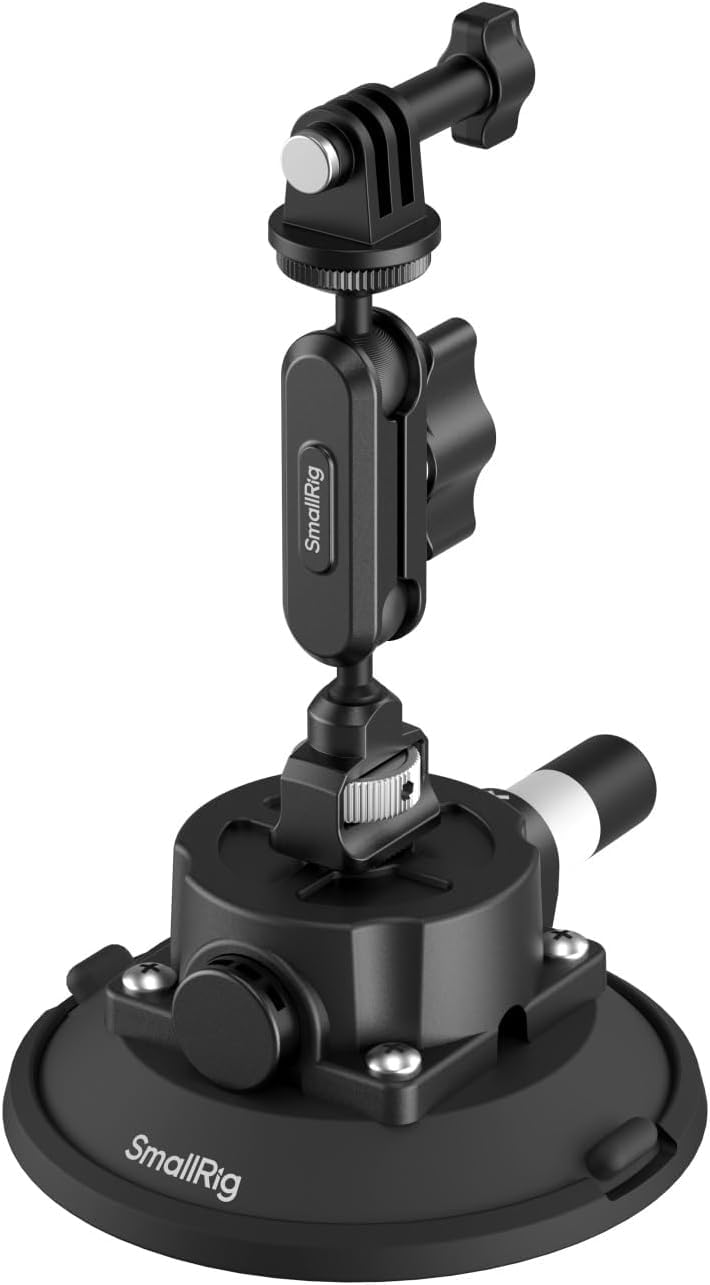
A 4.5-inch cup, a pump you press until the white line disappears, and a 1.5 kg rating with the arm attached — this is the suction mount to trust with a camera on a moving vehicle. The pump is why. It pulls the cup down onto the glass and leaves a marker you can glance at, so checking the seal takes a second instead of a tug.

The arm is aluminum with a ball head at each end, and it holds its angle rather than sagging under the camera's weight. That sag is the classic failure on cheaper suction mounts, and it spoils footage without ever letting go. An action camera adapter and a flat wrench for the locking ring come in the box.

Of the suction mounts here, this is the one we trust at speed, and the one to choose if the rig is more than a bare camera. Its limit is the surface: textured dash plastic and dusty glass will defeat the pump. Wipe the glass, press until the marker vanishes, and re-check it whenever you stop.

The bulk is real — 438 g and a shade over five inches across — so on a compact windshield the cup takes a corner you might have wanted. On a truck, a boat, or a side-by-side there's room to spare.

Pros

  • Pump cup with a visible seal marker
  • 1.5 kg rating covers camera and arm
  • Aluminum ball-head arm resists sagging

Cons

  • Cup and arm add bulk on a small windshield
Our verdict

The suction mount we trust at speed: a pump-assisted 4.5-inch cup rated to 1.5 kg, with an aluminum arm that holds its angle instead of drooping.

Check Latest Price
4

Best Hands-Free POV Mount

SmallRig Magnetic Neck Mount 5126

86 /100
Keeper Score Excellent

Key details

Weight
6.77 oz
Release
One-click magnetic
Mount Type
Wearable neck mount
Band Length
600mm/23.6in
Check Price on Amazon

Footage of your own hands — tying a fly, fixing a fitting, chopping onions — is awkward to get. A chest harness is overkill for it, and a head strap points at the ceiling. This is a silicone neckband with a magnetic plate that carries the camera at sternum height and lets go with one press.

We think it earns the body-worn slot here because it's the least fussy route to a stable chest-height view. The plate flips between horizontal and vertical without tools, and the one-click button means the camera comes off between takes rather than being unthreaded from a strap. At 192 g including the band, it sits under a jacket collar without announcing itself.

Two things to know. The mount is rated not water resistant, so sweat on a long climb and rain on a hike both deserve a thought before you trust it with a bare camera. And the latch is the piece that decides whether this is effortless or expensive: press until it clicks, then give the camera a tug before you start moving.

Pros

  • Chest-height POV without a harness
  • Magnetic plate flips horizontal to vertical
  • One-click release between setups
  • 192 g band sits under a collar

Cons

  • Not water resistant
Our verdict

This is the least fussy way we've found to film your own hands: a silicone neckband, a magnetic plate that flips horizontal to vertical, and a one-click release.

Check Latest Price
5

Best for DJI Osmo Action

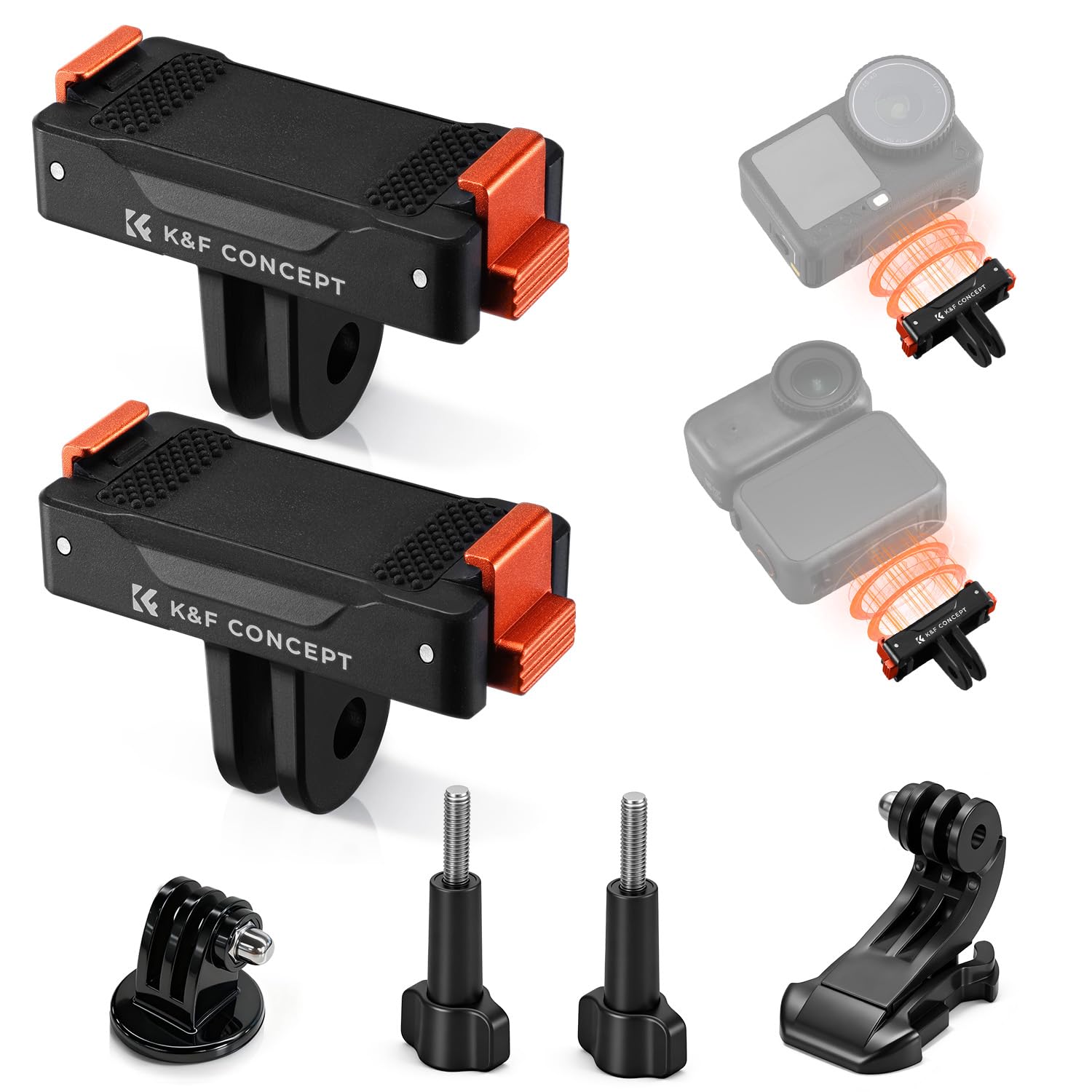
K&F Concept Osmo Action Adapter PP05

90 /100
Keeper Score Outstanding

Key details

Fits
DJI Osmo Action 3/4/5 Pro
Pack
2 magnetic bases
Includes
1/4" adapter, J-hook buckle
Mount Type
Magnetic quick release
Check Price on Amazon

This base is built for one camera family — DJI's Osmo Action 3, 4, and 5 Pro — and it does the thing those bodies are best at: coming off a mount in a second. The plate is magnetic with a dual-claw connector, so the camera drops in and presses free instead of being threaded on. If you shoot Osmo, it's the pick; if you shoot GoPro, it isn't.

Two bases come in the pack, along with thumbscrews, a 1/4-inch adapter, and a J-hook quick-release buckle. That's the combination that lets one camera move between a tripod, a selfie stick, and a GoPro-style mount without changing plates. The clips are aluminum and the body is high-strength nylon with a silicone face, so the parts that take the wear are metal.

Two bases is the detail that matters if you run more than one rig: leave one on the bike and one on the tripod plate, and the camera moves between them with a press. The limit is scope — the magnetic interface is DJI's, so this stays a DJI-ecosystem piece rather than a universal one.

Pros

  • Magnetic release made for Osmo Action
  • Two bases for two rigs
  • Aluminum clips, nylon body

Cons

  • Magnetic interface is DJI-only
Our verdict

If you shoot DJI Osmo Action, this is the quick-release base we recommend: two magnetic mounts plus the adapters to move between tripods and action mounts.

Check Latest Price
6

Best Tripod Adapter

DEKEENSTAR Tripod Adapter 3-Pack

86 /100
Keeper Score Excellent

Key details

Pack
Six adapters, three thumbscrews
Thread
1/4"-20
Material
Metal
Check Price on Amazon

A GoPro-style claw and a tripod thread don't speak to each other, which is why a camera that lives on a helmet can't go straight onto a monopod. This pack fixes that both ways: three adapters with a 1/4-inch screw hole for a tripod stud, three with a 1/4-inch screw for a camera socket, and thumbscrews for the set.

The thumbscrew is longer than most, which sounds trivial until you're tightening one in the cold with gloves on, and the body is a little thicker so it clears the camera's foot instead of bottoming out against it. Both are small changes that separate a snug fit from a wobbly one.

What it is not is a mount. Nothing here grips a bar, a window, or a helmet — it's a converter that lets an action camera use the tripods, magic arms, and clamps you already own, or lets a regular camera hang off your GoPro hardware.

We think it's the most useful small part in this guide, and the reason is the count. Having one of each style in the tripod bag, one in the camera case, and one in the car means the mismatch never happens at the trailhead, which is the only place it actually hurts.

Pros

  • Converts GoPro-style mounts to 1/4"-20
  • Longer thumbscrew is easier to torque
  • Thicker base clears the camera foot

Cons

  • Adds a thread, not a mount
Our verdict

The small part we recommend before another mount: it lets an action camera use any tripod you already own, and it works in both directions.

Check Latest Price
7

Light Dashcam Use

PULUZ Suction Cup Mount PU51

88 /100
Keeper Score Excellent

Key details

Weight
1.98 oz
Mount Type
Suction cup
Cup Diameter
68 mm
Load Capacity
7.09 oz
Check Price on Amazon

The number that decides whether this mount suits you is 201 g. That's the listed maximum load, and it tells you most of what you need to know: a bare action camera sits comfortably inside it, and a camera in a metal cage with a mic and a battery pack does not. At 56 g with a 68 mm cup, it's the lightest suction option here.

Angle is where it does well. Multiple joints rotate through 360 degrees, so a windshield or side-window position can be aimed wherever you want, and the cup holds on glass, tile, and painted panels. A long screw, an adapter, and a small storage bag come in the box — the bag matters more than it sounds, since a dusty cup is a cup that lets go.

We see it as the dashcam-style option: a light camera, a smooth surface, non-impact use. The listing is explicit about that last part — not for surfing or snowboarding — and it's the honest boundary for a mount this light. If your rig is heavier than a bare camera, the SmallRig cup is the one with headroom.

Pros

  • Weighs 56 g with a 68 mm cup
  • Multi-joint 360° aiming
  • Storage bag keeps the cup clean

Cons

  • 201 g limit excludes caged or accessorized rigs
  • Not intended for impact sports
Our verdict

We reach for this one when the camera is bare and the surface is glass: 56 g of mount, a 68 mm cup, and joints that aim it anywhere.

Check Latest Price
8

Angle Adjustment

SKEZN 360° Swivel Mount

88 /100
Keeper Score Excellent

Key details

Height
2.9 in
Weight
1.04 oz
Material
Aluminum alloy
Mount Type
360° swivel adapter
Check Price on Amazon

Plenty of mounts hold a camera; fewer hold it at the angle you actually want. This is a 2.9-inch aluminum riser with a ball joint in the middle and a knob on the side, and it slots between an existing base and the camera to add the adjustment a fixed adapter doesn't have.

It weighs 1.04 oz, so it barely changes what a helmet feels like, and the two-prong top and bottom let it double as a short extension arm between GoPro-style accessories. Turn the knob and the whole camera swings through the angle you need; tighten it and the joint stays put.

Leverage is the trade-off. Nearly three inches above the base gives vibration more to work with, so on a bike or a helmet the knob wants real torque, and it's worth checking at the same time you check the base. That is the price of adjustability, and it's a fair one.

It's the smallest piece in this guide and the one that changes framing most. Bolting one of these into a setup that already holds well costs less, in effort and in hardware, than starting over with a different mount.

Pros

  • Aluminum ball joint adds angles a fixed base can't
  • 1.04 oz barely changes helmet balance
  • Doubles as a short extension arm

Cons

  • Adds a joint, not a base
Our verdict

We like this as the fix for a mount that's solid but aimed wrong: a 1.04 oz aluminum joint that turns a fixed base into an adjustable one.

Check Latest Price

How We Tested These Action Camera Mounts

We started by shortlisting mounts that used standard action-camera fittings—quick-release buckles, 1/4-inch threads, or magnetic plates—then narrowed the field to 16 pieces that covered the styles people actually buy: sticky helmet bases, suction cups, magnetic adapters, a neck mount, and tripod converters. Over three months, I moved each one between a bike helmet, a car windshield, a walking POV setup, and a tripod, rather than testing them on a bench.

Adhesive mounts went onto helmets and stayed there through sweaty rides, hot parked-car interiors, and repeated strap adjustments; I checked the edges for lifting and gave each camera a firm tug before every ride. Suction mounts were cleaned onto glass, driven at highway speed, and left attached overnight, with a mark on the glass so I could see any slow creep. Magnetic mounts got a straight pull test and a shake test with the camera mounted, plus repeated one-handed swaps to see whether the plate grabbed cleanly or needed two hands and a second look.

For fit and build quality, I tried each mount with different camera bodies and housings, checked whether screws bottomed out or threads felt gritty, and noted any plastic flex or metal sharpness. Adjustability was judged by actual use—could I level a crooked horizon on a helmet, tilt a windshield mount without loosening the suction, or switch from landscape to portrait without tools? Durability came from leaving mounts installed between sessions and rechecking them after vibration, sun, and repeated attach-and-remove cycles. Value got the final pass: we counted what came in the box and whether the mount needed an extra adapter or screw kit to work with a standard setup.

How to Choose an Action Camera Mount

Match the mount to the surface it grips

Adhesive bases belong on helmets, board decks, kayak hulls, and anything curved you can't clamp. Magnetic bases need ferrous steel, which rules out aluminum vehicle panels and most plastics. Suction needs clean glass or smooth painted metal. Buy for the surface you'll use most, not the one you imagine using, because the traps are specific: a textured dash top defeats any suction cup, and a magnet slides straight off an aluminum truck bed.

If your shooting splits between a helmet and a windshield, two modest mounts make more sense than one compromise. That's why the picks here are spread across surfaces rather than ranked as one universal winner.

Check the connector, then count the joints

Every mount ends in one of three interfaces: a GoPro-style two-prong claw, a 1/4-inch tripod thread, or DJI's magnetic quick release. Adapters convert between them, and one adapter is fine — but each one you stack adds a joint that can work loose once the camera is vibrating.

Our rule is to use the shortest chain that reaches the surface. If your plan involves three adapters and a swivel, one of those parts is wrong for the job, and the camera will tell you so on the first rough ride.

Read the load rating against the whole rig

Ratings in this group run from 201 g to 1.5 kg, and they cover everything hanging off the mount: camera, cage, mic, adapter, and plate. A camera that weighs 150 g bare can pass 250 g dressed, which is exactly where a light suction cup stops being an option.

Stay comfortably inside the rating rather than at it, and tether anything mounted outside a vehicle or above hard ground. A mount that lets go at walking pace is an inconvenience; the same mount at road speed is an insurance claim.

Decide how much angle control you really need

A fixed adapter holds one angle and nothing else. A ball head gives you any angle but needs tightening. A flexible arm gives the most reach and the most shake. Short and rigid beats long and flexible whenever the camera is moving, so treat a gooseneck as a tool for static setups — a fence post, a table edge — rather than a helmet or a handlebar.

We prefer a ball head we can torque to either, which is why the swivel and suction picks here both use one.

Frequently Asked Questions

Final Verdict

Most people should start with the Sametop set. Real 3M adhesive in curved and flat shapes covers helmets, boards, and hulls, the locking buckles stop the camera leaving the shoe, and the spare hardware stretches to a second helmet.

If the camera is going on a vehicle, take the SmallRig suction cup instead — the pump and the 1.5 kg rating give you margin that tape can't. And if there's steel on your rig, the ULANZI magnet moves faster and leaves the paint alone.